Soil Remediation at White Sands Test Facility

Soil Remediation at White Sands Test Facility

NASA White Sands Test Facility

Las Cruces, New Mexico

Soil Remediation at the 600 Area Off-Site Pile

Origins of the 600 Area Off-Site Pile

The NASA White Sands Test Facility (WSTF) is crucial for supporting space exploration and technology development. Located in New Mexico, it provides a controlled environment for testing and evaluating spacecraft, propulsion systems, and other aerospace technologies. The facility is instrumental in conducting critical tests such as engine firings, thermal and environmental testing, and materials research. Its role in ensuring the safety, reliability, and performance of spacecraft and systems makes it a key asset in NASA’s mission to explore space and advance scientific knowledge. Unfortunately, past practices associated with the execution of its mission adversely impacted soil and groundwater resources. 

From June 1974 to December 1979, sludge and soil removed from a domestic and industrial wastewater lagoon was stockpiled on Bureau of Land Management land west of the NASA White Sands Test Facility (WSTF) facility boundary, less than a mile from the lagoon. When accumulation of material ceased, the sludge/soil debris pile lay dormant with no boundary identification. In 1993, during a Resource Conservation and Recovery Act field investigation the debris pile was identified and reported to the New Mexico Environment Department (NMED) and designated as Solid Waste Management Unit (SWMU) 16.

Investigation Summary

Initial investigations were completed at SWMU 16 in 2015 and 2018 to characterize the stockpiled sludge/soil and native soils beneath the stockpile to a depth of 30 feet. Analysis of soil sample data indicated the contaminants in the pile posed a risk to human health and the environment due to identified concentrations of nitrates, metals, volatile and semi-volatile organics, pesticides, polychlorinated biphenyls, and dioxins and furans. The NMED agreed to the removal and off-site disposal of New Mexico Special Waste in 2021.

Removal, Disposal, Confirmation Sampling

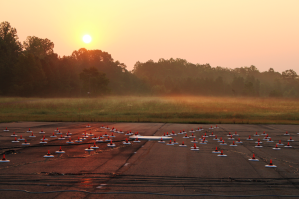
Excavation of the stockpile and the upper 6 inches of native soil was completed in January 2024. Excavation of native soils extended approximately 10 ft beyond the extent of the pile. A total of 1,072.7 tons of sludge and soil were disposed at the Corralitos Landfill.  In February 2024, confirmatory soil samples were collected from 38 locations on a 30-foot grid established across SWMU 16, encompassing the location of the removed stockpile and all areas potentially affected by site operations. These samples were submitted for laboratory chemical analyses to determine if NASA had met is remedial objectives and eliminated the exposure risk to human health and the environment.

Risk Assessment

The results showed that NASA had succeeded. The site was restored.  Results of soil sample analyses did not identify site contaminants remain at the site, and a risk assessment did not identify elevated risk to receptors or to groundwater beneath the site. NASA concluded that site contaminants have been removed, the risk to human health and the environment are below regulatory targets. NASA recommended a change in site status from “Requiring Corrective Action” to “Corrective Action Complete without Controls”. The report of results is currently under review by the NMED.

Visit nasa.gov/emd to learn more about NASA’s Environmental Management Division (EMD)!

Powered by WPeMatico

Get The Details…
Jordan T. Pogorzelski

Small Business Innovation Research (SBIR) and Small Business Technology Transfer (STTR)

Small Business Innovation Research (SBIR) and Small Business Technology Transfer (STTR)

1 Min Read

Small Business Innovation Research (SBIR) and Small Business Technology Transfer (STTR)

The SBIR/STTR programs provide an opportunity for small, high technology companies and research institutions (RI) to participate in Government sponsored research and development (R&D) efforts in key technology areas. NASA SBIR Phase I contracts have a period of performance for 6 months with a maximum funding of $125,000, and Phase II contracts have a period of performance up to 24 months with a maximum funding of $750,000. The STTR Phase I contracts last for 13 months with a maximum funding of $125,000, and Phase II contracts last for 24 months with the maximum contract value of $750,000. 

SBIR/STTR Status Search

SBIR.NASA.GOV Home Page

SBIR/STTR Extension Request Form

SBIR/STTR Electronic Handbook 

SBA – SBIR/STTR Policy Directive

Powered by WPeMatico

Get The Details…
NASA

NASA Small Business Funding Enables Aircraft Inspection by Drone

NASA Small Business Funding Enables Aircraft Inspection by Drone

3 min read

Preparations for Next Moonwalk Simulations Underway (and Underwater)

A small, black drone with four rotors is shown in the foreground flying in front of a commercial airliner in the background. The airliner is painted white and the front facing windows can be seen behind the drone. Concrete platforms surround the commercial airliner and yellow ramps connect the platforms to the plane.
A Boeing 777-300ER aircraft is being inspected by one of Near Earth Autonomy’s drones Feb. 2, 2024, at an Emirates Airlines facility in Dubai, United Arab Emirates.
Near Earth Autonomy

A small business called Near Earth Autonomy developed a time-saving solution using drones for pre-flight checks of commercial airliners through a NASA Small Business Innovation Research (SBIR) program and a partnership with The Boeing Company.

Before commercial airliners are deemed safe to fly before each trip, a pre-flight inspection must be completed. This process can take up to four hours, and can involve workers climbing around the plane to check for any issues, which can sometimes result in safety mishaps as well as diagnosis errors.

With NASA and Boeing funding to bolster commercial readiness, Near Earth Autonomy developed a drone-enabled solution, under their business unit Proxim, that can fly around a commercial airliner and gather inspection data in less than 30 minutes. The drone can autonomously fly around an aircraft to complete the inspection by following a computer-programmed task card based on the Federal Aviation Administration’s rules for commercial aircraft inspection. The card shows the flight path the drone’s software needs to take, enabling aircraft workers with a new tool to increase safety and efficiency.

“NASA has worked with Near Earth Autonomy on autonomous inspection challenges in multiple domains,” says Danette Allen, NASA senior leader for autonomous systems. 

“We are excited to see this technology spin out to industry to increase efficiencies, safety, and accuracy of the aircraft inspection process for overall public benefit.”

The photos collected from the drone are shared and analyzed remotely, which allows experts in the airline maintenance field to support repair decisions faster from any location. New images can be compared to old images to look for cracks, popped rivets, leaks, and other common issues.

The user can ask the system to create alerts if an area needs to be inspected again or fails an inspection. Near Earth Autonomy estimates that using drones for aircraft inspection can save the airline industry an average of $10,000 per hour of lost earnings during unplanned time on the ground.

Over the last six years, Near Earth Autonomy completed several rounds of test flights with their drone system on Boeing aircraft used by American Airlines and Emirates Airlines.

NASA’s Small Business Innovation Research / Small Business Technology Transfer program, managed by the agency’s Space Technology Mission Directorate, aims to bolster American ingenuity by supporting innovative ideas put forth by small businesses to fulfill NASA and industry needs. These research needs are described in annual SBIR solicitations and target technologies that have significant potential for successful commercialization. 

Small business concerns with 500 or fewer employees, or small businesses partnering with a non-profit research institution such as a university or a research laboratory can apply to participate in the NASA SBIR/STTR program.

Powered by WPeMatico

Get The Details…
Dede Dinius

NASA to Host Media Call Highlighting Mars Sample Return Update

NASA to Host Media Call Highlighting Mars Sample Return Update

The letters NASA on a blue circle with red and white detail, all surrounded by a black background
Credit: NASA

NASA Administrator Bill Nelson and Nicky Fox, associate administrator, Science Mission Directorate, will host a media teleconference at 1 p.m. EST, Tuesday, Jan. 7, to provide an update on the status of the agency’s Mars Sample Return Program.

The briefing will include NASA’s efforts to complete its goals of returning scientifically selected samples from Mars to Earth while lowering cost, risk, and mission complexity.

Audio of the media call will stream live on the agency’s website.

Media interested in participating by phone must RSVP no later than two hours prior to the start of the call to: dewayne.a.washington@nasa.gov. A copy of NASA’s media accreditation policy is online.

The agency’s Mars Sample Return Program has been a major long-term goal of international planetary exploration for more than two decades. NASA’s Perseverance rover is collecting compelling science samples that will help scientists understand the geological history of Mars, the evolution of its climate, and prepare for future human explorers. The return of the samples also will help NASA’s search for signs of ancient life.

For more information about NASA’s Mars exploration, visit:

https://nasa.gov/mars

-end-

Meira Bernstein / Dewayne Washington
Headquarters, Washington
202-358-1100
meira.b.bernstein@nasa.gov / dewayne.a.washington@nasa.gov

Share

Details

Last Updated

Jan 03, 2025

Editor
Jessica Taveau

Powered by WPeMatico

Get The Details…
Jessica Taveau

Approval to Exceed GSA Lodging for LPSC 2025

Approval to Exceed GSA Lodging for LPSC 2025

This letter from SARA is to issue a waiver for NASA grantees attending the 2025 Lunar and Planetary Science Conference (LPSC), allowing them to be reimbursed out of their grants for their actual lodging, although it’s expected to be above the approved GSA amount. This waiver does not supersede the travel policy of your institution if it is more restrictive. Note: I have specified grants (including cooperative agreements). This may also apply to those traveling on NASA contracts, but they should communicate with their contracting officers.

The host hotel for the 56th Lunar and Planetary Science Conference on March 10–14, 2025, is The Woodlands Waterway Marriott Hotel and Convention Center. Hotel information for this conference may be found at https://www.hou.usra.edu/meetings/lpsc2025/plan/.

The GSA-allowed daily lodging expense for March 2025 for zip code 77380 (for The Woodlands Waterway Marriott Hotel and Convention Center) is $128 per night. Many of the hotels may be significantly higher than the GSA allowed $128. Grantee travelers may need a waiver to cover lodging in excess of the GSA value, depending on the travel policy of your organization. This waiver does not supersede the travel policy of your institution if it is more restrictive.

By the power vested in me by the NSSC to issue approval of the actual lodging costs for a conference in “bulk” instead of individual approvals, I hereby affirm that for the 56th Lunar and Planetary Science Conference NASA, SMD grants may be charged up to $266/night plus taxes and fees, consistent with the average actual cost of the conference hotel, even though this exceeds the $128 allotted for lodging by GSA for The Woodlands for March 2025.

Share

Details

Last Updated
Jan 03, 2025
Editor
NASA Science Editorial Team

Powered by WPeMatico

Get The Details…