Health Checks and Suit Installs Before Thursday Spacewalk for Science Upkeep
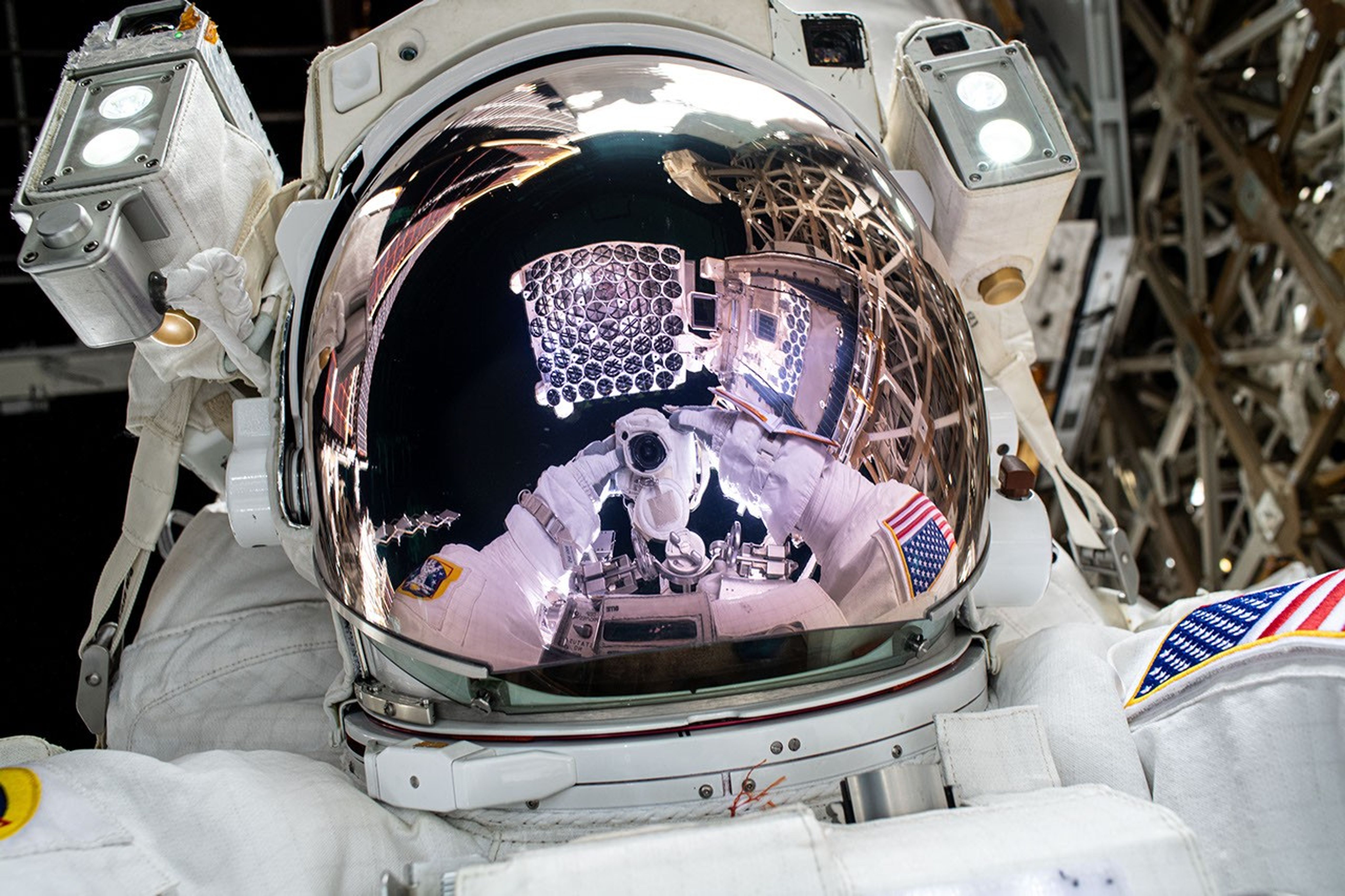
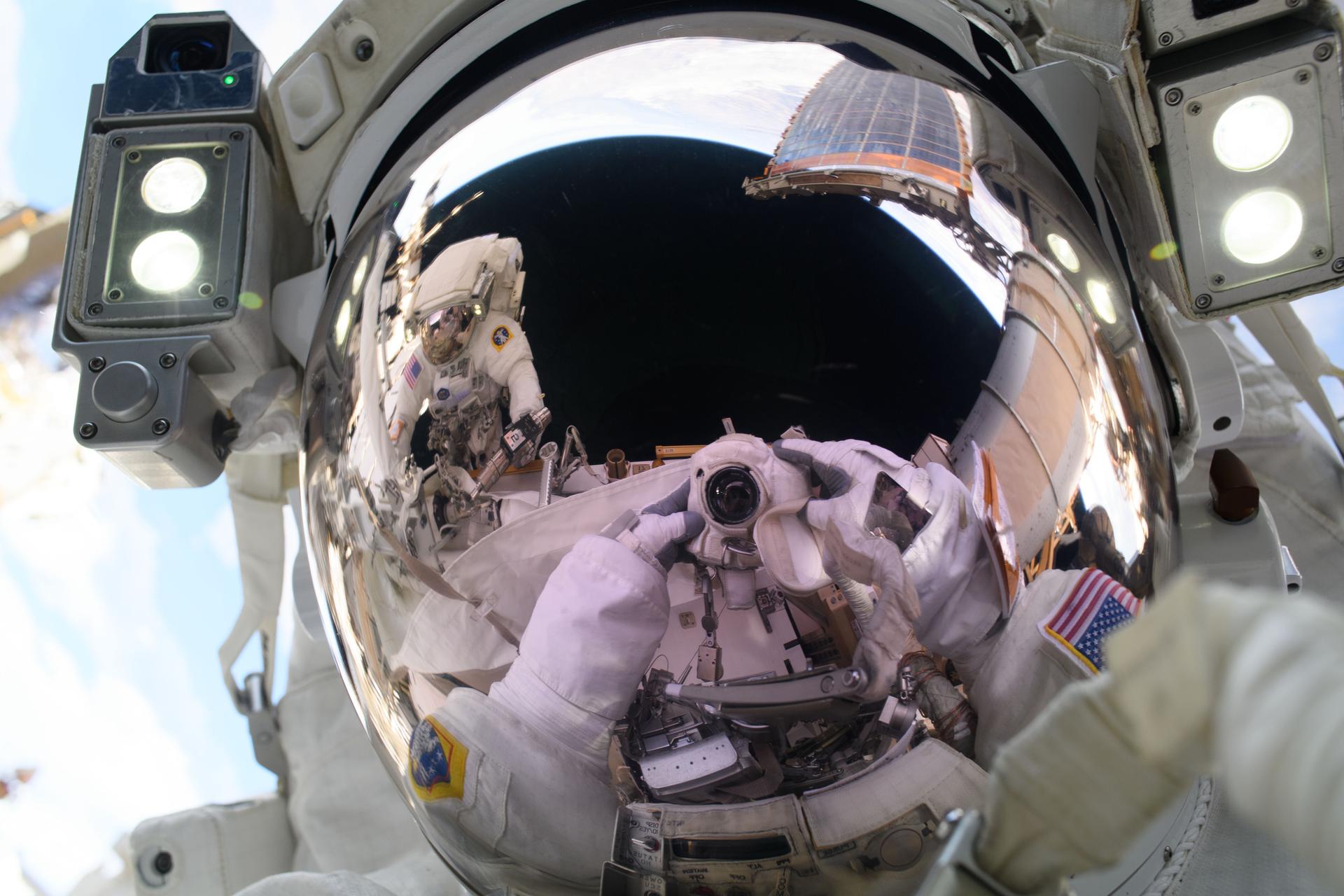
NASA astronaut Butch Wilmore (center) assists Suni Williams (left) and Nick Hague (right), both NASA astronauts, as they prepare to evaluate their spacesuits in a pressurized configuration.
Spacewalk preparations continued aboard the International Space Station as two astronauts conducted health checks and installed hardware on their spacesuits. Biology, physics, and lab maintenance also rounded out the Expedition 72 schedule on Tuesday.
Flight Engineer Nick Hague and space station Commander Suni Williams, both from NASA, began their shifts on Tuesday with standard health exams taken prior to the start of a spacewalk. The duo measured their vital signs including heart rate, breathing rate, and temperature, and participated in a hearing test. Next, the two spacewalkers installed lithium-ion batteries and tested electrical and communication components on their spacesuits. Flight Engineer Butch Wilmore also assisted the pair and readied cameras the astronauts will carry with them into the vacuum of space.
Hague and Williams will set their spacesuits to battery power at approximately 8 a.m. EST on Thursday signifying the official start of the first spacewalk of 2025. The experienced spacewalkers will exit the Quest airlock and spend about six-and-a-half hours servicing astrophysics hardware including the NICER X-ray telescope and the Alpha Magnetic Spectrometer. Also on the task list, are the replacement of a rate gyro assembly to maintain station orientation and the replacement of a planar reflector to provide navigation data. NASA+ begins its spacewalk coverage at 6:30 a.m. on Thursday.
Earlier in his shift, Wilmore set up and calibrated genetic sequencing hardware that analyzes station water samples to identify bacteria and fungi species. NASA Flight Engineer Don Pettit started his day on orbital plumbing tasks before removing and processing research samples collected from the Gradient Heating Furnace that enables semiconductor crystal growth research.
Working in the orbital outpost’s Roscosmos segment, all three cosmonauts, including Flight Engineers Alexey Ovchinin, Ivan Vagner, and Aleksandr Gorbunov, studied how microgravity affects blood flow through the tiniest vessels in the human circulatory system. The trio also replaced electronics gear and serviced orbital plumbing hardware throughout the day on Tuesday.
NASA’s Webb Reveals Intricate Layers of Interstellar Dust, Gas
6 Min Read
NASA’s Webb Reveals Intricate Layers of Interstellar Dust, Gas
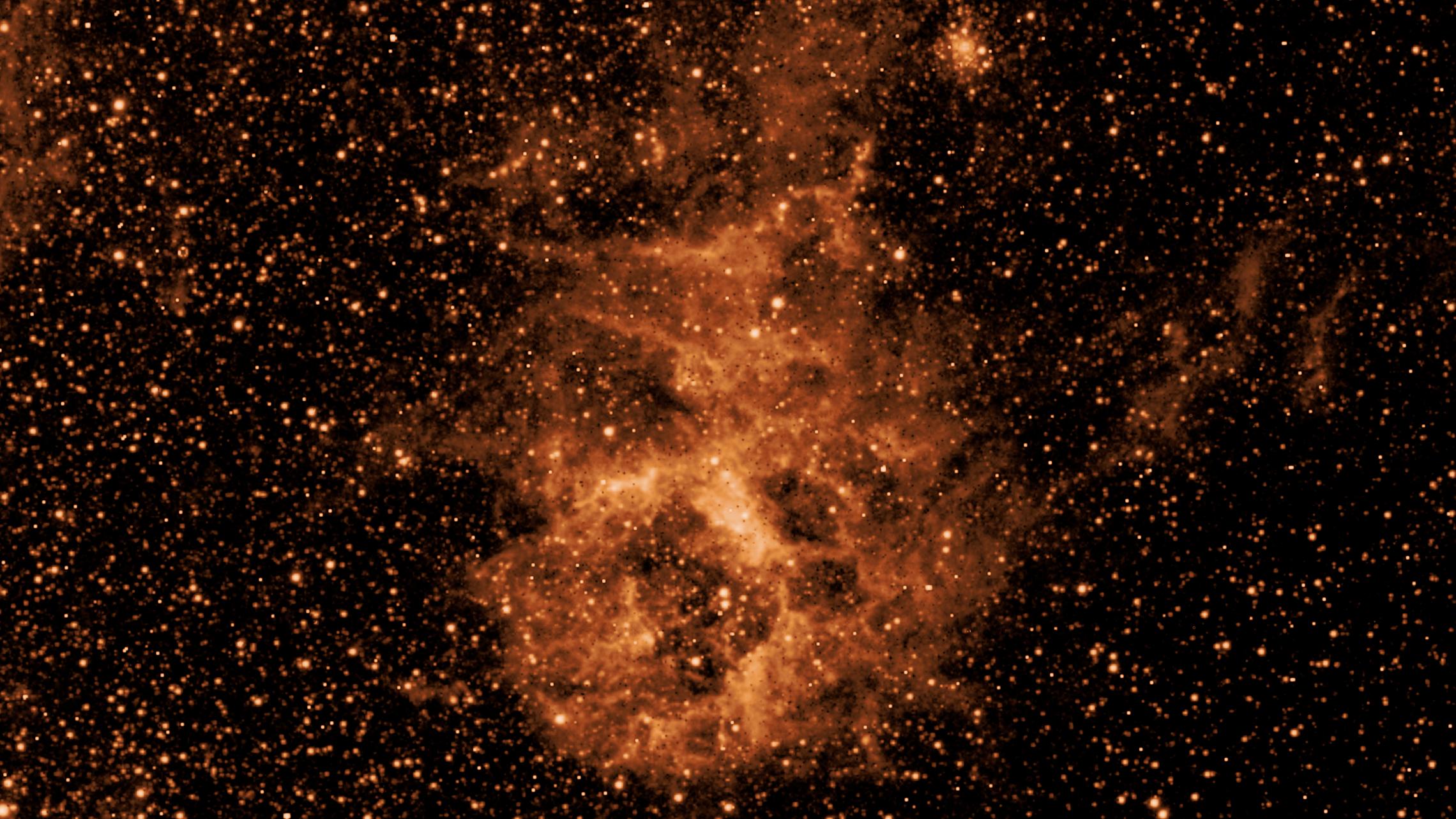
This shimmering cosmic curtain shows interstellar gas and dust that has been heated by the flashbulb explosion of a long-ago supernova. The gas then glows infrared light in what is known as a thermal light echo. As the supernova illumination travels through space at the speed of light, the echo appears to expand. NASA’s James Webb Space Telescope observed this light echo in the vicinity of the supernova remnant Cassiopeia A.
Credits: NASA, ESA, CSA, STScI, J. Jencson (Caltech/IPAC)
Once upon a time, the core of a massive star collapsed, creating a shockwave that blasted outward, ripping the star apart as it went. When the shockwave reached the star’s surface, it punched through, generating a brief, intense pulse of X-rays and ultraviolet light that traveled outward into the surrounding space. About 350 years later, that pulse of light has reached interstellar material, illuminating it, warming it, and causing it to glow in infrared light.
NASA’s James Webb Space Telescope has observed that infrared glow, revealing fine details resembling the knots and whorls of wood grain. These observations are allowing astronomers to map the true 3D structure of this interstellar dust and gas (known as the interstellar medium) for the first time.
“We were pretty shocked to see this level of detail,” said Jacob Jencson of Caltech/IPAC in Pasadena, principal investigator of the science program.
“We see layers like an onion,” added Josh Peek of the Space Telescope Science Institute in Baltimore, a member of the science team. “We think every dense, dusty region that we see, and most of the ones we don’t see, look like this on the inside. We just have never been able to look inside them before.”
The team is presenting their findings in a press conference at the 245th meeting of the American Astronomical Society in Washington.
“Even as a star dies, its light endures—echoing across the cosmos. It’s been an extraordinary three years since we launched NASA’s James Webb Space Telescope. Every image, every discovery, shows a portrait not only of the majesty of the universe but the power of the NASA team and the promise of international partnerships. This groundbreaking mission, NASA’s largest international space science collaboration, is a true testament to NASA’s ingenuity, teamwork, and pursuit of excellence,” said NASA Administrator Bill Nelson. “What a privilege it has been to oversee this monumental effort, shaped by the tireless dedication of thousands of scientists and engineers around the globe. This latest image beautifully captures the lasting legacy of Webb—a keyhole into the past and a mission that will inspire generations to come.”
Image A: Light Echoes Near Cassiopeia A (NIRCam)
These shimmering cosmic curtains show interstellar gas and dust that has been heated by the flashbulb explosion of a long-ago supernova. The gas then glows infrared light in what is known as a thermal light echo. As the supernova illumination travels through space at the speed of light, the echo appears to expand. NASA’s James Webb Space Telescope observed this light echo in the vicinity of the supernova remnant Cassiopeia A three separate times, in essence creating a 3D scan of the interstellar material. Note that the field of view in the top row is rotated slightly clockwise relative to the middle and bottom rows, due to the roll angle of the Webb telescope when the observations were taken.
NASA, ESA, CSA, STScI, J. Jencson (Caltech/IPAC)
Video A: Light Echoes Near Cassiopeia A (NIRCam)
This time-lapse video using data from NASA’s James Webb Space Telescope highlights the evolution of one light echo in the vicinity of the supernova remnant Cassiopeia A. A light echo is created when a star explodes or erupts, flashing light into surrounding clumps of interstellar dust and causing them to shine in an ever-expanding pattern. Webb’s exquisite resolution not only shows incredible detail within these light echoes, but also shows their expansion over the course of just a few weeks – a remarkably short timescale considering that most cosmic targets remain unchanged over a human lifetime. Credit: NASA, ESA, CSA, STScI, J. Jencson (Caltech/IPAC)
Taking a CT Scan
The images from Webb’s NIRCam (Near-Infrared Camera) highlight a phenomenon known as a light echo. A light echo is created when a star explodes or erupts, flashing light into surrounding clumps of dust and causing them to shine in an ever-expanding pattern. Light echoes at visible wavelengths (such as those seen around the star V838 Monocerotis) are due to light reflecting off of interstellar material. In contrast, light echoes at infrared wavelengths are caused when the dust is warmed by energetic radiation and then glows.
The researchers targeted a light echo that had previously been observed by NASA’s retired Spitzer Space Telescope. It is one of dozens of light echoes seen near the Cassiopeia A supernova remnant – the remains of the star that exploded. The light echo is coming from unrelated material that is behind Cassiopeia A, not material that was ejected when the star exploded.
The most obvious features in the Webb images are tightly packed sheets. These filaments show structures on remarkably small scales of about 400 astronomical units, or less than one-hundredth of a light-year. (An astronomical unit, or AU, is the average Earth-Sun distance. Neptune’s orbit is 60 AU in diameter.)
“We did not know that the interstellar medium had structures on that small of a scale, let alone that it was sheet-like,” said Peek.
These sheet-like structures may be influenced by interstellar magnetic fields. The images also show dense, tightly wound regions that resemble knots in wood grain. These may represent magnetic “islands” embedded within the more streamlined magnetic fields that suffuse the interstellar medium.
“This is the astronomical equivalent of a medical CT scan,” explained Armin Rest of the Space Telescope Science Institute, a member of the science team. “We have three slices taken at three different times, which will allow us to study the true 3D structure. It will completely change the way we study the interstellar medium.”
Image B: Cassiopeia A (Spitzer with Webb Insets)
This background image of the region around supernova remnant Cassiopeia A was released by NASA’s Spitzer Space Telescope in 2008. By taking multiple images of this region over three years with Spitzer, researchers were able to examine a number of light echoes. Now, NASA’s James Webb Space Telescope has imaged some of these light echoes in much greater detail. Insets at lower right show one epoch of Webb observations, while the inset at left shows a Webb image of the central supernova remnant released in 2023.
Spitzer Image: NASA/JPL-Caltech/Y. Kim (Univ. of Arizona/Univ. of Chicago). Cassiopeia A Inset: NASA, ESA, CSA, STScI, Danny Milisavljevic (Purdue University), Ilse De Looze (UGent), Tea Temim (Princeton University). Light Echoes Inset: NASA, ESA, CSA, STScI, J. Jencson (Caltech/IPAC).
Future Work
The team’s science program also includes spectroscopic observations using Webb’s MIRI (Mid-Infrared Instrument). They plan to target the light echo multiple times, weeks or months apart, to observe how it evolves as the light echo passes by.
“We can observe the same patch of dust before, during, and after it’s illuminated by the echo and try to look for any changes in the compositions or states of the molecules, including whether some molecules or even the smallest dust grains are destroyed,” said Jencson.
Infrared light echoes are also extremely rare, since they require a specific type of supernova explosion with a short pulse of energetic radiation. NASA’s upcoming Nancy Grace Roman Space Telescope will conduct a survey of the galactic plane that may find evidence of additional infrared light echoes for Webb to study in detail.
The James Webb Space Telescope is the world’s premier space science observatory. Webb is solving mysteries in our solar system, looking beyond to distant worlds around other stars, and probing the mysterious structures and origins of our universe and our place in it. Webb is an international program led by NASA with its partners, ESA (European Space Agency) and CSA (Canadian Space Agency).
Downloads
Right click any image to save it or open a larger version in a new tab/window via the browser’s popup menu.
Best of 2024: Dinosaur Prepared to Safely Watch Solar Eclipse
NASA/Joel Kowsky
An adult Alamosaurus sports eclipse glasses outside of The Children’s Museum of Indianapolis, on April 6, 2024. Two days later, the total solar eclipse swept across a narrow portion of the North American continent from Mexico’s Pacific coast to the Atlantic coast of Newfoundland, Canada. A partial solar eclipse was visible across the entire North American continent along with parts of Central America and Europe.
Ten NASA Science, Tech Instruments Flying to Moon on Firefly Lander
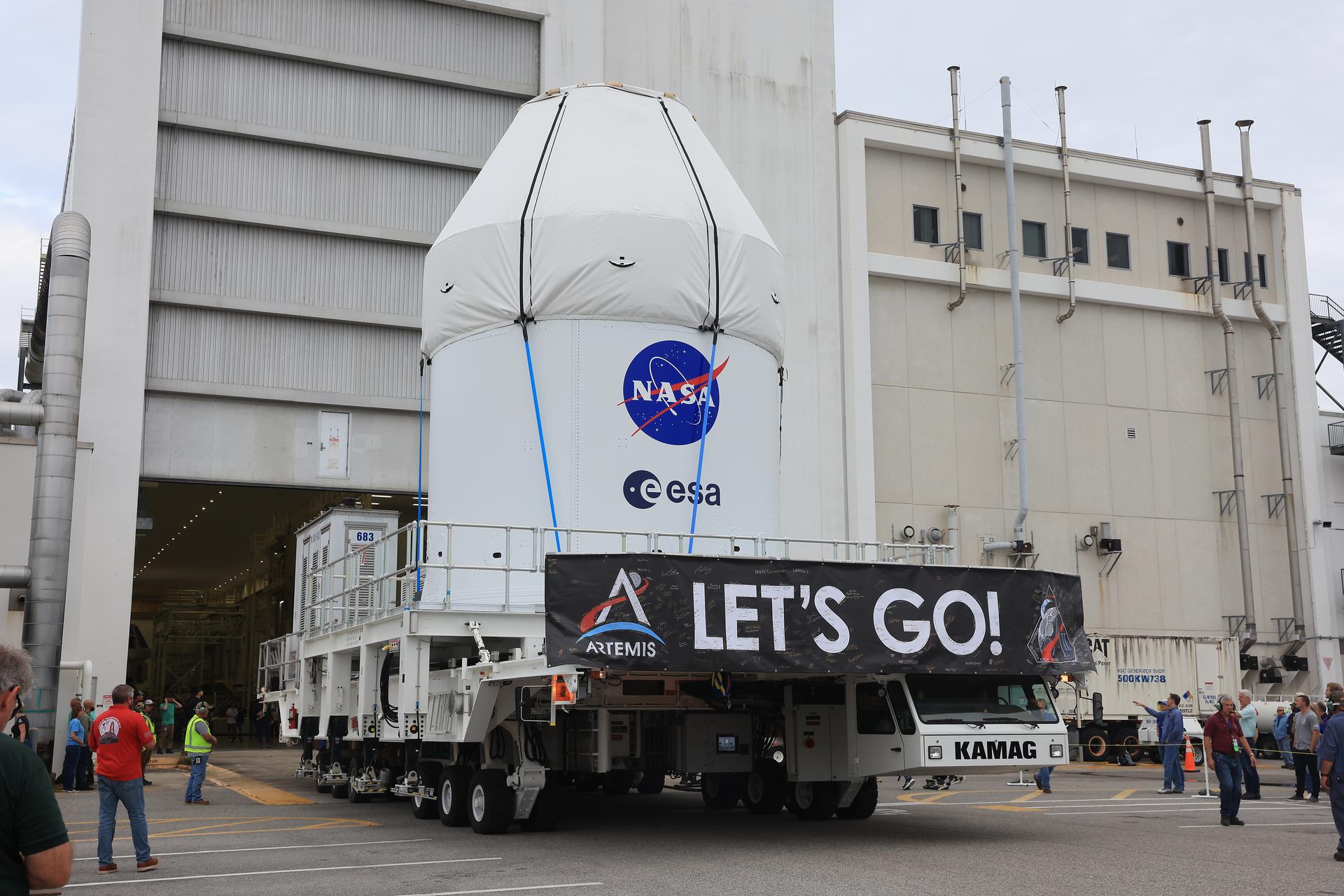
Firefly Aerospace’s Blue Ghost lander getting encapsulated in SpaceX’s rocket fairing ahead of the planned liftoff for 1:11 a.m. EST Jan. 15 from Launch Complex 39A at NASA’s Kennedy Space Center in Florida
SpaceX
As part of NASA’s CLPS (Commercial Lunar Payload Services) initiative and Artemis campaign, the agency is preparing to fly ten instruments aboard Firefly Aerospace’s first delivery to the Moon. These science payloads and technology demonstrations will help advance our understanding of the Moon and planetary processes, while paving the way for future crewed missions on the Moon and beyond, for the benefit of all.
Firefly’s lunar lander, named Blue Ghost, is scheduled to launch on a SpaceX Falcon 9 rocket Wednesday, Jan.15, from Launch Complex 39A at NASA’s Kennedy Space Center in Florida. After a 45-day cruise phase, Blue Ghost is targeted to land near a volcanic feature called Mons Latreille within Mare Crisium, a basin approximately 340 miles wide (550 kilometers) located in the northeast quadrant of the Moon’s near side.
How can we enable more precise navigation on the Moon? How do spacecraft interact with the lunar surface? How does Earth’s magnetic field influence the effects of space weather on our home planet? NASA’s instruments on this flight will conduct first-of-their-kind demonstrations to help answer these questions and more, including testing regolith sampling technologies, lunar subsurface drilling capabilities, increasing precision of positioning and navigation abilities, testing radiation tolerant computing, and learning how to mitigate lunar dust during lunar landings.
The ten NASA payloads aboard Firefly’s Blue Ghost lander include:
Lunar Instrumentation for Subsurface Thermal Exploration with Rapidity (LISTER)will measure heat flow from the Moon’s interior by measuring the thermal gradient, or changes in temperature at various depths, and thermal conductivity, or the subsurface material’s ability to let heat pass through it. LISTER will take several measurements up to 10 feet deep using pneumatic drilling technology with a custom heat flow needle instrument at its tip. Data from LISTER will help scientists retrace the Moon’s thermal history and understand how it formed and cooled. Lead organization: Texas Tech University
Lunar PlanetVac (LPV)is designed to collect regolith samples from the lunar surface using a burst of compressed gas to drive the regolith into a sample chamber (sieving) for collection and analysis by various instruments. Additional instrumentation will then transmit the results back to Earth. The LPV payload is designed to help increase the science return from planetary missions by testing low-cost technologies for collecting regolith samples in-situ. Lead organization: Honeybee Robotics
Next Generation Lunar Retroreflector (NGLR)serves as a target for lasers on Earth to precisely measure the distance between Earth and the Moon by reflecting very short laser pulses from Earth-based Lunar Laser Ranging Observatories. The laser pulse transit time to the Moon and back is used to determine the distance. Data from NGLR could improve the accuracy of our lunar coordinate system and contribute to our understanding of the inner structure of the Moon and fundamental physics questions. Lead organization: University of Maryland
Regolith Adherence Characterization (RAC)will determine how lunar regolith sticks to a range of materials exposed to the Moon’s environment throughout the lunar day. RAC will measure accumulation rates of lunar regolith on surfaces (for example, solar cells, optical systems, coatings, and sensors) through imaging to determine their ability to repel or shed lunar dust. The data captured will help test, improve, and protect spacecraft, spacesuits, and habitats from abrasive regolith. Lead organization: Aegis Aerospace
Radiation Tolerant Computer (RadPC)will demonstrate a computer that can recover from faults caused by ionizing radiation. Several RadPC prototypes have been tested aboard the International Space Station and Earth-orbiting satellites, but this flight will provide the biggest trial yet by demonstrating the computer’s ability to withstand space radiation as it passes through Earth’s radiation belts, while in transit to the Moon, and on the lunar surface. Lead organization: Montana State University
Electrodynamic Dust Shield (EDS)is an active dust mitigation technology that uses electric fields to move and prevent hazardous lunar dust accumulation on surfaces. EDS is designed to lift, transport, and remove particles from surfaces with no moving parts. Multiple tests will demonstrate the feasibility of the self-cleaning glasses and thermal radiator surfaces on the Moon. In the event the surfaces do not receive dust during landing, EDS has the capability to re-dust itself using the same technology. Lead organization: NASA’s Kennedy Space Center
Lunar Environment heliospheric X-ray Imager (LEXI)will capture a series of X-ray images to study the interaction of solar wind and Earth’s magnetic field that drives geomagnetic disturbances and storms. Deployed and operated on the lunar surface, this instrument will provide the first global images showing the edge of Earth’s magnetic field for critical insights into how space weather and other cosmic forces surrounding our planet impact Earth. Lead organizations: Boston University, NASA’s Goddard Space Flight Center, and Johns Hopkins University
Lunar Magnetotelluric Sounder (LMS)will characterize the structure and composition of the Moon’s mantle by measuring electric and magnetic fields. This investigation will help determine the Moon’s temperature structure and thermal evolution to understand how the Moon has cooled and chemically differentiated since it formed. Lead organization: Southwest Research Institute
Lunar GNSS Receiver Experiment (LuGRE)will demonstrate the possibility of acquiring and tracking signals from GNSS (Global Navigation Satellite System) constellations, specifically GPS and Galileo, during transit to the Moon, during lunar orbit, and on the lunar surface. If successful, LuGRE will be the first pathfinder for future lunar spacecraft to use existing Earth-based navigation constellations to autonomously and accurately estimate their position, velocity, and time. Lead organizations: NASA Goddard, Italian Space Agency
Stereo Camera for Lunar Plume-Surface Studies (SCALPSS)will use stereo imaging photogrammetry to capture the impact of the rocket exhaust plume on lunar regolith as the lander descends on the Moon’s surface. The high-resolution stereo images will aid in creating models to predict lunar regolith erosion, which is an important task as bigger, heavier spacecraft and hardware are delivered to the Moon in close proximity to each other. This instrument also flew on Intuitive Machines’ first CLPS delivery. Lead organization: NASA’s Langley Research Center
Through the CLPS initiative, NASA purchases lunar landing and surface operations services from American companies. The agency uses CLPS to send scientific instruments and technology demonstrations to advance capabilities for science, exploration, or commercial development of the Moon. By supporting a robust cadence of lunar deliveries, NASA will continue to enable a growing lunar economy while leveraging the entrepreneurial innovation of the commercial space industry.