Crew Wraps Up Spacewalk Preps, Keeps Up Human Research

Crew Wraps Up Spacewalk Preps, Keeps Up Human Research

Astronauts Don Pettit (top) and Butch Wilmore (bottom) assist astronaut Nick Hague (center) as he tries on and evaluates his spacesuit in a pressurized configuration inside the Quest airlock.

Two NASA astronauts have finalized preparations for the first spacewalk of 2025 to service astrophysics hardware on the International Space Station. The rest of the Expedition 72 crew split the day between assisting the upcoming spacewalkers and keeping up human research.

Flight Engineer Nick Hague and space station Commander Suni Williams, both from NASA, will set their spacesuits to internal battery power at 8 a.m. EST on Thursday beginning a six-and-a-half-hour spacewalk. They will exit the Quest airlock and patch light leaks in the NICER X-ray telescope then ready the Alpha Magnetic Spectrometer for future upgrades. The experienced spacewalking duo will also replace advanced engineering hardware to maintain station orientation and provide navigation data. NASA+ begins its spacewalk coverage at 6:30 a.m. on Thursday.

Hague and Williams started Wednesday in Quest reviewing the procedures they will use to fulfill their spacewalking tasks. The pair also staged spacesuits and organized the specialized tools inside Quest. NASA Flight Engineers Don Pettit and Butch Wilmore assisted with the spacewalking preparations then joined Hague and Williams for a readiness review with mission controllers on the ground at the end of their shift.

Roscosmos cosmonauts Alexey Ovchinin and Ivan Vagner were back on human research duty on Wednesday attaching sensors to their forehead, fingers, and toes measuring how blood flows to the tiniest vessels in microgravity. Scientists want to understand how the human circulatory system in the limbs of crew members adapt to living long-term in microgravity. Flight Engineer Aleksandr Gorbunov took a fitness test pedaling on an exercise cycle while electrodes measured his aerobic and cardiovascular output ensuring his health in weightlessness. All three cosmonauts also continued their orbital maintenance tasks servicing a variety of life support gear throughout the orbital outpost’s Roscosmos segment.


Learn more about station activities by following the space station blog@space_station and @ISS_Research on X, as well as the ISS Facebook and ISS Instagram accounts.

Get the latest from NASA delivered every week. Subscribe here: www.nasa.gov/subscribe

Powered by WPeMatico

Get The Details…

Mark Garcia

NASA Solar Observatory Sees Coronal Loops Flicker Before Big Flares

NASA Solar Observatory Sees Coronal Loops Flicker Before Big Flares

3 min read

NASA Solar Observatory Sees Coronal Loops Flicker Before Big Flares

For decades, scientists have tried in vain to accurately predict solar flares — intense bursts of light on the Sun that can send a flurry of charged particles into the solar system. Now, using NASA’s Solar Dynamics Observatory, one team has identified flickering loops in the solar atmosphere, or corona, that seem to signal when the Sun is about to unleash a large flare.

These warning signs could help NASA and other stakeholders protect astronauts as well as technology both in space and on the ground from hazardous space weather.

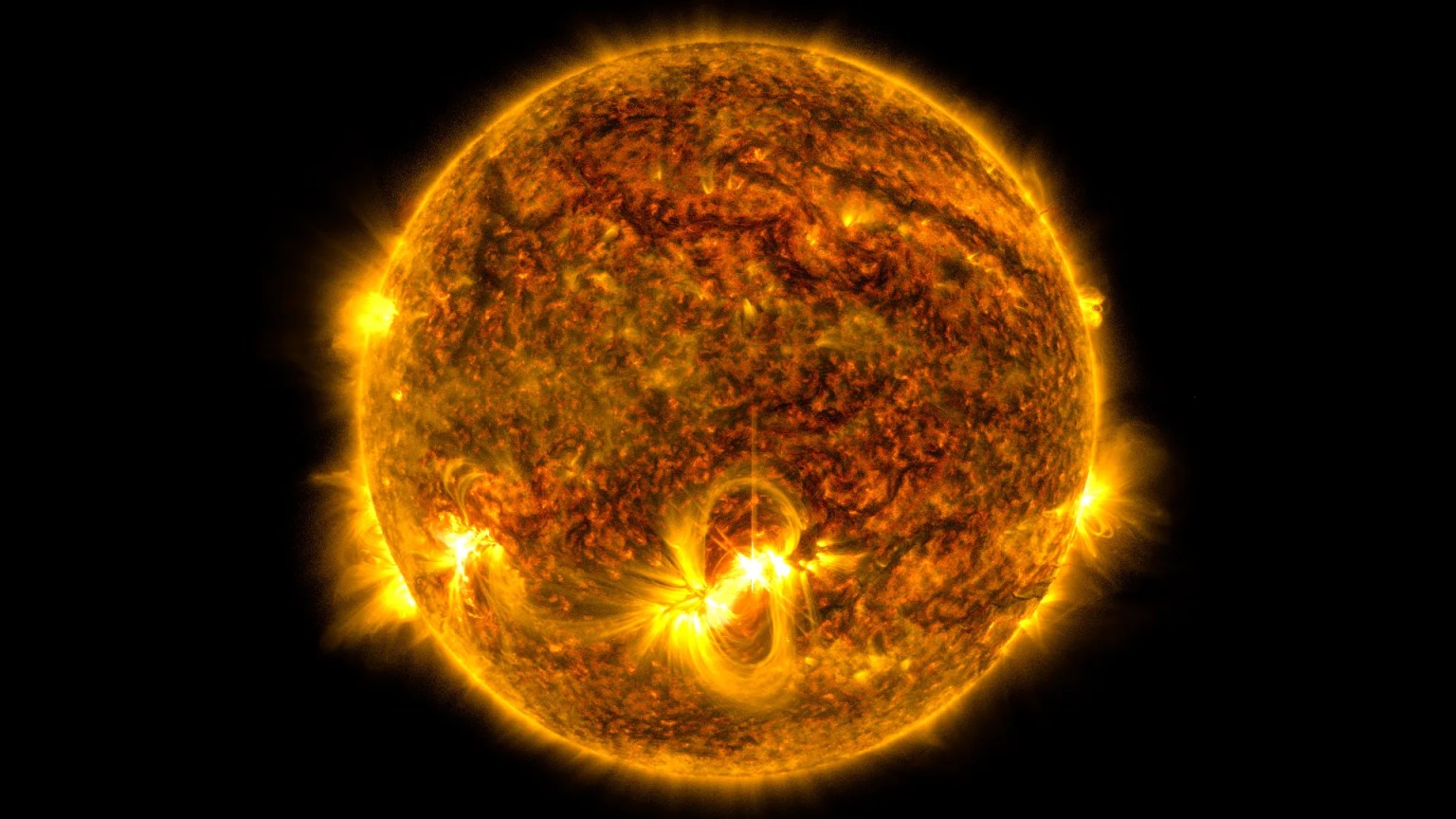
A portion of the Sun appears in shades of gold and black. In the upper left, several gold-shaded arches rise above a bright region on the Sun.
NASA’s Solar Dynamics Observatory captured this image of coronal loops above an active region on the Sun in mid-January 2012. The image was taken in the 171 angstrom wavelength of extreme ultraviolet light.
NASA/Solar Dynamics Observatory

Led by heliophysicist Emily Mason of Predictive Sciences Inc. in San Diego, California, the team studied arch-like structures called coronal loops along the edge of the Sun. Coronal loops rise from magnetically driven active regions on the Sun, where solar flares also originate.

The team looked at coronal loops near 50 strong solar flares, analyzing how their brightness in extreme ultraviolet light varied in the hours before a flare compared to loops above non-flaring regions. Like flashing warning lights, the loops above flaring regions varied much more than those above non-flaring regions.

“We found that some of the extreme ultraviolet light above active regions flickers erratically for a few hours before a solar flare,” Mason explained. “The results are really important for understanding flares and may improve our ability to predict dangerous space weather.”

Published in the Astrophysical Journal Letters in December 2024 and presented on Jan. 15, 2025, at a press conference during the 245th meeting of the American Astronomical Society, the results also hint that the flickering reaches a peak earlier for stronger flares. However, the team says more observations are needed to confirm this link.

The four panels in this movie show brightness changes in coronal loops in four different wavelengths of extreme ultraviolet light (131, 171, 193, and 304 angstroms) before a solar flare in December 2011. The images were taken by the Atmospheric Imaging Assembly (AIA) on NASA’s Solar Dynamics Observatory and processed to reveal flickering in the coronal loops.
NASA/Solar Dynamics Observatory/JHelioviewer/E. Mason

Other researchers have tried to predict solar flares by examining magnetic fields on the Sun, or by looking for consistent trends in other coronal loop features. However, Mason and her colleagues believe that measuring the brightness variations in coronal loops could provide more precise warnings than those methods — signaling oncoming flares 2 to 6 hours ahead of time with 60 to 80 percent accuracy.

“A lot of the predictive schemes that have been developed are still predicting the likelihood of flares in a given time period and not necessarily exact timing,” said team member Seth Garland of the Air Force Institute of Technology at Wright-Patterson Air Force Base in Ohio.

Each solar flare is like a snowflake — every single flare is unique.

Kara kniezewski

Kara kniezewski

Air Force Institute of Technology

“The Sun’s corona is a dynamic environment, and each solar flare is like a snowflake — every single flare is unique,” said team member Kara Kniezewski, a graduate student at the Air Force Institute of Technology and lead author of the paper. “We find that searching for periods of ‘chaotic’ behavior in the coronal loop emission, rather than specific trends, provide a much more consistent metric and may also correlate with how strong a flare will be.”

The scientists hope their findings about coronal loops can eventually be used to help keep astronauts, spacecraft, electrical grids, and other assets safe from the harmful radiation that accompanies solar flares. For example, an automated system could look for brightness changes in coronal loops in real-time images from the Solar Dynamics Observatory and issue alerts.

“Previous work by other researchers reports some interesting prediction metrics,” said co-author Vadim Uritsky of NASA’s Goddard Space Flight Center in Greenbelt, Maryland, and the Catholic University of Washington in D.C. “We could build on this and come up with a well-tested and, ideally, simpler indicator ready for the leap from research to operations.”

By Vanessa Thomas
NASA’s Goddard Space Flight Center, Greenbelt, Md.

Share

Details

Last Updated
Jan 15, 2025
Keep Exploring

Discover More Topics From NASA

Powered by WPeMatico

Get The Details…

Langley’s Propeller Research Tunnel

Langley’s Propeller Research Tunnel

A man stands inside the entrance of a tunnel, looking up at a small propeller plane. The tunnel, viewed from the side, is like a cylinder with sides curving inward. The photo is in black and white.
NASA

Elton W. Miller, chief of aerodynamics at what is now NASA’s Langley Research Center in Hampton, Virginia, stands in the entrance cone of the Propeller Research Tunnel in this Sept. 9, 1926, photo. In front of the entrance is the Sperry M-1 Messenger, the first full-scale airplane tested in the tunnel.

The Propeller Research Tunnel, or PRT as it came to be known, was only the National Advisory Committee for Aeronautics’ third wind tunnel and the largest one built. The PRT was in fact the largest tunnel built at that time anywhere in the world. Designed to accommodate a full-scale propeller, the throat of the PRT was 20 feet in diameter.

Learn more about the PRT from the report originally published in December 1928.

Image credit: NASA

Powered by WPeMatico

Get The Details…
Monika Luabeya

NASA Seeks Proposals for Space Biology and Physical Sciences Research 

NASA Seeks Proposals for Space Biology and Physical Sciences Research 

On Dec. 19, 2024, NASA released two amendments to the NASA Research Announcement Research Opportunities in Space and Earth Sciences (ROSES) 2024 (NNH24ZDA001N) to announce the E.9 Space Biology: Research Studies and E.12 Physical Sciences Research Studies program elements.  

Space Biology Proposals 

The research emphases of E.9 Space Biology: Research Studies fall under two broad categories: Precision Health and Space Crops  

  • For Precision Health-focused studies, investigators may propose to use any non-primate animal model system and any appropriate cell/tissue culture/microphysiological system/organoid or microbial models that are supported by the chosen platform.  
  • For Space Crop-focused studies, applicants may propose to use any plant, relevant microbe, and/or plant and microbe model system(s) that is (are) supported by the chosen platform.  

The E.9 Space Biology: Research Studies opportunity includes five different Project Types: Research Investigations, Early Career Research Investigations, New NASA Investigators, OSDR Analytical Investigations, and Tissue Sharing Investigations. Specific requirements for each of these Project Types are described in the program element text. Questions concerning E.9 Space Biology: Research Studies may be directed to Lynn Harrison (for Precision Health) and Elison Blancaflor (for Space Crops) at nasa-spacebiology@mail.nasa.gov.  

Physical Sciences Proposals 

E.12 Physical Sciences: Research Studies solicits proposals to investigate physical phenomena in the absence of gravity and fundamental laws that describe the universe, and applied research that contributes to the basic understanding of processes underlying space exploration technologies.  

The Physical Sciences program is divided into two key goals: Foundations and Quantum Leaps. Foundations focuses on understanding the behavior of fluids, combustion, soft matter, and materials in the spaceflight environment. Quantum Leaps aims to probe the very nature of the universe using exquisitely precise space-based quantum sensors to test the Einstein equivalence principle, dark sector physics, and the nature of fundamental physical constants.  

The E.12 Physical Sciences: Research Studies opportunity will include four different Project Types: Research Investigations, New NASA Investigators, Physical Sciences Informatics, and Fundamental Physics Investigations. Specific requirements for each of these Project Types are described in detail in the program element text. Questions concerning E.12 Physical Sciences Research Studies may be directed to Brad Carpenter (regarding Foundations and PSI) or Mike Robinson (regarding Quantum Leaps) by writing to BPS-PhysicalSciences@nasaprs.com.  

Town Hall 

A pre-proposer’s townhall for applicants interested in submitting a proposal to these program elements will be held virtually on Jan. 22, 2025, at 3 p.m. Eastern Time. Meeting information will be posted on the NSPIRES page for each of the program elements under “Other Documents.” 

Proposals to these program elements shall be submitted via a two-step process  

  • Step-1 proposals must be submitted by Feb. 4, 2025  
  • Step-2 proposals are due on May 6, 2025 

Related Resources: 

Powered by WPeMatico

Get The Details…

How It Started, How It’s Going: Johnson Space Center Edition

How It Started, How It’s Going: Johnson Space Center Edition

If you ask Johnson Space Center employees why they work for NASA, many will tell you it was always their dream. For others, landing a job at NASA was an unexpected stop on their career path. Here is a look at where five Johnson team members worked before NASA and how they are helping to advance the agency’s mission today.

Michelle Wood

Johnson Space Center employee Michelle Wood is pictured in her previous job as a sign language interpreter and in her current role at Mission Control Center.
How it started: Michelle Wood working as an American Sign Language interpreter (left). How it’s going: Wood as a flight controller in Johnson Space Center’s Mission Control Center in Houston. Images courtesy of Wood

Wood worked as an American Sign Language interpreter before joining NASA about seven years ago. Today, she is an Operational Support Officer flight controller and instructor in the Mission Control Center.

***

Warnecke Miller

Johnson Space Center employee Warnecke Miller is pictured as an intern during her college days and in her current role with NASA.
How it started: Miller is shown completing firearms training as a Federal Bureau of Investigation intern in the summer of 1998 (left). How it’s going: Miller emceeing a retirement celebration for a Johnson colleague in April 2024. Images courtesy of Miller

Miller has been an attorney in Johnson’s Office of the General Counsel for 12 years. Before that, she served as an administrative law judge for Social Security and adjudicated disability cases.

***

Celeste Budwit-Hunter

Johnson Space Center employee Celeste Budwit-Hunter is pictured in a former career and in her current role with NASA.
How it started: Celeste Budwit-Hunter is pictured as a school counselor (left). How it’s going: Budwit-Hunter with NASA astronauts Mike Finke, Suni Williams, and Butch Wilmore and her Procedures Group editorial team members in Johnson’s Space Vehicle Mockup Facility. Images courtesy of Budwit-Hunter

Budwit-Hunter was a technical writer in the oil and gas industry before earning a master’s degree in family therapy. She went on to work for The Council on Alcohol and Drugs (now The Council on Recovery) and then as a private school counselor for students with learning disabilities. She returned to technical writing while starting a private family therapy practice. After several years of treatment and recovery following a cancer diagnosis, Budwit-Hunter applied to become an editor in the Flight Operations Director’s Procedures Group. She is now the group’s lead editor and is training to become a book manager.

***

Don Walker

Johnson Space Center employee Don Walker is pictured as a child and in his current role at NASA.
How it started: A photo of a young Don Walker standing in front of an Apollo lunar module mockup on the Johnson campus in the early 1970s (left). How it’s going: Walker’s official NASA portrait.

Walker worked as a freelancer in television production before joining the Johnson team 38 years ago. Today, Walker is an engineering technician in the Office of the Chief Information Officer, working master control for the center’s television operations.

***

Donna Coyle

Johnson Space Center employee Donna Coyle is pictured as a college student in Rome an in her current role with NASA.
How it started: Donna Coyle as a college student in Rome (left). How it’s going: Coyle outside Space Center Houston prior to the Expedition 68 crew debrief and awards ceremony in 2023. Images courtesy of Coyle

Coyle earned a bachelor’s degree in international relations before switching gears to work as an expeditor in the oil and gas industry. That role involved working with cross-functional teams to ensure the smooth and timely delivery of equipment and materials to worksites. After visiting locations and seeing how equipment, piping, and steel were made, she was inspired to go back to school to become an engineer. Coyle’s grandfather worked at NASA during the Apollo missions, and she decided to follow in his footsteps. She joined the Johnson team in 2021 as a crew time engineer, analyzing astronaut time as a resource to help with decision-making before and during expeditions to the International Space Station.

Do you want to join the NASA team? Visit our Careers site to explore open opportunities and find your place with us!

Powered by WPeMatico

Get The Details…
Linda E. Grimm