NASA Selects Six Companies to Provide Orbital Transfer Vehicle Studies
Rendering of Quantum’s Ranger spacecraft engineered for rapid maneuverability and adaptability, enabling multi-destination delivery for missions from low Earth orbit to cislunar space.
Credit: Arrow Science and Technology/Quantum Space
Rendering of Blue Ring, a large high-mobility space platform providing full-service payload delivery, on-board edge computing, hosting, and end-to-end mission operations.
Credit: Blue Origin
Rendering of Firefly’s Elytra Dark orbital vehicle deploying Firefly’s Blue Ghost lander into lunar orbit.
Credit: Firefly Aerospace
Mira, a high-thrust, highly maneuverable spacecraft for payload hosting and deployment.
Credit: Impulse Space
Helios, a high-energy kick stage to rapidly deliver payloads to medium Earth orbit, geosynchronous orbit, and beyond.
Credit: Impulse Space
Pictured, two spacecraft for NASA and the University of California at Berkeley’s Space Sciences Laboratory’s ESCAPADE (Escape and Plasma Acceleration and Dynamics Explorers) mission. The spacecraft are based on Rocket Lab’s Explorer spacecraft, a configurable, high delta-V interplanetary platform.
Credit: Rocket Lab
Rocket Lab’s reusable rocket Neutron, a medium-lift class rocket designed for reuse and launch frequency to deliver cost-effective, reliable, and responsive launch for commercial and government missions.
Credit: Rocket Lab
NASA has selected six companies to produce studies focused on lower-cost ways to launch and deliver spacecraft of various sizes and forms to multiple, difficult-to-reach orbits.
The firm-fixed-price awards comprise nine studies with a maximum total value of approximately $1.4 million. The awardees are:
Arrow Science and Technology LLC, Webster, Texas
Blue Origin LLC, Merritt Island, Florida
Firefly Aerospace Inc., Cedar Park, Texas
Impulse Space Inc., Redondo Beach, California
Rocket Lab, Long Beach, California
United Launch Services LLC, Centennial, Colorado
“With the increasing maturity of commercial space delivery capabilities, we’re asking companies to demonstrate how they can meet NASA’s need for multi-spacecraft and multi-orbit delivery to difficult-to-reach orbits beyond current launch service offerings,” said Joe Dant, orbital transfer vehicle strategic initiative owner for the Launch Services Program at NASA’s Kennedy Space Center in Florida. “This will increase unique science capability and lower the agency’s overall mission costs.”
Each of the six companies will deliver studies exploring future application of orbital transfer vehicles for NASA missions:
Arrow will partner with Quantum Space for its study. Quantum’s Ranger provides payload delivery service as a multi-mission spacecraft engineered for rapid maneuverability and adaptability, enabling multi-destination delivery for missions from low Earth orbit to lunar orbit.
Blue Origin will produce two studies, including one for Blue Ring, a large, high-mobility space platform providing full-service payload delivery, on-board edge computing, hosting, and end-to-end mission operations. It uses hybrid solar-electric and chemical propulsion capability to reach geostationary, cislunar, Mars, and interplanetary destinations. The second is a New Glenn upper stage study.
Firefly’s line of Elytra orbital vehicles offers on-demand payload delivery, imaging, long-haul communications, and domain awareness across cislunar space. Firefly’s Elytra Dark is equipped to serve as a transfer vehicle and enable ongoing operations in lunar orbit for more than five years.
Impulse Space will produce two studies. The company provides in-space mobility with two vehicles, Mira and Helios. Mira is a high-thrust, highly maneuverable spacecraft for payload hosting and deployment, while Helios is a high-energy kick stage to rapidly deliver payloads from low Earth to medium Earth orbits, geostationary orbits and beyond.
Rocket Lab’s two studies will feature the upper stage of the company’s Neutron rocket, as well as a long-life orbital transfer vehicle based on its Explorer spacecraft. Both vehicles are equipped with their own propulsion systems and other subsystems for missions to medium Earth and geosynchronous orbit and deep space destinations like the Moon, Mars, and near-Earth asteroids.
United Launch Alliance will assess the cislunar mission capabilities of an extended-duration Centaur V upper stage. Centaur would be capable of directly delivering multiple rideshare spacecraft to two different orbital destinations in cislunar space, avoiding the need for an additional rocket stage or orbital transfer vehicle.
The studies will be complete by mid-September. NASA will use the findings to inform mission design, planning, and commercial launch acquisition strategies for risk-tolerant payloads, with a possibility of expanding delivery services to larger-sized payloads and to less risk-tolerant missions in the future.
NASA’s Launch Services Program selected providers through the agency’s VADR (Venture-Class Acquisition of Dedicated and Rideshare Launch Services) contract, which helps foster growth of the U.S. commercial launch market, enabling greater access to space at a lower cost for science and technology missions.
For more information about NASA’s Launch Services Program, visit:
NASA’s SpaceX Crew-10 Looks Back at Science Mission
7 Min Read
NASA’s SpaceX Crew-10 Looks Back at Science Mission
NASA’s SpaceX Crew-10 Looks Back at Science Mission
NASA’s SpaceX Crew-10 mission with agency astronauts Anne McClain and Nichole Ayers, JAXA (Japan Aerospace Exploration Agency) astronaut Takuya Onishi, and Roscosmos cosmonaut Kirill Peskov is preparing to return to Earth in early August after a long-duration mission aboard the International Space Station. During their stay, McClain, Ayers, and Onishi completed dozens of experiments and technology demonstrations, helping push the boundaries of scientific discovery aboard the orbiting laboratory.
Here’s a look at some scientific milestones accomplished during the Crew-10 mission:
Orbital effects on plants
NASA
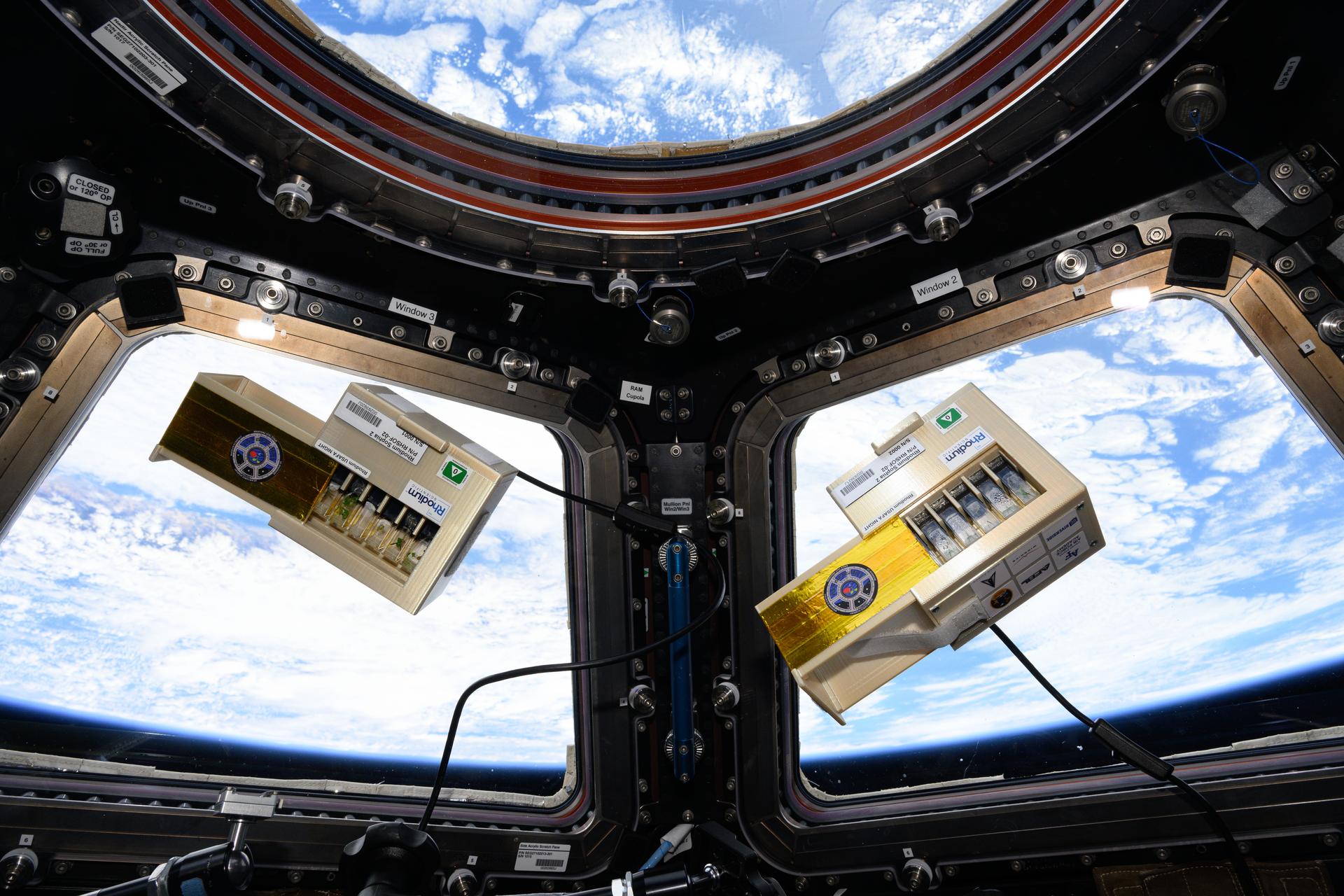
The canisters floating in the cupola of the International Space Station contain wild-type and genetically-modified thale cress plants for the Rhodium Plant LIFE experiment. The investigation studies how radiation and gravity environments at different orbital altitudes affect plant growth by comparing Crew-10 data with plants flown aboard the Polaris Dawn mission, which flew deeper into space. Studies have shown microgravity affects growth rates, and a better understanding of the mechanisms behind this could improve plant growth techniques in space and on Earth.
Solar spacewalk
NASA
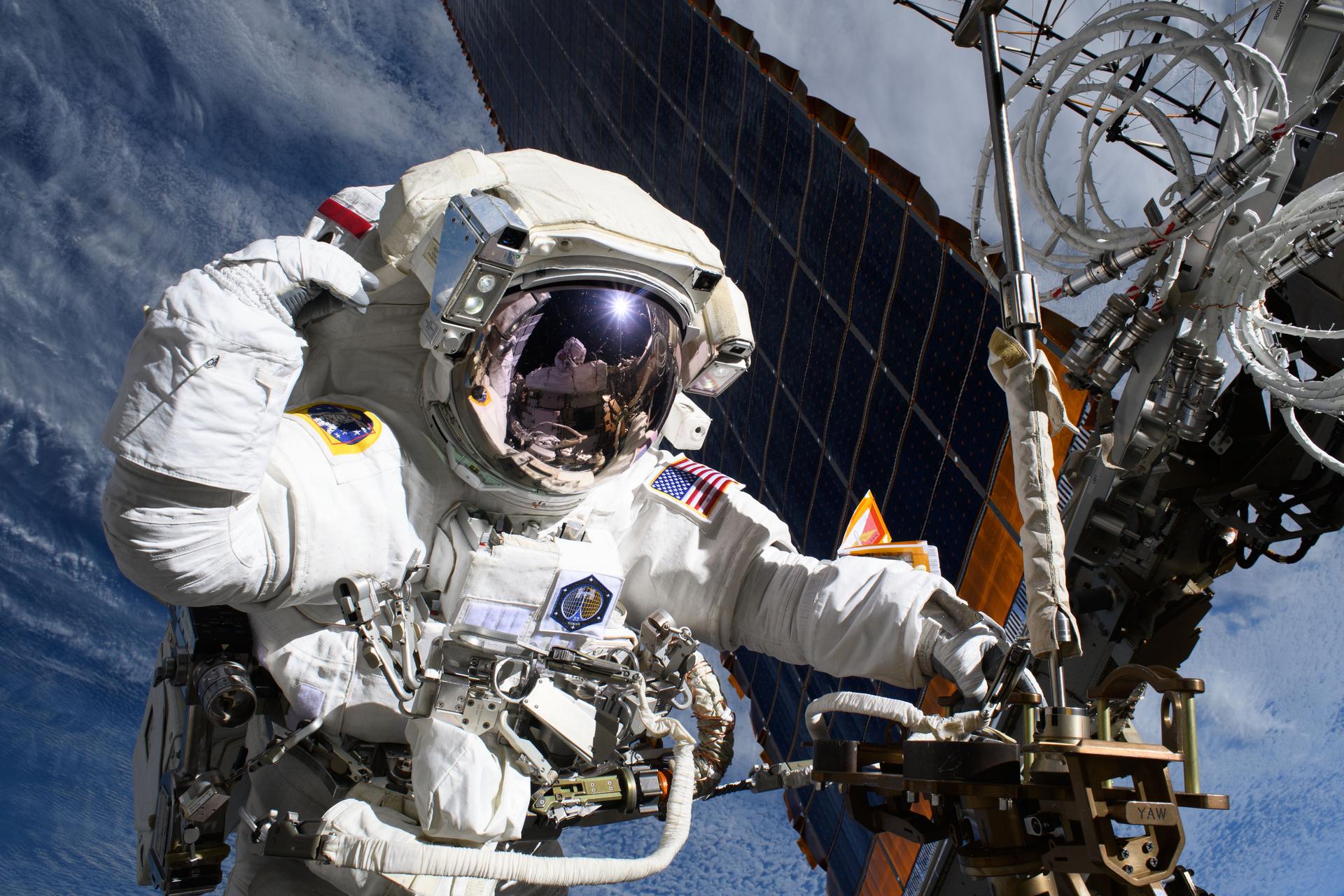
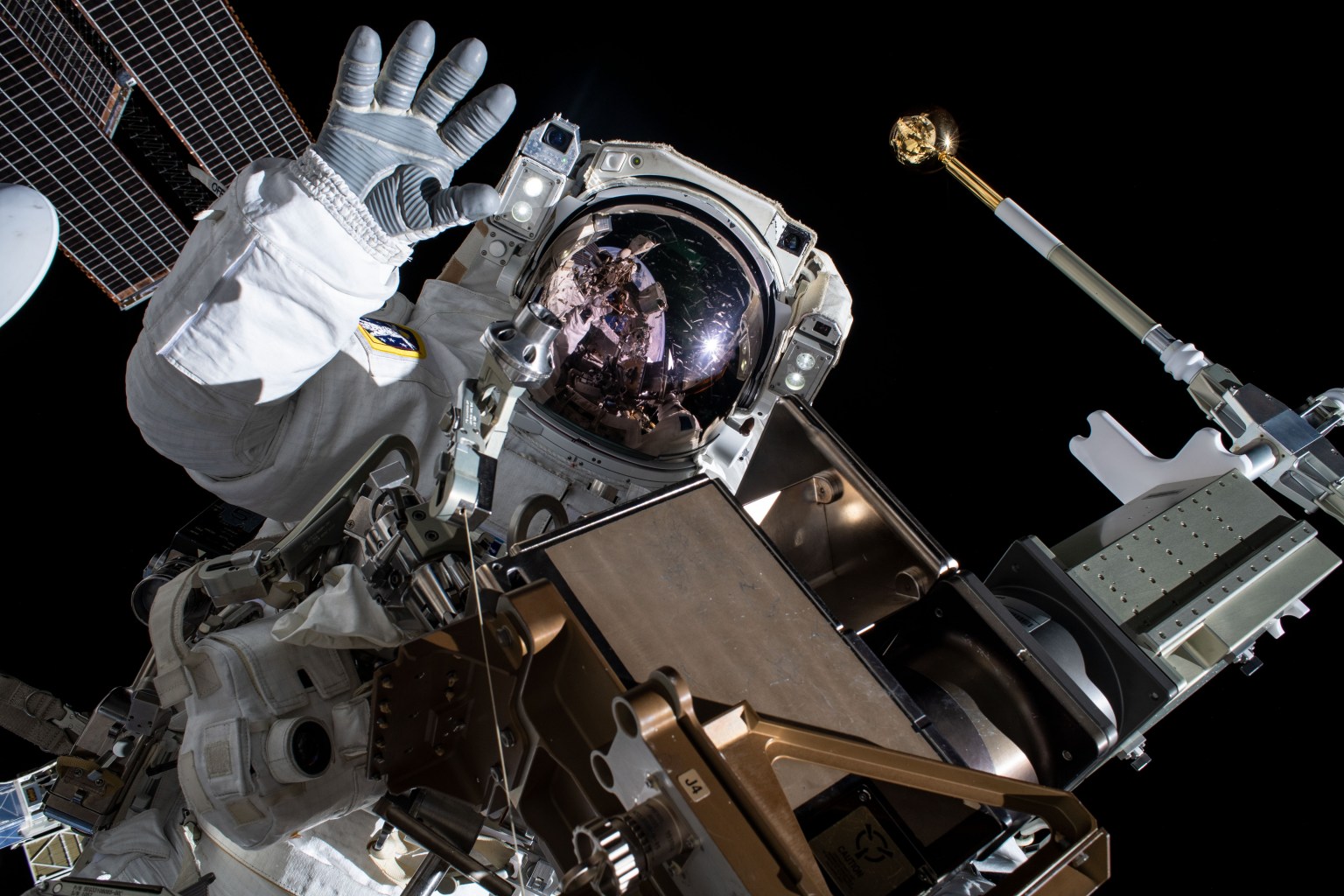
NASA astronaut Anne McClain conducts a spacewalk to upgrade the International Space Station’s power generation systems, which include main solar arrays like the one visible behind her. McClain is installing hardware to support an IROSA (International Space Station Roll-Out Solar Array), a type of array that is more compact and produces more power than the station’s original ones. The IROSAs were first demonstrated aboard the orbiting laboratory in June 2017, and eight have been installed to augment the power available for scientific research and other activities.
Microalgae on the menu
NASA
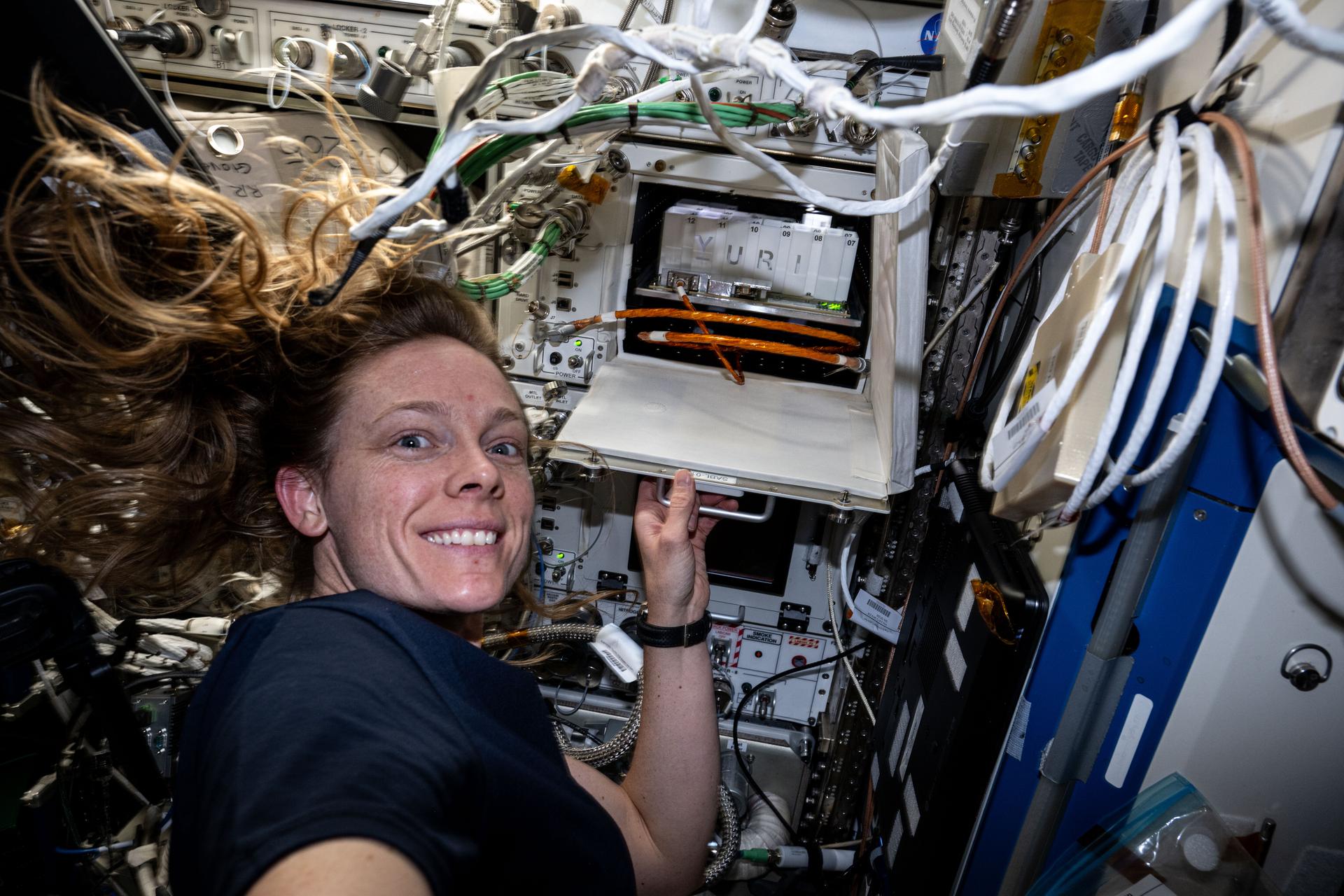
NASA astronaut Nichole Ayers uses the International Space Station’s Space Automated Bioproduct Laboratory to process samples for SOPHONSTER, a study of microgravity’s effects on the protein yield of microalgae. These organisms are highly nutritious, producing amino acids, fatty acids, B vitamins, iron, and fiber. The microalgae could provide sustainable meat and dairy alternatives during long-duration space missions. It also could be used to make biofuels and bioactive compounds in medicines in space and on Earth.
Looking down on lightning
NASA
The International Space Station orbits more than 250 miles above Earth, giving astronauts a unique view of their home planet, where they can photograph familiar places and interesting phenomena. While passing over a stormy night, NASA astronaut Nichole Ayers captured this image of simultaneous lightning at the top of two thunderstorms. Scientists use instruments installed on the space station to study lightning and other weather conditions in Earth’s upper atmosphere. This research helps protect communication systems and aircraft while improving atmospheric models and weather predictions.
Testing the tips of DNA
NASA
In this time-lapse video, JAXA (Japan Aerospace Exploration Agency) astronaut Takuya Onishi and NASA astronaut Nichole Ayers harvest samples for the APEX-12 investigation, which examines how space radiation affects telomere activity in thale cress plants. Telomeres, which are repetitive DNA sequences that protect the ends of chromosomes, become shorter each time a cell divides and indicate cell aging. The APEX-12 investigation could clarify the role of telomeres in aging and diseases and help scientists equip plants and other organisms for the stress of long-duration spaceflight.
Microscopic motion
NASA
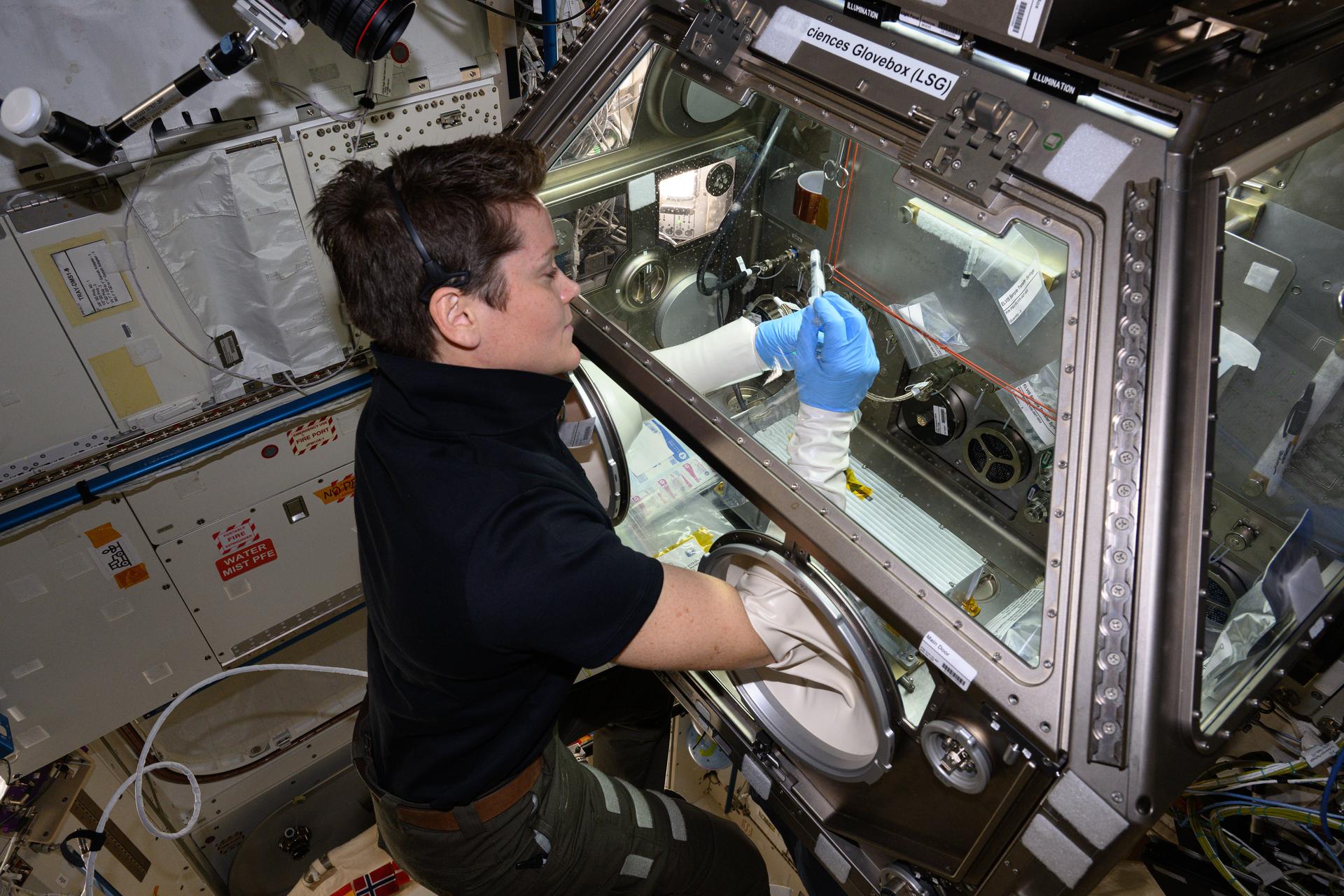
A fluorescent microscope, known as ELVIS, captures the motion of microscopic algae and bacteria in 3D, a new capability aboard the International Space Station. The technology could be helpful in various applications in space and on Earth, such as monitoring water quality and detecting potentially infectious organisms. NASA astronaut Anne McClain prepares bacterial samples for viewing with the microscope.
How cells sense gravity
NASA
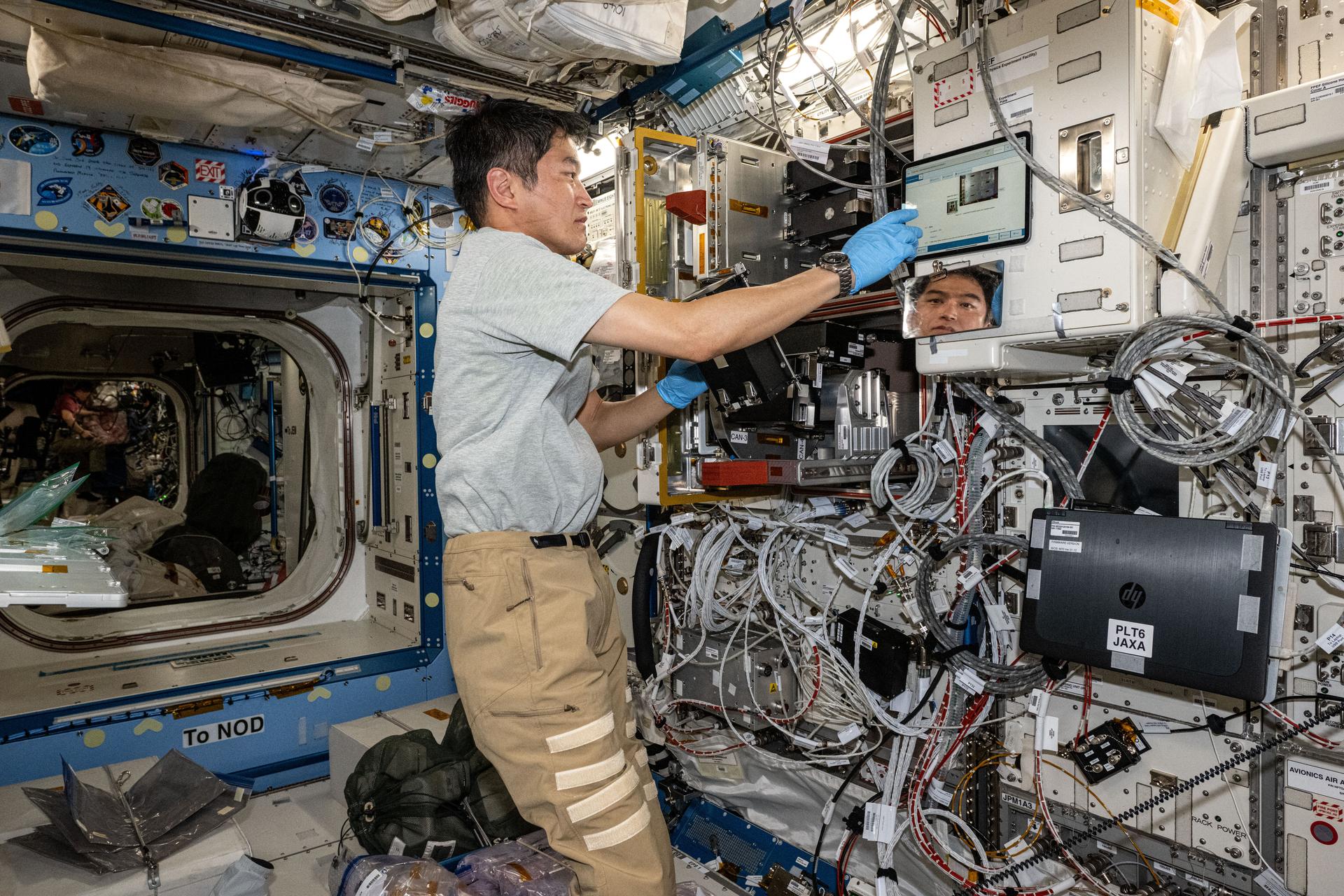
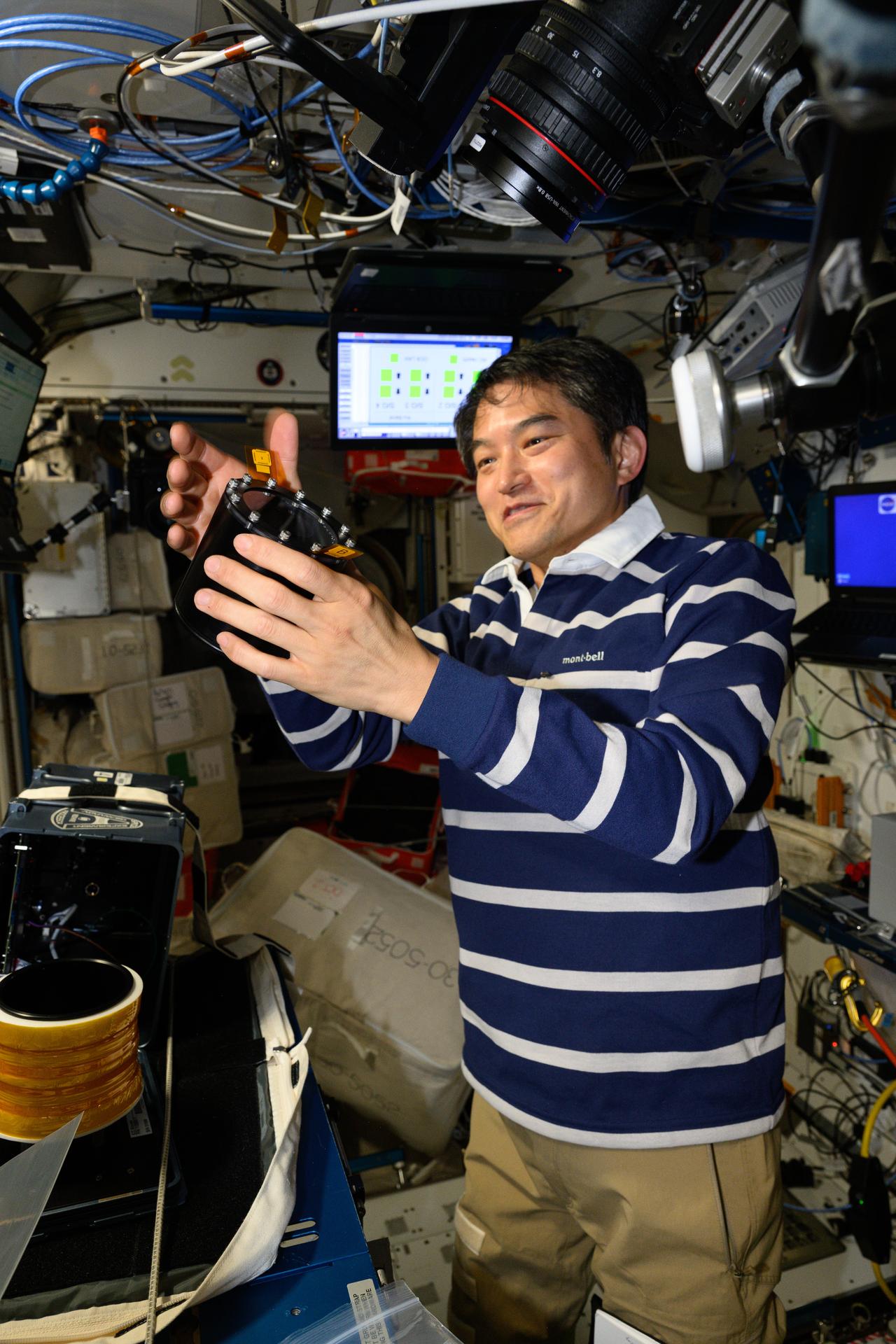
Individual cells in our bodies can respond to the effects of gravity, but how they do this is largely unknown. The Cell Gravisensing investigation is an effort to observe the mechanism that enables cells to sense gravity and could lead to therapies to treat muscle and bone conditions, like muscle atrophy during long-duration spaceflight and osteoporosis on Earth. JAXA (Japan Aerospace Exploration Agency) astronaut Takuya Onishi processes research samples in the International Space Station’s Kibo laboratory module.
Water works
NASA
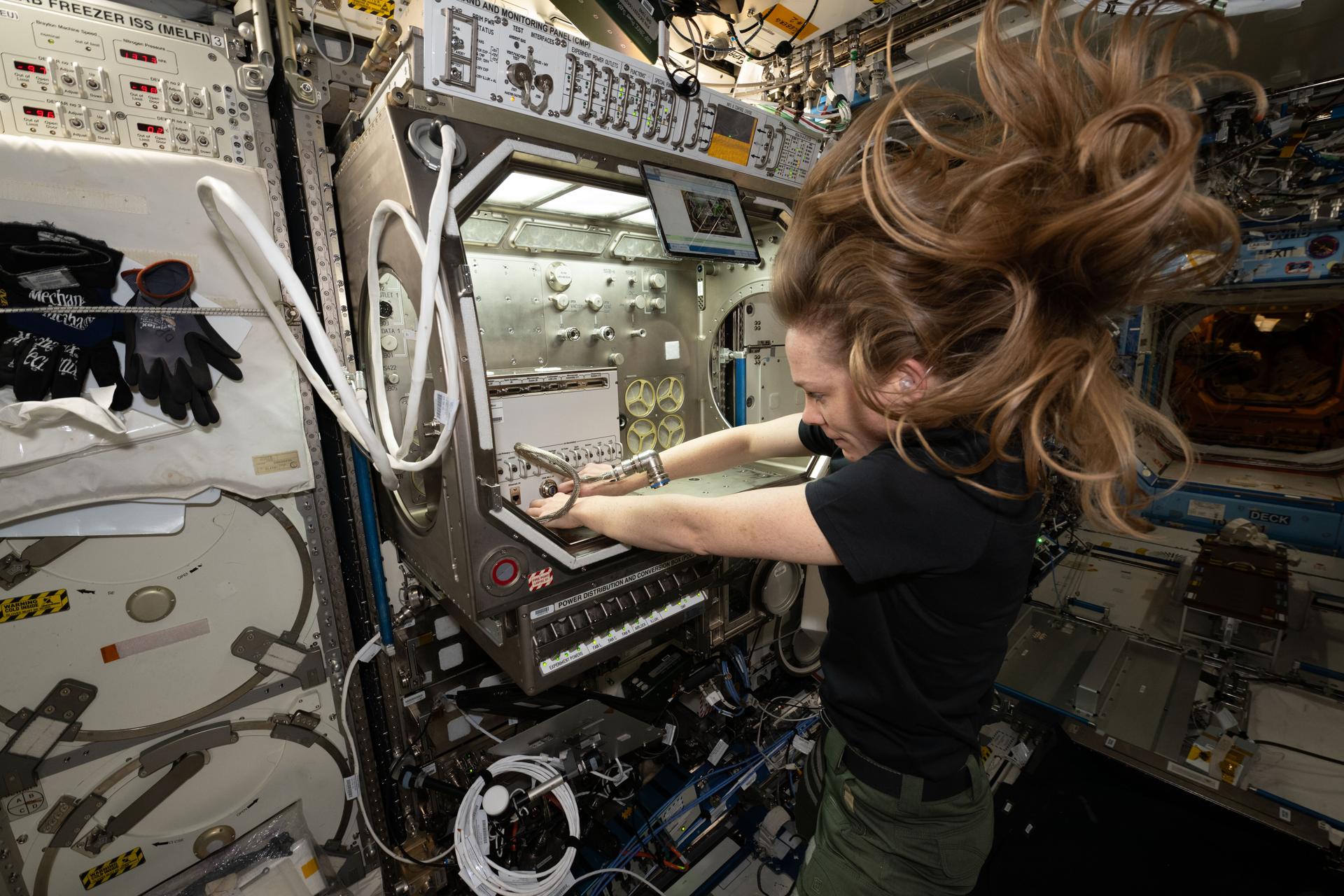
NASA astronauts Nichole Ayers and Anne McClain work on installing hardware for the International Space Station’s Exploration Potable Water Dispenser. Scientists are evaluating the device’s water sanitization and microbial growth reduction technology. The dispenser provides room temperature and hot water for crew consumption and food preparation. This technology could be adopted for future exploration missions.
Free-flying camera
NASA
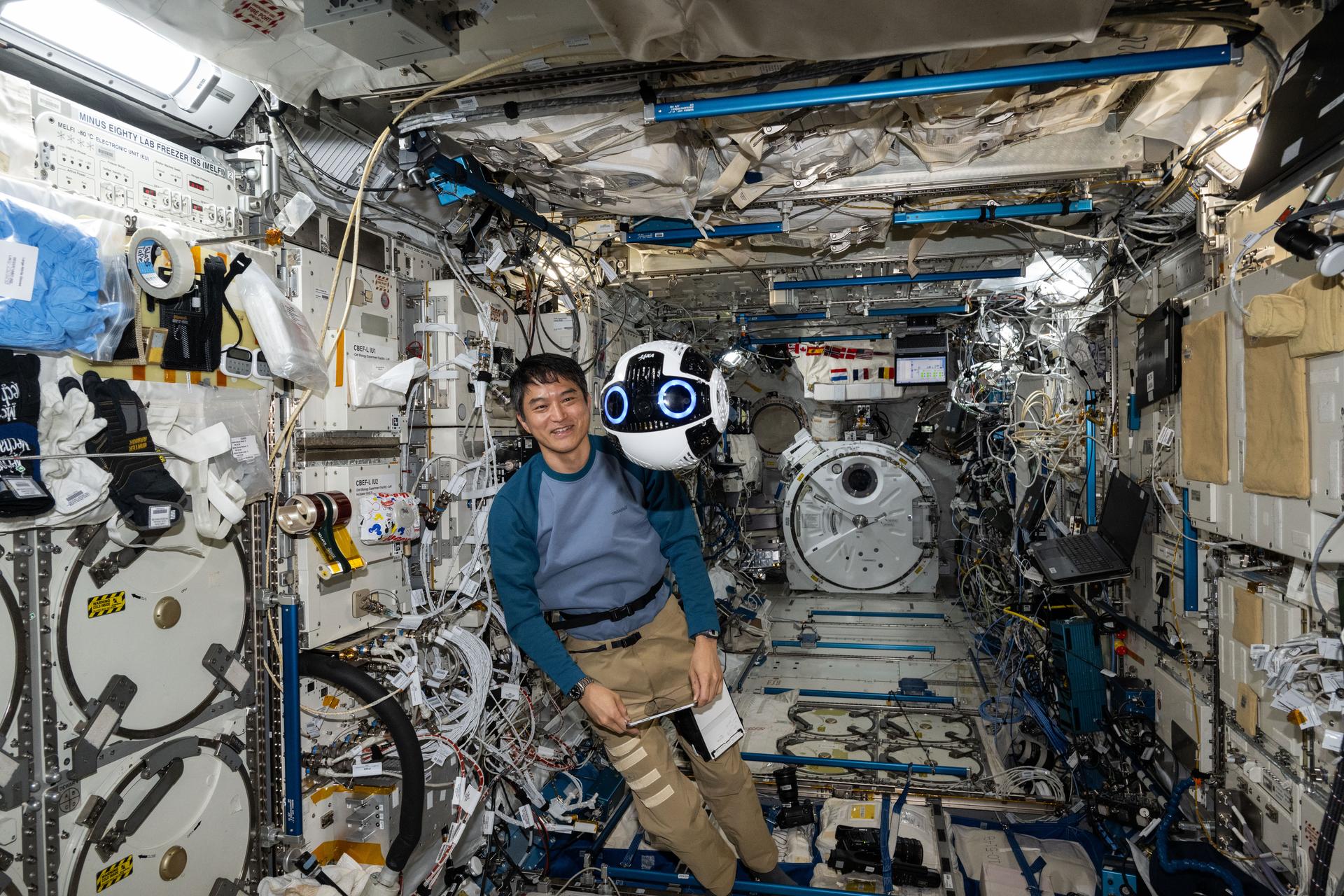
Astronaut Takuya Onishi of JAXA (Japan Aerospace Exploration Agency) monitors the JEM Internal Ball Camera 2 as it floats through the International Space Station. The free-flying, rechargeable camera provides a visual field outside the other cameras installed aboard the space station. JAXA is testing the robot’s ability to capture video and imagery of scientific experiments and other activities, which could free up crew time for research and other duties.
Two rings to pin them all
NASA
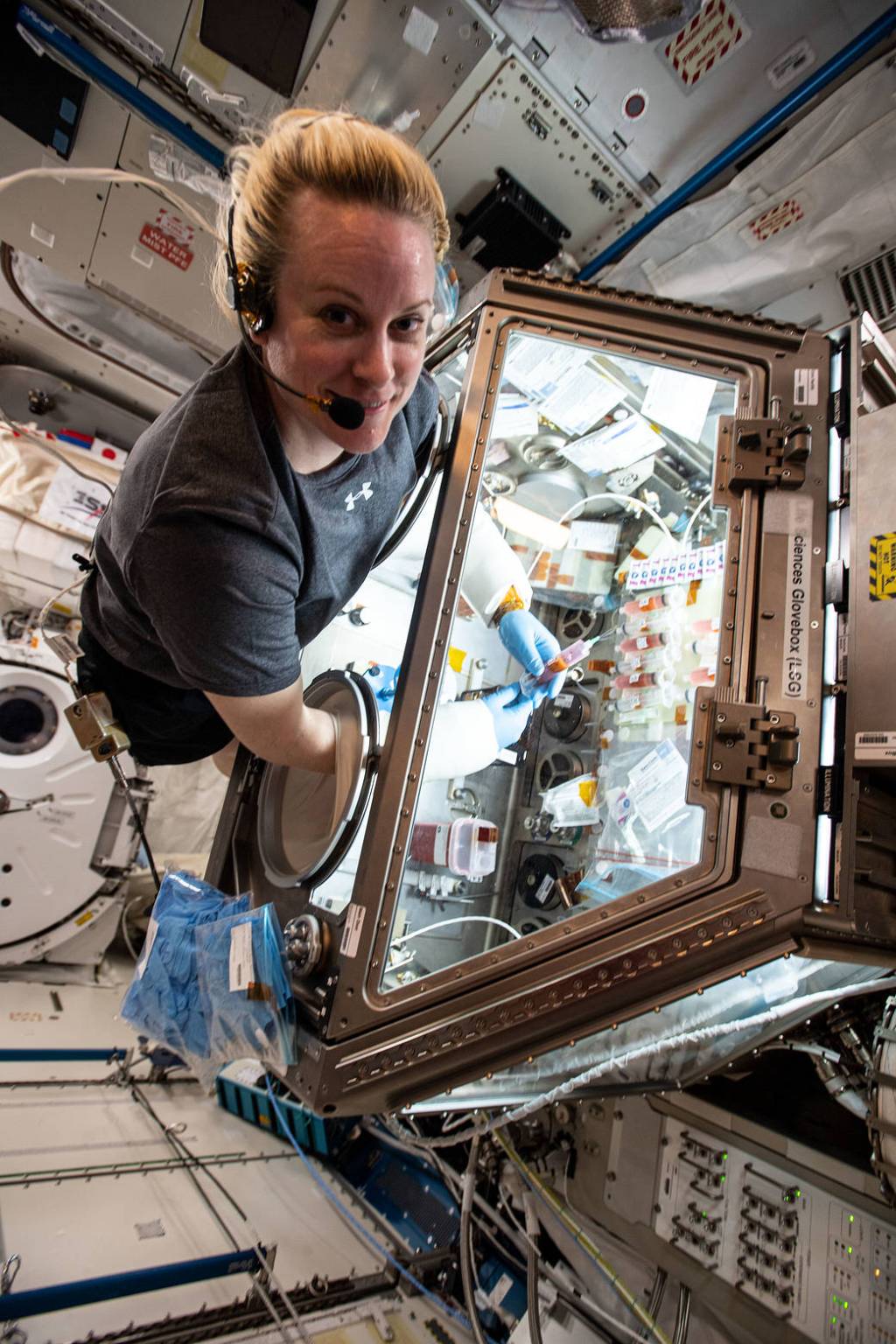
NASA astronaut Nichole Ayers sets up the space station’s Ring Sheared Drop device, which uses surface tension to pin a drop of liquid between two rings. The device makes it possible to study liquid proteins without a solid container, eliminating interactions between the solutions and container walls that can affect results. The Ring Sheared Drop-IBP-2 experiment studies the behavior of protein fluids in microgravity and tests predictive computer models. Better models could help advance manufacturing processes in space and on Earth for next-generation medicines to treat cancers and other diseases.
Crystallization research
NASA
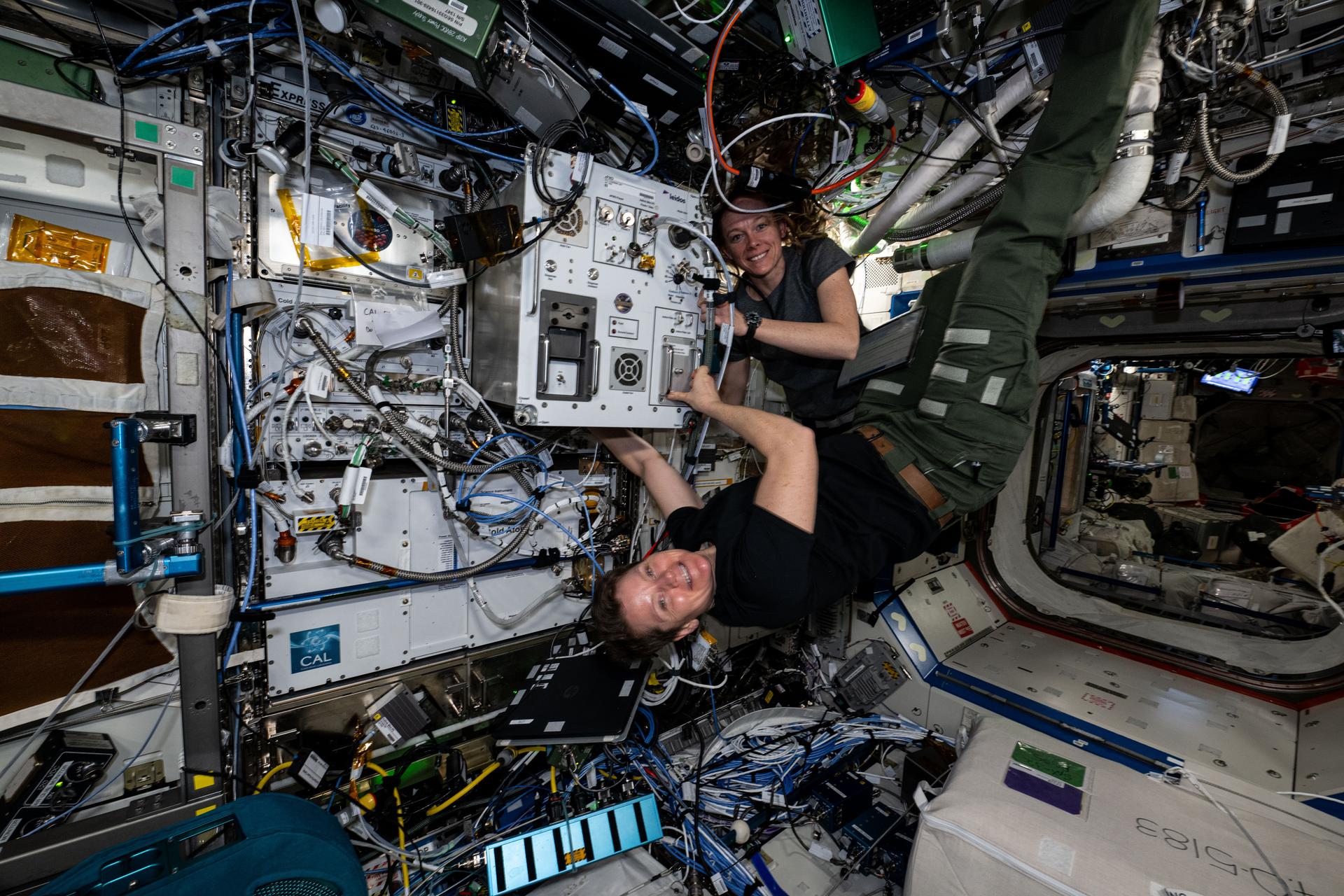
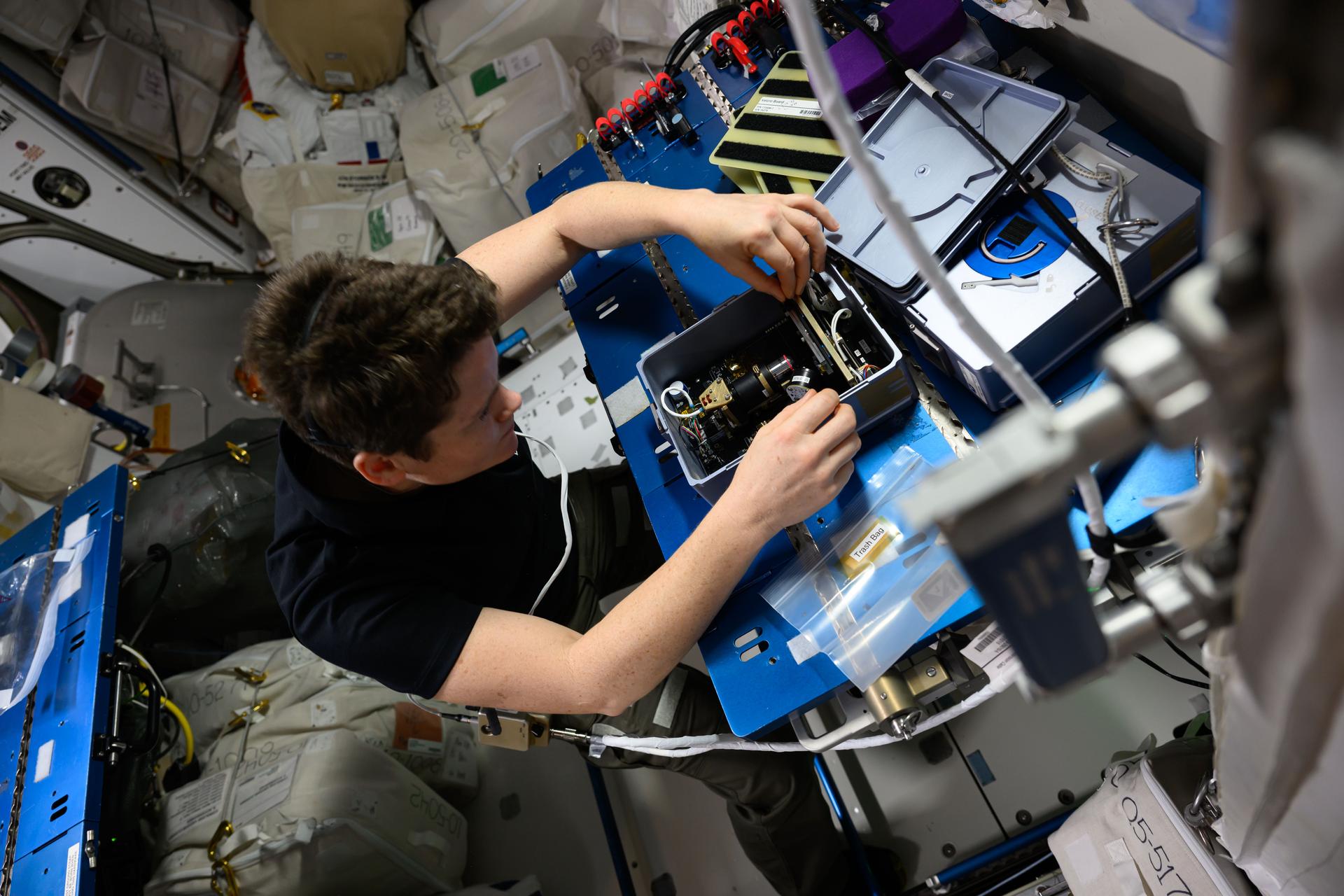
NASA astronaut Anne McClain swaps out hardware in the International Space Station’s Advanced Space Experiment Processor-4, which enables physical science and crystallization research. A current investigation uses the processor to demonstrate technology that may be able to produce medications during deep space missions and improve pharmaceutical manufacturing on Earth.
Monitoring astronaut health
NASA
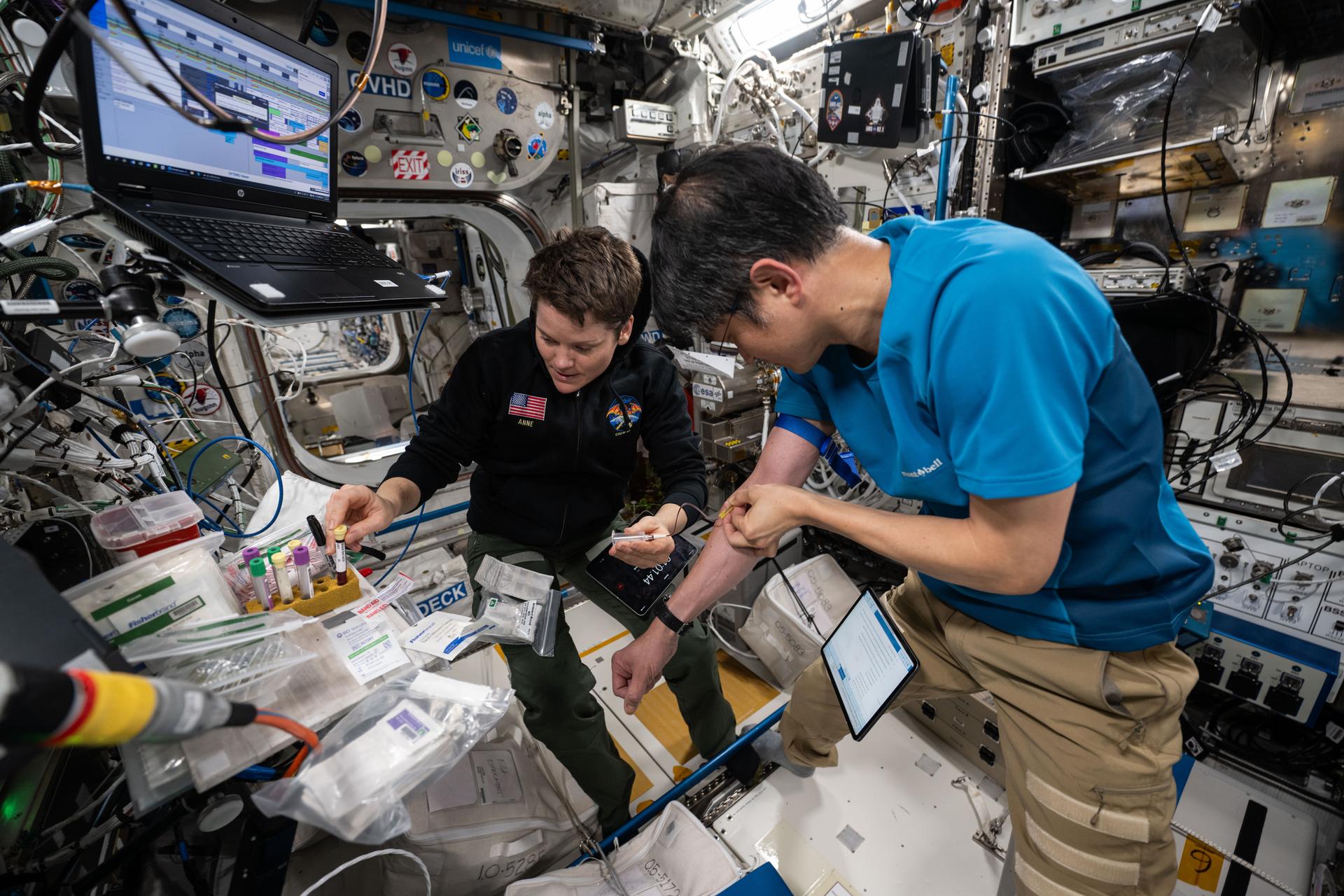
NASA astronaut Anne McClain helps JAXA (Japan Aerospace Exploration Agency) astronaut Takuya Onishi collect a sample of his blood. Analysis of blood samples is one tool NASA uses to continuously monitor crew health, including cardiovascular and immune system functions, bone and muscle mass changes, nutritional and metabolic status, and mental well-being. Crew members aboard the International Space Station also participate in various ongoing studies to better understand how different body systems adapt to weightlessness.
Catching a corona
NASA/KASI/INAF/CODEX
This animated, color-coded heat map shows temperature changes in the Sun’s outer atmosphere, or corona, over several days, with red indicating hotter regions and purple showing cooler ones. Scientists can observe these changes thanks to the International Space Station’s CODEX, which collected data during the Crew-10 mission. The instrument uses a coronagraph to block out sunlight and reveal details in the Sun’s corona. Data from this investigation could help scientists understand the energy source of the solar wind, a flow of charged particles from the Sun that constantly bombards Earth.
Expanding in-space crystallization
NASA
Astronaut Takuya Onishi of JAXA (Japan Aerospace Exploration Agency) services the International Space Station’s Advanced Space Experiment Processor-4 in preparation for ADSEP-Industrial Crystallization Cassette. This investigation tests new hardware that scales up research and could enable in-space production of pharmaceuticals and other materials for commercial space applications.
Sowing seeds in space
NASA
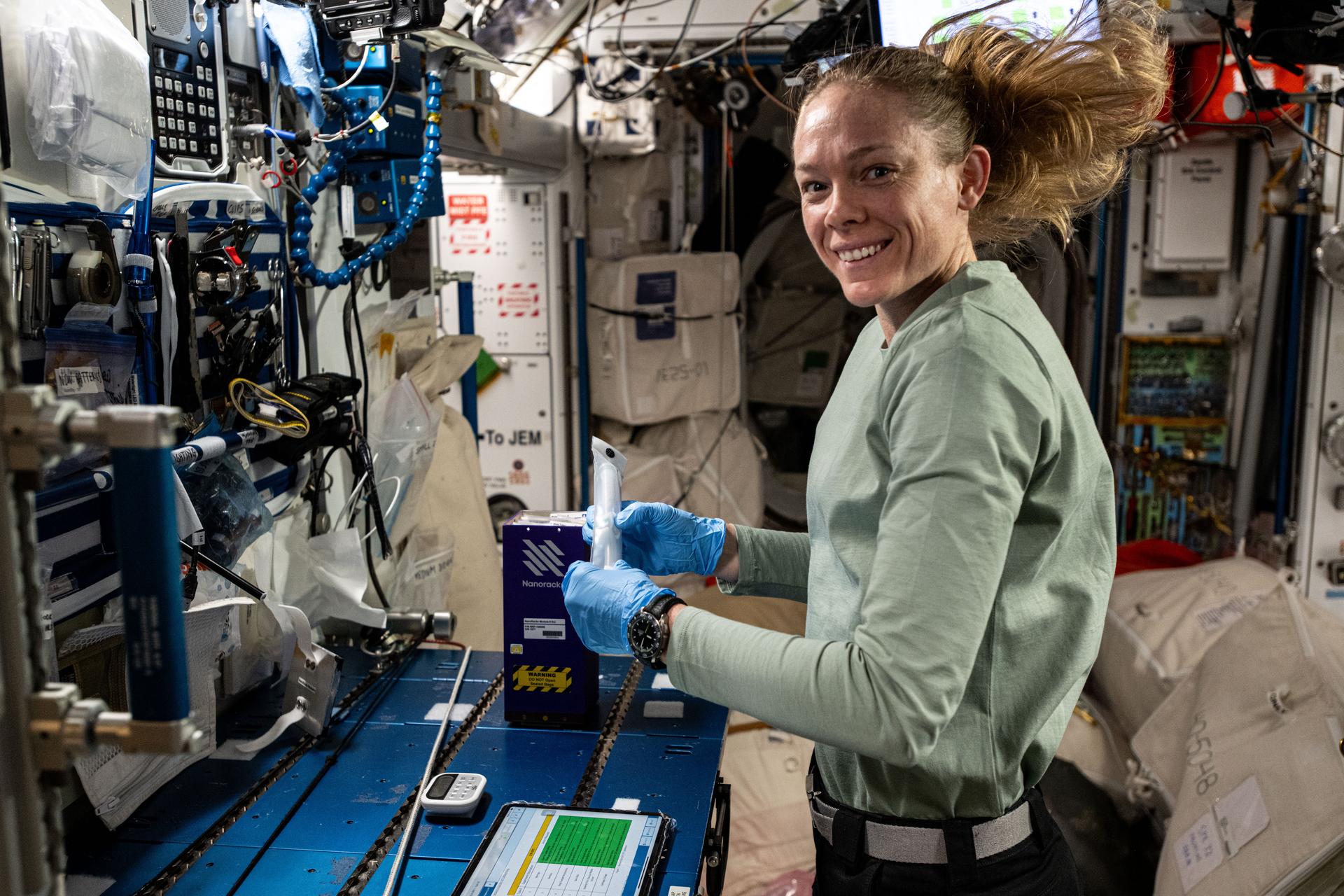
NASA astronaut Nichole Ayers prepares mixture tubes containing samples for Nanoracks Module-9 Swiss Chard. This student-designed experiment examines whether the size, shape, color, and nutritional content of Swiss chard seeds germinated in space differ from those grown on Earth. The International Space Station hosts ongoing plant research as a source of food and other benefits, including contributing to astronaut well-being, for future long-duration missions.
Protecting astronaut vision
NASA
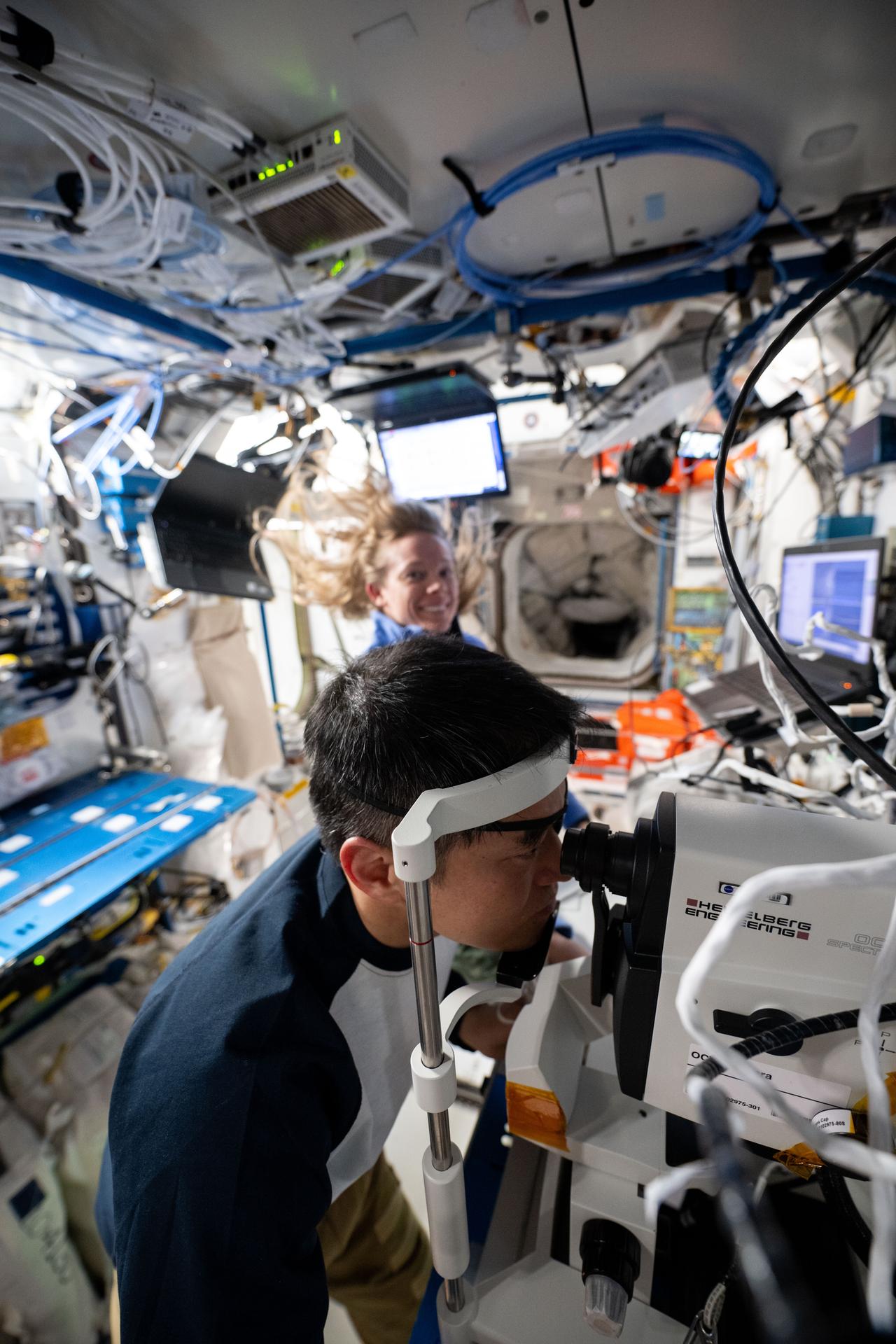
Spaceflight can cause changes to eye structure and vision, so crew members monitor eye health throughout their missions. Astronaut Takuya Onishi of JAXA (Japan Aerospace Exploration Agency), assisted by NASA astronaut Nichole Ayers, conducts an eye exam aboard the International Space Station using optical coherence tomography. This technology uses reflected light to produce 3D images of the retina, nerve fibers, and other eye structures and layers.
NASA Science Activation Teams Unite to Support Neurodiverse Learners with Public Libraries
3 min read
NASA Science Activation Teams Unite to Support Neurodiverse Learners with Public Libraries
On July 16, 2025, more than 400 public library staff from across the United States joined a powerful webinar, Serving Neurodiverse Library Patrons and Colleagues, hosted by two NASA Science Activation program teams: NASA@ My Library and NASA’s Neurodiversity Network (N3). The event brought together researchers, library professionals, and individuals with lived experience of neurodiversity to share insights and best practices for creating more inclusive and supportive environments in libraries.
Designed to equip library staff with tools and awareness, this interactive webinar explored how libraries can better serve neurodiverse patrons, such as those with autism, attention deficit hyperactivity disorder (ADHD), dyslexia, and other cognitive variations, while also supporting neurodiverse colleagues. Breakout rooms allowed participants to dive deeper into specific topics, including accessible program facilitation, supporting neurodiverse colleagues, and an “Ask Me Anything” space that encouraged open dialogue and learning.
Library staff everywhere are invited to watch the recorded webinar on YouTube and learn more about serving neurodiverse patrons and colleagues.
The collaboration between NASA@ My Library (led by the Space Science Institute), and NASA’s Neurodiversity Network (N3) (led by Sonoma State University), reflects a shared commitment to broadening participation in STEM (Science, Technology, Engineering, and Mathematics). NASA@ My Library works with public libraries nationwide to engage diverse communities in NASA science and discoveries. N3 focuses on empowering neurodiverse learners – particularly those in high school – with opportunities to engage with NASA science and explore potential STEM career pathways.
Participants left inspired, and the demand for more is clear: attendees and speakers alike expressed interest in continuing the conversation, requesting additional training, and expressing interest in organizing a future conference centered on neurodiversity and inclusion in libraries.
Youth Services Librarian and webinar panelist Molly Creveling shared, “This was such a great opportunity, and I’m extremely proud to have been able to contribute to it, I wish I was able to attend everyone’s break out room!” And participant Jason Wood expressed in the chat, “Really, really appreciate this webinar. This is one of those days I am extra proud to be a librarian. Thank you all.” Another enthusiast participant said, “This was the best webinar I’ve attended in years…more of this!”
As NASA continues to reach for the stars, it’s equally committed to ensuring that the journey is accessible to all – especially those whose unique ways of thinking and learning bring fresh perspectives to science, exploration, and discovery.
NASA@ My Library and N3, supported by NASA under cooperative agreement award numbers NNX16AE30A and 80NSSC21M0004, are part of NASA’s Science Activation Portfolio. Learn more about how Science Activation connects NASA science experts, real content, and experiences with community leaders to do science in ways that activate minds and promote deeper understanding of our world and beyond: https://science.nasa.gov/learn
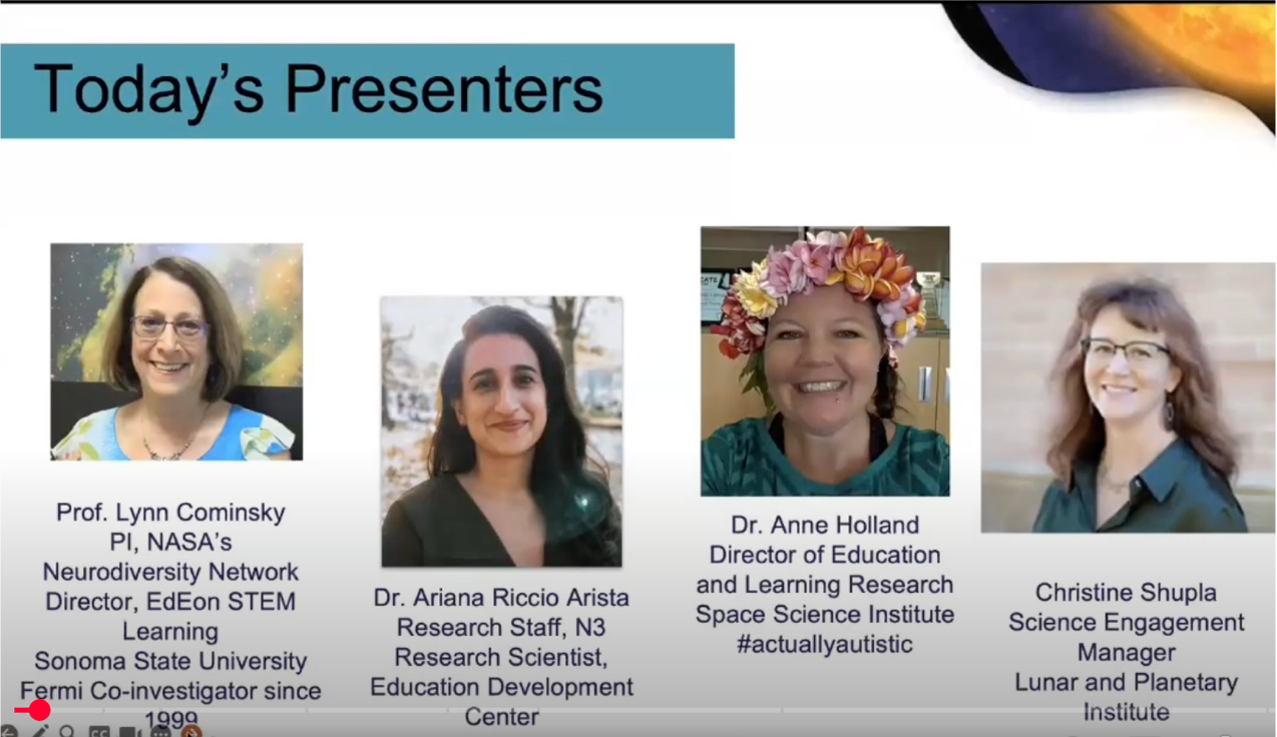
Presenters included staff from NASA’s Neurodiversity Network, NASA@ My Library, Education Development Center, and the Lunar and Planetary Institute.
Software designed to give spacecraft more autonomy could support a future where swarms of satellites navigate and complete scientific objectives with limited human intervention.
Caleb Adams, Distributed Spacecraft Autonomy project manager, monitors testing alongside the test racks containing 100 spacecraft computers at NASA’s Ames Research Center in California’s Silicon Valley. The DSA project develops and demonstrates software to enhance multi-spacecraft mission adaptability, efficiently allocate tasks between spacecraft using ad-hoc networking, and enable human-swarm commanding of distributed space missions.
Credit: NASA/Brandon Torres Navarrete
Astronauts living and working on the Moon and Mars will rely on satellites to provide services like navigation, weather, and communications relays. While managing complex missions, automating satellite communications will allow explorers to focus on critical tasks instead of manually operating satellites.
Long duration space missions will require teaming between systems on Earth and other planets. Satellites orbiting the Moon, Mars, or other distant areas face communications delays with ground operators which could limit the efficiency of their missions.
The solution lies within the Distributed Spacecraft Autonomy (DSA) project, led by NASA’s Ames Research Center in California’s Silicon Valley, which tests how shared autonomy across distributed spacecraft missions makes spacecraft swarms more capable of self-sufficient research and maintenance by making decisions and adapting to changes with less human intervention.
Adding autonomy to satellites makes them capable of providing services without waiting for commands from ground operators. Distributing the autonomy across multiple satellites, operating like a swarm, gives the spacecraft a “shared brain” to accomplish goals they couldn’t achieve alone.
The DSA software, built by NASA researchers, provides the swarm with a task list, and shares each spacecraft’s distinct perspective – what it can observe, what its priorities are – and integrates those perspectives into the best plan of action for the whole swarm. That plan is supported by decision trees and mathematical models that help the swarm decide what action to take after a command is completed, how to respond to a change, or address a problem.
Sharing the Workload
The first in-space demonstration of DSA began onboard the Starling spacecraft swarm, a group of four small satellites, demonstrating various swarm technologies. Operating since July 2023, the Starling mission continues providing a testing and validation platform for autonomous swarm operations. The swarm first used DSA to optimize scientific observations, deciding what to observe without pre-programmed instructions. These autonomous observations led to measurements that could have been missed if an operator had to individually instruct each satellite.
The Starling swarm measured the electron content of plasma between each spacecraft and GPS satellites to capture rapidly changing phenomena in Earth’s ionosphere – where Earth’s atmosphere meets space. The DSA software allowed the swarm to independently decide what to study and how to spread the workload across the four spacecraft.
Because each Starling spacecraft operates as an independent member within the swarm, if one swarm member was unable to accomplish its work, the other three swarm members could react and complete the mission’s goals.
The Starling 1.0 demonstration achieved several firsts, including the first fully distributed autonomous operation of multiple spacecraft, the first use of space-to-space communications to autonomously share status information between multiple spacecraft, the first demonstration of fully distributed reactive operations onboard multiple spacecraft, the first use of a general-purpose automated reasoning system onboard a spacecraft, and the first use of fully distributed automated planning onboard multiple spacecraft. These achievements laid the groundwork for Starling 1.5+, an ongoing continuation of the satellite swarm’s mission using DSA.
Advanced testing of DSA onboard Starling shows that distributed autonomy in spacecraft swarms can improve efficiencies while reducing the workload on human operators.
Credit: NASA/Daniel Rutter
A Helping Hand in Orbit
After DSA’s successful demonstration on Starling 1.0, the team began exploring additional opportunities to use the software to support satellite swarm health and efficiency. Continued testing of DSA on Starling’s extended mission included PLEXIL (Plan Execution Interchange Language), a NASA-developed programming language designed for reliable and flexible automation of complex spacecraft operations.
Onboard Starling, the PLEXIL application demonstrated autonomous maintenance, allowing the swarm to manage normal spacecraft operations, correct issues, or distribute software updates across individual spacecraft.
Enhanced autonomy makes swarm operation in deep space feasible – instead of requiring spacecraft to communicate back and forth between their distant location and Earth, which can take minutes or hours depending on distance, the PLEXIL-enabled DSA software gives the swarm the ability to make decisions collaboratively to optimize their mission and reduce workloads.
Simulated Lunar Swarming
To understand the scalability of DSA, the team used ground-based flight computers to simulate a lunar swarm of virtual small spacecraft. The computers simulated a swarm that provides position, navigation, and timing services on the Moon, similar to GPS services on Earth, which rely on a network of satellites to pinpoint locations.
The DSA team ran nearly one hundred tests over two years, demonstrating swarms of different sizes at high and low lunar orbits. The lessons learned from those early tests laid the groundwork for additional scalability studies. The second round of testing, set to begin in 2026, will demonstrate even larger swarms, using flight computers that could later go into orbit with DSA software onboard.
The Future of Spacecraft Swarms
Orbital and simulated tests of DSA are a launchpad to increased use of distributed autonomy across spacecraft swarms. Developing and proving these technologies increases efficiency, decreases costs, and enhances NASA’s capabilities opening the door to autonomous spacecraft swarms supporting missions to the Moon, Mars, and beyond.
Milestones:
October 2018: DSA project development begins.
April 2020: Lunar position, navigation, and timing (LPNT) simulation demonstration development begins.
July 2023: DSA launches onboard the Starling spacecraft swarm.
March 2024: DSA experiments onboard Starling reach the necessary criteria for success.
July 2024: DSA software development begins for the Starling 1.5+ mission extension.
September 2024: LPNT simulation demonstration concludes successfully.
October 2024: DSA’s extended mission as part of Starling 1.5+ begins.
Partners:
NASA Ames leads the Distributed Spacecraft Autonomy and Starling projects. NASA’s Game Changing Development program within the agency’s Space Technology Mission Directorate provided funding for the DSA experiment. NASA’s Small Spacecraft Technology program within the Space Technology Mission Directorate funds and manages the Starling mission and the DSA project.
Station Expands to 11 Before Next Crew Leaves This Week
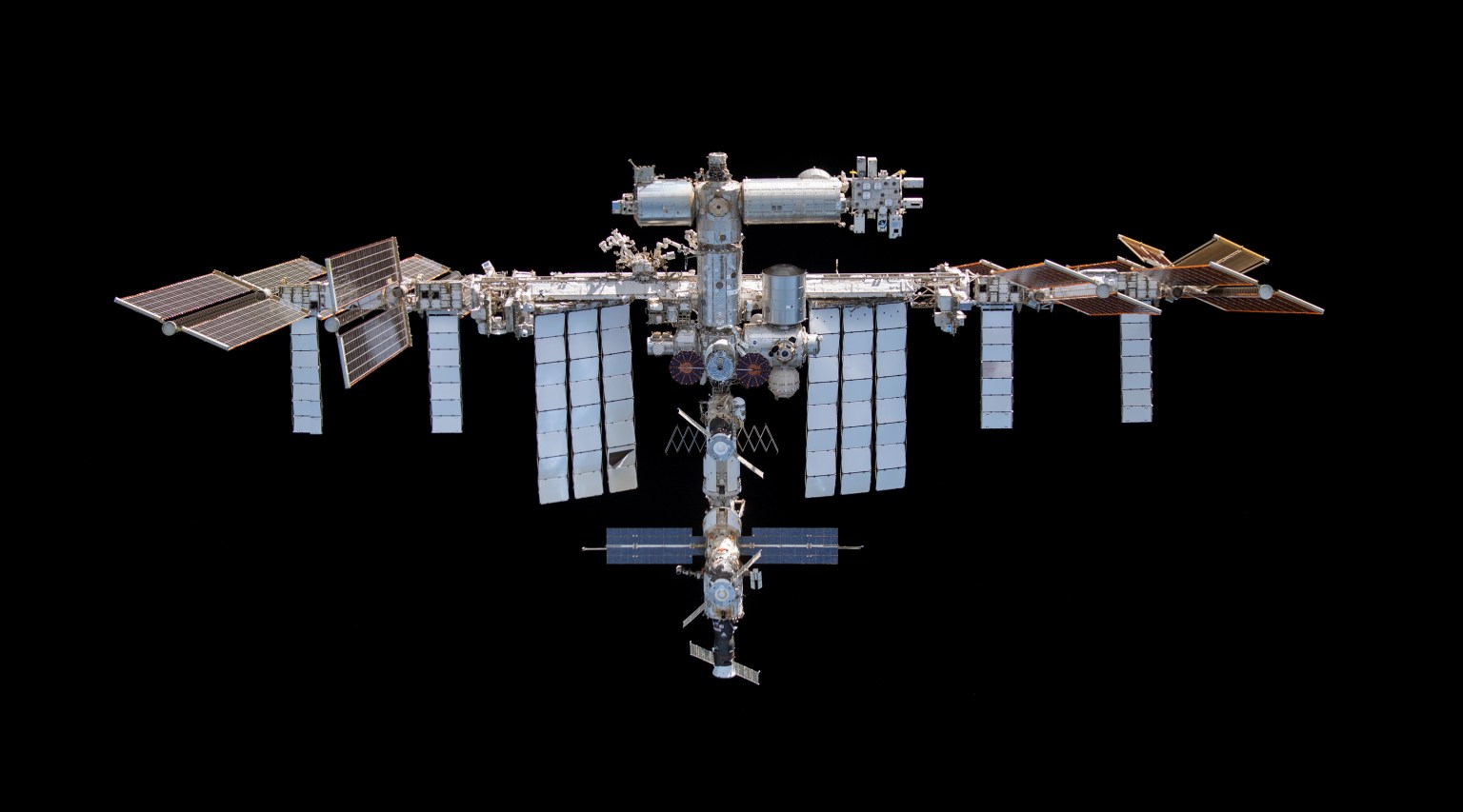
Expedition 73 welcomes NASA’s SpaceX Crew-11 mission aboard the International Space Station. In the front from left are, Crew-11 members Oleg Platonov, Mike Fincke, Zena Cardman, and Kimiya Yui. In the back are, Expedition 73 members Takuya Onishi, Kirill Peskov, Alexey Zubritsky, Sergey Ryzhikov, Jonny Kim, Nichole Ayers, and Anne McClain.
@Astro_Ayers
Four new crew members are adjusting to life on the International Space Station and gearing up for several months of microgravity research to benefit humans living on and off the Earth. Meanwhile, another quartet that has been orbiting Earth since March is packing up and handing over responsibilities to the new crew before returning to Earth this week.
Expedition 73 expanded to eleven individuals on Saturday when NASA’s SpaceX Crew-11 mission docked to the orbital outpost aboard the Dragon spacecraft after launching from Florida about 15 hours earlier. Crew 11’s Commander and Pilot, Zena Cardman and Mike Fincke, both from NASA, and Mission Specialists Kimiya Yui from JAXA (Japan Aerospace Exploration Agency) and Oleg Platonov from Roscosmos spent the weekend unpacking their Dragon spacecraft, reviewing safety procedures, and getting familiar with space station systems.
The crew is well trained for its space research program and will soon begin investigating a wide variety of microgravity phenomena to gain insights only achievable in space. They will explore manufacturing high quality stem cells, alternatives to antibiotics to treat bacterial infections, cell division in plants to promote space agriculture, and more.
The homebound foursome has spent the last two weeks gathering personal items and cargo for loading inside Dragon. Over the next couple of days, Crew-10 will also pack critical research samples stowed in portable science freezers inside Dragon for retrieval and analysis back on Earth. During the final cargo-packing and scientific sample-stowing duties, the crew will also review departure procedures before entering Dragon and undocking.
NASA astronaut Jonny Kim and Roscosmos cosmonauts Sergey Ryzhikov and Alexey Zubritsky will continue their mission aboard the station and conduct their complement of space research until December. The trio have been assisting with the crew swap activities as Kim helped Fincke learn to work out on the advanced resistive exercise device. Ryzhikov showed the Crew-11 foursome the location of emergency hardware and how to use NASA and Roscosmos station hardware. Zubritsky helped Peskov as he tested the lower body negative pressure suit that may counteract space-caused head and eye pressure and help crews adjust quicker to the return to Earth’s gravity.