Station Crew Ends Week with Half-Shift Filled with Space Research

Station Crew Ends Week with Half-Shift Filled with Space Research

NASA astronaut and Expedition 73 Flight Engineer Anne McClain checks out a pair of spacesuits during routine maintenance operations inside the International Space Station's Quest airlock.
Astronaut Anne McClain checks out a pair of spacesuits during routine maintenance operations inside the International Space Station’s Quest airlock.
NASA

The Expedition 73 crew wrapped up the week with another light duty day working half a shift filled with vein scans, a pharmaceutical study, and International Space Station upkeep.

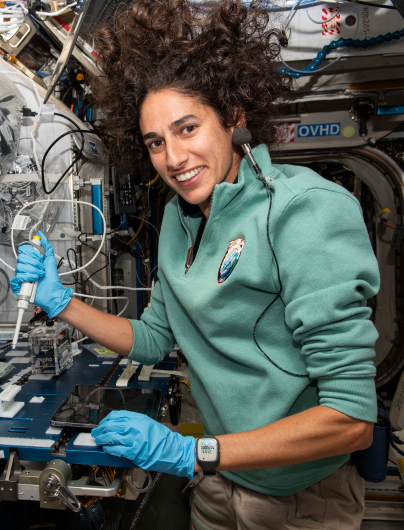
NASA Flight Engineer Nichole Ayers kicked off her day with station Commander Takuya Onishi from JAXA (Japan Aerospace Exploration Agency) taking turns operating the Ultrasound 2 device and scanning each other’s neck, shoulder, and leg veins. Afterward, Ayers handed over the biomedical hardware to NASA Flight Engineer Anne McClain who scanned the veins of Roscosmos Flight Engineer Kirill Peskov. Doctors on the ground monitored the regularly scheduled scans in real time checking for potential blood clots arising due to blood pooling toward a crew member’s upper body in microgravity.

Onishi and McClain then spent some time on different maintenance duties in the Quest airlock. Onishi observed, photographed, and documented the condition and location of a variety of spacewalking tools, while McClain transferred wastewater collected from a spacesuit into a contingency water container bag.

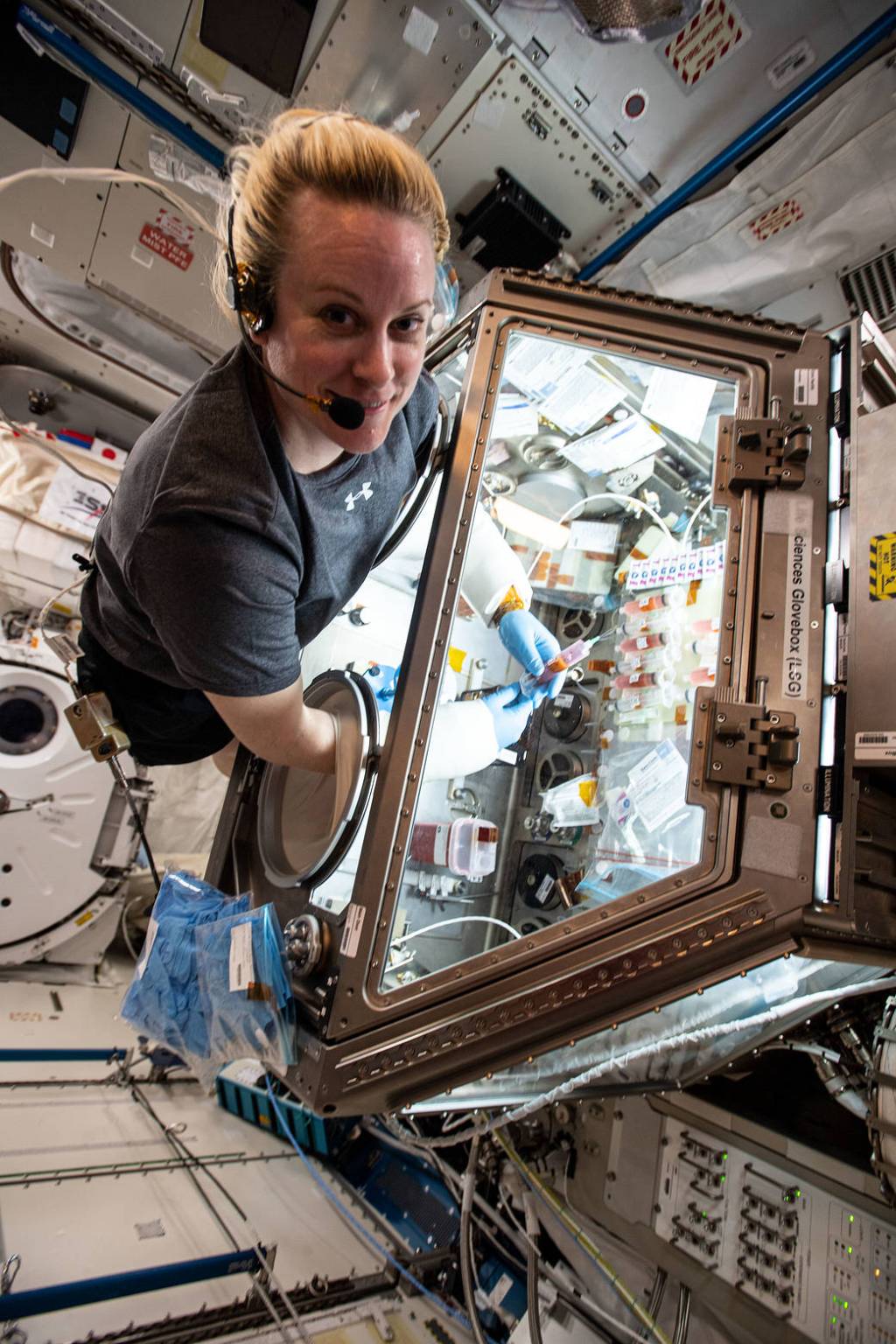
NASA Flight Engineer Jonny Kim began his shift inside Quest searching for and locating a specialized socket that will be used on a future spacewalk. Next, he worked inside the Destiny laboratory module installing hardware and setting up samples inside the Microgravity Science Glovebox to explore the behavior of amyloids, or protein deposits that affects organs and tissues, in weightlessness. Results may lead to a better understanding and newer treatments for neurodegenerative diseases such as Alzheimer’s and promote space commercialization opportunities.

Peskov began his shift in the orbital outpost’s Roscosmos segment and attached himself to a device that applies a known force to a crew member and uses the resulting acceleration to accurately calculate mass. After his vein scans, Peskov worked in the Zarya module and cleaned life support equipment and checked lighting systems.

Veteran space station resident and cosmonaut Sergey Ryzhikov spent his half-day in Zarya organizing electronics hardware to create more stowage space. First-time space-flyer cosmononaut Alexey Zubritskiy transferred fluids from the station into the Progress 90 cargo craft’s tanks then copied science data collected from a protein crystallization investigation to a flash drive.

Learn more about station activities by following the space station blog, @space_station and @ISS_Research on X, as well as the ISS Facebook and ISS Instagram accounts.

Get the latest from NASA delivered every week. Subscribe here.

Powered by WPeMatico

Get The Details…

Mark A. Garcia

NASA, DoD Practice Abort Scenarios Ahead of Artemis II Moon Mission

NASA, DoD Practice Abort Scenarios Ahead of Artemis II Moon Mission

Teams with NASA and the Department of Defense (DoD) rehearse recovery procedures for a launch pad abort scenario off the coast of Florida near the agency’s Kennedy Space Center on Wednesday, June 11, 2025.
NASA/Isaac Watson

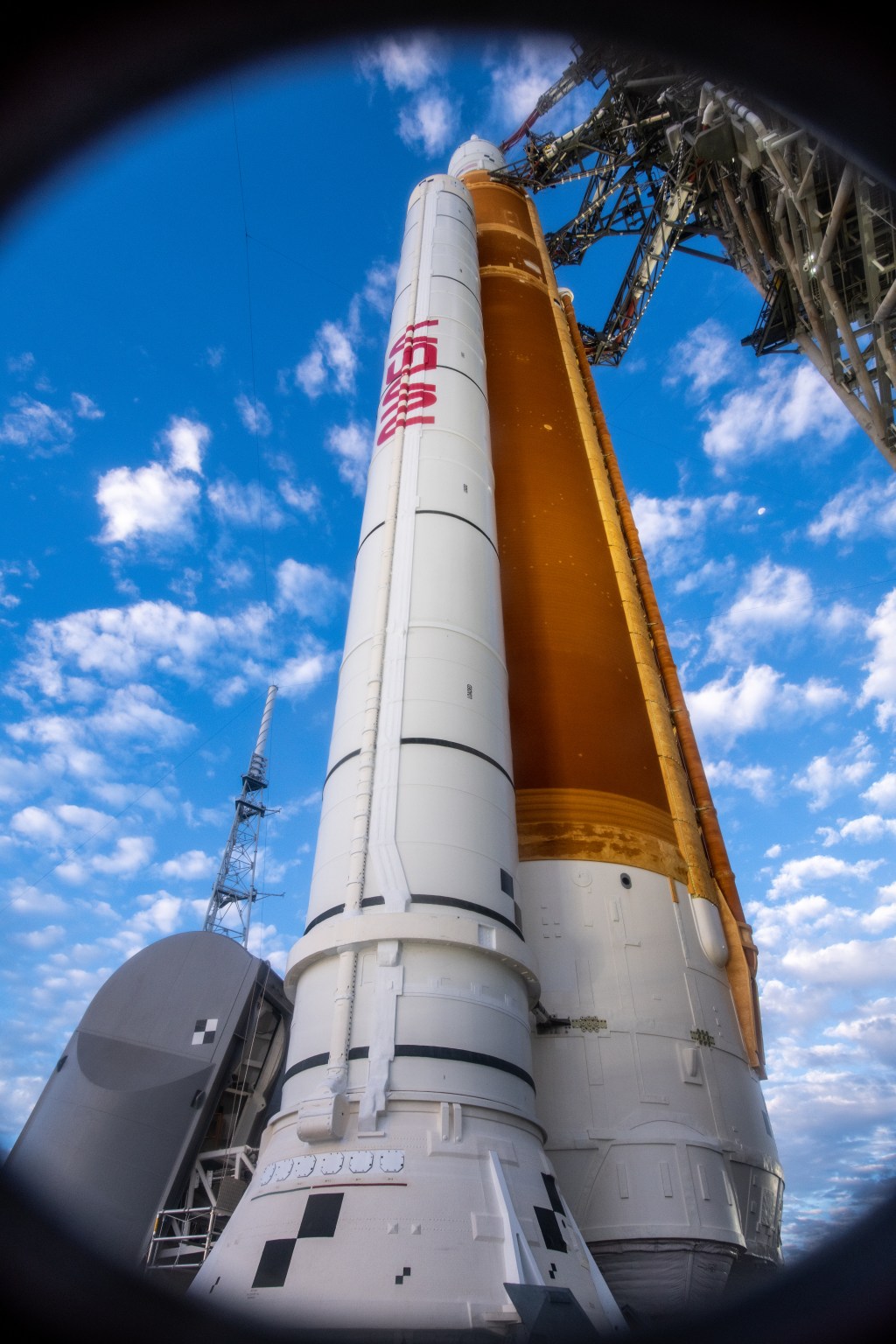
NASA and the Department of Defense (DoD) teamed up June 11 and 12 to simulate emergency procedures they would use to rescue the Artemis II crew in the event of a launch emergency. The simulations, which took place off the coast of Florida and were supported by launch and flight control teams, are preparing NASA to send four astronauts around the Moon and back next year as part of the agency’s first crewed Artemis mission.

The team rehearsed procedures they would use to rescue the crew during an abort of NASA’s Orion spacecraft while the SLS (Space Launch System) rocket is still on the launch pad, as well as during ascent to space. A set of test mannequins and a representative version of Orion called the Crew Module Test Article, were used during the tests.

The launch team at NASA’s Kennedy Space Center in Florida, flight controllers in mission control at the agency’s Johnson Space Center in Houston, as well as the mission management team, all worked together, exercising their integrated procedures for these emergency scenarios.

Teams with NASA and the Department of Defense (DoD) rehearse recovery procedures for a launch pad abort scenario off the coast of Florida near the agency’s Kennedy Space Center on Wednesday, June 11, 2025.
NASA/Isaac Watson

“Part of preparing to send humans to the Moon is ensuring our teams are ready for any scenario on launch day,” said Lakiesha Hawkins, NASA’s assistant deputy associate administrator for the Moon to Mars Program, and who also is chair of the mission management team for Artemis II. “We’re getting closer to our bold mission to send four astronauts around the Moon, and our integrated testing helps ensure we’re ready to bring them home in any scenario.”

The launch pad abort scenario was up first. The teams conducted a normal launch countdown before declaring an abort before the rocket was scheduled to launch. During a real pad emergency, Orion’s launch abort system would propel Orion and its crew a safe distance away and orient it for splashdown before the capsule’s parachutes would then deploy ahead of a safe splashdown off the coast of Florida.

Teams with NASA and the Department of Defense (DoD) rehearse recovery procedures for a launch pad abort scenario off the coast of Florida near the agency’s Kennedy Space Center on Wednesday, June 11, 2025.
NASA/Isaac Watson

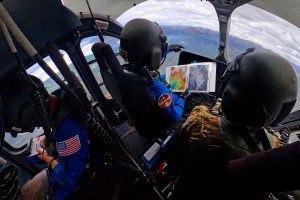
For the simulated splashdown, the test Orion with mannequins aboard was placed in the water five miles east of Kennedy. Once the launch team made the simulated pad abort call, two Navy helicopters carrying U.S. Air Force pararescuers departed nearby Patrick Space Force Base. The rescuers jumped into the water with unique DoD and NASA rescue equipment to safely approach the spacecraft, retrieve the mannequin crew, and transport them for medical care in the helicopters, just as they would do in the event of an actual pad abort during the Artemis II mission.

The next day focused on an abort scenario during ascent to space.

The Artemis recovery team set up another simulation at sea 12 miles east of Kennedy, using the Orion crew module test article and mannequins. With launch and flight control teams supporting, as was the Artemis II crew inside a simulator at Johnson, the rescue team sprung into action after receiving the simulated ascent abort call and began rescue procedures using a C-17 aircraft and U.S. Air Force pararescuers. Upon reaching the capsule, the rescuers jumped from the C-17 with DoD and NASA unique rescue gear. In an actual ascent abort, Orion would separate from the rocket in milliseconds to safely get away prior to deploying parachutes and splashing down.

Teams with NASA and the Department of Defense (DoD) rehearse recovery procedures for an ascent abort scenario off the coast of Florida near the agency’s Kennedy Space Center on Thursday, June 12, 2025.
NASA/Isaac Watson

Rescue procedures are similar to those used in the Underway Recovery Test conducted off the California coast in March. This demonstration ended with opening the hatch and extracting the mannequins from the capsule, so teams stopped without completing the helicopter transportation that would be used during a real rescue.

Exercising procedures for extreme scenarios is part of NASA’s work to execute its mission and keep the crew safe. Through the Artemis campaign, NASA will send astronauts to explore the Moon for scientific discovery, economic benefits, and to build the foundation for the first crewed missions to Mars – for the benefit of all. 

Powered by WPeMatico

Get The Details…
Jason Costa

“Cosmic Dawn” Screening at Greenbelt Cinema

“Cosmic Dawn” Screening at Greenbelt Cinema

10 people stand in a line at a movie theater. About half of the people are standing under the movie marquee, which reads "NASA presents Cosmic Dawn The Webb Space Telescope Story" in red capital letters.
Attendees line up to enter the theater for a screening of the new NASA+ documentary “Cosmic Dawn: The Untold Story of the James Webb Space Telescope,” Wednesday, June 11, 2025, at the Greenbelt Cinema in Greenbelt, Maryland. Featuring never-before-seen footage, Cosmic Dawn offers an unprecedented glimpse into the assembly, testing, and launch of NASA’s James Webb Space Telescope.
NASA/Joel Kowsky

Attendees line up to enter the theater for a screening of the new NASA+ documentary “Cosmic Dawn: The Untold Story of the James Webb Space Telescope,” Wednesday, June 11, 2025, at the Greenbelt Cinema in Greenbelt, Maryland. Following the screening, Jacob Pinter, host of NASA’s Curious Universe podcast, led a discussion with Sophia Roberts, a NASA video producer who documented the Webb project, and Paul Geithner, former deputy project manager for Webb.

Featuring never-before-seen footage, Cosmic Dawn offers an unprecedented glimpse into the assembly, testing, and launch of NASA’s James Webb Space Telescope.

Watch the documentary.

Image credit: NASA/Joel Kowsky

Powered by WPeMatico

Get The Details…
Monika Luabeya

Hubble Studies a Spiral’s Supernova Scene

Hubble Studies a Spiral’s Supernova Scene

2 min read

Hubble Studies a Spiral’s Supernova Scene

A spiral galaxy with a soft and slightly faint appearance. It glows most brightly around the pale-yellow bar across its center. It has two spiral arms which wrap around its core, quickly broadening out to join a wide, faint circular halo around the galaxy. Glowing, sparkling patches in the disk show stars forming in nebulae. Behind the galaxy, distant galaxies appear as orange dots on a black background.
This NASA/ESA Hubble Space Telescope image features the barred spiral galaxy IC 758.
ESA/Hubble & NASA, C. Kilpatrick

This serene spiral galaxy hides a cataclysmic past. The galaxy IC 758, shown in this NASA/ESA Hubble Space Telescope image, is situated 60 million light-years away in the constellation Ursa Major.

Hubble captured this image in 2023. IC 758 appears peaceful, with its soft blue spiral arms curving gently around its hazy barred center. However, in 1999, astronomers spotted a powerful explosion in this galaxy. The supernova SN 1999bg marked the dramatic end of a star far more massive than the Sun.

Researchers do not know exactly how massive this star was before it exploded, but will use these Hubble observations to measure the masses of stars in SN 1999bg’s neighborhood. These measurements will help them estimate the mass of the star that went supernova. The Hubble data may also reveal whether SN 1999bg’s progenitor star had a companion, which would provide additional clues about the star’s life and death.

A supernova represents more than just the demise of a single star — it’s also a powerful force that can shape its neighborhood. When a massive star collapses, triggering a supernova, its outer layers rebound off its shrunken core. The explosion stirs the interstellar soup of gas and dust out of which new stars form. This interstellar shakeup can scatter and heat nearby gas clouds, preventing new stars from forming, or it can compress them, creating a burst of new star formation. The cast-off layers enrich the interstellar medium, from which new stars form, with heavy elements manufactured in the core of the supernova.

Text Credit: ESA/Hubble

Media Contact:

Claire Andreoli (claire.andreoli@nasa.gov)
NASA’s Goddard Space Flight CenterGreenbelt, MD

Powered by WPeMatico

Get The Details…

NuSTAR Art + Coloring Pages

NuSTAR Art + Coloring Pages

NuSTAR Mission
Art inspired by the NuSTAR Mission.
A coloring page for NASA's NuSTAR mission.
A coloring page for NASA’s NuSTAR mission.
NuSTAR - The Sun
Art inspired by the NuSTAR Mission.
A coloring page for NASA's NuSTAR mission.
A coloring page for NASA’s NuSTAR mission.
NuSTAR - Supernova Remnants
Art inspired by the NuSTAR Mission.
A coloring page for NASA's NuSTAR mission.
A coloring page for NASA’s NuSTAR mission.
NuSTAR - X-ray Binaries
A coloring page for NASA's NuSTAR mission.
A coloring page for NASA’s NuSTAR mission.
NuSTAR - Spiral Galaxies
Art inspired by the NuSTAR Mission.
A coloring page for NASA's NuSTAR mission.
A coloring page for NASA’s NuSTAR mission.
NuSTAR - Active Galaxies
A coloring page for NASA's NuSTAR mission.
A coloring page for NASA’s NuSTAR mission.

Powered by WPeMatico

Get The Details…