NASA’s Aerospace Safety Advisory Panel Releases 2025 Annual Report 

NASA’s Aerospace Safety Advisory Panel Releases 2025 Annual Report 
Credit: NASA

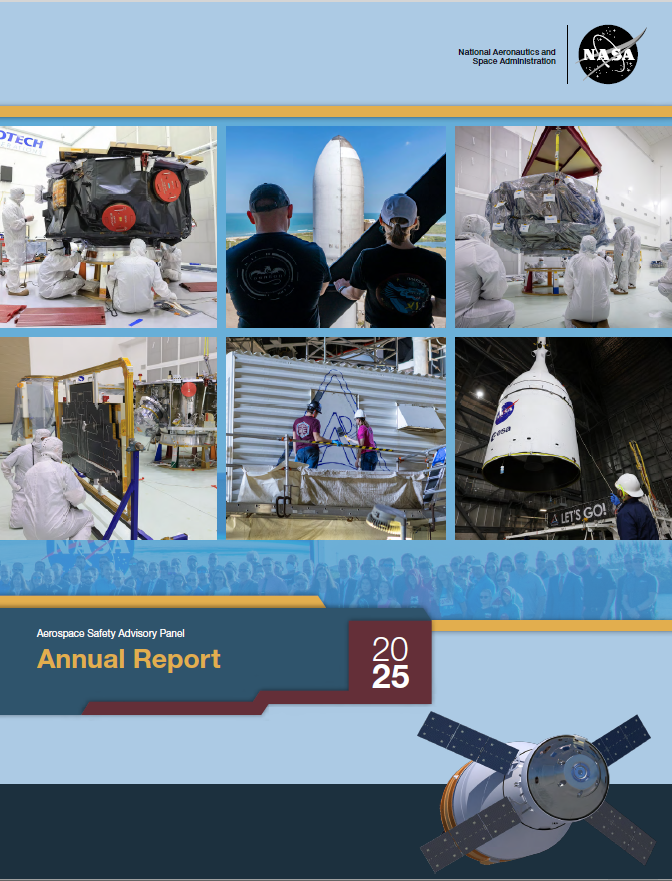
The Aerospace Safety Advisory Panel (ASAP), which advises NASA and Congress on safety, has released its 2025 annual report on NASA’s performance and challenges.  

While the panel acknowledged NASA’s safety achievements, it warned that the agency’s biggest challenges stem from interconnected factors – workforce, acquisition, technical authority, budgets, and the growing complexity of human spaceflight – requiring sustained attention as missions become more ambitious.

“Independent assessments like this will make NASA better,” said NASA Administrator Jared Isaacman. “The panel’s report underscores areas where we must raise the bar, from how we structure oversight and manage integrated risk to how we declare and learn from anomalies. We are wholly committed to transparency. That’s how we protect crews, earn trust, and keep the Artemis lunar campaign and our transition to a commercial presence in low Earth orbit on a safe, sustainable path.” 

This year’s report focused on the following topics: 

  • strategic vision and governance 
  • Moon to Mars program 
  • future U.S. presence in low Earth orbit 
  • health and medical risks in human spaceflight 
  • NASA’s X-59 Low-Boom Flight Demonstrator 

The panel noted progress on Artemis II readiness and improved oversight through the Moon to Mars Program Office, as well as safe International Space Station operations, advances in astronaut health research, and the first flight of the X-59 Low-Boom Demonstrator. At the same time, it flagged significant challenges, including Artemis III’s high-risk posture, lessons from Boeing’s Starliner test, space station deorbit planning, and systemic concerns. 

To respond to these new challenges, the panel recommends NASA: 

  • Realign its governance of acquisition strategies for human spaceflight-related capabilities agencywide. 
  • Re-examine the mission objectives and system architecture for Artemis III and subsequent missions to establish a more balanced approach to risk.  
  • Require timely declaration of mishap or high-visibility close call. 

“We were already on the path to implementing change and this report only adds more urgency,” added Isaacman. “That means recalibrating our acquisition strategy — including a build versus buy versus service procurement approach — restoring core competencies through initiatives like converting contractors to civil servant roles and increasing our launch cadence. We’re also aligning our long-term vision for the agency and industry to guide priorities. This includes clarifying our plans for the Artemis architecture moving forward and accelerating proposals for human landing systems to preserve schedule margin. We’ve already shown what transparency and now accountability looks like — through the Boeing Starliner Program Investigation Team report, we owned our mistakes, classified the mission as a Type A mishap, and launched corrective actions to ensure they never happen again. These steps, along with addressing health and medical risk documentation and overhauling and accelerating programs like X-59, reflect our commitment to live up to the expectations of the world’s most accomplished space agency.”  

On Feb. 19, Isaacman held a news conference to present the agency’s findings from the Starliner Crewed Flight Test. Earlier this month, he outlined a new workforce plan to strengthen NASA’s core competencies in technical, engineering, and operational excellence. The agency also is working with both its human landing system industry providers to streamline and accelerate America’s return to the surface of the Moon by 2028. 

“The panel commends NASA for its impressive efforts in 2025 to strategically enhance the agency’s risk management posture despite turbulence in the agency’s organizational environment,” said retired U.S. Air Force Lt. Gen. Susan J. Helms, chair of ASAP. “We very sincerely thank NASA’s leaders and workforce for their passionate dedication to space exploration and their unwavering commitment to the safe pursuit of the nation’s lofty aims to the great benefit of the future of humanity.”  

The annual report is based on the panel’s 2025 fact-finding and quarterly public meetings; direct observations of NASA operations and decision-making; discussions with NASA management, employees, and contractors; and the panel members’ experiences.  

Congress established the panel in 1968 to provide advice and make recommendations to the NASA administrator on safety matters after the 1967 Apollo 1 fire claimed the lives of three American astronauts. 

To learn more about the ASAP, and view annual reports, visit: 

https://www.nasa.gov/asap

-end-

Bethany Stevens / Elizabeth Shaw
Headquarters, Washington
202-358-1600
bethany.c.stevens@nasa.gov / elizabeth.a.shaw@nasa.gov

Share

Details

Last Updated

Feb 25, 2026

Editor
Jessica Taveau

Powered by WPeMatico

Get The Details…
Jessica Taveau

Making an Entrance

Making an Entrance

A man with dark hair and a mustache looks up at the camera, smiling. His hands are on the bottom edge of the hatch entrance as he makes his way inside the space station. The path he is coming through has many square cargo bags strapped to each side.
NASA astronaut and SpaceX Crew-12 Pilot Jack Hathaway enters the International Space Station after docking aboard the Dragon spacecraft to join Expedition 74 and begin a long-duration microgravity research mission.
NASA/Chris Williams

NASA astronaut Jack Hathaway smiles up at the camera as he enters the International Space Station Feb. 14, 2026, after docking to the orbiting laboratory aboard a SpaceX Dragon spacecraft.

Since Hathaway and fellow Crew-12 members Jessica Meir of NASA, Sophie Adenot of ESA (European Space Agency), and Andrey Fedyaev of Roscosmos began their mission on the space station, they have conducted science investigations including scanning their veins to monitor the risk of blood clots and testing balance and orientation in space using virtual reality goggles. The crew will continue to run various experiments and technology demonstrations to benefit life on Earth and in orbit, furthering our journey back to the Moon, to Mars, and beyond.

Keep up with space station activities by visiting the blog.

Image credit: NASA/Chris Williams

Powered by WPeMatico

Get The Details…
Monika Luabeya

Listen to This Month’s ‘Planetary Parade’ With NASA’s Chandra

Listen to This Month’s ‘Planetary Parade’ With NASA’s Chandra

6 Min Read

Listen to This Month’s ‘Planetary Parade’ With NASA’s Chandra

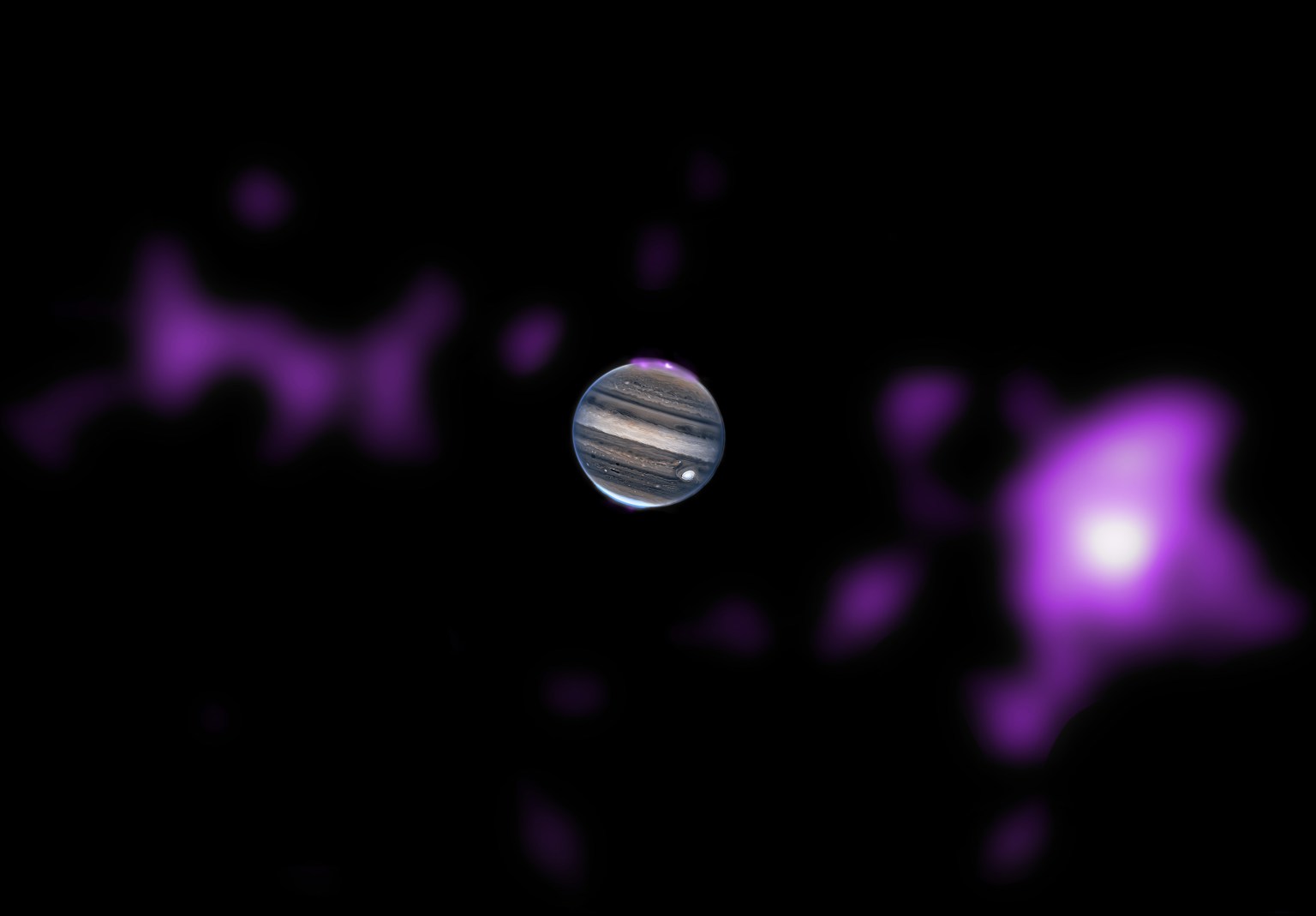
Three new Chandra sonifications of data of Jupiter, Saturn, and Uranus have been released. Planets and other Solar System bodies can reflect X-rays given off by the Sun, which Chandra can detect. Sonification is a process that translates data captured by Chandra and other telescopes into sound. In addition to X-rays from Chandra, these new sonifications contain data from Hubble, Cassini, and Keck telescopes. In this image, the amount of diffuse X-rays from a donut-shaped ring of energetic particles around Jupiter, seen on the left and right side of the planet, has been enhanced compared to the amount of X-rays from the planet's auroras, seen at the poles. As the scan moves left to right, it encounters X-rays that bracket the planet on either side, and this plays as woodwind sounds. As we pass over the planet itself, seen in an infrared image from NASA’s Hubble Space Telescope, the sounds become fuller as the infrared data is represented by other instruments. Since Jupiter is tilted slightly, the pitch descends as the scan passes over the bright band near the equator and through the Great Red Spot. On the other side, more X-ray data from Chandra flanks the planet and can be heard as gusty wind sounds at the end.

In late February, people in the Northern Hemisphere can look up for a special sight : Six planets will all be visible from clear and dark night skies. New sonifications from NASA’s Chandra X-ray Observatory released [day of week] will help commemorate this latest “planetary parade.”

Because the planets in our solar system travel around the Sun in the same plane (known as the ecliptic), they will sometimes appear bunched together in the sky when their orbits find them on the same side of the Sun at the same time. When this happens, it looks like the planets have roughly formed a line from our vantage point on Earth.

In Chandra’s sonifications, which translate astronomical data into sound, three of the planets that will be on display – Jupiter, Saturn, and Uranus – can be seen and heard in ways that they cannot from Earth.

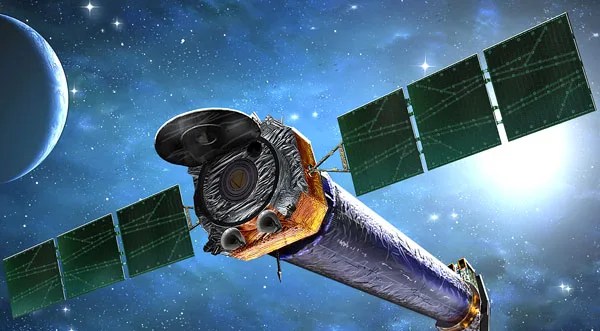
While Chandra is best known for its X-ray insight into black holes and other extreme objects, the telescope has also played an important role in the exploration of our solar system. The Sun gives off X-rays that travel out into the solar system and can be reflected by planets, moons, and other bodies. This gives astronomers a unique window into certain physics that cannot be discovered through other kinds of telescopes.

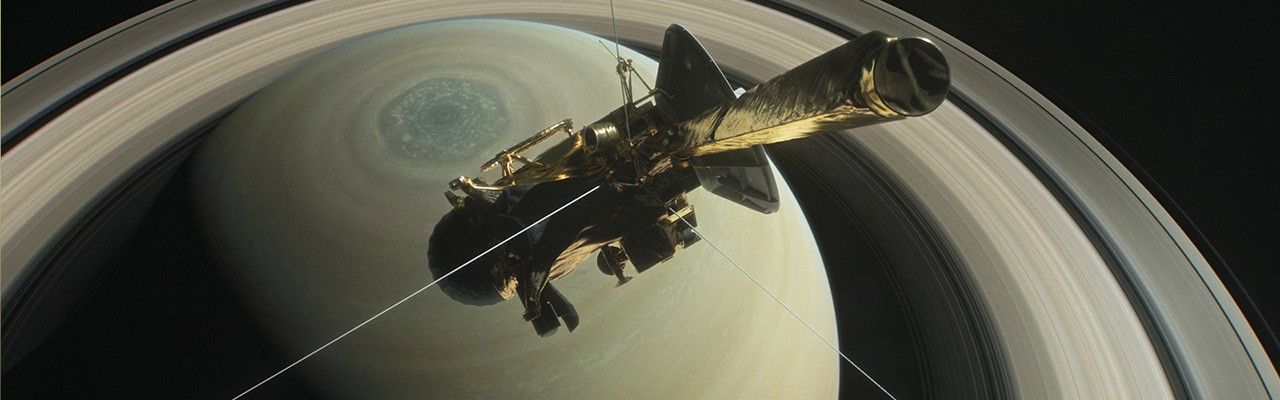
The sonification of Jupiter combines X-ray data from Chandra with an infrared image from NASA’s Hubble Space Telescope. Woodwind sounds reveal Chandra’s X-ray data, including emission from the planet’s auroras. More instruments join in to represent the planet’s complex cloud layers. Next, through the combination of an optical image from NASA’s Cassini mission and X-rays from Chandra, listeners can experience Saturn like never before. A siren-like sound follows the arc of the rings, and different tones of synthesizers play as the scan passes the planet itself. Finally, listeners can hear the ice giant Uranus through the data collected by Chandra and the W.M. Keck Observatory. The data in this sonification reflects the amount of light detected from the planet and the orientation of its ring.

The process of creating a sonification preserves the integrity of the data, which arrives on Earth as a series of ones and zeroes (binary code), and shifts it into a form that can be processed through hearing. Sonifications expand options for people to explore what telescopes discover in space, an example of NASA’s ongoing commitment to share its data as widely as possible.

Jupiter

In this image, the amount of diffuse X-rays from a donut-shaped ring of energetic particles around Jupiter, seen on the left and right side of the planet, has been enhanced compared to the amount of X-rays from the planet’s auroras, seen at the poles. As the scan moves left to right, it encounters X-rays that bracket the planet on either side, and this plays as woodwind sounds. As we pass over the planet itself, seen in an infrared image from NASA’s Hubble Space Telescope, the sounds become fuller as the infrared data is represented by other instruments. Since Jupiter is tilted slightly, the pitch descends as the scan passes over the bright band near the equator and through the Great Red Spot. On the other side, more X-ray data from Chandra flanks the planet and can be heard as gusty wind sounds at the end.
NASA/CXC/SAO/K.Arcand, SYSTEM Sounds (M. Russo, A. Santaguida)

Saturn

The scan of Saturn begins on the right and moves to the left. As it encounters Saturn’s famous rings, seen in an optical image from the Cassini mission, listeners hear a siren effect whose frequency follows the arc of the rings. Once the scan reaches the planet itself, the sounds change, to lower tones with a dark synthetic bass sound. This distinguishes the rings from the planet. Chandra’s X-rays are heard as higher synthetic tones that mark where high-energy activity is found across the planet, rings, and poles.
NASA/CXC/SAO/K.Arcand, SYSTEM Sounds (M. Russo, A. Santaguida)

Uranus

Returning to the left to right scan, the sounds begin with a cello that traces the arcing ring – not as famous as Saturn’s but still prominent – around the ice giant Uranus. The notes change to represent the amount of reflected light and its location on Uranus as seen in an optical light image from the W.M. Keck Observatory. The X-rays detected by Chandra, which come from X-rays from the Sun that are reflected, are heard as higher frequencies as the scan passes over the pinkish region of the planet. The apparent asymmetry in the X-rays may not be a real effect because of the faint signal and the smoothing that was applied to the image.
NASA/CXC/SAO/K.Arcand, SYSTEM Sounds (M. Russo, A. Santaguida)

NASA’s Marshall Space Flight Center in Huntsville, Alabama, manages the Chandra program. The Smithsonian Astrophysical Observatory’s Chandra X-ray Center controls science operations from Cambridge, Massachusetts, and flight operations from Burlington, Massachusetts.

For more on the Chandra sonification program, visit:

https://chandra.si.edu/sound

To learn more about Chandra, visit:

https://science.nasa.gov/chandra

Read more from NASA’s Chandra X-ray Observatory

Learn more about the Chandra X-ray Observatory and its mission here:

https://www.nasa.gov/chandra

https://chandra.si.edu

Visual Description

This release features three sonifications, each focusing on a different planet in our solar system. The sonifications are presented as soundtracks to short videos. Each video features a composite image and an activation line. As the activation line sweeps across the image, it encounters visual elements. These elements are translated into sound, or sonified, according to parameters established by Chandra’s sonification team.

The first sonification focuses on the planet Jupiter. At the center of the associated composite image is the gas giant itself; a seemingly perfect sphere with an atmosphere of latitudinal bands. The bands are different shades of grey, brown, and black, each with its own texture and width. Flanking Jupiter are neon pink and white clouds, representing X-rays from energetic particles in a ring around the planet. In the video, the activation line moves from our left to right. It first encounters a pink cloud, triggering whooshing woodwinds. When the activation line encounters Jupiter, dramatic low notes are triggered. Listen for the dip as the line passes over the Great Red Spot in Jupiter’s southern hemisphere. The activation line continues toward our right, passing more pink X-ray clouds. The largest cloud, the last one encountered, has a bright white core, which translates to loud gusty woodwinds.

The second sonification focuses on the ringed planet, Saturn. In the composite image, the large gas giant fills the frame, its spherical outer layer a pale sandy grey. In this image, the wide bands of rings surrounding the planet are in shades of pale grey and sandy yellow. Here, Saturn is tilted away from us, making the round rings appear oval in shape. Dotting the planet are small pockets of neon blue. These represent reflected X-ray light observed by Chandra. In this video, the activation line moves from our right to left. When the line passes over the rings, a whooshing sounds spreads, conveying the widening middle of the oval shapes. Pockets of neon blue X-ray light trigger synthesizer sounds, with the pitch mapped to each pocket’s vertical position in the image. When the line sweeps across Saturn’s large round body, a low rumbling synth tone is triggered. The volume is linked to brightness, such that the low tone fades when the line reaches the shady side of the planet, on our left.

The third sonification features the planet Uranus. In the composite image, the icy giant is a greenish-blue cyan color, with a blush of neon pink X-rays hovering over its core. Uranus has a collection of very narrow rings, much finer than the wide disk-like rings surrounding Saturn. In this image, the fine rings are near vertical and slightly tilted, creating an oval shape with rounded points at our lower left and upper right. In this sonification, the activation line moves from our left to right. Brightness is mapped to volume and height is mapped to pitch, such that brighter objects at the top of the image sound louder and higher. Here, the curved oval shape of the rings is conveyed as a swooping cello note, with the pitch sliding up as the activation line passes the oval tilted toward our upper right.

News Media Contact

Megan Watzke
Chandra X-ray Center
Cambridge, Mass.
617-496-7998
mwatzke@cfa.harvard.edu

Joel Wallace
Marshall Space Flight Center, Huntsville, Alabama
256-544-0034
joel.w.wallace@nasa.gov

Powered by WPeMatico

Get The Details…
Lee Mohon

NASA Study to Analyze Fermented Food Samples from Space

NASA Study to Analyze Fermented Food Samples from Space

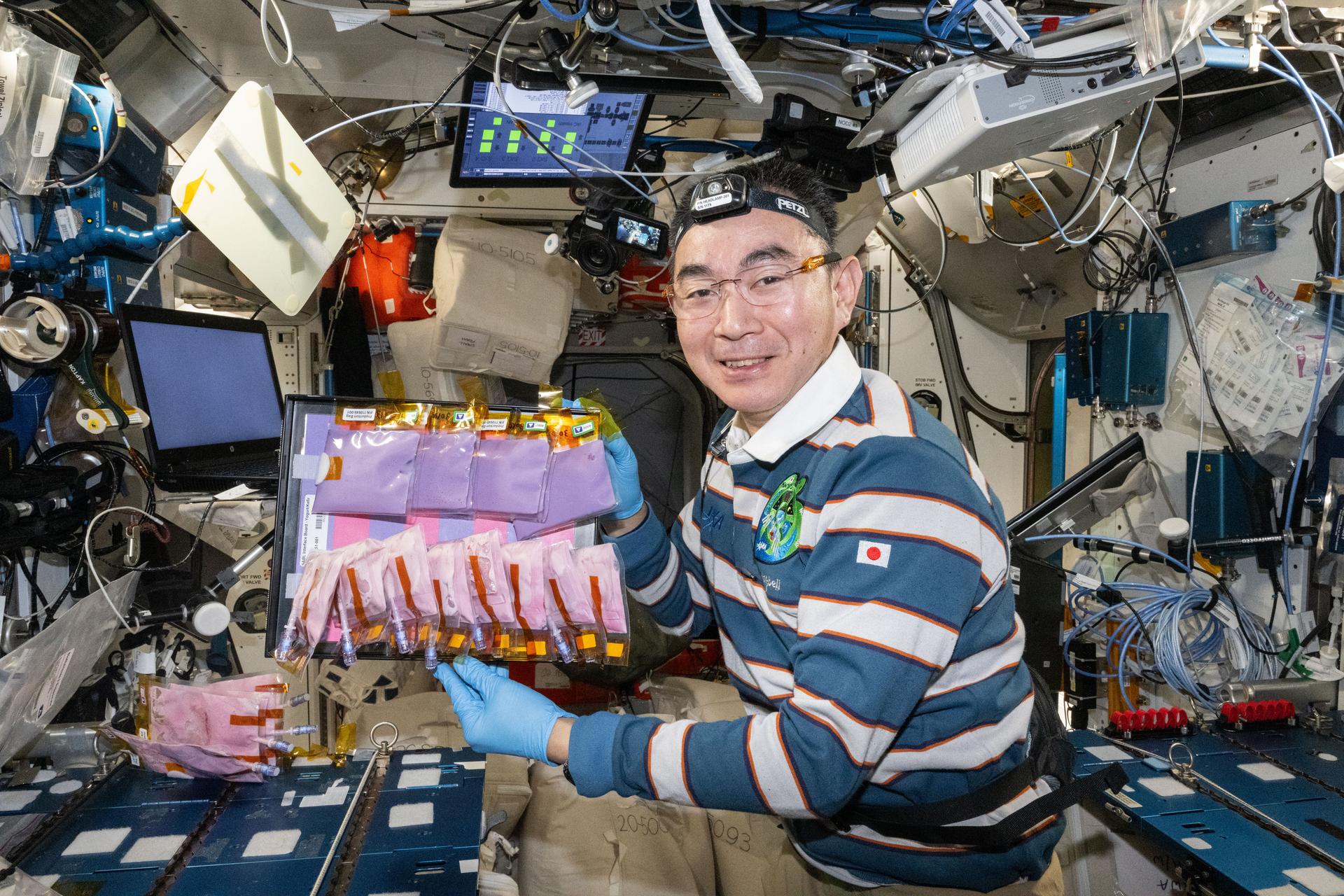
JAXA (Japan Aerospace Exploration Agency) astronaut and Expedition 73 Flight Engineer Kimiya Yui shows off production bags containing bioengineered yeasts and probiotic cultures for the BioNutrients-3 investigation. Yui conducted passaging and straw tests to demonstrate how astronauts could grow and safely consume fresh vitamins and nutrients on demand helping researchers plan future missions farther from Earth.
Astronaut and Expedition 73 Flight Engineer Kimiya Yui of JAXA (Japan Aerospace Exploration Agency) displays production bags containing probiotic yogurt cultures for the BioNutrients-3 investigation on Oct. 2, 2025, aboard the International Space Station.
NASA

Certain nutrients critical for human health lack the shelf life needed to span multi-year missions to the Moon, Mars, and beyond. NASA’s BioNutrients-3 is part of an experiment series testing ways to use microorganisms to produce these nutrients in space and on demand.

The on-demand nature of this experiment is similar to making nutrient-dense fermented foods on Earth, such as how milk is transformed by good bacteria into yogurt. But in this case, there is a focus on producing specific types and quantities of nutrients essential for future space explorers.

Samples from BioNutrients-3, along with other valuable experiments, are set to return from the International Space Station aboard a SpaceX Dragon spacecraft supporting the company’s 33rd commercial resupply mission for NASA. The spacecraft is set to depart the space station on Thursday, Feb. 26 for its return to Earth. Watch NASA’s live coverage of the undocking and departure starting at 11:45 a.m. EST on NASA+Amazon Prime, and the agency’s YouTube channel.

Once the samples return to Earth, the science team at NASA’s Ames Research Center in California’s Silicon Valley will perform analysis procedures. Results from this study can help NASA develop methods to produce vital nutrients that could support human deep space exploration as part of NASA’s Artemis campaign.

NASA’s BioNutrients-3 is part of the Synthetic Biology project, which is funded by the Game Changing Development program within NASA’s Space Technology Mission Directorate.

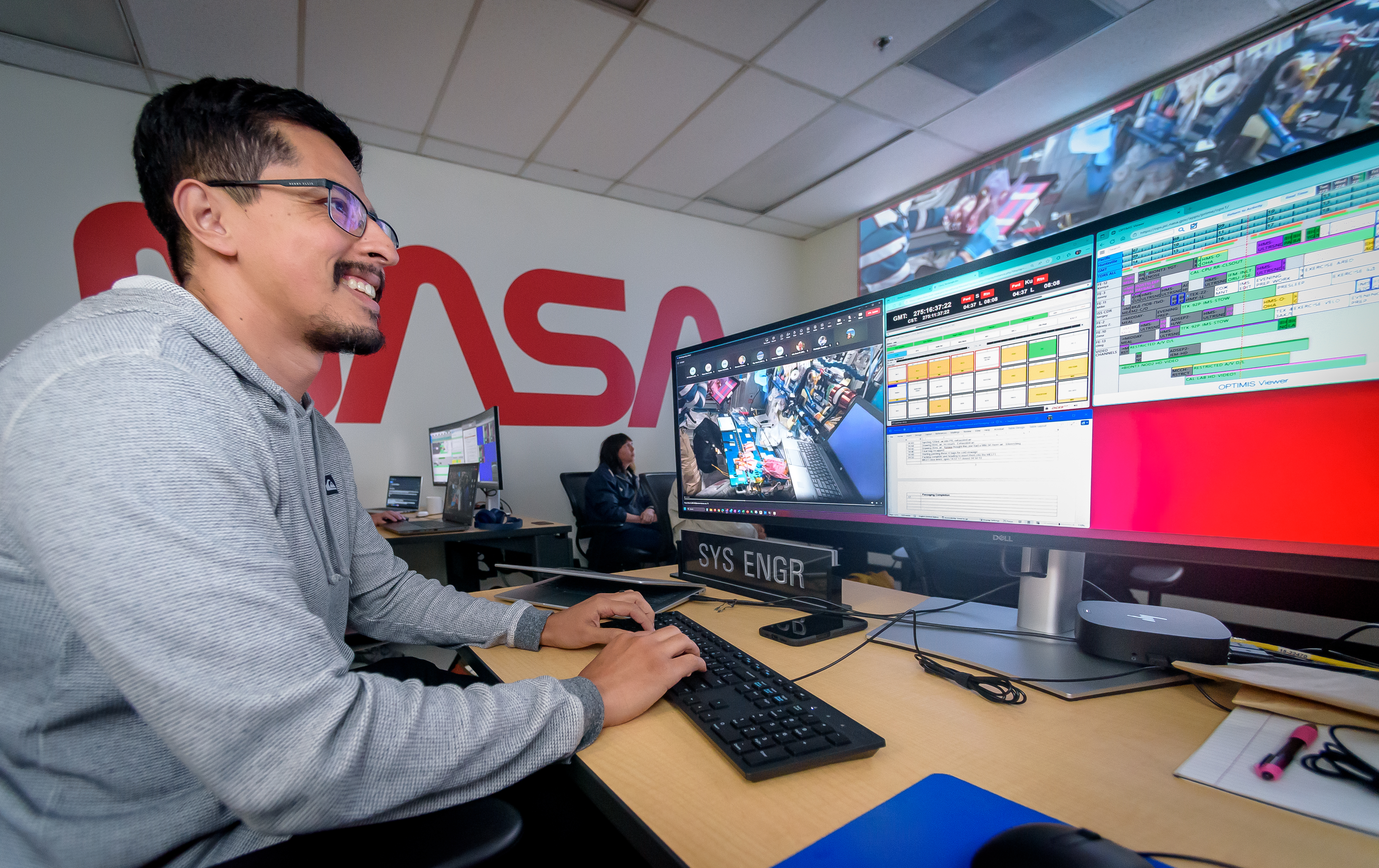
A person typing on a keyboard and looking at a monitor that shows data and an view of a lab area aboard the International Space Station.
Oscar Roque, engineer for NASA’s BioNutrients-3 project, works at a console on Oct. 2, 2025, at the Multi-Mission Operations Center at NASA’s Ames Research Center in California’s Silicon Valley. The facility allowed the BioNutrients team to remotely observe experiments conducted by crew members aboard the International Space Station and communicate with astronauts in real-time.
NASA/Donald Richey

Powered by WPeMatico

Get The Details…
Gianine Figliozzi

Human Research, Advanced Tech Keep Crew Busy Before Dragon Departs

Human Research, Advanced Tech Keep Crew Busy Before Dragon Departs

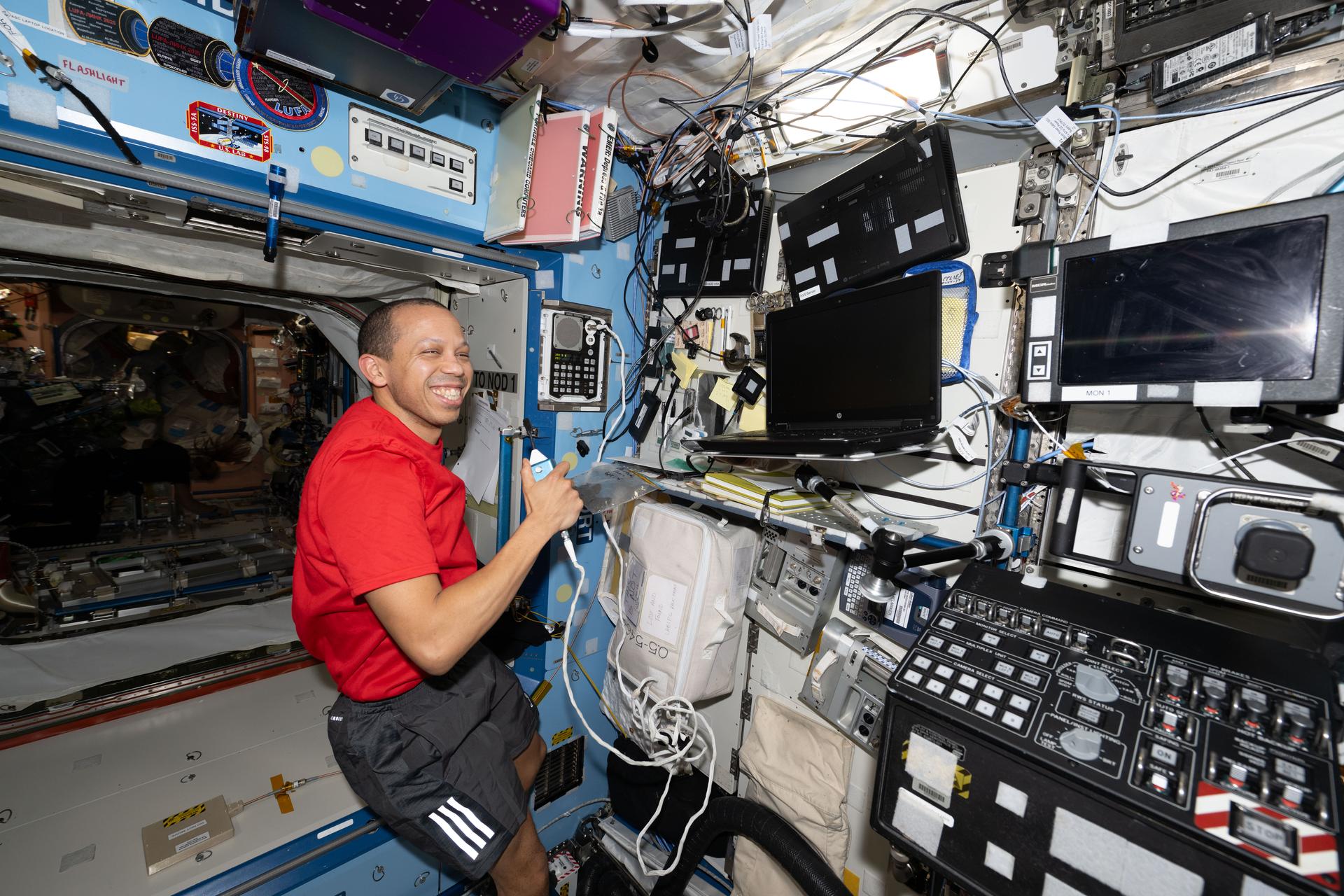
NASA astronaut and Expedition 74 Flight Engineer Chris Williams calls down to mission controllers during Crew Medical Officer training inside the International Space Station’s Destiny laboratory module. Williams trained to use medical hardware, including an automated external defibrillator, and reviewed procedures such as conducting eye exams and administering medicine.
NASA astronaut Chris Williams calls down to mission controllers during Crew Medical Officer training inside the International Space Station’s Destiny laboratory module.
NASA/Jessica Meir

Human research, advanced robotics, and experimental workout gear filled the schedule for the Expedition 74 crew aboard the International Space Station on Wednesday. The orbital residents also continued packing a SpaceX Dragon with science experiments and space hardware for its departure on Thursday.

Flight Engineers Jessica Meir of NASA and Sophie Adenot of ESA (European Space Agency) kicked off their shift together answering a questionnaire about their sleep quality and collecting their saliva samples for analysis. Researchers will use the biomedical data to understand the stress and behavioral risks during a spaceflight, devise meditation and relaxation techniques for crews, and improve the experience of a long-term mission.

Meir then collected and processed her blood samples with assistance from NASA Flight Engineer Jack Hathaway for the Venous Flow study that examines the risk of space-caused blood clots. Next, Meir inspected and cleaned the Enhanced European Exploration Exercise Device, an advanced, compact all-in-one workout device being tested for use on deep space missions. Adenot partnered with Hathaway at the end of their shift loading hardware packed with research samples into a SpaceX Dragon scheduled to undock from the orbital outpost’s Harmony module at 12:05 p.m. EST on Thursday.

NASA Flight Engineer Chris Williams started his shift inside the Kibo laboratory module installing and configuring a pair of small robotic arms. The advanced robotic technology is demonstrating precision mobility and experiment automation in microgravity to reduce astronaut workloads. Williams then joined Meir in the Tranquility module and replaced components on the advanced resistive exercise device that mimics free weights on Earth.

Station Commander Sergey Kud-Sverchkov, attached to electrodes, pedaled on an exercise cycle for a cardiovascular assessment while Flight Engineer Sergei Mikaev monitored and assisted. The Roscosmos cosmonauts then split up their day with semiconductor research, an artificial intelligence investigation, and photographic inspections of windows on the Zvezda service module.

Roscosmos Flight Engineer Andrey Fedyaev closed out an automated photography session that imaged Earth landmarks in a variety of wavelengths during the crew’s sleep shift. The two-time station visitor then spent the rest of his day servicing the Nauka science module’s ventilation system and inventorying hardware located in the Zarya module.

Learn more about station activities by following the space station blog, @space_station on X, as well as the ISS Facebook and ISS Instagram accounts.

Get the latest from NASA delivered every week. Subscribe here.

Powered by WPeMatico

Get The Details…

Mark A. Garcia