Studying Storms from Space Station

Studying Storms from Space Station

3 Min Read

Studying Storms from Space Station

A view of Earth’s atmosphere from space, showing a bright blue lightning-like phenomenon striking upwards from a storm system. The International Space Station is visible in the top left, hovering above the Earth’s curvature.

An artist’s impression of a blue jet as observed from the space station.

Credits:
Mount Visual/University of Bergen/DTU

Science in Space June 2025

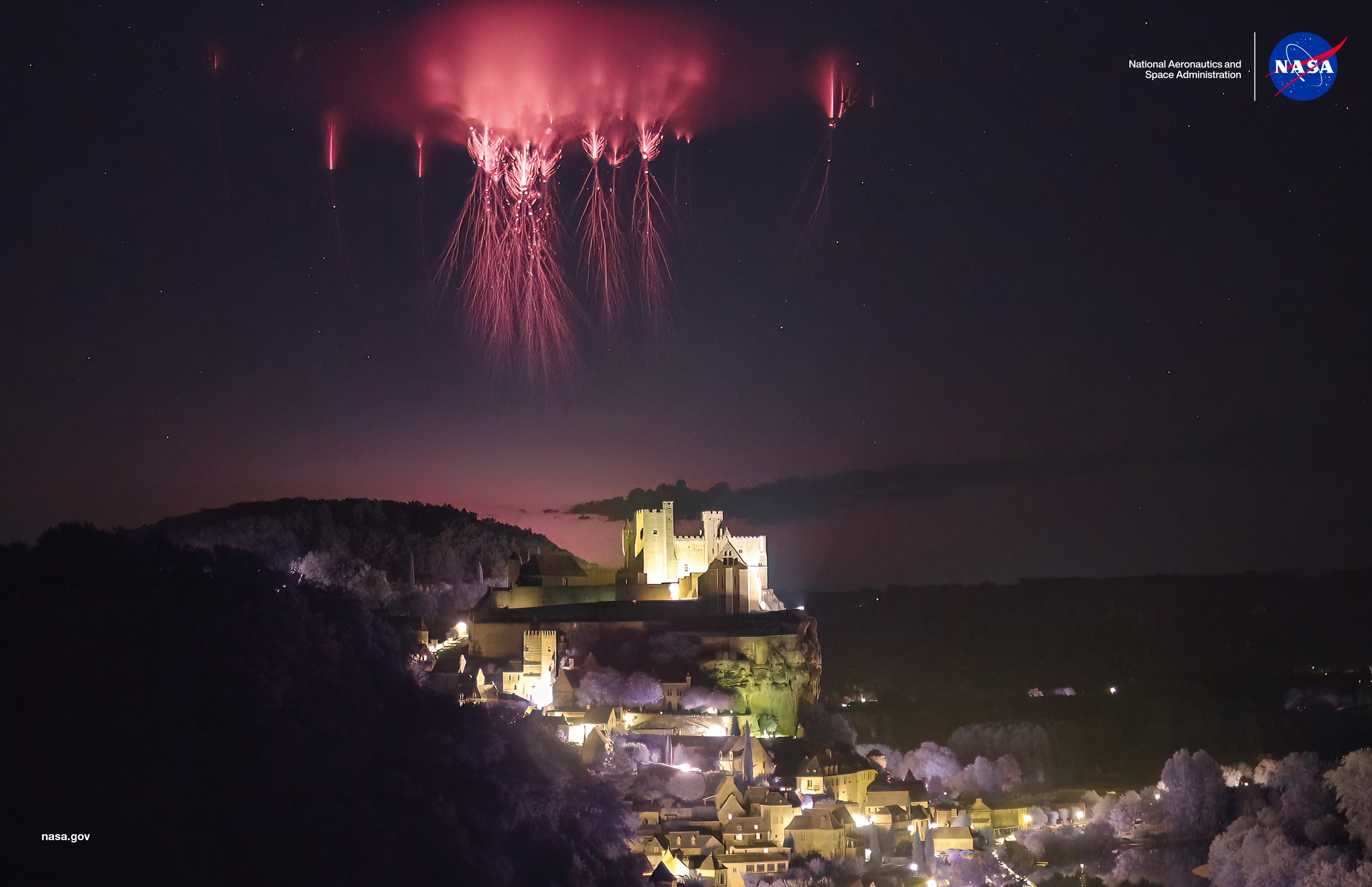
Scientists use instruments on the International Space Station to study phenomena in Earth’s ionosphere or upper atmosphere including thunderstorms, lightning, and transient luminous events (TLEs). TLEs take many forms, including blue jets, discharges that grow upward into the stratosphere from cloud tops, and colorful bursts of energy above storms called Stratospheric/Mesospheric Perturbations Resulting from Intense Thunderstorm Electrification or SPRITES.

Lightning creates a large, bright white spot in the center of this image, with several sprites, thin red vertical lines, above it. Several other white spots extend to the left and the city lights line the coast on the far left. Earth’s horizon is a faint green band across the top of the image.
Red SPRITES are visible above a line of thunderstorms off the coast of South Africa.
NASA

TLEs can disrupt communication systems on the ground and pose a threat to aircraft and spacecraft. Understanding these phenomena also could improve atmospheric models and weather predictions. Because these events occur well above the altitudes of normal lightning and storm clouds, they are difficult to observe from the ground. ASIM, an investigation from ESA (European Space Agency), uses a monitor on the exterior of the space station to collect data on TLEs. These data are providing insights into how thunderstorms affect Earth’s atmosphere and helping to improve atmospheric models used for weather and climate predictions.

ELVES and coronas

A study based on ASIM data confirmed that lightning-like discharges at the tops of thunderstorms can create another type of TLE, massive glowing rings in the upper atmosphere known as Emissions of Light and VLF Perturbations from EMP events, or ELVES. This experiment showed that these discharges influence the ionosphere and helped scientists learn more about Earth and space weather.

ASIM-based research also described the physical properties of different types of corona discharges in thunderstorm clouds. Corona discharges are linked to powerful but short-lived electrical bursts near the tops of clouds. The data provide a reference to support further investigation into the mechanisms behind these discharges and their role in the initiation of lightning, an important problem in lightning physics.

Other researchers used ASIM measurements along with ground-based electric field measurements to determine the height of a blue discharge from a thundercloud.

Cloud close-ups

Lightning on Earth as captured from the space station.
NASA

Another ESA investigation, Thor-Davis, evaluated use of a special camera to photograph high-altitude thunderstorms through the windows of the space station’s cupola. The camera can observe thunderstorm electrical activity at up to 100,000 frames per second and could be a useful tool for space-based observation of severe electrical storms and other applications.

Seeing storms from satellites

A module of the space station is visible in the upper right of this image, with an arm extending downward toward the middle of it. At the end of the arm is a white square deployer with two boxes on its right side. The door on one of the boxes is open and just below it is a white and black rectangular CubeSat that has just been ejected from the deployer. Long, gold-colored solar panels fill the left side of the image and Earth covers the lower half of the image, blue ocean with scattered white clouds.
Deployment of the Light-1 CubeSat from the space station.
NASA

The JAXA (Japan Aerospace Exploration Agency) investigation Light-1 CubeSat used detectors integrated into a compact satellite to observe terrestrial gamma-ray flashes in the upper atmosphere. These high intensity, energetic events can expose aircraft, aircraft electronics, and passengers to excessive radiation. Researchers are planning to compare data collected from the mission with ground-based observations to provide more comprehensive maps of lightning and thunderstorms in the atmosphere. Small satellite detectors could cost less and be manufactured in less time than other approaches.

Powered by WPeMatico

Get The Details…
Christian M. Getteau

Curiosity Rover Blog — Sols 4566-4567: Drilling Success

Curiosity Rover Blog — Sols 4566-4567: Drilling Success

The image above shows the drill poised on the surface of Mars
This image was taken by Front Hazard Avoidance Camera (Front Hazcam) onboard NASA’s Mars rover Curiosity on Sol 4564
NASA/JPL-Caltech

Written by Michelle Minitti, Planetary Geologist at Framework

Earth planning date: Monday, June 9, 2025

The image above shows the drill poised on the surface of Mars at the start of our attempt to collect sample at “Altadena” over the weekend. Now we know, from subsequent imaging and telemetry, that the drill activity was successful, allowing planning today to focus on delivering sample powder to CheMin and SAM. CheMin and SAM will give us their distinct and valuable insights into the mineralogy (CheMin) and volatiles and organic compounds (SAM) within Altadena, which are key to our continued unravelling the history of Mt. Sharp. It is always exciting to find out what each of these instruments uncovers from Martian samples.

In addition to those sample deliveries, we had three other Altadena-focused activities. We acquired ChemCam RMI of the drill hole which helps ChemCam refine their laser targeting for future LIBS analyses of the drill hole. We planned a ChemCam passive spectroscopy observation of the cuttings around the drill hole for more insight into the mineralogy of the sample. We also included a single Mastcam M100 image of the drill hole which helps us track the wind activity at the drill site and thus the stability of the cuttings ahead of planned observations with APXS and MAHLI.

The weekend activities ran faster and more efficiently than modeled so that we had power to add additional science observations into the plan. We gathered more ChemCam data from the bedrock near Altadena at the target “Bolsa Chica,” and planned two ChemCam RMI long distance mosaics on sedimentary structures within “Texoli” butte and nearby boxwork structures. We kept track of the environment around us with yet more Mastcam imaging for wind-induced changes in the “Camp Williams” area, regular RAD and REMS measurements, two DAN measurements, and Navcam dust devil imaging and cloud movies.

Powered by WPeMatico

Get The Details…

Light Duty Day Aboard Station as Crew Awaits Axiom Mission 4

Light Duty Day Aboard Station as Crew Awaits Axiom Mission 4

South Florida, the Bahamas, and Cuba are prominently featured in this photograph from the International Space Station as it orbited 261 miles above the Sunshine State.
NASA

The Expedition 73 crew members lightened their schedule on Wednesday following several days of Axiom Mission 4 (Ax-4) preparations including readying International Space Station systems, tablet computers, and temporary crew quarters. The orbital residents relaxed throughout the day while setting aside some time to continue ongoing human research and orbital maintenance.

NASA, Axiom Space, and SpaceX have postponed the launch opportunity on Wednesday, June 11, of Ax-4 to the orbital outpost to allow additional time for SpaceX teams to repair a liquid oxygen leak identified during post-static fire Falcon 9 rocket inspections.  A new launch date for the fourth private astronaut mission will be provided once repair work is complete, pending range availability. 

Four astronauts, three from NASA and one from JAXA (Japan Aerospace Exploration Agency, moderated their shifts on Wednesday opening up time to relax after focusing on the upcoming arrival of the Ax-4 mission. The quartet still kept up some space science duties while maintaining the upkeep of the orbital outpost.

Station Commander Takuya Onishi from JAXA, during the middle of his short day, opened up the Microgravity Science Glovebox and installed samples into research hardware to study how proteins behave in a liquid in microgravity. Results may lead to a better understanding and newer treatments for neurodegenerative diseases such as Alzheimer’s and promote space commercialization opportunities.

The three NASA Flight Engineers Jonny Kim, Anne McClain, and Nichole Ayers worked on a variety of life support maintenance tasks during their light duty day ensuring the orbital outpost operates in tip-top shape.

Kim calibrated and checked the functionality of the total organic carbon analyzer, one of several on-orbit tools that measure the quality of the station’s water. McClain activated audio hardware and measured the station’s acoustic environment, with its continuously running science racks and ventilation systems, to learn how it affects a crew member’s hearing. Finally, Ayers inspected and cleaned fans inside the Destiny laboratory module.

The three cosmonauts had a full shift on Wednesday studying space biology and maintaining life support systems in the Roscosmos segment of the space station. Flight Engineers Sergey Ryzhikov and Alexey Zubritskiy joined each other at the beginning of their day and studied how microgravity affects the exchange of blood between the bloodstream and surrounding tissues. Ryzhikov then pumped water from the Progress 90 spacecraft into station tanks and serviced the Elektron oxygen generator located in the Zvezda service module. Zubritsky photographed the condition of windows inside Zvezda and also partnered with Flight Engineer Kirill Peskov documenting and organizing cargo space inside the Nauka science module.

Learn more about station activities by following the space station blog, @space_station and @ISS_Research on X, as well as the ISS Facebook and ISS Instagram accounts.

Get the latest from NASA delivered every week. Subscribe here.

Powered by WPeMatico

Get The Details…

Mark A. Garcia

Welcome Home, Expedition 72 Crew! 

Welcome Home, Expedition 72 Crew! 

On May 22, 2025, NASA hosted an Expedition 72 crew debrief and awards ceremony at Space Center Houston, where more than 1,000 attendees gathered to celebrate. The event recognized the achievements of the crew as well as NASA employees and partners whose dedication and support contributed to the expedition’s success. Crew members from Expedition 72 shared reflections and anecdotes from their time on the International Space Station and expressed gratitude for the opportunity to contribute to scientific research aboard the orbiting laboratory. 

A group photo of participants from the Expedition 72 crew debrief and awards ceremony on May 22, 2025, at Space Center Houston’s IMAX theater.
NASA/James Blair

The event included four NASA astronauts: 

  • Nick Hague, Crew-9 commander and Expedition 72 flight engineer 
  • Butch Wilmore, Boeing Starliner commander and Expedition 72 flight engineer 
  • Suni Williams, Boeing Starliner pilot and Expedition 72 commander 
  • Don Pettit, Soyuz MS-26 and Expedition 72 flight engineer 

The Expedition 72 crew also included Roscosmos cosmonauts Aleksandr Gorbunov, Aleksey Ovchinin, and Ivan Vagner, who were not in attendance. The cosmonauts served as Crew-9 mission specialist, Soyuz-MS commander, and Soyuz-MS flight engineer, respectively. 

NASA astronaut Matt Dominick kicked off the event by striking the ceremonial bell, a tradition symbolizing the end of the mission for the crew and those that support them.  

Johnson Space Center Acting Director Stephen Koerner recognized the crew’s commitment to the mission and their role in the advancement of human spaceflight. “These brave men and women make the tough yet rewarding choice to embark on long-duration missions away from their family and friends,” he said. “They do this to conduct groundbreaking research and inspire generations. Spaceflight is hard, but through togetherness we make giant leaps, going further than ever before.” 

NASA astronauts (from left) Don Pettit and Butch Wilmore, both Expedition 72 flight engineers, pack external research hardware removed from the Kibo laboratory module's airlock. The hardware housed a variety of samples exposed to the vacuum of space such as polymers, photovoltaic devices, and more. The samples will be returned to Earth and examined to understand how space radiation, the extreme thermal environment, micrometeoroids, and more affect materials possibly benefitting the space industry.
NASA astronauts (from left) Don Pettit and Butch Wilmore, Expedition 72 flight engineers, pack external research hardware which housed a variety of samples exposed to the vacuum of space such as polymers, photovoltaic devices, and more. The samples were returned to Earth to be examined to understand how space radiation, the extreme thermal environment, micrometeoroids, and more affect materials possibly benefitting the space industry.
NASA
NASA astronauts Nick Hague and Suni Williams, Expedition 72 Flight Engineer and Commander respectively, discuss orbital lab maintenance procedures aboard the International Space Station.
NASA


The Expedition 72 crew dedicated more than 1,000 combined hours to scientific research and technology demonstrations aboard the International Space Station. Their work included enhancing metal 3D printing capabilities in orbit, exploring the potential of stem cell technology for treating diseases, preparing the first wooden satellite for deployment, and collecting samples from the station’s exterior to examine whether microorganisms can survive in the harsh environment of space. They also conducted studies on plant growth and quality, investigated how fire behaves in microgravity, and advanced life support systems, all aimed at improving the health, safety, and sustainability of future space missions.  

Pettit also used his spare time and surroundings aboard the station to conduct unique experiments and captivate the public with his photography. Expedition 72 captured a record 1 million photos during the mission, showcasing the unique research and views aboard the orbiting laboratory through astronauts’ eyes. 

The expedition was a historic venture, with Williams and Wilmore launching aboard Boeing’s Starliner spacecraft as part of NASA’s Boeing Crew Flight Test before being integrated with the Expedition 71/72 crew and returning on NASA’s SpaceX Crew-9. While working aboard the orbiting laboratory, Williams established a new record for the most cumulative spacewalking time by a woman — 62 hours and 6 minutes — placing her fourth among the most experienced spacewalkers in history. Additionally, Expedition 72 saw the first reboost of the International Space Station by a Dragon spacecraft.  

The crew participated in a panel discussion, sharing further details about the expedition including experiments conducted, favorite foods, and experiencing the Aurora Borealis. The conversation closed with a special patch presentation from Wilmore to Williams to highlight her achievement of exceeding Mach 25 in the Boeing Starliner spacecraft.  

Following the panel, an award ceremony recognized team members for their efforts in supporting the mission, with recipients including the crew, NASA employees, and commercial partners.  

The Expedition 72 crew poses for a portrait inside the International Space Station's Harmony module with a cake commemorating a total of 3,000 cumulative days in space gained between the individual crew members. In the front row (from left), are Roscosmos cosmonaut Ivan vagner, NASA astronaut Nick Hague, and Roscosmos cosmonaut Aleksandr Gorbunov. In the back (from left), are NASA astronauts Butch Wilmore and Don Pettit, Roscosmos cosmonaut Alexey Ovchinin, and NASA astronaut Suni Williams.
The Expedition 72 crew poses for a portrait inside the International Space Station’s Harmony module with a cake commemorating a total of 3,000 cumulative days in space gained between the individual crew members. Front row (from left): Roscosmos cosmonaut Ivan Vagner, NASA astronaut Nick Hague, and Roscosmos cosmonaut Aleksandr Gorbunov. Back row (from left): NASA astronauts Butch Wilmore and Don Pettit, Roscosmos cosmonaut Alexey Ovchinin, and NASA astronaut Suni Williams.
NASA

Flight Operations Directorate Acting Director Kjell Lindgren discussed the impact of collaboration with commercial and international partners. “Your collaboration is vital not just to mission success but to the very identity of this program,” he said. “Together, we can demonstrate what global collaboration can achieve in pursuit of excellence and exploration.” 

Watch below to recap the Expedition 72 crew members’ journey aboard the International Space Station and to celebrate those who helped make the mission a success.    

Powered by WPeMatico

Get The Details…
Mary Pfister

NASA+ Documentary “Cosmic Dawn” Reveals Untold Story of James Webb Space Telescope 

NASA+ Documentary “Cosmic Dawn” Reveals Untold Story of James Webb Space Telescope 

What does it take to gaze through time to our universe’s very first stars and galaxies?  

NASA answers this question in its new documentary, “Cosmic Dawn: The Untold Story of the James Webb Space Telescope.” The agency’s original documentary, which chronicles the story of the most powerful telescope ever deployed in space, was released Wednesday, June 11.

Cosmic Dawn offers an unprecedented glimpse into the delicate assembly, rigorous testing, and triumphant launch of NASA’s James Webb Space Telescope. The documentary showcases the complexity involved in creating a telescope capable of peering billions of years into the past.  

Cosmic Dawn is now available for streaming on NASA’s YouTube, NASA+, and select local theaters. The trailer is available on NASA+ and YouTube.

Relive the pitfalls and the triumphs of the world’s most powerful space telescope—from developing the idea of an impossible machine to watching with bated breath as it unfolded, hurtling through space a million miles away from Earth.

The film features never-before-seen footage captured by the Webb film crew, offering intimate access to the challenges and triumphs faced by the team at NASA’s Goddard Space Flight Center in Greenbelt, Maryland — the birthplace of Webb.

“At NASA, we’re thrilled to share the untold story of our James Webb Space Telescope in our new film ‘Cosmic Dawn,’ celebrating not just the discoveries, but the extraordinary people who made it all happen, for the benefit of humanity,” said Rebecca Sirmons, head of NASA+ at the agency’s headquarters in Washington.

From its vantage point more than a million miles from Earth and a massive sunshield to block the light of our star, Webb’s First Deep Field  the deepest and sharpest infrared images of the universe that the world had seen.

Webb’s images have dazzled people around the globe, capturing the very faint light of the first stars and galaxies that formed more than 13.5 billion years ago. These are baby pictures from an ancient past when the first objects were turning on and emitting light after the Big Bang. Webb has also given us new insights into black holes, planets both inside and outside of our own solar system, and many other cosmic phenomena.

Webb was a mission that was going to be spectacular whether that was good or bad — if it failed or was successful. It was always going to make history

Sophia roberts

Sophia roberts

NASA Video Producer

NASA’s biggest and most powerful space telescope was also its most technically complicated to build. It was harder still to deploy, with more than 300 critical components that had to deploy perfectly. The risks were high in this complicated dance of engineering, but the rewards were so much higher.

“Webb was a mission that was going to be spectacular whether that was good or bad — if it failed or was successful,” said video producer Sophia Roberts, who chronicled the five years preceding Webb’s launch. “It was always going to make history.”

NASA scientists like Nobel Laureate Dr. John Mather conceived Webb to look farther and deeper into origins of our universe using cutting edge infrared technology and massive mirrors to collect incredibly rich information about our universe, from the light of the first galaxies to detailed images of planets in our own solar system.

To achieve this goal, NASA and its partners faced unprecedented hurdles.

Webb’s development introduced questions that no one had asked before. How do you fit a telescope with the footprint of a tennis court into a rocket? How do you clean 18 sensitive mirrors when a single scratch could render them inoperable? How do you maintain critical testing while hurricane stormwater pours through ceilings?

An engineer stands in front of the primary mirror of the James Webb Space Telescope in the cleanroom at the NASA's Goddard Space Flight Center. The mirror segments are golden with a
A technician inspects the James Webb Space Telescope primary mirrors at NASA’s Goddard Space Flight Center in Greenbelt, Maryland.
NASA/Sophia Roberts

Cosmic Dawn captures 25 years of formidable design constraints, high-stake assessments, devastating natural disasters, a global pandemic and determined individuals who would let none of that get in the way of getting this monumental observatory to its rightful place in the cosmos.

“There was nothing easy about Webb at all,” said Webb project manager Bill Ochs. “I don’t care what aspect of the mission you looked at.”

Viewers will experience a one-of-a-kind journey as NASA and its partners tackle these dilemmas — and more — through ingenuity, teamwork, and unbreakable determination.

“The inspiration of trying to discover something — to build something that’s never been built before, to discover something that’s never been known before — it keeps us going,” Mather said. “We are pleased and privileged in our position here at NASA to be able to carry out this [purpose] on behalf of the country and the world.”

Bound by NASA’s 66-year commitment to document and share its work with the public, Cosmic Dawn details every step toward Webb’s launch and science results.

By Laine Havens,
NASA’s Goddard Space Flight Center, Greenbelt, Md.

Media Contact:
Katie Konans,
NASA’s Goddard Space Flight Center, Greenbelt, Md.

Share

Details

Last Updated

Jun 11, 2025

Powered by WPeMatico

Get The Details…
Jamie Adkins