Ax-4 Returns Home; Expedition 73 Studies Space Effects on Heart, Nervous System

Ax-4 Returns Home; Expedition 73 Studies Space Effects on Heart, Nervous System

Expedition 73 Flight Engineer Jonny Kim from NASA and Axiom Mission 4 Commander Peggy Whitson work together inside the International Space Station's Destiny laboratory module setting up research hardware to culture patient-derived cancer cells, model their growth in microgravity, and test a state-of-the-art fluorescence microscope. Results may lead to earlier cancer detection methods, development of advanced cancer treatments, and promote future stem cell research in space.
NASA astronaut Jonny Kim from works with Axiom Mission 4 private astronaut Peggy Whitson inside the International Space Station setting up research hardware on June 28, 2025.
NASA

Axiom Mission 4 (Ax-4) splashed down in the Pacific Ocean at 2:31 a.m. PDT Tuesday ending a 20-day spaceflight that saw the private astronauts perform critical microgravity research aboard the International Space Station. Veteran astronaut Peggy Whitson, who has accumulated 695 days in space over five missions, led Pilot Shubhanshu Shukla and Mission Specialists Sławosz Uznański-Wiśniewski and Tibor Kapu back to Earth aboard the SpaceX Dragon spacecraft.

Back on the orbital outpost, the Expedition 73 crew kicked off several days of human research activities starting with exploring how the human heart and nervous system adapt to weightlessness. NASA Flight Engineers Jonny Kim and Anne McClain joined each other in the Columbus laboratory module on Tuesday for heart scans using the Ultrasound 2 device to understand how living in space affects blood flow. McClain then partnered with NASA Flight Engineer Nichole Ayers and studied how an astronaut’s nervous system, or sense of balance, adjusts to microgravity. McClain wore virtual reality goggles and responded to visual stimuli as Ayers monitored and operated the hardware with assistance from doctors on the ground in real time. Both studies are part of the CIPHER suite of 14 human research experiments.

Kim later assisted station Commander Takuya Onishi of JAXA (Japan Aerospace Exploration Agency) as he worked in the Tranquility module for upcoming electrical and life support maintenance. The duo removed a variety of exercise racks and orbital plumbing components to access electrical hardware for maintenance and begin installing a new catalytic reactor.

Roscosmos cosmonauts Alexey Zubritskiy and Kirill Peskov continued unpacking cargo from inside the Progress 92 resupply ship that delivered about three tons of food, fuel, and supplies to the Expedition 73 crew on July 5. Veteran cosmonaut Sergey Ryzhikov spent his day checking electronics gear and servicing space physics research equipment.

The docked Progress 91 cargo craft will fire its engines on Wednesday for several minutes boosting the station’s orbit to the correct altitude for the arrival of the SpaceX Crew-11 mission. Crew-11 is targeted to launch no earlier than 12:09 p.m. EDT on July 31 aboard the Dragon spacecraft for a docking on Aug. 2 to the Harmony module’s space-facing port. NASA astronaut Zena Cardman will lead Crew-11 with Pilot Mike Fincke of NASA and Mission Specialists Kimiya Yui of JAXA and Oleg Platonov of Roscosmos.

50 years ago today, two different spacecraft from the United States and the Soviet Union launched from opposites of the world to begin an era of international cooperation in space. Two days later, the Apollo spacecraft with NASA astronauts Tom Stafford, Vance Brand, and Deke Slayton docked with the Soyuz spacecraft carrying cosmonauts Alexei Leonov and Valery Kubasov. Stafford and Leonov opened the hatches between both spacecraft, shook hands, and conducted research before undocking two days later. The experience gained from the Apollo-Soyuz mission would inform operations on the International Space Station that will reach 25 years of continuous human habitation on Nov. 2 this year.

Learn more about station activities by following the space station blog, @space_station on X, as well as the ISS Facebook and ISS Instagram accounts.

Get the latest from NASA delivered every week. Subscribe here.

Powered by WPeMatico
Get The Details…

Mark A. Garcia

NASA Selects Companies for Architect-Engineer Services Contract

NASA Selects Companies for Architect-Engineer Services Contract

The letters NASA on a blue circle with red and white detail, all surrounded by a black background
Credit: NASA

NASA has selected seven companies to assist the agency with architectural and engineering services at multiple agency centers and facilities.

The Western Regional Architect-Engineer Services is an indefinite-delivery/indefinite-quantity multiple award contract has a total estimated value not to exceed $75 million. The contract was awarded on July 14 with a five-year period of performance with the possibility of a six-month extension.

The selected contractors are:

  • DYNOTEC-KZF JV LLC of Columbus, Ohio
  • Merrick-IMEG JV LLP of Greenwood Village, Colorado
  • G Squared Design of Lakewood, Colorado
  • Kal Architects Inc. of Irvine, California
  • AECOM Technical Services Inc. of Los Angeles
  • Stell SIA Sala O’Brien LLC DBA S3, LLC (S3) of Mountlake Terrace, Washington
  • Jacobs Engineering Group Inc. of Arlington, Virginia

Under the contract, the awarded companies will support general construction, alteration, modification, maintenance and repair, new construction of buildings, facilities, and real property for NASA’s Ames Research Center in California’s Silicon Valley and Armstrong Flight Research Center in Edwards, California. Support also includes optional back-up capacity in support of other NASA centers and federal tenants at agency facilities, including NASA’s Jet Propulsion Laboratory in Southern California, Goldstone Deep Space Communications Complex in Fort Irwin, California, and the NASA launch alliance at Vandenberg Space Force Base in California.

For information about NASA and other agency programs, visit:

https://www.nasa.gov

-end-

Tiernan Doyle
Headquarters, Washington
202-358-1600
tiernan.doyle@nasa.gov

Powered by WPeMatico
Get The Details…
Tiernan P. Doyle

NASA SCoPE Summer Symposium Celebrates Early Career Scientists and Cross-Team Collaboration

NASA SCoPE Summer Symposium Celebrates Early Career Scientists and Cross-Team Collaboration

4 min read

NASA SCoPE Summer Symposium Celebrates Early Career Scientists and Cross-Team Collaboration

From June 16–18, 2025, the NASA Science Mission Directorate Community of Practice for Education (SCoPE) Summer Symposium brought together a community of scientists, educators, and outreach professionals to celebrate and strengthen NASA’s commitment to developing its workforce and broadening participation in science.

NASA SCoPE is a NASA-funded initiative at Arizona State University that connects early career scientists with NASA Science Activation (SciAct) program teams to build capacity in science communication, community engagement, and educational outreach. Through targeted support like Seed Grants, Travel Grants, and Mission Liaison opportunities, SCoPE equips scientists with the skills and networks needed to meaningfully engage the public with NASA science.

Held in collaboration with key SciAct teams—including Infiniscope, Co-creating with Communities, NASA’s Community College Network, and NASA’s Universe of Learning—the 2025 symposium highlighted the incredible impact of SCoPE over the past four and a half years. The program has financially supported more than 100 early career scientists across a growing network of nearly 1,000 participants.

Over the course of the three-day event, 23 awardees of SCoPE Seed Grants, Travel Grants, and Mission Liaison Grants came together to share their work, connect across disciplines, and explore new avenues for collaboration. Twelve Seed Grant awardees presented their projects, illustrating the transformative power of partnerships with SciAct teams. Highlights included learning how to write for young audiences through mentorship from NASA eClips in support of the children’s book ‘Blai and Zorg Explore the Moon’, designed for elementary learners; a collaborative effort between ‘Lost City, Icy Worlds’ and OpenSpace that evolved into long-term networking and visualization opportunities; and an Antarctic research project that, through collaboration with the Ocean Community Engagement and Awareness using NASA Earth Observations and Science (OCEANOS) project and Infiniscope, both expanded training opportunities for expedition guides and brought polar science to Puerto Rican high school summer interns.

Beyond formal sessions, the symposium embraced community building through shared meals, informal networking, and hands-on experiences like a 3D planetarium show using OpenSpace software, a telescope demonstration with 30 high school students, and a screening of NASA’s Planetary Defenders documentary. Workshop topics addressed the real-world needs of early career professionals, including grant writing, logic model development, and communicating with the media.

Survey responses revealed that 95% of attendees left with a stronger sense of belonging to a community of scientists engaged in outreach. Participants reported making valuable new connections—with peers, mentors, and potential collaborators—and left inspired to try new approaches in their own work, from social media storytelling to designing outreach for hospital patients or other specialized audiences.

As one participant put it, “Seeing others so passionate about Science Communication inspired me to continue doing it in different ways… it feels like the start of a new wave.” Another attendee remarked, “I want to thank the entire team for SCoPE to even exist. It is an incredible team/program/resource and I can’t even imagine the amount of work, dedication and pure passion that has gone into this entire project over the years. Although I only found SCoPE very recently, I feel like it has been incredibly helpful in my scientific journey and I only wish I had learned of the program sooner. Thank you to the entire team for what was a truly educational and inspirational workshop, and the wonderful community that SCoPE has fostered.”

This successful event was made possible through the dedication of NASA SciAct collaborators and the leadership of SciAct Program Manager Lin Chambers, whose continued support of early career engagement through SCoPE has created a growing, connected community of science communicators. The SCoPE Summer Symposium exemplifies how cross-team collaboration and community-centered design can effectively amplify the reach of NASA science.

Learn more about how NASA’s Science Activation program connects NASA science experts, real content, and experiences with community leaders to do science in ways that activate minds and promote deeper understanding of our world and beyond: https://science.nasa.gov/learn/about-science-activation/

Group photo of SCoPE-funded scientists and attendees at the SCoPE Summer Symposium, gathered in a circular formation and smiling up at the camera in a modern indoor atrium. The carpet beneath features a variety of craters and terrain of the Moon and Mars, emphasizing the space science theme. Lounge chairs and tables surround the group.
SCoPE-funded scientists and collaborators gather at the 2025 SCoPE Summer Symposium to celebrate program success, share ideas, build partnerships, and advance science communication and education efforts across NASA’s Science Activation program.

Share

Details

Last Updated
Jul 15, 2025
Editor
NASA Science Editorial Team

Powered by WPeMatico
Get The Details…

Ax-4 Undocks from Station Inside Dragon for Earth Return

Ax-4 Undocks from Station Inside Dragon for Earth Return

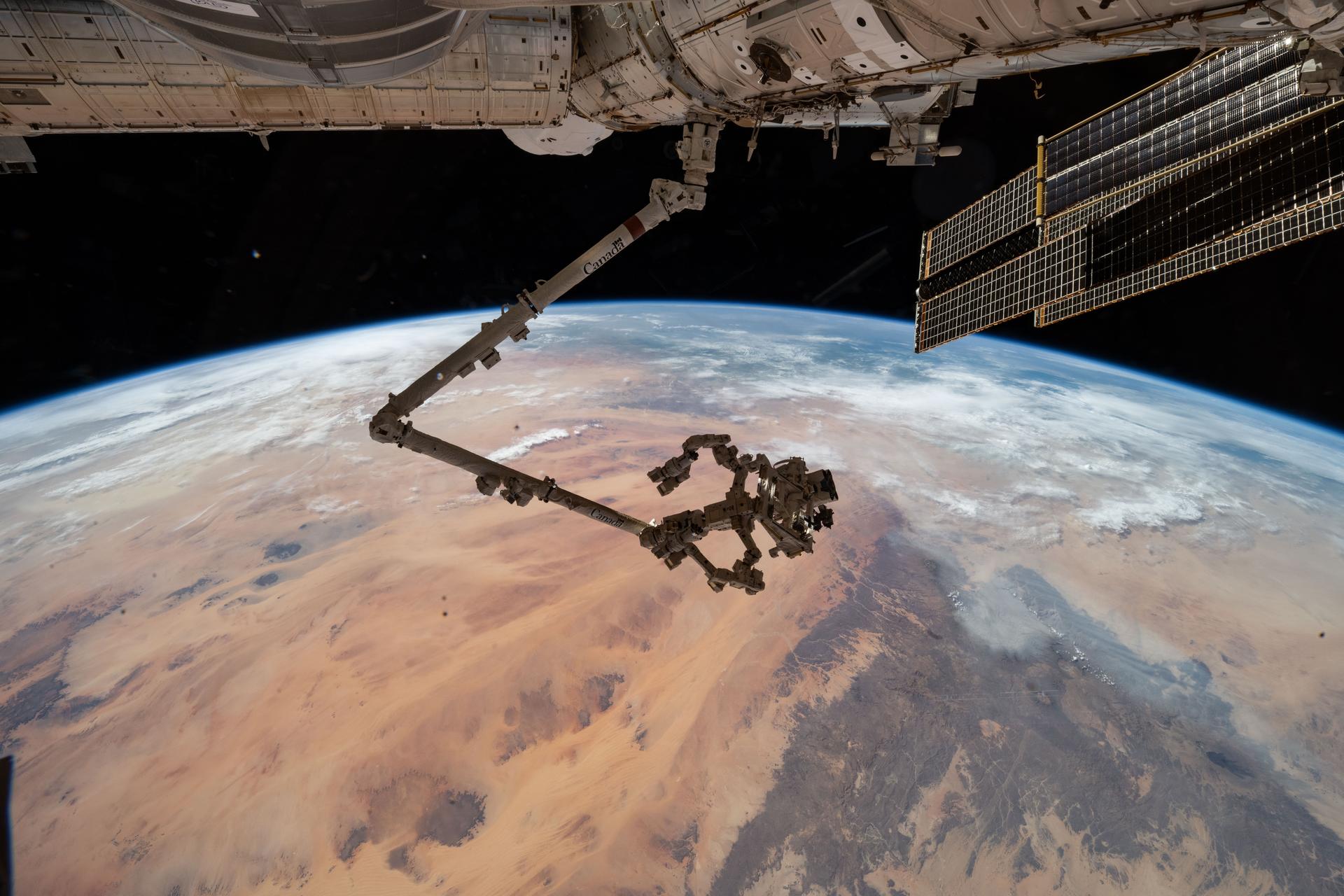
The SpaceX Dragon spacecraft with the Axiom Mission 4 crew inside is pictured docked to the International Space Station's space-facing port on the Harmony module.
The SpaceX Dragon spacecraft with the Axiom Mission 4 crew inside is pictured docked to the International Space Station’s space-facing port on the Harmony module. In the foreground, is the Canadarm2 robotic arm and its latching end effector.
NASA+

The SpaceX Dragon spacecraft undocked at 7:15 a.m. EDT from the space-facing port of the International Space Station’s Harmony module, completing the fourth private astronaut mission to the orbiting laboratory, Axiom Mission 4 (Ax-4). 

Dragon is slowly maneuvering away from the station into an orbital track that will return the crew and its cargo safely to Earth, targeting a splashdown off the coast of California on Tuesday, July 15.

NASA’s coverage will end in approximately 30 minutes when space station joint operations with Axiom Space and SpaceX conclude. Axiom Space will resume coverage of Dragon’s re-entry and splashdown on the company’s website

The Dragon spacecraft is returning with more than 580 pounds of cargo, including NASA hardware and data from over 60 experiments conducted during the mission. 

Learn more about station activities by following the space station blog, @space_station on X, as well as the ISS Facebook and ISS Instagram accounts.

Get the latest from NASA delivered every week. Subscribe here.

Powered by WPeMatico

Get The Details…

Mark A. Garcia

NASA+ is Live as Ax-4 Prepares to Undock from Station

NASA+ is Live as Ax-4 Prepares to Undock from Station

The Axiom Mission 4 (Ax-4) and Expedition 73 crews join each other for a group portrait inside the International Space Station's Harmony module. In the front row (from left) are, Ax-4 crewmates Tibor Kapu, Peggy Whitson, Shubhanshu Shukla, and Sławosz Uznański-Wiśniewski with Expedition 73 crewmates Anne McClain and Takuya Onishi. In the rear are, Expedition 73 crewmates Alexey Zubritskiy, Kirill Peskov, Sergey Ryzhikov, Jonny Kim, and Nichole Ayers.
The Axiom Mission 4 (Ax-4) and Expedition 73 crews join each other for a group portrait on June 26, 2025. In the front row (from left) are, Ax-4 crewmates Tibor Kapu, Peggy Whitson, Shubhanshu Shukla, and Sławosz Uznański-Wiśniewski with Expedition 73 crewmates Anne McClain and Takuya Onishi. In the rear are, Expedition 73 crewmates Alexey Zubritskiy, Kirill Peskov, Sergey Ryzhikov, Jonny Kim, and Nichole Ayers.
NASA

NASA’s live coverage is underway on NASA+ for the undocking of the fourth private astronaut mission, Axiom Mission 4 (Ax-4), from the International Space Station. Learn how to watch NASA content through a variety of platforms, including social media.

NASA’s coverage will end approximately 30 minutes after undocking when space station joint operations with Axiom Space and SpaceX conclude. Axiom Space will resume coverage of re-entry and splashdown on the company’s website

At 5:07 a.m. EDT, the crew closed the hatch between the SpaceX Dragon spacecraft and the space station in preparation for undocking and the return of private astronauts Peggy Whitson, Shubhanshu Shukla, Sławosz Uznański-Wiśniewski, and Tibor Kapu.

The Dragon spacecraft is scheduled to undock from the orbiting laboratory at 7:05 a.m., heading for a targeted splashdown on Tuesday, July 15, off the coast of California. The spacecraft is returning more

Learn more about station activities by following the space station blog, @space_station on X, as well as the ISS Facebook and ISS Instagram accounts.

Get the latest from NASA delivered every week. Subscribe here.

Powered by WPeMatico

Get The Details…

Mark A. Garcia