NASA Fuel Cell Tests Pave Way for Energy Storage on Moon

NASA Fuel Cell Tests Pave Way for Energy Storage on Moon

A man wearing a blue NASA polo, purple gloves, and safety glasses adjusts a small tube connected to a silver and yellow cylinder inside the Fuel Cell Testing Laboratory. Behind him are numerous other tubes, wires, and sensors connected to a large system and the lab’s wall.
Lead research engineer Dr. Kerrigan Cain adjusts tubes connected to a fuel cell inside NASA Glenn Research Center’s Fuel Cell Testing Laboratory in Cleveland on Feb. 23, 2026. His team is testing a system that could revolutionize power generation and energy storage for future Moon and Mars missions.
NASA/Jef Janis

With a small blue crane, four researchers hoist a cylindrical fuel cell, which looks like a stack of flattened silver and gold soda cans bundled together, into the air and lower it into a rectangular cart on wheels. A tangle of tubes and wires spiral away from the system, where nearly 270 sensors and 1,000 components are nestled inside.

“It’s a behemoth; it’s a researcher’s dream,” said Dr. Kerrigan Cain, lead engineer for the team at NASA’s Glenn Research Center in Cleveland preparing to test this technology, known as a regenerative fuel cell system, over the next few months.

The system, about as long as a sedan and as tall as a person, operates like a rechargeable battery and could revolutionize the way NASA stores energy during future Moon missions through the Artemis program. When power is needed, it’s designed to combine hydrogen and oxygen gas into water, heat, and electricity, and then “recharge” by splitting the water back into hydrogen and oxygen — all on the lunar surface.

“It is an ideal technology for habitats, exploration with rovers, and many of the systems that are envisioned under Artemis,” Cain said. “Developing a sustainable, long-term human presence on the Moon requires power and energy storage solutions that fit those needs. Regenerative fuel cells fit into that puzzle perfectly.”

From left to right, Dr. Kerrigan Cain, Jessica Cashman, Dr. Devon Powers, and Ryan Grotenrath install a fuel cell onto the regenerative fuel cell system inside NASA Glenn Research Center’s Fuel Cell Testing Laboratory in Cleveland on Feb. 23, 2026.
NASA/Jef Janis

This technology can weigh less but store the same amount of energy as comparable battery systems and could even operate during cold, dark, nearly two-week-long lunar nights. Its recharging capability also would ensure astronauts make the most of their resources and energy on the lunar surface without needing new supplies delivered from Earth.

The upcoming tests are the culmination of over five years of work. The system was designed and assembled at NASA Glenn. Researchers completed initial testing in 2025 to understand the basics of how the technology functions and make modifications.

Now, the team is passing a major milestone as they get ready to operate the complete system, storing the hydrogen and oxygen gas generated during recharge for the first time. They hope to gather essential data, identify any additional challenges, and further advance the technology toward a lunar mission.

On an average test day, researchers will secure the thick double doors to the test cell where the system is located in NASA Glenn’s Fuel Cell Testing Laboratory, head to a nearby control room, and begin to run the system remotely. Once it is powered up and a test has started, the technology can operate on its own without researcher intervention.

Two researchers stand in a control room and converse with two other researchers sitting in chairs behind colorful monitors and laptops showing testing data. A whiteboard with equations is shown to their right.
From left to right, Jessica Cashman, Dr. Kerrigan Cain, Dr. Mathew McCaskey, and Dr. Devon Powers discuss operation of the regenerative fuel cell system inside the control room of NASA Glenn Research Center’s Fuel Cell Testing Laboratory in Cleveland on Feb. 23, 2026.
NASA/Jef Janis

“This testing is going to generate crucial data, so every day is exciting,” Cain said. “This effort was made possible by countless hours of work. The desire for fuel cell technology is so high, it makes it very easy to get up every morning and go, ‘All right, we have to keep moving forward so that we can be ready for Artemis.’”

Researchers will use lessons learned from testing to continue advancing regenerative fuel cell technology. Before the system can launch to the Moon, researchers will put it through its paces outside of the lab.

“We want to simulate being on the lunar surface and prove the system can work under much harsher conditions compared to a controlled laboratory environment,” Cain said.

Cain and his team noted working on the complex regenerative fuel cell system is both rewarding and challenging as they consider the impacts their research could have on NASA’s future deep space missions.

“Creating a sustainable presence on the Moon is a team effort requiring a lot of collaboration between NASA and industry,” Cain said.

NASA’s Regenerative Fuel Cell project is funded by the Space Technology Mission Directorate’s Game Changing Development Program, managed at NASA’s Langley Research Center in Hampton, Virginia.

Powered by WPeMatico

Get The Details…
Ellen Bausback

Tracy Arm’s Post-Tsunami Landscape

Tracy Arm’s Post-Tsunami Landscape


July 26, 2025
August 19, 2025

Satellite view of a fjord with a glacier occupying the right half and open water on the left. Much of the fjord valley walls are covered with exposed rock and green vegetation.
NASA Earth Observatory/Michala Garrison

Satellite view of a fjord with a glacier occupying the right half and open water on the left. The glacier’s front has retreated, and brown has replaced previously green areas on land where a tsunami stripped away the vegetation.
NASA Earth Observatory/Michala Garrison

Satellite view of a fjord with a glacier occupying the right half and open water on the left. Much of the fjord valley walls are covered with exposed rock and green vegetation.
NASA Earth Observatory/Michala Garrison
Satellite view of a fjord with a glacier occupying the right half and open water on the left. The glacier’s front has retreated, and brown has replaced previously green areas on land where a tsunami stripped away the vegetation.
NASA Earth Observatory/Michala Garrison

July 26, 2025

August 19, 2025


The shores of Tracy Arm, a fjord in southeast Alaska, are stripped of vegetation following a landslide and tsunami that occurred on August 10, 2025. The OLI (Operational Land Imager) on Landsat 8 and Landsat 9 show the area in the weeks before and after the event, respectively.

Carved over millennia by the pressure and motion of glacial ice, the valley walls cradling the Tracy Arm fjord in southeast Alaska continue to be reshaped. In summer 2025, following the rapid retreat of South Sawyer Glacier, a large landslide sent rock careening into the fjord, altering the wider landscape in a matter of minutes.

The slide culminated on the morning of August 10, 2025, when at least 64 million cubic meters of rock slid downslope. Material entering the fjord induced a tsunami that stripped trees and other vegetation from the opposing fjord wall up to 1,578 feet (481 meters) above sea level. While this peak was the highest “runup” reached by the tsunami, shores and islands down the fjord also saw substantial destruction.

NASA-USGS Landsat satellites captured these images on July 26 (left) and August 19 (right), before and after the event, respectively. “The bright landslide scar on the north side of the fjord is striking, as is the ‘bathtub’ ring around the fjord showing the areas where the forest was leveled by the tsunami,” said Dan Shugar, a geomorphologist at the University of Calgary.

Note that Sawyer Island, about 6 miles (9 kilometers) from the landslide, also turned from green to brown. Only a few trees still stood at the island’s higher elevations.

An aerial view shows a glacier ending in a fjord with small icebergs in the water. A recent landslide scars the foreground fjord wall, while a tsunami has stripped vegetation from the opposite wall.
The landslide scar and the zone where vegetation was stripped by the resulting tsunami are both visible in this aerial photo of Tracy Arm and South Sawyer Glacier, captured on August 13, 2025.
U.S. Geological Survey/John Lyons

In the months following the slide, Shugar and colleagues combined satellite, airborne, and ground-based observations with eyewitness reports and simulations to build a more complete picture of how the event unfolded. Their analysis, detailing the event from its lead-up through its aftermath, was published May 6, 2026, in the journal Science.

In addition to the details outlined above, the researchers showed that water continued to slosh around the fjord—a phenomenon known as a “seiche”—for more than a day. Both the landslide and seiche produced seismic signals detected around the world, the former equivalent to a magnitude 5.4 earthquake.

The Landsat images also reveal significant retreat at the front of South Sawyer Glacier in less than a month. “Part of that occurred between the date of the first image and the date of the landslide,” Shugar said. “But part of it is from the landslide itself, which broke off a big chunk of the terminus of South Sawyer Glacier, resulting in a slurry of icebergs in the fjord.”

The exact mechanisms that caused the landslide remain uncertain and could have involved a combination of factors. Rainfall, which was moderate prior to the event, and the rapid retreat of glaciers can both destabilize a slope. What is clear, however, is that the glacier’s retreat exposed a new area of open water, leaving it vulnerable to a landscape-reorganizing tsunami. 

A satellite view shows Tracy Arm, centered, in context with other nearby waterways and glaciers in southeast Alaska.
Tracy Arm and other nearby fjords connect with Stephens Passage, a major waterway in southeast Alaska, visible in this image captured on August 19, 2025, by the OLI (Operational Land Imager) on Landsat 9.
NASA Earth Observatory/Michala Garrison

No one was injured in the event, though it did catch some by surprise. Kayakers camping on Harbor Island near the fjord’s mouth had their gear swept away, and passengers aboard a small cruise vessel in neighboring Endicott Arm reported swings in water levels and a strong current associated with the tsunami. Brentwood Higman of Ground Truth Alaska, a co-author of the paper, noted that a glacier’s shift from relative stability to renewed retreat, visible in satellite images, could serve as an important indicator that an area has become more susceptible to landslide and tsunami hazards.

NASA Earth Observatory images by Michala Garrison, using Landsat data from the U.S. Geological Survey. Photograph by John Lyons/U.S. Geological Survey. Story by Kathryn Hansen.

References & Resources

You may also be interested in:

Stay up-to-date with the latest content from NASA as we explore the universe and discover more about our home planet.

Landslide and Avalanche Debris Litter Hubbard Glacier

4 min read

Satellite-based radar images show where a powerful earthquake in the Yukon, Canada, sent rock, snow, and ice spilling across the…

Article

Cyclone Rains Spur Papua New Guinea Landslides

3 min read

Heavy rains from Tropical Cyclone Maila triggered a deadly landslide in the mountains of East New Britain.

Article

Record-Setting Retreat of Hektoria Glacier

5 min read

Scientists relied on satellite data to understand how the Antarctic glacier lost so much ice so rapidly.

Article

Powered by WPeMatico

Get The Details…

Meet the Fleet: NASA Armstrong Continues Legacy of Flight Research

Meet the Fleet: NASA Armstrong Continues Legacy of Flight Research

3 min read

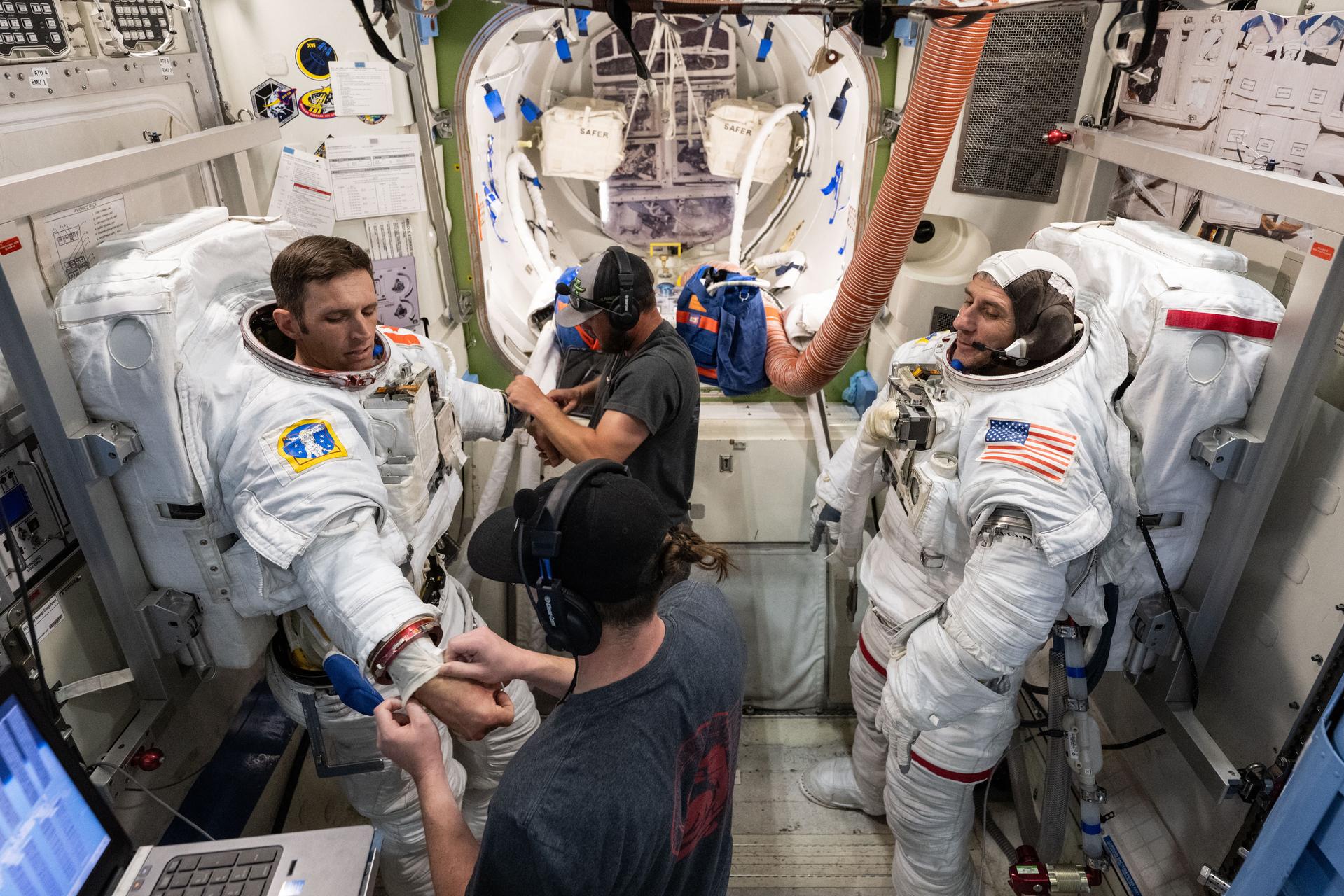
Preparations for Next Moonwalk Simulations Underway (and Underwater)

NASA’s X-59 flies above the Mojave Desert with a NASA F/A-18 chase aircraft nearby.
NASA’s X-59 quiet supersonic research aircraft flies above Palmdale and Edwards, California, during its first flight Tuesday, Oct. 28, 2025, accompanied by a NASA F/A-18 research aircraft serving as chase.
NASA/Jim Ross

NASA’s home for experimental flight is welcoming more flyers to its already high-performing fleet as it continues to support science and aeronautics test missions – continuing the legacy of pioneers like Neil Armstrong.

NASA’s Armstrong Flight Research Center in Edwards, California, added multiple aircraft this year: two F-15s supersonic jets, a Pilatus PC-12 utility plane, and a T-34 turboprop trainer, which the center will use to support the agency’s advancement of aerospace research.

Throughout the center’s history, pilots have flown everything from large aircraft like the 747 Shuttle Carrier Aircraft and rocket-powered airplanes like the X-15 to high-speed repurposed fighter jets like the F-18. And after almost 80 years, flight research is still going strong in the desert today.

“Armstrong has a rich history of flight research, but it’s the multidimensional skills of the people we have here, and the knowledge they’ve built to handle very unique aircraft maintenance and modifications, that stands out,” said Darren Cole, capabilities manager for the Flight Demonstrations and Capabilities project at NASA Armstrong.

Armstrong has a rich history of flight research, but it’s the multidimensional skills of the people we have here … that stands out.

Darren Cole

Darren Cole

Capabilities Manager at NASA Armstrong

The center plays a pivotal role in worldwide airborne science missions, flying scientists and equipment from NASA, other government agencies, industry, and academia to collect measurements such as air pollution levels, glacier melt trends, and wildland fire mapping.

Scientists can manage experiments in real time aboard flying laboratories like the NASA ER-2, to collect important data with the help of Armstrong’s pilots and airborne science team.

“We all come together to make the science happen,” said Matt Berry, airborne research platforms branch chief at NASA Armstrong. “It is the agility of the Armstrong team that allows us to collaborate with scientists, get their equipment onboard, and to fly them to areas where they need to collect data.”

The center sits on Rogers Dry Lake, a 44-square-mile slat flat area used for aviation research and test operations. Rogers and the adjacent Rosamond Dry Lake have seen everything from space shuttle landings to emergency test flight recoveries. The Rogers lakebed continues to serve as an important piece of Armstrong’s test missions.

For NASA Armstrong, it all started with the first attempt by a human to fly faster than the speed of sound in the Bell X-1. In 1946, 13 employees from NASA’s predecessor agency, the National Advisory Committee for Aeronautics (NACA), arrived at what was then known as Muroc Army Airfield to prepare for the X-1 tests. A year later, NACA’s Muroc Flight Test Unit was established as a permanent facility at the airfield.

The center has gone by several names over the years, most recently changing from NASA’s Dryden Flight Research Center to NASA Armstrong in 2014. But its legacy has never shifted: The Bell X-1E, the last of the X-1 series of aircraft, now sits in front of NASA Armstrong, welcoming the newest test pilots, engineers, scientists, explorers, and dreamers. And they’re using the aircraft of today to break new barriers.

“I don’t think there is another place in the world with a more diverse fleet of aircraft. We have everything from a low-altitude powered glider to ER-2s, which are flying at high altitudes, and a multitude of aircraft in between,” Cole said.

From sourcing rare components to machining custom parts in-house, NASA Armstrong’s teams transform these aircraft into research workhorses. The center continues its crucial role in leading aeronautics testing, Earth science research, and supporting government and industry partners.

Share

Details

Last Updated

May 07, 2026

Editor
Dede Dinius
Contact
Teresa Whiting

Powered by WPeMatico

Get The Details…
Dede Dinius

DNA-Inspired Treatments, Space Agriculture Top Crew’s Research Schedule

DNA-Inspired Treatments, Space Agriculture Top Crew’s Research Schedule

NASA astronaut and Expedition 74 flight engineer Jessica Meir inspects sensitive fiber cables that emit light to help cool, trap, and study atoms with high accuracy inside the Cold Atom Lab (CAL) aboard the International Space Station. The CAL, a quantum research facility, chills atoms to near absolute zero, providing insights into atomic wave functions, general relativity, and dark matter.
NASA astronaut Jessica Meir inspects sensitive fiber cables that emit light to help cool, trap, and study atoms with high accuracy inside the Cold Atom Lab aboard the International Space Station.
NASA/Jack Hathaway

DNA-inspired therapies and space agriculture topped the research schedule aboard the International Space Station on Thursday. The Expedition 74 crew members also serviced a variety of lab hardware including a quantum physics facility, a spacesuit, and life support gear throughout their busy day.

NASA flight engineer Jessica Meir worked in the Harmony module on a biotechnology investigation to observe how tiny, engineered materials that mimic DNA behave in microgravity. Meir pointed a light-measuring device, called a spectrophotometer, at the DNA-like sample materials housed in small transparent containers to analyze their ability to form stable structures. Next, she transferred the research data to a computer so doctors can downlink the information and learn how to improve and develop future treatments, or nano-therapies, that target cancer cells more precisely.

Flight engineer Sophie Adenot of ESA (European Space Agency) watered alfalfa plants growing inside the Columbus laboratory module’s Veggie botany research facility for the Veg-06 plant-microbe study. The experiment is exploring how plants source nitrogen and thrive in microgravity to promote food production in space during long term missions. Afterward, Adenot had her eye pressure checked by Meir who used a tonometer, an optometry tool that measures fluid pressure in the eye. Doctors regularly examine an astronaut’s eyes to detect and counteract potential space-caused vision conditions.

NASA flight engineer Jack Hathaway began his shift inside the Destiny laboratory module servicing a cooling unit inside the Cold Atom Lab (CAL) quantum research device. CAL chills atoms to near absolute zero trapping them for observation providing insights into atomic wave functions, general relativity, and dark matter. The CAL received a new quantum physics module, expanding the capacity of the research device, on April 13 when Northrop Grumman’s Cygnus XL cargo spacecraft arrived at the station. Hathaway ended his shift in the Quest airlock swapping components on a spacesuit for return to Earth.

NASA flight engineer Chris Williams was back inside the Kibo laboratory module continuing to remove research hardware for packing inside a SpaceX Dragon cargo spacecraft due to arrive next week. Williams later rearranged cargo inside the Cygnus XL spacecraft then took off the sensor-packed Bio-Monitor vest and headband that he wore for two days of health data collection.

Station commander Sergey Kud-Sverchkov and flight engineer Sergei Mikaev began their shift taking turns wearing an acoustic sensor around their necks and recording their rapid exhalation to understand how microgravity affects the respiratory system. The Roscosmos duo then partnered together the rest of the day unloading cargo packed inside the Progress 95 resupply ship.

Roscosmos flight engineer Andrey Fedyaev spent his shift continuing to replace hoses, connectors, and valves that carry water removed from the station’s air by the Zvezda service module’s dehumidifiers.

Learn more about station activities by following the space station blog, @space_stationon X, as well as the ISS Facebookand ISS Instagram accounts.

Get the latest from NASA delivered every week. Subscribe here.

Powered by WPeMatico

Get The Details…

Mark A. Garcia

NASA Welcomes Paraguay as 67th Artemis Accords Signatory

NASA Welcomes Paraguay as 67th Artemis Accords Signatory

Credit: NASA

The Republic of Paraguay signed the Artemis Accords on Thursday during a ceremony in Asunción, becoming the latest nation to commit to the shared principles guiding civil space exploration.

“Today, I am proud to welcome Paraguay as the 67th signatory to the Artemis Accords,” said NASA Administrator Jared Isaacman. “They join an ever-growing coalition of like-minded nations committed to the peaceful, transparent, and responsible exploration of space. Established by President Trump in his first term, the Artemis Accords provided the principles for how we explore the Moon, Mars, and beyond. Now, with his national space policy, we are putting the Artemis Accords into practice with our Moon Base. We are creating opportunities for all Artemis Accords signatories, including Paraguay, to join us on the lunar surface and advance our shared objectives in this next era of exploration.”

U.S. Embassy Asunción Chargé d’Affaires ad interim Aaron Pratt shared Isaacman’s remarks during the ceremony. Minister President of the Paraguayan Space Agency Osvaldo Almirón Riveros signed on behalf of Paraguay.

“The signing of the Artemis Accords represents a historic milestone for Paraguay and reflects our commitment to international cooperation, the peaceful use of outer space, scientific development, and the advancement of national space capabilities,” said Almirón Riveros. “This step strengthens Paraguay’s position within the global space community and opens new opportunities for research, innovation, and sustainable development.”

The Paraguayan Space Agency was established in 2014 and has worked to develop capabilities in satellite technology and Earth observation, including with international partners. Its first satellite, GuaraníSat‑1, launched from the International Space Station in 2021. The agency now is preparing to launch its second satellite, GuaraníSat‑2, in October aboard a Falcon 9 from Vandenberg Space Force Base in California. The mission was developed with collaborators from NASA’s Jet Propulsion Laboratory and other partners.

In 2020, the United States, led by NASA and the U.S. State Department, joined with seven other founding nations to establish the Artemis Accords, responding to the growing interest in lunar activities by both governments and private companies. The Artemis Accords introduced the first set of practical principles aimed at enhancing the safety and coordination between like-minded nations as they explore the Moon, Mars, and beyond.  

Signing the Artemis Accords means committing to explore peaceably and transparently, to render aid to those in need, to enable access to scientific data that all of humanity can learn from, to ensure activities do not interfere with those of others, and to preserve historically significant sites and artifacts by developing best practices for space exploration for the benefit of all. 

More countries are expected to sign the Artemis Accords in the months and years ahead, as NASA continues its work to establish a safe, peaceful, and prosperous future in space. 

For more information about the Artemis Accords, visit:

https://www.nasa.gov/artemis-accords

Powered by WPeMatico

Get The Details…
Elizabeth Shaw