Crew Preps for Dragon Departure and Arrival; Keeps Up Space Research

Crew Preps for Dragon Departure and Arrival; Keeps Up Space Research

A wispy aurora spikes across the Indian Ocean with a set of the International Space Station's main solar arrays (augmented by its rollout solar arrays) draping the foreground. At right, is the unoccupied Rassvet module that hosts visiting spacecraft from Roscosmos. The orbital outpost was soaring 270 miles above Earth southwest of Australia at the time of this photograph.
A wispy aurora spikes across the Indian Ocean as the orbital outpost soars 270 miles above Earth southwest of Australia.
NASA

The Expedition 73 crew is readying a SpaceX Dragon spacecraft for return to Earth while a new crew on the ground is preparing to launch aboard another Dragon to the International Space Station. Meanwhile, exercise research, lab maintenance, and Earth observations rounded out the day aboard the orbital outpost.

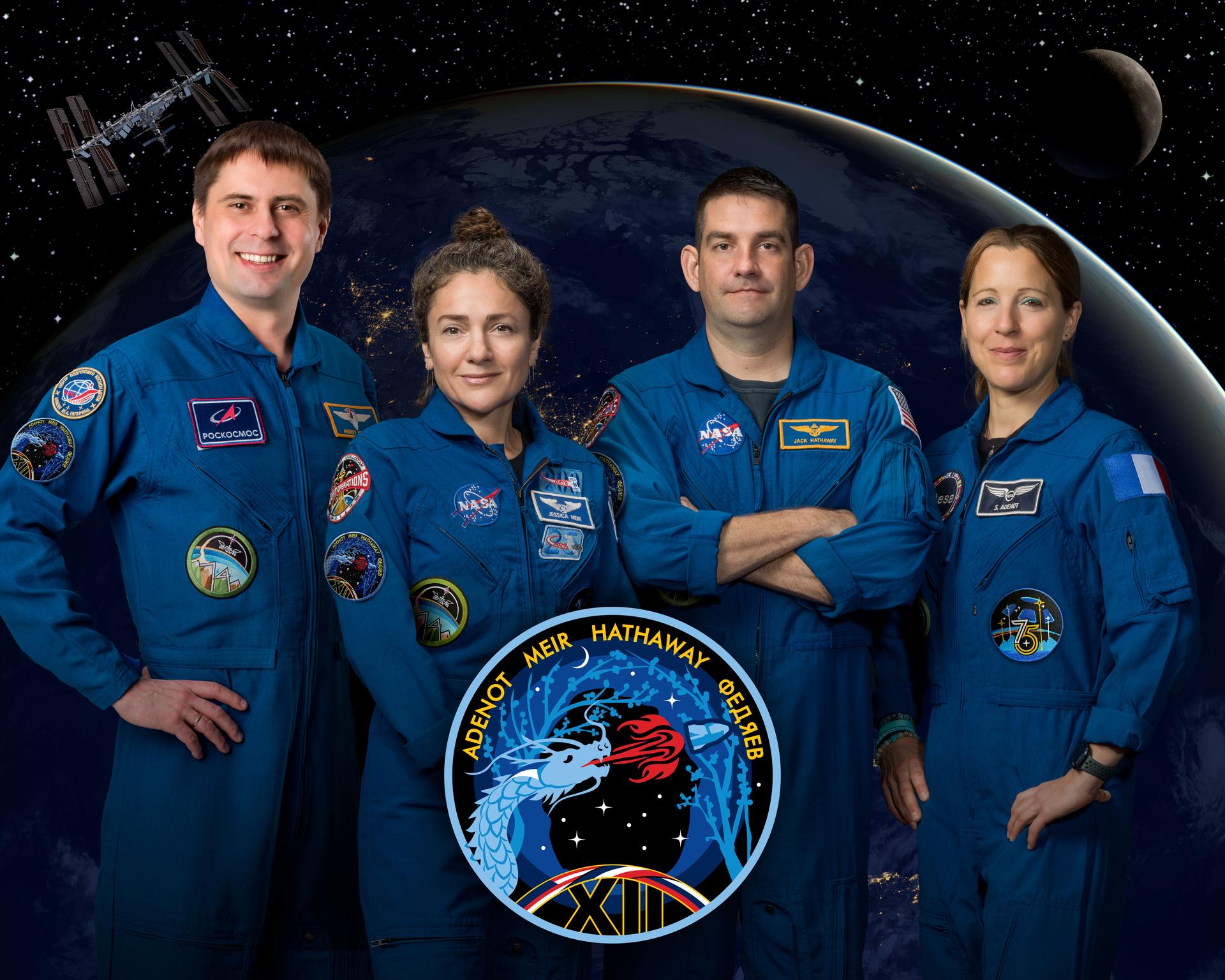
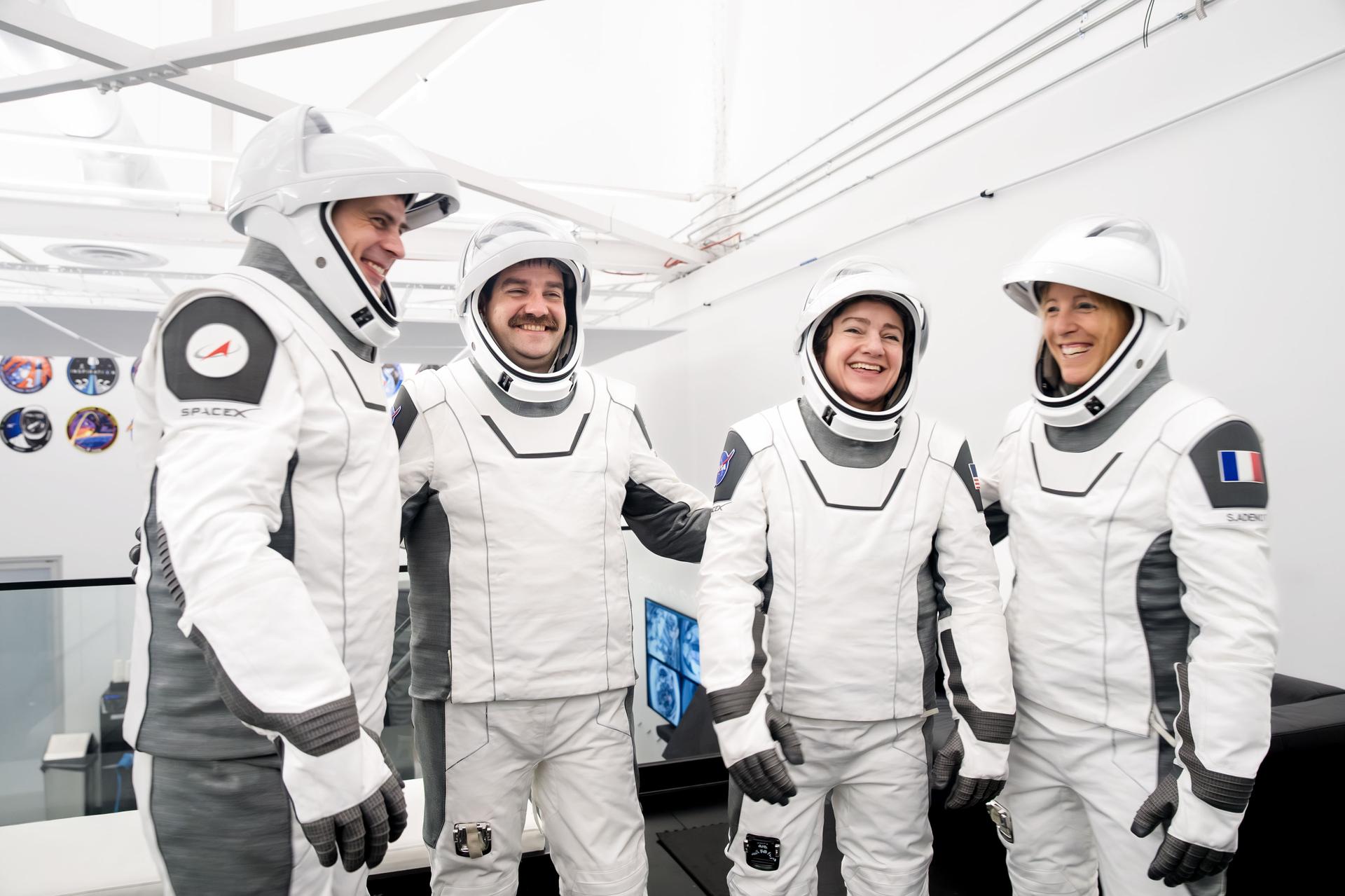
Station crewmates Anne McClain and Nichole Ayers, both from NASA, Takuya Onishi from JAXA (Japan Aerospace Exploration Agency), and Kirill Peskov from Roscosmos continue packing personal items and other cargo inside the Dragon that will return them home in early August. McClain and Ayers, with assistance from NASA Flight Engineer Jonny Kim who is staying in space until December, set up the four seats inside Dragon that NASA’s SpaceX Crew-10 members will ride back home in. The trio also transferred emergency gear inside the departing Dragon while preparing emergency air supply components for the next crewed Dragon mission. Peskov tested the lower body negative pressure suit from Roscosmos that reverses the space-caused headward flow of body fluids possibly preventing head and eye pressure and easing the adjustment to Earth’s gravity.

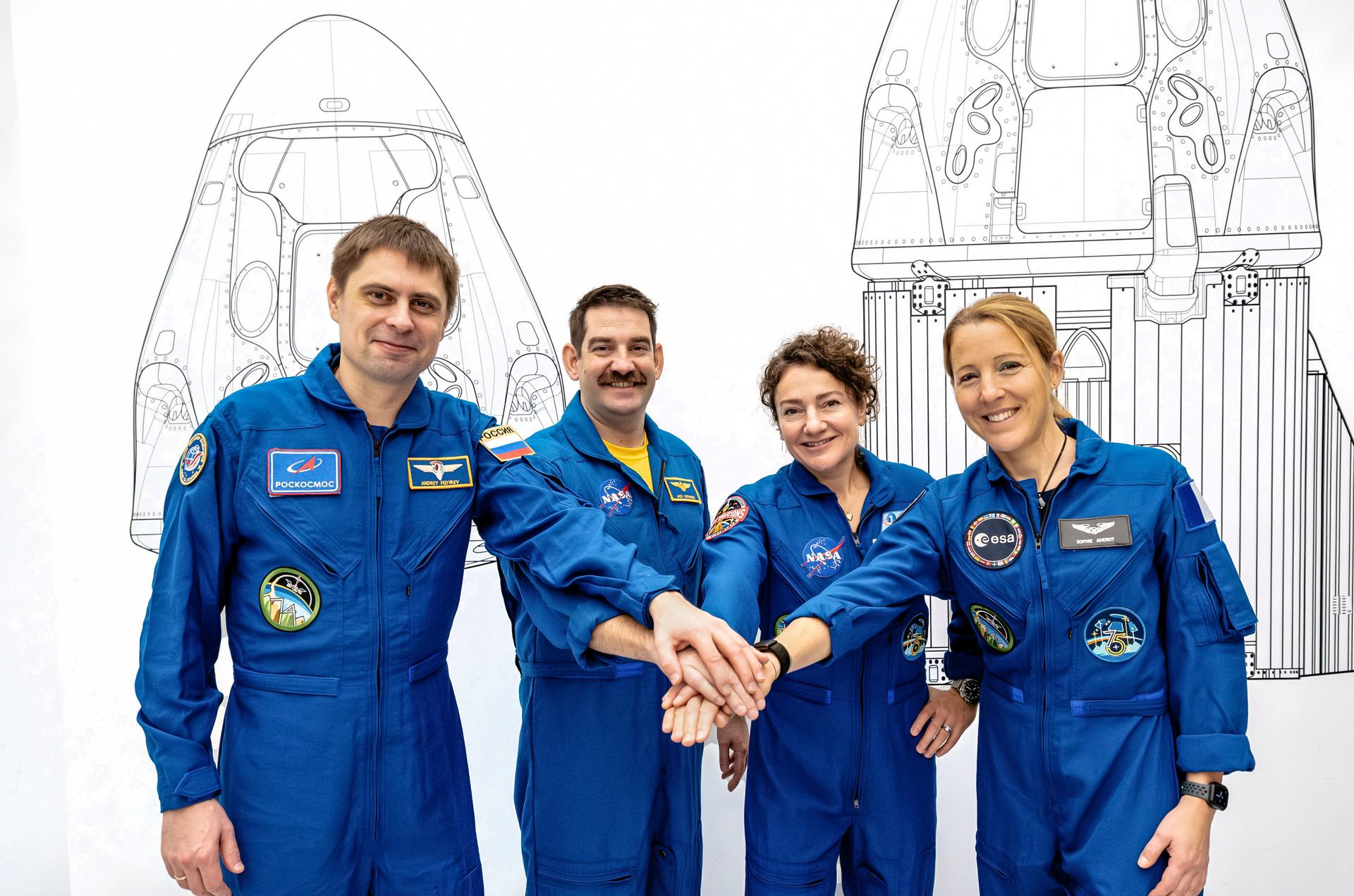
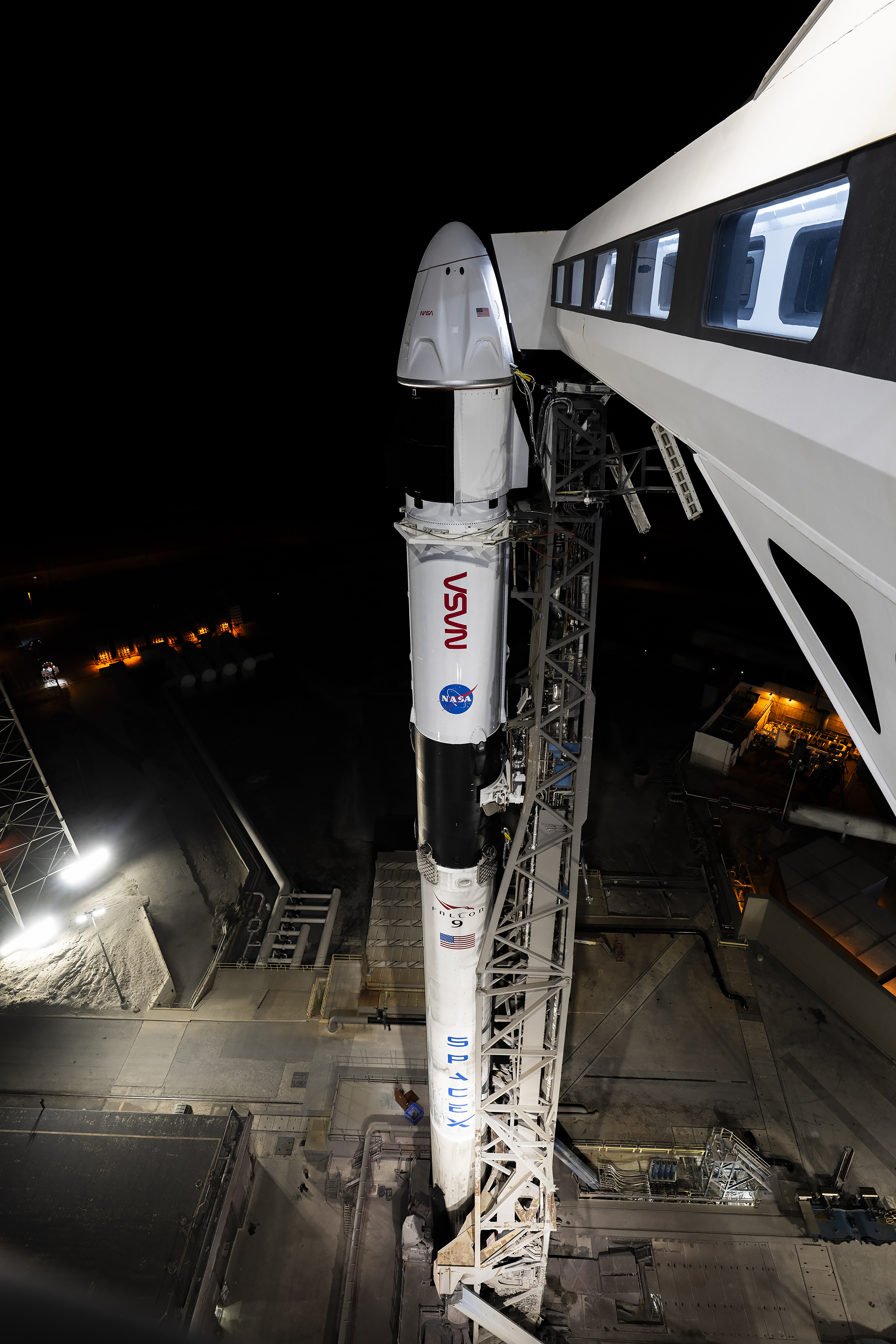
Back on Earth, NASA’s SpaceX Crew-11 mission is counting down to its launch no earlier than 12:09 p.m. EDT on Thursday from NASA’s Kennedy Space Center. Crew-11 Commander Zena Cardman and Pilot Mike Fincke, both NASA astronauts, along with Mission Specialists Kimiya Yui from JAXA and Oleg Platonov from Roscosmos will orbit Earth inside Dragon for a day-and-a-half before an automated docking to the Harmony module’s space-facing port. NASA+ will begin its Crew-11 launch coverage beginning at 8 a.m. on Thursday.

Meanwhile, the orbiting residents kept up their daily research and maintenance duties advancing the Earth and space economies while ensuring the International Space Station operates in tip-top shape.

While McClain and Kim spent their shift on Dragon preparations, Ayers and Onishi worked on science investigations and research hardware configurations. Ayers began her shift wearing electrodes on her shoulders and abdomen measuring how blood flows from the brain to the heart. Next, she wore a heart monitor measuring her heart rate as she jogged on the COLBERT treadmill and worked out on the advanced resistive exercise device. Onishi checked cables and tubes inside the BioLab’s life support module located in the Columbus laboratory module where microorganisms, cells, tissues cultures, and more are studied to understand the effects of weightlessness on biology.

Roscosmos Flight Engineer Alexey Zubritsky began his shift assisting Peskov with the experimental suit studies then measured the vibrations the Zvezda service module’s treadmill creates and inspected Zvezda’s windows. Veteran cosmonaut Sergey Ryzhikov photographed the effects of natural and man-made disasters on Earth and tested new freeze-dried food packs for their ease of use for both eating and drinking.

Learn more about station activities by following the space station blog, @space_station on X, as well as the ISS Facebook and ISS Instagram accounts.

Get the latest from NASA delivered every week. Subscribe here.

Powered by WPeMatico

Get The Details…

Mark A. Garcia

NASA Releases Opportunity to Boost Commercial Space Tech Development

NASA Releases Opportunity to Boost Commercial Space Tech Development

5 min read

Preparations for Next Moonwalk Simulations Underway (and Underwater)

NASA meatball logo
Credit: NASA

NASA has released a new proposal opportunity for industry to tap into agency know-how, resources, and expertise. The Announcement of Collaboration Opportunity (ACO), managed by the Space Technology Mission Directorate, enables valuable collaboration without financial exchanges between NASA and industry partners. Instead, companies leverage NASA subject matter experts, facilities, software, and hardware to accelerate their technologies and prepare them for future commercial and government use. 

On Wednesday, NASA issued a standing ACO announcement for partnership proposals which will be available for five years and will serve as the umbrella opportunity for topic-specific appendix releases. NASA intends to issue appendices every six to 12 months to address evolving space technology needs. The 2025 ACO appendix is open for proposals until Sept. 24.  

NASA will host an informational webinar about the opportunity and appendix at 2 p.m. EDT on Wednesday, Aug. 6. Interested proposers are encouraged to submit questions which will be answered during the webinar and will be available online after the webinar.   

NASA teaming with industry isn’t new – decades of partnerships have resulted in ambitious missions that benefit all of humanity. But in recent years, NASA has also played a key role as a technology enabler, providing one-of-a-kind tools, resources, and infrastructure to help commercial aerospace companies achieve their goals.  

Since 2015, NASA has collaborated with industry on approximately 80 ACO projects. Here are some ways the collaborations have advanced space technology: 

Lunar lander systems 

Blue Origin and NASA worked together on several ACOs to mature the company’s lunar lander design. NASA provided technical reports and assessments and conducted tests at multiple centers to help Blue Origin advance a stacked fuel cell system for a lander’s primary power source. Other Blue Origin ACO projects evaluated high-temperature engine materials and advanced a landing navigation and guidance system. 

Blue Origin’s Blue Moon Mark 1 (MK1) lander is delivering NASA science and technology to the Moon through the agency’s Commercial Lunar Payload Services initiative. In 2023, NASA selected Blue Origin as a Human Landing System provider to develop its Blue Moon MK2 lander for future crewed lunar exploration. 

Artist concept of Blue Origin’s Blue Moon Mark 1 (MK1) lander.
Credit: Blue Origin

Cryogenic fluid transfer 

Throughout a year-long ACO, NASA and SpaceX engineers worked together to perform in-depth computational fluid analysis of proposed propellant transfer methods between two SpaceX Starship spacecraft in low-Earth orbit. The SpaceX-specific analysis utilized Starship flight data and data from previous NASA research and development to identify potential risks and help mitigate them during the early stages of commercial development. NASA also provided inputs as SpaceX developed an initial concept of operations for its orbital propellant transfer missions. 

SpaceX used the ACO analyses to inform the design of its Starship Human Landing System, which NASA selected in 2021 to put the first Artemis astronauts on the Moon. 

This artist’s concept depicts a SpaceX Starship tanker (bottom) transferring propellant to a Starship depot (top) in low Earth orbit. Before astronauts launch in Orion atop the agency’s SLS (Space Launch System) rocket, SpaceX will launch a storage depot to Earth orbit. For the Artemis III and Artemis IV missions, SpaceX plans to complete propellant loading operations in Earth orbit to send a fully fueled Starship Human Landing System (HLS) to the Moon.
Credit: SpaceX

Autonomous spacecraft navigation solution 

Advanced Space and NASA partnered to advance the company’s Cislunar Autonomous Positioning System – software that allows lunar spacecraft to determine their location without relying exclusively on tracking from Earth.  

Dylan Schmidt, CAPSTONE assembly integration and test lead, installs solar panels onto the CAPSTONE spacecraft at Tyvak Nano-Satellite Systems, Inc., in Irvine, California.
NASA/Dominic Hart

The CAPSTONE (Cislunar Autonomous Positioning System Technology Operations and Navigation Experiment) spacecraft launched to the Moon in 2022 and continues to operate and collect critical data to refine the software. Under the ACO, Advanced Space was able to use NASA’s Lunar Reconnaissance Orbiter to conduct crosslink experiments with CAPSTONE, helping mature the navigation solution for future missions. The mission’s Cislunar Autonomous Positioning System technology was initially supported through the NASA Small Business Innovation Research program. 

Multi-purpose laser sensing system 

Sensuron and NASA matured a miniature, rugged fiber optic sensing system capable of taking thermal and shape measurements for multiple applications. Throughout the ACO, Sensuron benefitted from NASA’s expertise in fiber optics and electrical, mechanical, and system testing engineering to design, fabricate, and “shake and bake” its prototype laser. 

NASA’s Armstrong Flight Research Center’s FOSS, Fiber Optic Sensing System, recently supported tests of a system designed to turn oxygen into liquid oxygen, a component of rocket fuel. Patrick Chan, electronics engineer, and NASA Armstrong’s FOSS portfolio project manager, shows fiber like that used in the testing.
NASA/Genaro Vavuris

Space missions could use the technology to monitor cryogenic propellant levels and determine a fuel tank’s structural integrity throughout an extended mission. The laser technology also has medical applications on Earth, which ultimately resulted in the Sensuron spinoff company, The Shape Sensing Company. 

Flexible lunar tires 

In 2023, Venturi Astrolab began work with NASA under an ACO to test its flexible lunar tire design. The company tapped into testing capabilities unique to NASA, including heat transfer to cold lunar soil, traction, and life testing. The data validated the performance of tire prototypes, helping ready the design to support future NASA missions. 

In 2024, NASA selected three companies, including Venturi Astrolab, to advance capabilities for a lunar terrain vehicle that astronauts could use to travel around the lunar surface, conducting scientific research on the Moon and preparing for human missions to Mars. 

Artist rendition of the flex venturi wheel
Venturi Lab designed and developed a durable, robust, and hyper-deformable lunar wheel.
Venturi Lab

The Announcement of Collaboration Opportunity (ACO) is one of many ways NASA enables commercial industry to develop, build, own, and eventually operate space systems. To learn more about these technology projects and more, visit: https://techport.nasa.gov/.

Powered by WPeMatico

Get The Details…
Loura Hall

NASA Tests Epic Solution for Supersonic Parachute Deliveries

NASA Tests Epic Solution for Supersonic Parachute Deliveries

2 min read

Preparations for Next Moonwalk Simulations Underway (and Underwater)

NASA/Lori Losey

The best way to solve a mystery is by gathering evidence and building a case. That’s exactly what NASA researchers are doing with a series of research flights aimed at advancing a sensor for supersonic parachutes. The clues they find could help make these parachutes more reliable and safer for delivering scientific instruments and payloads to Mars.

These investigative research flights are led by the EPIC (Enhancing Parachutes by Instrumenting the Canopy) team at NASA’s Armstrong Fight Research Center in Edwards, California. During a June flight test, a quadrotor aircraft, or drone, air-launched a capsule that deployed a parachute equipped with a sensor. The flexible, strain-measuring sensor attached to the parachute did not interfere with the canopy material, just as the EPIC team had predicted. The sensors also provided data, a bonus for planning upcoming tests.

“Reviewing the research flights will help inform our next steps,” said Matt Kearns, project manager for EPIC at NASA Armstrong. “We are speaking with potential partners to come up with a framework to obtain the data that they are interested in pursuing. Our team members are developing methods for temperature testing the flexible sensors, data analysis, and looking into instrumentation for future tests.”

The flight tests were a first step toward filling gaps in computer models to improve supersonic parachutes. This work could also open the door to future partnerships, including with the aerospace and auto racing industries.

NASA’s Space Technology Mission Directorate (STMD) funds the EPIC work through its Entry Systems Modeling project at NASA’s Ames Research Center in California’s Silicon Valley. The capsule and parachute system were developed by NASA’s Langley Research Center in Hampton, Virginia. NASA Armstrong interns worked with Langley to build and integrate a similar system for testing at NASA Armstrong. An earlier phase of the work focused on finding commercially available flexible strain sensors and developing a bonding method as part of an STMD Early Career Initiative project.

One man secures a cannister containing a parachute to a system that will be carried by an Alta X drone, while another man assists.
NASA researchers Paul Bean, center, and Mark Hagiwara, right, attach the capsule with parachute system to the Enhancing Parachutes by Instrumenting the Canopy test experiment on June 4, 2025, at NASA’s Armstong Flight Research Center in Edwards, California. NASA researchers are developing technology to make supersonic parachutes safer and more reliable for delivering science instruments and payloads to Mars.
NASA/Christopher LC Clark
Two men attached a science experiment to a drone for a research flight.
Derek Abramson, left, and Justin Link, right, attach an Alta X drone to the Enhancing Parachutes by Instrumenting the Canopy test experiment on June 4, 2025, at NASA’s Armstong Flight Research Center in Edwards, California. Abramson is NASA chief engineer at the center’s Dale Reed Subscale Flight Research Laboratory, where Link also works as a pilot for small uncrewed aircraft systems. NASA researchers are developing technology to make supersonic parachutes safer and more reliable for delivering science instruments and payloads to Mars.
NASA/Christopher LC Clark
A drone with four rotors hoovers against a canvas of deep blue sky prior to releasing the experiment it carries high above the desert floor.
An Alta X drone is positioned at altitude for an air launch of the Enhancing Parachutes by Instrumenting the Canopy test experiment on June 4, 2025, at NASA’s Armstong Flight Research Center in Edwards, California. NASA researchers are developing technology to make supersonic parachutes safer and more reliable for delivering science instruments and payloads to Mars.
NASA/Christopher LC Clark
A parachute carrying a capsule is fully open against a canvas of deep blue sky.
The parachute of the Enhancing Parachutes by Instrumenting the Canopy test experiment deploys following an air launch from an Alta X drone on June 4, 2025, at NASA’s Armstong Flight Research Center in Edwards, California. NASA researchers are developing technology to make supersonic parachutes safer and more reliable for delivering science instruments and payloads to Mars.
NASA/Christopher LC Clark
A group of researchers on a barren dry lake examine a capsule after it was released from a drone and carried by an instrumented parachute.
The Enhancing Parachutes by Instrumenting the Canopy project team examines a capsule and parachute following an air launch from an Alta X drone on June 4, 2025, at NASA’s Armstong Flight Research Center in Edwards, California. NASA researchers are developing technology to make supersonic parachutes safer and more reliable for delivering science instruments and payloads to Mars.
NASA/Christopher LC Clark

Powered by WPeMatico

Get The Details…
Dede Dinius

NASA-ISRO Satellite Lifts Off to Track Earth’s Changing Surfaces

NASA-ISRO Satellite Lifts Off to Track Earth’s Changing Surfaces

A large white rocket with a fiery trail launches through a cloudy sky above India.
The Indian Space Research Organisation’s Geosynchronous Satellite Launch Vehicle lifts off from Satish Dhawan Space Centre on India’s southeastern coast at 5:40 p.m. IST (8:10 a.m. EDT), July 30, 2025.
Credit: ISRO

Editor’s Note: This release was edited on July 30, 2025, to correct the mission launch time in the IST time zone.

Carrying an advanced radar system that will produce a dynamic, three-dimensional view of Earth in unprecedented detail, the NISAR (NASA-ISRO Synthetic Aperture Radar) satellite has launched from Satish Dhawan Space Centre in Sriharikota, Andhra Pradesh, India.

Jointly developed by NASA and the Indian Space Research Organisation (ISRO), and a critical part of the United States – India civil-space cooperation highlighted by President Trump and Prime Minister Modi earlier this year, the satellite can detect the movement of land and ice surfaces down to the centimeter. The mission will help protect communities by providing unique, actionable information to decision-makers in a diverse range of areas, including disaster response, infrastructure monitoring, and agricultural management. 

The satellite lifted off aboard an ISRO Geosynchronous Satellite Launch Vehicle (GSLV) rocket at 5:40 p.m. IST (8:10 a.m. EDT), Wednesday. The ISRO ground controllers began communicating with NISAR about 20 minutes after launch, at just after 8:29 a.m. EDT, and confirmed it is operating as expected.

“Congratulations to the entire NISAR mission team on a successful launch that spanned across multiple time zones and continents in the first-ever partnership between NASA and ISRO on a mission of this sheer magnitude,” said Nicky Fox, associate administrator, Science Mission Directorate at NASA Headquarters in Washington. “Where moments are most critical, NISAR’s data will help ensure the health and safety of those impacted on Earth, as well as the infrastructure that supports them, for the benefit of all.”

From 464 miles (747 kilometers) above Earth, NISAR will use two advanced radar instruments to track changes in Earth’s forests and wetland ecosystems, monitor deformation and motion of the planet’s frozen surfaces, and detect the movement of Earth’s crust down to fractions of an inch — a key measurement in understanding how the land surface moves before, during, and after earthquakes, volcanic eruptions, and landslides.

“ISRO’s GSLV has precisely injected NISAR satellite into the intended orbit, 747 kilometers. I am happy to inform that this is GSLV’s first mission to Sun-synchronous polar orbit. With this successful launch, we are at the threshold of fulfilling the immense scientific potential NASA and ISRO envisioned for the NISAR mission more than 10 years ago,” said ISRO Chairman V Narayanan. “The powerful capability of this radar mission will help us study Earth’s dynamic land and ice surfaces in greater detail than ever before.”

The mission’s two radars will monitor nearly all the planet’s land- and ice-covered surfaces twice every 12 days, including areas of the polar Southern Hemisphere rarely covered by other Earth-observing radar satellites. The data NISAR collects also can help researchers assess how forests, wetlands, agricultural areas, and permafrost change over time.

“Observations from NISAR will provide new knowledge and tangible benefits for communities both in the U.S. and around the world,” said Karen St. Germain, director, Earth Science division at NASA Headquarters. “This launch marks the beginning of a new way of seeing the surface of our planet so that we can understand and foresee natural disasters and other changes in our Earth system that affect lives and property.”

The NISAR satellite is the first free-flying space mission to feature two radar instruments — an L-band system and an S-band system. Each system is sensitive to features of different sizes and specializes in detecting certain attributes. The L-band radar excels at measuring soil moisture, forest biomass, and motion of land and ice surfaces, while S-band radar excels at monitoring agriculture, grassland ecosystems, and infrastructure movement.

Together, the radar instruments will enhance all of the satellite’s observations, making NISAR more capable than previous synthetic aperture radar missions. Unlike optical sensors, NISAR will be able to “see” through clouds, making it possible to monitor the surface during storms, as well as in darkness and light.

NASA’s Jet Propulsion Laboratory in Southern California provided the L-band radar, and ISRO’s Space Applications Centre in Ahmedabad developed the S-band radar. The NISAR mission marks the first time the two agencies have co-developed hardware for an Earth-observing mission.

“We’re proud of the international team behind this remarkable satellite. The mission’s measurements will be global but its applications deeply local, as people everywhere will use its data to plan for a resilient future,” said Dave Gallagher, director, NASA JPL, which manages the U.S. portion of the mission for NASA. “At its core is synthetic aperture radar, a technology pioneered at NASA JPL that enables us to study Earth night and day, through all kinds of weather.”

Including L-band and S-band radars on one satellite is an evolution in SAR airborne and space-based missions that, for NASA, started in 1978 with the launch of Seasat. In 2012, ISRO began launching SAR missions starting with Radar Imaging Satellite (RISAT-1), followed by RISAT-1A in 2022, to support a wide range of applications in India.

In the coming weeks, the spacecraft will begin a roughly 90-day commissioning phase during which it will deploy its 39-foot (12-meter) radar antenna reflector. This reflector will direct and receive microwave signals from the two radars. By interpreting the differences between the two, researchers can discern characteristics about the surface below. As NISAR passes over the same locations twice every 12 days, scientists can evaluate how those characteristics have changed over time to reveal new insights about Earth’s dynamic surfaces.

The NISAR mission is an equal collaboration between NASA and ISRO. Managed for the agency by Caltech, NASA JPL leads the U.S. component of the project and is providing the mission’s L-band SAR. NASA also is providing the radar reflector antenna, the deployable boom, a high-rate communication subsystem for science data, GPS receivers, a solid-state recorder, and payload data subsystem.

Space Applications Centre Ahmedabad, ISRO’s lead center for payload development, is providing the mission’s S-band SAR instrument and is responsible for its calibration, data processing, and development of science algorithms to address the scientific goals of the mission. U R Rao Satellite Centre in Bengaluru, which leads the ISRO components of the mission, is providing the spacecraft bus. The launch vehicle is from ISRO’s Vikram Sarabhai Space Centre, launch services are through ISRO’s Satish Dhawan Space Centre, and satellite operations are by ISRO Telemetry Tracking and Command Network. National Remote Sensing Centre in Hyderabad is responsible for S-band data reception, operational products generation, and dissemination.

To learn more about NISAR, visit:

https://nisar.jpl.nasa.gov

-end-

Karen Fox / Elizabeth Vlock
Headquarters, Washington
202-358-1600
karen.c.fox@nasa.gov / elizabeth.a.vlock@nasa.gov

Andrew Wang / Jane J. Lee
Jet Propulsion Laboratory, Pasadena, Calif.
626-379-6874 / 818-354-0307
andrew.wang@jpl.nasa.gov / jane.j.lee@jpl.nasa.gov

Powered by WPeMatico

Get The Details…
Jessica Taveau

NASA’s Webb Traces Details of Complex Planetary Nebula

NASA’s Webb Traces Details of Complex Planetary Nebula

5 Min Read

NASA’s Webb Traces Details of Complex Planetary Nebula

Colorful, mostly red glowing cloud with a distorted, asymmetrical shape that is illuminated from within by a bright central star. The asymmetrical shape resembles a large squished bug on the ground. In the center, a light blue glow appears over areas of dark pockets that look dark blue and are traced with orange material. It has a clumpy appearance. Shells of gas and dust appear as lobes stretching from roughly 11 to 5 o’clock, another from 1 to 7 o’clock, and possibly a third from 12 to 6 o’clock. The shells become a deeper red with distance from the center. These outflows push gas toward the equatorial plane, forming a disk that appears to span from 9 to 3 o’clock. The background of space is black and speckled with tiny bright stars and distant galaxies.
NASA’s James Webb Space Telescope’s view of planetary nebula NGC 6072 in the near-infrared shows a complex scene of multiple outflows expanding out at different angles from a dying star at the center of the scene. In this image, the red areas represent cool molecular gas, for example, molecular hydrogen. Full image below.
Credits:
NASA, ESA, CSA, STScI

Since their discovery in the late 1700s, astronomers have learned that planetary nebulae, or the expanding shell of glowing gas expelled by a low-intermediate mass star late in its life, can come in all shapes and sizes. Most planetary nebula present as circular, elliptical, or bi-polar, but some stray from the norm, as seen in new high-resolution images of planetary nebulae by NASA’s James Webb Space Telescope.

Webb’s newest look at planetary nebula NGC 6072 in the near- and mid-infrared shows what may appear as a very messy scene resembling splattered paint. However, the unusual, asymmetrical appearance hints at more complicated mechanisms underway, as the star central to the scene approaches the very final stages of its life and expels shells of material, losing up to 80 percent of its mass. Astronomers are using Webb to study planetary nebulae to learn more about the full life cycle of stars and how they impact their surrounding environments.

Image A: NGC 6072 (NIRCam Image)

Colorful, mostly red glowing cloud with a distorted, asymmetrical shape that is illuminated from within by a bright central star. The asymmetrical shape resembles a large squished bug on the ground. In the center, a light blue glow appears over areas of dark pockets that look dark blue and are traced with orange material. It has a clumpy appearance. Shells of gas and dust appear as lobes stretching from roughly 11 to 5 o’clock, another from 1 to 7 o’clock, and possibly a third from 12 to 6 o’clock. The shells become a deeper red with distance from the center. These outflows push gas toward the equatorial plane, forming a disk that appears to span from 9 to 3 o’clock. The background of space is black and speckled with tiny bright stars and distant galaxies.
NASA’s James Webb Space Telescope’s view of planetary nebula NGC 6072 in the near-infrared shows a complex scene of multiple outflows expanding out at different angles from a dying star at the center of the scene. In this image, the red areas represent cool molecular gas, for example, molecular hydrogen.
NASA, ESA, CSA, STScI

First, taking a look at the image from Webb’s NIRCam (Near-Infrared Camera), it’s readily apparent that this nebula is multi-polar. This means there are several different elliptical outflows jetting out either way from the center, one from 11 o’clock to 5 o’clock, another from 1 o’clock to 7 o’clock, and possibly a third from 12 o’clock to 6 o’clock. The outflows may compress material as they go, resulting in a disk seen perpendicular to it.

Astronomers say this is evidence that there are likely at least two stars at the center of this scene. Specifically, a companion star is interacting with an aging star that had already begun to shed some of its outer layers of gas and dust.

The central region of the planetary nebula glows from the hot stellar core, seen as a light blue hue in near-infrared light. The dark orange material, which is made up of gas and dust, follows pockets or open areas that appear dark blue. This clumpiness could be created when dense molecular clouds formed while being shielded from hot radiation from the central star. There could also be a time element at play. Over thousands of years, inner fast winds could be ploughing through the halo cast off from the main star when it first started to lose mass.

Image B: NGC 6072 (MIRI Image)

Colorful, mostly blue image of mid-infrared light from a glowing cloud with a distorted, asymmetrical shape. A star at the center of the image is a small point of pinkish-white light. The asymmetrical shape of the expanding cloud of gas and dust resembles paint splattered on the ground. The filaments of the expanding shells are wispy, and mostly white and blue. The shells appear as lobes stretching from roughly 11 to 5 o’clock, another from 1 to 7 o’clock, and possibly a third from 12 to 6 o’clock. These outflows push gas toward the equatorial plane, forming a disk that appears to span from 9 to 3 o’clock. A perfect circle of whitish blue dust traces the outer edges of the shells. The background of the image is black and speckled with tiny bright stars and distant galaxies.
The mid-infrared view of planetary nebula NGC 6072 from NASA’s James Webb Space Telescope show expanding circular shells around the outflows from the dying central star. In this image, the blue represents cool molecular gas seen in red in the image from Webb’s NIRCam (Near-Infrared Camera) due to color mapping.
NASA, ESA, CSA, STScI

The longer wavelengths captured by Webb’s MIRI (Mid-Infrared Instrument) are highlighting dust, revealing the star researchers suspect could be central to this scene. It appears as a small pinkish-whitish dot in this image.

Webb’s look in the mid-infrared wavelengths also reveals concentric rings expanding from the central region, the most obvious circling just past the edges of the lobes.

This may be additional evidence of a secondary star at the center of the scene hidden from our view. The secondary star, as it circles repeatedly around the original star, could have carved out rings of material in a bullseye pattern as the main star was expelling mass during an earlier stage of its life.

The rings may also hint at some kind of pulsation that resulted in gas or dust being expelled uniformly in all directions separated by say, thousands of years.

The red areas in NIRCam and blue areas in MIRI both trace cool molecular gas (likely molecular hydrogen) while central regions trace hot ionized gas.

As the star at the center of a planetary nebula cools and fades, the nebula will gradually dissipate into the interstellar medium — contributing enriched material that helps form new stars and planetary systems, now containing those heavier elements.

Webb’s imaging of NGC 6072 opens the door to studying how the planetary nebulae with more complex shapes contribute to this process.

The James Webb Space Telescope is the world’s premier space science observatory. Webb is solving mysteries in our solar system, looking beyond to distant worlds around other stars, and probing the mysterious structures and origins of our universe and our place in it. Webb is an international program led by NASA with its partners, ESA (European Space Agency) and CSA (Canadian Space Agency).

To learn more about Webb, visit:

https://science.nasa.gov/webb

Downloads

View/Download all image products at all resolutions for this article from the Space Telescope Science Institute.

Media Contacts

Laura Betz – laura.e.betz@nasa.gov
NASA’s Goddard Space Flight Center, Greenbelt, Md.

Hannah Braunhbraun@stsci.edu
Space Telescope Science Institute, Baltimore, Md.

Related Information

View more Webb planetary nebula images

Learn more about planetary nebula

Interactive: Explore the Helix Nebula planetary nebula

Watch ViewSpace videos about planetary nebulas

More Webb News

More Webb Images

Webb Science Themes

Webb Mission Page

Related For Kids

What is the Webb Telescope?

SpacePlace for Kids

En Español

Ciencia de la NASA

NASA en español 

Space Place para niños

Powered by WPeMatico

Get The Details…