NASA Welcomes Record-Setting Artemis II Moonfarers Back to Earth 

NASA Welcomes Record-Setting Artemis II Moonfarers Back to Earth 
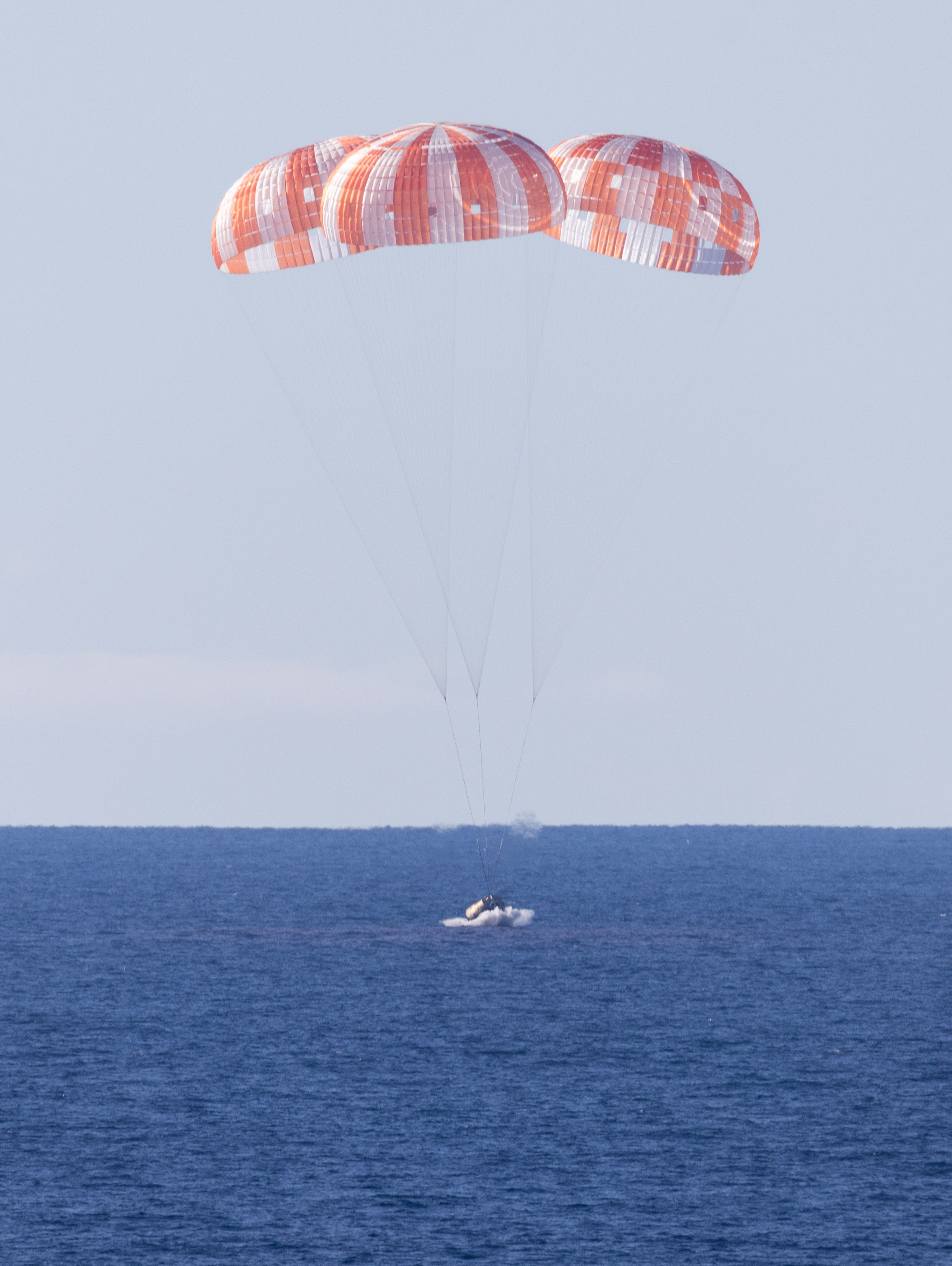
NASA’s Orion spacecraft with Artemis II crewmembers NASA astronauts Reid Wiseman, commander; Victor Glover, pilot; Christina Koch, mission specialist; and CSA (Canadian Space Agency) astronaut Jeremy Hansen, mission specialist aboard was seen as it splashed down at 5:07 p.m. PDT in the Pacific Ocean off the coast of California, Friday, April 10, 2026. NASA’s Artemis II mission took Wiseman, Glover, Koch, and Hansen on a 10-day journey around the Moon and back to Earth.
Credit: NASA/Joel Kowsky

The first astronauts to travel to the Moon in more than half a century are back on Earth after a record-setting mission aboard NASA’s Artemis II test flight.

NASA astronauts Reid Wiseman, Victor Glover, and Christina Koch, and CSA (Canadian Space Agency) astronaut Jeremy Hansen splashed down at 5:07 p.m. PDT Friday off the coast of San Diego, completing a nearly 10-day journey that took them 252,756 miles from home at their farthest distance from Earth.

“Reid, Victor, Christina, and Jeremy, welcome home, and congratulations on a truly historic achievement. NASA is grateful to President Donald Trump and partners in Congress for providing the mandate and resources that made this mission and the future of Artemis possible,” said NASA Administrator Jared Isaacman. “Artemis II demonstrated extraordinary skill, courage, and dedication as the crew pushed Orion, SLS (Space Launch System), and human exploration farther than ever before. As the first astronauts to fly this rocket and spacecraft, the crew accepted significant risk in service of the knowledge gained and the future we are determined to build. NASA also acknowledges the contributions of the entire NASA workforce, along with our international partners, whose expertise and commitment were essential to this mission’s success. With Artemis II complete, focus now turns confidently toward assembling Artemis III and preparing to return to the lunar surface, build the base, and never give up the Moon again.”

After splashdown in the Pacific Ocean, the astronauts were met by a combined NASA and U.S. military team that assisted them out of the spacecraft in open water and transported them via helicopter to the USS John P. Murtha for initial medical checkouts. The crew members are expected to return to NASA’s Johnson Space Center in Houston on Saturday, April 11.

During their mission, Wiseman, Glover, Koch, and Hansen flew 694,481 miles in total. Their lunar flyby took them farther than any humans have ever traveled before, surpassing the previous distance record set by Apollo 13 astronauts in 1970.

The first Artemis crew launched on NASA’s SLS rocket at 6:35 p.m. April 1, from Launch Pad 39B at the agency’s Kennedy Space Center in Florida. With 8.8 million pounds of thrust at liftoff, the American-built rocket propelled the crew inside the Orion spacecraft to space, delivering it to orbit with pinpoint accuracy after a smooth countdown conducted by the agency’s Artemis launch control team.

During the first day in space, the astronauts and teams on the ground checked out the spacecraft — named Integrity by the crew — to confirm all systems were healthy ahead of the transit to the Moon. NASA also deployed four CubeSats from international partners to Earth orbit.

On the second day of the test flight, with all systems Go, Orion’s service module fired its main engine, placing the astronauts on a trajectory that brought them 4,067 miles above the lunar surface at their closest approach.

“The Artemis II crew is home. The entry, descent, and landing systems performed as designed and the final test was completed as intended. This moment belongs to the thousands of people across fourteen countries who built, tested, and trusted this vehicle. Their work protected four human lives traveling at 25,000 miles per hour and brought them safely back to Earth,” said NASA Associate Administrator Amit Kshatriya. “Artemis II proved the vehicle, the teams, the architecture, and the international partnership that will return humanity to the lunar surface. Reid, Victor, Christina, and Jeremy carried the hopes of this world farther than humans have traveled in more than half a century. Fifty‑three years ago, humanity left the Moon. This time, we returned to stay. The future is ours to win.”

With astronauts aboard for the first time, engineers put Orion through a full in‑flight evaluation. The crew tested the spacecraft’s life support systems, confirming Orion can sustain humans in deep space. During several piloting demonstrations, crew members took manual control of the spacecraft, flying Orion to validate its handling and collect data that will guide future rendezvous and docking operations with human-rated landers during Artemis III and beyond.

The crew completed a series of tests to inform how NASA will fly future missions to the Moon, including evaluations of how the spacecraft operates during crew exercise, emergency equipment and procedures, the Orion crew survival system spacesuits, and other critical spacecraft systems.

Wiseman, Glover, Koch, and Hansen also supported scientific investigations to help NASA prepare astronauts to live and work on the Moon as the agency builds a Moon Base and looks toward Mars. These experiments — including the AVATAR investigation, which studies how human tissue responds to microgravity and the deep space radiation environment, and other human research performance studies — are gathering essential health data for long-duration missions.

During their April 6 lunar flyby, the astronauts captured more than 7,000 images of the lunar surface and a solar eclipse, during which the Moon blocked the Sun from Orion’s vantage point. The imagery includes striking views of earthset and earthrise, impact craters, ancient lava flows, our Milky Way galaxy, and surface fractures and color variations across the lunar terrain.

They documented the topography along the terminator — the boundary between lunar day and night — where low-angle sunlight casts long shadows across the surface, creating illumination conditions similar to those in the South Pole region where astronauts are scheduled to land in 2028. The crew also proposed potential names for two lunar craters and reported meteoroid impact flashes on the night side of the Moon.

Artemis II science will pave the way for future missions to the Moon’s surface by helping advance mission operations and training astronauts to use well-informed judgment to identify areas of high interest for science and exploration.

With the crew safely on Earth, NASA and its partners now will turn attention to preparing for next year’s Artemis III mission, when a new Orion crew will test integrated operations with commercially built Moon landers in low Earth orbit.

As part of a Golden Age of innovation and exploration, NASA will send Artemis astronauts on increasingly challenging missions to explore more of the Moon for scientific discovery, economic benefits, establish an enduring human presence on the lunar surface, and lay the groundwork for sending the first astronauts – American astronauts –  to Mars.

To learn more about the Artemis program, visit:

https://www.nasa.gov/artemis

-end-

Bethany Stevens / Rachel Kraft
Headquarters, Washington
202-358-1600
bethany.c.stevens@nasa.gov / rachel.h.kraft@nasa.gov

Powered by WPeMatico

Get The Details…
Jennifer M. Dooren
Crew Preps for Cygnus XL Cargo Mission Targeted for Saturday Launch

Crew Preps for Cygnus XL Cargo Mission Targeted for Saturday Launch

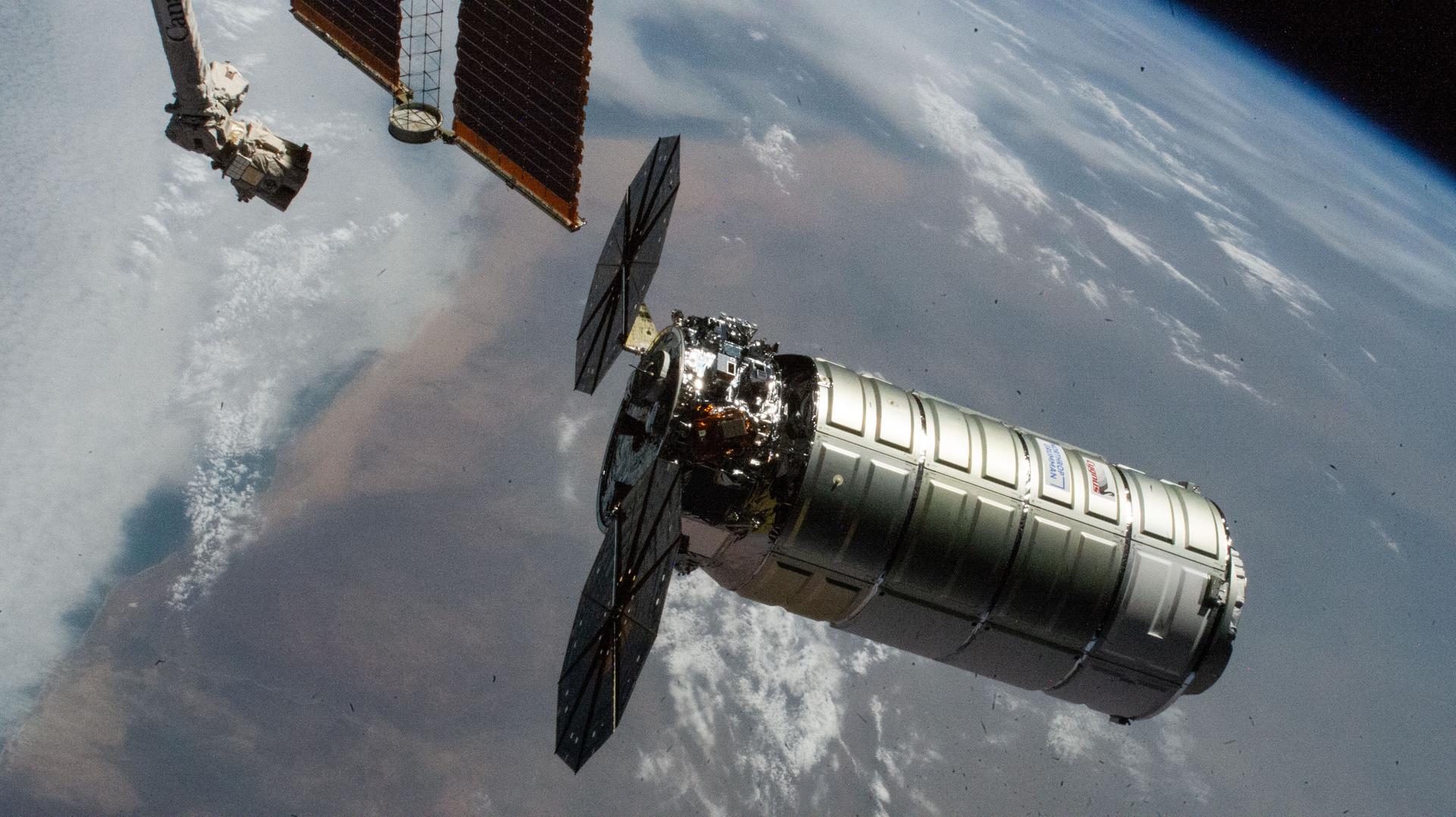
Northrop Grumman's Cygnus XL cargo craft, carrying over 11,000 pounds of new science and supplies for the Expedition 73 crew, is pictiured moments before its capture with the International Space Station's Canadarm2 robotic arm. Both spacecraft were orbiting 257 miles above Namibia. Cygnus XL is Northrop Grumman's expanded version of its previous Cygnus cargo craft increasing its payload capacity and pressurized cargo volume.
Northrop Grumman’s Cygnus XL cargo craft, carrying over 11,000 pounds of new science and supplies for the Expedition 73 crew, is pictiured moments before its capture with the International Space Station’s Canadarm2 robotic arm on Sept. 18, 2025.
NASA

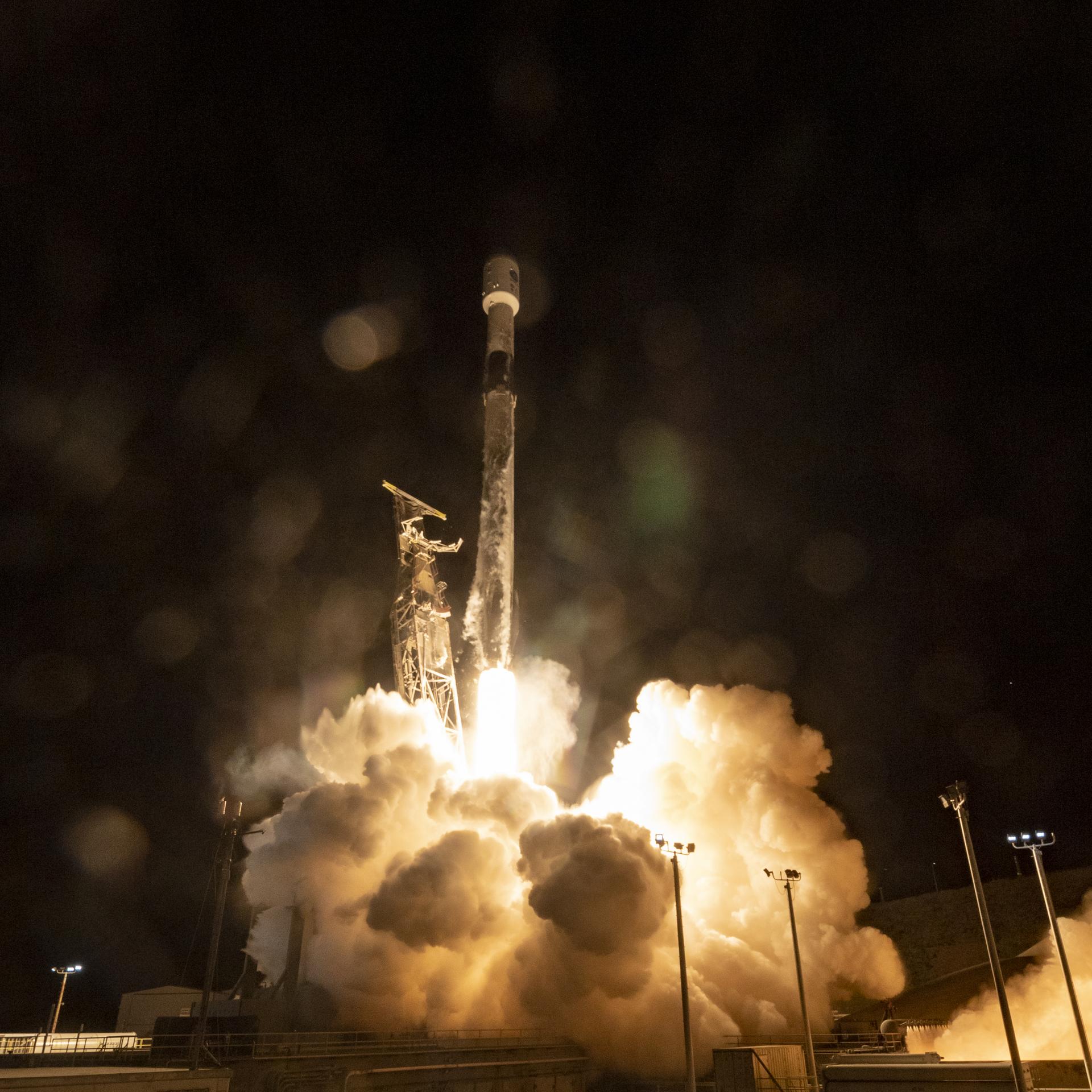
Northrop Grumman’s Cygnus XL cargo spacecraft sits atop a SpaceX Falcon 9 rocket counting down to a launch targeted at 7:41 a.m. EDT on Saturday to resupply the Expedition 74 crew. Packed with over 11,000 pounds of lab hardware, science experiments, and crew supplies, Cygnus XL is due to arrive at the International Space Station where it will be captured with the Candarm2 robotic arm on Monday.

NASA flight engineers Chris Williams and Jack Hathaway joined each other in the cupola on Friday and practiced capturing Cygnus XL during a computer simulation using the robotics workstation. Williams and Hathaway trained to use the workstation’s control panel and hand controllers to maneuver the Canadarm2. The duo watched camera views simulating the Cygnus XL approaching the station and prepared for different capture scenarios.

Williams will be at the controls of the robotics workstation on Monday maneuvering the Canadarm2 to capture Cygnus XL while Hathaway monitors the spacecraft’s approach and rendezvous. Following its capture, mission controllers will take over and remotely command the Canadarm2 to install Cygnus XL to the Unity module’s Earth-facing port where it will stay for a six-month mission.

Watch the agency’s Cygnus XL launch and arrival coverage on NASA+, Amazon Prime, and the agency’s YouTube channel. Learn how to watch NASA content through a variety of platforms, including social media.

Afterward, Williams and Hathaway gathered together with flight engineers Jessica Meir of NASA and Sophie Adenot of ESA (European Space Agency) and called down to mission controllers to discuss cargo operations after the hatches are opened on Cygnus XL. Inside the resupply ship will be a host of new science experiments including a quantum physics module to expand the abilities of the Cold Atom Lab,  a blood stem cell study to treat cancers and blood disorders, an investigation to protect astronaut gut health, and more.

In the Roscosmos segment of the orbital outpost, station commander Sergey Kud-Sverchkov and flight engineer Sergei Mikaev took turns wearing an acoustic sensor around their necks and recorded their rapid exhalation to understand how microgravity affects the respiratory system. Flight engineer Andrey Fedyaev continued testing artificial intelligence tools to improve space crew operations and communications.

Learn more about station activities by following the space station blog, @space_station on X, as well as the ISS Facebook and ISS Instagram accounts.

Get the latest from NASA delivered every week. Subscribe here.

Powered by WPeMatico

Get The Details…

Mark A. Garcia

New Perspective of Home

New Perspective of Home

This image, taken from behind the Moon, shows its half-illuminated surface in sharp detail. To the right, a much smaller crescent Earth can be seen, with shades of blue and white just barely distinguishable. A faint reflection of the Orion spacecraft's window overlays the scene, especially in its right half.
NASA

Seen during Artemis II’s lunar flyby on April 6, 2026, the Moon and Earth align in the same frame, each partially illuminated by the Sun. The Moon’s surface appears in sharp detail in the foreground, while Earth sits much farther away, smaller and softly lit in the background. A faint reflection in the spacecraft window is also visible, subtly overlaying the scene. Though their phases differ, both are shaped by the same sunlight, revealing the geometry of the Sun–Earth–Moon system from deep space.

NASA astronauts Reid Wiseman, Christina Koch, and Victor Glover, and CSA (Canadian Space Agency) astronaut Jeremy Hansen are set to return to Earth, splashing down in the Pacific Ocean around 8:07 p.m. EDT. Watch their return with NASA.

Image credit: NASA

Powered by WPeMatico

Get The Details…
Monika Luabeya

Earthset From the Lunar Far Side

Earthset From the Lunar Far Side

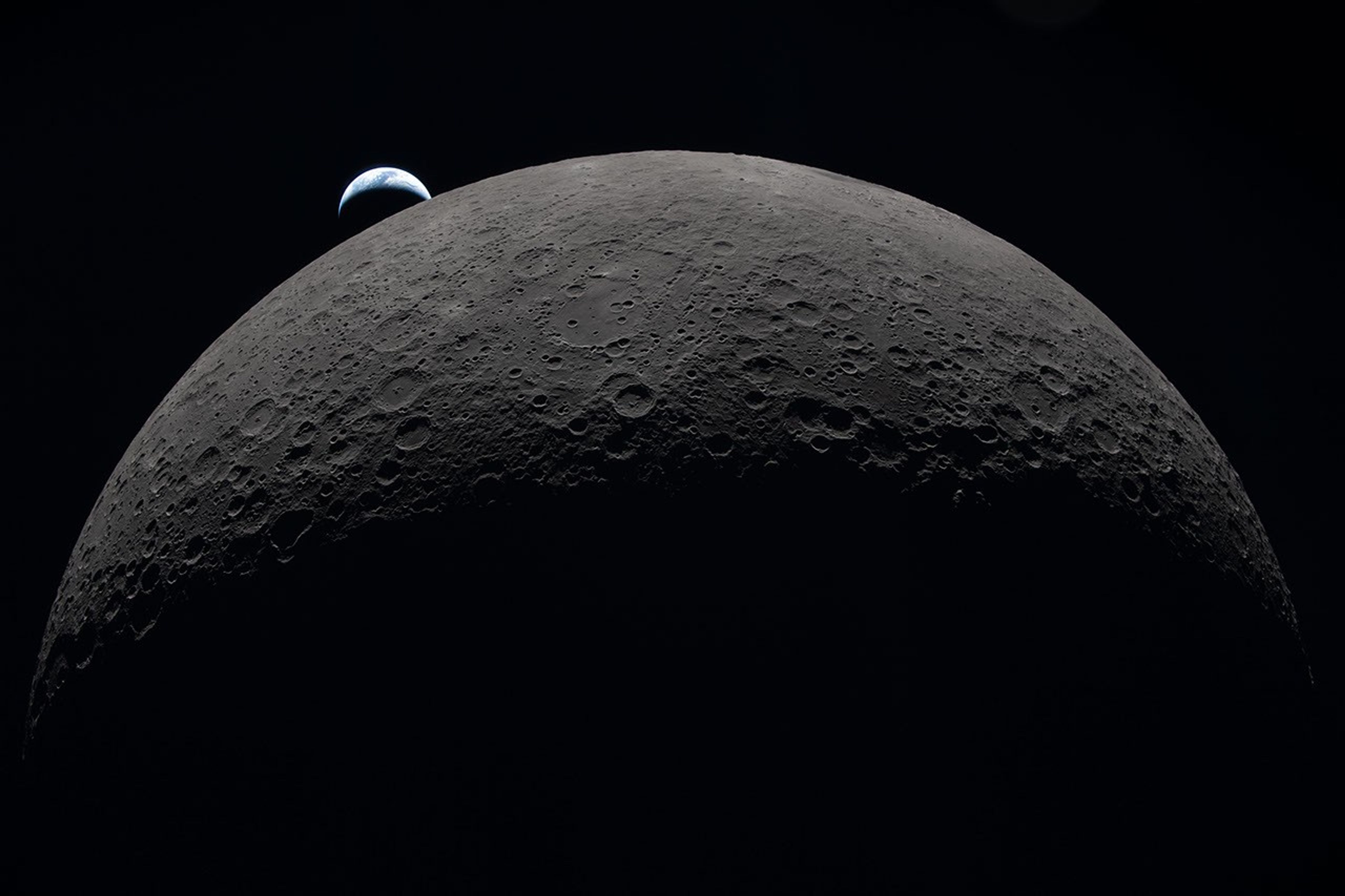
Alt text: The gray-brown, heavily cratered Moon dominates the frame against black space, with a partially lit crescent Earth setting behind its upper-left edge.
April 6, 2026

NASA’s Artemis II mission will conclude its 10-day journey around the Moon on April 10, 2026, when the crew splashes down off the California coast. While additional imagery will continue to be processed after their return, the astronauts have already delivered a remarkable collection of photos. Among them is a shot of Earthset, echoing the iconic Earthrise photos taken by Apollo 8 astronauts in 1968.

During an Earthset, the planet appears to sink below the lunar horizon. In this scene, a partially lit crescent Earth drops behind the Moon as seen by crew on the Orion spacecraft. The Earth’s sunlit side shows white clouds and blue water over the Oceania region, while the dark areas are experiencing nighttime. The image also shows incredible detail of the Moon’s surface and its overlapping craters and basins.

The image was taken at 6:41 p.m. Eastern Daylight Time on April 6, 2026, as the Artemis II astronauts passed behind the Moon’s far side. It is one of many photos taken during the seven-hour flyby, including images of a total solar eclipse, the light from several planetary neighbors, and the long shadows cast along the terminator line where lunar day meets night.

More images from the historic flyby can be viewed in the Artemis II lunar flyby gallery, and other mission photos and resources are available on the mission’s multimedia page. Past views of Earth from afar can be found in this collection from NASA Earth Observatory.

Image by NASA. Text by Kathryn Hansen, adapted from NASA resources.

References & Resources

You may also be interested in:

Stay up-to-date with the latest content from NASA as we explore the universe and discover more about our home planet.

Shades of a Lunar Eclipse

3 min read

A series of nighttime satellite images revealed how moonlight reaching Earth varied throughout a total lunar eclipse.

Article

City Lights Glow Along Moonlit Waters

3 min read

An astronaut photographed moonglint shimmering across the sea surface and the bright clusters of Florida’s cities at night.

Article

The Galaxy Next Door

3 min read

The Large Magellanic Cloud—one of our closest neighboring galaxies—is a hotbed of star formation that is visible to both astronauts…

Article

Powered by WPeMatico

Get The Details…

Busy Day of Space Science and Lab Maintenance Greets Station Crew

Busy Day of Space Science and Lab Maintenance Greets Station Crew

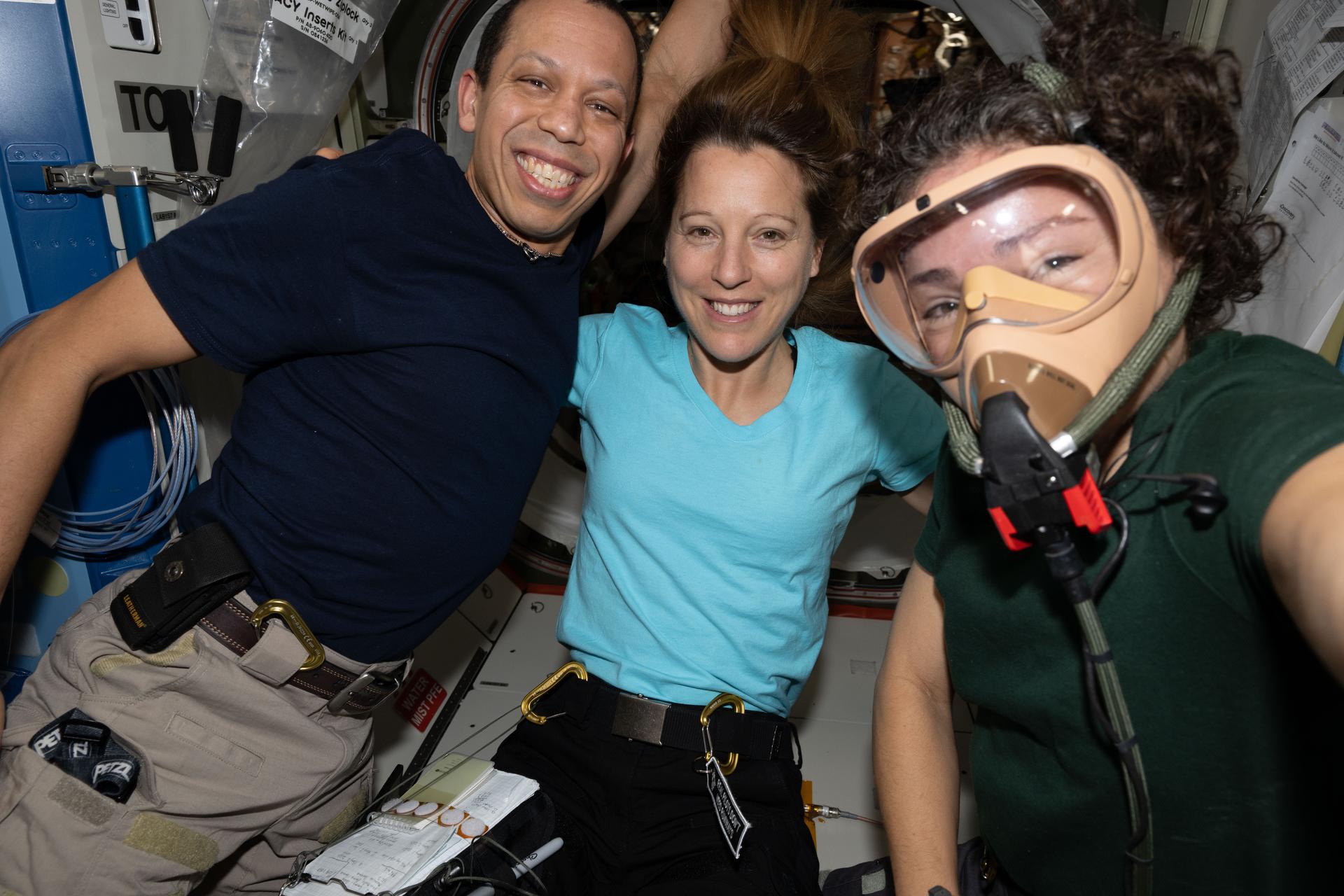
Expedition 74 flight engineers (from left) Chris Williams of NASA, Sophie Adenot of ESA (European Space Agency), and Jessica Meir of NASA pose for a portrait aboard the International Space Station. Meir is wearing a portable breathing apparatus to test its readiness for unlikely emergency scenarios such as an oxygen leak, chemical leak, or fire aboard the orbital outpost.
Astronauts (from left) Chris Williams, Sophie Adenot, and Jessica Meir, who is wearing a portable breathing apparatus for testing purposes, pose for a portrait aboard the International Space Station.
ESA/Sophie Adenot

A packed schedule filled with numerous science objectives and critical lab maintenance tasks greeted the Expedition 74 crew aboard the International Space Station on Thursday. Meanwhile, the orbital residents await the next U.S. cargo mission.

A wide array of research is always ongoing aboard the orbital lab as NASA and its international partners use the unique microgravity environment to gain results unobtainable on Earth. Insights reveal new phenomena that inform scientists and engineers of ways to advance human health and innovate Earth and space industries.

Over 25 years of medical knowledge gained from crews living on the space station has shown that living and working in weightless in the confines of a spacecraft impacts stress and immunity levels. A new investigation sponsored by ESA (European Space Agency) is exploring mindfulness and meditation techniques to manage stress and improve sleep quality during a long-term spaceflight. NASA flight engineer Jessica Meir documented her sleep patterns then collected and stowed her saliva samples for the RelaxPro study. Scientists will analyze the saliva samples to measure how microgravity affects an astronaut’s stress hormones and immune markers.

NASA flight engineer Chris Williams spent most of his day on standard housekeeping and maintenance duties. Williams first stowed spacesuit helmet components inside the Quest airlock. Next, he entered his nutritional and pharmaceutical intake on the EveryWear health data collection app. Finally, Williams stocked and reorganized food packs inside the Unity module making space for new crew supplies being delivered on the upcoming Cygnus XL mission.

NASA flight engineer Jack Hathaway kicked off his shift reviewing safety procedures when connecting electronics gear inside the orbiting lab. Next, Hathaway inventoried biomedical research hardware in the Columbus and Destiny laboratory modules. At the end of his day, he set up a camera inside the Unity’s Earth-facing port where mission controllers tested its downlink video they will use to monitor the arrival of Cygnus XL.

Mission managers continue targeting no earlier than 7:41 a.m. EDT Saturday, April 11, for the launch of Northrop Grumman’s Cygnus XL cargo spacecraft to resupply the Expedition 74 crew. Watch the agency’s launch and arrival coverage on NASA+, Amazon Prime, and the agency’s YouTube channel. Learn how to watch NASA content through a variety of platforms, including social media.

The small TUSK experimental robotic arm was configured inside the Kibo laboratory module for a technology demonstration by flight engineer Sophie Adenot of ESA (European Space Agency) at the beginning of her shift. TUSK seeks to save crew time and test the robotic arm’s precise, sub-millimeter motion in weightlessness. Adenot wrapped up her shift familiarizing herself with spacewalking hardware then videotaping how to measure the human body’s height, arm length, and leg length as they expand due to the lack of gravity.

The orbital outpost’s three cosmonauts focused on their list of research and lab upkeep throughout the International Space Station’s Roscosmos segment on Thursday. Station commander Sergey Kud-Sverchkov and flight engineer Sergei Mikaev took turns filling out a questionnaire to help researchers understand a crew member’s decision‑making styles, stress responses, interpersonal approaches, and preferred working patterns. The duo then split up conducting life support maintenance and cargo transfers. Flight engineer Andrey Fedyaev spent his shift on European robotic arm maintenance inside the Nauka science module.

Learn more about station activities by following the space station blog, @space_station on X, as well as the ISS Facebook and ISS Instagram accounts.

Get the latest from NASA delivered every week. Subscribe here.

Powered by WPeMatico

Get The Details…

Mark A. Garcia