NASA Awards Contract to Launch Initial Elements for Lunar Outpost
NASA has selected Space Exploration Technologies (SpaceX) of Hawthorne, California, to provide launch services for the agency’s Power and Propulsion Element (PPE) and Habitation and Logistics Outpost (HALO), the foundational elements of the Gateway.
Two Cargo Ships Near Launch as Crew Conducts Space Research
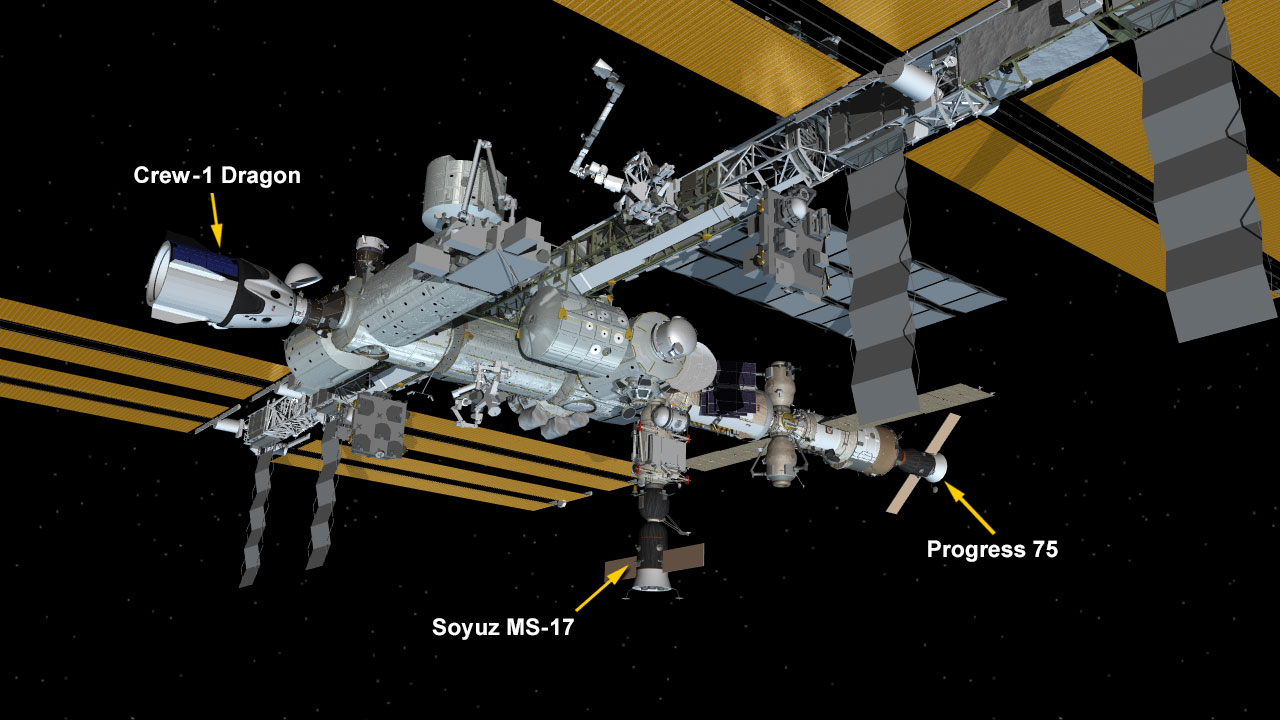
Feb. 8, 2021: International Space Station Configuration. Three spaceships are docked at the space station including the SpaceX Crew Dragon and Russia’s Progress 75 resupply ship and Soyuz MS-17 crew ship.
A Russian resupply ship departed the International Space Station overnight as two more cargo missions get ready for their launch. Meanwhile, the Expedition 64 crew has been focusing on space research exploring botany and biology.
Russia’s uncrewed ISS Progress 76 space freighter undocked from the station’s Pirs docking compartment early Tuesday packed with trash and discarded gear. The Progress 76 then fired its engines one last time for a safe, but fiery reentry above the Pacific Ocean ending its six-and-a-half-month cargo mission.
A new Russian space freighter, the ISS Progress 77, is gearing up for its launch to the station on Sunday at 11:45 p.m. EST from the Baikonur Cosmodrome in Kazakhstan. It will dock to Pirs’ vacant port two days later delivering 1.1 tons of nitrogen, water and propellant.
The U.S. Cygnus cargo craft from Northrop Grumman will follow the Progress 77 blasting off from Virginia on Feb. 20. It will rendezvous with the station for a robotic capture and installation on Feb. 22 carrying about 8,000 pounds of crew supplies and science experiments.
Space scientists are learning how to grow food in space so future crews can support themselves on long-term missions to the Moon, Mars and beyond. Today, NASA Flight Engineer Shannon Walker set up hydroponics components for a study exploring ways to sustain plants in microgravity from germination through harvest.
Flight Engineer Kate Rubins swabbed station surfaces on Tuesday collecting microbe samples for DNA sequencing to understand their adaptation to weightlessness. Flight Engineer Victor Glover strapped himself into a restraint then wore a virtual reality headset to understand how an astronaut visually interprets motion, orientation, and distance in space.
The two cosmonauts, Commander Sergey Ryzhikov and Flight Engineer Sergey Kud-Sverchkov, trained to remotely dock a spacecraft in the unlikely event its automated rendezvous system fails. The duo practiced using the tele-robotically operated rendezvous unit (TORU) to safely maneuver a spacecraft to its docking port.
This view of a sunrise breaking through the Earth’s horizon was taken as the International Space Station orbited 271 miles above the Pacific Ocean off the coast of southern Chile.
NASA Celebrates Black History Month with Lessons from African American Leaders
As part of its celebration of Black History Month, NASA will host a virtual discussion at 12 p.m. EST Wednesday, Feb. 10, featuring a panel of current and past agency leaders.
Crew Gets Ready for Cargo Missions, Opens New Airlock
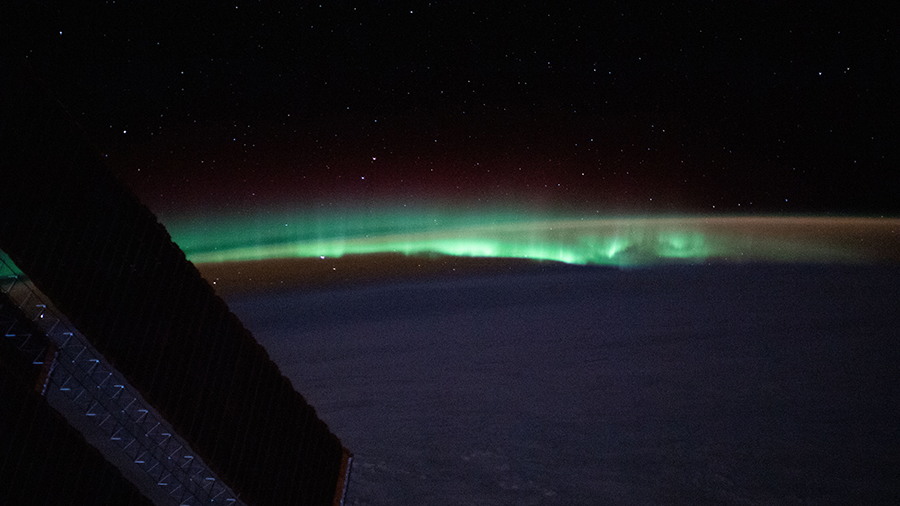
Earth’s atmospheric glow and the aurora blanket the horizon as the space station orbited above the North Atlantic.
Two cargo rockets on opposite sides of the world are nearing their launch to resupply the Expedition 64 crew this month. A new science and cargo airlock installed late last year on the International Space Station is now open for business.
Russia’s Progress 76 (76P) cargo craft, packed with trash and discarded hardware, will depart the orbiting lab tonight completing a 201-day mission attached to the Pirs docking compartment. It will deorbit a few hours later for a fiery, but safe destruction over the South Pacific.
The 76P will be replaced after the Progress 77 (77P) cargo craft blasts off on Feb. 14 at 11:45 p.m. EST from the Baikonur Cosmodrome in Kazakhstan. The 77P will dock to the vacant Pirs port a little more than two days later on Feb. 17 at 1:20 a.m. The launch and docking activities will be broadcast live on NASA TV.
The next cargo mission to resupply the station will be Northrop Grumman’s Cygnus cargo ship lifting off atop an Antares rocket on Feb. 20 from Virginia. Cygnus will be delivering about 8,000 pounds of station hardware, science experiments, and crew supplies to replenish the orbiting lab on Feb. 22. It will be captured with the Canadarm2 robotic arm and installed to the Unity module‘s Earth-facing port.
Aboard the space station today, NASA astronauts Kate Rubins and Victor Glover configured and opened the NanoRacks Bishop airlock. Bishop was attached to the station’s Tranquility module on Dec. 19 two weeks after it was delivered inside the SpaceX Cargo Dragon spacecraft. Bishop will enable more commercial research, satellite deployments, and cargo operations outside in the vacuum of space.