NASA, SpaceX Work Toward Friday Morning Crew-12 Launch

NASA, SpaceX Work Toward Friday Morning Crew-12 Launch

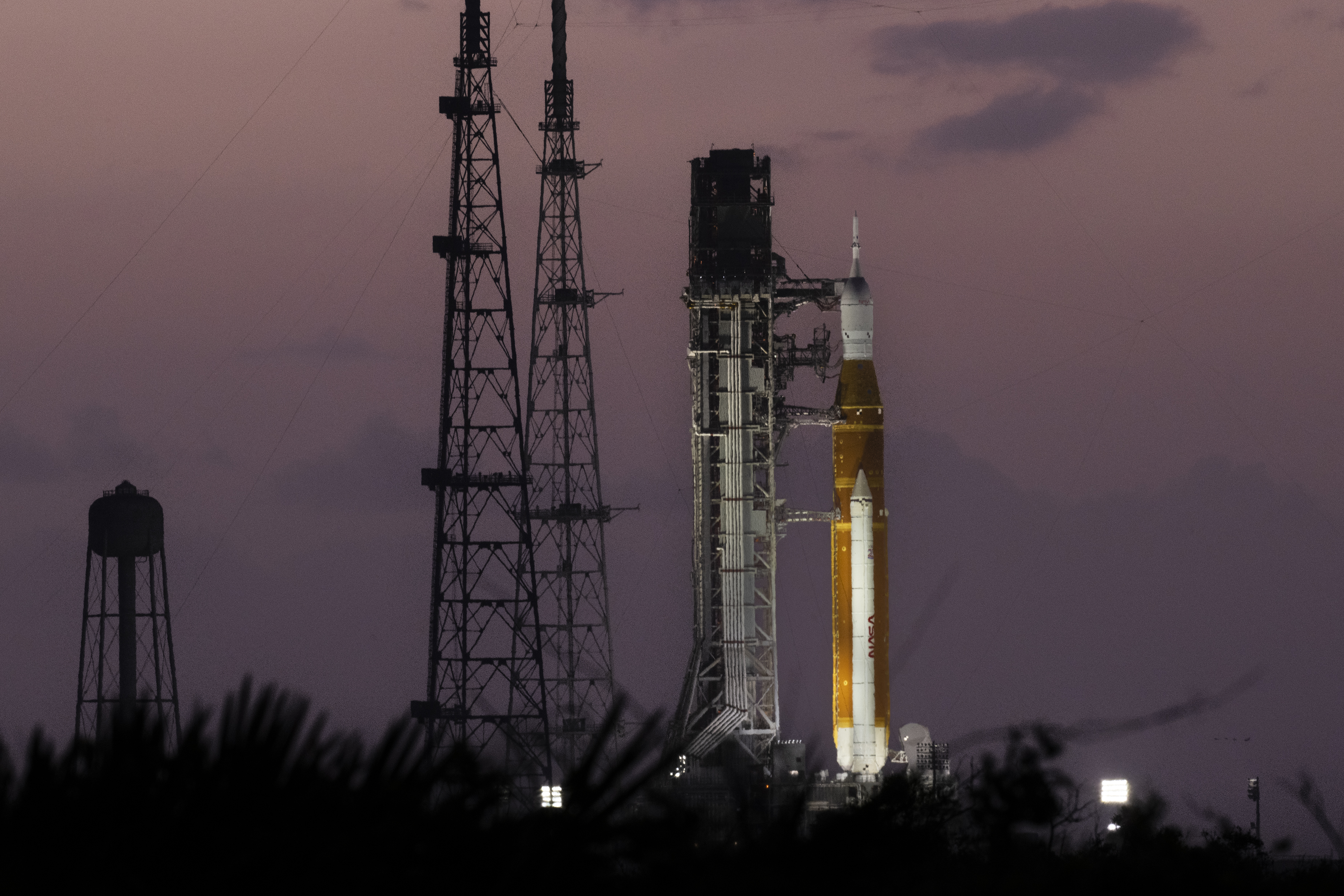
Image shows a sunset at Space Launch Complex 40 at Cape Canaveral Space Force Station in Florida on Tuesday, Feb. 10, 2026. A SpaceX Falcon 9 rocket with the company's spacecraft is atop, along with the crew access arm and lighting tower. Photo credit: NASA/Aubrey Gemignani
A SpaceX Falcon 9 rocket with the company’s Dragon spacecraft on top is seen on the launch pad at sunset at Space Launch Complex 40 as preparations continue for the Crew-12 mission, Tuesday, Feb. 10, 2026, at Cape Canaveral Space Force Station in Florida.
NASA/Aubrey Gemignani

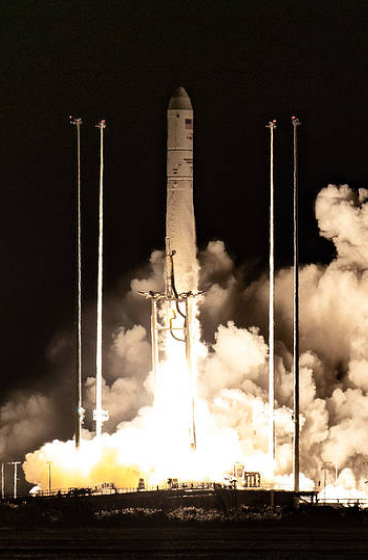
NASA and SpaceX teams are continuing final preparations on Thursday as the four crew members of Crew-12 follow their own precise checklist of activities before they launch to the International Space Station. Crew-12 is set to lift off from Space Launch Complex 40 at Cape Canaveral Space Force Station in Florida at 5:15 a.m. EST Friday, Feb. 13, aboard a SpaceX Dragon spacecraft and Falcon 9 rocket.

Weather forecasters issued an improved outlook for the launch site conditions, with a 90% chance of acceptable weather at launch time. They also will be watching the weather conditions along Crew-12’s flight path throughout the countdown, specifically the potential for elevated wind speeds. After detailed weather briefings Thursday morning, forecasters and mission managers opted to continue into the Crew-12 launch countdown. They will again review the forecast around 10 p.m. Thursday, a few hours before the crew suits up.

NASA astronauts Jessica Meir, commander, and Jack Hathaway, pilot, ESA (European Space Agency) astronaut Sophie Adenot, and Roscosmos cosmonaut Andrey Fedyaev will fly aboard the Dragon spacecraft to begin an eight-month rotation aboard the space station, where they will conduct a host of experiments. They will return the orbiting laboratory to its full crew complement of seven crew members following the return of Crew-11 in January.

Crew-12 will be SpaceX’s 12th crew rotational flight to the space station and 13th crewed mission as part of NASA’s Commercial Crew Program.

Watch NASA’s live launch coverage starting at 3:15 a.m., on Feb. 13 on NASA+, Amazon Prime, and the agency’s YouTube channel. Learn how to watch NASA content through a variety of online platforms, including social media. Launch blog coverage begins at 1:15 a.m. on Feb. 13. 

For a Feb. 13 launch, Crew-12 would arrive at the space station at approximately 3:15 p.m. Saturday, Feb. 14. NASA’s live coverage of Crew-12’s arrival to the space station will begin at 1:15 p.m. on NASA+, Amazon Prime, and the agency’s YouTube channel. 

Powered by WPeMatico

Get The Details…

Elyna Niles-Carnes

Crew-12 Proceeds to Friday Launch as Health Research Continues on Station

Crew-12 Proceeds to Friday Launch as Health Research Continues on Station

A SpaceX Falcon 9 rocket with the company's Dragon spacecraft on top is seen on the launch pad at sunset at Space Launch Complex 40 as preparations continue for the Crew-12 mission, Tuesday, Feb. 10, 2026, at Cape Canaveral Space Force Station in Florida. NASA’s SpaceX Crew-12 mission is the twelfth crew rotation mission of the SpaceX Dragon spacecraft and Falcon 9 rocket to the International Space Station as part of the agency’s Commercial Crew Program. NASA astronauts Jessica Meir, Jack Hathaway, ESA (European Space Agency) astronaut Sophie Adenot, and Roscosmos cosmonaut Andrey Fedyaev are scheduled to launch at 5:15 a.m. EST on Friday, Feb. 13, from Space Launch Complex 40.
A SpaceX Falcon 9 rocket with the company’s Dragon spacecraft on top is seen at Space Launch Complex 40 as preparations continue for the Crew-12 mission’s launch from Cape Canaveral Space Force Station in Florida to the International Space Station.
NASA/Aubrey Gemignani

NASA and SpaceX continue proceeding toward a launch of Crew-12 to the International Space Station for no earlier than 5:15 a.m. EST on Friday, Feb. 13. NASA astronauts Jessica Meir and Jack Hathaway, ESA (European Space Agency) astronaut Sophie Adenot, and Roscosmos cosmonaut Andrey Fedyaev will ride a SpaceX Dragon to the orbital outpost for a docking at 3:15 p.m. on Saturday, Feb. 14.

NASA’s Crew-12 launch coverage begins at 3:15 a.m. on Friday with docking coverage starting at 1:15 p.m. on Saturday on NASA+. Learn how to watch NASA content through a variety of online platforms, including social media.

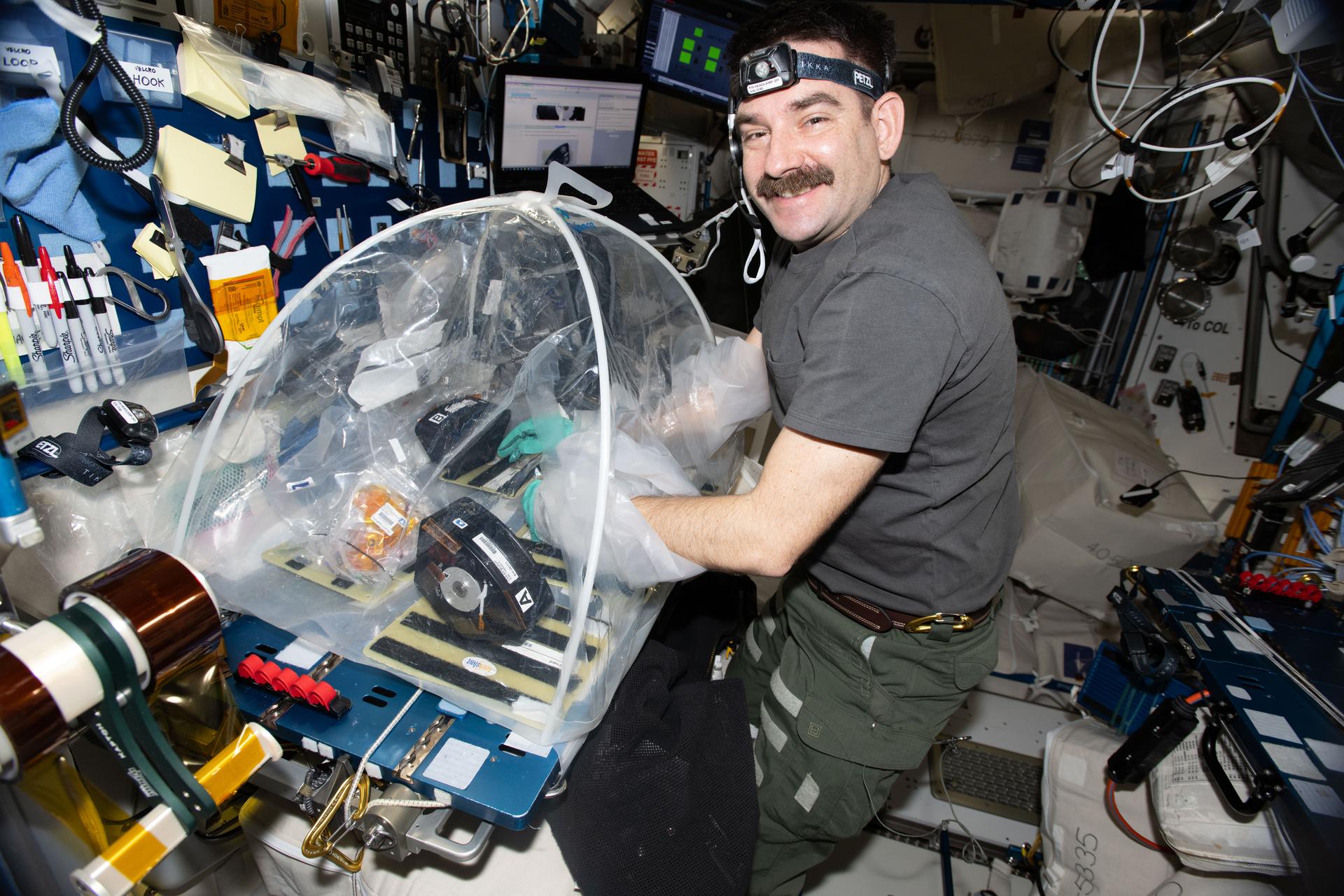
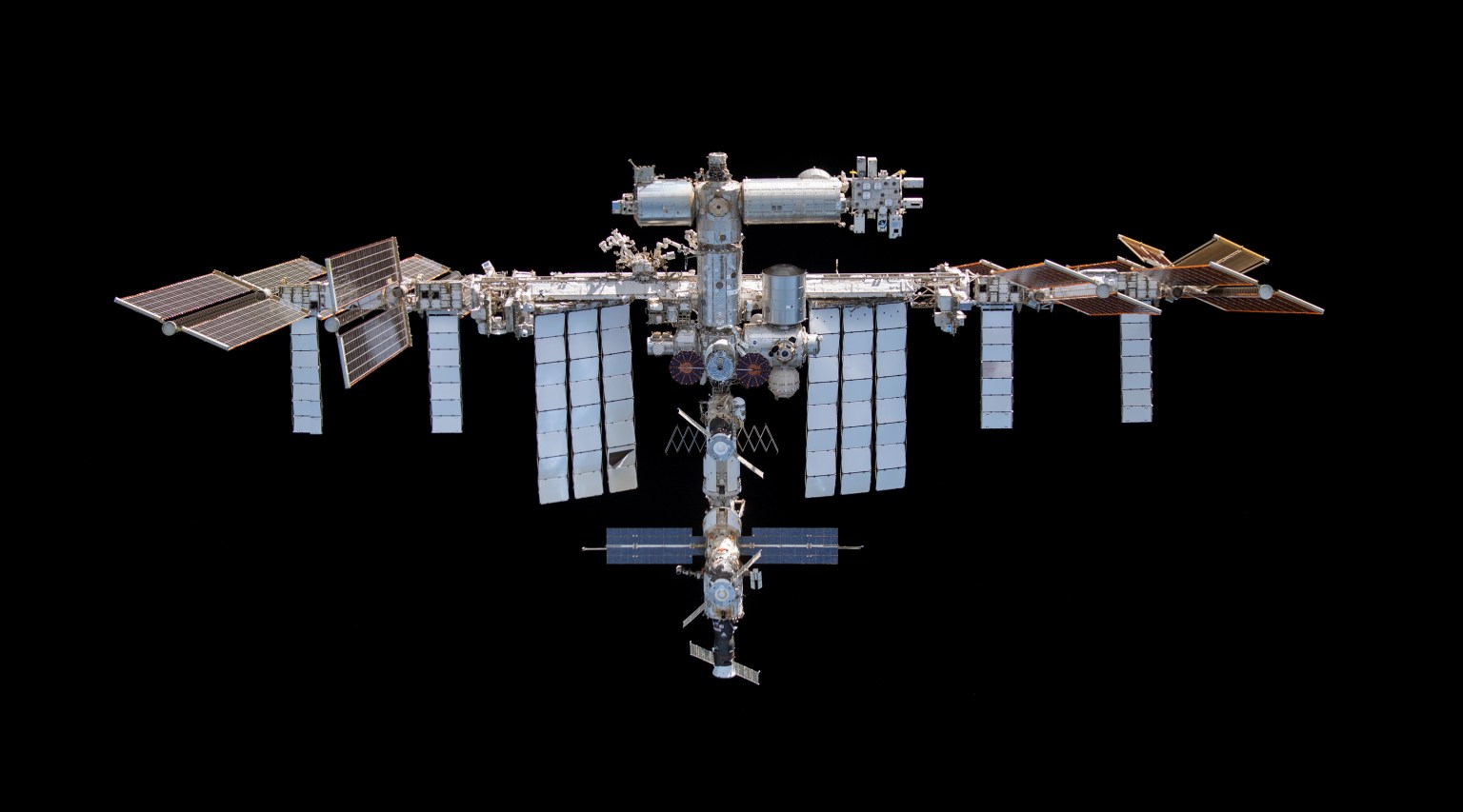
Back onboard the orbital outpost, NASA Flight Engineer Chris Williams continued staging gear the Crew-12 quartet will use throughout its long-duration research mission on the station. Williams also set up the Lumina radiation monitoring experiment and transferred the radiation data it collected to the EveryWear health data application for later analysis. Finally, the first-time lab resident loaded trash and obsolete gear inside the HTV-X1 cargo craft from JAXA (Japan Aerospace Exploration Agency) targeted to end its mission at the orbital outpost in March.

Station commander Sergey Kud-Sverchkov of Roscosmos began his shift testing the performance of the regenerative water recycling system in the Zvezda service module then sending the results to mission controllers on the ground. The veteran cosmonaut also treated moisture-prone surfaces for mold and mildew in the Zvezda and Nauka modules to maintain the safety and reliability of station hardware and systems.

Roscosmos Flight Engineer Sergei Mikaev began his shift taking a memory test, answering a questionnaire, and collecting his hair samples for analysis helping researchers understand how living in space affects stress, cognitive performance, and immune function. Next, Mikaev removed air bubbles from fluid systems, transferred water between tanks, then photographed the results helping engineers on the ground ensure the operability of life support hardware. He wrapped up his shift in the Zarya module inspecting and videotaping the operation of fans to determine their acoustic characteristics.

Learn more about station activities by following the space station blog, @space_station on X, as well as the ISS Facebook and ISS Instagram accounts.

Get the latest from NASA delivered every week. Subscribe here.

Powered by WPeMatico

Get The Details…

Mark A. Garcia

NASA Selects Vast for Sixth Private Mission to Space Station

NASA Selects Vast for Sixth Private Mission to Space Station

The letters NASA on a blue circle with red and white detail, all surrounded by a black background
Credit: NASA

NASA and Vast have signed an order for the sixth private astronaut mission to the International Space Station, targeted to launch no earlier than summer 2027 from Florida.

This private astronaut mission marks the company’s first selection to the orbiting laboratory, underscoring NASA’s ongoing investment in fostering a commercial space economy and expanding opportunities for private industry in low Earth orbit.

“Private astronaut missions represent more than access to the International Space Station — they create opportunities for new ideas, companies, and capabilities that further enhance American leadership in low Earth orbit and open doors for what’s next,” said NASA Administrator Jared Isaacman. “We’re proud to welcome Vast to this growing community of commercial partners. Each new entrant brings unique strengths that fuel a dynamic, innovative marketplace as we advance research and technology and prepare for missions to the Moon, Mars, and beyond.”

The mission is expected to spend up to 14 days aboard the space station. A specific launch date will depend on overall spacecraft traffic at the orbital outpost and other planning considerations.

“The International Space Station plays an essential role in shaping the future of low Earth orbit,” said Dana Weigel, manager, International Space Station Program at NASA’s Johnson Space Center in Houston. “By hosting private astronaut missions, the station helps accelerate innovation, opens new commercial pathways, and advances research strengthening the foundation of a thriving space economy.”

Vast will submit four proposed crew members to NASA and its international partners for review. Once approved and confirmed, they will train with NASA, international partners, and SpaceX for their flight. The company has contracted with SpaceX as launch provider for transportation to and from the space station.

“Vast is honored to have been selected by NASA for the sixth private astronaut mission to the International Space Station,” said Max Haot, CEO of Vast. “Leveraging the remaining life of the space station with science and research-led commercial crewed missions is a critical part of the transition to commercial space stations and fully unlocking the orbital economy.”

The company will purchase mission services from NASA, including crew consumables, cargo delivery, storage, and other in-orbit resources for daily use. NASA will purchase the capability to return scientific samples that must remain cold during transit back to Earth.

NASA made the selection from proposals received in response to its March 2025 NASA Research Announcement.

Missions aboard the International Space Station, including private astronaut missions, help advance scientific knowledge and demonstrate new technologies in the unique microgravity environment. These commercial efforts in low Earth orbit are helping develop capabilities and technologies that could support NASA’s long-term goals for missions beyond low Earth orbit, including deep space exploration to the Moon and eventually to Mars through the agency’s Artemis campaign.

Learn more about NASA’s commercial space strategy at:

https://www.nasa.gov/commercial-space

-end-

Jimi Russell
Headquarters, Washington
202-358-1600
james.j.russell@nasa.gov

Anna Schneider / Joseph Zakrzewski
Johnson Space Center, Houston
281-483-5111
anna.c.schneider@nasa.gov / joseph.a.zakrzewski@nasa.gov

Powered by WPeMatico

Get The Details…
Tiernan P. Doyle

NASA Moon Mission Spacesuit Nears Milestone

NASA Moon Mission Spacesuit Nears Milestone

4 min read

Preparations for Next Moonwalk Simulations Underway (and Underwater)
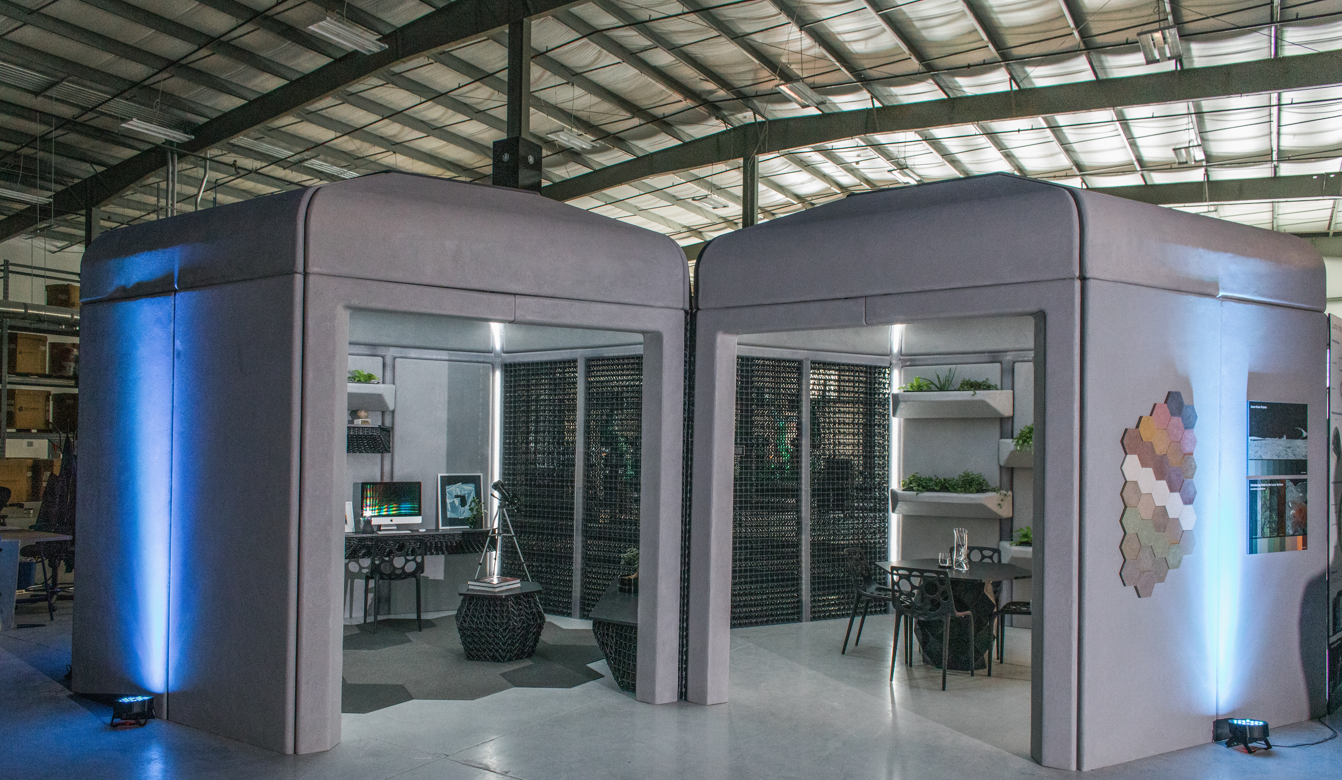
A NASA crew member practices using lunar tools to collect geology samples at NASA’s Johnson Space Center during an elevated suit pressure test where teams evaluate how well crew perform tasks in different suit pressure levels while wearing the Artemis III lunar spacesuit developed by Axiom Space called the AxEMU (Axiom Extravehicular Mobility Unit).
NASA/Bill Stafford

The next-generation spacesuit for NASA’s Artemis III mission continues to advance by passing a contractor-led technical review, as the agency prepares to send humans to the Moon’s South Pole for the first time. Testing is also underway for the new suits, built by Axiom Space, with NASA astronauts and spacesuit engineers recently simulating surface operations and tasks underwater to demonstrate safety and mobility. 

The AxEMU (Axiom Extravehicular Mobility Unit), is designed to give astronauts increased flexibility and improved mobility for moonwalking, including bending down to collect geology samples and perform a variety of scientific tasks. The suit features increased sizing options and adjustability to fit a wider range of crew members. It incorporates advanced life-support systems and enhanced protection to withstand the harsh lunar environment. Axiom Space is also developing specialized tools and equipment for work on the lunar surface, allowing astronauts to more easily gather geology samples.  

Now that Axiom Space has completed their technical review of the AxEMU, NASA will evaluate whether the spacesuit is ready for the agency’s Artemis III mission that will return American astronauts to the Moon. A NASA-led critical design sync review, which is an agency-required technical evaluation, will confirm that the design’s hardware and systems are on track for final testing and delivery. In parallel, Axiom Space has begun receiving parts for the first flight unit, which will be assembled later this spring.

This achievement reflects our shared commitment to deliver a safe, capable lunar spacesuit that will enable astronauts to explore the Moon’s surface.

Lara Kearney

Lara Kearney

Manager, Extravehicular Activity and Human Surface Mobility Program

“The completion of their internal review brings Axiom Space one step closer to delivering a next-generation lunar spacesuit,” said Lara Kearney, manager of the Extravehicular Activity and Human Surface Mobility Program at Johnson Space Center in Houston. “This achievement reflects our shared commitment to deliver a safe, capable lunar spacesuit that will enable astronauts to explore the Moon’s surface.”

NASA and Axiom Space have conducted over 850 hours of pressurized testing with a person inside the AxEMU. Leading up to the review, teams conducted underwater and simulated lunar gravity tests of the AxEMU in facilities at NASA Johnson that demonstrate how the spacesuit’s capabilities will offer increased mobility as astronauts explore the Moon’s surface and prepare for missions to Mars. These tests allow astronauts and engineers to become familiar with the spacesuit and practice moving and performing tasks in a simulated lunar gravity environment, which is one-sixth the gravity we experience on Earth. Suit users have provided feedback on design, functionality, and safety.

Agency and Axiom Space teams recently finished the first series of test runs in the Neutral Buoyancy Laboratory at NASA Johnson. While in the 40-foot-deep pool, they weighted the AxEMU to match lunar gravity and assessed functionality and ease of movement.

Now, teams are in the middle of evaluating how well test subjects can perform tasks while wearing the spacesuit in different suit pressure levels in NASA Johnson’s Active Response Gravity Offload System facility. The agency uses an overhead lift system that connects to a spacesuit to create a reduced-gravity environment allowing anyone in the suit to walk around in simulated lunar gravity. Higher suit pressures reduce time to acclimate to the suits, enabling astronauts to spend more time walking on the lunar surface during Artemis missions.

Astronaut safety is NASA’s top priority for the Artemis campaign. Using more than 50 years of spacesuit expertise, NASA defined the technical and safety standards and requirements by which the next generation of lunar spacesuits are being built. At key milestones in the spacesuit’s development, NASA has and will continue to verify the AxEMU and its system deliverables to ensure the risk to the Artemis crew members is understood and minimized. 

NASA’s spacesuits contract is managed by the Extravehicular Activity and Human Surface Mobility Program which serves as the agency’s program to develop next-generation spacesuits, human-rated rovers, and spacewalking tools, along with all required spacewalking support systems that will enable astronauts to survive and work outside the confines of a spacecraft to explore on and around the Moon. 

As part of a Golden Age of innovation and exploration, NASA’s Artemis astronauts will use these new spacesuits, along with advanced landers and rovers, to explore more of the Moon for scientific discovery, economic benefits, and to prepare for future human exploration of Mars.

Learn more about NASA’s Artemis campaign at:

https://www.nasa.gov/artemis

Powered by WPeMatico

Get The Details…
Victoria Ugalde

Shimmering Light in Egg Nebula

Shimmering Light in Egg Nebula

In the image center, an opaque oval cloud of gray gas aligned from 1 o’clock to 7 o’clock hides a star. Two strong beams of light from the star emerge from large holes in both sides of the cloud, forming narrow cones extending toward 10 o’clock and 4 o’clock. The central cloud is surrounded by concentric, wispy shells of gas illuminated by the star’s light. The shells reflect extra light where they’re hit by the twin beams. A crowd of smaller stars with cross-shaped spikes over them surrounds the nebula on a black background.
NASA’s Hubble Space Telescope reveals the clearest view yet of the Egg Nebula. This structure of gas and dust was created by a dying, Sun-like star. These newest observations were taken with Hubble’s Wide Field Camera 3.
NASA, ESA, Bruce Balick (UWashington)

This image from NASA’s Hubble Space Telescope released on Feb. 10, 2026, reveals a dramatic interplay of light and shadow in the Egg Nebula, sculpted by freshly ejected stardust. Located approximately 1,000 light-years away in the constellation Cygnus, the Egg Nebula features a central star obscured by a dense cloud of dust — like a “yolk” nestled within a dark, opaque “egg white.”

It is the first, youngest, and closest pre-planetary nebula ever discovered. (A pre-planetary nebula is a precursor stage of a planetary nebula, which is a structure of gas and dust formed from the ejected layers of a dying, Sun-like star. The term is a misnomer, as planetary nebulae are not related to planets.) 

Read more about the Egg Nebula.

Image credit: NASA, ESA, Bruce Balick (UWashington)

Powered by WPeMatico

Get The Details…
Monika Luabeya