Spacewalkers Conclude Today’s Spacewalk

Spacewalkers Conclude Today’s Spacewalk
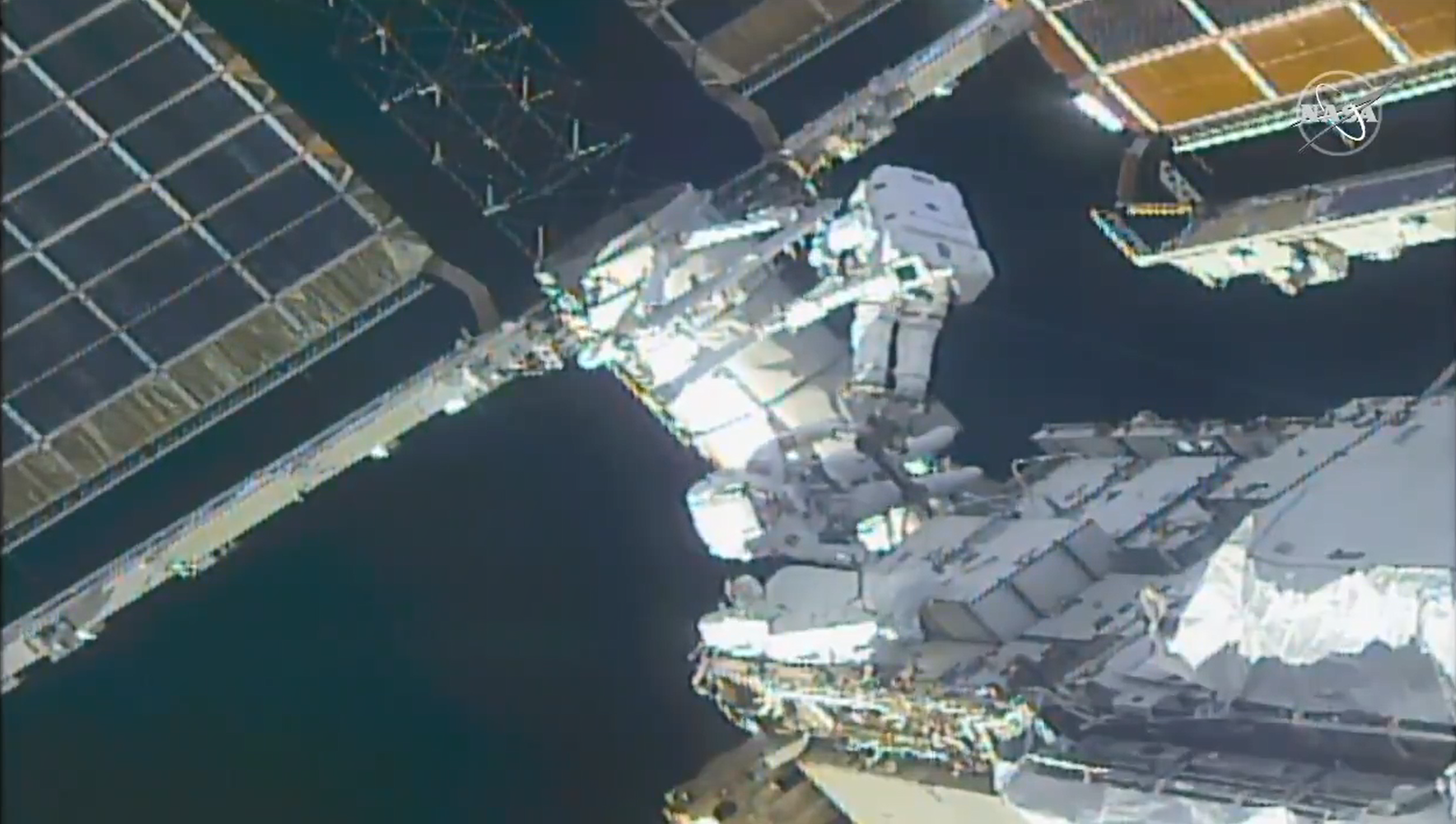
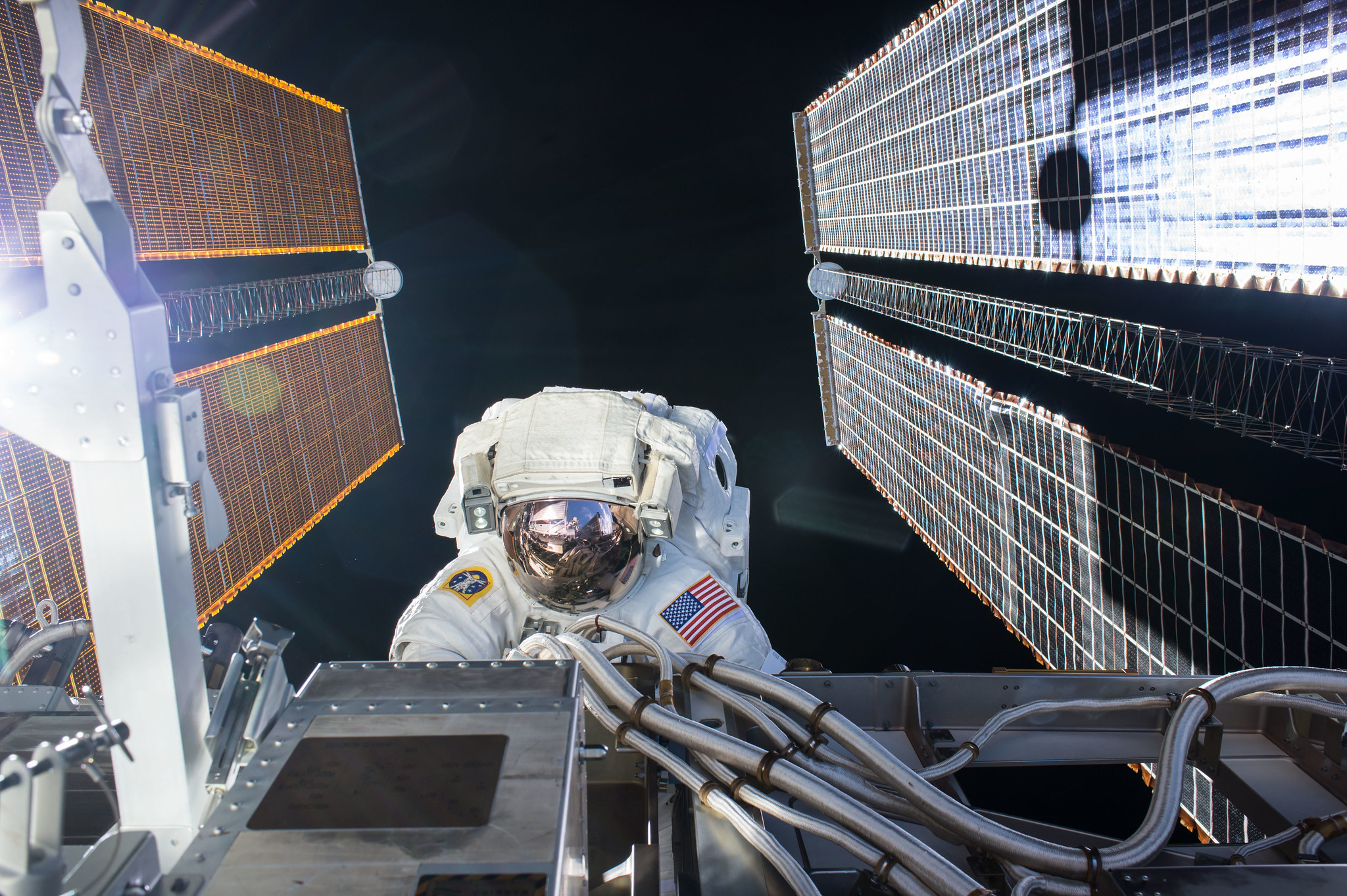
Spacewalkers Victor Glover and Kate Rubins are pictured at the mast canister, installing bracket support struts to the base of the solar array on Feb, 28th 2021.

NASA astronauts Kate Rubins and Victor Glover concluded their spacewalk at 1:16 p.m. EST, after 7 hours and 4 minutes. In the third spacewalk of the year outside the International Space Station, the two NASA astronauts began work to install modification kits required for upcoming solar array upgrades.

The duo worked near the farthest set of existing solar arrays on the station’s left (port) side, known as P6. Glover built a bracket structure and worked with Rubins to attach the bracket and support struts to the mast canister, the base, of one of the P6 solar arrays, known as 2B. One of the bolts did not fully engage on the first attempt, so Rubins used a power drill to back it out and reseat it, then used a ratchet wrench to tighten the bolt, reaching a safe configuration. The bolt likely will need to be secured further before installing one of the new solar arrays that will be delivered to the space station later this year aboard SpaceX’s 22nd commercial resupply services mission.

Rubins and Glover then moved to begin identical assembly work for the bracket for the second of the P6 solar array pair, known as 4B. They completed the construction of upper support hardware and secured it to the space station’s exterior structure until work can be completed on the next spacewalk on Friday, March 5.

To ensure a sufficient power supply is maintained for NASA’s exploration technology demonstrations for Artemis and beyond as well as utilization and commercialization, NASA is augmenting six of the eight existing power channels of the space station with new solar arrays. The new solar arrays, a larger version of the Roll-Out Solar Array (ROSA) technology, will be positioned in front of six of the current arrays, ultimately increasing the station’s total available power from 160 kilowatts to up to 215 kilowatts. The current solar arrays are functioning well but have begun to show signs of degradation, as expected, as they were designed for a 15-year service life.

This was the third career spacewalk for both Rubins and Glover. Rubins has now spent a total of 19 hours and 50 minutes spacewalking. Glover now has spent a total of 19 hours and 20 minutes spacewalking.

Space station crew members have conducted 235 spacewalks in support of assembly and maintenance of the orbiting laboratory. Spacewalkers have now spent a total of 61 days, 14 hours, and 11 minutes working outside the station.

During the spacewalk March 5, Rubins and Japan Aerospace Exploration Agency (JAXA) astronaut Soichi Noguchi will venture outside the orbiting outpost to complete the installation of the 4B array modification kit and are expected to tackle additional work, including the venting of ammonia from the Early Ammonia System.

Learn more about station activities by following the space station blog, @space_station and @ISS_Research on Twitter as well as the ISS Facebook and ISS Instagram accounts.

Get The Details…

Norah Moran

Powered by WPeMatico

Astronauts Rubins and Glover Begin Spacewalk

Astronauts Rubins and Glover Begin Spacewalk

NASA Astronaut Kate Rubins during a six-hour and 48-minute spacewalk on Sept. 1, 2016.

NASA astronauts Kate Rubins and Victor Glover have begun their spacewalk outside the International Space Station to begin assembling and installing modification kits required for upcoming solar array upgrades.

The spacewalkers switched their spacesuits to battery power at 6:12 a.m. EST to begin the spacewalk, which is expected to last about six and a half hours.

Watch the spacewalk on NASA TV, the NASA app, and on the agency’s website.

Rubins is extravehicular crew member 1 (EV 1), wearing a spacesuit bearing red stripes and using helmet camera #22. Glover is extravehicular crew member 2 (EV 2), wearing the spacesuit without stripes and helmet camera #20.

Rubins and Glover will traverse out the station’s backbone truss structure to the far left (port) side set of solar arrays, the first pair of solar arrays deployed in December 2000 that have been powering the station for more than 20 years. The spacewalkers will work together to construct and begin installing bracket support structures at the base of the current solar arrays that will enable new solar arrays to be installed to augment the space station’s power supply.

This is the 235th spacewalk in support of space station assembly.

Learn more about station activities by following the space station blog, @space_station and @ISS_Research on Twitter as well as the ISS Facebook and ISS Instagram accounts.

Get The Details…

Norah Moran

Powered by WPeMatico

NASA TV Broadcasts Spacewalk on Sunday

NASA TV Broadcasts Spacewalk on Sunday

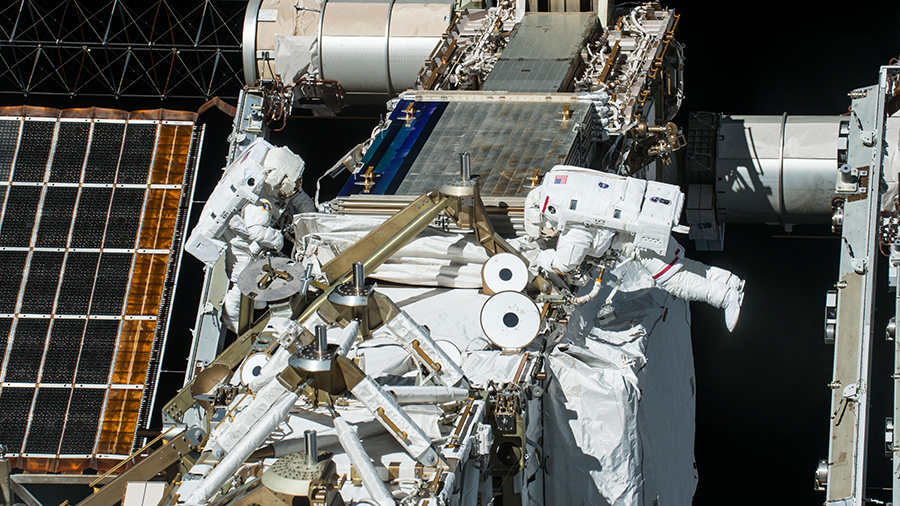
From left, NASA astronauts Kate Rubins and Jeff Williams are pictured during a spacewalk in September of 2016 performing solar array maintenance.

NASA astronauts Kate Rubins and Victor Glover are scheduled to exit the International Space Station’s Quest airlock Sunday for a spacewalk to begin assembling and installing modification kits required for upcoming solar array upgrades.

The pair will set their spacesuits to battery power about 6 a.m. EST tomorrow, signifying the start of their spacewalk, which is expected to last about six and a half hours. NASA will begin its live coverage on NASA Television, the NASA app, and the agency’s website at 4:30 a.m.

The current solar arrays are functioning well but have begun to show signs of degradation, as expected, as they were designed for a 15-year service life. The first pair of solar arrays were deployed in December 2000 and have been powering the station for more than 20 years. Later this year, the new solar arrays will be positioned in front of six of the current arrays, ultimately increasing the station’s total available power from 160 kilowatts to up to 215 kilowatts.

This will be the 235th spacewalk in support of space station assembly. Rubins will be designated extravehicular crew member 1 (EV 1) and wear a spacesuit bearing red stripes. Glover will be extravehicular crew member 2 (EV 2), wearing a suit with no stripes.

Rubins arrived at the space station Oct. 14, 2020, aboard a Russian Soyuz spacecraft, and Glover arrived at the space station in November as part of NASA’s SpaceX Crew-1 mission. This will be the third career spacewalk for each.

Watch a video providing an overview of the spacewalk and learn more about station activities by following @space_station and @ISS_Research on Twitter as well as the ISS Facebook and ISS Instagram accounts.

Get The Details…

Mark Garcia

Powered by WPeMatico

NASA Celebrates ‘Hidden Figure’ Mary W. Jackson With Building Naming Ceremony

NASA Celebrates ‘Hidden Figure’ Mary W. Jackson With Building Naming Ceremony

On Friday, NASA celebrated the agency’s first African American female engineer, Mary W. Jackson, with a ceremony to formally name the agency’s headquarters building in Washington in her honor.

Get The Details…

Powered by WPeMatico