High-Powered Computing, Orbital Plumbing and Spacewalk Preps Today

High-Powered Computing, Orbital Plumbing and Spacewalk Preps Today
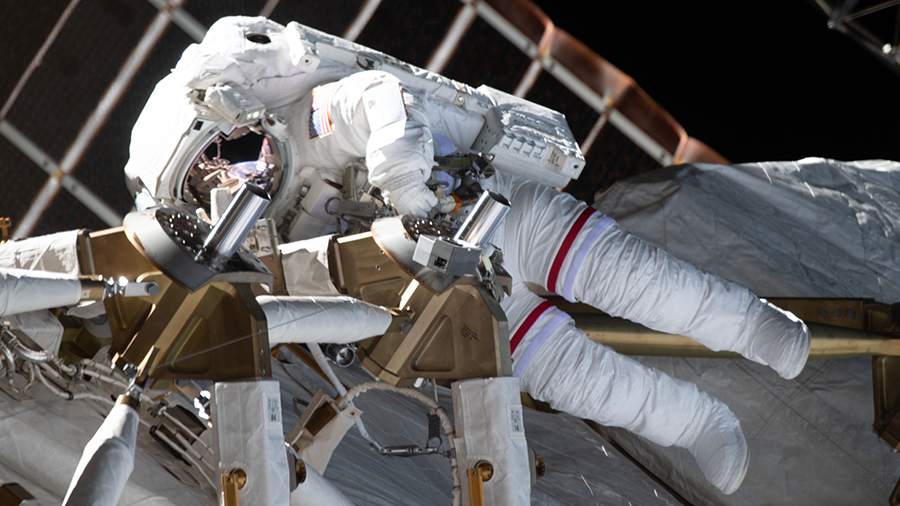
NASA astronaut Kate Rubins (lower left) is pictured during a spacewalk on Feb. 28, 2021, to install solar array modification kits on the space station.

Preparations are stepping up ahead of Friday’s spacewalk at the International Space Station to continue solar array modifications. The Expedition 64 crew is also studying high-powered space computing while maintaining orbital lab systems.

Flight Engineers Kate Rubins and Soichi Noguchi are getting ready to begin a spacewalk on Friday to finish installing solar array modification kits. The installation work began during a spacewalk on Feb. 28 to ready the station for new, more powerful solar arrays being delivered soon on upcoming SpaceX Dragon cargo missions.

The duo will set their spacesuits to battery power about 7 a.m. EST on Friday officially beginning the fourth spacewalk of the year. They will exit the U.S. Quest airlock and maneuver to the far-left side of the station to their worksite on the Port-6 truss structure. Rubins of NASA and Noguchi of JAXA (Japan Aerospace Exploration Agency) will spend about six-and-a-half hours wrapping up the modifications and performing get-ahead work if time permits. NASA TV begins its live spacewalk coverage at 5:30 a.m.

As the spacewalk preparations are underway, the rest of the crew is staying focused on a multitude of research work. Ensuring the stable operation of space station systems is also a daily priority.

Space technology is a big topic and scientists want to extend the power of Earth-based data processing to microgravity. Today, NASA Flight Engineer Victor Glover installed the Spaceborne Computer-2 delivered last month aboard the Cygnus space freighter. The new computing device, located in Europe’s Columbus laboratory module, seeks to demonstrate artificial intelligence and high-powered computations on the station rather than downloading scientific data for analysis on Earth.

NASA astronauts Shannon Walker and Michael Hopkins worked on space plumbing tasks on Wednesday. Walker readied cables that will power the station’s new water recycling device, the Brine Processor Assembly. Hopkins worked on fluid transfers and swapped pipes inside the Waste and Hygiene Compartment, the station’s bathroom in the U.S. segment.

Commander Sergey Ryzhikov completed a 24-hour session that recorded his electrical heart signal with a portable electrocardiogram. Flight Engineer Sergey Kud-Sverchkov repressurized the station’s environment with nitrogen stored inside the docked ISS Progress 77 cargo ship.

Get The Details…

Mark Garcia

Powered by WPeMatico

Spacewalk, Science and BEAM Work Keeping Crew Busy

Spacewalk, Science and BEAM Work Keeping Crew Busy

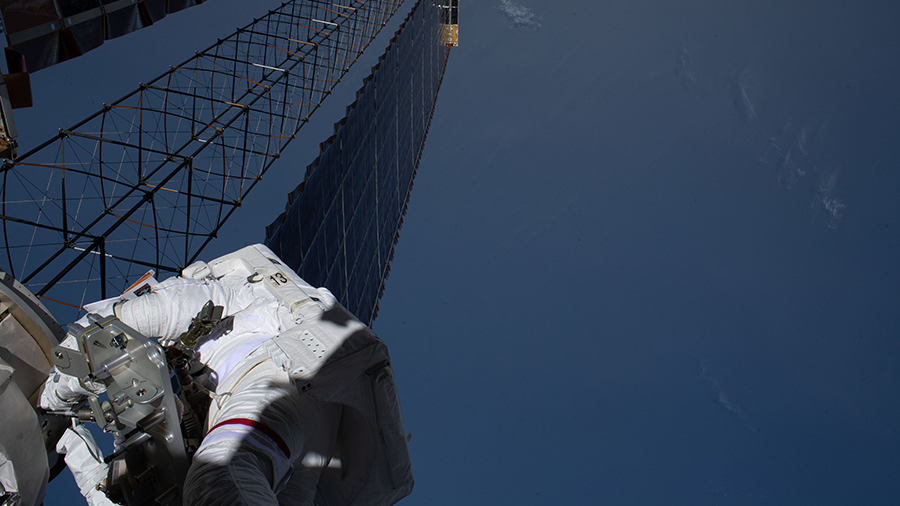
NASA astronaut Kate Rubins is pictured during a spacewalk to install solar array modification kits on the space station.

Two astronauts are gearing up for another spacewalk scheduled this Friday to continue maintenance on the outside of the International Space Station. The rest of the Expedition 64 crew set up advanced research hardware and also entered BEAM for cargo activities.

NASA astronaut Kate Rubins is readying tools and reviewing procedures for Friday’s spacewalk to continue installing solar array modification kits begun during Sunday’s spacewalk. She was joined by JAXA (Japan Aerospace Exploration Agency) astronaut Soichi Noguchi on Tuesday as he assisted with spacesuit preparations. Flight Engineer Victor Glover partnered with Noguchi for the spacesuit work and collected water samples from the suits for microbial analysis.

Rubins and Noguchi will set their U.S. spacesuits to battery power inside the U.S. Quest airlock around 7 a.m. EST signifying the start of their spacewalk. NASA TV will begin its live coverage of the planned six-and-a-half-hour spacewalk at 5:30 a.m.

NASA Flight Engineer Shannon Walker checked out radiation and biological gear today. She first deployed an experimental radiation detector to validate its use on future Orion spacecraft carrying crews to the Moon. Next, Walker powered up the Bio-Analyzer for upcoming cellular and molecular analysis work aboard the orbiting lab.

Walker also joined Flight Engineer Michael Hopkins opening up the Bigelow Expandable Activity Module, or BEAM, for cargo work. The duo stowed hardware and replaced a wireless sensors inside the commercial module.

Commander Sergey Ryzhikov and Flight Engineer Sergey Kud-Sverchkov focused on Russian science experiments in the station’s Russian segment. Ryzhikov wore a portable electrocardiogram that will record his electrical heart signals for 24 hours. Kud-Sverchkov serviced biology gear that enables investigations of cell cultures exposed to microgravity.

Get The Details…

Mark Garcia

Powered by WPeMatico