NASA Spacewalk Briefing to Highlight New Solar Array Installation
Two astronauts will venture outside the International Space Station Tuesday, Aug. 24, for a spacewalk to install a support bracket in preparation for future installation of the orbiting laboratory’s third new solar array.
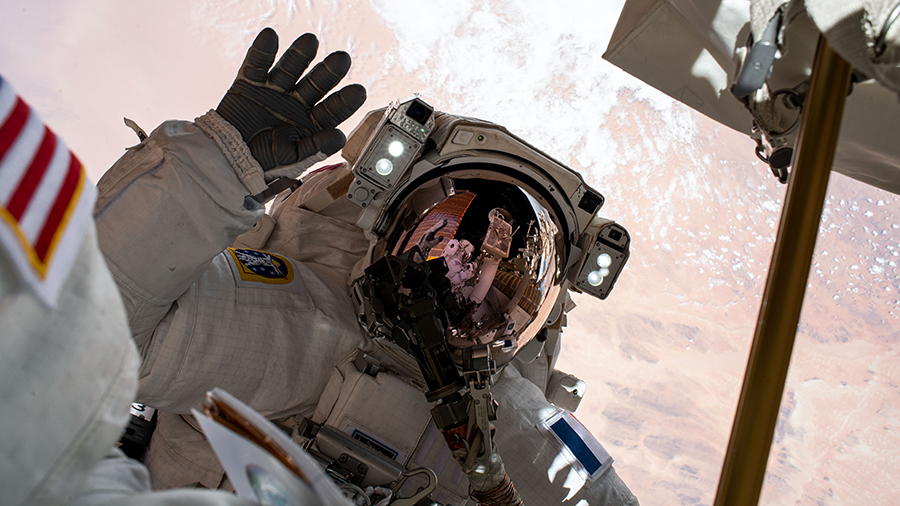
Astronaut Thomas Pesquet waves to the camera during a spacewalk to install Roll-Out Solar Arrays on June 25, 2021.
The Expedition 65 crew spent Tuesday on a variety of biology experiments exploring how living in microgravity affects the human muscle system. The residents aboard the International Space Station are also intensifying their preparations for three spacewalks over the coming weeks.
Astronauts Megan McArthur of NASA and Thomas Pesquet of ESA (European Space Agency) split the day working on the Cardinal Muscle study in Japan’s Kibo laboratory module. McArthur started the morning setting up engineered muscle cell samples in the Life Sciences Glovebox for observation. Pesquet took over in the afternoon continuing the sample work to learn how to treat space-caused muscle loss and Earth-bound muscle conditions.
Pesquet and Commandeer Akihiko Hoshide from the Japan Aerospace Exploration Agency (JAXA) started their morning research duties on another pair of muscle investigations. For the Anti-Atrophy investigation, Pesquet installed cell samples into Kibo’s Cell Biology Experiment Facility to test biomaterials that may prevent muscle loss in space as well as on Earth. Hoshide, also working inside Kibo, inserted cell samples into a specialized microscope to observe how they adapt to weightlessness for the Cell Gravisensing muscle atrophy study.
Hoshide then spent the rest of Tuesday with NASA Flight Engineer Mark Vande Hei getting ready for their first spacewalk together set for next week. They started configuring the U.S. Quest airlock and checking components on their U.S. spacesuits. McArthur joined them afterward and helped the duo suit up for a fit verification. Hoshide and Vande Hei will exit Quest on Aug. 24 to prepare the Port-4 truss structure for future Roll-Out Solar Array installation work.
Flight Engineers Oleg Novitskiy and Pyotr Dubrov are getting ready for two of their own spacewalks targeted for early September. They began collecting their spacewalk tools located in the station’s Russian segment and photographed them for inspection today. The cosmonaut duo from Roscosmos will exit the Poisk module for both excursions and outfit the Nauka Multipurpose Laboratory Module for science operations.
Week Kicks Off with Spacewalk Preps, Cygnus Cargo Transfers
Russia’s Soyuz MS-18 crew ship (foreground) and Nauka Multipurpose Laboratory Module are pictured docked to the station as it orbited above Africa’s Indian Ocean coast.
Two astronauts and two cosmonauts are gearing up for three spacewalks set to begin next week at the International Space Station. The Expedition 65 crew is also continuing to unpack a U.S. cargo craft in the middle of ongoing science and maintenance activities.
The first spacewalk is planned to take place on Aug. 24. Commander Akihiko Hoshide and Flight Engineer Mark Vande Hei will exit the Quest airlock in their U.S. spacesuits around 8 a.m. EDT and translate over to the Port-4 truss structure. Once there, the duo will prepare the worksite for the next set of Roll-Out Solar Arrays due to arrive on an upcoming SpaceX Cargo Dragon mission. The pair went over their spacewalk maneuvers on a computer Monday afternoon.
Cosmonauts Oleg Novitskiy and Pyotr Dubrov will perform the other two spacewalks in early September to prepare cables and other external equipment for the recently arrived Nauka Multipurpose Laboratory Module. Today, the flight engineers from Roscosmos reviewed the steps and procedures planned for the second spacewalk.
NASA Flight Engineers Megan McArthur and Shane Kimbrough joined ESA (European Space Agency) Flight Engineer Thomas Pesquet and took turns offloading cargo packed inside the Cygnus space freighter today. Cygnus delivered over four tons of cargo including over 2,300 pounds of new science experiments last week. The resupply ship from Northrop Grumman will stay attached to the Unity module for about three months.