Space Station Maneuvers to Avoid Debris After Conjunction Postpones Spacewalk
The space station was pictured from the SpaceX Crew Dragon Endeavour during its departure on Nov. 8, 2021.
The International Space Station conducted a Pre-Determined Debris Avoidance Maneuver (PDAM) today, Dec. 21, at 8:42 a.m. EST. The decision to conduct the maneuver was based on tracking data that showed a close approach to station of a fragment of Russian Fregat-SB upper stage debris.
During the manuever, the Roscosmos Progress 81 thrusters fired for 10 minutes, 21 seconds to provide the complex an extra measure of distance away from the predicted track of the debris. Without the maneuver, it was estimated that the debris could have passed less than a quarter of a mile from the station.
The decision to conduct the maneuver earlier this morning resulted in a postponement of today’s planned spacewalk by NASA astronauts Frank Rubio and Josh Cassada. The crew was never in any immediate danger.
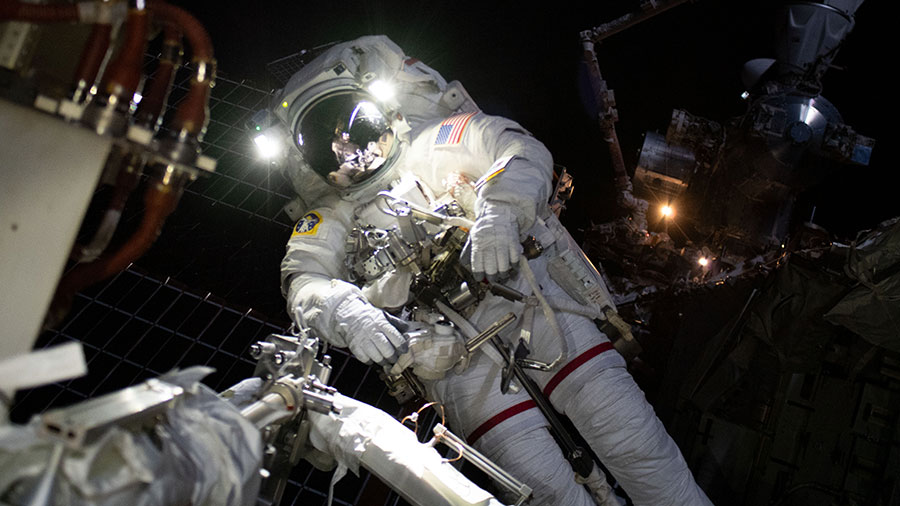
Astronaut Josh Cassada is pictured during a spacewalk on Nov. 15, 2022, to ready the space station for future rollout solar array installation work.
While flight control teams were preparing for today’s U.S. spacewalk, updated tracking data on a fragment of Russian Fregat-SB upper stage debris showed a close approach to station. Based on this new data, flight control teams directed the crew to stop spacewalk preparations as the ground team stepped into procedures to perform a Pre-Determined Debris Avoidance Maneuver (PDAM.)
The maneuver will use the Roscosmos Progress 81 thrusters to provide the complex an extra measure of distance away from the predicted track of the debris. Thruster firing is targeted to occur at 8:42 a.m. EST. The crew is not in any immediate danger.
Without the maneuver, it is predicted that the fragment could pass within less than a quarter mile from the station.
NASA managers will assess the next possible opportunity to perform the day’s planned spacewalk to install a new set of roll-out solar arrays to augment the station’s power capabilities.
Rubio and Cassada spent Tuesday gathering their tools and preparing the Quest airlock for the 12th spacewalk of 2022. The pair were joined for the spacewalk preparations by Flight Engineers Nicole Mann of NASA, Koichi Wakata of the Japan Aerospace Exploration Agency (JAXA), and Commander Sergey Prokopyev from Roscosmos. The quintet gathered together and reviewed Wednesday’s spacewalk procedures, tools, and components then called down to specialists on the ground for a readiness conference.
Mann and Wakata also took turns studying on a computer the Canadarm2 robotic arm maneuvers necessary to support the NASA spacewalkers when they install the roll-out solar array on the P4. The two flight engineers will be at the robotics workstation commanding Canadarm2 and assisting the spacewalking duo during the fine-tuned installation job.
The pair also had time on Tuesday for microgravity research work. Mann watered dwarf tomatoes growing inside the Veggie facility for the Veg-05 space agriculture study. Wakata checked cable connections on the Cell Biology Experiment Facility, a specialized incubator with an artificial gravity generator housing research samples for a bone healing study.
Before Prokopyev assisted the spacewalking team today, he worked on electronics maintenance and orbital plumbing tasks. Roscosmos Flight Engineer Dmitri Petelin assisted Prokopyev with the electronics work before studying advanced Earth photography techniques and exploring ways to pilot spacecraft and robots on future planetary missions. Flight Engineer Anna Kikina also worked on electronic component installations before checking radiation detection hardware and finally researching how international crews and mission controllers from around the world can improve communications.