The Overview Effect: Astronaut Perspectives from 25 Years in Low Earth Orbit

The Overview Effect: Astronaut Perspectives from 25 Years in Low Earth Orbit

To see Earth from space is to be forever changed by the view. Since Alan Shepard became the first American to lay eyes on our home planet from above, countless NASA astronauts have described feeling awed by the astonishing sight and a profound shift in perspective that followed.

NASA astronaut Matthew Dominick points his camera through a cupola window as the International Space Station orbits 262 miles above the Atlantic Ocean off the coast of Africa.
NASA

This unique experience is known as the overview effect – a term coined in 1987 by space philosopher and author Frank White in a book of the same name. The phenomenon creates powerful changes in the way astronauts think about Earth and life and can be particularly strong for those who lived and worked aboard the International Space Station during its 25 years of continuous human presence. The orbiting laboratory’s cupola module, equipped with seven windows looking down on Earth, provides the perfect place for observation and reflection.

NASA astronaut Jessica Watkins is pictured looking out from the International Space Station's cupola window.
NASA astronaut Jessica Watkins is pictured looking out from the International Space Station’s “window to the world” – the cupola. Astronauts use the seven-windowed observation module to monitor the arrival of spacecrafts at the orbiting laboratory and view the Earth below.
NASA

As Artemis II Mission Specialist Christina Koch explained:

    “The overview effect is when you’re looking through the cupola and you see the Earth as it exists with the whole universe in the background. You see the thin blue line of the atmosphere, and then when you’re on the dark side of the Earth, you actually see this very thin green line that shows you where the atmosphere is. What you realize is every single person that you know is sustained and inside of that green line and everything else outside of it is completely inhospitable. You don’t see borders, you don’t see religious lines, you don’t see political boundaries. All you see is Earth and you see that we are way more alike than we are different.”

Koch’s Artemis II crewmate, NASA astronaut Victor Glover, said the overview effect’s potency is closely tied to the “sea level effect” – humanity’s shared experience on Earth. “You come back to sea level, and then you have a choice,” he explained. “Are you going to try to live your life a little differently? Are you going to really choose to be a member of this community of Earth?”

NASA astronaut Don Pettit, Expedition 30 flight engineer, is pictured in a window of the cupola of the International Space Station, backdropped by Earth’s horizon and the blackness of space.
NASA

Many astronauts emphasize the importance of unity after experiencing the overview effect. “You see that it’s a single planet with a shared atmosphere. It’s our shared place in this universe,” said former NASA astronaut Bob Behnken. “I think that perspective, as we go through things like the pandemic or we see the challenges across our nation or across the world, we recognize that we all face them together.”

Seeing the Earth from space can also change their concept of home. Former NASA astronaut Nicole Stott recalls wanting to see her home state of Florida during her first mission to the International Space Station. “Finally, we were flying over Florida. I wanted to go to the window and see it, and then realized somewhere down the line that I wasn’t looking at Florida that same way anymore,” she said. “I still wanted to see Florida, but Florida had just become this special part of home, which is Earth. We’re all earthlings.”

The sun shines above Earth's horizon as the space station orbits 264 miles above the Canadian province of Quebec.
The sun shines above Earth’s horizon as the space station orbits 264 miles above the Canadian province of Quebec.
NASA

For some astronauts, their perspective shift inspired them to make changes on the ground. “I think if you’re not a conservationist before you go to space, you’re at least partly a conservationist when you come back. Because when you see how thin that atmosphere is, that protective layer that we have here, you think, wow, we really have to take care of this because it does look so fragile from space,” said retired NASA astronaut Mike Foreman.

Others hope to share the overview effect with more people. “That perspective helps you grow. It has really inspired me to try to get more people this experience and to get a permanent foothold in the stars for our species,” said former NASA astronaut Jack Fischer. “I want to do everything I possibly can to help the human species, humanity as a whole, go further and grow and evolve like I know they’re capable of.”

An Earth observation taken through cupola windows by the Expedition 39 crew. Portions of the International Space Station are in view.
NASA

Future crews to the orbiting laboratory can look forward to a similar experience. “In that instant, when you’re overwhelmed with that vista, when your eyes see nothing but the beauty of the Earth – every single crew member that I brought in [the cupola] for that exposure, cried,” said retired NASA astronaut T.J. Creamer. “It is heart stopping. It is soul pounding. It is breathtaking.”

For more astronaut perspectives from the International Space Station, watch “Down to Earth” on NASA+.

Powered by WPeMatico

Get The Details…
Linda E. Grimm

Week Wraps with Fluid Physics, Stem Cell Research as New Crew Preps Begin

Week Wraps with Fluid Physics, Stem Cell Research as New Crew Preps Begin

The Canadarm2 robotic arm releases Northrop Grumman’s Cygnus XL cargo craft after it was installed on the Earth-facing port of the Unity module. The International Space Station was soaring into an orbital sunrise 269 miles above the Atlantic Ocean southwest of Cape Town, South Africa, at the time of this photgraph.
The Canadarm2 robotic arm releases Northrop Grumman’s Cygnus XL cargo craft after it was installed on the Earth-facing port of the Unity module on Sept. 18, 2025.
NASA

Expedition 73 wrapped up the work week continuing to study fluid physics and stem cells, preparing for next week’s new crew arrival, and unpacking a U.S. cargo spacecraft. The International Space Station residents also serviced exercise gear, performed life support system troubleshooting, and analyzed the orbital outpost’s microbial environment.

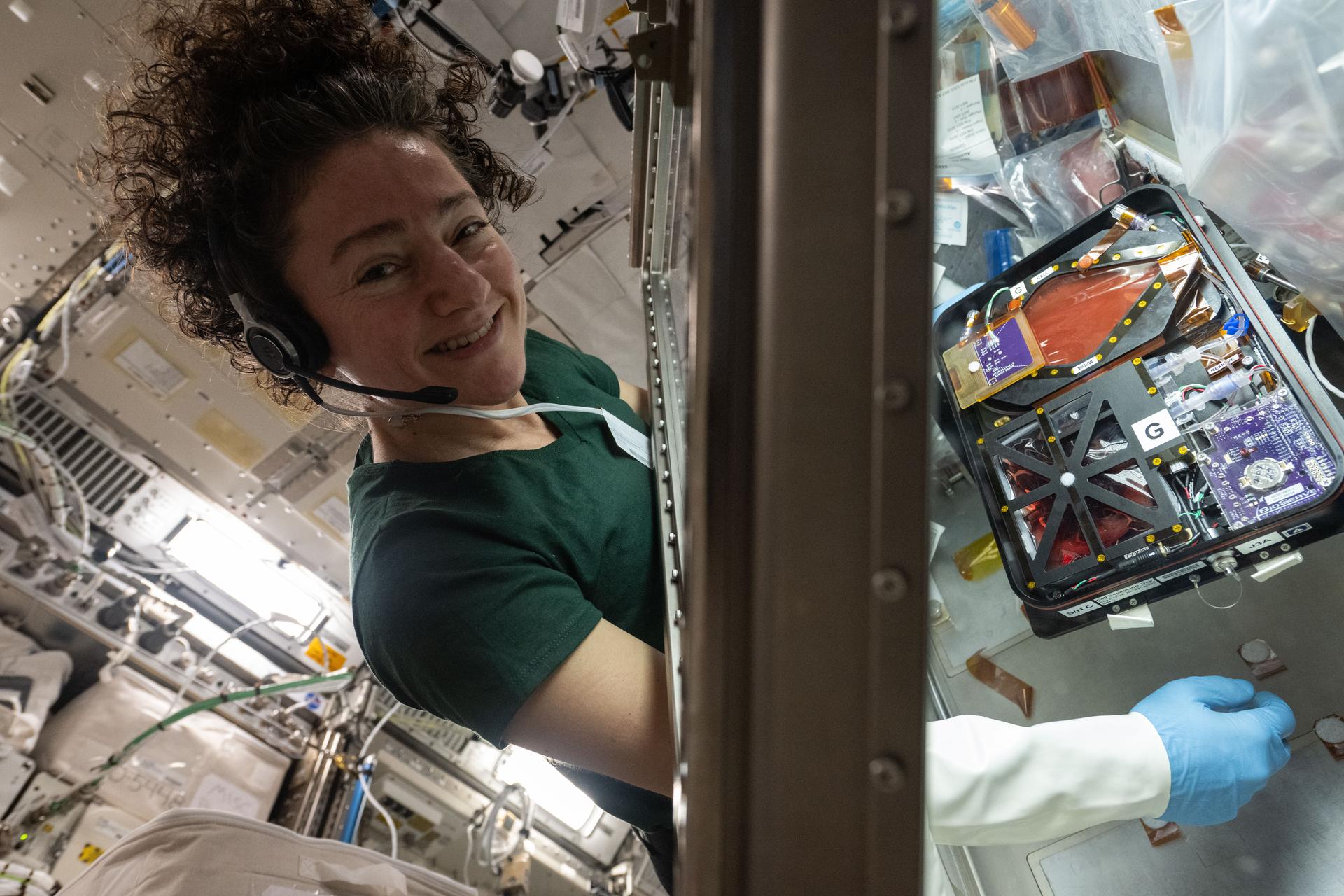
NASA Flight Engineer Zena Cardman primarily spent her day on research first starting in the Destiny laboratory module and installing fluid samples inside a fluorescence microscope. Scientists on the ground will image the samples to observe how particles behave inside fluids. Results may inform commercial in-space manufacturing techniques and improve optical materials and pollution removal operations. Cardman then moved to the Kibo laboratory module and processed stem cells samples inside the Life Science Glovebox. Afterward, she stowed the samples in a portable science freezer for preservation and return to Earth for analysis. Scientists are exploring how microgravity affects the stem cells programmed to change into heart and brain cells that may lead to advanced treatments for cardiac and neurological disorders.

Cardman also assisted Flight Engineers Mike Fincke of NASA and Kimiya Yui of JAXA (Japan Aerospace Exploration Agency) as they continued transferring new science and supplies from inside the Northrop Grumman’s Cygnus XL cargo spacecraft. Cygnus XL arrived on Sept. 18 delivering over 11,000 pounds of cargo resupplying the orbital residents.

Northrop Grumman’s Cygnus XL cargo spacecraft, supporting the company’s 23rd commercial resupply mission to the International Space Station for NASA, will be uninstalled from the Earth-facing port of the space station’s Unity module on Monday, Nov. 24. The cargo spacecraft will remain attached to the station’s Canadarm2 robotic arm until Monday, Dec. 1, clearing the way for the arrival of the crewed Roscosmos Soyuz MS-28 spacecraft on Thursday, Nov. 27. 

NASA, Northrop Grumman, and Roscosmos coordinated the spacecraft’s movement to prevent any unnecessary structural loads from being imparted on Cygnus XL and its solar arrays when the Soyuz spacecraft docks to the Rassvet module, which is the adjacent docking port. The maneuver will be conducted by the robotics officer in Mission Control Center at NASA’s Johnson Space Center in Houston, while agency astronauts Jonny Kim and Zena Cardman monitor from inside the orbital complex.

Cygnus XL will be reattached to the space station Dec. 1, and will remain there until no earlier than March 2026, when it is scheduled to depart and dispose of several thousand pounds of trash during its destructive re-entry into Earth’s atmosphere. 

Fincke then used a computer to test the performance of a pressure management device, gear that saves station air during visiting vehicle pressurization activities, inside the Unity module. Yui also assisted NASA Flight Engineer Jonny Kim in the Tranquility module correctly positioning and centering the COLBERT treadmill, tightening its bolts, and activating the exercise device for operations. Kim then drained recycle tanks and configured emergency breathing masks. Yui swapped batteries inside a wireless environmental monitor then joined Kim again at the end of their shift servicing a vacuum cleaner.

Roscosmos cosmonaut and station Commander Sergey Ryzhikov began preparing for next week’s arrival of three new crew members aboard the Soyuz MS-28 crew spacecraft. Flight Engineer Alexey Zubritsky joined him rearranging cargo and making space inside the Rassvet module. The Soyuz MS-28 will dock to Rassvet on Nov. 27 carrying NASA astronaut Chris Williams and Roscosmos cosmonauts Sergey Mikaev and Sergey Kud-Sverchkov. Ryzhikov also began packing cargo inside the Soyuz MS-27 spacecraft that will return him, Zubritsky, and Kim to Earth in early December. Zubritsky collected microbe samples swabbed from inside the station’s Roscosmos segment for analysis to protect crew health.

Roscosmos Flight Engineer Oleg Platonov focused on maintenance at the end of the week beginning his shift replacing components on the Zvezda service module’s toilet. Next, Platonov inspected the Zarya module to identify workspace before completing his shift working on the Nauka science module’s ventilation system.

Learn more about station activities by following the space station blog, @space_station on X, as well as the ISS Facebook and ISS Instagram accounts.

Get the latest from NASA delivered every week. Subscribe here.

Powered by WPeMatico

Get The Details…

Mark A. Garcia

NASA Awards Liquid Hydrogen Supply Contracts

NASA Awards Liquid Hydrogen Supply Contracts

The letters NASA on a blue circle with red and white detail, all surrounded by a black background
Credit: NASA

NASA has selected Plug Power, Inc., of Slingerlands, New York, and Air Products and Chemicals, Inc., of Allentown, Pennsylvania, to supply up to approximately 36,952,000 pounds of liquid hydrogen for use at facilities across the agency.

The NASA Agency-wide Supply of Liquid Hydrogen awards are firm-fixed-price requirements contracts that include multiple firm-fixed-price delivery orders critical for the agency’s centers as they use liquid hydrogen, combined with liquid oxygen, as fuel in cryogenic rocket engines, and the commodity’s unique properties support the development of aeronautics. The total value for the combined awards is about $147.2 million.

The contracts begin Monday, Dec. 1, and each consists of a two-year base period followed by three one-year option periods that, if exercised, would extend the contracts to Nov. 30, 2030.

Air Products and Chemicals Inc. will supply up to about 36.5 million pounds of liquid hydrogen to NASA’s Kennedy Space Center and Cape Canaveral Space Force Station in Florida; NASA’s Marshall Space Flight Center in Huntsville, Alabama; and NASA’s Stennis Space Center in Bay St. Louis, Mississippi, for a maximum contract value of approximately $144.4 million.

Plug Power, Inc. will deliver up to approximately 480,000 pounds of the commodity to NASA’s Glenn Research Center in Cleveland, Ohio, and at Neil A. Armstrong Test Facility in Sandusky, Ohio, for a maximum contract value of about $2.8 million.

For additional information about NASA and agency programs, visit:

https://www.nasa.gov/

-end-

Tiernan Doyle
Headquarters, Washington
tiernan.doyle@nasa.gov
202-358-1600

Amanda Griffin
Kennedy Space Center, Fla.
amanda.griffin@nasa.gov
321-593-6244

Powered by WPeMatico

Get The Details…
Tiernan P. Doyle

10 Years of Students Helping NASA Grow Space Food with Growing Beyond Earth

10 Years of Students Helping NASA Grow Space Food with Growing Beyond Earth

3 min read

10 Years of Students Helping NASA Grow Space Food with Growing Beyond Earth

Student from 71 Classrooms engaged with NASA scientists to learn about how their Growing Beyond Earth research is contributing to feeding astronauts for long distance space travel.
Students from 71 Classrooms engaged with NASA scientists to learn about how their Growing Beyond Earth research is contributing to feeding astronauts for long distance space travel.

Nearly 1,250 middle and high school students from 71 schools around the world joined Fairchild Tropical Botanic Garden for the Growing Beyond Earth (GBE) Student Launch Chat with the Scientists, marking an inspiring milestone in the program’s 10th anniversary year.

The live session, held in collaboration with NASA, connected classrooms directly with Dr. Gioia Massa and Trent M. Smith, senior leaders of NASA Kennedy Space Center’s Space Crop Production team. Students heard firsthand how their classroom experiments are helping NASA identify and grow the best crops for future astronauts on long-duration missions to the Moon and Mars.

“Our students are contributing to real NASA science,” said one participating teacher. “It’s incredibly motivating for them to know their data could influence what astronauts eat in space someday.”

Connecting Classrooms with NASA Science

Growing Beyond Earth, led by Fairchild Tropical Botanic Garden in Miami, Florida, brings authentic NASA research into classrooms in a way that few science programs can. For more than a decade, the 83-acre botanic garden – renowned for its conservation, education, and research programs – has worked hand-in-hand with NASA to advance understanding of food production in space.

Students use specially designed plant growth chambers to test how different crops perform under conditions that mimic spacecraft environments. The data they collect are shared with NASA scientists, who use the findings to refine ongoing space crop production research.

Since the program’s inception, more than 120,000 students across 800+ classrooms have tested over 250 plant cultivars, with five student-tested crops already grown aboard the International Space Station.

Cultivating the Future STEM (Science, Technology, Engineering, & Mathematics) Workforce

The Growing Beyond Earth project exemplifies the mission of NASA’s Science Activation (SciAct) program, which connects NASA Science with people of all ages and backgrounds in ways that activate minds and promote a deeper understanding of our world and beyond, with the ultimate Vision: To increase learners’ active participation in the advancement of human knowledge. By engaging students as active participants in cutting-edge research, projects like GBE not only advance NASA’s goals but also cultivate curiosity, creativity, and confidence in the next generation of scientists and explorers. This year’s GBE Student Launch Chat celebrated that impact, showing how student research from classrooms around the globe contributes to the future of space exploration.

“When students see themselves as part of NASA’s mission, they realize science isn’t something distant, it’s something they can do,” said Dr. Massa. Teacher Espy Rodriguez from Hialeah Senior High School said, “It made their [her students] projects matter. I think it gave the kids a real sense of community. We are far, but we are one.” By growing plants, analyzing data, and sharing results with NASA, these students are helping humanity prepare for life beyond Earth, proving that the seeds of tomorrow’s discoveries are being planted in today’s classrooms.

GBE is supported by NASA under cooperative agreement award number 80NCCS2M0125 and is part of NASA’s Science Activation Portfolio. Learn more about how Science Activation connects NASA science experts, real content, and experiences with community leaders to do science in ways that activate minds and promote deeper understanding of our world and beyond: https://science.nasa.gov/learn/about-science-activation/.

www.fairchildgarden.org/gbe

Powered by WPeMatico

Get The Details…

Crew Works on Stem Cells, CubeSats; Prepares for Soyuz and Commercial Crew Launches

Crew Works on Stem Cells, CubeSats; Prepares for Soyuz and Commercial Crew Launches

Expedition 73 Flight Engineers Jonny Kim and Zena Cardman, both NASA astronauts, practice Canadarm2 robotic maneuvers at the robotics workstation inside the International Space Station's cupola. The duo was preparing for the robotic capture of the Northrop Grumman Cygnus XL cargo spacecraft that launched on Sept. 14, 2025, and arrived on Sept. 18 delivering about 11,000 pounds of science, supplies, and hardware to the Expedition 73 crew. Credit: NASA
Expedition 73 Flight Engineers Jonny Kim and Zena Cardman, both NASA astronauts, practice Canadarm2 robotic maneuvers at the robotics workstation inside the International Space Station’s cupola. The duo was preparing for the robotic capture of the Northrop Grumman Cygnus XL cargo spacecraft that launched on Sept. 14, 2025, and arrived on Sept. 18 delivering about 11,000 pounds of science, supplies, and hardware to the Expedition 73 crew.
Credit: NASA

Stem cells and CubeSat installations were the main research focus aboard the International Space Station on Thursday. The Expedition 73 crew also collected microbe samples for analysis, configured Earth observation gear, and replaced hoses on a treadmill.

Also, NASA and SpaceX have been working to be ready as early as Feb. 15 for the next commercial crew rotation launch to the International Space Station. This change maximizes launch opportunities for NASA’s SpaceX Crew-12, while also accommodating the Artemis II launch windows. As both missions advance toward launch and rely on resources and facilities at NASA’s Kennedy Space Center, this change helps deconflict operations.

NASA also set the agency’s coverage of NASA astronaut Chris Williams’ will launch aboard the Roscosmos Soyuz MS-28 spacecraft to the International Space Station on Thursday, Nov. 27

Back on station, researchers are studying how to turn stem cells into brain and cardiac cells in microgravity. NASA Flight Engineer Zena Cardman serviced the stem cell samples for viewing inside a fluorescence microscope for the Stellar Stem Cells Mission 2 experiment. Doctors on the ground will observe how weightlessness affects the reprogrammed stem cells possibly leading to advances in regenerative medicine, drug testing, and space-based biomanufacturing.

Cardman also assisted NASA Flight Engineers Mike Fincke and Jonny Kim and JAXA (Japan Aerospace Exploration Agency) Flight Engineer Kimiya Yui who swapped thermal control system hoses on the COLBERT treadmill located inside the Tranquility module. The quartet worked throughout Thursday temporarily uninstalling the station’s bathroom, or waste and hygiene compartment, to access the life support hoses.

Earlier, Yui installed the NanoRacks CubeSat Deployer on the multi-purpose experiment platform inside the Kibo laboratory module’s airlock. It will soon be placed outside the orbital outpost in the external microgravity environment. The Japanese robotic arm will grapple the CubeSat deployer then position it away from the orbiting lab to deploy a set of CubeSats into Earth orbit for private and public research.

Roscosmos cosmonauts Sergey Ryzhikov and Alexey Zubritsky, station Commander and Flight Engineer respectively, partnered together on Thursday and swabbed surfaces inside the Zarya module then placed the samples inside test tubes. The samples will be analyzed later to understand the microbial environment aboard the space station and protect crew health.

Roscosmos Flight Engineer Oleg Platonov began his day with orbital plumbing in the Nauka science module then set up a camera to capture time-lapse photography of the Earth. Platonov spent the end of his shift inside the Zvezda service module servicing the Elektron oxygen generator.

Learn more about station activities by following the space station blog, @space_station on X, as well as the ISS Facebook and ISS Instagram accounts.

Get the latest from NASA delivered every week. Subscribe here.

Powered by WPeMatico

Get The Details…

Mark A. Garcia