NASA Glenn Opens Applications for Free Summer Engineering Institute

NASA Glenn Opens Applications for Free Summer Engineering Institute
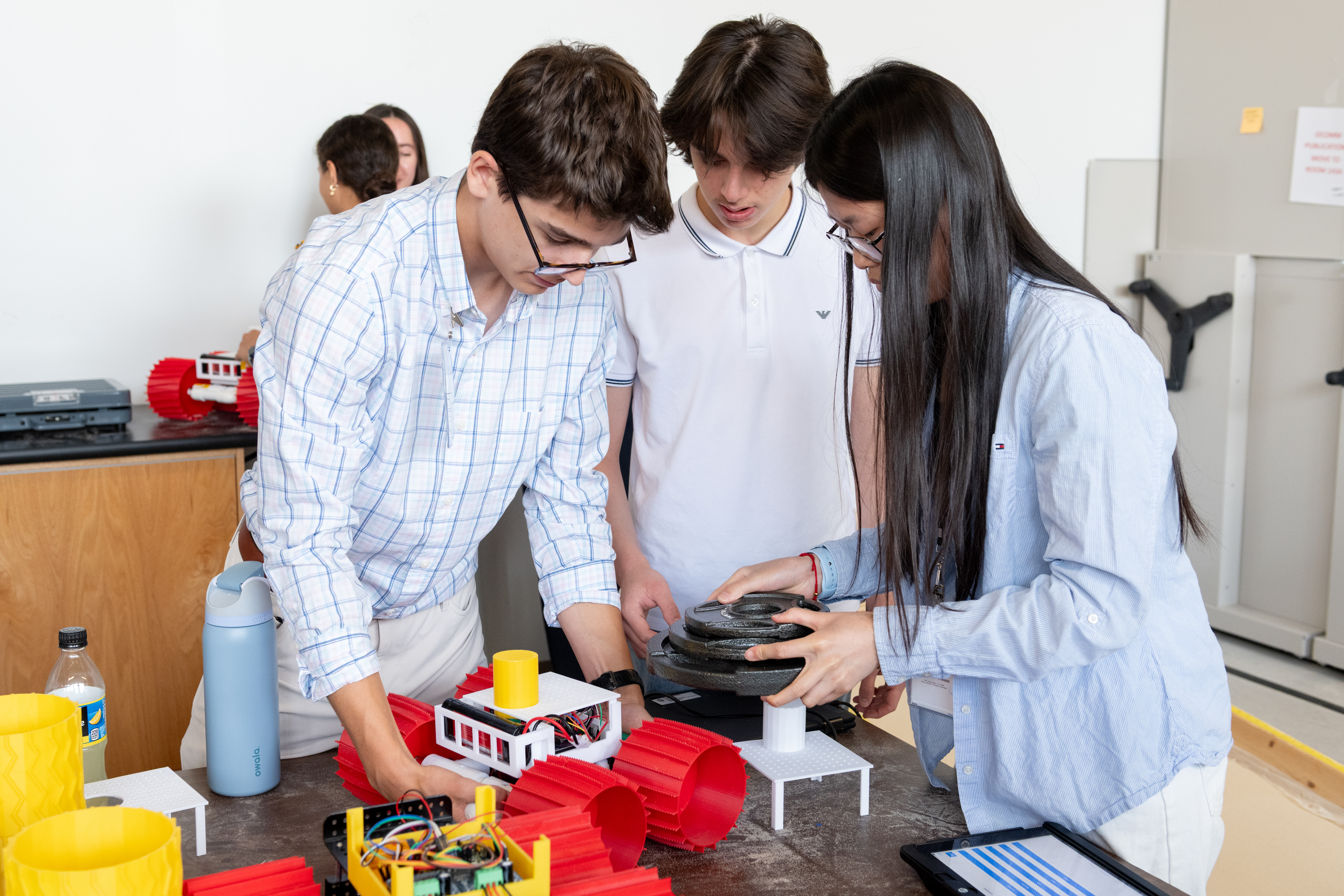
Three High School Engineering Institute students are centered in the foreground of the image working on a small vehicle with large red plastic wheels. There are two more students in the background working on their own identical vehicle.
Students collaborate on a hands‑on STEM project, assembling and testing components during the NASA Glenn High School Engineering Institute at NASA’s Glenn Research Center on July 18, 2025.
NASA/Sara Lowthian-Hanna

NASA’s Glenn Research Center in Cleveland is hosting the 2026 NASA Glenn High School Engineering Institute this July. The hands-on learning experience is designed to help high school students prepare for a future in the aerospace workforce.  

Rising high school juniors and seniors can submit applications for this summer program beginning Friday, March 20, through Friday, May 1. 

The institute will immerse students in NASA’s work while providing essential career readiness tools to help them in future science, technology, engineering, and math-focused academic and professional pursuits.  

Throughout the five-day program, students will use authentic NASA mission content and work alongside Glenn’s technical experts to gain a deeper understanding of the engineering design process, develop practical engineering solutions to real-world challenges, and test prototypes to answer questions in key mission areas: 

  • Acoustic dampening – How can we reduce noise pollution from jet engines? 
  • Power management and distribution – How can we develop a smart power system for future space stations? 
  • Simulated lunar operations – Can we invent tires that don’t use air? 

How to Apply
To be considered for the 2026 NASA Glenn High School Engineering Institute, applicants must submit a complete application package no later than May 1, 2026, at 11:59 p.m. ET. 

Program Dates 
Selected students will participate in one of the following weeklong sessions:

  • Session 1: July 13-17, 2026 
  • Session 2: July 20-24, 2026 
  • Session 3: July 27-31, 2026 

Eligibility and Application Requirements 
To be eligible for this program, students must:  

  • Be entering 11th or 12th grade for the 2026-2027 academic year
  • Have a minimum 3.2 GPA, verified by their school counselor 
  • Submit a letter of recommendation from a teacher 
  • Be a U.S. citizen

Questions about the institute should be directed to GRC-Ed-Opportunities@mail.nasa.gov.  

For information about NASA Glenn, visit:  

https://www.nasa.gov/glenn

-end- 

Heather Roe 
NASA Glenn Research Center, Cleveland
216-695-7292
heather.m.roe@nasa.gov

Powered by WPeMatico

Get The Details…
Heather Roe
Restless Kīlauea Launches Lava and Ash

Restless Kīlauea Launches Lava and Ash

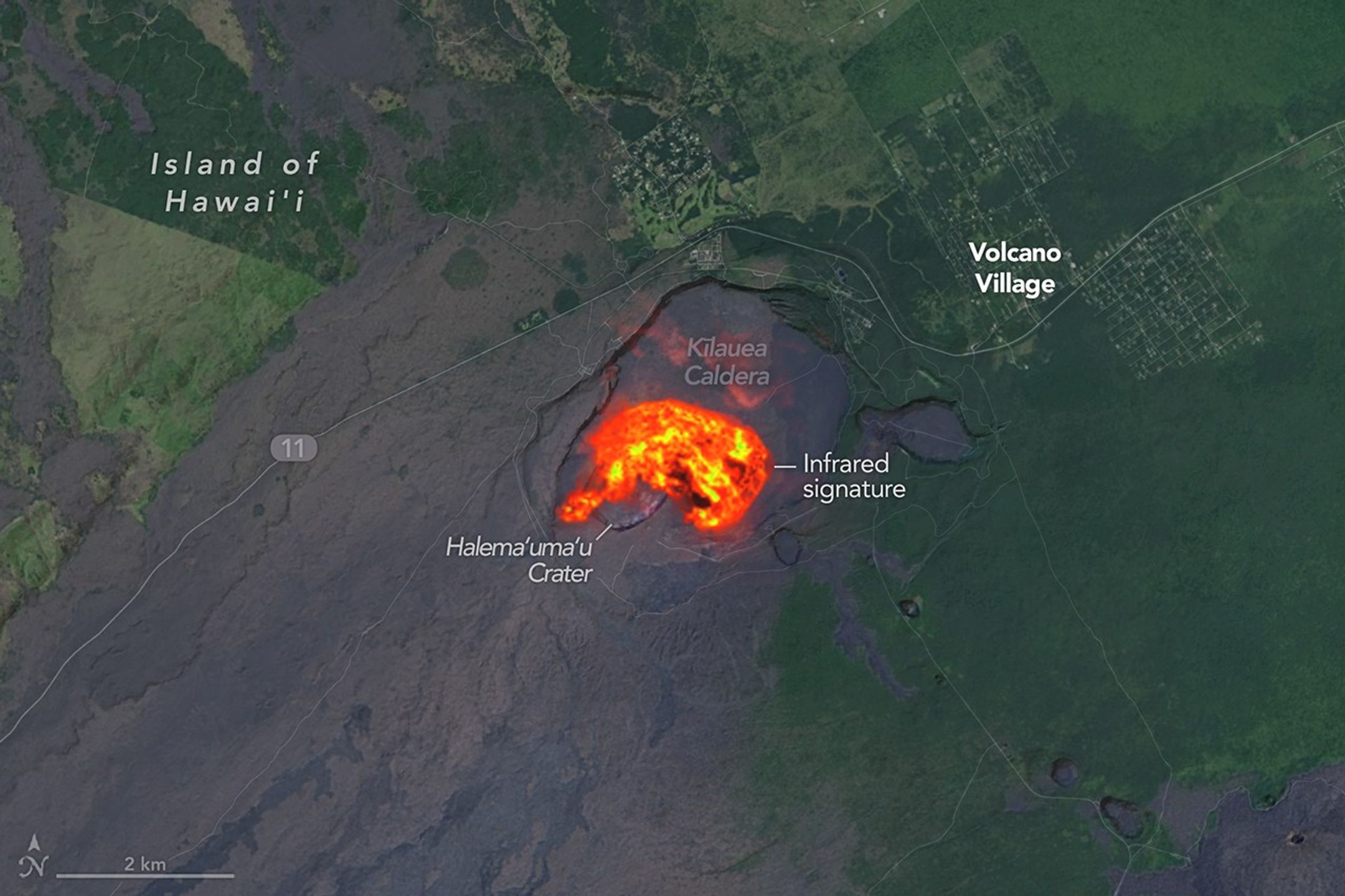
The heat signature from an eruption at Kilauea glows yellow and orange in the volcano’s summit crater.
March 10, 2026

Kīlauea has entered its second year of episodic activity after reawakening in December 2024. Since then, the Hawaiian volcano has gone through dozens of bouts of lava fountaining, each lasting several hours to several days.

Activity ramped up once again on March 10, 2026, for episode 43 of the eruption. From approximately 9 a.m. to 6 p.m. local time that day, lava spewed from two active vents on the southwest side of Halema‘uma‘u Crater, adding to the ever-thickening layer of fresh basaltic rock in the summit caldera. The flareup also featured the highest lava fountains of the current eruption, estimated at 1,770 feet (540 meters). Meanwhile, ash and other airborne debris fell on communities up to 50 miles (80 kilometers) away.

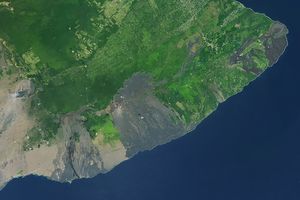
About 4 hours after fountaining subsided, the Landsat 9 satellite passed over the Island of Hawai‘i. This image shows shortwave infrared and near-infrared data, acquired with the satellite’s OLI (Operational Land Imager) at 10:20 p.m. local time on March 10 (08:20 Universal Time on March 11), revealing heat emanating from the still-sizzling lava. That information is layered over a composite of daytime Landsat images and a digital elevation model.

An estimated 16 million cubic yards (12 million cubic meters) of lava erupted during the episode, according to the Hawaiian Volcano Observatory (HVO), bringing the total volume erupted across all episodes since December 2024 to close to 325 million cubic yards (250 million cubic meters). Over the same period, the depth of lava in the crater has increased by about 300 feet (90 meters).

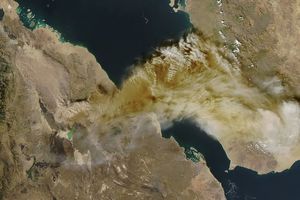
While lava remained confined to the summit area, other erupted material traveled much farther. Images captured by satellites orbiting over the area during the daytime showed a volcanic plume drifting northeast from the vents. Volcanic gas and ash reached a maximum height in the atmosphere of more than 30,000 feet (9,100 meters) above sea level, the HVO said. The aviation color code was elevated to red during the eruption, and several flights at the airport in Hilo were canceled, according to news reports.

Volcanic fragments up to several inches in diameter fell along the north rim of the caldera and in adjacent communities. The hazards and accumulation of debris caused the temporary closure of Highway 11 and the evacuation of visitors from parts of Hawaiʻi Volcanoes National Park. Smaller particles were carried farther: people reported ash and Pele’s hair falling tens of miles to the north and east of Kīlauea, including in Hilo, Keaʻau, and other communities on the coast. Volcanic debris is an eye, skin, and respiratory irritant, the HVO warned, and it may affect water quality for those using rainwater catchment systems.

NASA Earth Observatory image by Michala Garrison, using Landsat data from the U.S. Geological Survey. Story by Lindsey Doermann.

References & Resources

You may also be interested in:

Stay up-to-date with the latest content from NASA as we explore the universe and discover more about our home planet.

Krasheninnikova Remains Restless

3 min read

The volcano on Russia’s Kamchatka Peninsula continues to erupt after centuries of quiescence.

Article

A Hot and Fiery Decade for Kīlauea

6 min read

The volcano in Hawaii is one of the most active in the world, and NASA tech makes it easier for…

Article

Hayli Gubbi’s Explosive First Impression

4 min read

In its first documented eruption, the Ethiopian volcano sent a plume of gas and ash drifting across continents.

Article

Powered by WPeMatico

Get The Details…

Crew Enjoys Light-Duty Day, Debriefs Spacewalk

Crew Enjoys Light-Duty Day, Debriefs Spacewalk

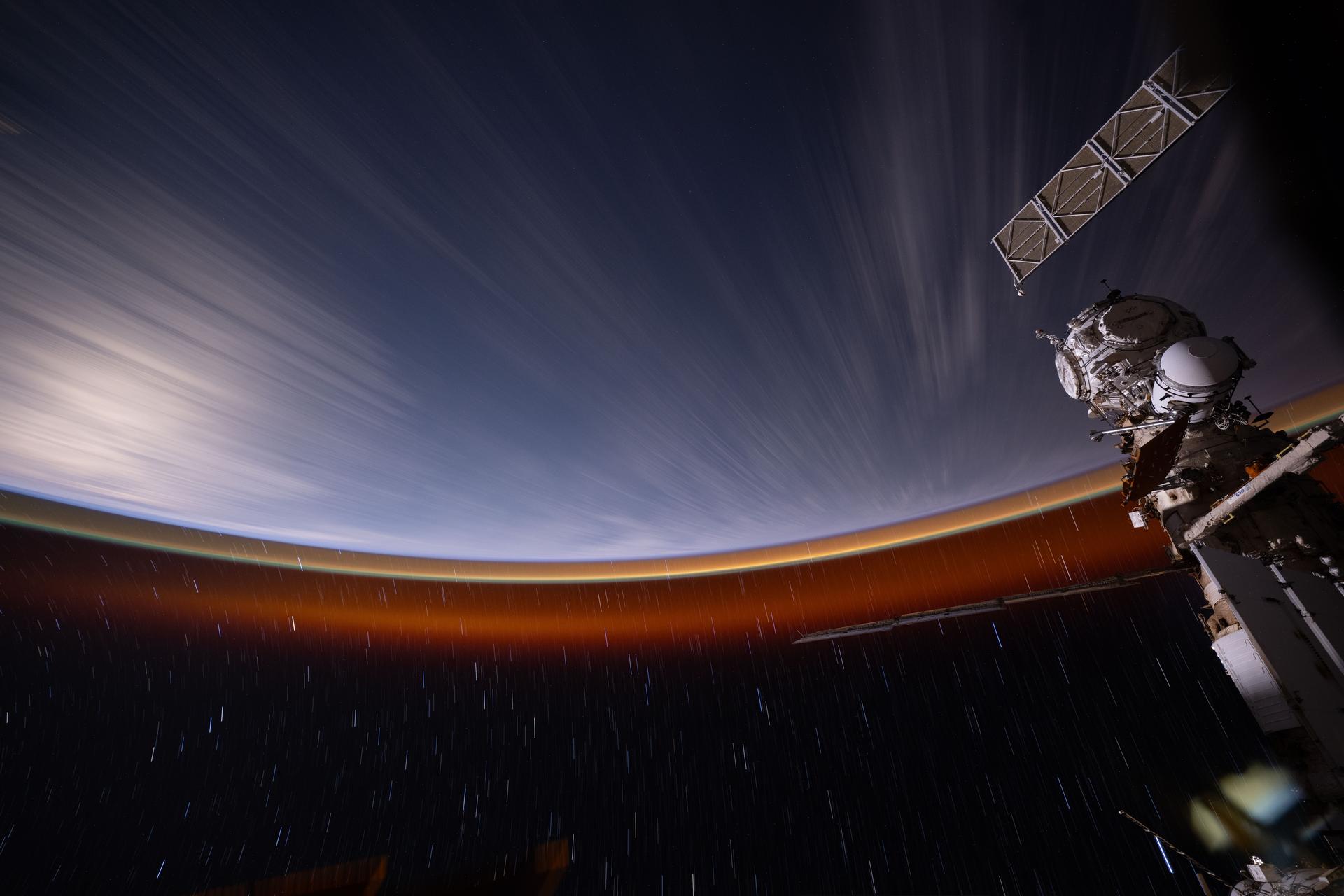
The International Space Station was soaring 263 miles above the Pacific Ocean near the island of Hawaii when this 30‑second long‑duration photograph was taken, revealing Earth’s atmospheric glow and star trails at approximately midnight local time.
NASA/Chris Williams

Four International Space Station residents had a light-duty day Thursday as they enjoyed some time off and worked on close out procedures following the conclusion of yesterday’s spacewalk. The three other Expedition 74 crew members spent the day inspecting various modules of the orbital complex, cleaning, and stowing cargo.

NASA astronauts Jessica Meir and Chris Williams concluded a seven-hour, two-minute spacewalk yesterday at 3:54 p.m. EDT, completing their primary objectives which included preparing the 2A power channel for the future installation of roll-out solar arrays. It was Meir’s fourth spacewalk and Williams’ first.

The spacewalkers, along with NASA astronaut Jack Hathaway and European Space Agency (ESA) astronaut Sophie Adenot, enjoyed the morning off. Hathaway and Adenot, who monitored yesterday’s spacewalk and assisted Meir and Williams with donning and doffing their suits, joined the duo in the afternoon for a post-spacewalk debrief with ground teams.

Later in the evening, Williams completed some spacesuit work, performed a water recharge and reset a torque wrench. Meir also worked in some time for health research, collecting biological samples for analysis, routine work that helps scientists take a closer look at the effects of spaceflight on the human body.

In the Roscosmos segment, the three cosmonauts spent the day exercising, inspecting modules, cleaning, and stowing cargo. In the morning, flight engineer Andrey Fedyaev exercised on the station’s treadmill before moving throughout the station to collect radiation sensors. Once gathered, he logged radiation measurements for analysis.

In the Zarya module, flight engineer Sergei Mikaev inspected and photographed lighting units for documentation, then vacuumed the space. He later moved into the Nauka module to record ventilation fan operations for possible repairs in the future. Meanwhile, Commander Sergey Kud-Sverchkov performed various inspections in the Zvezda Service Module before teaming up with Mikaev to gather and load cargo items into the Progress 93 cargo spacecraft for future disposal.

Learn more about station activities by following the space station blog@space_station on X, as well as the ISS Facebook and ISS Instagram accounts.

Get the latest from NASA delivered every week. Subscribe here.

Powered by WPeMatico

Get The Details…

Abby Graf

American Bald Eagle at NASA’s Kennedy Space Center

American Bald Eagle at NASA’s Kennedy Space Center

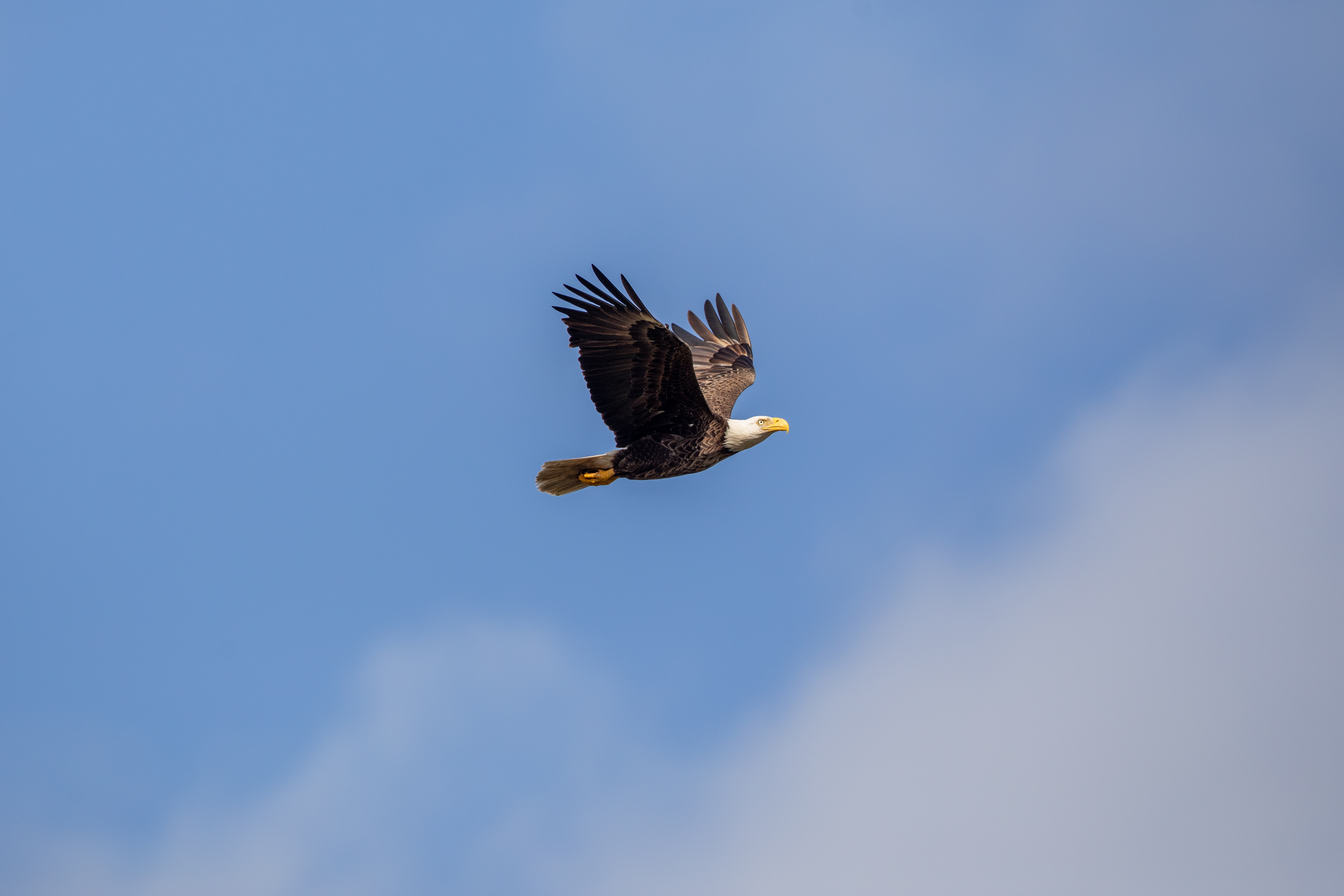
A bald eagle soars through a cloudy blue sky. Its wings are spread out and you can see its orange feet tucked under its tail.
NASA/Ben Smegelsky

An American bald eagle flies away from its nest and tree at NASA’s Kennedy Space Center in Florida on Friday, March 13, 2026. Bald eagle nesting surveys across NASA Kennedy, Merritt Island National Wildlife Refuge, and Canaveral National Seashore are conducted annually to document the number of bald eagle active and inactive nests in support of wildlife management and regulatory compliance. Each year, eagles take up winter residence at the Florida spaceport, breeding and raising a new generation.

See more bald eagle photos and video.

Text credit: Elyna Niles-Carnes

Image credit: NASA/Ben Smegelsky

Powered by WPeMatico

Get The Details…
Monika Luabeya

NASA Laser Reflecting Instrument Makes GPS Satellite More Accurate

NASA Laser Reflecting Instrument Makes GPS Satellite More Accurate

3 min read

NASA Laser Reflecting Instrument Makes GPS Satellite More Accurate

A NASA laser reflecting technology that will aid Global Positioning System (GPS) accuracy is now operational as of March 9.

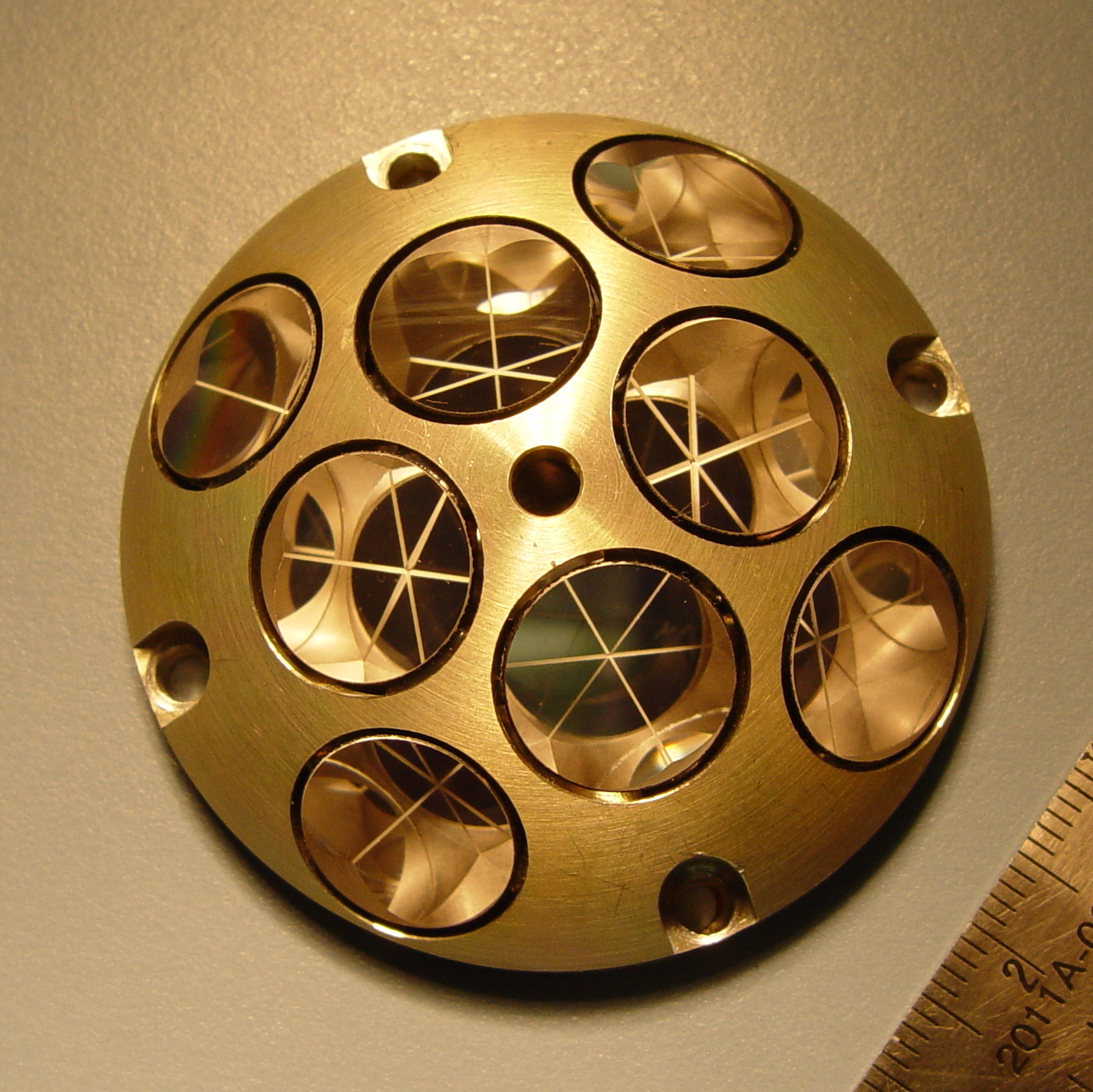
The instrument, known as a laser retroreflector array, or LRA, launched aboard GPS III SV-09, the ninth of U.S. Space Force’s Block III Global Positioning System satellites, on Jan. 27. LRAs are sets of mirrors shaped like the corners of a cube, a configuration that is designed to precisely reflect beams of light back to their source. They are a key component to laser ranging, a technique that enables the measurement of precise distance by observing the time it takes for a pulse of light to travel from a ground station to the mirrors and back.

Centered in the image is a rocket in the process of taking off, with bright plumes of smoke and fire emitting from the bottom of the rocket as it launches upwards. The smoke also appears in plumes on the left side of the image. Four stabilizing structures are in the foreground and background of the image, two on either side of the launching rocket. The background of the image is all black, indicating the launch took place at night.
A SpaceX Falcon 9 rocket lifted off from Space Launch Complex 40 (SLC-40), Cape Canaveral Space Force Station, Florida, carrying the GPS III SV-09 satellite into Earth orbit.
Credit: SpaceX

“LRAs are the most efficient and cost-effective way to improve products that come out of GPS,” said Lucia Tsaoussi, program manager for NASA’s Space Geodesy at NASA Headquarters in Washington.

Whether walking, driving, sailing, or flying, GPS technology helps people know their location and navigate to their destination. With the LRA being put to work, this GPS satellite will have an improved tie to the global coordinate system, resulting in more accurate location and navigation information for users.

“We are the hidden infrastructure,” said Stephen Merkowitz, project manager for the Space Geodesy Project at NASA’s Goddard Space Flight Center in Greenbelt, Maryland. “Most people don’t realize that they’re relying on these kinds of measurements every day throughout their lives.”

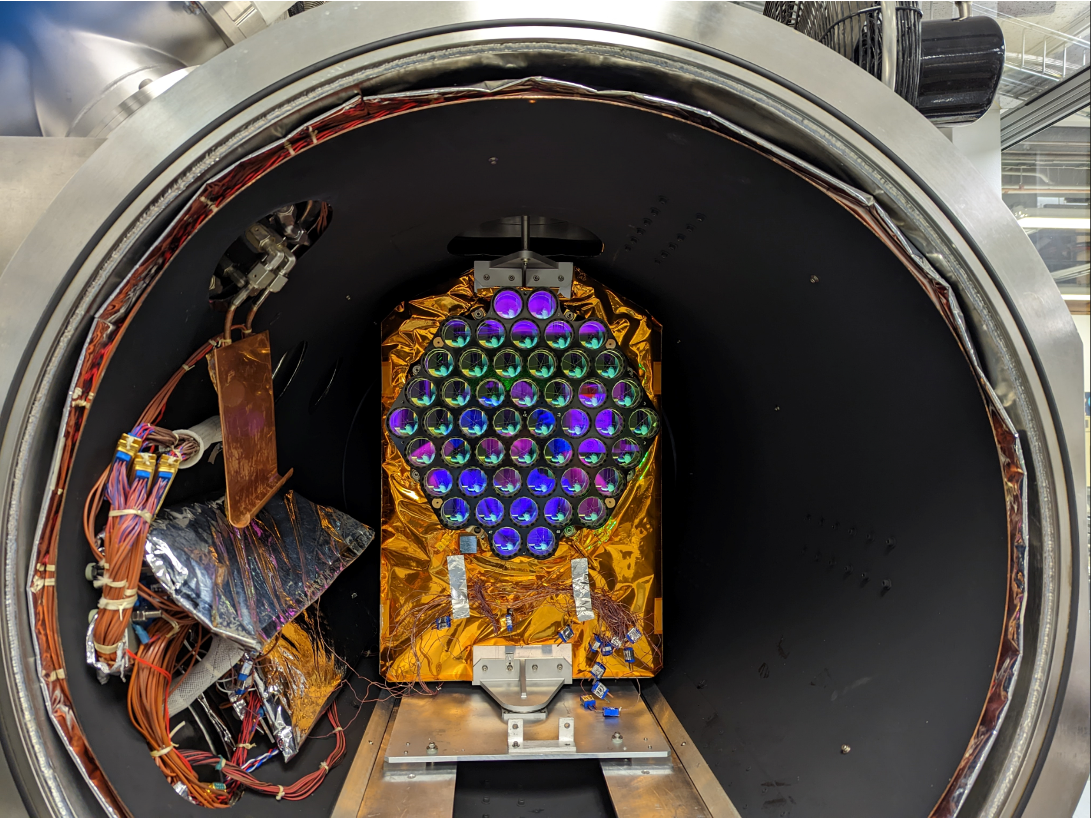
The laser retroreflector array is attached to the satellite in preparation for launch. The array is covered in a silver foil-like material. The mirrors of the array are placed in a honeycomb pattern and are reflecting magenta colors back to the camera. These are the colors of what is surrounding the camera.
The LRA instrument aboard the GPS III SV-09 satellite at inspection before launch.  
Credit: NASA

Using GPS data also supports other Earth-observing satellites and the data they collect. These satellites help us understand our planet and provide early warnings for natural hazards. Satellites orbiting the planet have GPS receivers to help pinpoint their exact location in space. The more precise the GPS orbit information, the more accurate and reliable the rest of the satellite’s data becomes, Tsaoussi said.

Satellites like ICESat-2 (Ice, Cloud, and land Elevation satellite 2), SWOT (Surface Water and Ocean Topography), and GRACE-FO (Gravity Recovery and Climate Experiment Follow On) also rely on laser-ranging technology to pinpoint their location in orbit.

NASA’s Space Geodesy Project operates a global network of Satellite Laser Ranging stations dedicated to continuous satellite tracking. Local stations are currently monitoring the latest GPS III satellite, with international stations set to follow soon.

These LRAs were developed by the Space Geodesy Project in partnership with the Naval Research Laboratory’s Naval Center for Space Technology in Washington.

By Erica McNamee

NASA’s Goddard Space Flight Center, Greenbelt, Md.

Share

Details

Last Updated

Mar 19, 2026

Editor
Jenny Marder
Contact
Jenny Marder
Location
Goddard Space Flight Center

Powered by WPeMatico

Get The Details…