Chilled New York City

Chilled New York City

Chunks of ice, which appear light blue in this false-color image, line the western shore of Manhattan in the Hudson River. Smaller rivers and lakes in the scene also appear frozen or partially frozen. The ground is snow-covered, and tall buildings cast long, dark shadows.
January 28, 2026

The New York metropolitan area was showing the effects of a prolonged cold spell in late January 2026. During a stretch of frigid weather, ice choked the Hudson River along Manhattan’s western shore.

The OLI (Operational Land Imager) on Landsat 8 captured this image of the wintry landscape around midday on January 28. The image is false-color (bands 5-4-3) to distinguish ice (light blue) from open water and snow. Vegetation appears red. Ice is abundant in the Hudson River and visible in smaller amounts in the East River, the Jacqueline Kennedy Onassis Reservoir in Central Park, and waterways in New Jersey.

Temperatures in New York City dropped below freezing on January 24 and stayed there for over a week. The high on January 28, the date of the image, was 23 degrees Fahrenheit (minus 5 degrees Celsius). Low temperatures and harsh wind chills gripped much of eastern North America over this period amid a surge of Arctic air.

Much of the ice in the image likely floated there from farther upriver, where tidal currents are weaker and salinity is lower. These conditions allow water to freeze sooner and at higher temperatures than the faster-flowing, brackish water near the river’s mouth, shown here. A complete freeze of the Hudson around Manhattan is unlikely, experts say, although it did occur back in 1888. Still, the ice buildup was substantial enough for NYC Ferry to suspend services for several days.

Iced-up rivers can have other implications, from flooding and infrastructure damage to changes in hydrologic processes that affect water quality and aquatic habitats.

Scientists, government agencies, and emergency responders are increasingly turning to remote sensing technologies such as synthetic aperture radar and hyperspectral imaging to track river ice. Improved monitoring can aid in water resource management and mitigate ice’s effects on infrastructure and ecosystems.

In addition to the river ice, other signs of winter were visible across New York. A fresh layer of snow coated the landscape following a winter storm, in which a weather station in Central Park recorded nearly 12 inches (30 centimeters) of accumulation on January 25. And the low angle of the midwinter Sun caused the tall buildings in Midtown and Lower Manhattan to cast long shadows.

In a neighboring borough on February 2, a shorter shadow was cast—this one by the weather-prognosticating groundhog known as Staten Island Chuck. Folklore holds that the sighting signals six more weeks of winter. When compared with data from NOAA’s National Centers for Environmental Information, the New York rodent was deemed the most accurate of his peer weather “forecasters.” This year, Chuck might be right, at least in the near term: the National Weather Service forecast called for below-average temperatures to persist, with Arctic air returning to the city by the weekend.

NASA Earth Observatory image by Michala Garrison, using Landsat data from the U.S. Geological Survey. Story by Lindsey Doermann.

References & Resources

You may also be interested in:

Stay up-to-date with the latest content from NASA as we explore the universe and discover more about our home planet.

Arctic Sea Ice Ties for 10th-Lowest on Record

3 min read

Satellite data show that Arctic sea ice likely reached its annual minimum extent on September 10, 2025.

Article

Greenland Ice Sheet Gets a Refresh

3 min read

A moderately intense season of surface melting left part of the ice sheet dirty gray in summer 2025, but snowfall…

Article

Antarctic Sea Ice Saw Its Third-Lowest Maximum

2 min read

Sea ice around the southernmost continent hit one of its lowest seasonal highs since the start of the satellite record.

Article

Powered by WPeMatico

Get The Details…

Biomedical Research, CubeSat Deployments Top Crew Schedule

Biomedical Research, CubeSat Deployments Top Crew Schedule

This tranquil view from the International Space Station captures the Kibo laboratory module with its Exposed Facility, a portion of the station’s main solar arrays (right), and part of the Canadarm2 robotic arm (left). The photograph was taken during an orbital sunset as the station soared 270 miles above a cloudy Atlantic Ocean off the coast of South Africa.
This tranquil view from the International Space Station captures the Kibo laboratory module with its Exposed Facility, a portion of the station’s main solar arrays (right), and part of the Canadarm2 robotic arm (left) above a cloudy Atlantic Ocean.
NASA

Biomedical research to keep crews healthy and CubeSat deployments for educational research topped the science schedule aboard the International Space Station on Tuesday. The Expedition 74 crew also focused on cargo swaps and life support maintenance throughout the day.

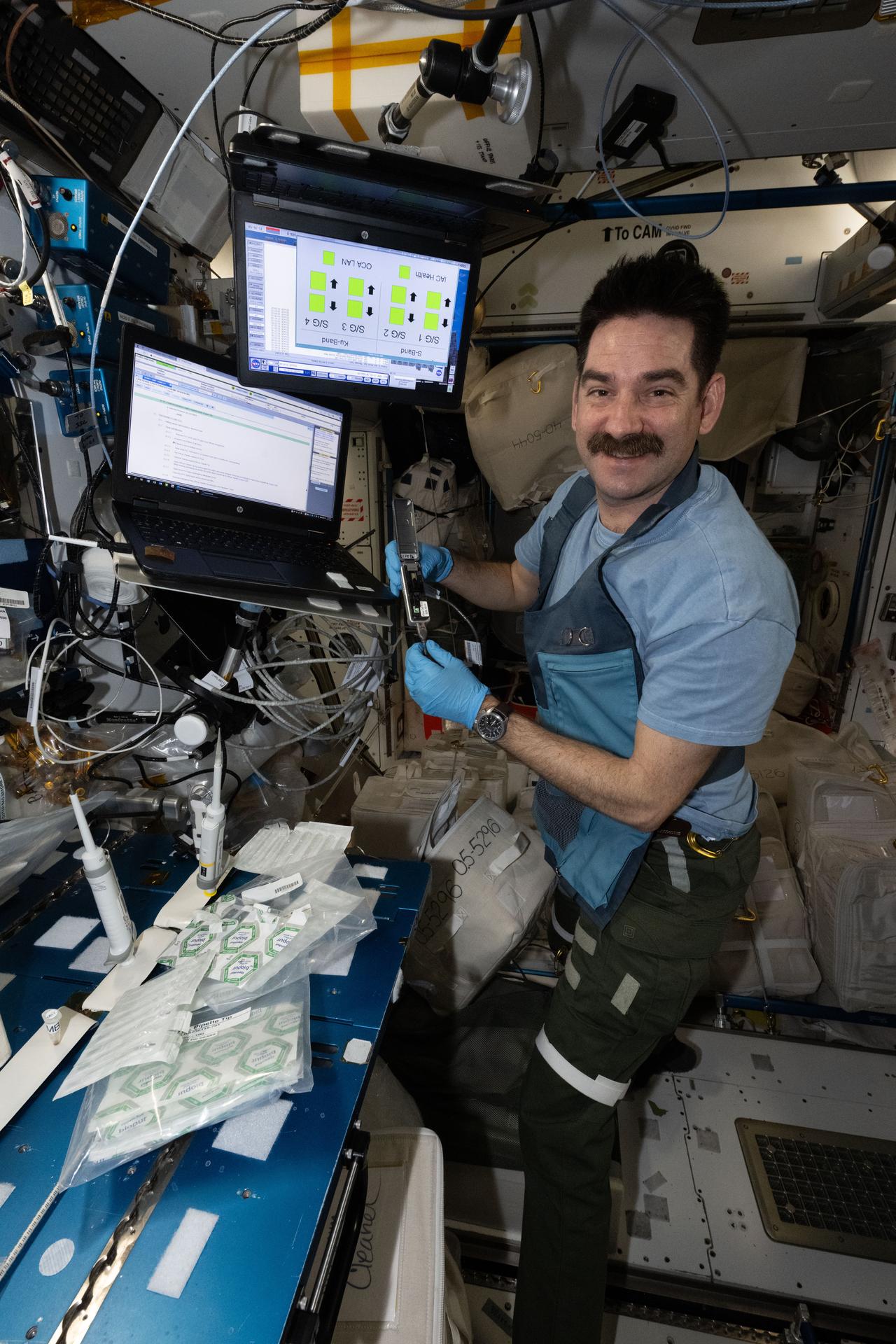
NASA Flight Engineer Chris Williams processed his body samples during the first half of his shift for the long-running CIPHER astronaut health study. He collected then stowed his urine samples inside a science freezer for preservation and later analysis. The human research investigation looks at a broad range of physiological and psychological parameters before, during, and after a spaceflight to understand how the human body adapts to weightlessness. Doctors will use the insights to keep crews healthy as they travel farther away from Earth.

Williams also pointed a camera out a window on the cupola as a set of CubeSats were deployed outside the Kibo laboratory module by a small satellite orbital deployer into Earth orbit. Students from Mexico, Italy, Thailand, Malaysia, and Japan designed the shoe-boxed satellites for a series of Earth observations and technology demonstrations.

Williams also logged onto a station computer and studied procedures to monitor the approach and rendezvous of the SpaceX Crew-12 mission aboard a Dragon spacecraft targeted to launch no earlier than Feb. 11 from Cape Canaveral in Florida. The first-time space flyer then continued packing completed science experiments and station hardware for return to Earth inside a Dragon spacecraft docked to the Harmony module’s forward port.

Flight Engineer Sergei Mikaev started his shift in the Nauka science module replacing battery controllers to maintain safe operations of the Roscosmos segment’s electrical power system. After lunchtime, Mikaev inspected and cleaned a pair of laptop computers before removing hardware and crew supplies from the Progress 92 cargo craft and stowing them inside the orbital outpost.

Station Commander Sergey Kud-Sverchkov spent his shift primarily on lab maintenance in the station’s Roscosmos’ modules. He first verified the location and configuration of a variety tool kits then inventoried and photographed the tools for analysis on the ground. Afterward, Kud-Sverchkov cleaned and inspected station smoked detectors and their components verifying they were in functional condition.

Learn more about station activities by following the space station blog, @space_station on X, as well as the ISS Facebook and ISS Instagram accounts.

Get the latest from NASA delivered every week. Subscribe here.

Powered by WPeMatico
Get The Details…

Mark A. Garcia

Full Moon over Artemis II

Full Moon over Artemis II

A golden full moon is seen shining over NASA’s SLS (Space Launch System) and Orion spacecraft, atop the mobile launcher in the early hours of February 1, 2026. The SLS core stage is a distinctive deep orange, while Orion is white and sits on top of the core stage.
NASA/Sam Lott

A full moon is seen shining over NASA’s SLS (Space Launch System) and Orion spacecraft, atop the mobile launcher at Launch Pad 39B at NASA’s Kennedy Space Center in Florida in the early hours of February 1, 2026.

The agency concluded a wet dress rehearsal for the agency’s Artemis II test flight early Tuesday morning, successfully loading cryogenic propellant into the SLS (Space Launch System) tanks, sending a team out to the launch pad to closeout Orion, and safely draining the rocket. The wet dress rehearsal was a prelaunch test to fuel the rocket, designed to identify any issues and resolve them before attempting a launch. To allow teams to review data and conduct a second wet dress rehearsal, NASA now will target March as the earliest possible launch opportunity for the flight test.

Read more about the wet dress rehearsal.

Image credit: NASA/Sam Lott

Powered by WPeMatico
Get The Details…
Monika Luabeya

NASA Space to Soil Challenge

NASA Space to Soil Challenge

A 3D rendering of a satellite with solar panels and a wire mesh antenna orbiting Earth. The Earth is textured with continents and oceans. The satellite is in the foreground against a dark background with stars.
NASA/JPL-Caltech

Rapid advances in commercial space, artificial intelligence, and edge computing are transforming what is possible for Earth observation. By pushing more intelligence onboard, missions can move from passively collecting data to actively interpreting and responding to changing surface conditions in near-real time, enabling more targeted observations and dramatically improving the value of data returned to the ground. Within this context, land-focused applications such as regenerative agriculture, sustainable forestry, and broader land resilience efforts stand to benefit enormously from satellites that can adapt what, when, and how they sense based on dynamic environmental signals and algorithmic insight rather than fixed schedules or static acquisition plans.

NASA Earth Science Technology Office (ESTO) invites participants to design small satellite (SmallSat) mission concepts that leverage adaptive sensing and onboard processing to enhance regenerative agriculture, forestry, or a similar land resilience objective.​ Participants must work within onboard power, compute, and bandwidth constraints characteristic of SmallSat missions, focusing on how to orchestrate existing land observation algorithms into an efficient, responsive onboard intelligence layer.​ Both hardware-oriented and software-oriented solutions—or combinations of the two—are encouraged.

NASA’s primary objective for this challenge is to advance computational and systems approaches for adaptive sensing or onboard processing on SmallSat missions. The goal is not to develop new agricultural or forestry science but rather to improve how SmallSats sense, process, and deliver information to enable these applications.

Award: $400,000 in total prizes

Challenge Open Date: January 30, 2026

Submission Close Date: May 4, 2026

For more information, visit: https://nasa-space-to-soil.org/

Powered by WPeMatico
Get The Details…
Bailey G. Light

NASA Astronaut to Answer Questions from Students in Pennsylvania

NASA Astronaut to Answer Questions from Students in Pennsylvania

NASA astronauts Chris Williams and Zena Cardman, both Expedition 74 Flight Engineers, work on spacesuit maintenance inside the International Space Station's Quest airlock.
NASA astronauts Chris Williams and Zena Cardman, both Expedition 74 flight engineers, work on spacesuit maintenance inside the International Space Station’s Quest airlock on Dec. 16, 2025.
Credit: NASA

NASA astronaut Chris Williams will connect with students in Pennsylvania to answer prerecorded science, technology, engineering, and mathematics (STEM) questions while aboard the International Space Station.

The Earth-to-space call will begin at 12:20 p.m. EST Thursday, Feb. 5, and will stream live on the agency’s Learn With NASA YouTube channel.

Media interested in covering the event must RSVP by 5 p.m., Wednesday, Feb. 4, to Tamara Krizek at: 917-692-5038 or tamara.krizek@davincisciencecenter.org.

The Da Vinci Science Center will host this event in Allentown, Pennsylvania, for students in kindergarten through grade 12, and members of the community. This unique opportunity aims to deepen understanding of space exploration and inspire young people to pursue a future career in STEM.

For more than 25 years, astronauts have continuously lived and worked aboard the space station, testing technologies, performing science, and developing skills needed to explore farther from Earth. Astronauts communicate with NASA’s Mission Control Center in Houston 24 hours a day through SCaN’s (Space Communications and Navigation) Near Space Network.

Research and technology investigations taking place aboard the space station benefit people on Earth and lay the groundwork for other agency deep space missions. As part of NASA’s Artemis campaign, the agency will send astronauts to the Moon to prepare for future human exploration of Mars, inspiring the world through discovery in a new Golden Age of innovation and exploration.

See more information on NASA in-flight calls at:

https://www.nasa.gov/stemonstation

-end-

Gerelle Dodson
Headquarters, Washington
202-358-1600
gerelle.q.dodson@nasa.gov

Sandra Jones
Johnson Space Center, Houston
281-483-5111
sandra.p.jones@nasa.gov

Share

Details

Last Updated

Feb 02, 2026

Editor
Jessica Taveau

Powered by WPeMatico
Get The Details…
Jessica Taveau