NASA Facility Builds on Space Station Legacy at Kennedy

NASA Facility Builds on Space Station Legacy at Kennedy
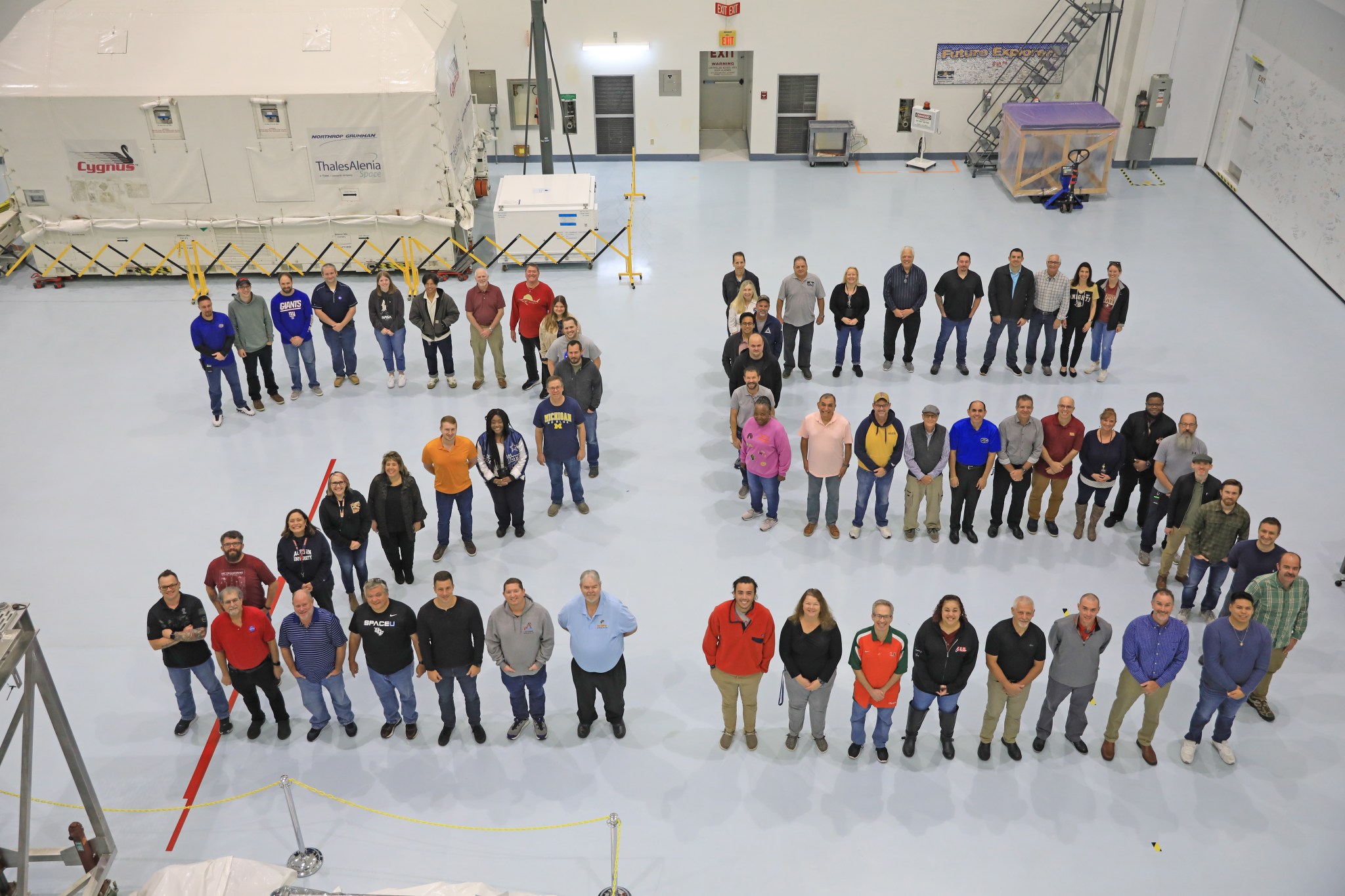
Teams at the Space Station Processing Facility at NASA’s Kennedy Space Center in Florida celebrate 25 years of supporting the International Space Station on November 28, 2023.
Teams at NASA’s Kennedy Space Center in Florida pose inside the Space Station Processing Facility’s high bay to celebrate 25 years of supporting the International Space Station.
NASA/Ben Smegelsky

Built to be the last stop for components of the International Space Station, the Space Station Processing Facility (SSPF) at NASA’s Kennedy Space Center in Florida, has been given a new name that honors this legacy while embracing its role as a multi-tenant processing facility.

Agency officials have updated the name of the 457,000 square foot, three-story building to “Space Systems Processing Facility,” recognizing its progression into a workplace for processing hardware bound for the station as well as to the Moon and beyond.
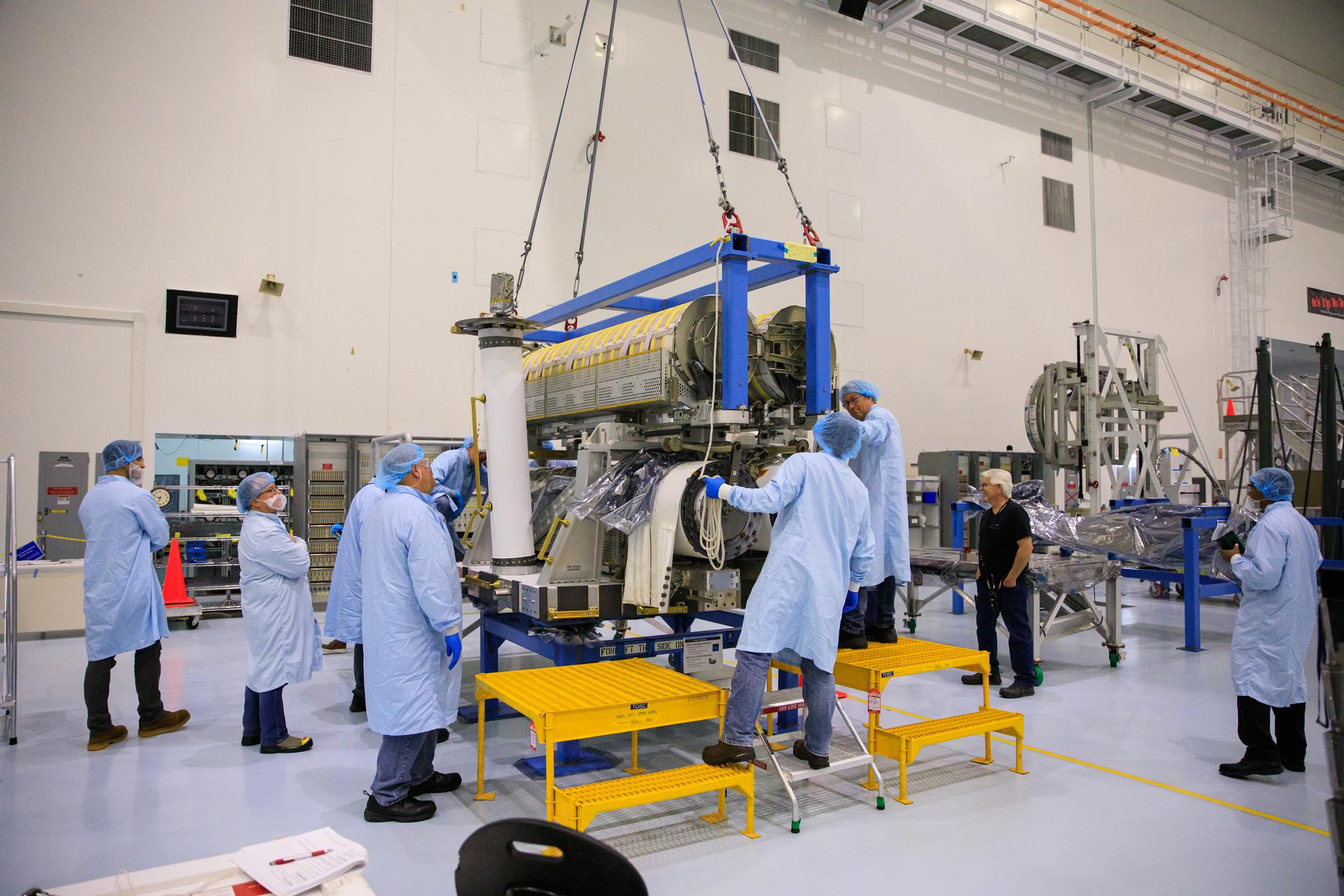
Inside the Space Station Processing Facility high bay at NASA’s Kennedy Space Center in Florida, technicians assist as a crane is used to lower a set of International Space Station Roll Out Solar Arrays (iROSA) onto a platform on March 23, 2023.
NASA/Isaac Watson

“Kennedy Space Center has a strong history of supporting the missions that have improved life on our planet while inspiring the world,” said Kennedy Space Center Director Janet Petro. “For the last 25 years, the facility has processed many of the critical components and elements necessary to build and sustain the work of the International Space Station. This name change reflects its remarkable evolution into a dynamic, multi-user processing environment in the wake of the center’s transformation to the nation’s premier spaceport, and we are seeing our vision of igniting space exploration and discovery come to life.”

Today, NASA programs such as Artemis and Commercial Resupply Services use the SSPF processing areas, with Gateway processing set to begin within the next few years. Commercial companies such as Northrop Grumman, Sierra Space, and SpaceX also manufacture and process payloads and hardware in the facility.
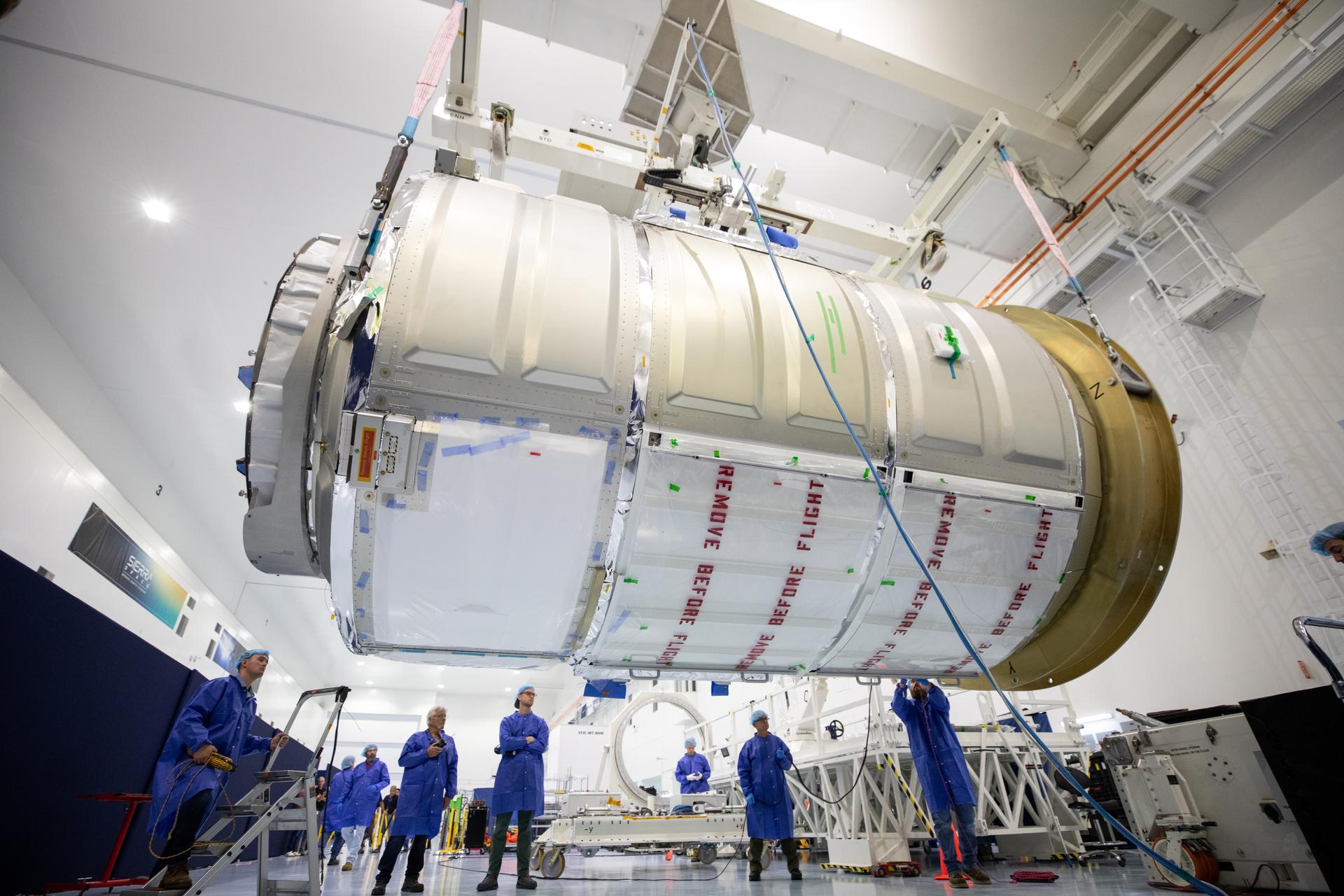
The Northrop Grumman Cygnus spacecraft’s pressurized cargo module (PCM) for the company’s 20th commercial resupply mission is lifted and moved by crane inside the high bay in the Space Station Processing Facility at NASA’s Kennedy Space Center in Florida on Monday, Sept. 18, 2023.
NASA/Ben Smegelsky

“All of the tenants in the facility are under contract with NASA to develop a product,” said Kevin Zari, associate director for the International Space Station and Exploration. “The next step in the evolution of the SSPF is going from government to commercial, just like we did with Low Earth Orbit launch vehicles. Soon, commercial entities might be using the facility, or some parts of the facility, on purely commercial ventures.”

Built originally for assembling and processing components for the space station, the SSPF hosted processing of the first U.S.-built component of the station, Node 1 – or the Unity connecting module – which was carried to orbit on STS-88 from Kennedy in December 1998. Node 1 helped kick off a 25-year legacy of 275 launches to the station, 337 dockings or redockings of spacecraft or modules, and over 3,700 science investigations since Expedition 0. This includes hosting 273 people from 21 countries – and counting – visiting or living on the orbiting laboratory. The SSPF played a key role each step of the way as the main site for processing station components, flight hardware, and science experiments in the clean room environment of its processing bays.
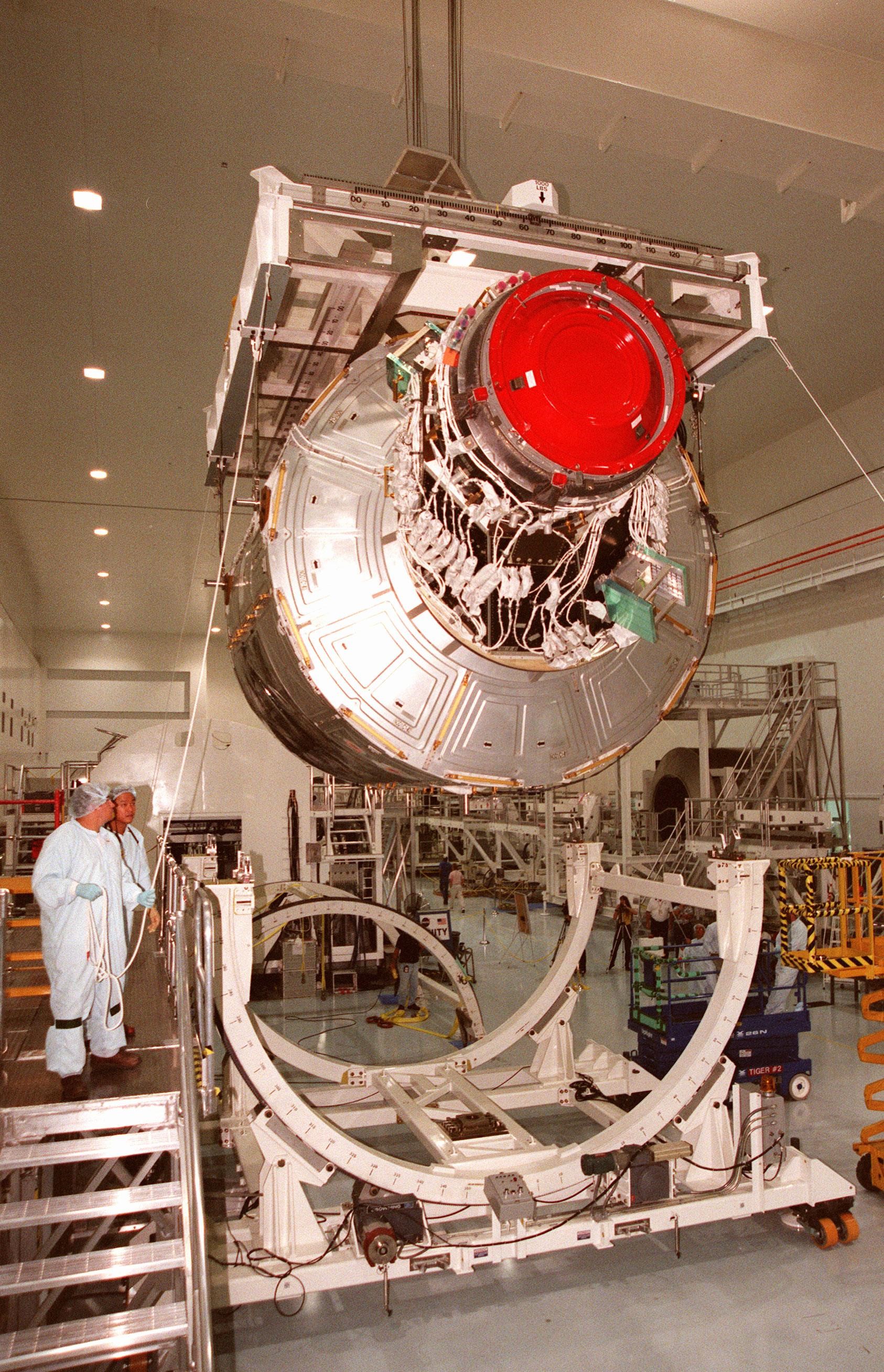
Workers in the SSPF high bay oversee the lifting of the Unity connecting module for its move to another location in the SSPF on Oct. 10, 1998. In the SSPF, Unity is undergoing testing such as the Pad Demonstration Test to verify the compatibility of the module with the Space Shuttle.
NASA

“The SSPF started off with the need to meet the requirements of the space station program,” Zari said. “Since the space shuttle was the lift vehicle for assembling the space station, with the exception of the Russian module and components, all NASA, ESA (European Space Agency), and JAXA (Japan Aerospace Exploration Agency) equipment came here to the SSPF for processing prior to launch.”

Space shuttle missions delivered nine elements of the station processed in the SSPF: Unity, Z1 truss, P6 integrated truss, Destiny, Canadarm 2, the joint airlock, and the S0, S1, and P1 trusses. All preparation and postflight maintenance for other vital parts of space station assembly was conducted in the SSPF, including multi-purpose logistics modules with critical supplies and science experiments that were flown to the station.
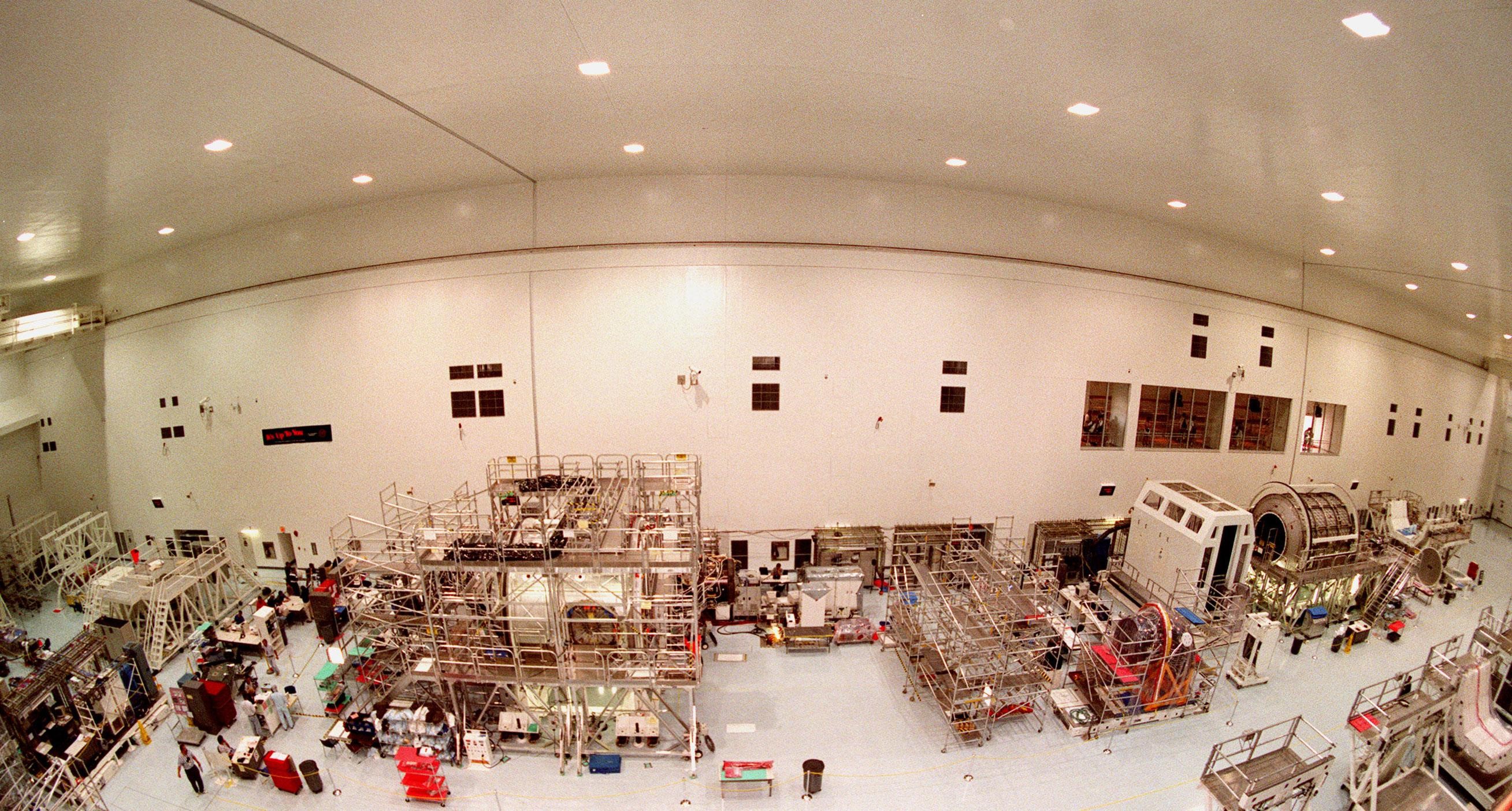
In this panoramic view of the SSPF taken Aug. 27, 1998, visible is (left to right) the Unity connecting module, the Rack Insertion Device and the first Multi-Purpose Launch Module, the Leonardo. Windows at the right above Leonardo allow visitors on tour to watch the activities in the SSPF.
NASA

“Even while the space station was still being built in the SSPF, you had science being checked out and ready to fly up to the station,” Curt Horanic, International Space Station technical director. “The SSPF was critical to assemble the space station, to test space station hardware on the ground, and to the science. First and foremost, the station is a laboratory and the research that’s happening is helping humans on Earth. And all of that research, for the most part, is coming through the SSPF.”

Both Horanic and Zari are among the small group of Kennedy employees who have been a part of the SSPF’s evolution since the beginning. Located just east of the Neil A. Armstrong Operations and Checkout Building, groundbreaking for the SSPF took place in March 1991 and dedication occurred in June 1994.
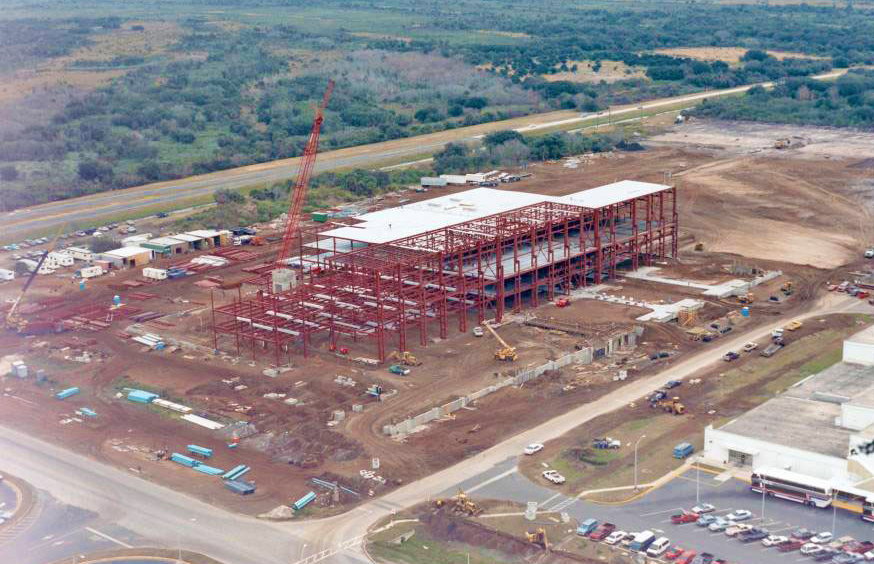
Aerial view of the Space Station Processing Facility
Construction of the SSPF as seen in an aerial view from January 1992.
NASA

“I remember being across the street at the Operations and Checkout Building when they used a golden shovel to dig the dirt that was here,” said Zari. “It’s been an amazing journey to watch it transform from a facility with only the space station in mind to a multi-program, multi-tenanted facility.”

Powered by WPeMatico

Get The Details…
Jason Costa
Experience the Launch of NASA’s PACE Mission

Experience the Launch of NASA’s PACE Mission

5 min read

Preparations for Next Moonwalk Simulations Underway (and Underwater)

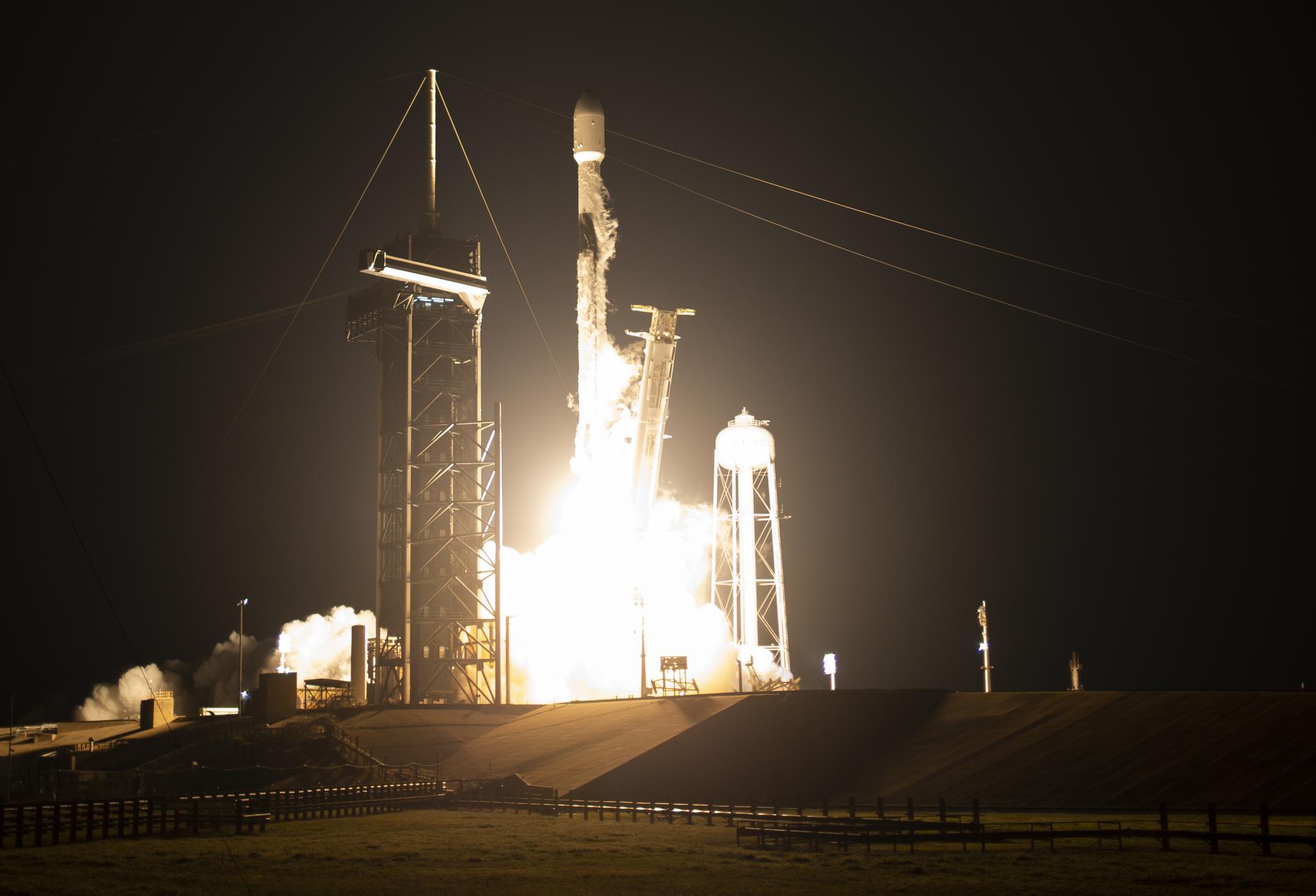
Digital content creators are invited to register to attend the launch of NASA’s Plankton, Aerosol, Cloud Ocean Ecosystem (PACE) mission and create content based on the experience. PACE is a NASA mission scheduled to launch no earlier than Feb. 6, 2024, on a SpaceX Falcon 9 rocket from Space Launch Complex 40 at Cape Canaveral Space Force Station in Florida.

The PACE mission will continue and improve NASA’s 20-year record of satellite observations of global ocean biology, aerosols, and clouds. PACE will help us better understand how the ocean and atmosphere exchange carbon dioxide, measure key atmospheric variables associated with air quality and Earth’s climate, and monitor ocean health, in part by studying phytoplankton, tiny plants and algae that sustain the marine food web. 

If your passion is to communicate and engage the world online, then this is the event for you! Seize the opportunity to see and share the #PACE mission launch. 

A maximum of 50 social media users will be selected to attend this three-day event and will be given access similar to news media. 

NASA Social participants will have the opportunity to: 

  • View a launch of the SpaceX Falcon 9 rocket and PACE spacecraft. 
  • Tour NASA facilities at Kennedy Space Center. 
  • Meet and interact with PACE subject matter experts. 
  • Meet fellow space enthusiasts who are active on social media. 

NASA Social registration for the PACE mission launch opens on Thursday, Dec. 14, and the deadline to apply is at 3 p.m. EST Tuesday, Dec. 19. All social applications will be considered on a case-by-case basis.   

APPLY NOW 

Do I need to have a social media account to register? 
Yes. This event is designed for people who: 

  • Actively use multiple social networking platforms and tools to disseminate information to a unique audience. 
  • Regularly produce new content that features multimedia elements. 
  • Have the potential to reach a large number of people using digital platforms, or reach a unique audience, separate and distinctive from traditional news media and/or NASA audiences. 
  • Must have an established history of posting content on social media platforms. 
  • Have previous postings that are highly visible, respected and widely recognized. 

Users on all social networks are encouraged to use the hashtag #NASASocial. Updates and information about the event will be shared on X via @NASASocial and @NASAKennedy, and via posts to Facebook and Instagram. 

How do I register? 
Registration for this event opens Thursday, Dec. 14, and closes at 3 p.m. EST on Tuesday, Dec. 19. Registration is for one person only (you) and is non-transferable. Each individual wishing to attend must register separately. Each application will be considered on a case-by-case basis. 

Can I register if I am not a U.S. citizen? 
Because of the security deadlines, registration is limited to U.S. citizens. If you have a valid permanent resident card, you will be processed as a U.S. citizen. 

When will I know if I am selected? 
After registrations have been received and processed, an email with confirmation information and additional instructions will be sent to those selected. We expect to send the acceptance notifications on Jan. 8. 

What are NASA Social credentials? 
All social applications will be considered on a case-by-case basis. Those chosen must prove through the registration process they meet specific engagement criteria. 

If you do not make the registration list for this NASA Social, you still can attend the launch offsite and participate in the conversation online. Find out about ways to experience a launch here. 

What are the registration requirements? 
Registration indicates your intent to travel to NASA’s Kennedy Space Center in Florida and attend the three-day event in person. You are responsible for your own expenses for travel, accommodations, food, and other amenities. 

Some events and participants scheduled to appear at the event are subject to change without notice. NASA is not responsible for loss or damage incurred as a result of attending. NASA, moreover, is not responsible for loss or damage incurred if the event is cancelled with limited or no notice. Please plan accordingly. 

Kennedy is a government facility. Those who are selected will need to complete an additional registration step to receive clearance to enter the secure areas. 

IMPORTANT: To be admitted, you will need to provide two forms of unexpired government-issued identification; one must be a photo ID and match the name provided on the registration. Those without proper identification cannot be admitted.  

For a complete list of acceptable forms of ID, please visit: NASA Credentialing Identification Requirements. 

All registrants must be at least 18 years old. 

What if the launch date changes? 
Many different factors can cause a scheduled launch date to change multiple times. If the launch date changes, NASA may adjust the date of the NASA Social accordingly to coincide with the new target launch date. NASA will notify registrants of any changes by email. 

If the launch is postponed, attendees will be invited to attend a later launch date. NASA cannot accommodate attendees for delays beyond 72 hours. 

NASA Social attendees are responsible for any additional costs they incur related to any launch delay. We strongly encourage participants to make travel arrangements that are refundable and/or flexible. 

What if I cannot come to the Kennedy Space Center? 
If you cannot come to the Kennedy Space Center and attend in person, you should not register for the NASA Social. You can follow the conversation online using #NASASocial. 

You can watch the launch on NASA Television or www.nasa.gov/live. NASA will provide regular launch and mission updates on @NASA, @NASAKennedy, and @NASA_LSP. 

If you cannot make this NASA Social, don’t worry; NASA is planning many other Socials in the near future at various locations! 

Powered by WPeMatico

Get The Details…
Andres D. Almeida

NASA Study Finds Life-Sparking Energy Source and Molecule at Enceladus

NASA Study Finds Life-Sparking Energy Source and Molecule at Enceladus

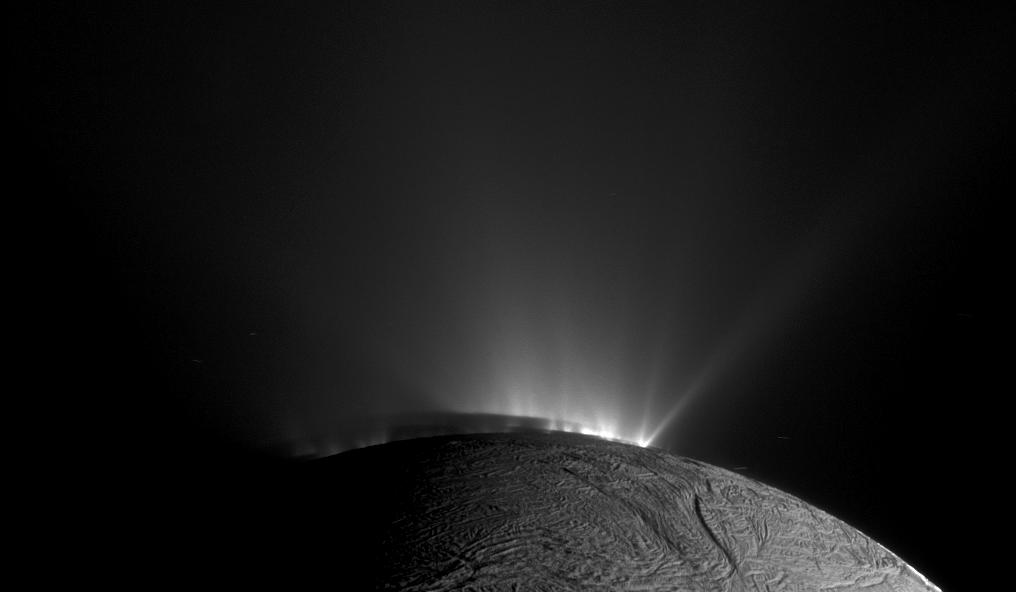
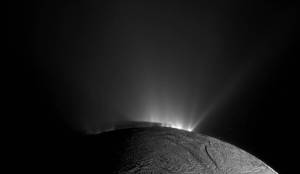
This image from NASA Cassini spacecraft, one of those acquired in the survey conducted by the Cassini imaging science team of the geyser basin at the south pole of Enceladus, was taken as Cassini was looking across the moon south pole.
Water from the subsurface ocean of Saturn’s moon Enceladus sprays from huge fissures out into space. NASA’s Cassini spacecraft, which captured this image in 2010, sampled icy particles and scientists are continuing to make new discoveries from the data.
NASA/JPL-Caltech/Space Science Institute

A study zooms in on data that NASA’s Cassini gathered at Saturn’s icy moon and finds evidence of a key ingredient for life and a supercharged source of energy to fuel it.

Scientists have known that the giant plume of ice grains and water vapor spewing from Saturn’s moon Enceladus is rich with organic compounds, some of which are important for life as we know it. Now, scientists analyzing data from NASA’s Cassini mission are taking the evidence for habitability a step further: They’ve found strong confirmation of hydrogen cyanide, a molecule that is key to the origin of life.

The researchers also uncovered evidence that the ocean, which is hiding below the moon’s icy outer shell and supplies the plume, holds a powerful source of chemical energy. Unidentified until now, the energy source is in the form of several organic compounds, some of which, on Earth, serve as fuel for organisms.

The findings, published Thursday, Dec. 14, in Nature Astronomy, indicate there may be much more chemical energy inside this tiny moon than previously thought. The more energy available, the more likely that life might proliferate and be sustained.

“Our work provides further evidence that Enceladus is host to some of the most important molecules for both creating the building blocks of life and for sustaining that life through metabolic reactions,” said lead author Jonah Peter, a doctoral student at Harvard University who performed much of the research while working at NASA’s Jet Propulsion Laboratory in Southern California. “Not only does Enceladus seem to meet the basic requirements for habitability, we now have an idea about how complex biomolecules could form there, and what sort of chemical pathways might be involved.”

Gathering of Moons
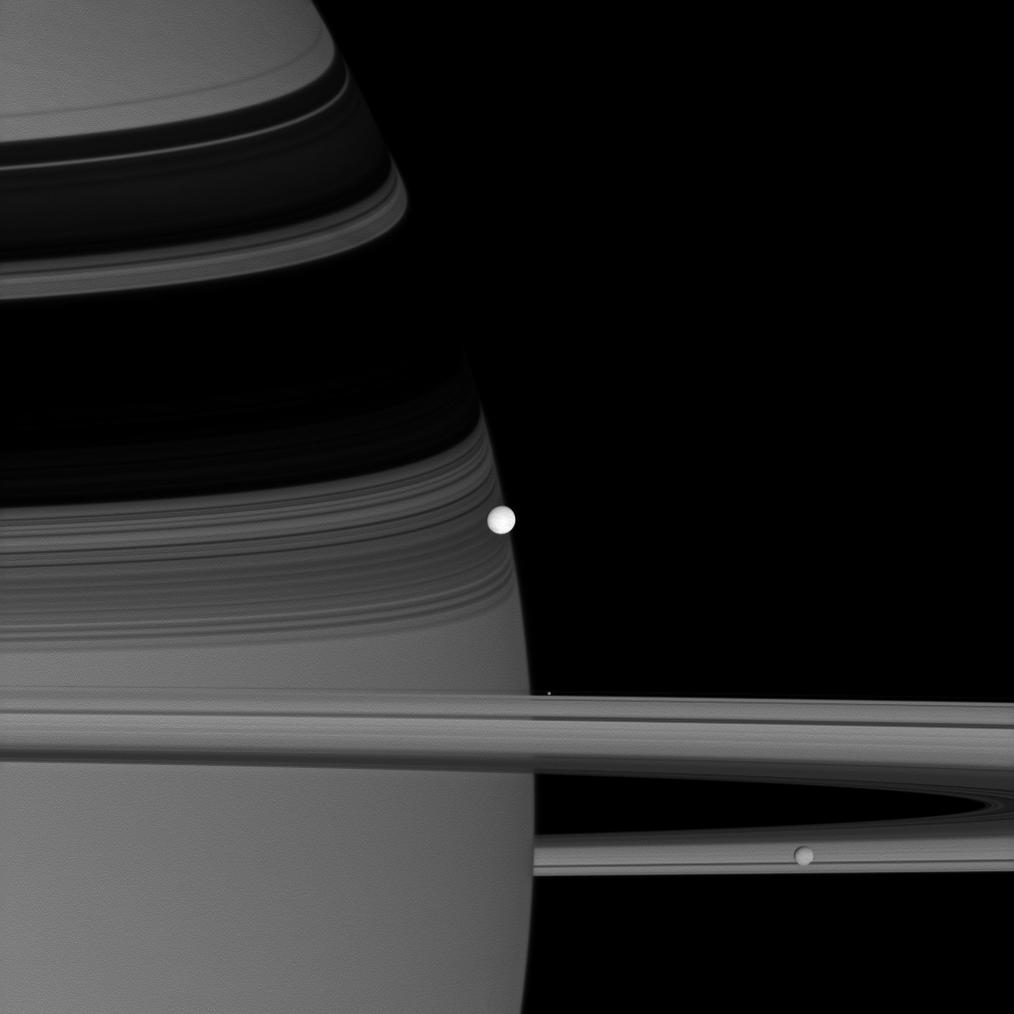
NASA’s Cassini spacecraft captured this image of reflective Enceladus, seen at center, as it orbits Saturn. Also in the 2007 image are two other moons: Pandora, a bright speck hovering near the rings, and Mimas, at lower right.
NASA/JPL/Space Science Institute

Versatile and Energetic

“The discovery of hydrogen cyanide was particularly exciting, because it’s the starting point for most theories on the origin of life,” Peter said. Life as we know it requires building blocks, such as amino acids, and hydrogen cyanide is one of the most important and versatile molecules needed to form amino acids. Because its molecules can be stacked together in many different ways, the study authors refer to hydrogen cyanide as the Swiss army knife of amino acid precursors.

“The more we tried to poke holes in our results by testing alternative models,” Peter added, “the stronger the evidence became. Eventually, it became clear that there is no way to match the plume composition without including hydrogen cyanide.”

In 2017, scientists found evidence at Enceladus of chemistry that could help sustain life, if present, in its ocean. The combination of carbon dioxide, methane, and hydrogen in the plume was suggestive of methanogenesis, a metabolic process that produces methane. Methanogenesis is widespread on Earth, and may have been critical to the origin of life on our planet.

The new work uncovers evidence for additional energy chemical sources far more powerful and diverse than the making of methane: The authors found an array of organic compounds that were oxidized, indicating to scientists that there are many chemical pathways to potentially sustain life in Enceladus’ subsurface ocean. That’s because oxidation helps drive the release of chemical energy.

“If methanogenesis is like a small watch battery, in terms of energy, then our results suggest the ocean of Enceladus might offer something more akin to a car battery, capable of providing a large amount of energy to any life that might be present,” said JPL’s Kevin Hand, co-author of the study and principal investigator of the effort that led to the new results.

Math Is the Way

Unlike earlier research that used lab experiments and geochemical modeling to replicate the conditions Cassini found at Enceladus, the authors of the new work relied on detailed statistical analyses. They examined data collected by Cassini’s ion and neutral mass spectrometer, which studied the gas, ions, and ice grains around Saturn.

By quantifying the amount of information contained in the data, the authors were able to tease out subtle differences in how well different chemical compounds explain the Cassini signal.

“There are many potential puzzle pieces that can be fit together when trying to match the observed data,” Peter said. “We used math and statistical modeling to figure out which combination of puzzle pieces best matches the plume composition and makes the most of the data, without overinterpreting the limited dataset.”

Scientists are still a long way from answering whether life could originate on Enceladus. But as Peter noted, the new work lays out chemical pathways for life that could be tested in the lab.

Meanwhile, Cassini is the mission that keeps giving – long after it revealed that Enceladus is an active moon. In 2017, the mission ended by deliberately plunging the spacecraft into Saturn’s atmosphere. “Our study demonstrates that while Cassini’s mission has ended, its observations continue to provide us with new insights about Saturn and its moons – including the enigmatic Enceladus,” said Tom Nordheim, a JPL planetary scientist who’s a co-author of the study and was a member of the Cassini team.

More About the Mission

The Cassini-Huygens mission was a cooperative project of NASA, ESA (European Space Agency), and the Italian Space Agency. JPL, a division of Caltech in Pasadena, California, managed the mission for NASA’s Space Mission Directorate in Washington. JPL designed, developed, and assembled the Cassini orbiter.

For more information about Cassini, visit:

http://nasa.gov/cassini

News Media Contacts

Gretchen McCartney
Jet Propulsion Laboratory, Pasadena, Calif.
818-287-4115
gretchen.p.mccartney@jpl.nasa.gov 

Karen Fox / Alana Johnson
NASA Headquarters, Washington
301-286-6284 / 202-358-1501
karen.c.fox@nasa.gov / alana.r.johnson@nasa.gov

2023-183

Share

Details

Last Updated

Dec 14, 2023

Powered by WPeMatico

Get The Details…
Naomi Hartono

120 Years Ago: The First Powered Flight at Kitty Hawk

120 Years Ago: The First Powered Flight at Kitty Hawk

On Dec. 17, 1903, humanity’s long-held dream of flying came true. Ideas of flying date back centuries, from the Greek legend of Icarus and Daedalus, to kite flying in China, to the development of hydrogen-filled balloons in 18th century France, to early experiments with gliders in 19th century England and Germany. Around the turn of the 20th century, advances in engine technology and aerodynamics enabled powered flight using heavier-than-air machines, but attempts by leading designers proved unsuccessful. The honor of the first sustained and controlled flight of a powered heavier-than-air aircraft went to two bicycle shop owners from Dayton, Ohio, Orville and Wilbur Wright. The brothers combined the mechanical experience from their business with the fundamental breakthrough invention of three-axis control to enable them to steer the aircraft and maintain its equilibrium. Their 12-second flight changed the world forever.

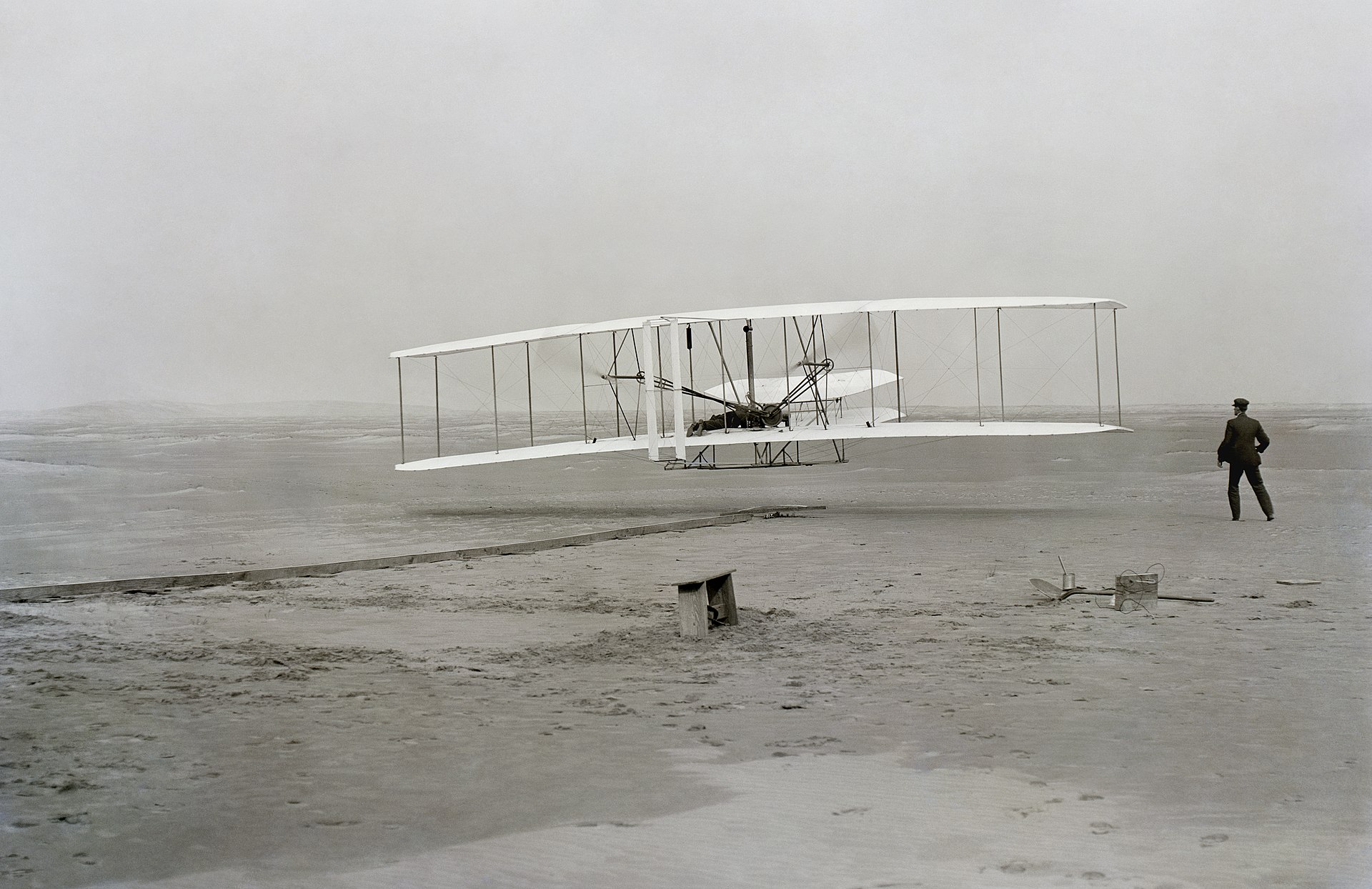
Orville Wright during the first powered flight of a heavier-than-air aircraft; Wilbur is standing to the right of the aircraft The Wrights’ third flight on Dec. 17, 1903
Left: Orville Wright during the first powered flight of a heavier-than-air aircraft; Wilbur is standing to the right of the aircraft. Right: The Wrights’ third flight on Dec. 17, 1903. Image credits: courtesy National Park Service.

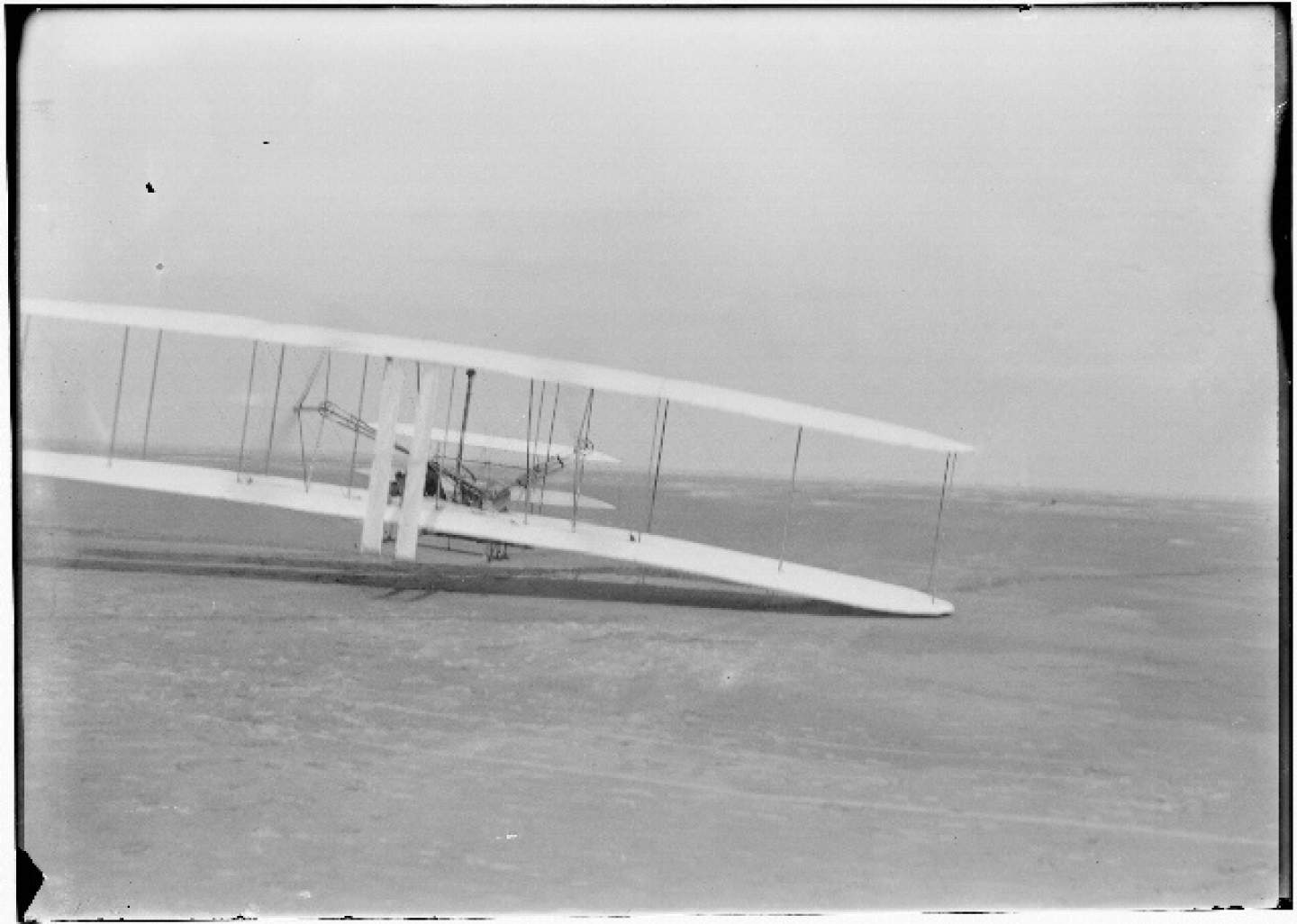
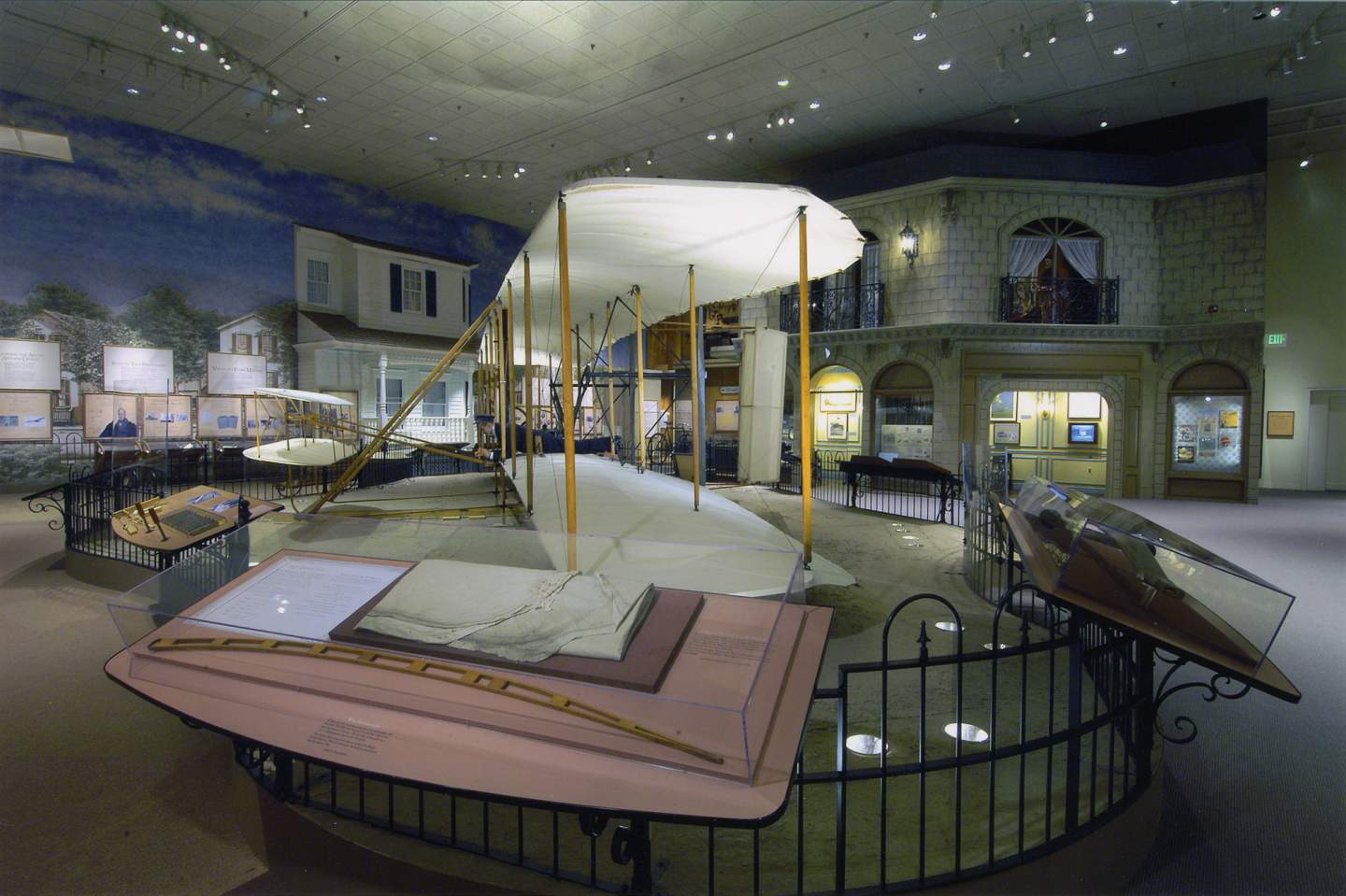
After several unsuccessful attempts, on Dec. 17, 1903, at Kill Devil Hills near Kitty Hawk, North Carolina, Orville Wright completed the first powered flight of a heavier-than-air aircraft known as the Wright Flyer. The flight lasted just 12 seconds, traveled 120 feet, and reached a top speed of 6.8 miles per hour. Amazing for the day, one of the five people to witness this historic first flight snapped a photograph of the event. The brothers completed three more flights that day, taking turns piloting, the longest traveling 852 feet in 59 seconds. The highest altitude reached in any of the flights was about 10 feet. The aircraft sustained damage at the end of its fourth flight, and gusty winds tipped it over, wrecking it beyond repair. The aircraft never flew again, but Orville took the wreckage home to Ohio and restored it. It went on display at the London Science Museum until 1948 when the Smithsonian Institution took ownership. Visitors can view the Wright Flyer in the Wright Brothers & The Invention of the Aerial Age exhibit at the Smithsonian’s National Air and Space Museum (NASM) in Washington, D.C.

Distant view of the Wright Flyer, at left, after its fourth flight on Dec. 17, 1903
Distant view of the Wright Flyer, at left, after its fourth flight on Dec. 17, 1903. Image credit: courtesy Library of Congress.

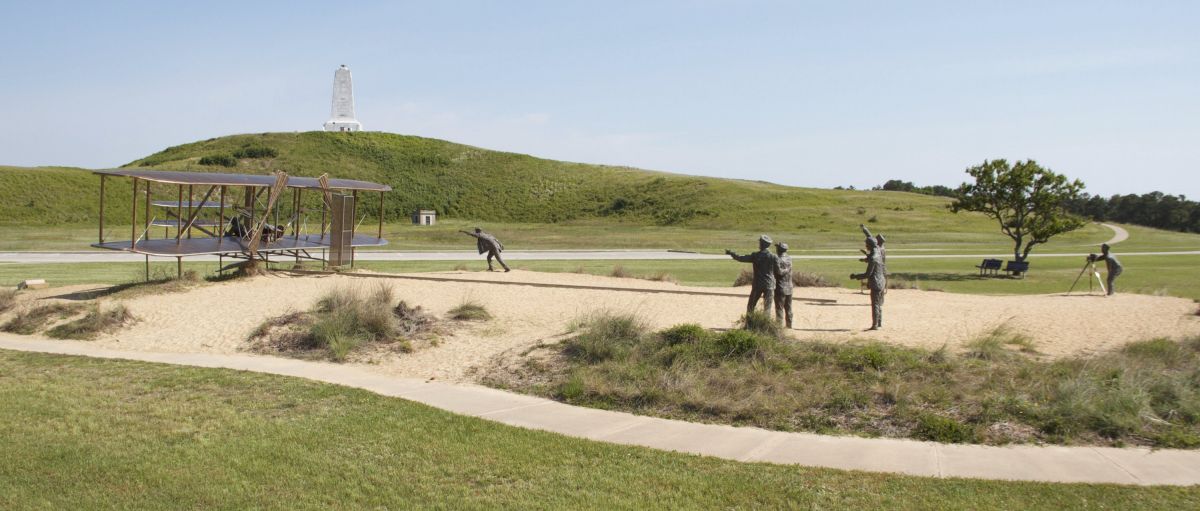
Bronze statues recreate the day of the first powered flight at the Wright Brothers National Memorial near Kitty Hawk, North Carolina
Bronze statues recreate the day of the first powered flight at the Wright Brothers National Memorial near Kitty Hawk, North Carolina. Image credit: courtesy National Park Service.

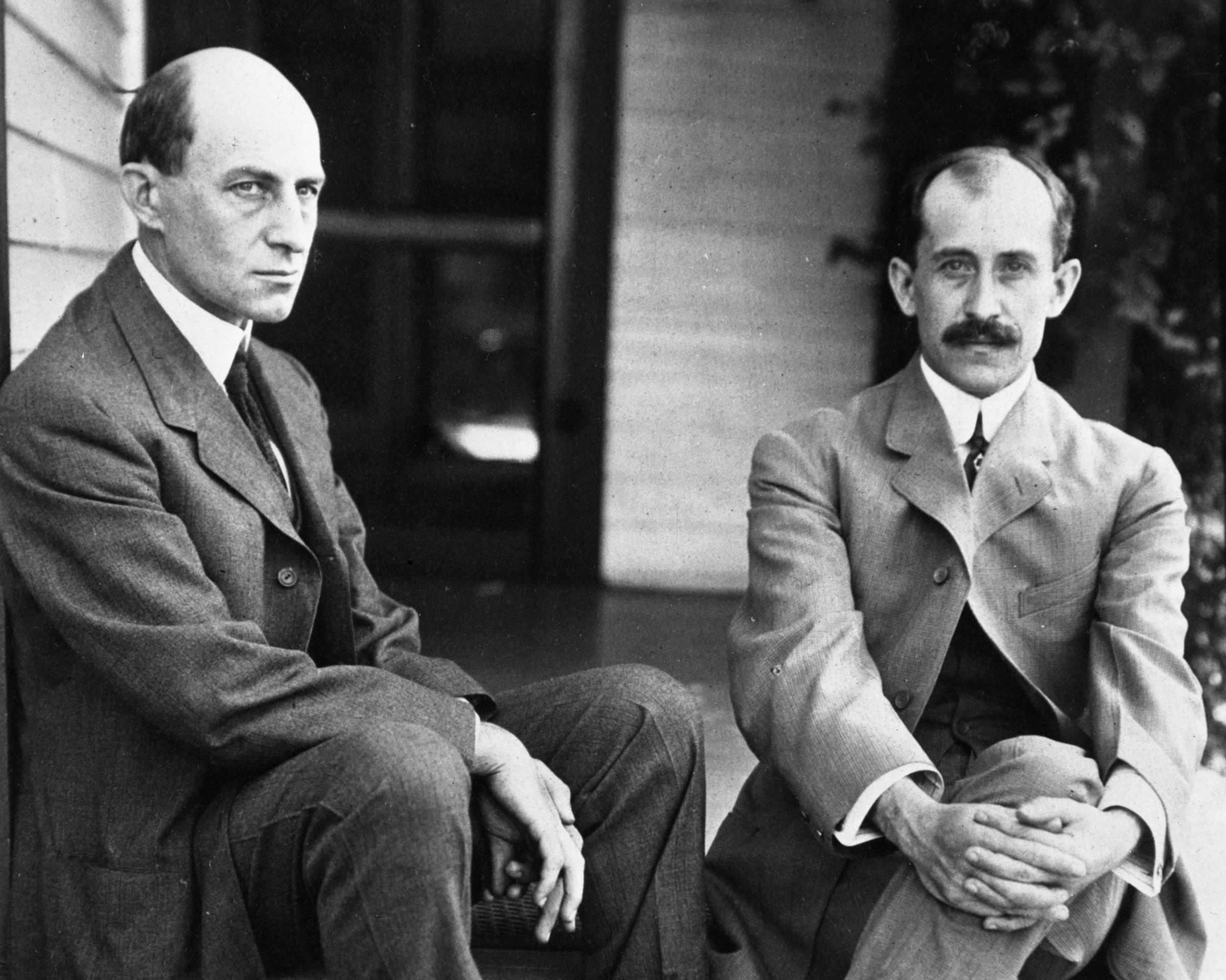
Photo of the Wright brothers. Wilbur, left, and Orville Wright The Wright Flyer at the Smithsonian Institution’s National Air and Space Museum (NASM) in Washington, D.C.
Left: Wilbur, left, and Orville Wright. Image credit: courtesy Carillon Historical Park. Right: The Wright Flyer at the Smithsonian Institution’s National Air and Space Museum (NASM) in Washington, D.C. Image credit: courtesy NASM.

The Wrights continued flying, building more and more advanced aircraft, and paving the way for future aerial explorers. By 1905, they completed a 24-mile flight in their Flyer III. Others in the United States and Europe made advances in the rapidly expanding field of aviation, and World War I (1914-1918) saw the first use of aircraft in warfare. The first scheduled commercial passenger flight took place on Jan. 1, 1914, between St. Petersburg and Tampa, Florida, shortening travel between the two cities by more than 90 minutes. The Post Office emerged as one of the first major users of airplanes to speed up the delivery of mail across the country.

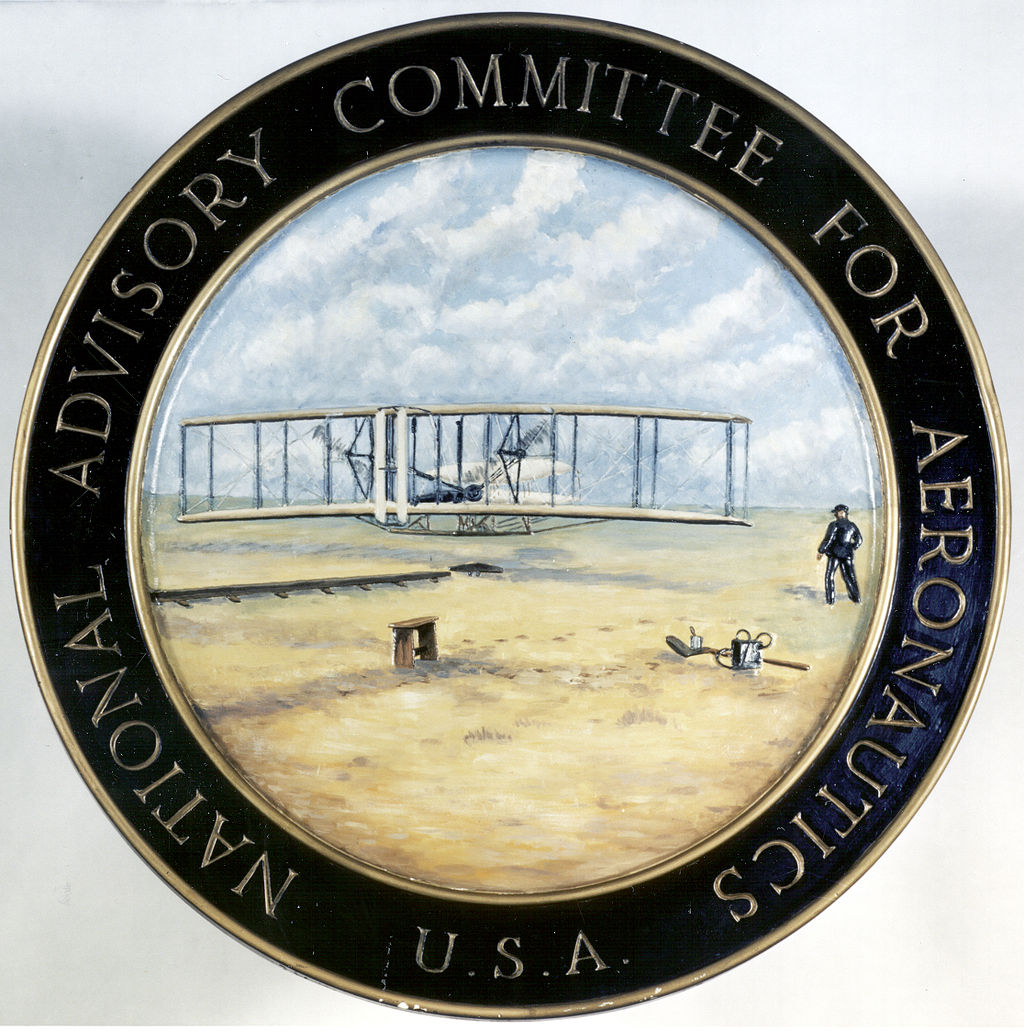
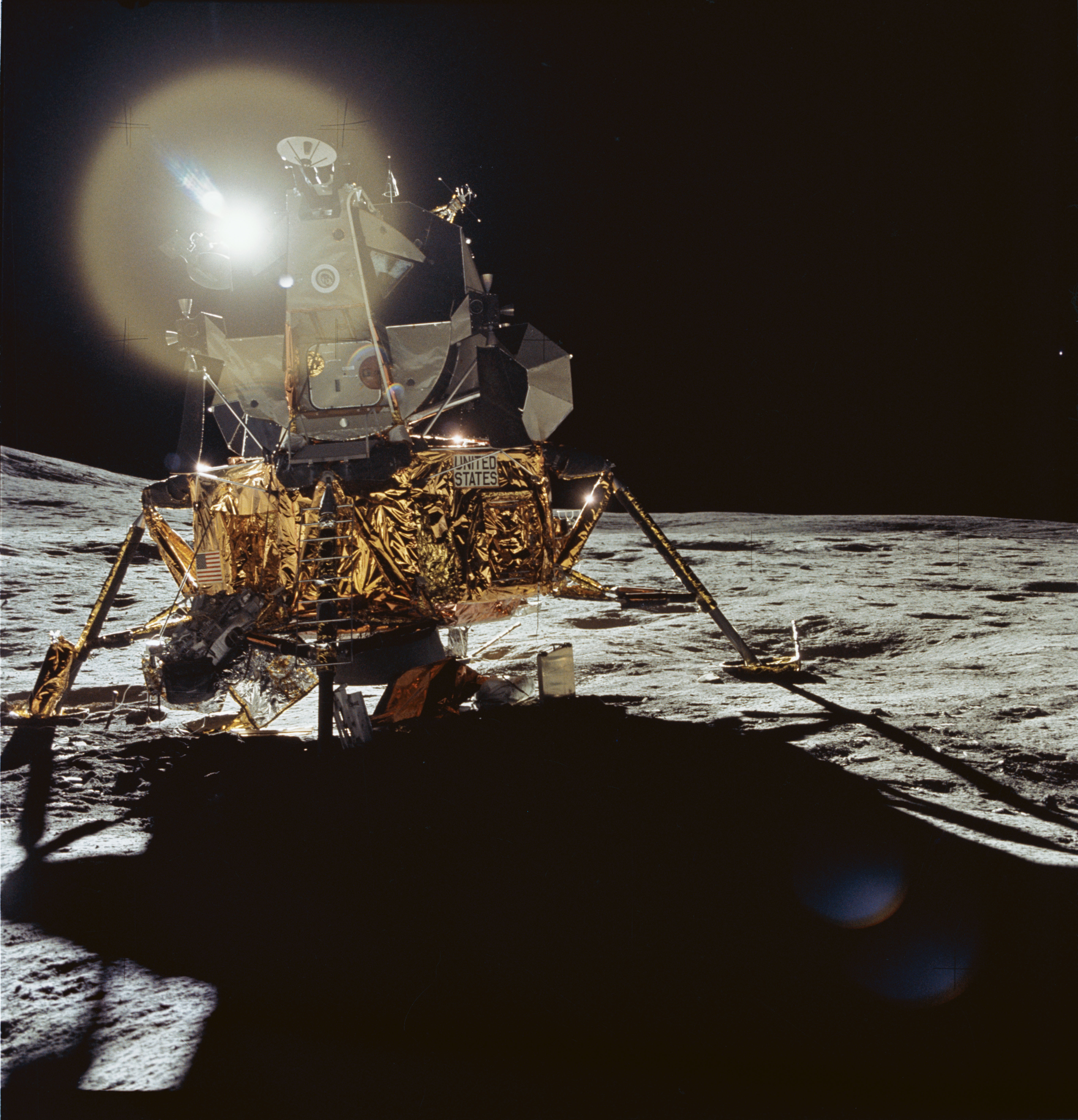
Seal of NACA, including an illustration of the first flight at Kitty Hawk Seal of NASA Apollo 14 Lunar Module Kitty Hawk on the surface of the Moon
Left: Seal of NACA, including an illustration of the first flight at Kitty Hawk. Middle: Seal of NASA. Right: Apollo 14 Lunar Module Kitty Hawk on the surface of the Moon.

Within a dozen years after the first powered flight, the U.S. government formed the National Advisory Committee on Aeronautics (NACA) to advance the field of aeronautics. Research conducted at NACA facilities – Langley Aeronautical Laboratory in Hampton, Virginia; Ames Aeronautical Laboratory in Mountain View, California; Lewis Flight Propulsion Laboratory in Cleveland, Ohio; and Muroc Flight Test Unit at Edwards Air Force Base near Lancaster, California – led to breakthroughs that greatly advanced the field of aeronautics including supersonic flight. In 1958, in response to Soviet advances in space flight, the U.S. government established the National Aeronautics and Space Administration (NASA), a civilian agency to lead American space activities. At its core, the new agency incorporated NACA’s facilities and employees. In 1961, President John F. Kennedy gave NASA the goal of landing a man on the Moon within the decade. Just 65 years after the Wrights made their pioneering flight on the sands of Kitty Hawk, Apollo 11 astronauts left humanity’s first footprints on the dusty surface of the Moon. To honor the Wrights’ accomplishment, the Apollo 14 astronauts named their Lunar Module Kitty Hawk.

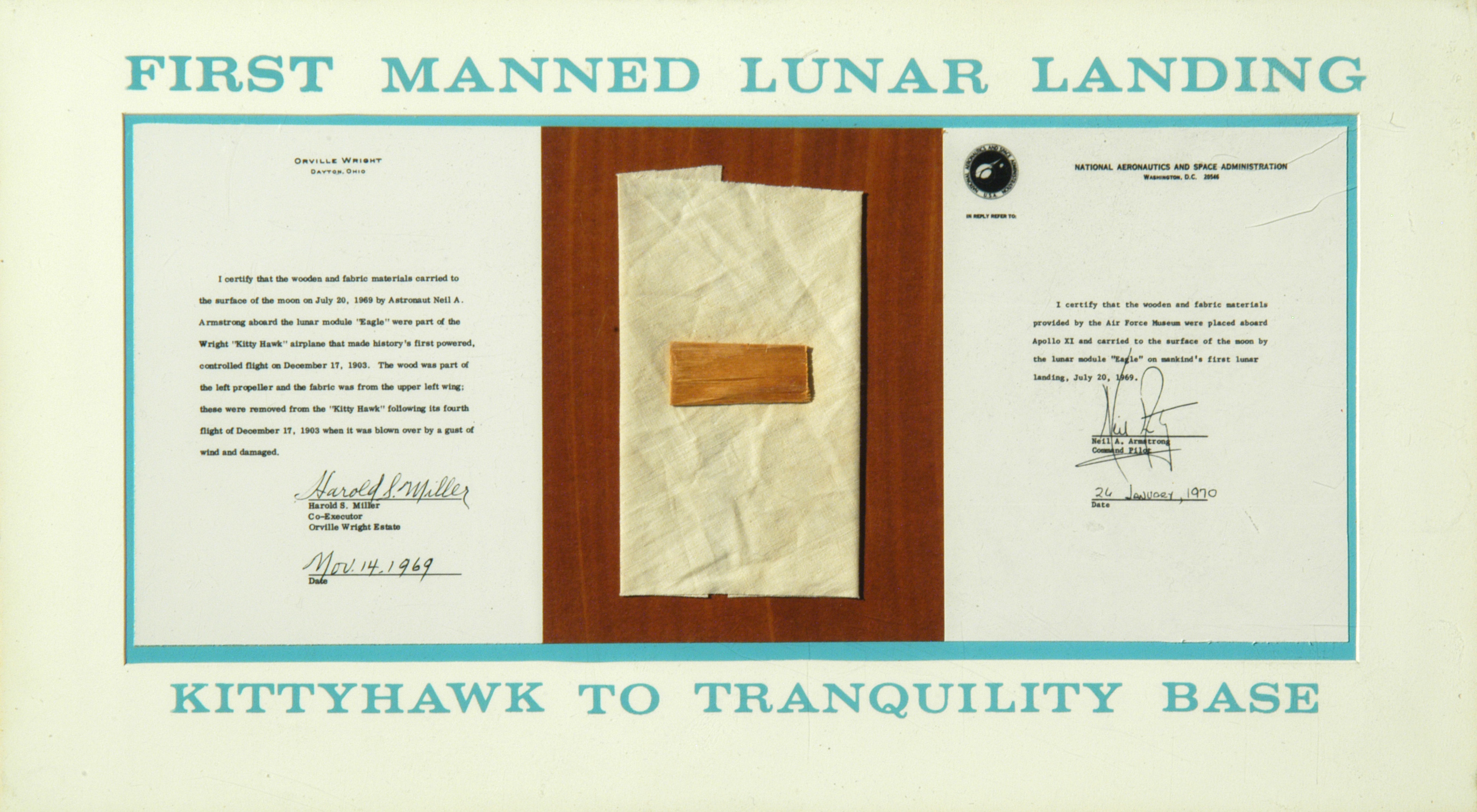
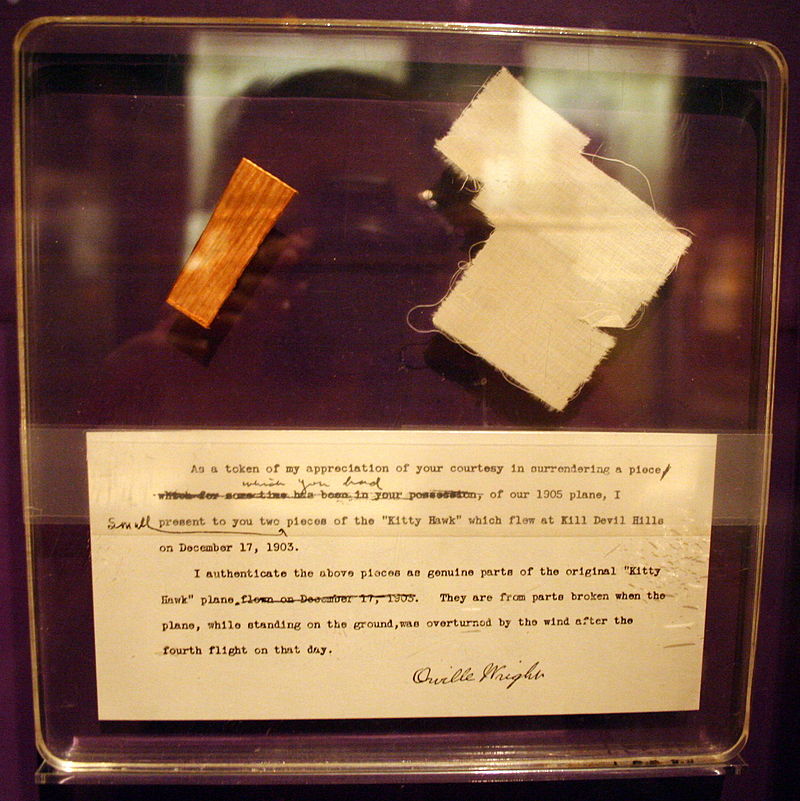
Display of the wood and fabric pieces of the Wright Flyer that Apollo 11 astronaut Neil A. Armstrong took to the Moon. Display of the pieces of wood and fabric from the Wright Flyer that launched on space shuttle Challenger’s STS-51L mission and recovered from the wreckage
Left: Display of the wood and fabric pieces of the Wright Flyer that Apollo 11 astronaut Neil A. Armstrong took to the Moon. Image credit: courtesy National Air and Space Museum. Right: Display of the pieces of wood and fabric from the Wright Flyer that launched on space shuttle Challenger’s STS-51L mission and recovered from the wreckage. Image credit: courtesy North Carolina Museum of History.

Pieces of the Wright Flyer, sometimes called Kitty Hawk, have flown in space, carried there by astronauts with a geographic connection and a sense of history. In 1969, under a special arrangement with the U.S. Air Force Museum in Dayton, Ohio, Apollo 11 astronaut Neil A. Armstrong, like the Wright brothers a native of Ohio, took with him a piece of wood from the Wright Flyer’s left propeller and a piece of muslin fabric (8 by 13 inches) from its upper left wing. The items, stowed in his Lunar Module Eagle personal preference kit, landed with him and fellow astronaut Edwin E. “Buzz” Aldrin at Tranquility Base, and returned to Earth with third crew member Michael Collins in the Command Module Columbia. Visitors can view these items near the Wright Flyer at the NASM. In 1986, North Carolina native NASA astronaut Michael J. Smith arranged with the North Carolina Museum of History in Raleigh to take a piece of wood and a swatch of fabric salvaged, and authenticated by Orville Wright, from the damaged Wright Flyer aboard space shuttle Challenger’s STS-51L mission. Although Challenger and its crew perished in the tragic accident, divers recovered the artifacts from the wreckage and visitors can view them at the North Carolina Museum of History. Astronaut John H. Glenn, an Ohioan like the Wrights and Armstrong, took different pieces of the Wright Flyer when he returned to space aboard STS-95 in 1998. In October 2000, North Carolina native NASA astronaut William S. McArthur, on behalf of North Carolina’s First Flight Centennial Commission, flew a piece from the Wright Flyer donated by the National Park Service. McArthur carried a fragment of muslin fabric from the aircraft’s wing to the International Space Station during the STS-92 mission, the 100th space shuttle flight, to promote the then-upcoming 100th anniversary of the first powered flight.

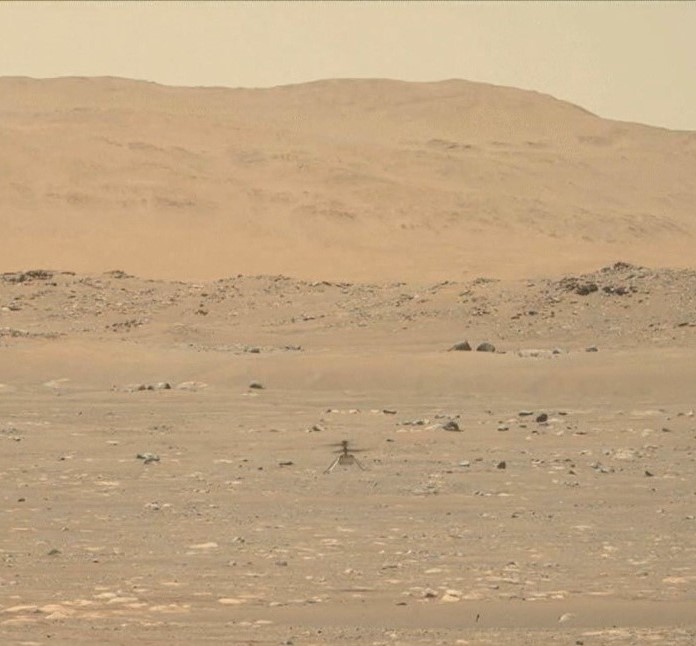
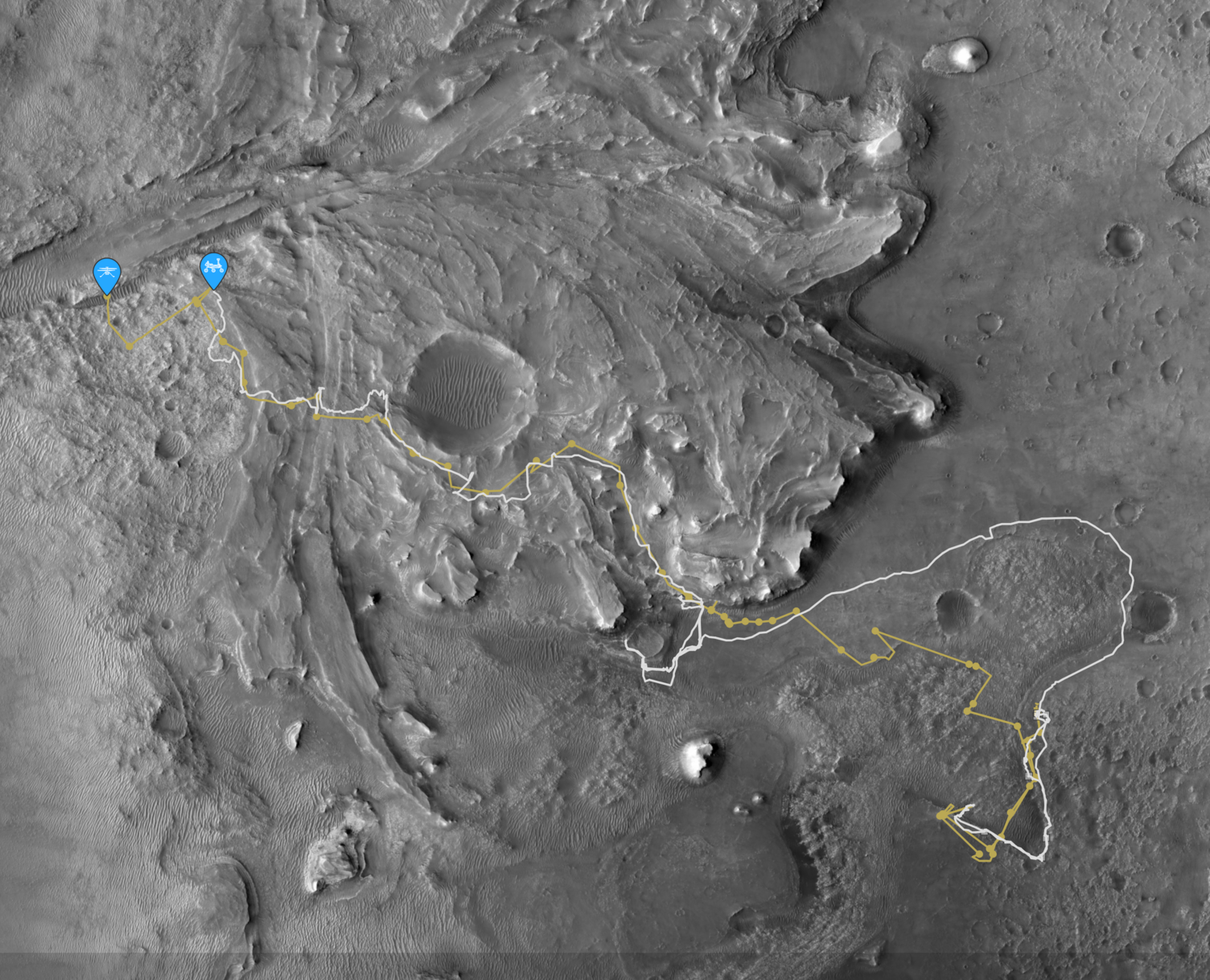
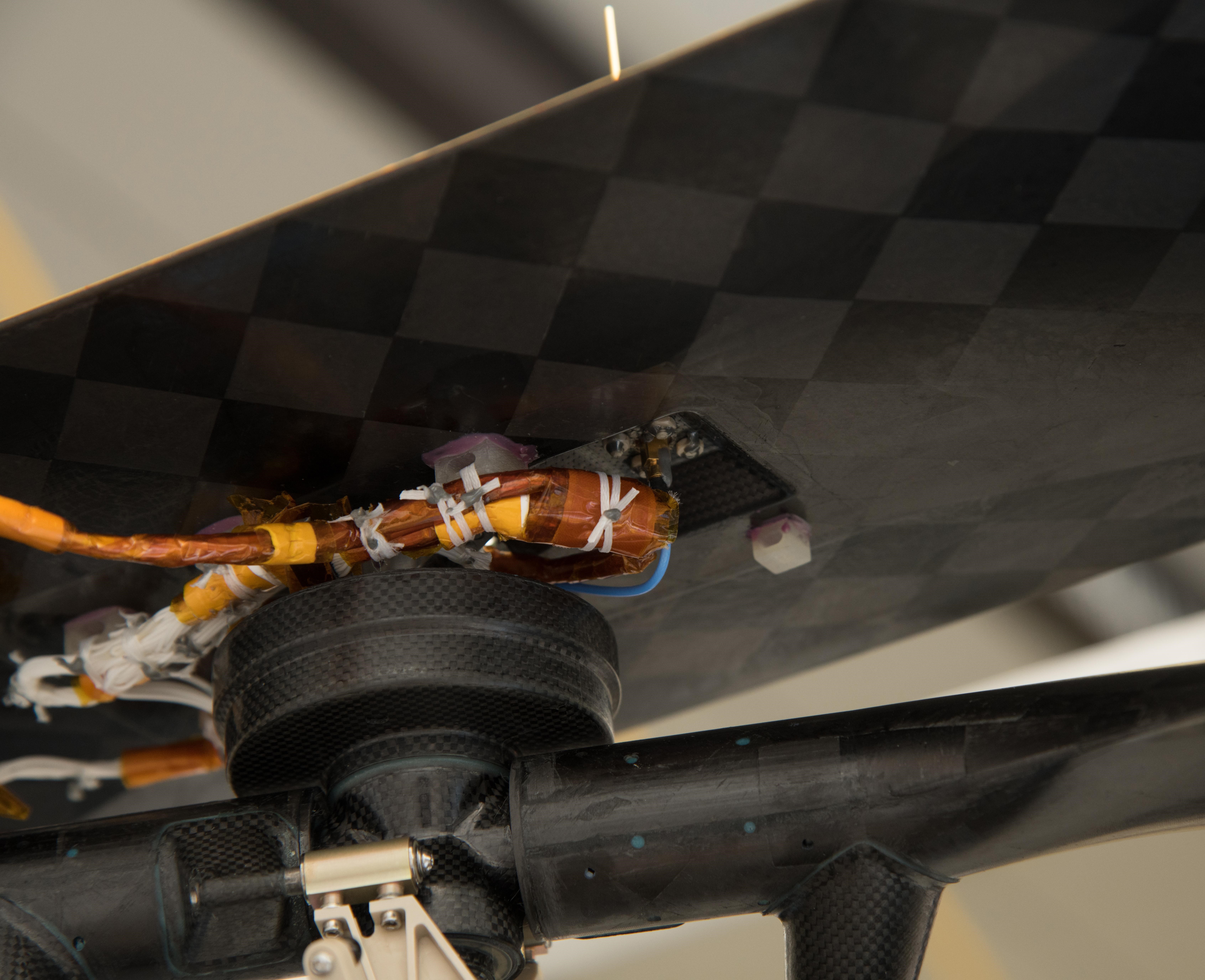
The autonomous helicopter Ingenuity, near center of photograph, makes the first powered flight on Mars, imaged by the Perseverance rover Routes of the Perseverance rover, white, and the Ingenuity helicopter, yellow, in Mars’ Jezero Crater A piece of cloth from the Wright Flyer’s wing attached to the underside of Ingenuity’s solar panel
Left: The autonomous helicopter Ingenuity, near center of photograph, makes the first powered flight on Mars, imaged by the Perseverance rover. Middle: Routes of the Perseverance rover, white, and the Ingenuity helicopter, yellow, in Mars’ Jezero Crater. Right: A piece of cloth from the Wright Flyer’s wing attached to the underside of Ingenuity’s solar panel.

A piece of the Wright Flyer has even traveled beyond the Earth-Moon system. When the Mars 2020 Perseverance rover landed in Mars’ Jezero Crater on Feb. 18, 2021, it carried underneath it a four-pound autonomous helicopter named Ingenuity. Engineers attached a small piece of cloth the size of a postage stamp from the Wright Flyer’s wing to a cable underneath the helicopter’s solar panel. On April 19, 2021, when Ingenuity lifted off to a height of 10 feet, it marked the first powered aircraft flight on a world other than Earth. Ingenuity’s first flight lasted 39 seconds in an area NASA named Wright Brothers Field. The United Nations International Civil Aviation Organization gave the field the airport code of JZRO – for Jezero Crater – and the helicopter type designator IGY, with the call-sign INGENUITY. With no humans present to record the event, the Perseverance rover imaged Ingenuity’s first flight. As of Dec. 2, 2023, Ingenuity has completed 67 flights over 947 Sols, far exceeding its technology demonstration goal of five flights over 30 Sols (Martian days), with a total flight time of 2 hours 1 minute 5 seconds, traveling a total distance of 9.6 miles and reaching a maximum altitude of 78.7 feet. Its ground-breaking mission continues, paving the way for future aerial explorers of Mars.

Share

Details

Last Updated

Dec 14, 2023

Related Terms

Powered by WPeMatico

Get The Details…
Kelli Mars

Dragon Departure Postponed, Microgravity Research Continues

Dragon Departure Postponed, Microgravity Research Continues

Astronaut Andreas Mogensen works on the Aquamembrane-3 investigation exploring the contaminant rejection and water transport capabilities of advanced life support equipment.

The Expedition 70 crew continues packing the SpaceX Dragon cargo spacecraft while also keeping up microgravity research for NASA and its partners to advance humanity on Earth and in space.

NASA and SpaceX are postponing the Friday, Dec. 15, undocking of a SpaceX Dragon cargo resupply spacecraft from the International Space Station due to unfavorable weather conditions as a result of a cold front passing through the splashdown zones off the coast of Florida.

Joint teams continue to evaluate weather conditions to determine the best opportunity for Dragon to autonomously undock from the space station with the next available opportunity no earlier than 5:05 p.m. EST Saturday, Dec. 16.

Weather permitting for the Saturday undocking, coverage of Dragon’s departure will begin at 4:45 p.m. on the NASA+ streaming service via the web or the NASA app. Coverage also will air live on NASA Television, YouTube, and on the agency’s website. Learn how to stream NASA TV through a variety of platforms including social media.

After re-entering Earth’s atmosphere, the spacecraft will splash down off the coast of Florida, which will not be broadcast on NASA TV. Follow updates on return plans on the agency’s space station blog.

Astronauts Jasmin Moghbeli of NASA and Satoshi Furukawa of JAXA (Japan Aerospace Exploration Agency) continued securing bags packed with return cargo and discarded items inside Dragon for the undocking and return to Earth’s gravity. Moghbeli also joined NASA astronaut Loral O’Hara and tended to biological samples on the station that will soon be stowed aboard Dragon.

Commander Andreas Mogensen of ESA (European Space Agency) turned his attention to the Northrop Grumman Cygnus spacecraft scheduled to depart later this month. Moghbeli joined Mogensen readying the private cargo craft for its robotic detachment from the Unity module and release back into Earth orbit for descent.

Meanwhile, a wide array of space science to improve life for astronauts in space and people on Earth is ongoing aboard the orbiting lab. The seven space station residents explored how weightlessness affects plant life, robotics, and more.

O’Hara worked in the Kibo laboratory module adding water to the Advanced Plant Habitat to prepare for an upcoming experiment observing how microgravity affects a plant’s immunity system. Furukawa configured a pair of toaster-sized, Astrobee robotic free-flyers and tested their ability to autonomously dock with each other.

Cosmonauts Oleg Kononenko and Nikolai Chub joined each other at the beginning of their shift and took turns pedaling on an exercise cycle. The Roscosmos flight engineers assisted each other attached electrodes to each other and collected blood pressure measurements during the periodic physical fitness evaluation. Flight Engineer Konstantin Borisov also participated in the exercise test at the end of his shift.

Kononenko later joined Borisov in the afternoon checking an incubator and a centrifuge holding egg samples for a space biology study. Chub wrapped up his day working on the Elektron oxygen generator and changing out smoke detectors.

Axiom Space has announced the launch date for its third private astronaut mission to the station for no earlier than Jan. 9, from Florida. Commander Michael Lopez-Alegria will lead Pilot Walter Villadei and Mission Specialists Alper Gezeravci and Marcus Wandt aboard the SpaceX Dragon spacecraft and stay aboard the orbital outpost for a two-week research mission.


Learn more about station activities by following the space station blog, @space_station and @ISS_Research on X, as well as the ISS Facebook and ISS Instagram accounts.

Get weekly video highlights at: https://roundupreads.jsc.nasa.gov/videoupdate/

Get the latest from NASA delivered every week. Subscribe here: www.nasa.gov/subscribe

Powered by WPeMatico

Get The Details…

Mark Garcia