Crew Relaxes, Rubio Breaks NASA Record as New Trio Preps for Launch

Crew Relaxes, Rubio Breaks NASA Record as New Trio Preps for Launch

Astronaut Frank Rubio works in the Microgravity Science Glovebox swapping graphene aerogel samples for a space manufacturing study.

The seven Expedition 69 crew members enjoyed an off-duty day on Monday aboard the International Space Station. They will be welcoming three new crewmates at the end of the week when they launch and dock to the orbital outpost.

Three future station crew members are at the Baikonur Cosmodrome in Kazakhstan counting down to their lift off aboard the Soyuz MS-24 crew ship planned for 11:44 a.m. EDT on Friday. The trio, consisting of NASA astronaut Loral O’Hara and Roscosmos cosmonauts Oleg Kononenko and Nikolai Chub, will dock to the Rassvet module just over three hours later at 2:56 p.m. First time space-flyers O’Hara and Chub along with Kononenko, who is making a record fifth trip to the space station, will orbit Earth on the station for six months conducting advanced space research.

The current Expedition 69 crew is composed of two separate crews, one of which has been aboard the space station for nearly a year and the other which has been on the station since Aug. 27. The longest serving crew, with Commander Sergey Prokopyev and Flight Engineers Dmitri Petelin and Frank Rubio, will depart at the end of the month after living in space for just over a year in space.

Rubio today has surpassed NASA’s single spaceflight record of 355 continuous days in space made by astronaut Mark Vande Hei on March 30, 2022. At 11 a.m. on Tuesday, NASA TV will broadcast a pre-recorded space-to-ground conversation Vande Hei had with Rubio on Sept. 5 when he congratulated the orbiting astronaut for his record-breaking mission.

The station’s newest crew is in its third week of a six-month-long space mission. The quartet consists of first-time space-flyers NASA astronaut Jasmin Moghbeli and Roscosmos cosmonaut Konstantin Borisov, as well as two-time station visitors Satoshi Furukawa of JAXA (Japan Aerospace Exploration Agency) and Andreas Mogensen of ESA (European Space Agency). They will stay in space conducting a variety of microgravity science experiments benefitting humans living on and off the Earth until late February.


Learn more about station activities by following the space station blog@space_station and @ISS_Research on X, as well as the ISS Facebook and ISS Instagram accounts.

Get weekly video highlights at: https://roundupreads.jsc.nasa.gov/videoupdate/

Get the latest from NASA delivered every week. Subscribe here: www.nasa.gov/subscribe

Powered by WPeMatico

Get The Details…

Mark Garcia

NASA Leadership to Call Agency’s Record-Breaking Astronaut in Space

NASA Leadership to Call Agency’s Record-Breaking Astronaut in Space

During an Earth-to-Space call at 12:05 p.m. EDT Wednesday, Sept. 13, NASA Administrator Bill Nelson and Deputy Administrator Pam Melroy will speak with agency astronaut Frank Rubio about his record-breaking mission aboard the International Space Station.

Powered by WPeMatico

Get The Details…

NASA Selects Ball Aerospace to Develop NOAA’s GeoXO Sounder Instrument

NASA Selects Ball Aerospace to Develop NOAA’s GeoXO Sounder Instrument

NASA, on behalf of the National Oceanic and Atmospheric Administration (NOAA), selected Ball Aerospace & Technologies Corporation of Boulder, to develop the sounder instrument for a Geostationary Extended Observations (GeoXO) satellite program.

Powered by WPeMatico

Get The Details…

Week Ends with Microbiology, Spacesuits, and Lab Maintenance

Week Ends with Microbiology, Spacesuits, and Lab Maintenance

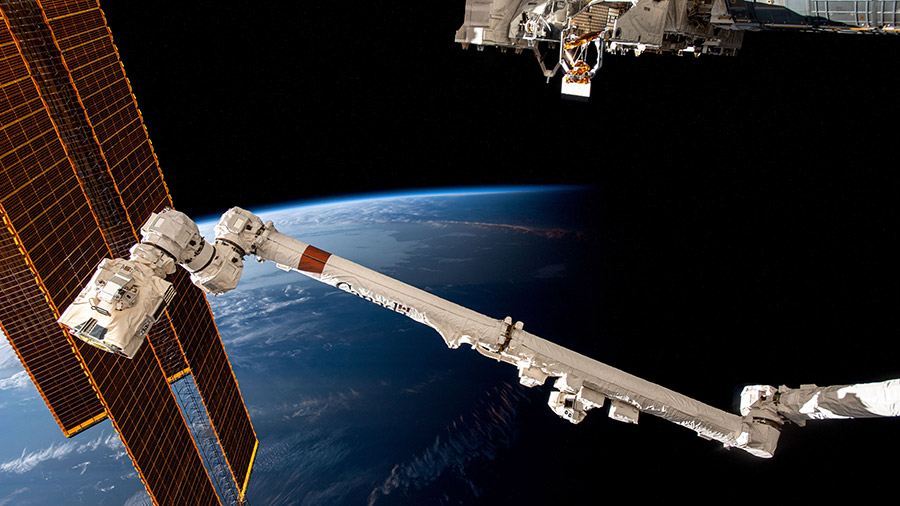
The space station soars above the coast of Argentina into an orbital sunset. From left are, the station's main solar arrays, the Canadarm2 robotic arm, and an external research platform.
The space station soars above the coast of Argentina into an orbital sunset. From left are, the station’s main solar arrays, the Canadarm2 robotic arm, and an external research platform.

Human research and spacesuit work topped the schedule for the Expedition 69 crew aboard the International Space Station at the end of the week. The orbital residents also analyzed microbes, maintained life support systems, and worked on cargo transfers.

Researchers on the ground continuously investigate how living in space affects astronauts to keep crews healthy. The crew members provide blood samples and other specimens during their mission for examination on the orbital outpost or in laboratories on the ground. They also attach a variety of sensors to themselves measuring their physiological reactions while either at rest, exercising, or even working. The data is downlinked real-time or later to help doctors understand how weightlessness affects their bodies.

Two astronauts, Jasmin Moghbeli of NASA and Satoshi Furukawa of JAXA (Japan Aerospace Exploration Agency), took turns pedaling on an exercise cycle for a workout study in the Destiny laboratory module. The duo wore breathing gear and cardiac sensors for the investigation monitoring their aerobic fitness. Moghbeli later sequenced DNA from microbe samples collected from the potable water dispenser. Furukawa moved on and inventoried medical supplies inside the Human Research Facility.

Flight Engineer Andreas Mogensen of ESA (European Space Agency) wrapped up four days of an immunity study of Friday. He removed experiment hardware, stowed blood samples in a science freezer, and disconnected the Kubik research incubator. Mogensen was helping doctors learn how microgravity affects cellular immune functions and to monitor the human immune system in space.

NASA Flight Engineer Frank Rubio worked in the Quest airlock scrubbing cooling loops in a pair of U.S. spacesuits. After Rubio’s cooling loop work was completed, Moghbeli would take over and deconfigure the spacesuits then stow them in Quest.

In the Roscosmos segment of the orbiting lab, Commander Sergey Prokopyev serviced docking hardware, jogged on a treadmill for a fitness evaluation, then began packing items inside the Soyuz MS-23 crew ship. The two cosmonaut flight engineers, Dmitri Petelin and Konstantin Borisov, split their day between collecting station microbe samples for analysis, replacing life support hardware, and disposing trash and used hardware inside the Roscosmos Progress 84 cargo craft.

The space station is orbiting slightly higher after the Roscosmos Progress 85 cargo craft fired its engines for 21 minutes and 55 seconds Friday afternoon. The orbital reboost sets up the correct phasing for the Soyuz MS-24 spacecraft docking on Sept. 15.


Learn more about station activities by following the space station blog@space_station and @ISS_Research on X, as well as the ISS Facebook and ISS Instagram accounts.

Get weekly video highlights at: https://roundupreads.jsc.nasa.gov/videoupdate/

Get the latest from NASA delivered every week. Subscribe here: www.nasa.gov/subscribe

Powered by WPeMatico

Get The Details…

Mark Garcia