Lagniappe

Lagniappe

9 Min Read

Lagniappe

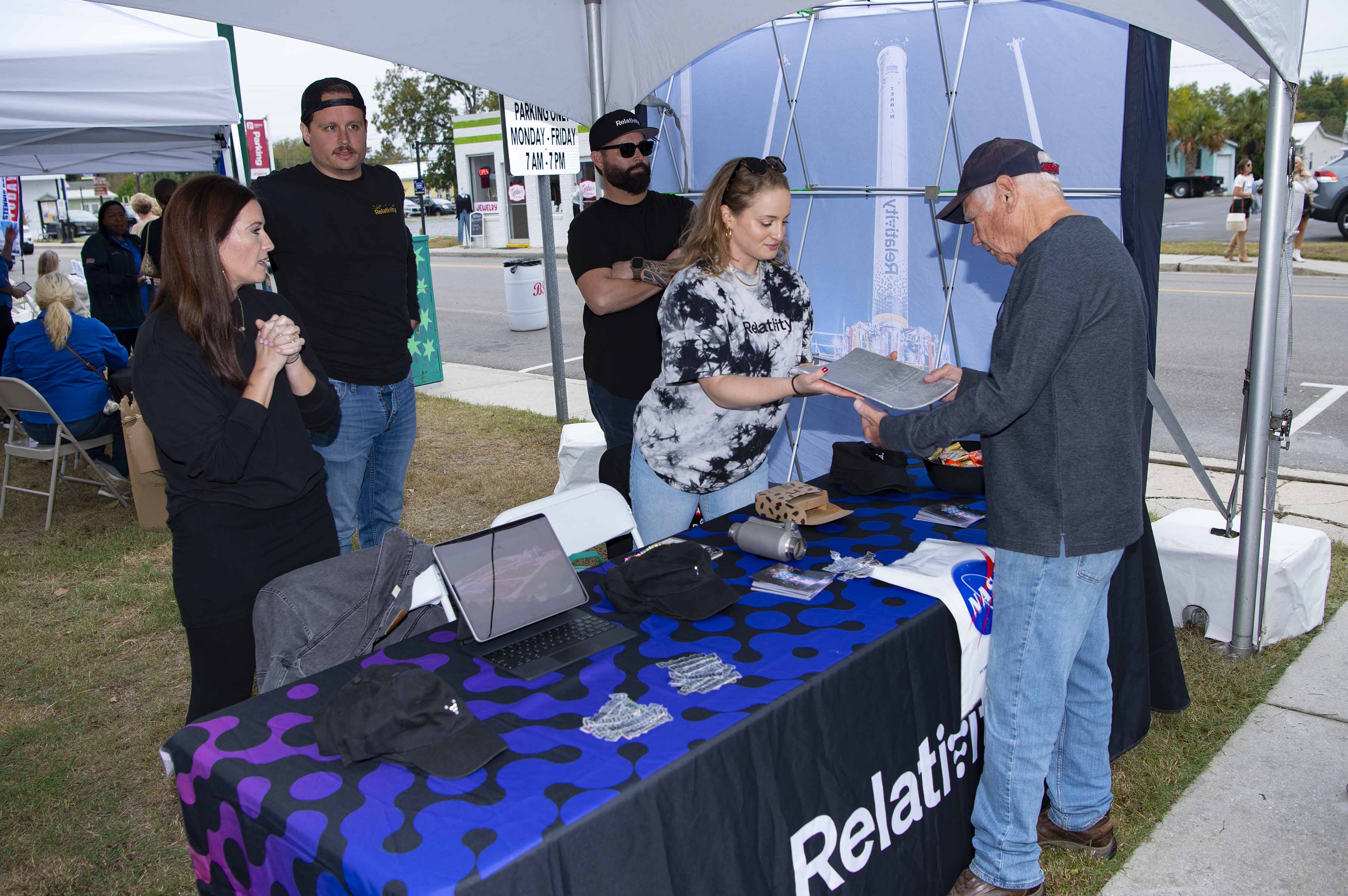
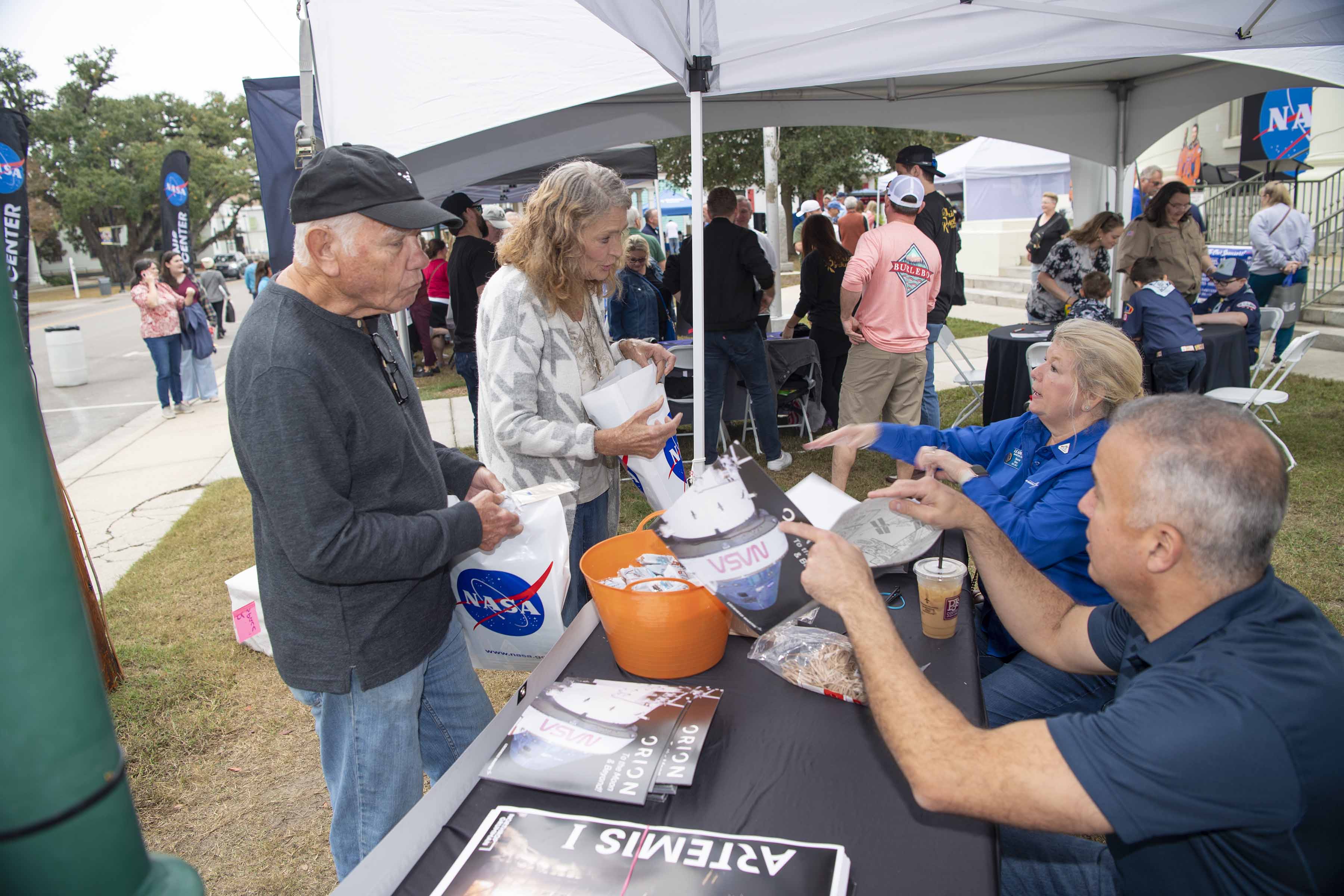
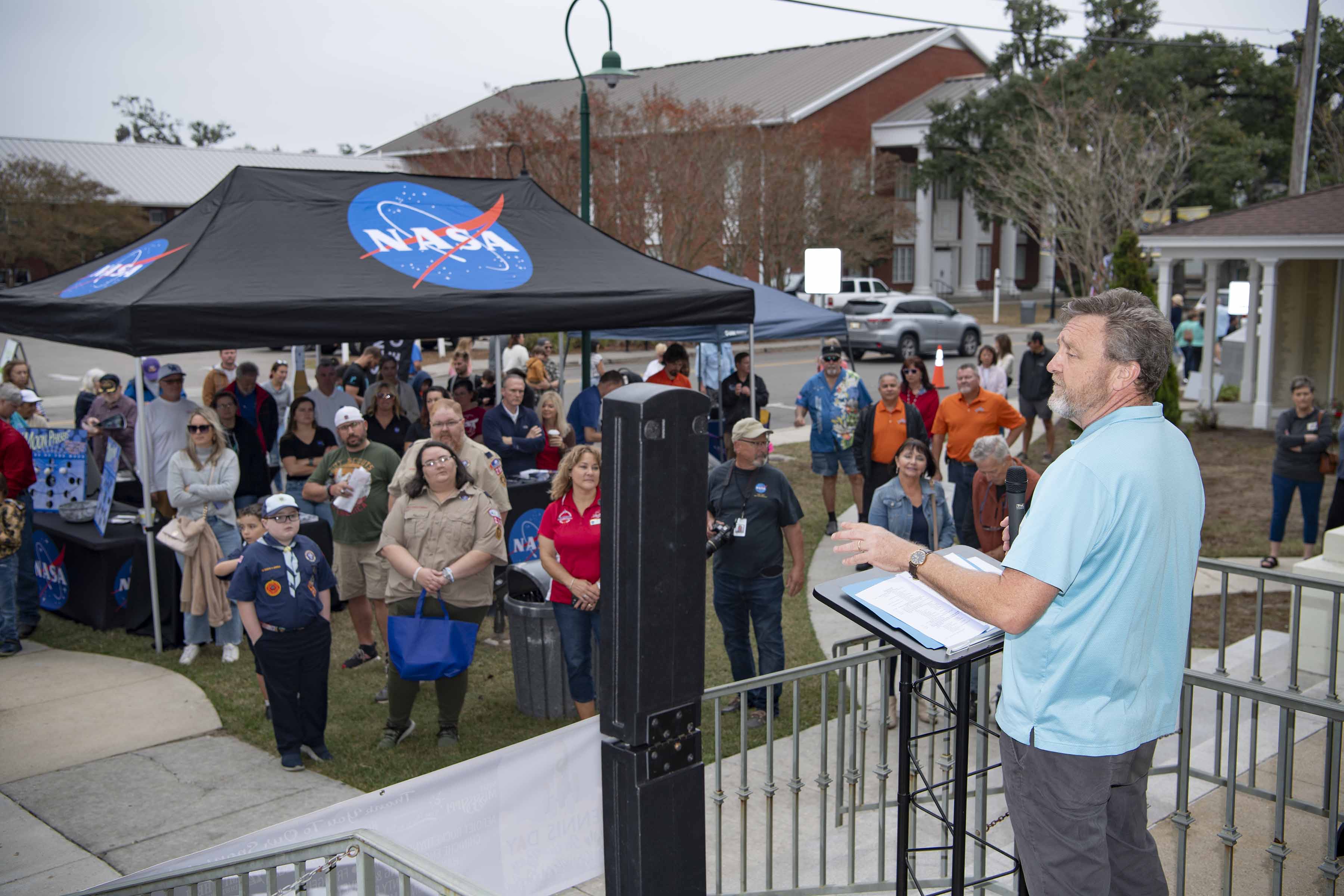
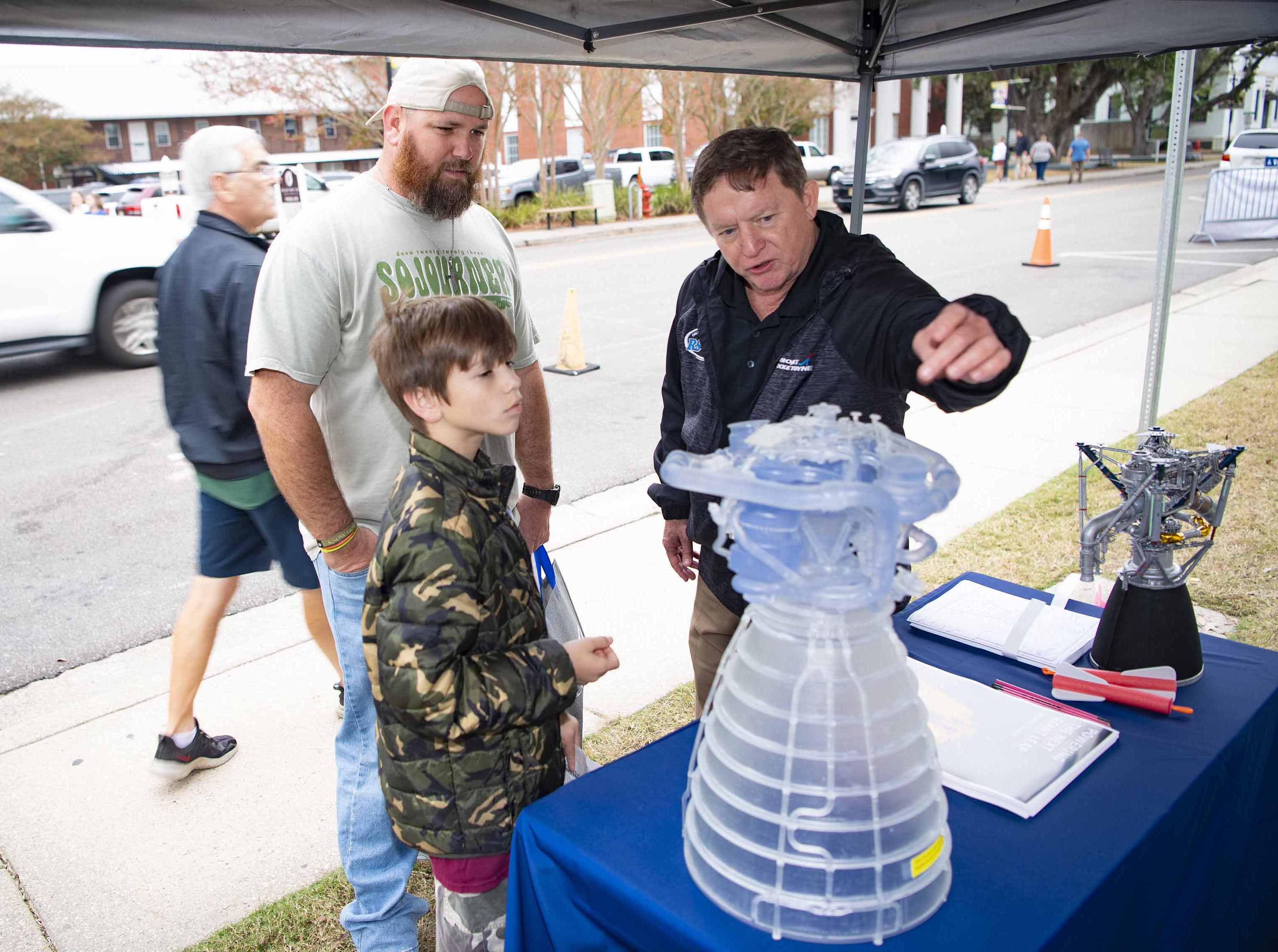
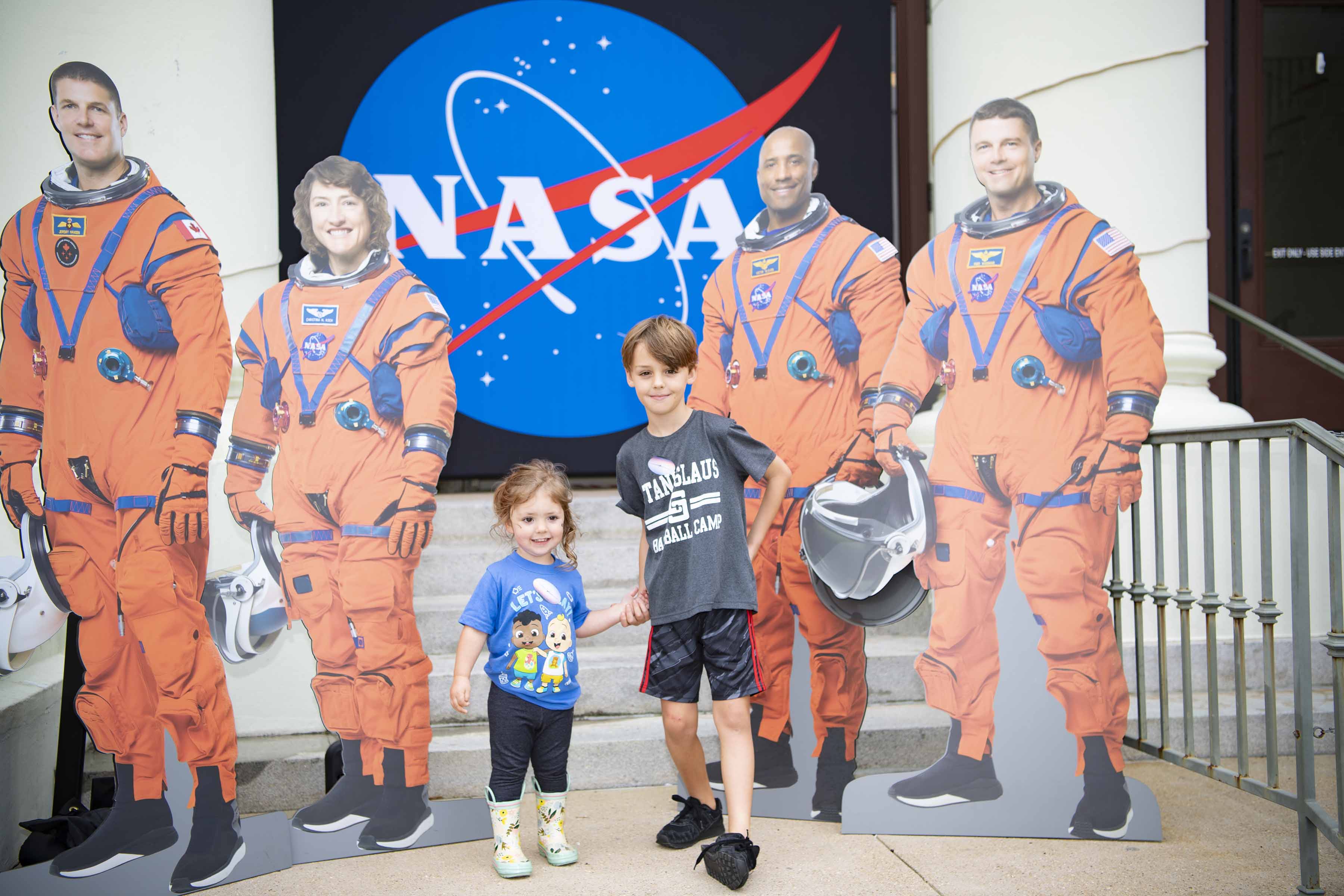
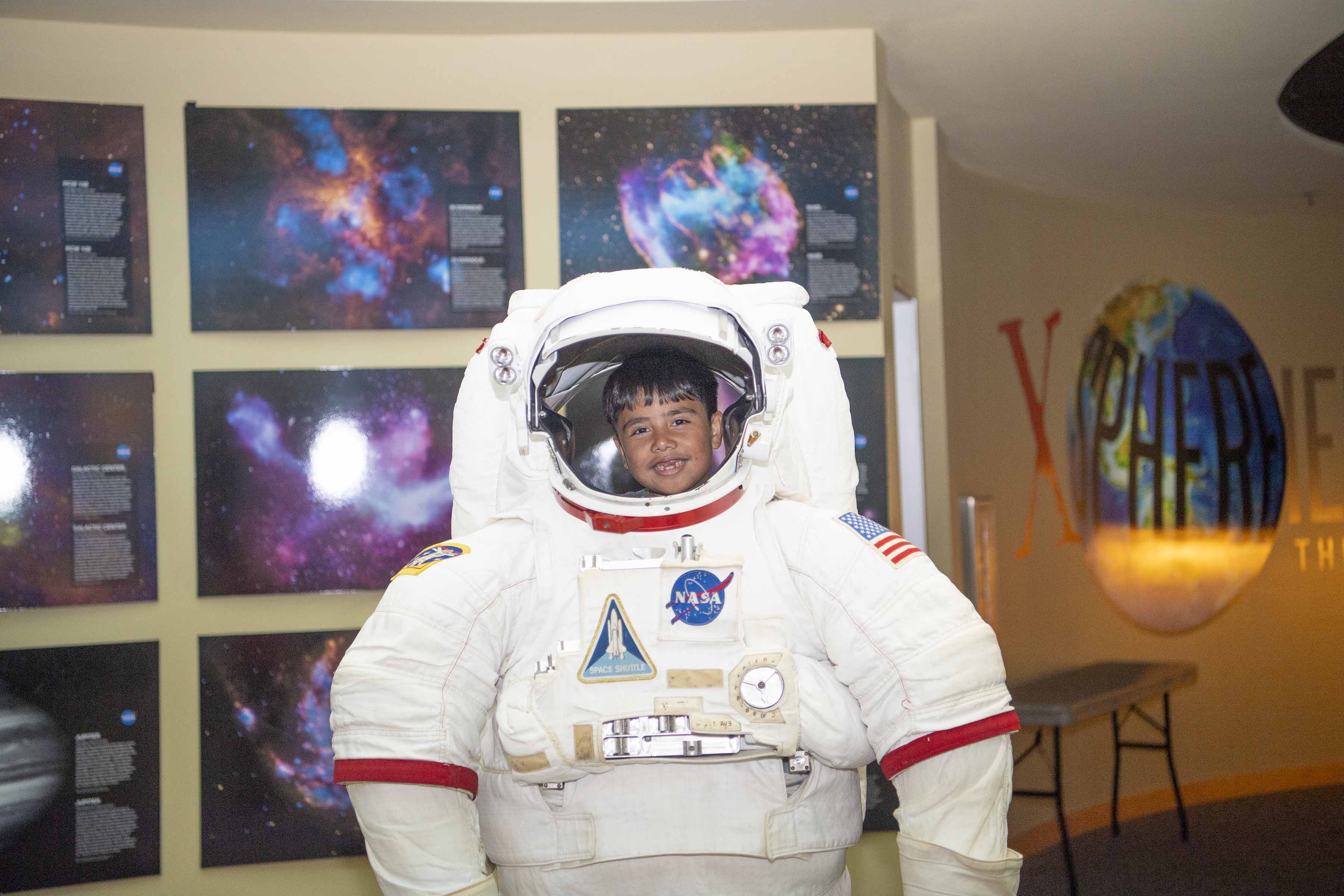
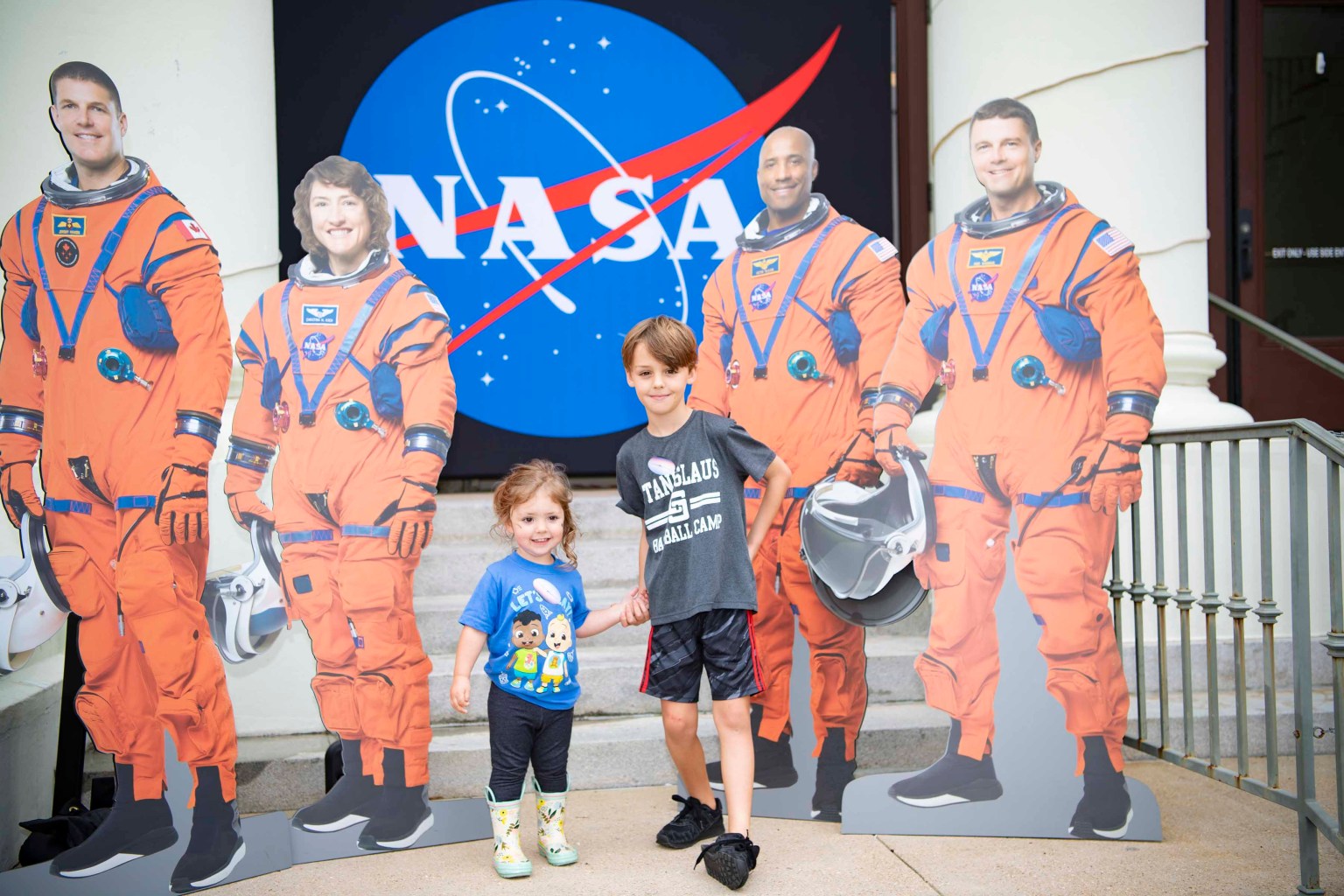
Young attendees pose with four astronaut standees at Stennis Day in the Bay

Explore the November 2023 edition to learn about the framework for the future of NASA Stennis, the first RS-25 hot fire of the ongoing certification series, Stennis Day in the Bay, and much more!

9 min read

Lagniappe

Explore the November 2023 edition featuring:

  • NASA Stennis Compiles Framework for the Future to Guide Center Forward
  • NASA Conducts 1st Hot Fire of New RS-25 Certification Test Series
  • NASA ASTRO CAMP® Sets New Record While Providing STEM Opportunities

Gator Speaks
Gator Speaks cover image
Gator Speaks

Thank you very much!

You may be thinking, ‘Why is Gator telling me thanks?’

The month of November naturally brings a sense of gratitude with it, and I feel the joy by merely expressing thankfulness to others, so I wanted to thank you for reading this month’s portion of Gator Speaks.

Whether surrounded by the love and laughter of cherished family or the comforts of a shared experience with valued friends, November warms the heart like indulging in a fresh slice of pumpkin pie (something else to be thankful for!).

Just like it is easy to eat a slice or three of pumpkin pie, it is easy to find reasons to be thankful at NASA Stennis.

Nov. 11 was Veterans Day. There are many NASA employees at NASA Stennis who have served in various military branches and are now contributing their talents as part of our skilled and diverse workforce. One such veteran working at NASA Stennis is featured this month.

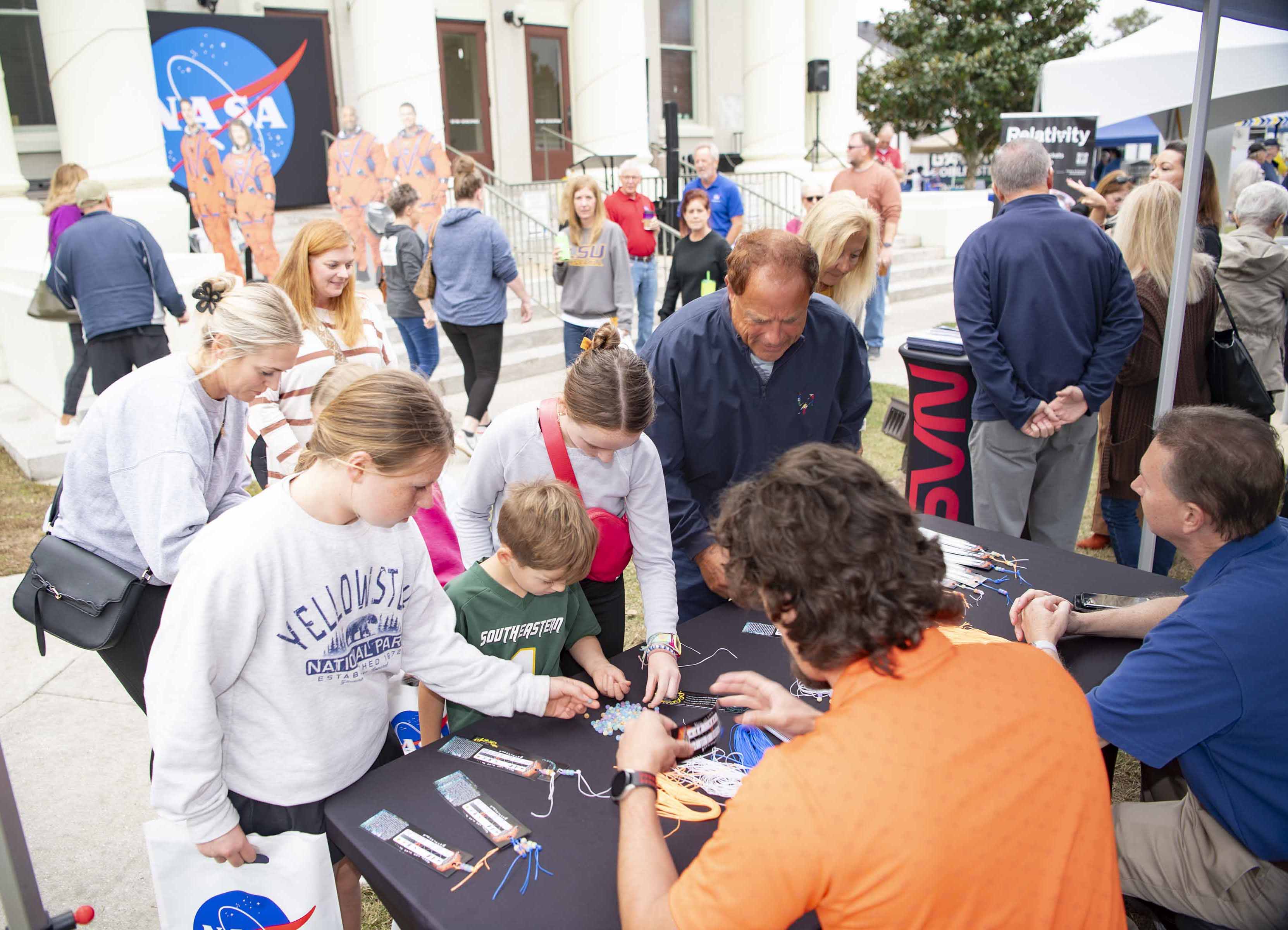
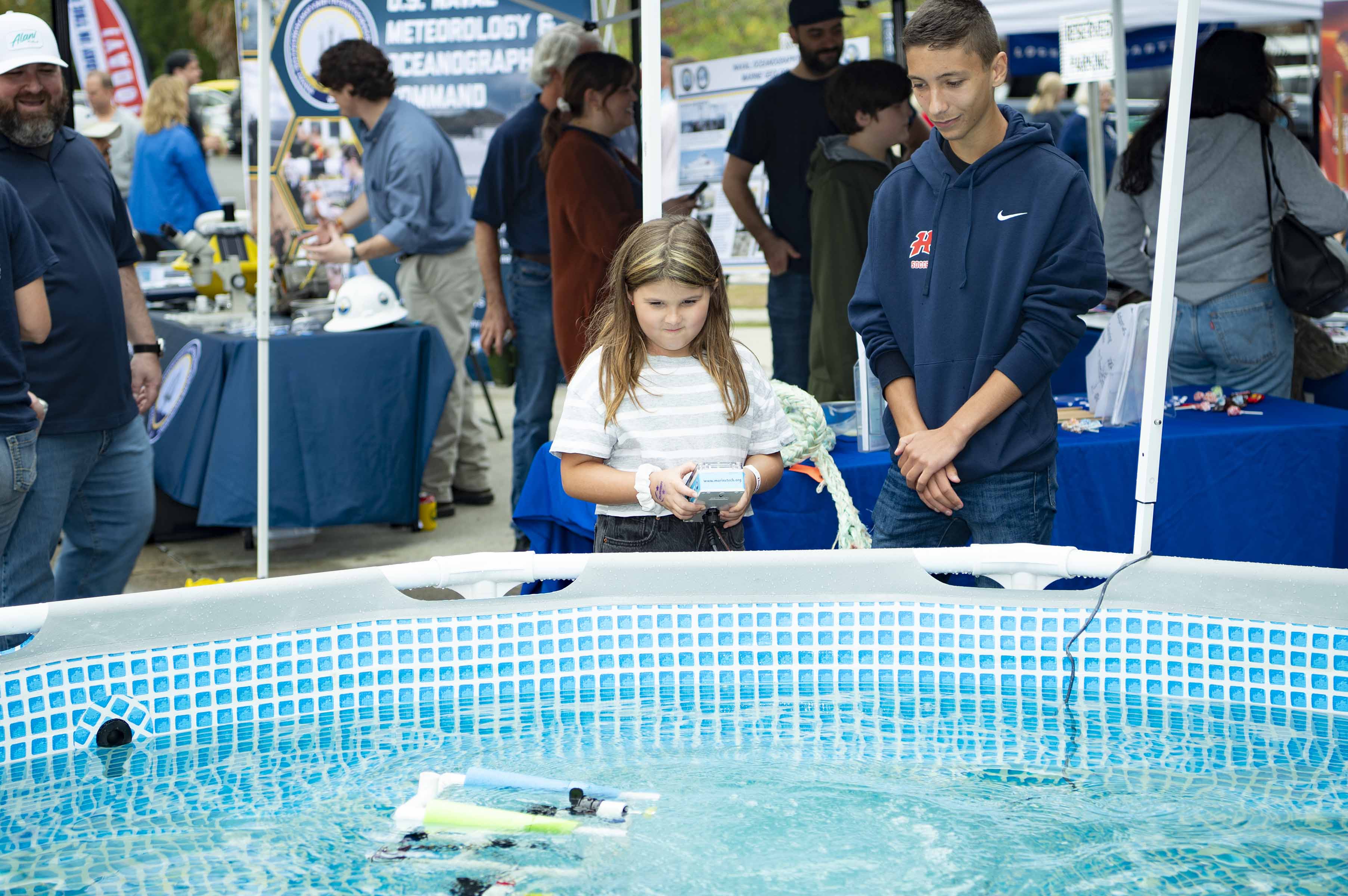
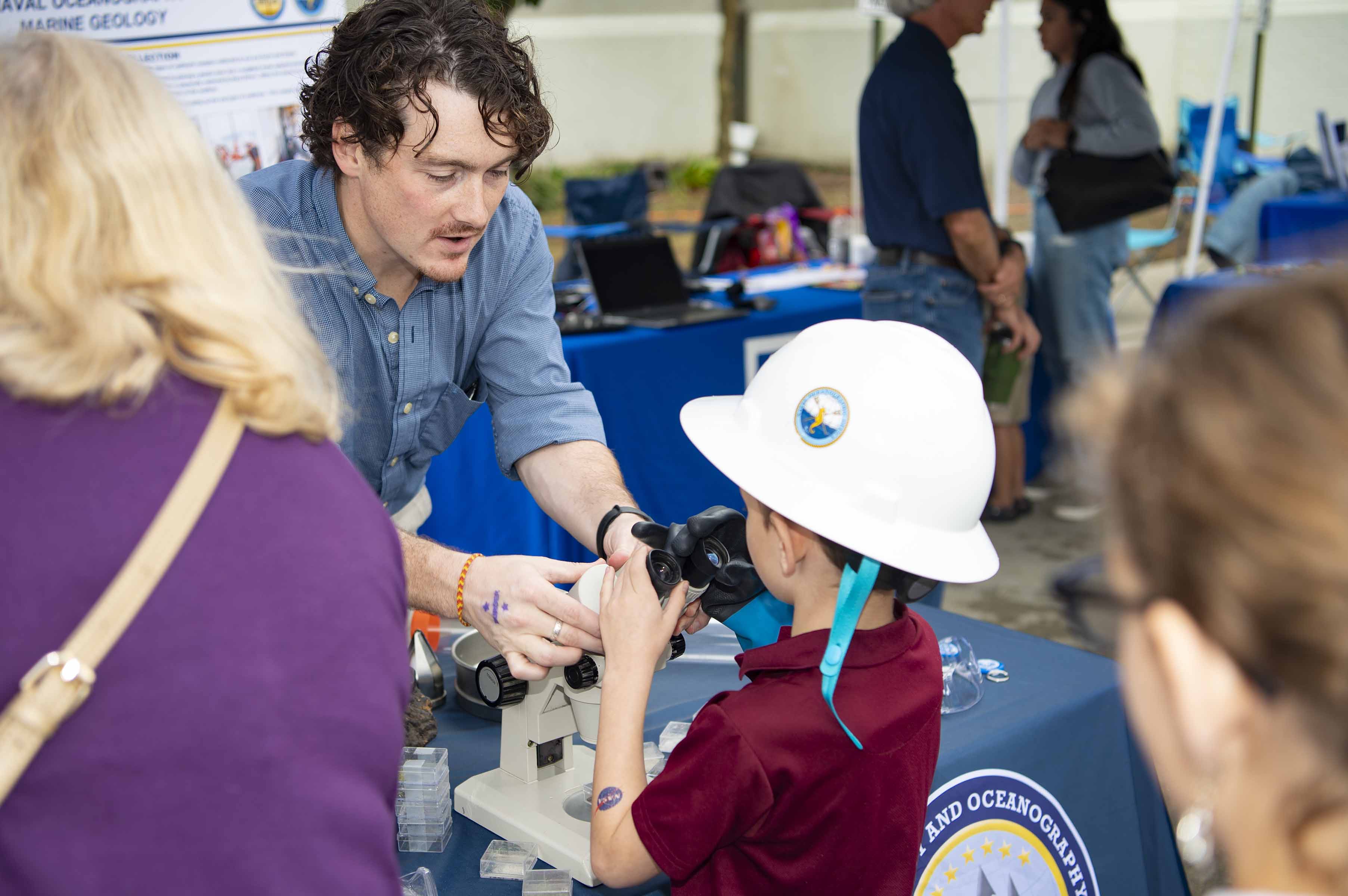
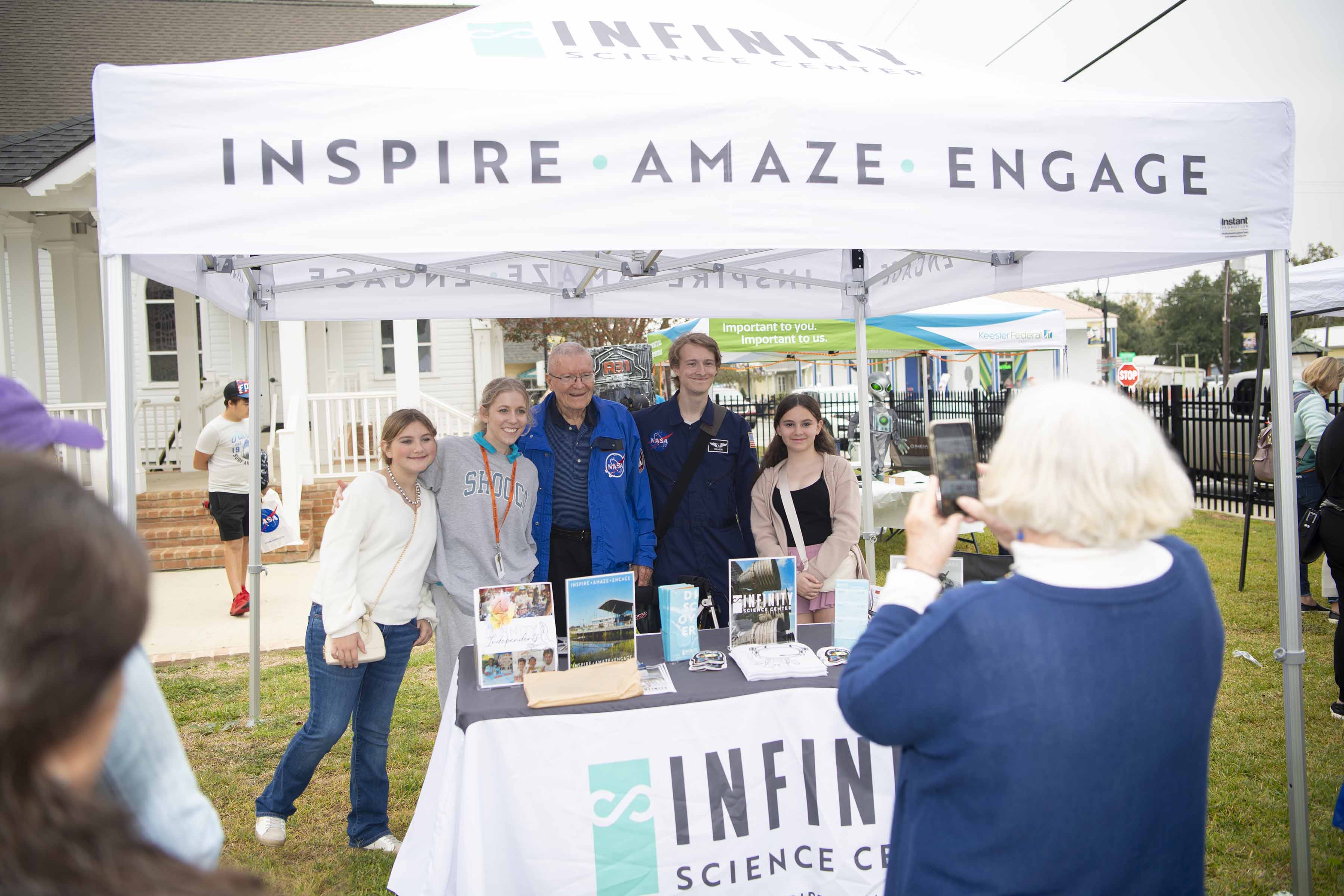
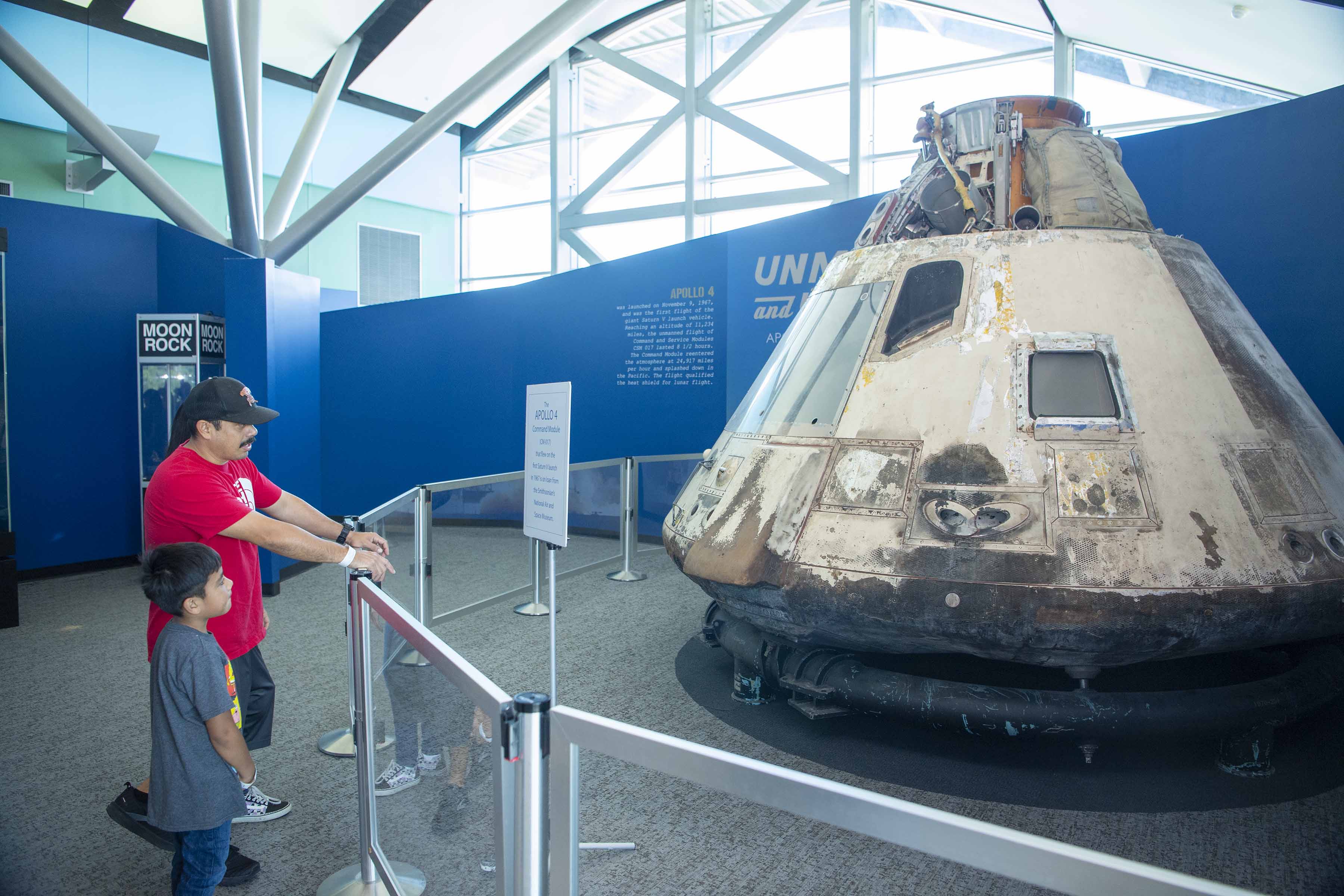
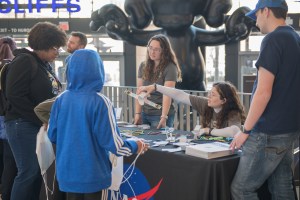
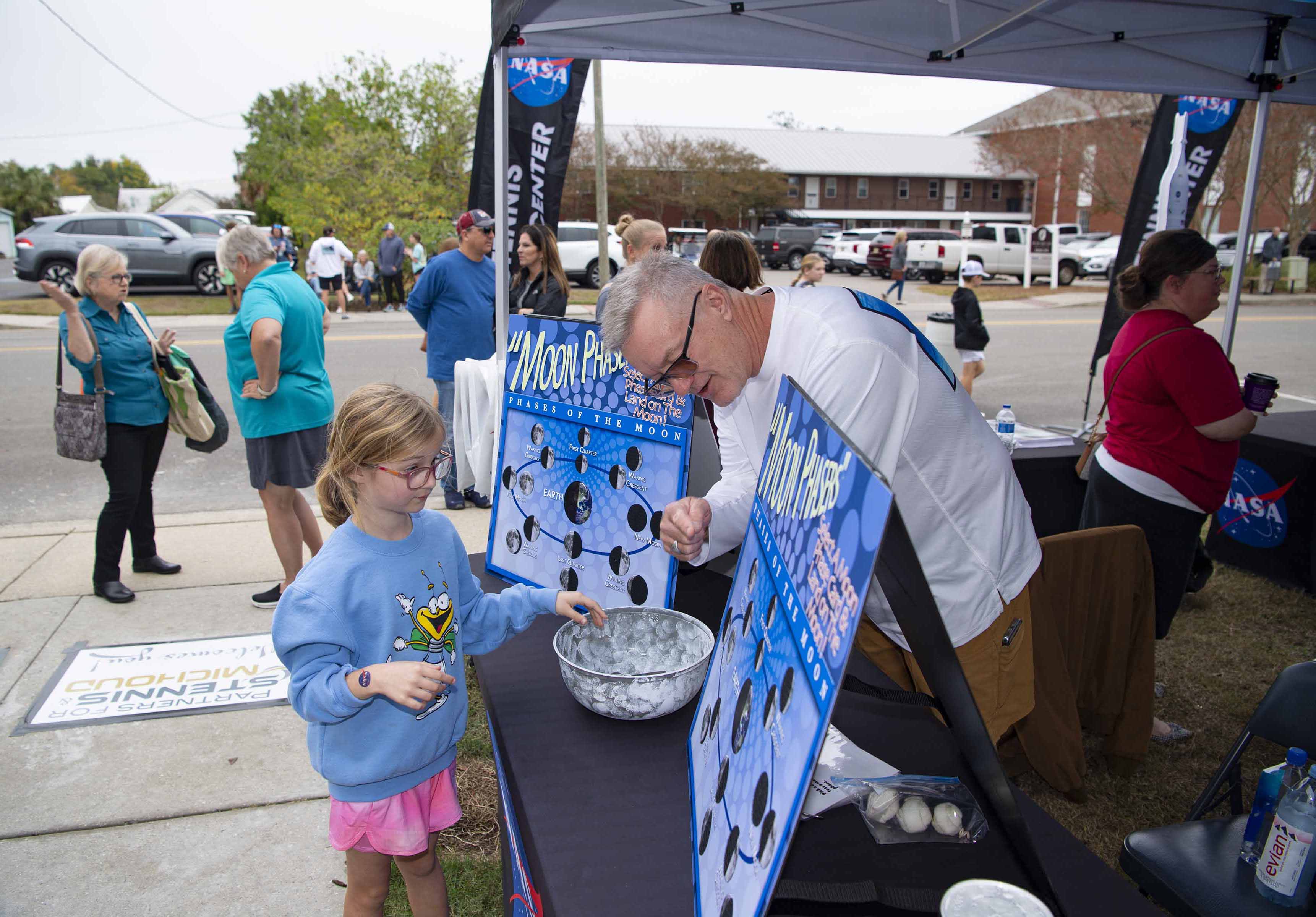
In addition to Veterans Day on Nov. 11, the Stennis Day in the Bay event highlighted how thankful NASA Stennis is for the great community support and relationships NASA Stennis enjoys. We are all better together!

Nov. 14 is the 90th birthday for the great, NASA astronaut Fred Haise. His name graces the test stand where RS-25 engine testing is underway for future Artemis missions. Haise also is a veteran, as the Korean War put him on a path to joining the military and ultimately becoming a NASA astronaut. Read how that came to pass here.

Nov. 23 is Thanksgiving. How can one not be thankful for the benefits NASA provides to humanity? From exploring the Moon and Mars, to increasing access to space for all, to growing new commercial markets, space exploration helps us gain a new perspective.

And just like exploring space helps us gain a new perspective, so, too, does taking inventory of all we have to be thankful for throughout the month of November.

NASA Stennis Top News

NASA Stennis Compiles Framework for the Future to Guide Center Forward

NASA’s Stennis Space Center began with a single mission – to test Apollo rocket stages to carry humans to the Moon. Moving forward, the site has a renewed vision – to evolve as a unique, multifaceted aerospace and technology hub.

NASA Conducts 1st Hot Fire of New RS-25 Certification Test Series

NASA conducted the first hot fire of a new RS-25 test series Oct. 17, beginning the final round of certification testing ahead of production of an updated set of the engines for the SLS (Space Launch System) rocket. 

NASA ASTRO CAMP® Sets New Record While Providing STEM Opportunities

Another year equals another record as NASA’s ASTRO CAMP® initiative reached across the nation and beyond to help a broad spectrum of students learn about NASA and STEM (science, technology, engineering, and mathematics).

NASA Stennis Participates in Stennis Day in the Bay Activities
Center Activities

NASA Stennis Deputy Director Receives Distinguished Award
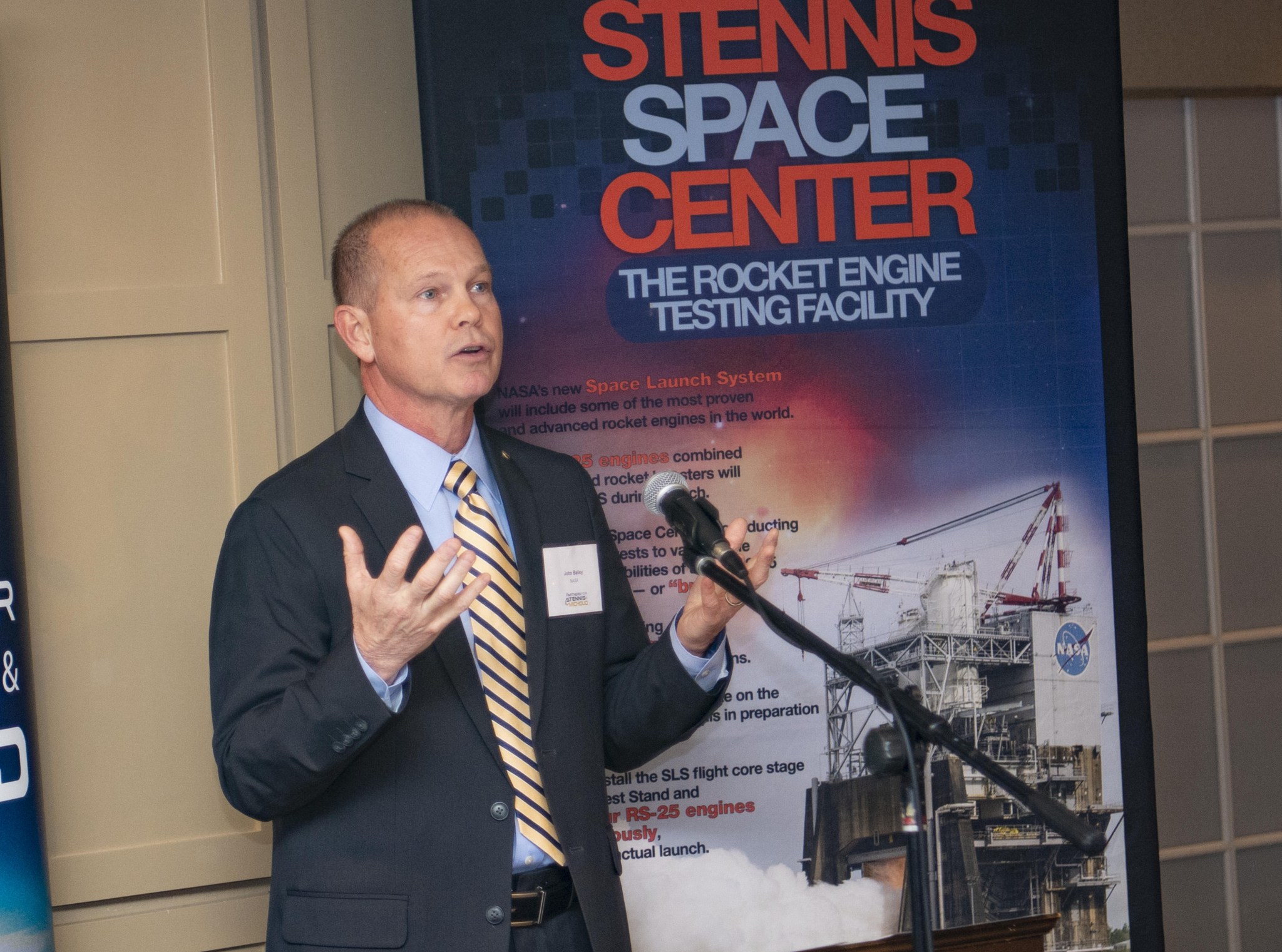
John Bailey
John Bailey, NASA Stennis Deputy Director
NASA/Stennis

NASA Stennis Deputy Director John Bailey was among 232 federal employees to receive a 2023 Presidential Rank Award for exceptional leadership, accomplishments, and service over an extended period of time. The U.S. Office of Personnel Management (OPM) announced the awards, one of the most prestigious in career civil service, Nov. 2. The president’s 2023 list included distinguished and meritorious award recipients.

Bailey was one of just 14 NASA employees to receive a Presidential Meritorious Award. Bailey joined the NASA Stennis team in 1998 after working as a Department of Defense civil servant. He served in various positions at the center prior to being named director of the NASA Stennis Engineering and Test Directorate in 2015. Bailey was selected as NASA associate director in 2018, before assuming his current role in January 2021.

“Public servants are unsung heroes – working to better the lives of families across America,” White House Chief of Staff Jeff Zients said in a release announcing the awards. “They do everything from making sure you get your tax refund to helping you set up your small business to keeping us all safe at home. They get things done with grace and skill and first and foremost to serve the American people. The president, the vice president, and everyone across the Biden-Harris Administration are grateful for their dedication and their service.”

OPM Director Kiran Ahuja added, “Every day, tens of thousands of dedicated federal employees are solving the nation’s most pressing challenges and developing new technologies to improve the lives of millions. The Presidential Rank Awards highlight public servants who exemplify integrity, exceptional leadership, and a relentless commitment to the American people. Congratulations to all the awardees. The federal government and the American people are safer and better off thanks to your hard work and dedication.”

The Civil Service Reform Act of 1978 established the Presidential Rank Awards Program to recognize a select group of career members of senior leaders for exceptional performance. For a complete list of 2023 recipients, visit here.

NASA Stennis Employee named NASA Energy Action Hero
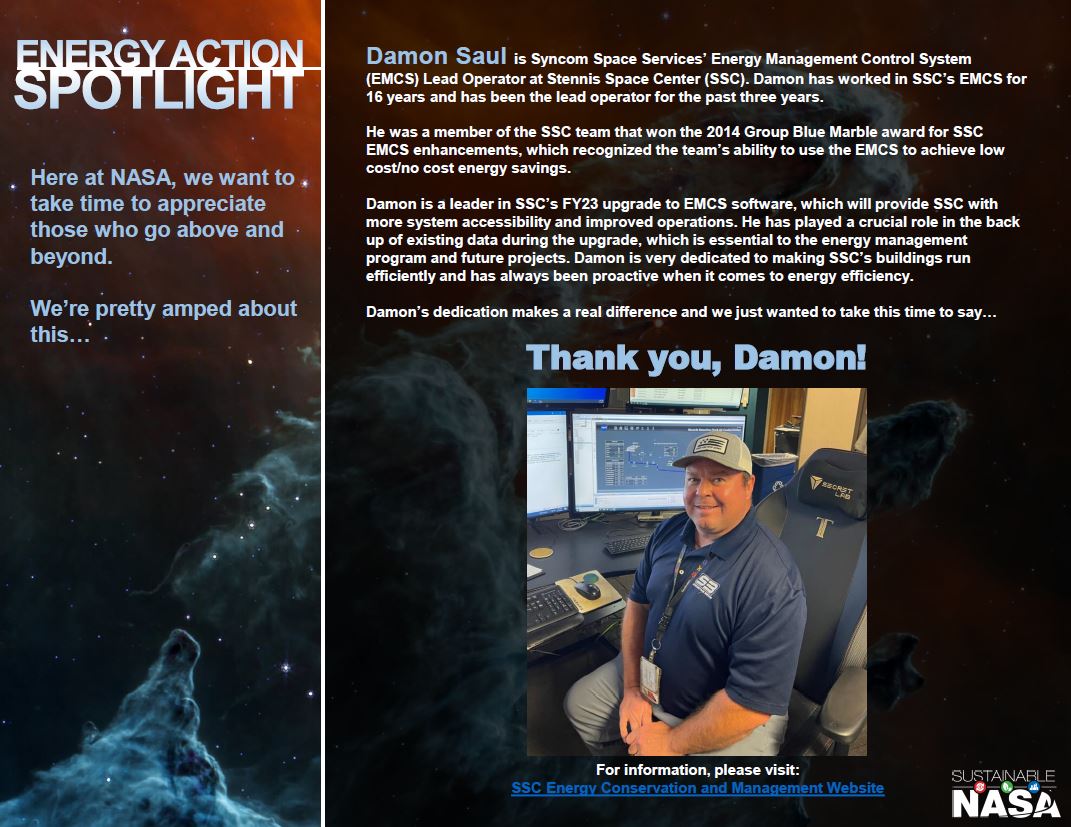
Damon Saul
Energy Action Spotlight: Damon Saul
NASA

Damon Saul, lead operator of NASA’s Stennis Space Center’s Energy Management Control System, was honored as a NASA energy action hero in October.

Each October, the federal government celebrates Energy Action Month to honor the work of the federal workforce to achieve mission success while also cutting energy waste, reducing costs, optimizing performance, and advancing America’s progress toward energy independence, resilience, and security.

NASA has made significant strides in its Energy and Water Management Program, including

  • Reducing total energy consumption by 19% and greenhouse gas emissions 47% since FY 2008
  • Increasing our consumption of carbon pollution-free electricity to 41% of total electricity
  • Reducing facility water intensity by 33% since FY 2007

None of this would be possible without the efforts of hundreds of NASA personnel, many of whom are never recognized for their contributions. Since 2021, NASA has recognized some of the unsung heroes through the Energy Action Spotlights.

NASA Chief Technologist Visits NASA Stennis
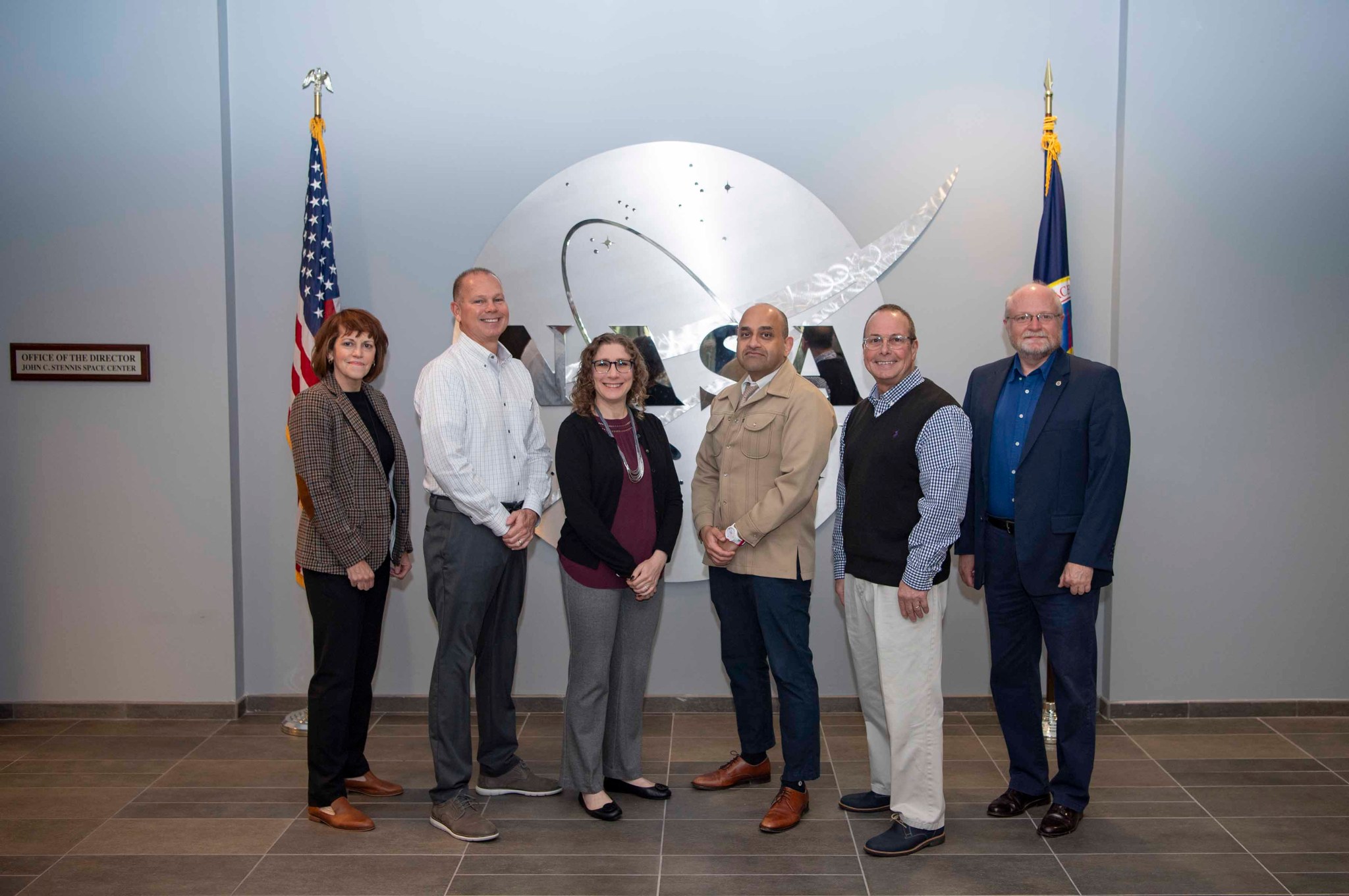
NASA Chief Technologist A.C. Charania (third from right) stands with NASA Stennis leaders during his first visit onsite
NASA Chief Technologist A.C. Charania (third from right) stands with NASA Stennis leaders during his first visit onsite early this month since assuming his new agency role in January. As chief technologist, Charania serves as the NASA administrator’s principal advisor on technology policy and programs, leads technology innovation at the agency, and works to align NASA’s agencywide technology investments with mission needs across its six mission directorates. Charania also oversees technology collaboration with other federal agencies and the private sector while coordinating with external stakeholders. During the two-day visit to NASA Stennis on Nov. 1-2, Charania, along with Charity Weeden, associate administrator for the NASA Office of Technology, Policy, and Strategy, and Deputy Associate Administrator Ellen Gertson, learned about the NASA Stennis federal city, home to about 40 companies, agencies, and organizations. On Nov. 1, the group visited with officials from federal city tenants Rocket Lab, Relativity Space, Lockheed-Martin, Rolls-Royce, Aerojet Rocketdyne, and Evolution Space. On Nov. 2, the group learned about NASA Stennis work with the commercial aerospace companies, autonomous systems lab, and RS-25 testing, as well as site preparations for Green Run testing the Exploration Upper Stage. Shown above (l to r) are NASA Stennis Chief Technologist Anne Peek, NASA Stennis Deputy Director John Bailey, Gertsen, Charania, NASA Stennis Director Rick Gilbrech, and NASA Stennis Strategic Business Officer Manager Duane Armstrong.
NASA/Stennis

NASA Stennis Hosts Mississippi Lieutenant Governor
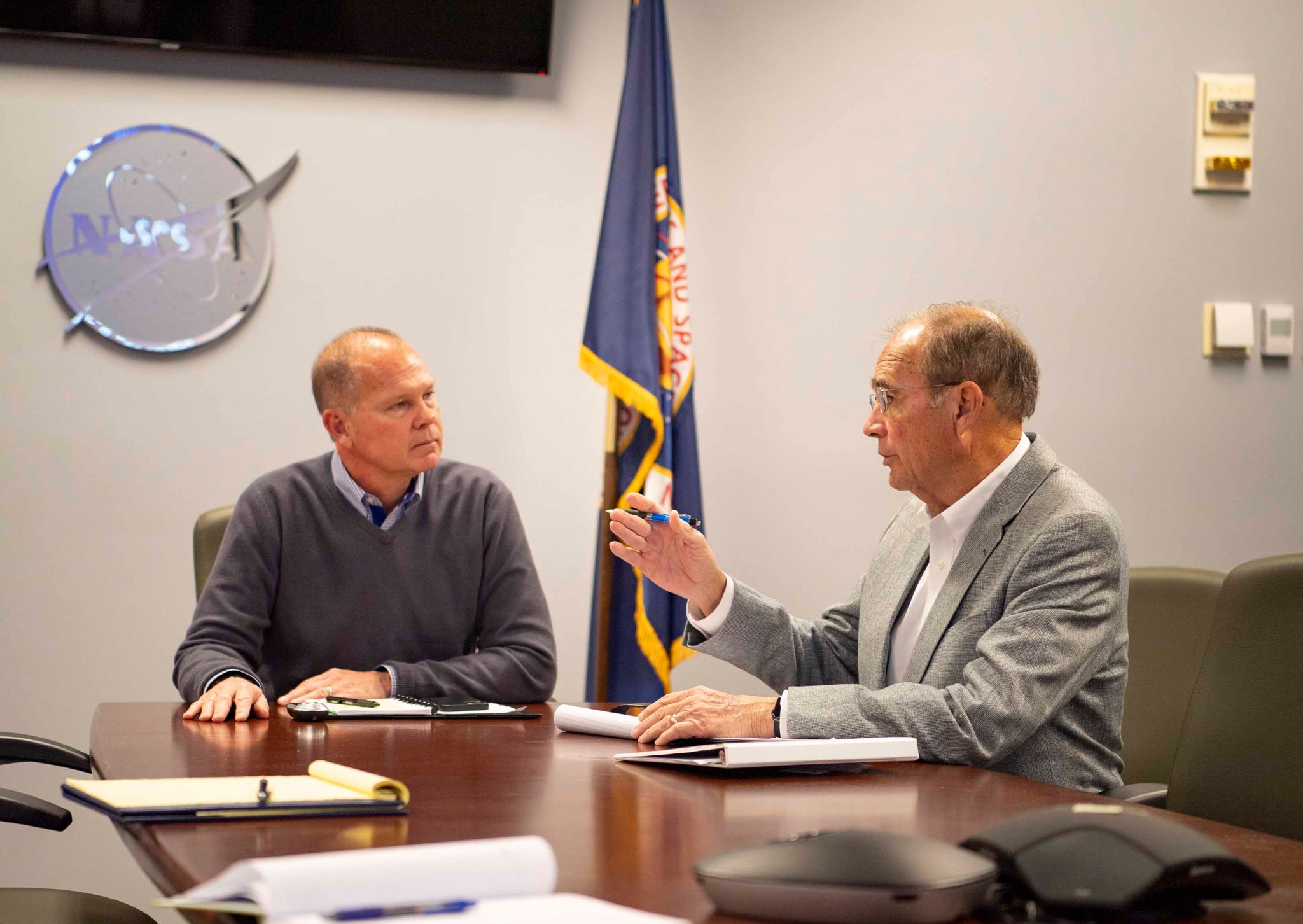
Mississippi Lt. Gov. Delbert Hosemann (r) talks with NASA Stennis Deputy Director John Bailey (l)
Mississippi Lt. Gov. Delbert Hosemann (r) talks with NASA Stennis Deputy Director John Bailey (l) during a visit to the south Mississippi site. During the visit, Bailey and other NASA Stennis leaders briefed Hosemann on site business opportunities and the potential for future growth. They also provided information about the center’s primary lines of business – including propulsion testing, autonomous systems, and range operations – and commercial aerospace and technology companies currently operating at NASA Stennis.
NASA/Stennis

Mississippi Development Authority Visits NASA Stennis
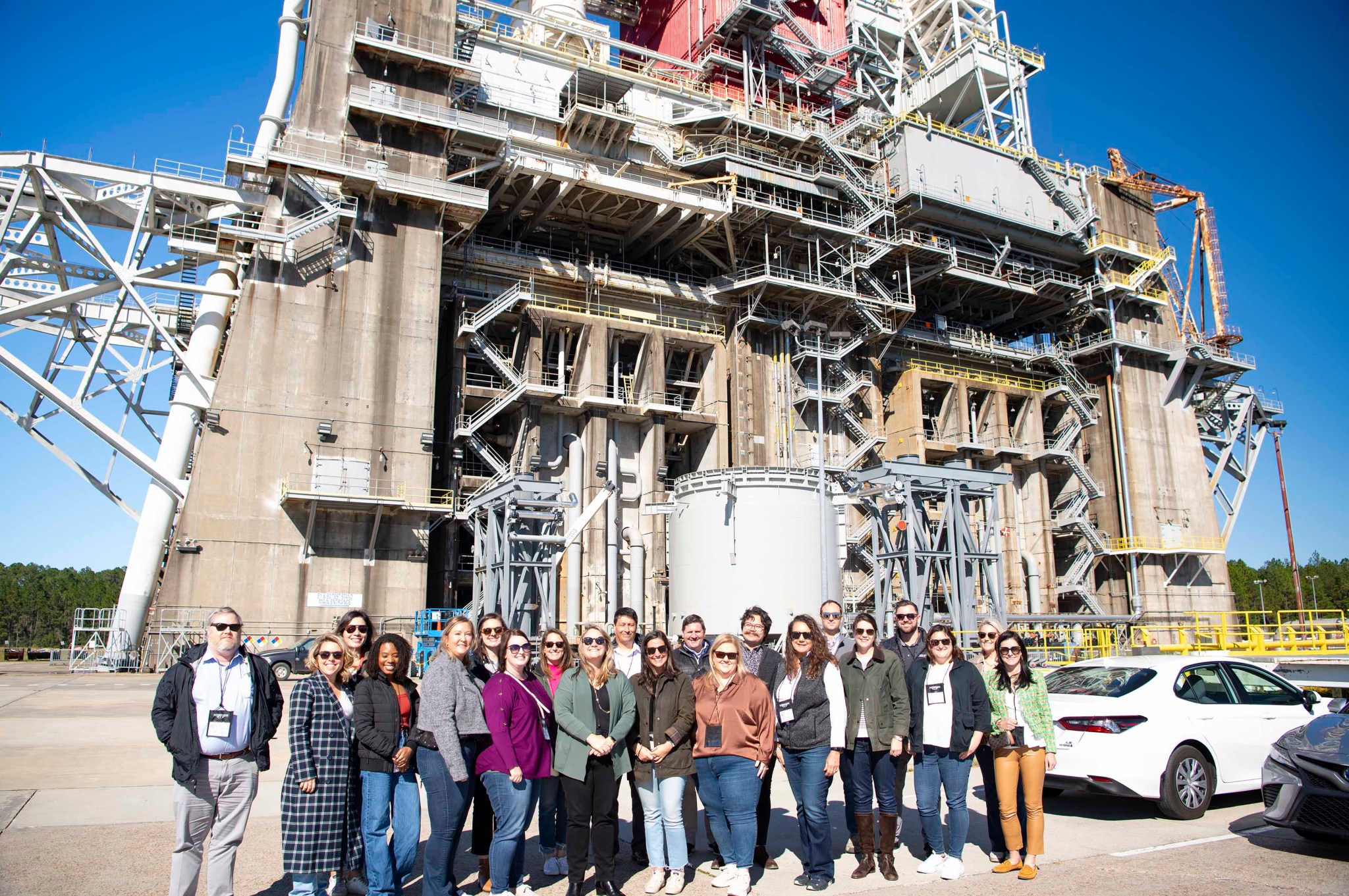
Members of the Mississippi Development Authority
Members of the Mississippi Development Authority, including site selectors from across the country, stand in front of the Thad Cochran Test Stand during their Gulf Coast Road Trip stop at NASA Stennis on Nov. 1. The road trip was designed to introduce developers to the Gulf Coast region and provide information about doing business in Mississippi, including at NASA Stennis.
NASA/Stennis

LSU Aeronautics Organization Visits NASA Stennis
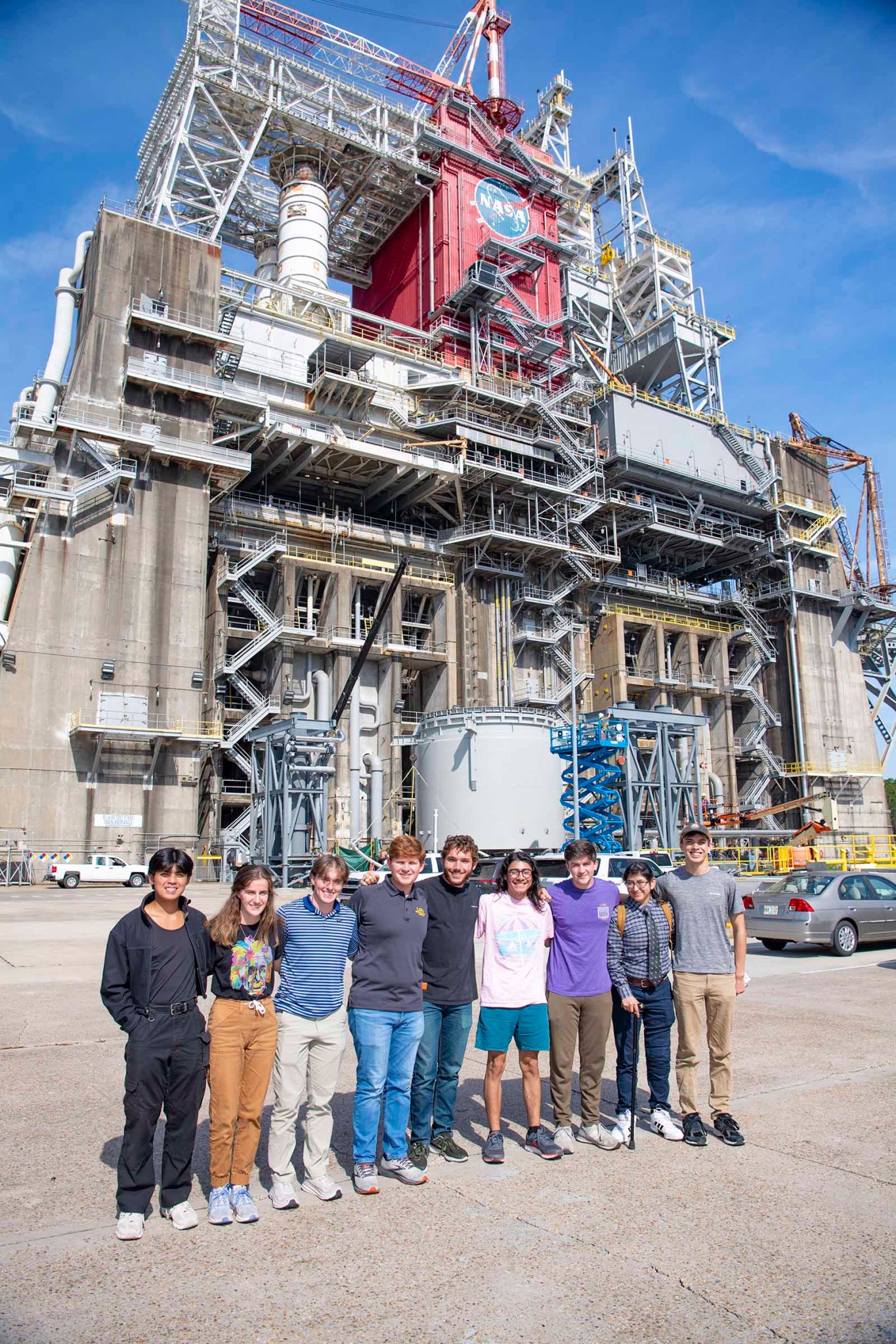
Members of the Louisiana State University branch of the American Institute of Aeronautics and Astronautics (AIAA) stand at the Thad Cochran Test Stand
Members of the Louisiana State University branch of the American Institute of Aeronautics and Astronautics (AIAA) stand at the Thad Cochran Test Stand, site of future Green Run testing for NASA’s Exploration Upper Stage, during a visit to NASA Stennis on Nov. 6. During the visit, branch members learned about propulsion testing activity at NASA Stennis and received guidance on how to find a career in the aerospace industry. The LSU branch of AIAA is dedicated to research and development of aerospace technology and careers.
NASA/Stennis

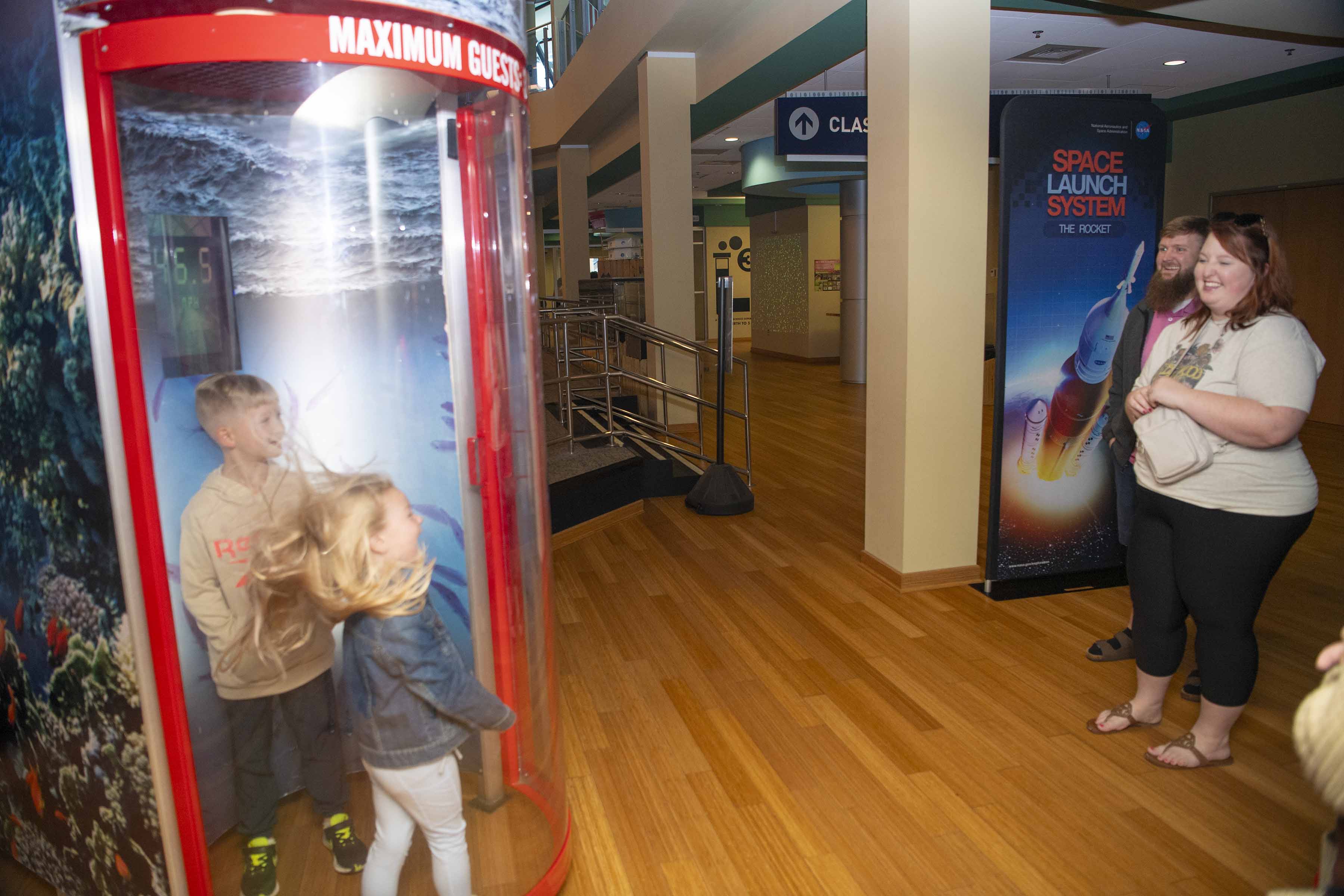
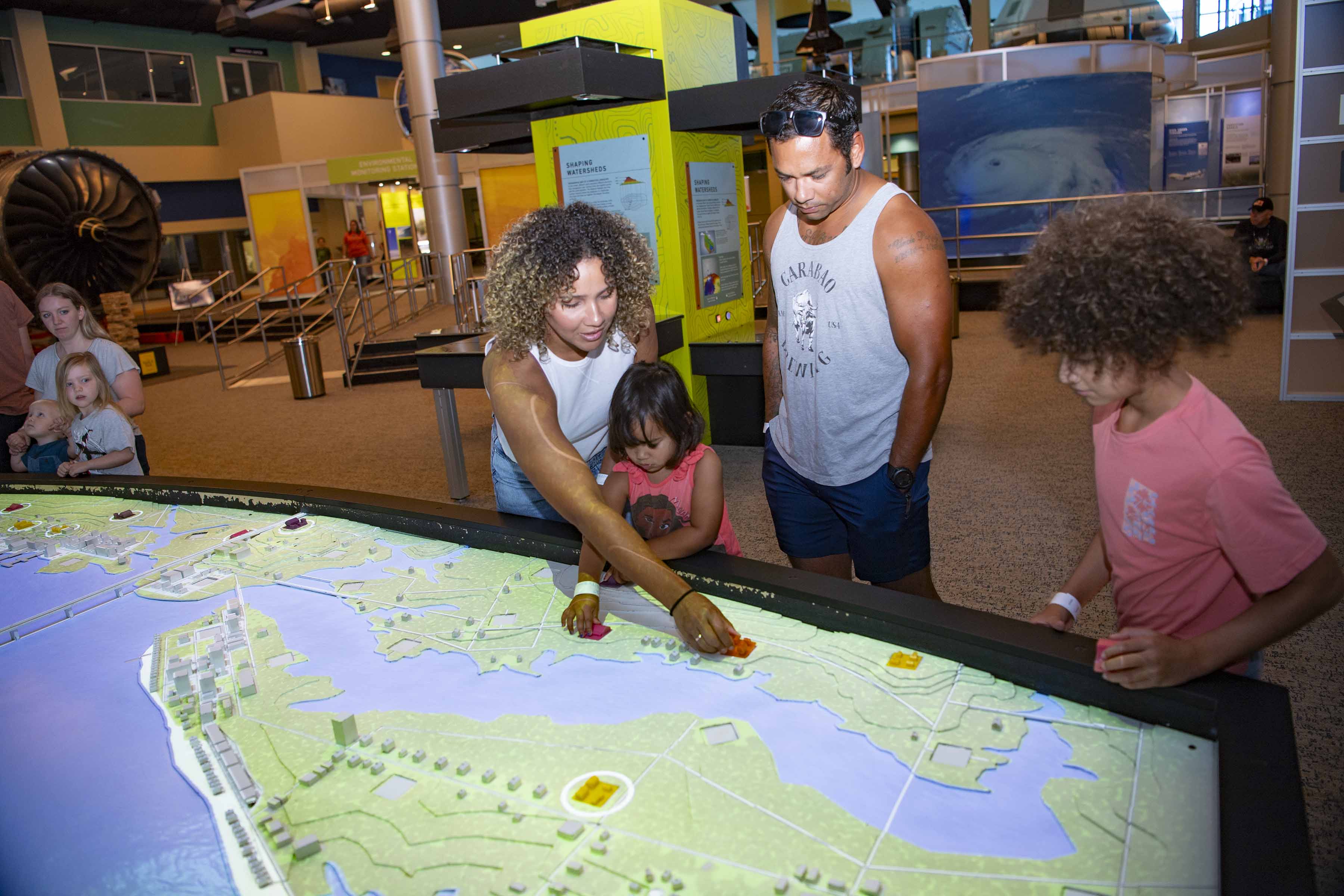
Stennis Employees Enjoy Family Day at INFINITY
NASA in the News

Employee Profile

Van Ward
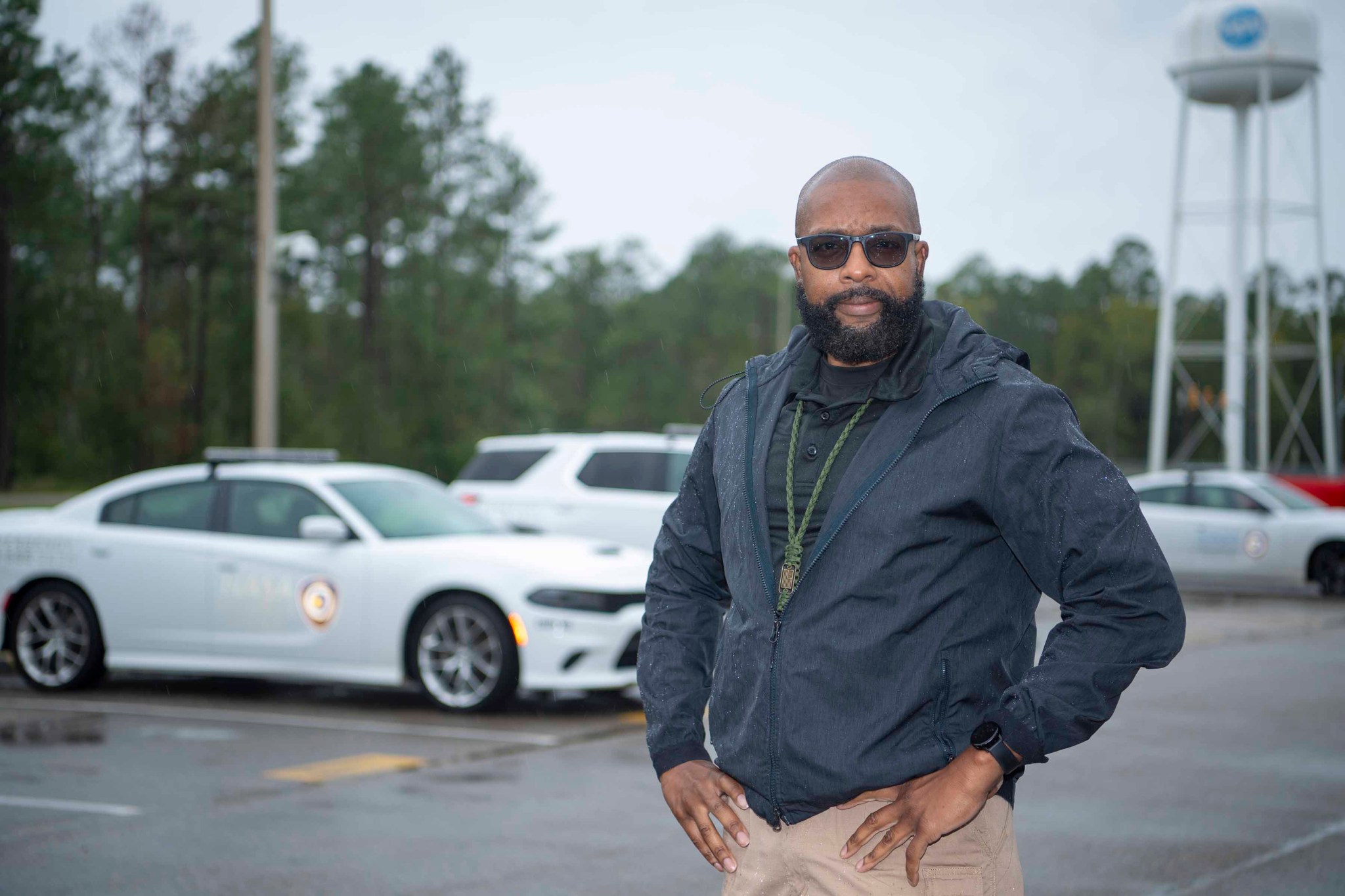
Van Ward leads center operations for security, emergency management, and fire protection at NASA Stennis.
NASA/Danny Nowlin

It was “many Moons ago,” but Van Ward distinctly remembers the presentation a NASA speaker gave to his third-grade class in Union, Mississippi.

Looking Back
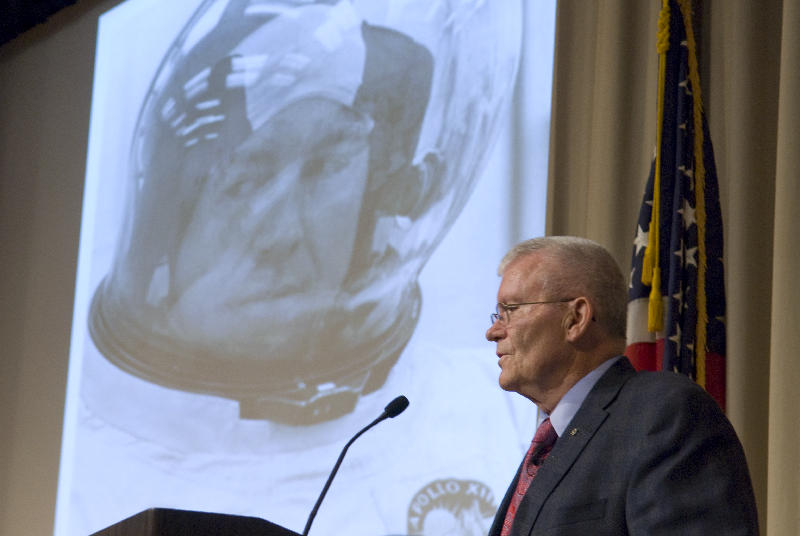
Fred Haise
An image shows former NASA astronaut Fred Haise during the 40th Anniversary of the Apollo 13 mission on April 20, 2010.
NASA/Stennis

Former NASA Astronaut Haise Turns 90

Former NASA astronaut and Biloxi, Mississippi native, Fred Haise, celebrated his 90th birthday – and lifetime of accomplishments – on Nov. 14.

Haise initially pursued a career in journalism before serving in the Korean War as a Marine Corps fighter pilot. After the war, he flew as a research pilot. One of 19 individuals selected by NASA as an astronaut candidate in April 1966, Haise was the highest-scoring applicant of Astronaut Group 5.

Following training, Haise served as a backup crew member for the Apollo 8 and Apollo 11 missions to the Moon before his chance to fly in space came on the Apollo 13 mission as lunar module pilot with commander Jim Lovell and command module pilot Jack Swigert. He was slated to become the sixth person to walk on the lunar surface.

However, Haise never had his chance to step onto the Moon. Just 56 hours into the Apollo 13 mission, an oxygen tank explosion created a crisis that held the world spellbound for days. Haise was in the lunar module at the time of the incident; by the time he reached his command module seat, oxygen tank No. 2 was gone.

The world watched as the crew endured a perilous trip around the Moon and back to Earth in the crippled spacecraft. The mission is well documented in print and onscreen. In total, Haise logged 142 hours and 54 minutes in space on the Apollo 13 mission.

The Mississippi native remained a NASA astronaut for nine more years and was slated to serve as commander of the Apollo 19 mission to the Moon before it was canceled by the end of the Apollo Program. Haise was inducted into the Astronaut Hall of Fame in 1997. Twelve years later, NASA presented him with the agency’s Ambassador of Exploration Award in recognition of his role as a spokesperson for space.

Haise presented the encased Moon rock he received for the recognition to his former Biloxi elementary school – Goren Elementary – for display to students. Since then, he has remained a space spokesperson and a staunch supporter of NASA’s Stennis Space Center and INFINITY Science Center.

“I think aviation, space, and science museums are important for the knowledge imparted to young and old,” he said of the Mississippi science facility that serves as the official visitor center of NASA Stennis. “For the young, it is possible the interesting things they see and learn about will inspire them to make the most of the talent with which they are blessed. INFINITY also serves as a beacon along the highway into Mississippi to encourage people to visit and stay awhile. It gives them a view of the incredible work being done at Stennis Space Center. Through the hands-on exhibits and special programs, education is provided to many visiting young people.”

Happy birthday to Mississippi’s own Fred Haise!

Additional Resources

Artemis

Subscription Info

Lagniappe is published monthly by the Office of Communications at NASA’s Stennis Space Center. The NASA Stennis office may be contacted by at 228-688-3333 (phone); ssc-office-of-communications@mail.nasa.gov (email); or NASA OFFICE OF COMMUNICATIONS, Attn: LAGNIAPPE, Mail code IA00, Building 1111 Room 173, Stennis Space Center, MS 39529 (mail).

The Lagniappe staff includes: Managing Editor Lacy Thompson, Editor Bo Black, and photographer Danny Nowlin.

To subscribe to the monthly publication, please email the following to ssc-office-of-communications@mail.nasa.gov – name, location (city/state), email address.

Powered by WPeMatico

Get The Details…
LaToya Dean

How NASA’s Roman Space Telescope Will Chronicle the Active Cosmos

How NASA’s Roman Space Telescope Will Chronicle the Active Cosmos

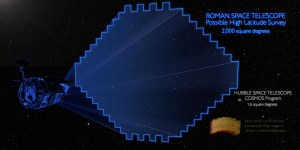
A light blue outline of 18 squares arranged in three rows of six that are slightly arched downward like a rainbow appears near the top left on a black background. Six more appear in a column directly beneath it, and then two more rows that are slightly taller appear to the right, and finally one more row the same length as the first one appears to the right of that. Then this whole grouping of blue squares is slightly rotated and stamped many times. The final product looks like a flower-like mandala or an intricate snowflake.
This animation shows a possible layout of NASA’s Nancy Grace Roman Space Telescope’s High Latitude Time-Domain Survey tiling pattern. The observing program will be designed by a community process, but it is expected to cover five square degrees – a region of the sky as large as 25 full moons – and pierce far into space, back to when the universe was about 500 million years old, less than 4 percent of its current age of 13.8 billion years.
Credit: NASA’s Goddard Space Flight Center

NASA’s Nancy Grace Roman Space Telescope will pair space-based observations with a broad field of view to unveil the dynamic cosmos in ways that have never been possible before.

“Roman will work in tandem with NASA observatories such as the James Webb Space Telescope and Chandra X-ray Observatory, which are designed to zoom in on rare transient objects once they’ve been identified, but seldom if ever discover them,” said Julie McEnery, Roman’s senior project scientist at NASA’s Goddard Space Flight Center in Greenbelt, Maryland. “Roman’s much larger field of view will reveal many such objects that were previously unknown. And since we’ve never had an observatory like this scanning the cosmos before, we could even find entirely new classes of objects and events.”

The mission’s High Latitude Time-Domain Survey is well-designed to discover a particular type of exploding star that astronomers can use to trace the evolution of the universe and probe possible explanations for its accelerated expansion. And since this survey will repeatedly observe the same large vista of space, scientists will also see sporadic events like stellar corpses colliding and stars being swept into black holes.

The survey will look beyond our galaxy to observe the same patch of sky approximately every five days for two years. Stitching these observations together like stop-motion animation will create movies that will reveal a wealth of transient events.

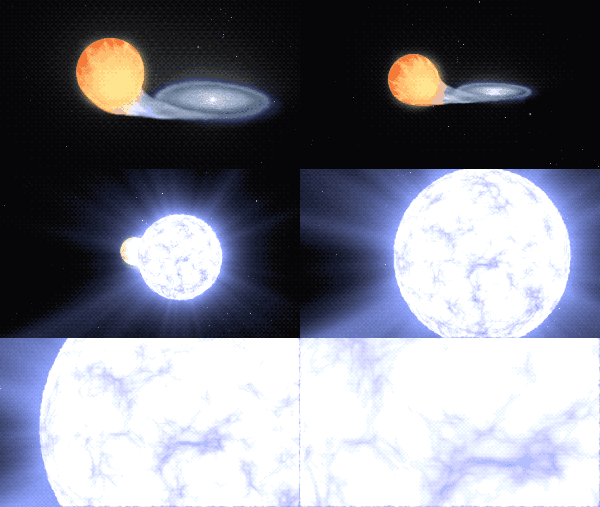
NASA’s upcoming Nancy Grace Roman Space Telescope will see thousands of exploding stars called supernovae across vast stretches of time and space. One kind, called type Ia, serves as “standard candles” because they peak at about the same intrinsic brightness. Scientists can use them to measure distances and trace cosmic expansion over time, providing a window onto the universe’s distant past. Credit: NASA’s Goddard Space Flight Center/CI Lab

Retreating Stellar Sparks

Astronomers will hunt through all this data for a special kind of exploding star called type Ia supernovae. These phenomena originate from certain binary star systems that contain at least one white dwarf – the small, hot core remnant of a Sun-like star. In some cases, the dwarf may siphon material from its companion. This triggers a runaway nuclear reaction that ultimately detonates the thief. Astronomers have also found evidence supporting another scenario, involving two white dwarfs that spiral toward each other until they merge. If their combined mass is high enough, they, too, may produce a type Ia supernova.

Since these explosions each peak at a similar, known intrinsic brightness, astronomers can use them to determine how far away they are by simply measuring how bright they appear. Astronomers will use Roman to study the spectrum of light from these supernovae to find out how rapidly they appear to be moving away from us due to the expansion of space.

By comparing how fast type Ia supernovae at different distances are receding, scientists will trace cosmic expansion over time. This will help us understand whether and how dark energy – the unexplained pressure thought to be speeding up the universe’s expansion – has changed throughout time. Using these and other Roman measurements should also help clear up mismatched measurements of the Hubble constant, which is the universe’s current expansion rate.

“Roman will paint a more vivid picture of our universe’s past and present, giving us new clues about its possible fate,” said Rebekah Hounsell, a research scientist at the University of Maryland, Baltimore County and Goddard, who is exploring ways to optimize Roman’s High Latitude Time-Domain Survey. “Its findings could reshape our understanding of the cosmos.”

This time-lapse of supernova 2018gv in galaxy NGC 2525 compresses nearly one-year of observations from NASA’s Hubble Space Telescope into a few seconds. The supernova initially outshines the brightest stars in the galaxy before fading into obscurity. NASA’s Nancy Grace Roman Space Telescope, currently under construction, could capture such events from start to finish and alert other telescopes, such as the Hubble and James Webb space telescopes, for even more detailed observations. Credit: NASA, ESA, and A. Riess (STScI/JHU) and the SH0ES team; acknowledgment: M. Zamani (ESA/Hubble)

Fleeting Cosmic Wonders

Because of the way this survey will observe the cosmos, it will also spot other rare phenomena. Through Roman, we will witness the birth of new black holes that form when neutron stars – the cores of exploded stars that weren’t quite massive enough to collapse to form black holes on their own – merge. These titanic events create ripples in the fabric of space-time and brilliant kilonova explosions.

The mission is also expected to reveal several dozen tidal disruption events, which happen when a star venturing too close to a black hole is shredded by the black hole’s extreme gravity. The stellar shrapnel generates a huge amount of light as it speeds toward the black hole. Roman will pick up these flares of energy to learn how black holes affect their surroundings.

The survey will also allow astronomers to explore variable objects, like active galaxies whose cores each host an extremely bright quasar. A quasar is a brilliant beacon of intense light powered by a supermassive black hole. The black hole voraciously feeds on infalling matter that unleashes a torrent of radiation. Roman’s steady gaze will help astronomers study how and why these outbursts fluctuate in brightness.

And by finding hundreds of faint, faraway quasars, Roman will also allow scientists to probe the period of reionization. During this cosmic epoch, scientists think intense ultraviolet light from quasars stripped electrons from atoms and turned them into ions. This transition ushered in “cosmic dawn,” as the universe went from being mostly opaque to transparent, allowing visible and ultraviolet light to travel freely.

“This Roman survey will provide a treasure trove of data for astronomers to comb through, enabling more open-ended cosmic exploration than is typically possible,” McEnery said. “We may serendipitously discover entirely new things we don’t yet know to look for.”

The Nancy Grace Roman Space Telescope is managed at NASA’s Goddard Space Flight Center in Greenbelt, Maryland, with participation by NASA’s Jet Propulsion Laboratory and Caltech/IPAC in Southern California, the Space Telescope Science Institute in Baltimore, and a science team comprising scientists from various research institutions. The primary industrial partners are Ball Aerospace and Technologies Corporation in Boulder, Colorado; L3Harris Technologies in Melbourne, Florida; and Teledyne Scientific & Imaging in Thousand Oaks, California.

Download high-resolution video and images from NASA’s Scientific Visualization Studio

By Ashley Balzer
NASA’s Goddard Space Flight Center, Greenbelt, Md.

Media contact:

Claire Andreoli
NASA’s Goddard Space Flight Center, Greenbelt, Md.
301-286-1940

301-286-1940

Powered by WPeMatico

Get The Details…
Ashley Balzer

Webb Telescope’s Marcia Rieke Awarded Catherine Wolfe Bruce Gold Medal

Webb Telescope’s Marcia Rieke Awarded Catherine Wolfe Bruce Gold Medal

4 min read

Webb Telescope’s Marcia Rieke Awarded Catherine Wolfe Bruce Gold Medal

Dr. Marcia Rieke, principal investigator for the Near-Infrared Camera on NASA’s James Webb Space Telescope is the Astronomical Society of the Pacific’s (ASP) 2023 recipient of its most prestigious award. ASP’s Catherine Wolfe Bruce Gold Medal honors Rieke, a Regents Professor of astronomy and Elizabeth Roemer Endowed Chair, Steward Observatory, at the University of Arizona. Rieke’s award and achievements will be recognized at the ASP Awards Gala on Saturday, Nov. 11, in Redwood City, California.

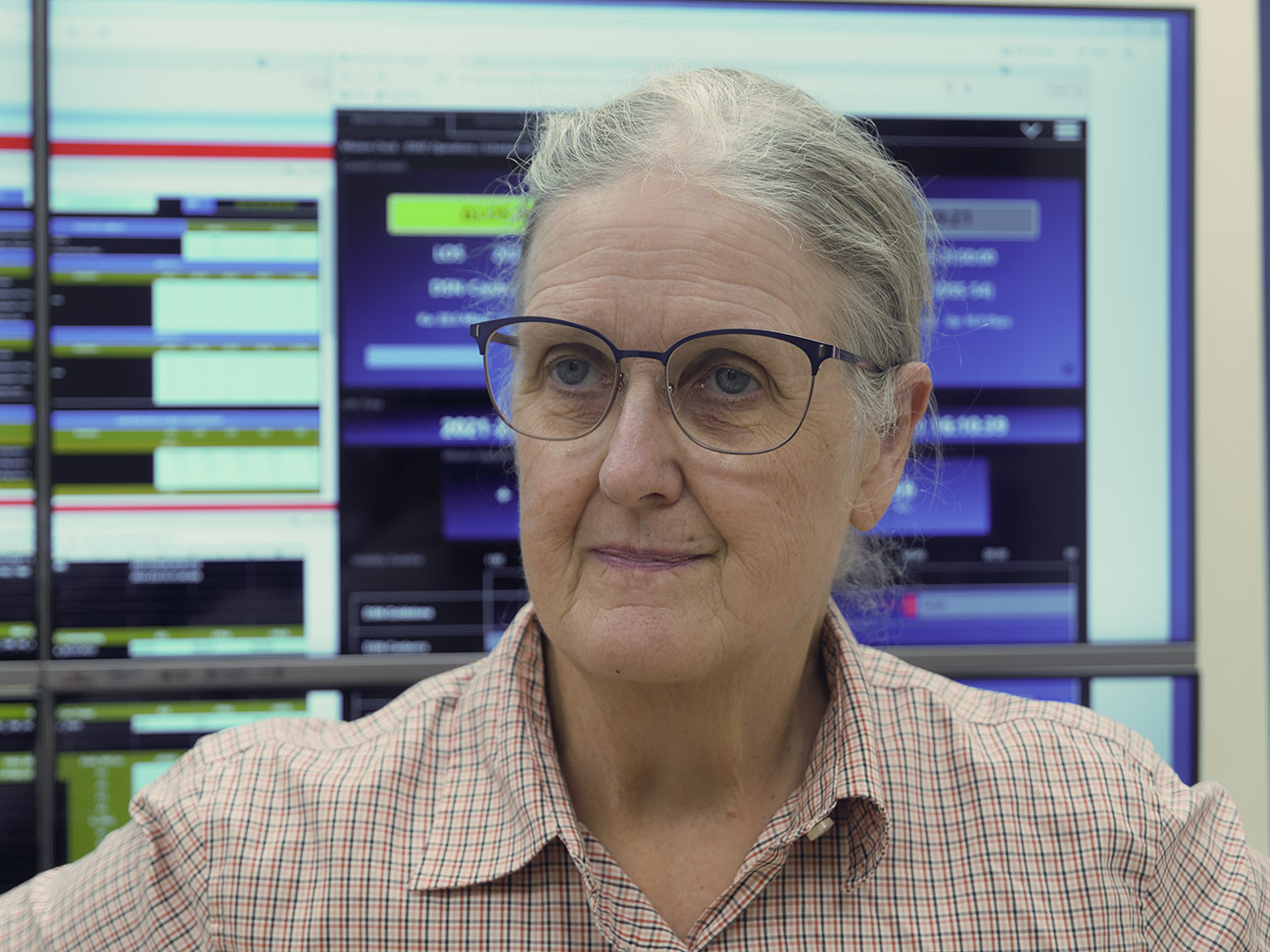
Headshot of Marcia Rieke with a background of blurred monitors of scientific data
Marcia Rieke, Regents’ Professor of Astronomy at the University of Arizona and principal investigator for the near-infrared camera on the James Webb Space Telescope.
Credit: George Rieke / UAZ

Groundbreaking Contributions

Rieke’s research has focused on infrared observations of the center of the Milky Way and high redshift galaxies in the early universe. Rieke is considered by many to be one of the “founding mothers of infrared astronomy,” and it is for her groundbreaking contributions to astronomical research at these wavelengths that she is being recognized and celebrated.   

“I owe a debt of gratitude to my team that made all this possible. I am humbled that I’m on a list that includes the founders of infrared astronomy, Gerry Neugebauer and Frank Low,” said Rieke.

Rieke served as deputy principal investigator for the Near Infrared Camera and Multi-Object Spectrometer (NICMOS) on NASA’s Hubble Space Telescope and co-investigator for the multiband imaging photometer on NASA’s retired Spitzer Space Telescope. Rieke was also involved with several infrared ground-based observatories, including the Multiple Mirror Telescope Observatory in Arizona

Rieke’s nominators credit her leadership for the success of Webb’s Near-Infrared Camera (NIRCam). As one of her nominators stated, “NIRCam was the Webb program’s most challenging instrument development effort. The instrument’s outstanding performance is due largely to the outstanding performance of its principal investigator. Marcia’s consistent focus, diligence, and ‘lead from the front’ approach under extremely difficult technical and programmatic circumstances presents an example for others to follow.”

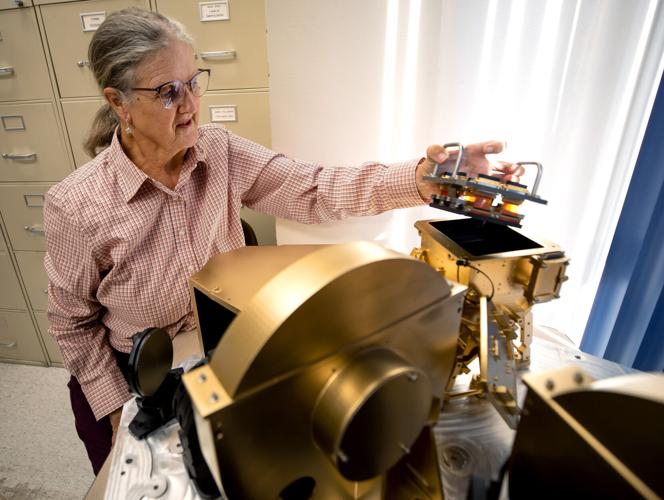
Marcia Rieke standing while working on scientific equipment with file cabinets in background
Marcia Rieke, Regents’ Professor of Astronomy at the University of Arizona and principal investigator for the near-infrared camera on the James Webb Space Telescope.
Credit: George Rieke / UAZ

Rieke has authored 310 refereed publications, which have over 30,000 citations. Her deep knowledge and expertise were put into service as vice chair for program prioritization for the Astro 2010 Decadal Survey Committee’s report, “New Worlds, New Horizons.” Her landmark contributions to astronomical research and instrument development, as well as her service to public policy and public outreach, have been recognized nationally. She was elected a fellow of the American Academy of Arts and Sciences in 2007, a fellow of the National Academy of Sciences in 2012, and a legacy fellow of the American Astronomical Society in 2020. Rieke has also been the recipient of numerous prestigious awards, including the NASA Distinguished Public Service Medal in 2023 for her contribution to the field of astronomy and key role in the development of cutting-edge instruments for Webb.

About the Catherine Wolfe Bruce Gold Medal

ASP is an international non-profit scientific and educational organization, founded in 1889, that works to increase understanding and appreciation of astronomy.

The Catherine Wolfe Bruce Gold Medal is the organization’s highest award given annually to a professional astronomer in recognition of a lifetime of outstanding achievement and contributions to astrophysics research. It was established by Catherine Wolfe Bruce, an American philanthropist and patroness of astronomy.   

The James Webb Space Telescope is the world’s largest, most powerful, and most complex space science telescope ever built. Webb is solving mysteries in our solar system, looking beyond to distant worlds around other stars, and probing the mysterious structures and origins of our universe and our place in it. Webb is an international program led by NASA with its partners, ESA (European Space Agency) and the Canadian Space Agency.

For more information about NASA’s Webb telescope visit: www.nasa.gov/webb

Media Contact

Rob Gutro
NASA’s Goddard Space Flight Center, Greenbelt, Maryland

Share

Details

Last Updated

Nov 14, 2023

Editor

Marty McCoy

Powered by WPeMatico

Get The Details…
Marty McCoy

Indigenous Student Brings Skills, Perspective to NASA Internship

Indigenous Student Brings Skills, Perspective to NASA Internship

5 min read

Indigenous Student Brings Skills, Perspective to NASA Internship

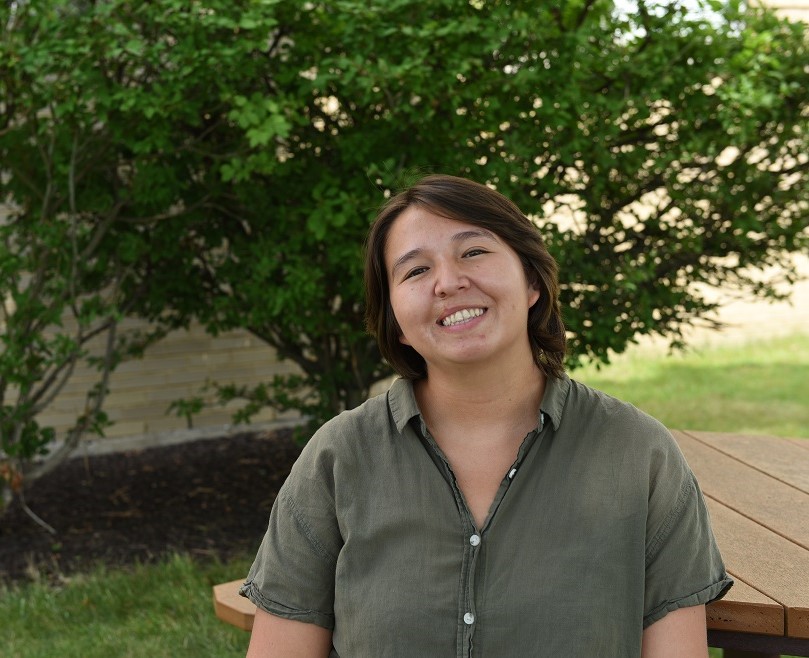
Alyssa Warrior poses outdoors and smiles at the camera. She is sitting at a wooden picnic table in front of a bright green bush. She is wearing a dark green collared shirt.
Alyssa Warrior, who is Onödowá’ga’(Seneca) and belongs to the Haudenosaunee Confederacy, was an intern at NASA’s Glenn Research Center in summer 2023.
Credit: NASA/Ellen Bausback

On hot, summer days when Alyssa Warrior was growing up, she spent her time outside by her home on the Seneca Nation Cattaraugus Reservation near Buffalo, New York. She lay in the creek to escape the boiling sun, ran through the woods with her sister and five brothers, picked raspberries and wild onions, and lounged in a hammock.

When night came, her father started a fire and told scary stories while hot dogs and s’mores sizzled. Her family sunk down in lawn chairs after the fire turned to ash and gazed up, searching for lights in the sky.

“Looking at stars was always my favorite thing,” Warrior said. “I think I’ve always been interested in the natural world.”

With a blanket wrapped around her, Warrior walked barefoot in the dewy grass, staying out long after her family retreated inside. Other nights, she lay with her face pressed against the sliding glass door in her living room, hoping to catch just one more glimpse of the sky.

“I was always like, ‘One more, just one more shooting star,’’ Warrior said. “I just couldn’t stop. I loved to see them.”

In summer 2023, Warrior – now a physics senior at the University at Buffalo – interned at NASA’s Glenn Research Center in Cleveland, where she used software to validate and verify a model of a control system that could be used in future hybrid-electric aircraft. Adjusting the model and combing over code for hours to make improvements reminded Warrior of her skywatching memories.

“At one point, I needed to stop,” Warrior said. “But I’d be thinking, well, maybe I’ll just make one more adjustment and that’ll help.”

Warrior, who is Onödowá’ga’(Seneca) and belongs to the Haudenosaunee Confederacy, never expected to come to NASA. But after attending an American Indian Science and Engineering Society (AISES) conference and meeting Glenn engineer Joseph Connolly, she was recruited as an intern.

Outreach is integral to bringing more Indigenous people to NASA, says Connolly, who shares Warrior’s Haudenosaunee background and has mentored a handful of other Indigenous interns during his 19 years at Glenn.

“I think one of the reasons that it’s really important to get more Indigenous people at NASA, and just people with different perspectives, is because the problems that we work on are ridiculously hard,” Connolly said. “If we have all of the smartest people, but they get trained the exact same way, sometimes you just don’t have the insights that can give you the ability to look at problems in a new way.”

Building connections with fellow Indigenous employees is another way to help inspire the next generation, Connolly says, and Warrior connected with many through an online Natives at NASA group.

“It’s been really great to see other Native people working here at NASA – people that looks like me or look like my family – because it’s not something I see or that I’m used to,” Warrior said. “Everyone I’ve met has held some sort of information or knowledge that has improved my time here and will improve my future.”

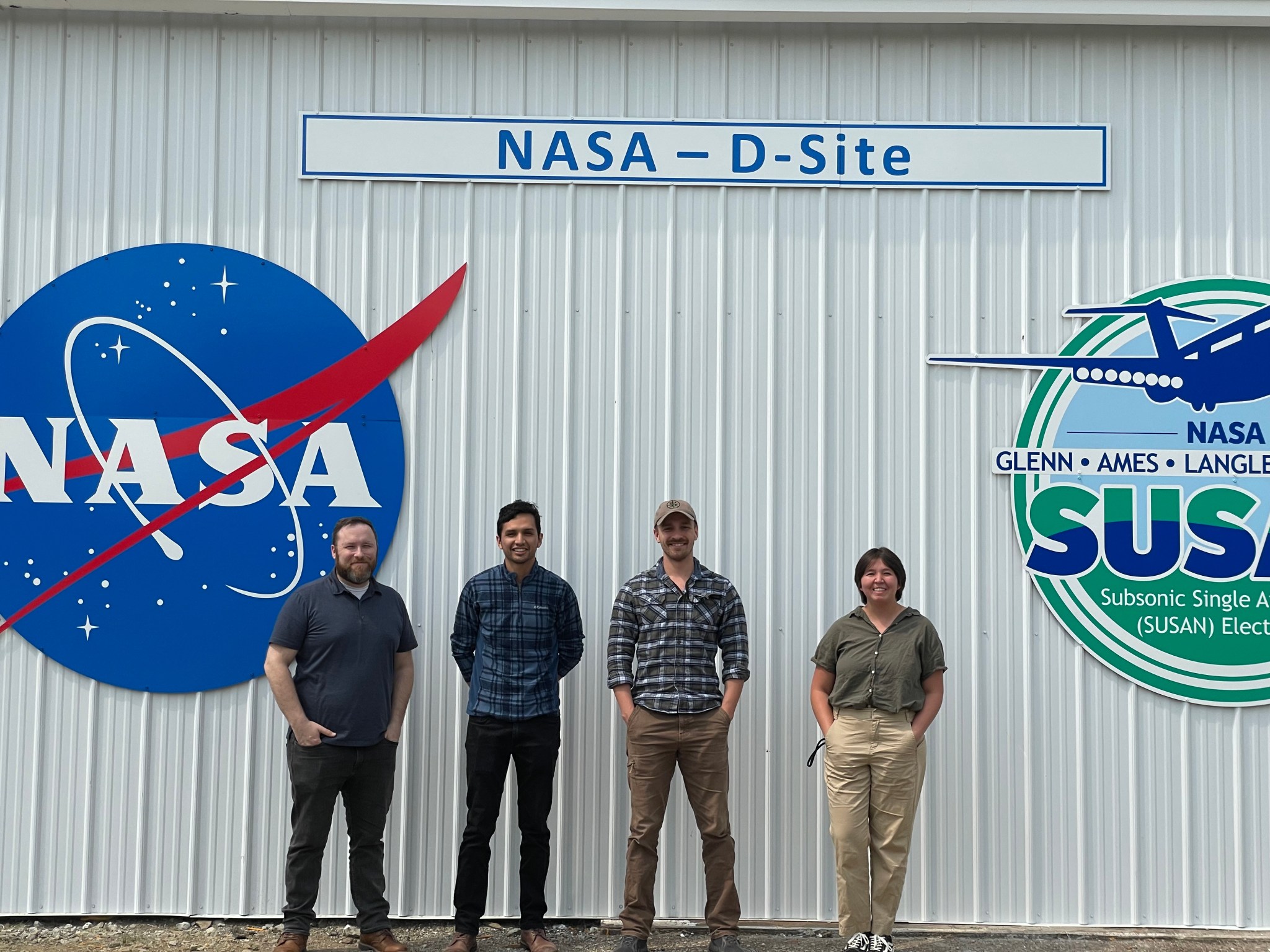
: A group of four students pose in front of a white metal building. On the side of the building is a NASA meatball logo, a sign that says, “NASA – D-site,” and a colorful SUSAN aircraft logo.
Alyssa Warrior (far right) poses with other summer 2023 interns outside a small-scale electrical lab at NASA’s Glenn Research Center.
Credit: Joe Connolly

Warrior sees a clear connection between Indigenous people and the STEM fields.

“I think a lot of Native people specifically are connected with nature and have an interest in learning from it,” she said. “I think that’s its own science.”

In addition, working on hybrid-electric aircraft and sustainability aligned with Warrior’s cultural values, she said.

“Within Native communities, that is very important,” Warrior said. “It’s not always just trying to go to space, it’s also just trying to improve the planet that we’re on now. “

Besides recruiting and speaking at conferences, NASA Glenn works with Cleveland organizations, like the Lake Erie Native American Council and the Cleveland Metroparks, to support Indigenous Peoples Day events and other gatherings. NASA also supports a high-powered rocket competition for Indigenous students called First Nations Launch. Within the agency, the Science Mission Directorate hosts monthly conversations with Indigenous scholars.

“It’s incredibly important to make sure that Alyssa and some of the other students see that these communities exist, because when I was getting started [in STEM], I had no idea they did,” Connolly said.

Along with continuing outreach, Warrior suggests that those at NASA and others seeking to connect with Indigenous people learn about Indigenous heritage and history.

“Those are all really important things to know before even trying to open your arms up to Native people because then you‘re aware of where they’re coming from and certain struggles that they face,” Warrior said. “That makes it easier to reach out.”

Warrior says she is proud to have been an intern at NASA and hopes she’ll inspire younger Indigenous people, like her nieces and nephews, to reach for the stars. She knows she’ll continue to draw on the lessons of the natural world as she pursues a future STEM career.

“It’s always with me, this mindset and maybe looking at things a little differently. I feel more comfortable outside, seeing green,” Warrior said. “I think it’s definitely affected who I am today. I’ve got to put my feet in the grass sometimes.”

Powered by WPeMatico

Get The Details…
Ellen Bausback

Five Ways NASA Supercomputing Takes Missions from Concept to Reality

Five Ways NASA Supercomputing Takes Missions from Concept to Reality

NASA high-end computing plays a key role in taking many agency missions from concept to application in the real world. From increasing accuracy of global weather forecasts for forecast entities (like NOAA) to warn of severe storms, to designs for future air taxis to safely fly people around urban areas, to parachute design tests for landing spacecraft on the Moon and other planets, our supercomputing resources and experts are driving science and engineering advances for the benefit of humanity.

These projects and much more will be on display in the agency’s hybrid exhibit during SC23, the International Conference for High Performance Computing, Networking, Storage and Analysis. This year’s conference is being held in Denver, Nov. 12–17.

1. Simulating Air Taxi Safety Near the Ground

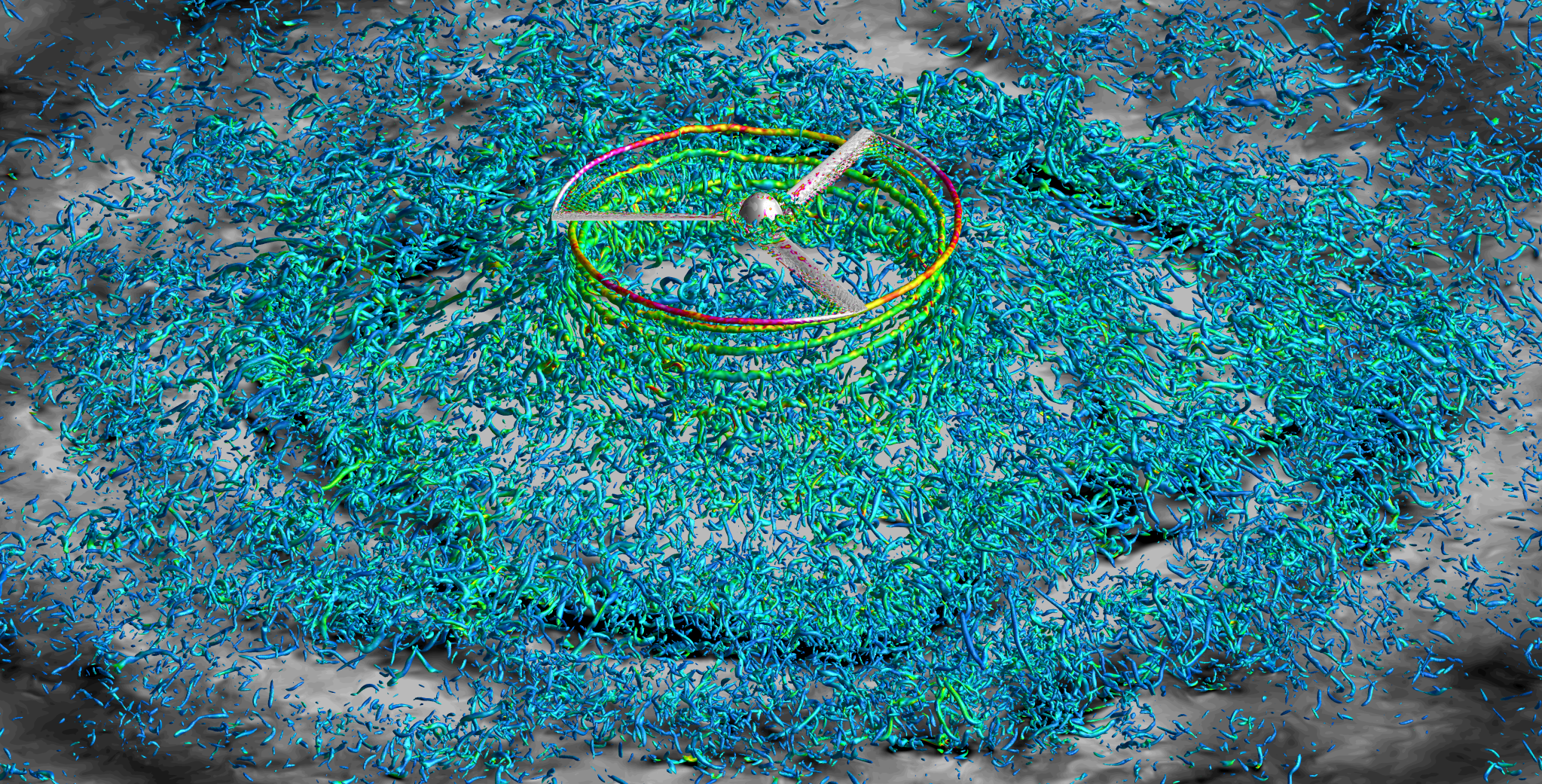
With the development of urban air mobility (UAM) vehicles, in the near future people might be hailing rides in air taxis. Researchers studying the aerodynamics performance of multiple UAM designs are focusing this year on simulations to analyze how these vehicles perform close to the ground. Many of the agency’s UAM aircraft concepts have rotors, just like helicopters. Supercomputers at the NASA Advanced Supercomputing (NAS) facility at NASA’s Ames Research Center in California’s Silicon Valley run complex, high-fidelity computational fluid dynamics simulations that capture in detail the interaction between rotors, other vehicle components, and the ground surface. These simulations enable scientists to better understand the vehicle aerodynamics and the rotor-induced flow around the vehicles to detect potentially dangerous areas with high winds and gusts. Simulation data allows the team to predict changes in how UAMs handle close to the ground and to provide guidelines for safe crew and passenger movement near the vehicles.

NASA’s six-passenger air taxi quadcopter in hover (out of ground effect). Q-criterion — a measure of the amount of vorticity in the aerodynamic flow — isosurfaces colored with the vorticity magnitude show the vortex wake, where blue is low and magenta is high. In the background, the pressure coefficient is shown, where black is low and white is high. Understanding the complex flow and aerodynamic interactions of multi-rotor vehicles is key to design the future air taxis.
NASA/Patricia Ventura Diaz

2. Predicting the Strongest Storms within a Global Computer Model

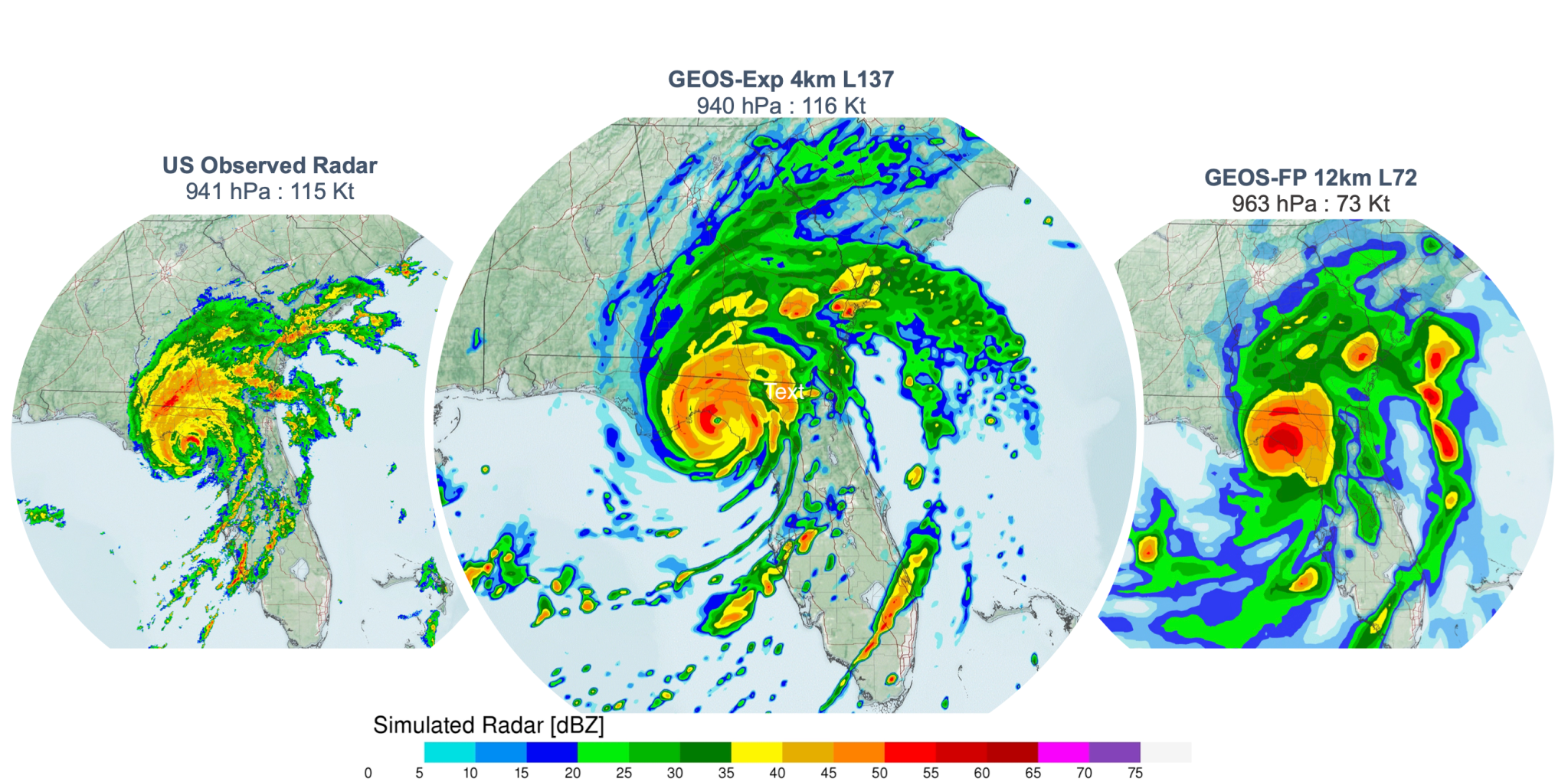
The common fuel for severe thunderstorms, tornadoes, and hurricanes is convection – vigorous up-and-down motions of the atmosphere that vertically transport heat and moisture. Operational weather forecasting centers typically predict convective-scale weather using regional, limited-area computer models because global models at convection resolving resolution need too much computing power. Researchers at NASA’s Goddard Space Flight Center in Greenbelt, Maryland, have adapted their global Goddard Earth Observing System (GEOS) model to apply finer grid resolutions of 2 to 4 kilometers (about 1.25 to 2.5 miles) over the continental United States. GEOS forecasts running on the NASA Center for Climate Simulation’s (NCCS’s) Discover supercomputer and NAS’s Aitken supercomputer are extending the predictability of the strongest storms beyond two days while better representing local impacts from intense precipitation, winds, and heat. Ongoing simulations accurately tracked extreme weather events of 2023 including hurricanes Idalia and Lee and tropical storm Ophelia.

Hurricane Idalia made landfall along Florida’s northern Gulf Coast on August 30, 2023. Radar reflectivity from observations (left) and simulations by the Goddard Earth Observing System (GEOS) model at 4-kilometer (2.5-mile) (center) and 12-kilometer (7.5-mile) (right) resolution visualize Idalia’s internal structure. While both GEOS forecasts captured Idalia’s landfall within miles of the actual landfall days in advance, the 4- kilometer forecast improved representations of central pressure values, near-surface wind speeds, a very compact eye, and banding convection spiraling inwards from the southeast.
NASA/William Putman

3. Protecting Space Capsules During Planetary Entry, Descent, and Landing

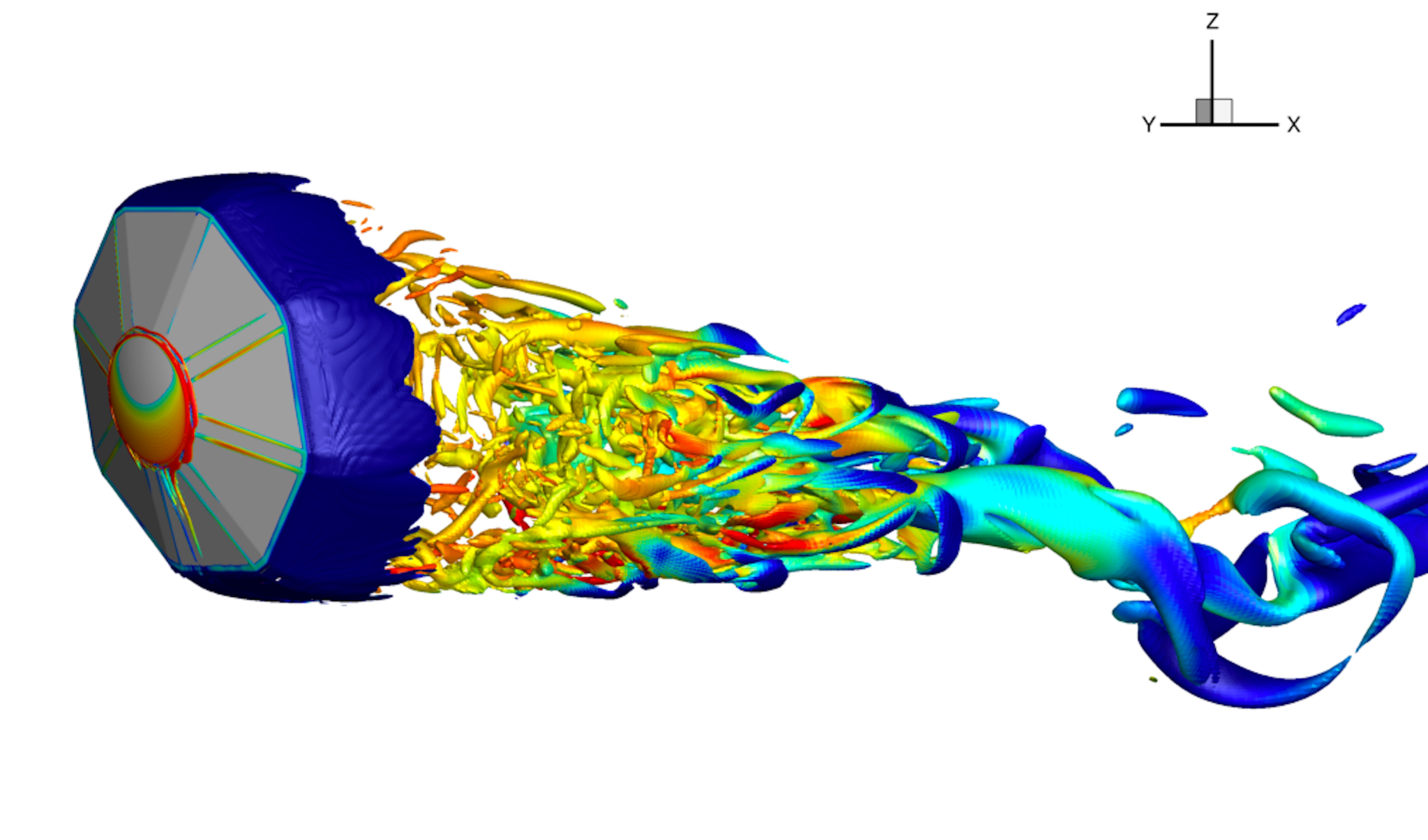
NASA space capsules are designed to survive entering planetary atmospheres at hypersonic speeds and protect their payloads – or their crew – from the extreme temperatures that occur during entry. In addition to heat, the spacecraft can also encounter instabilities as they are slowed down by aerodynamic drag during descent. To quantify and understand this additional hazard, researchers at NASA Ames used the agency’s Pleiades and Electra supercomputers to simulate the free-flight conditions of capsules during the full trajectory of planetary entry. These complex simulations are used to analyze capsule flight dynamics and identify any risks the instabilities may pose during the later stage of the flight trajectory. The resulting analyses help engineers design entry vehicles for planetary exploration, helping ensure the success of NASA programs including Artemis and the upcoming Dragonfly mission to Saturn’s largest moon, Titan. 

Free-flight simulation of the Adaptable Deployable Entry and Placement Technology vehicle showing Q-criterion, which is a measure of the amount of vorticity in the aerodynamic flow. The iso-contours indicate vortex structure, indicating lower vorticity in blue and higher vorticity in red.
NASA/Joseph Brock

4. Transforming and Depicting Earth Science Data

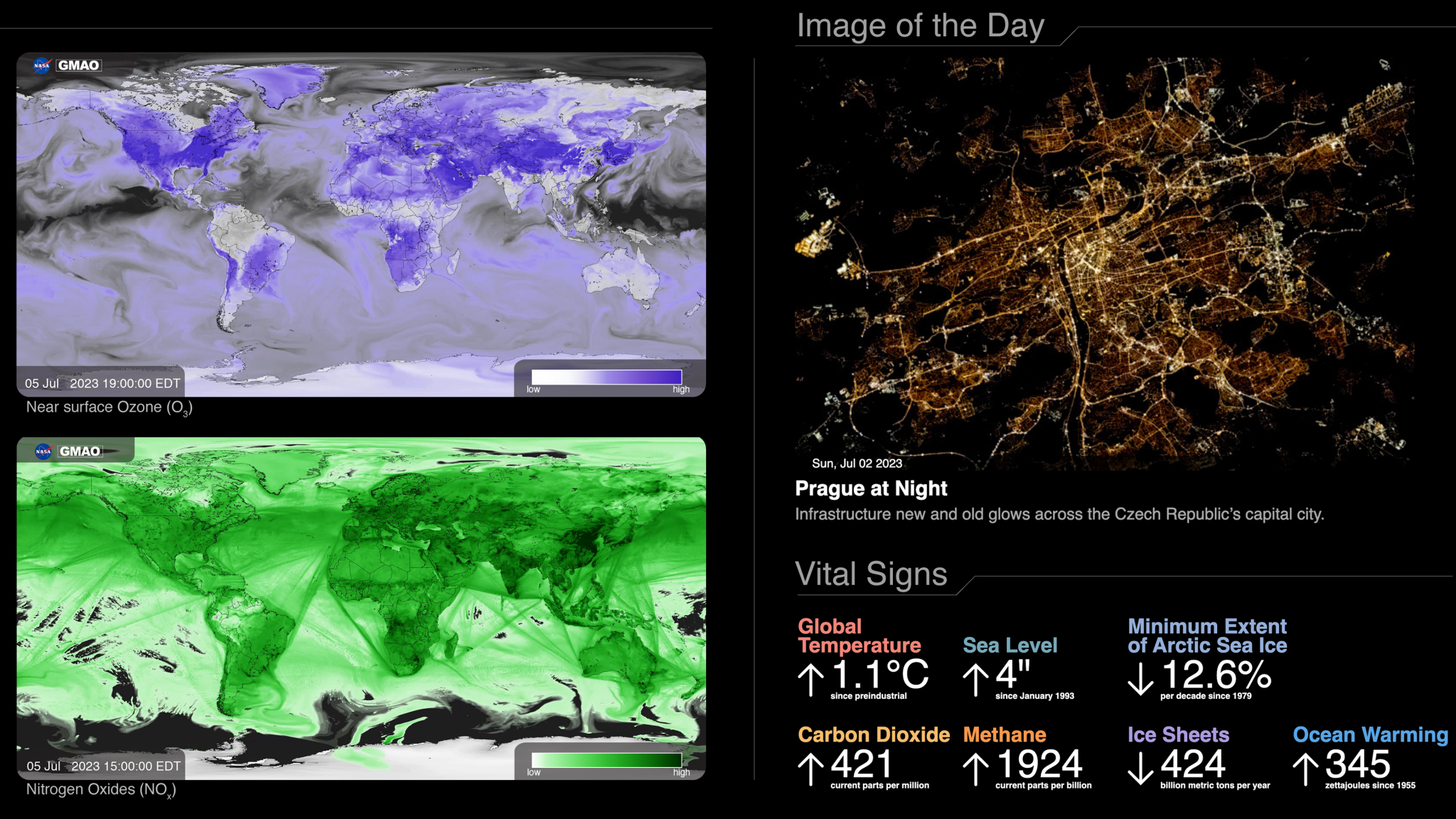
From the agency’s founding in 1958, NASA has been tasked with widely disseminating information about its activities and results. One new NASA public communication effort is the Earth Information Center (EIC), which presents visualizations of raw observational and model data across a set of dashboards arranged like a NASA Mission Control Center for our planet. The EIC installation at NASA Headquarters in Washington includes a multi-panel hyperwall for displaying large-format animations surrounded by smaller portals depicting a number of “vital signs” of the Earth. The diverse data sources include simulations run on the NCCS Discover supercomputer and observations from satellites and ground instruments maintained by NASA and partners. Since opening in late June 2023, the EIC has drawn a great variety of visitors, from dignitaries to elementary school students. In addition, EIC information is aiding policy makers, scientists, and NASA data users such as farmers, business owners, and researchers.

The Earth Information Center (EIC) dashboards include (left) visualizations generated by simulations run on the NASA Center for Climate Simulation’s Discover supercomputer and (right) an “Image of the Day” and “Vital Signs” of the planet compiled from NASA and partner agency observations.
NASA/Brenda Lopez Silva, Michael Chyatte

5. Using Autonomous Onboard Science Agents for Planetary Exploration

Researchers in NASA Goddard’s Distributed Systems Missions initiative are working to enable deep-space missions that are adaptable and can autonomously interpret and respond to newly-collected science data using an onboard software “agent” rather than waiting for new instructions from Earth at each phase of the mission. To test this new, autonomous mission design, they chose Enceladus, an icy ocean moon of Saturn and one of the most promising targets to search for life in our solar system. In a simulated mission scenario, the scientists modeled various trajectories and orbits of eight small spacecraft to produce what would be the first stable constellation around Enceladus to provide global coverage of the moon for collecting science observations. The team deployed their  autonomous onboard science agent to analyze simulated data in “real-time.” The agent uses multiple machine learning models to process and interpret the relative amounts of various compounds detected in Europa’s icy plumes – indicators of the possibility of life – autonomously interprets those data, then makes decisions impacting follow-on analysis or prioritized data transmission based on pre-programmed mission goals.   

With its steady plume of subsurface liquid water jetting out into space, Saturn’s moon Enceladus is a likely candidate for an astrobiology study on a future NASA mission using autonomous spacecraft. In this visualization of that mission, the onboard system (science agent) tracks all eight spacecraft in the constellation (top center window). When the ground track lights up (shows white), the animation in the left window shows a close-up view of the position of that spacecraft. The spacecraft field of view is shown by a green cone (representing a volume of space) and corresponding green rectangle (on the surface). These spacecraft positions could be altered if strongly recommended by the science data results, and these changes can be safely executed autonomously.
NASA/Pavel Galchenko, NASA’s Scientific Visualization Studio

For more information about supercomputers run by NASA High-End Computing, visit:

https://hec.nasa.gov/

For news media:

Members of the news media interested in covering this topic should reach out to the NASA Ames newsroom.

Authors: Jill Dunbar and Michelle Moyer, NASA’s Ames Research Center, and Jarrett Cohen and Sean Keefe, NASA’s Goddard Space Flight Center

Powered by WPeMatico

Get The Details…
Abby Tabor