Dragon Hatch Opened, Crew Unpacking Science and Supplies

Dragon Hatch Opened, Crew Unpacking Science and Supplies

The space station soars 260 miles above the southernmost point of Alaska into an orbital nighttime.

The Expedition 70 crew is unpacking the SpaceX Dragon cargo spacecraft following its arrival early Saturday morning. Meanwhile, the orbital residents are also continuing their research and maintenance activities following the International Space Station’s debris avoidance maneuver last week.

The hatches are open between Dragon and the orbital outpost following its arrival on Saturday. NASA Flight Engineers Jasmin Moghbeli and Loral O’Hara monitored Dragon’s arrival and entered the cargo spacecraft less than two hours after its docking. The duo along with Commander Andreas Mogensen and Flight Engineer Satoshi Furukawa spent a busy weekend unloading time-sensitive experiments for installation and activation aboard the orbital outpost.

The foursome worked throughout Monday transferring science freezers stocked with research samples from Dragon into the station and kicking off some of the new investigations. Mogensen from ESA (European Space Agency) and Furukawa from JAXA (Japan Aerospace Exploration Agency) configured space biology hardware and began offloading some of the 6,500 pounds of new crew supplies and hardware.

O’Hara and Moghbeli assisted the two international astronauts with both the science freezer work and the cargo transfers during the morning. O’Hara then spent the afternoon servicing components on a biological printer, the BioFabrication Facility (BFF), that is testing the printing of organ-like tissues in microgravity. Moghbeli set up new life science hardware, helped with the BFF work, and maintained standard life support and electronics hardware.

At the end of the day, the four astronauts joined the space station’s three cosmonauts reviewing updated emergency procedures while the new Dragon cargo spacecraft is docked to the Harmony module’s forward. Dragon will stay attached to Harmony until early December when it will return to Earth filed with station hardware and completed research for retrieval and analysis.

Veteran cosmonaut Oleg Kononenko began his day inside the Poisk airlock checking pressurization gear, then inspected windows on the Zvezda service module, and finally jogged on Zvezda’s treadmill for a fitness evaluation. Flight Engineer Nikolai Chub spent much of his day testing a 3D printer to make tools and supplies without depending on cargo missions from Earth. Flight Engineer Konstantin Borisov deactivated a camera remotely controlled by students on Earth, inspected Roscosmos laptop computers, and cleaned ventilation systems.

On Nov. 10, the International Space Station’s Zvezda service module engines were fired for five minutes and 16 seconds beginning at 10:07 a.m. to maneuver the complex away from the predicted track of an orbital debris fragment.  The maneuver had no effect on the rendezvous and docking of NASA’s SpaceX 29th commercial resupply mission, which docked to the space station at 5:07 a.m. Nov. 11 after launching two days prior.


Learn more about station activities by following the space station blog@space_station and @ISS_Research on X, as well as the ISS Facebook and ISS Instagram accounts.

Get weekly video highlights at: https://roundupreads.jsc.nasa.gov/videoupdate/

Get the latest from NASA delivered every week. Subscribe here: www.nasa.gov/subscribe

Powered by WPeMatico

Get The Details…

Mark Garcia

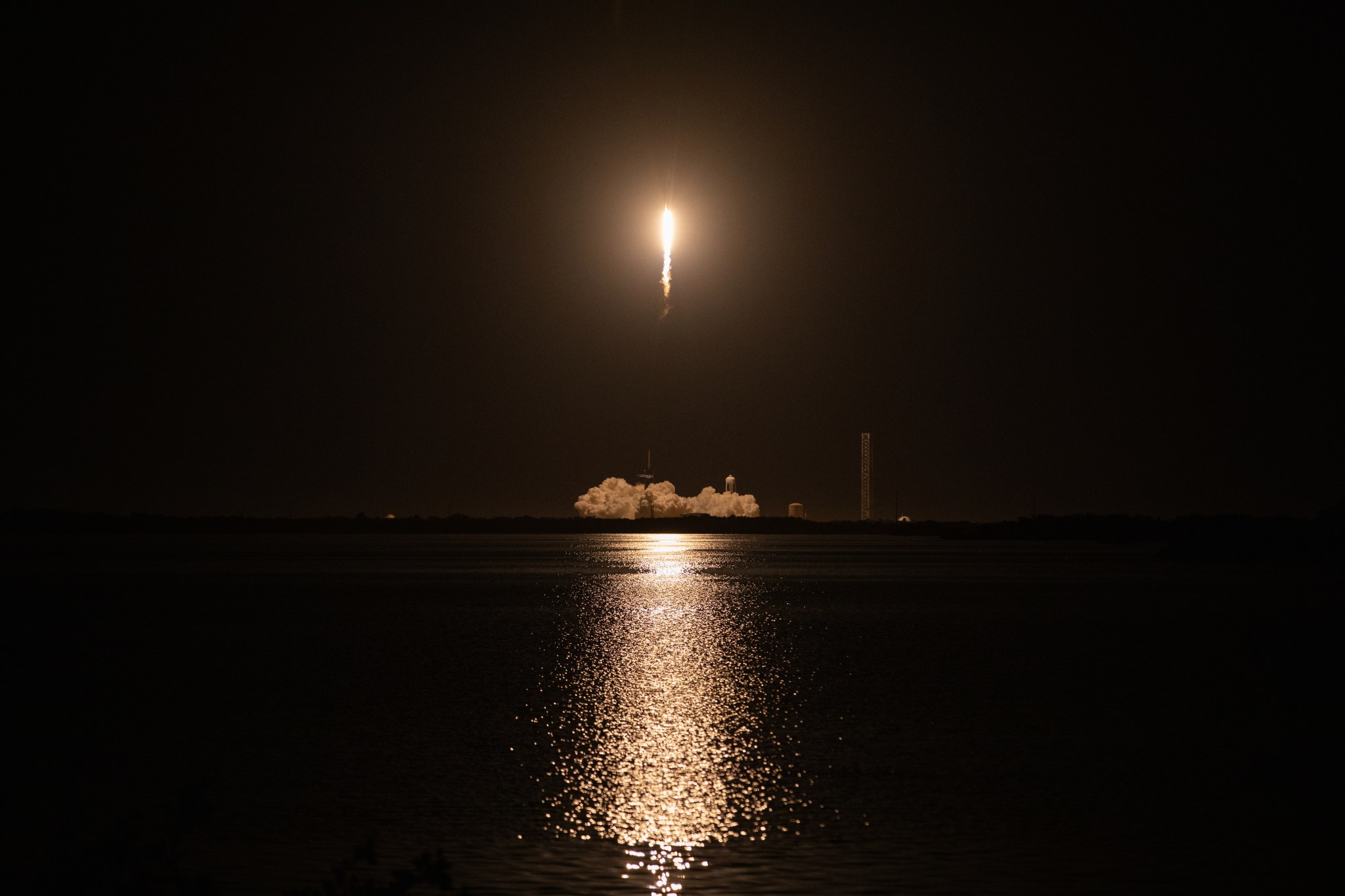
Dragon Lights Up the Night

Dragon Lights Up the Night

SpaceX's Cargo Dragon launches from Launch Complex 39A at NASA's Kennedy Space Center in Florida in its 29th commercial resupply mission. The rocket's engines are glowing brightly as it takes off through the dark night sky, and the light illuminates the water below.

In this photo from Nov. 9, 2023, a SpaceX Falcon 9 rocket illuminates the water as it launches at night from NASA’s Kennedy Space Center in Florida. The 29th commercial resupply mission of the Cargo Dragon spacecraft brought new scientific research, technology demonstrations, crew supplies, and hardware to the International Space Station, including NASA’s Integrated Laser Communications Relay Demonstration Low Earth Orbit User Modem and Amplifier Terminal (ILLUMA-T) and Atmospheric Waves Experiment (AWE).

Image Credit: NASA/Kim Shiflett

Powered by WPeMatico

Get The Details…
Michelle Zajac

NASA Associate Administrator Bob Cabana to Retire After 38 Years

NASA Associate Administrator Bob Cabana to Retire After 38 Years

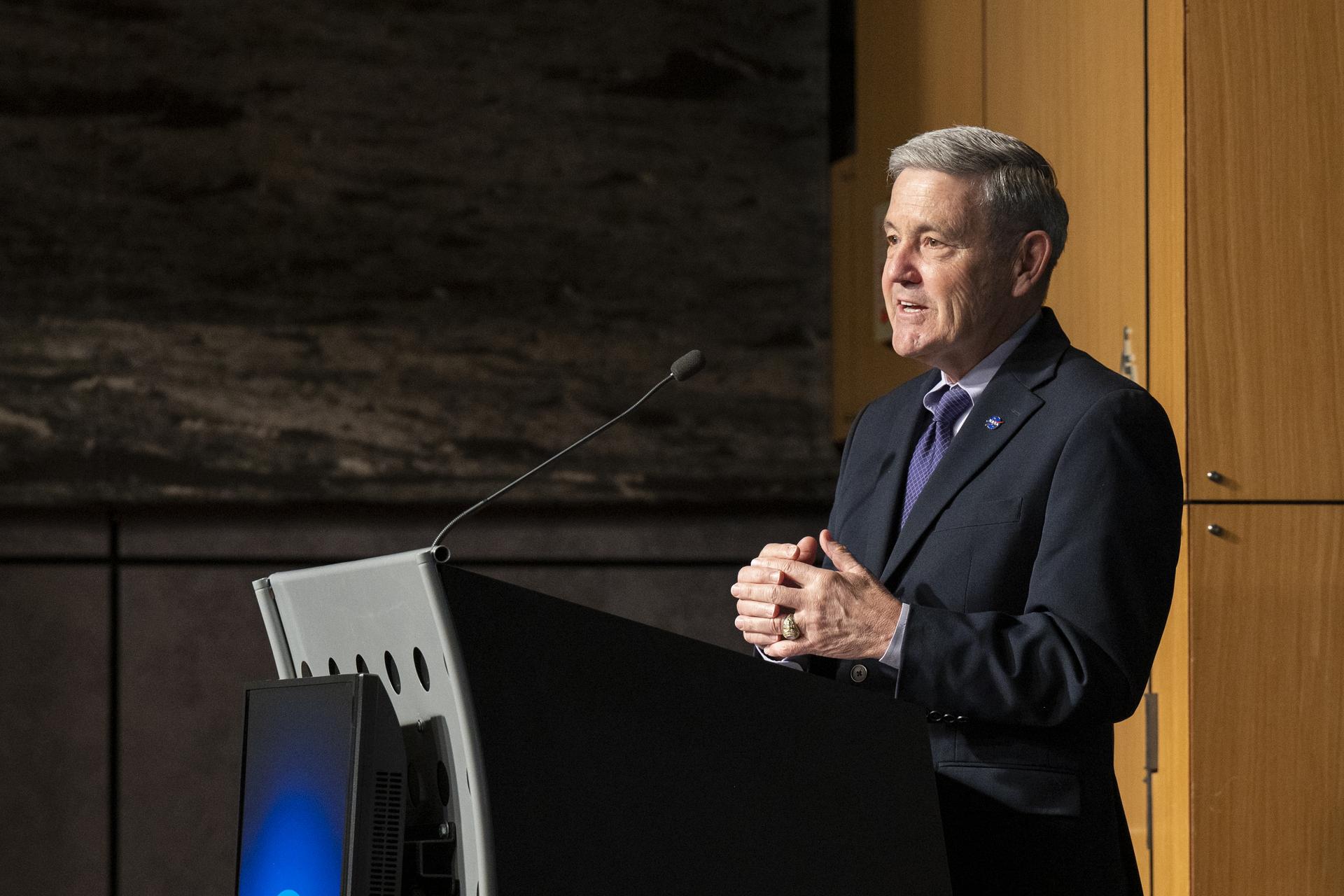
NASA Associate Administrator Bob Cabana delivers remarks during a Moon to Mars Town Hall, Thursday, May 18, 2023, at the Mary W. Jackson NASA Headquarters building in Washington.
NASA/Keegan Barber

NASA Associate Administrator and former astronaut Robert Cabana announced Monday his retirement, effective Sunday, Dec. 31 after more than 38 years of service. As associate administrator, Cabana has been the agency’s highest ranking civil servant, third highest ranking NASA official, and the senior advisor to NASA Administrator Bill Nelson and Deputy Administrator Pam Melroy.  

Among notable contributions to the nation during his NASA career that included being an astronaut, Cabana flew in space four times, including twice as commander. His final space shuttle flight was the first International Space Station assembly mission. Cabana also was the director of the agency’s Kennedy Space Center in Florida for more than a decade. There he led its transition from retirement of the space shuttle to a multi-user spaceport once again launching NASA astronauts to low Earth orbit, and for the first time, doing so with commercial partners.  

“Bob is one of the finest leaders I’ve ever known. I’ve been fortunate to know him for decades, and I couldn’t be prouder to have had such a great colleague and friend throughout the years. Bob is an example of the American grit, passion, and excellence that are woven into the fabric of our nation,” said Nelson. “Pam and I are eternally grateful for the years of service and positive influence he has had on the United States, NASA, and space exploration and wish him all the best on his upcoming retirement.”

As associate administrator, Cabana leads NASA’s 10 center directors, as well as the mission directorate associate administrators at NASA Headquarters in Washington. He is the agency’s chief operating officer for more than 18,000 employees and oversaw an annual budget of more than $25 billion.  

“Leading the exceptional people at NASA who explore the universe for the benefit of humanity has been a great honor,” said Cabana. “From flying in space to guiding teams across the agency in achieving NASA’s mission, I am grateful for an incredible career at NASA and in the space industry, and thankful for all the enriching friendships made throughout this journey. I have been blessed to be part of such an amazing team these last 38 years and serving as associate administrator alongside Bill and Pam has been a highlight.”

Cabana was selected as an astronaut candidate in June 1985 and completed training in July 1986. He logged 38 days in space during four shuttle missions. Cabana was a pilot aboard space shuttle Discovery on both the STS-41 mission in October 1990 that deployed the Ulysses spacecraft and the STS-53 mission in December 1992. He was the mission commander aboard space shuttle Columbia for the STS-65 mission in July 1994 that conducted experiments as part of the second International Microgravity Laboratory mission. He commanded space shuttle Endeavour for the STS-88 mission in December 1998.

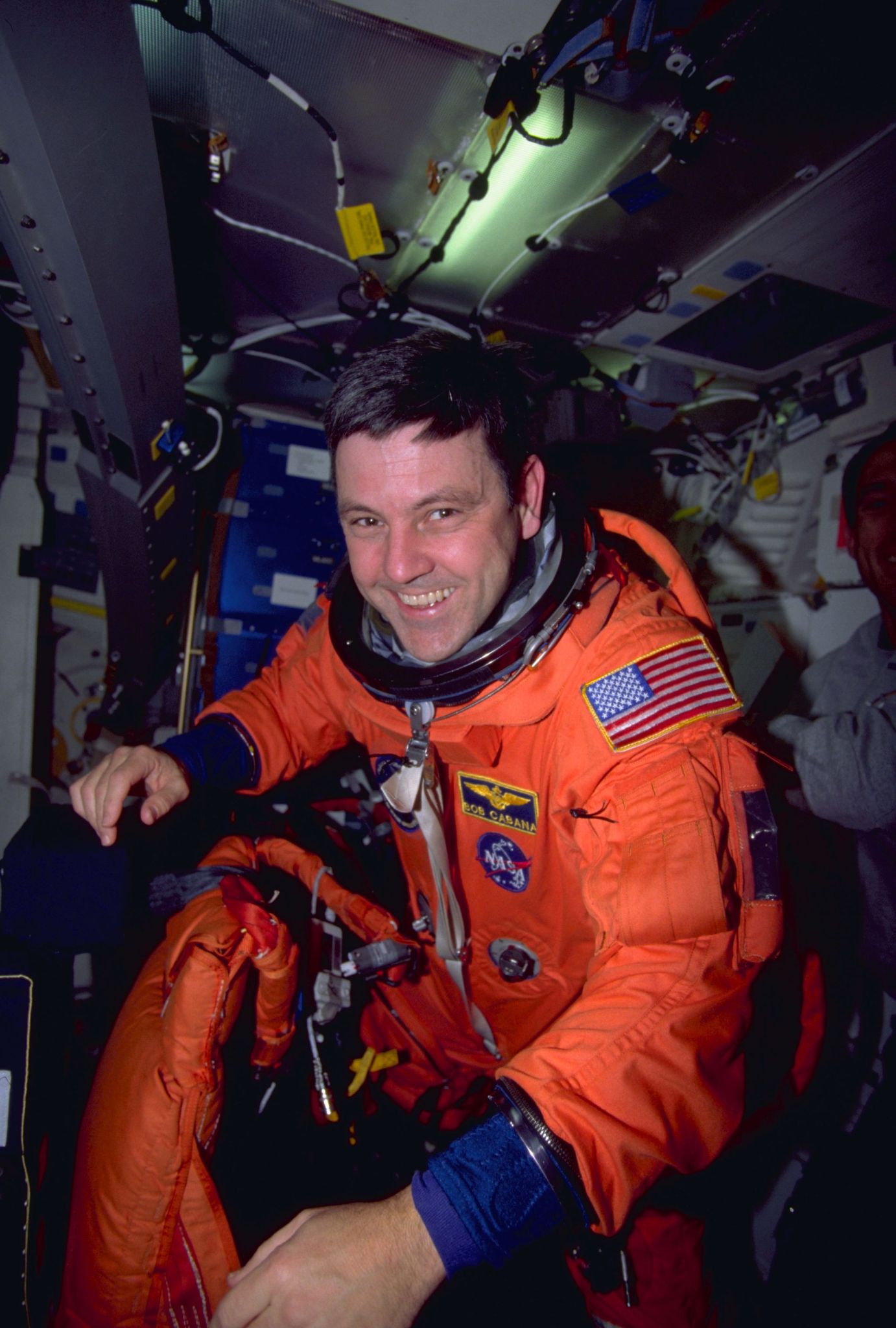
Space Shuttle Endeavour Commander Robert Cabana prepares to return to Earth following successful delivery and mating of the first American module, Unity, to the International Space Station during the STS-88 mission.

Cabana was appointed a member of the Federal Senior Executive Service in 2000 and served in numerous senior management positions at NASA’s Johnson Space Center in Houston, ultimately becoming deputy director. He was named director of NASA’s Stennis Space Center in Mississippi in October 2007 and a year later was selected as the Kennedy director. 

Born in Minneapolis, Cabana graduated from the U.S. Naval Academy in 1971 with a bachelor’s degree in mathematics. He became a naval aviator and graduated with distinction from the U.S. Naval Test Pilot School in 1981. In his career, Cabana logged over 7,000 hours in more than 50 different kinds of aircraft. He retired as a colonel from the U.S. Marine Corps in September 2000. 

Cabana’s many achievements have been recognized with induction into the Astronaut Hall of Fame and being named an Associate Fellow in the American Institute of Aeronautics and Astronautics and a Fellow in the Society of Experimental Test Pilots. He has received numerous personal awards and decorations, including the Distinguished Flying Cross and the Presidential Distinguished Rank Award. He also is a recipient of the Rotary National Award for Space Achievement’s National Space Trophy. 

For Cabana’s full bio, visit: 

https://go.nasa.gov/3u9hGB2

-end- 

Jackie McGuinness / Stephanie Schierholz
Headquarters, Washington 
202-358-1600 
jackie.mcguinness@nasa.gov / stephanie.schierholz@nasa.gov

Share

Details

Last Updated

Nov 13, 2023

Related Terms

Powered by WPeMatico

Get The Details…
Abbey A. Donaldson

Time Is Running Out to Add Your Name to NASA’s Europa Clipper

Time Is Running Out to Add Your Name to NASA’s Europa Clipper

3 min read

Time Is Running Out to Add Your Name to NASA’s Europa Clipper

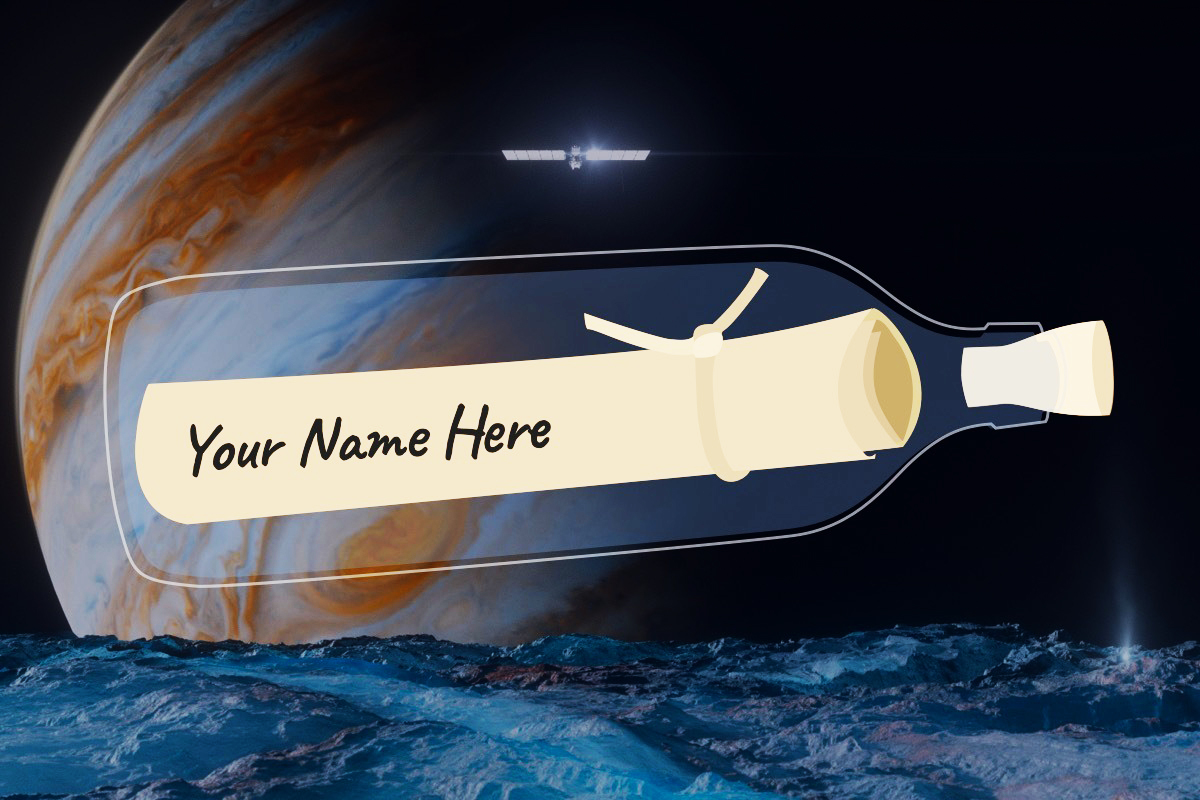
“Message in a Bottle” campaign
The “Message in a Bottle” campaign offers everyone the opportunity to have their name stenciled onto a microchip bearing U.S. Poet Laureate Ada Limón’s “In Praise of Mystery: A Poem for Europa.” The chip will ride aboard NASA’s Europa Clipper spacecraft to Jupiter and its moon Europa.
NASA/JPL-Caltech

Six weeks remain for you to add your name to a microchip that will ride aboard the spacecraft as it explores Jupiter’s moon Europa.

It’s not every day that members of the public have the chance to send their names into deep space beyond Mars, all the way to Jupiter and its moon Europa. But with NASA’s Europa Clipper, you have that opportunity: Names will ride aboard the spacecraft as it journeys 1.8 billion miles (2.6 billion kilometers) to this icy moon, where an ocean hides beneath a frozen outer shell. The deadline to join the mission’s “Message in a Bottle” campaign is only six weeks away. The campaign closes at 11:59 p.m. EST, Dec. 31, 2023.

So far, about 700,000 names have been submitted. Once all the names have been gathered, technicians in the Microdevices Laboratory at NASA’s Jet Propulsion Laboratory in Southern California will use an electron beam to stencil them onto a dime-size silicon microchip. Each line of text is smaller than 1/1000th the width of a human hair (75 nanometers).

See how your name will be stenciled onto a dime-size microchip at NASA’s Jet Propulsion Laboratory. This video takes you into the Microdevices Laboratory. Credit: NASA/JPL-Caltech

The chip will be attached to a metal plate engraved with the original poem “In Praise of Mystery,” written by U.S. Poet Laureate Ada Limón to celebrate the mission. Riding on the exterior of the spacecraft, the poem and names will be like a message in a bottle as they make about 50 close flybys of the ocean world.

The mission will log a half-billion miles (800 million kilometers) during these orbits as the spacecraft’s payload of science instruments gathers data on Europa’s subsurface ocean, icy crust, and atmosphere to determine if the moon could support life.

Once assembly of Europa Clipper has been completed at JPL, the orbiter will be shipped to NASA’s Kennedy Space Center in Florida in preparation for its October 2024 launch.

“Message in a Bottle” draws from NASA’s long tradition of shipping inspirational messages on spacecraft that have explored our solar system and beyond. The program aims to spark the imaginations of people around the world as the Voyager spacecraft did in 1977 by sending a time capsule of sounds and images reflecting the diversity of life on Earth.

To sign, read the poem, and hear Limón recite it in an animated video, go to:

https://go.nasa.gov/MessageInABottle

The site also enables participants to create and download a customizable souvenir – an illustration of your name on a message in a bottle against a rendering of Europa and Jupiter – to commemorate the experience. Participants are encouraged to share their enthusiasm on social media using the hashtag #SendYourName.

More About the Mission

Europa Clipper’s main science goal is to determine whether there are places below Jupiter’s icy moon, Europa, that could support life. The mission’s three main science objectives are to determine the thickness of the moon’s icy shell and its surface interactions with the ocean below, to investigate its composition, and to characterize its geology. The mission’s detailed exploration of Europa will help scientists better understand the astrobiological potential for habitable worlds beyond our planet.

Find more information about Europa here:

europa.nasa.gov

News Media Contacts

Gretchen McCartney
Jet Propulsion Laboratory, Pasadena, Calif.
818-393-6215
gretchen.p.mccartney@jpl.nasa.gov

Karen Fox / Alana Johnson
NASA Headquarters, Washington
301-286-6284 / 202-358-1501
karen.c.fox@nasa.gov / alana.r.johnson@nasa.gov

2023-166

Share

Details

Last Updated

Nov 13, 2023

Powered by WPeMatico

Get The Details…
Anthony Greicius

NASA’s Launch Services Program Selects New Launch Director

NASA’s Launch Services Program Selects New Launch Director

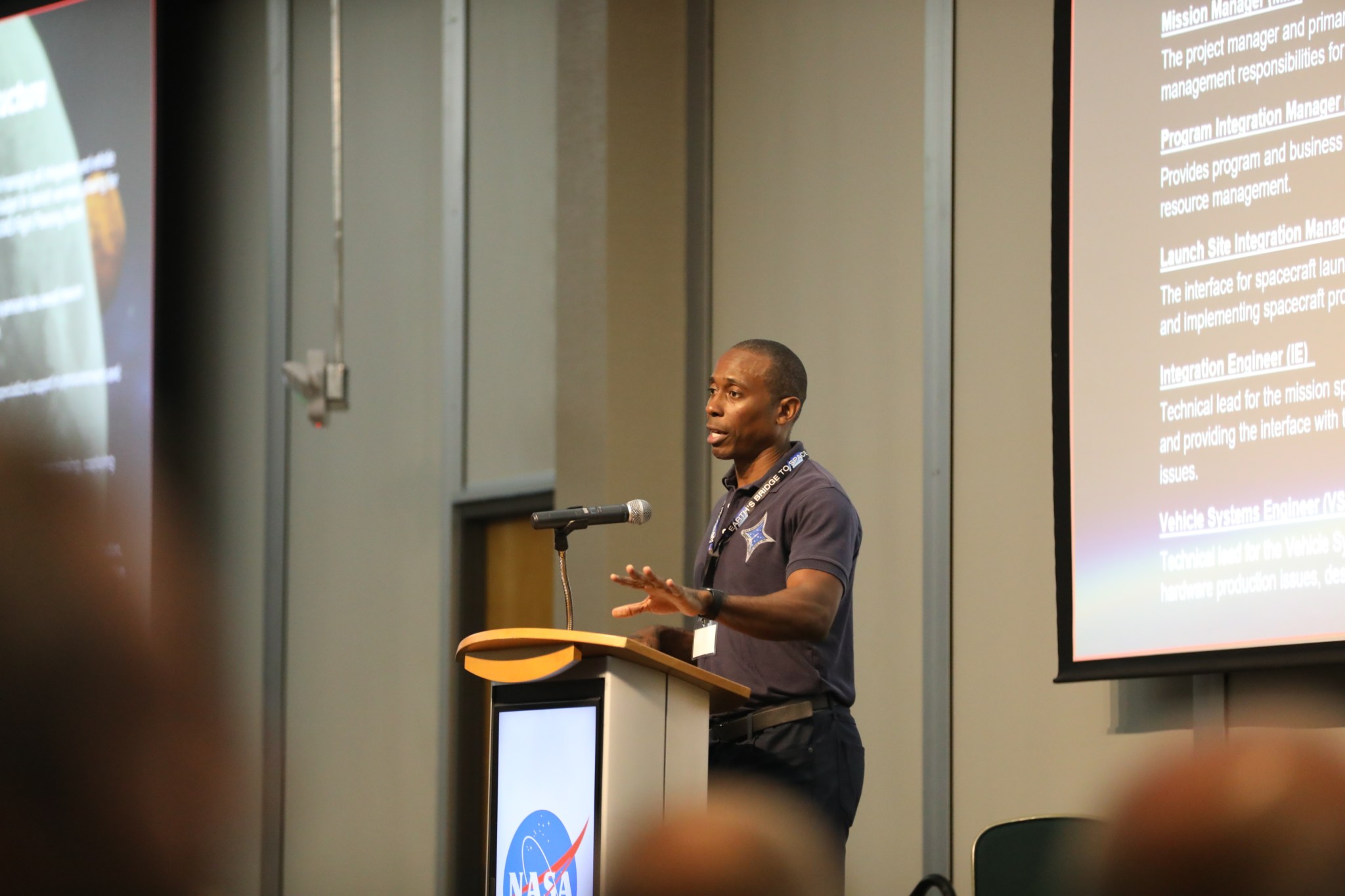
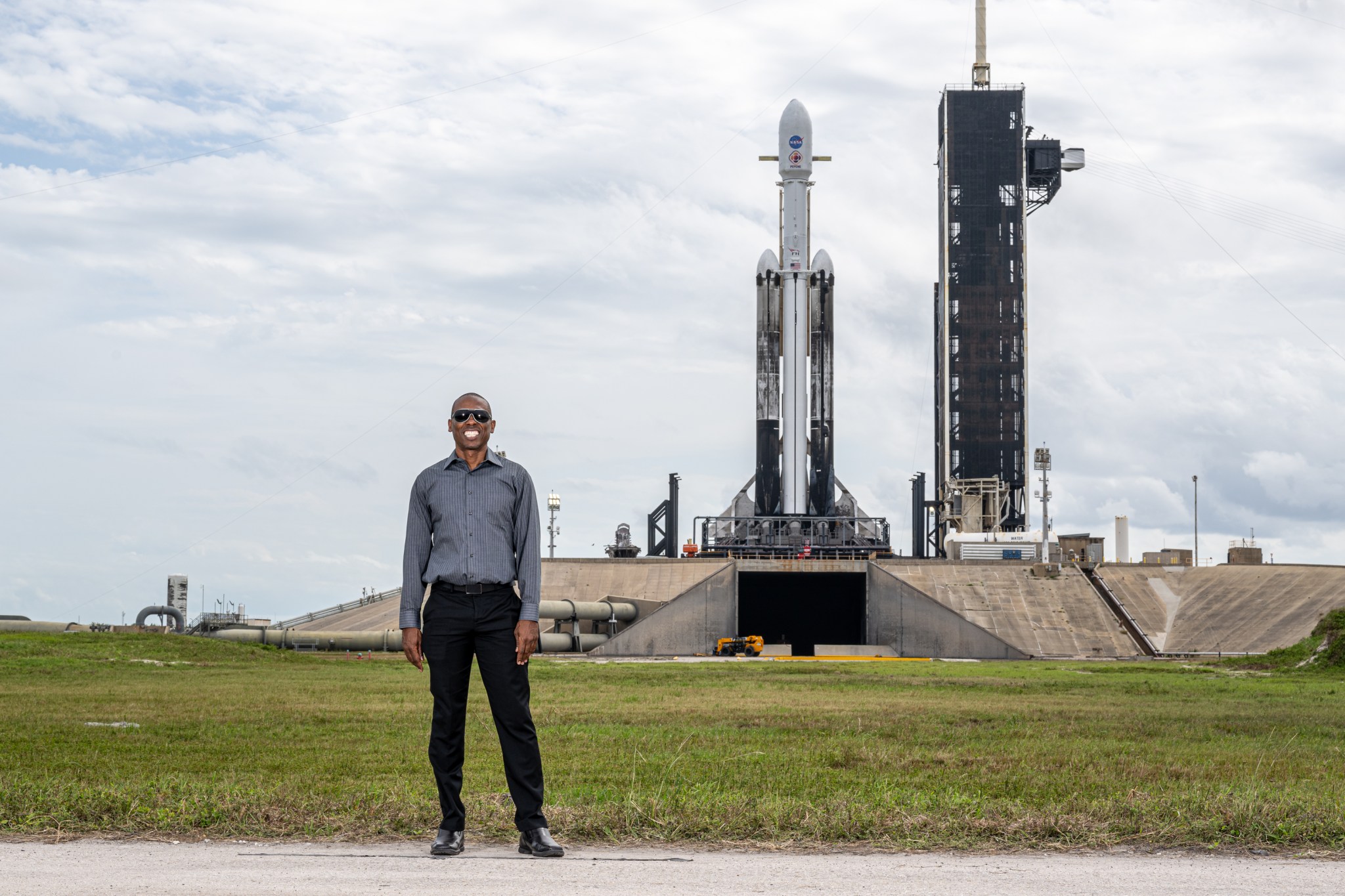
Launch Services Program Launch Director Denton Gibson at NASA's Kennedy Space Center
Denton Gibson, who began his career at Kennedy Space Center in Florida in 2004, has been named a launch director for NASA’s Launch Services Program.
NASA

NASA has named Denton Gibson launch director for the Launch Services Program at NASA’s Kennedy Space Center in Florida. Gibson fills a position made available with the recent retirement of former senior Launch Director Omar Baez. Denton will join senior Launch Director Tim Dunn in leading launch activities for NASA’s science and robotic missions. This team is responsible for planning, implementing, and directing launch campaigns for NASA-managed launch vehicle services.

“The Launch Services Program is looking forward to having Denton in his new role as launch director,” Amanda Mitskevich, program manager of the Launch Services Program said. “He has contributed his talents in several technical and programmatic areas for NASA and now his experience will culminate in leading the team that will be launching some of NASA’s most important and valuable missions.  He’s going to be great at it!”

Gibson began his career at Kennedy with NASA’s Launch Services Program in 2004, most recently serving as a senior mission manager. His experience involved serving as the primary interface between the program and customers from other NASA centers, federal agencies, federally funded science organizations, as well as international partners.

NASA Launch Services Program Launch Director Denton Gibson
Launch Services Program Launch Director Denton Gibson stands in front of the Psyche mission satellite, atop a SpaceX Falcon Heavy rocket, at Kennedy Space Center in Florida in Oct. 2023.
NASA

“As a launch director, the responsibility for the entire mission falls to you when you give the final ‘go’ for launch,” Gibson said. “However, our meticulous preparations that begin years before the rocket is on the pad, and the amazing team we have, instill that confidence to say NASA is ready to launch.”

Previous roles with the program have helped prepare Gibson for his new responsibilities. As a senior vehicle systems engineer discipline expert, Gibson led the program’s engineering team and was responsible for oversight and insight of a mixed fleet of commercial rockets. He expanded his leadership skills and industry experience during a detail assignment in 2016 to the U.S. Senate’s Space, Science, and Competitiveness Subcommittee staff working on U.S. space policy.

Gibson earned a Bachelor of Science in electrical engineering from the University of Florida in Gainesville. He received a master’s in industrial engineering in 2006 from the University of Miami and a doctorate in systems engineering in 2019 from the University of Central Florida in Orlando.

“Denton has accumulated knowledge of launch operations from his years of working advanced planning through integration, systems analysis, and launch” Dunn said. “His ability to ensure the readiness of spacecraft and rockets, as well as handling unique mission challenges that pop up, make him ready to lead the team on launch day.”

Dunn and Gibson will be sharing the responsibilities for launching missions in 2024, including NASA’s PACE (Plankton, Aerosol, Cloud ocean Ecosystem); GOES-U, NOAA’s latest generation of Geostationary Operational Environmental Satellites; and NASA’s Europa Clipper, which will explore Jupiter’s icy moon and determine if it harbors conditions suitable for life. Gibson was born in Nassau, Bahamas, but considers Miami, Florida, where he grew up, to be his hometown.

When Denton is not planning, implementing, and directing launch campaigns he enjoys building cars, scuba diving, working out and spending time with his daughter Phenix. He also is a professional salsa dancer, instructor, and choreographer.

Powered by WPeMatico

Get The Details…
Jim Cawley