More Space Biology, Lab Upkeep Day Before Thanksgiving

More Space Biology, Lab Upkeep Day Before Thanksgiving

Four Expedition 70 crewmates wish a Happy Thanksgiving from the International Space Station to the Earth below.
Four Expedition 70 crewmates wish a Happy Thanksgiving from the International Space Station to the Earth below. Watch the video on YouTube. Credit: NASA TV

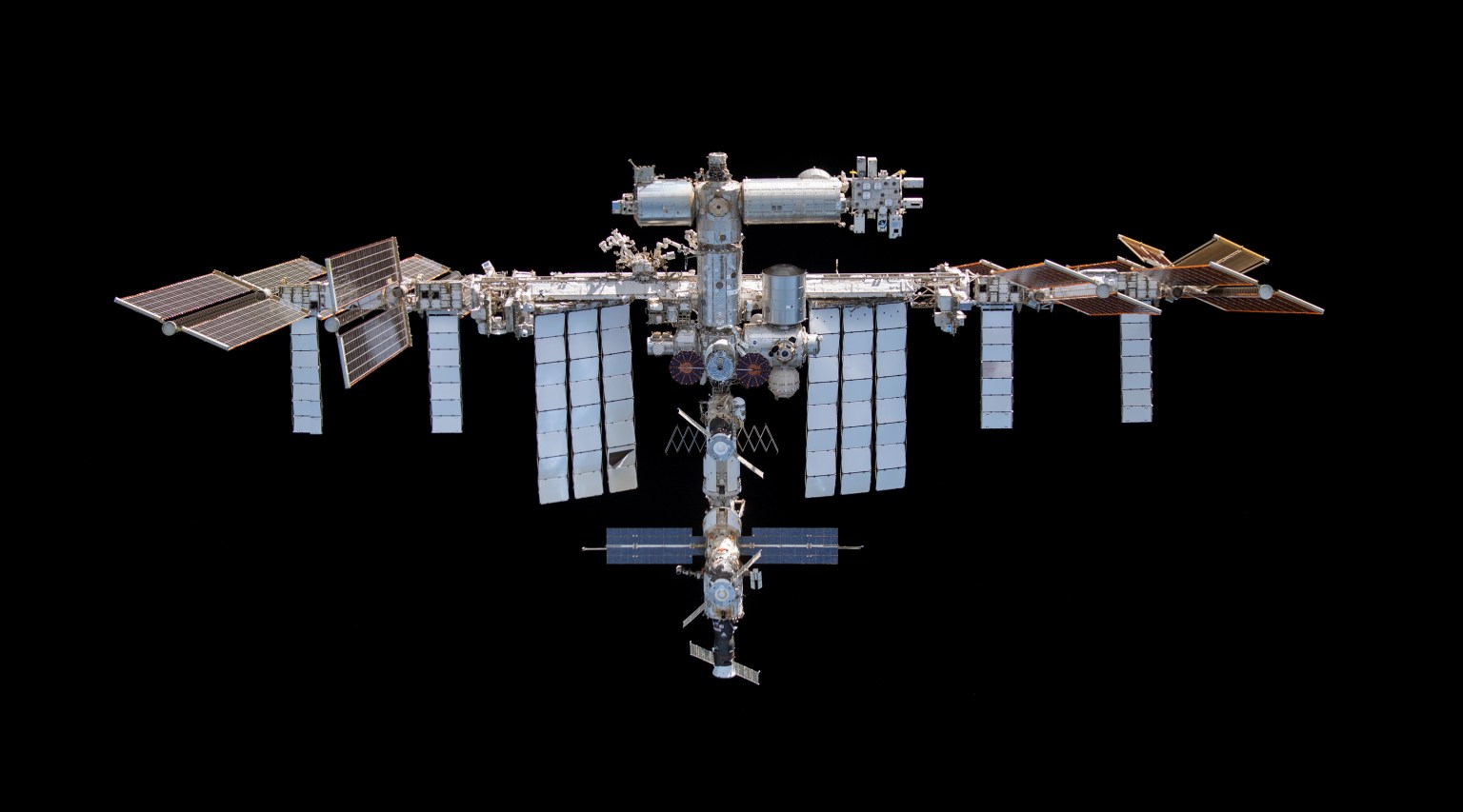
All seven members of the Expedition 70 crew spent Wednesday continuing its space biology research and maintaining the upkeep of the International Space Station. The orbital septet will also observe the Thanksgiving holiday and share a traditional turkey meal aboard the space laboratory.

Astronauts Jasmin Moghbeli, Satoshi Furukawa, and Andreas Mogensen kicked off the day with a periodic health evaluation checking each other’s temperature, blood pressure, pulse, and respiratory rate. The trio also took turns using an otoscope examining their ear canals and eardrums. Doctors are constantly monitoring how living and working in microgravity affects an astronaut’s health.

Afterward, NASA’s Moghbeli processed liver stem samples inside the Life Science Glovebox for the Space AGE investigation exploring regenerative medicine technology. Furukawa from JAXA (Japan Aerospace Exploration Agency) worked in the Kibo laboratory module’s airlock removing lithium-ion batteries and installing research gear to be exposed to the space environment. Mogensen from ESA (European Space Agency) wore a specialized vest filled with sensors monitoring his heart and breathing for the Cardiobreath blood pressure study.

NASA astronaut Loral O’Hara performed orbital plumbing tasks in both the station’s Tranquility module and the SpaceX Dragon Endurance spacecraft. She then filmed a video for students on Earth demonstrating how to use a microscope in the microgravity environment of the space station.

In the orbiting lab’s Roscosmos segment, five-time station visitor and cosmonaut Oleg Kononenko swapped out life support and electronics gear. He also joined cosmonaut Nikolai Chub and tested communications with the Progress 84 cargo craft that is due to undock from the Poisk module and depart at the end of the month. Chub also partnered with Flight Engineer Konstantin Borisov for abdomen scans using an ultrasound device after breakfast to learn how microgravity affects the digestive system. Borisov later worked on ventilation systems in the Rassvet module.

On Thursday, the entire seven-member crew will take the day off, relax, and enjoy a hearty meal. The seven crewmates from three countries are due to enjoy a Thanksgiving feast with items such as turkey, duck, quail, seafood, and cranberry sauce. Treats awaiting the crew include chocolate, pumpkin spice cappuccino, rice cake, and mochi. Crew preference is also considered when planning festive meals in space.


Learn more about station activities by following the space station blog@space_station and @ISS_Research on X, as well as the ISS Facebook and ISS Instagram accounts.

Get weekly video highlights at: https://roundupreads.jsc.nasa.gov/videoupdate/

Get the latest from NASA delivered every week. Subscribe here: www.nasa.gov/subscribe

Powered by WPeMatico

Get The Details…

Mark Garcia

Thanksgiving Celebrations in Space

Thanksgiving Celebrations in Space

The Thanksgiving holiday typically brings families and friends together in a celebration of common gratitude for all the good things that have happened during the previous year. People celebrate the holiday in various ways, with parades, football marathons, and attending religious services, but food remains the over-arching theme. For astronauts embarked on long-duration space missions, separation from family and friends is inevitable and they rely on fellow crew members to share in the tradition and enjoy the culinary traditions as much as possible. In this most unusual of years when the pandemic may alter typical Thanksgiving gatherings, it seems appropriate to review how astronauts over the years have celebrated the holiday during their time in space. Enjoy the stories and photographs from orbital Thanksgiving celebrations over the years.
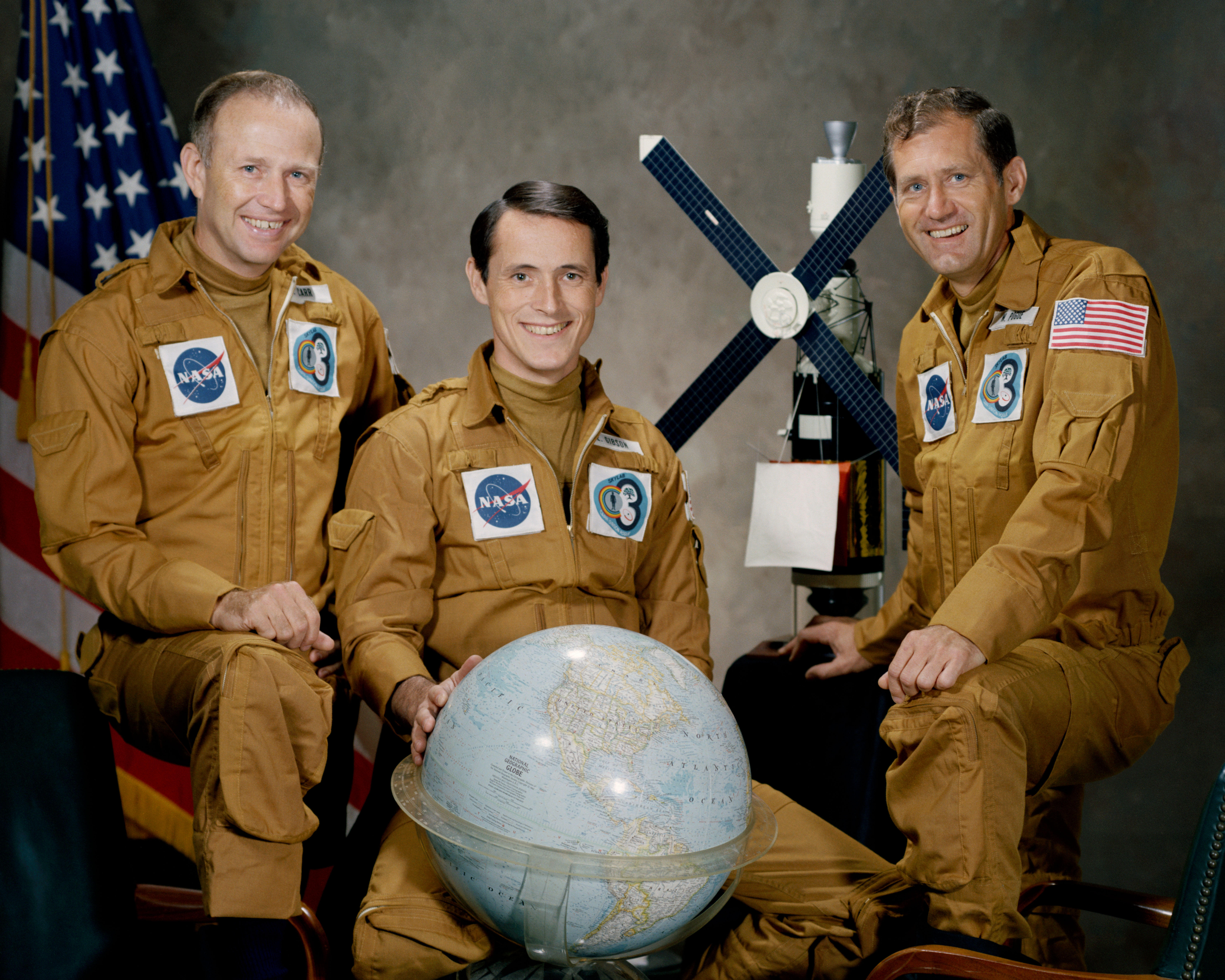
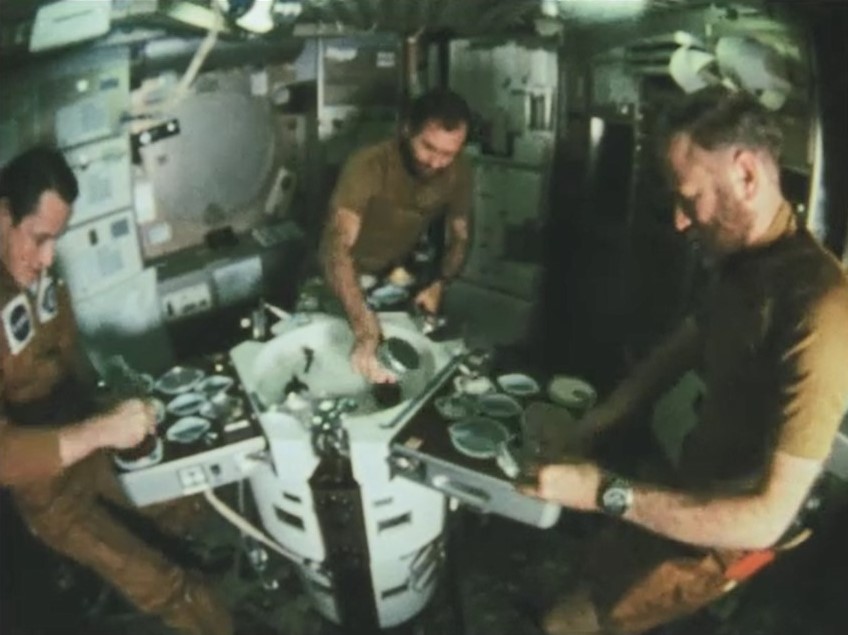
Skylab 4 astronauts Gerald P. Carr, Edward G. Gibson, and William R. Pogue Gibson, Pogue, and Carr demonstrate eating aboard Skylab
Thanksgiving 1973. Left: Skylab 4 astronauts Gerald P. Carr, Edward G. Gibson, and William R. Pogue, the first crew to celebrate Thanksgiving in space. Right: Gibson, left, Pogue, and Carr demonstrate eating aboard Skylab.

Skylab 4 astronauts Gerald P. Carr, Edward G. Gibson, and William R. Pogue were the first crew to celebrate Thanksgiving in space on Nov. 22, 1973. On that day, their seventh of an 84-day mission, Gibson and Pogue completed a 6-hour and 33-minute spacewalk, while Carr remained in the Multiple Docking Adaptor with no access to food. All three made up for missing lunch by consuming two meals at dinner time, although neither included special items for Thanksgiving.
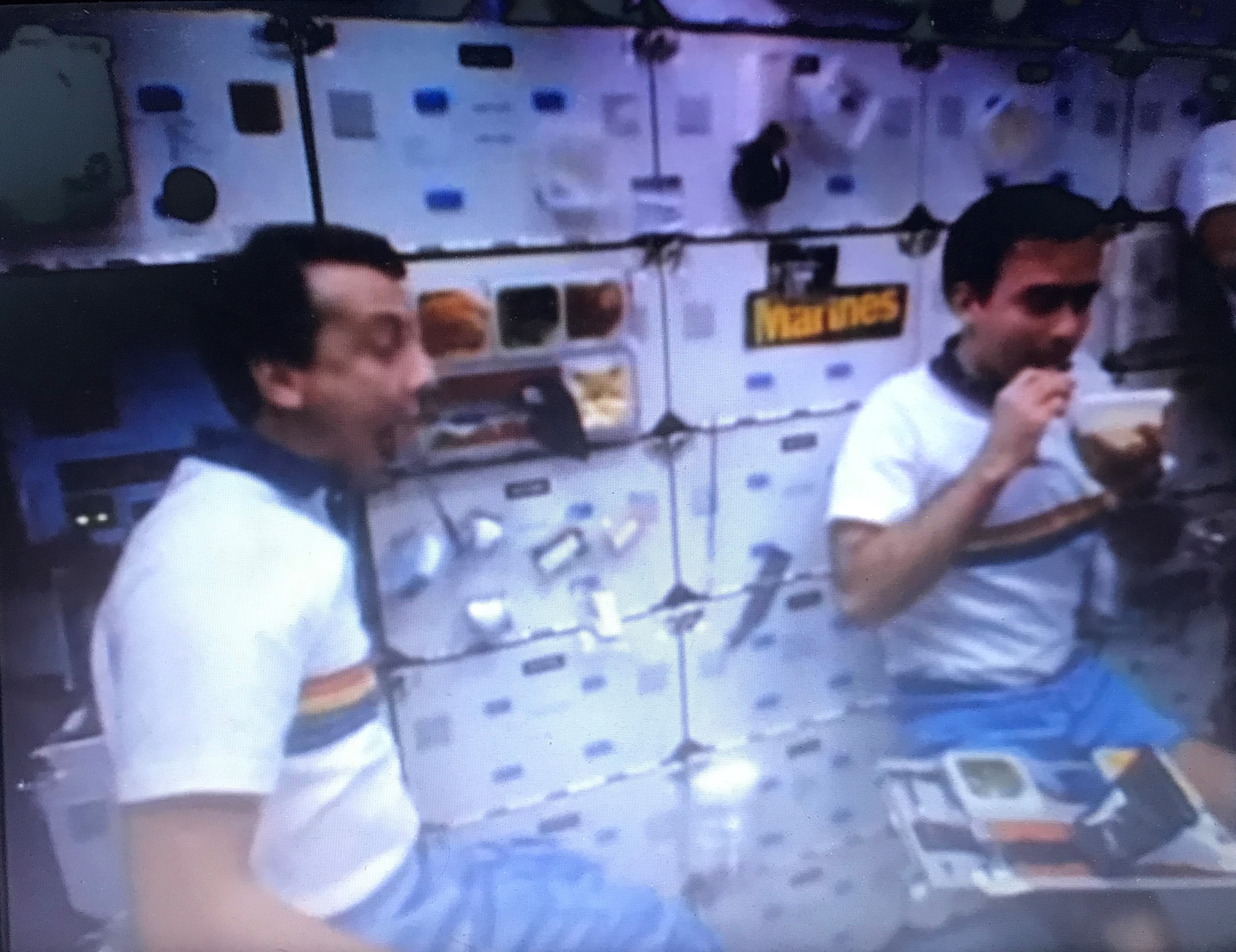
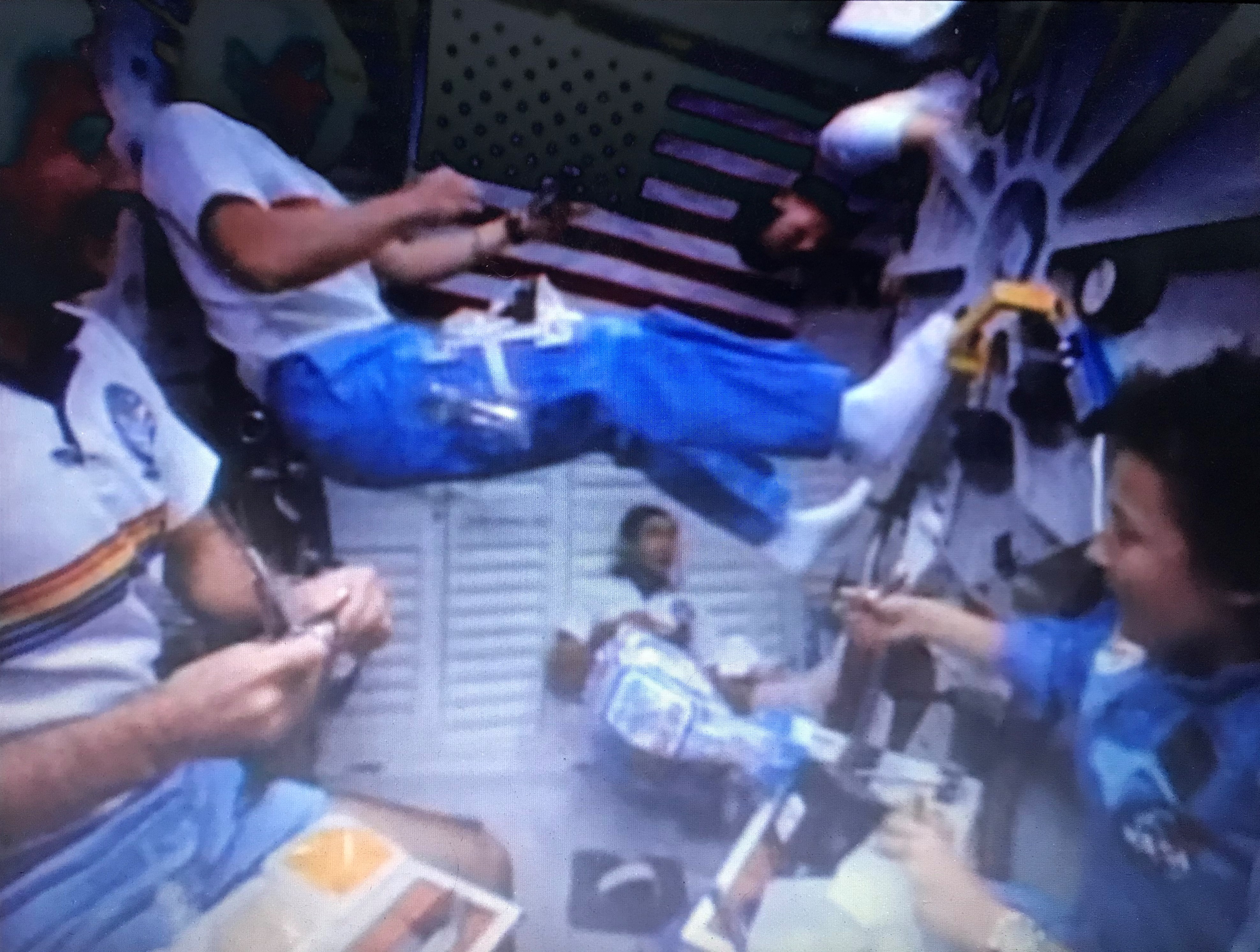
STS-61B payload specialists Charles D. Walker and Rodolfo Neri Vela of Mexico enjoy the first Thanksgiving aboard a space shuttle in Atlantis’ middeck Image of the STS-61B crew enjoying their Thanksgiving dinner while floating in Atlantis’ middeck Mexican payload specialist Neri Vela
Thanksgiving 1985. Left: STS-61B payload specialists Charles D. Walker, left, and Rodolfo Neri Vela of Mexico enjoy the first Thanksgiving aboard a space shuttle in Atlantis’ middeck. Middle: The STS-61B crew enjoying their Thanksgiving dinner while floating in Atlantis’ middeck. Right: Mexican payload specialist Neri Vela, who introduced tortillas to space menus.

Twelve years passed before the next orbital Thanksgiving celebration. On Nov. 28, 1985, the seven-member crew of STS-61B, NASA astronauts Brewster H. Shaw, Bryan D. O’Connor, Jerry L. Ross, Mary L. Cleave, and Sherwood C. “Woody” Spring, and payload specialists Charles D. Walker from the United States and Rodolfo Neri Vela from Mexico, feasted on shrimp cocktail, irradiated turkey, and cranberry sauce aboard the space shuttle Atlantis. Neri Vela introduced tortillas to space menus, and they have remained favorites among astronauts ever since. Unlike regular bread, tortillas do not create crumbs, a potential hazard in weightlessness, and have multiple uses for any meal of the day. The crew of STS-33, NASA astronauts Frederick D. Gregory, John E. Blaha, Manley L. “Sonny” Carter, F. Story Musgrave, and Kathryn C. Thornton, celebrated Thanksgiving aboard space shuttle Discovery in 1989. Gregory and Musgrave celebrated their second Thanksgiving in space two years later, joined by fellow STS-44 NASA astronauts Terrence T. “Tom” Henricks, James S. Voss, Mario Runco, and Thomas J. Hennen aboard space shuttle Atlantis.
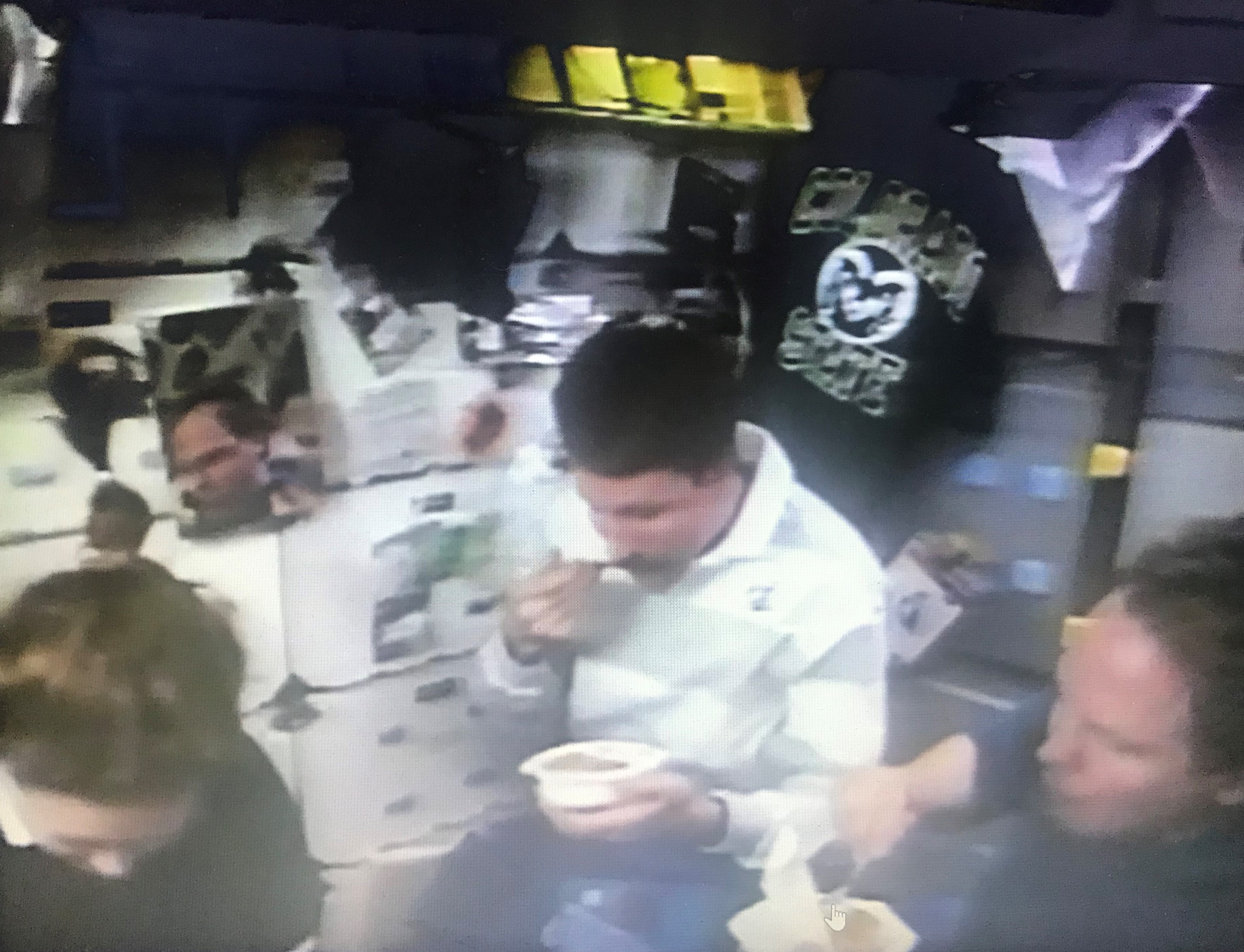
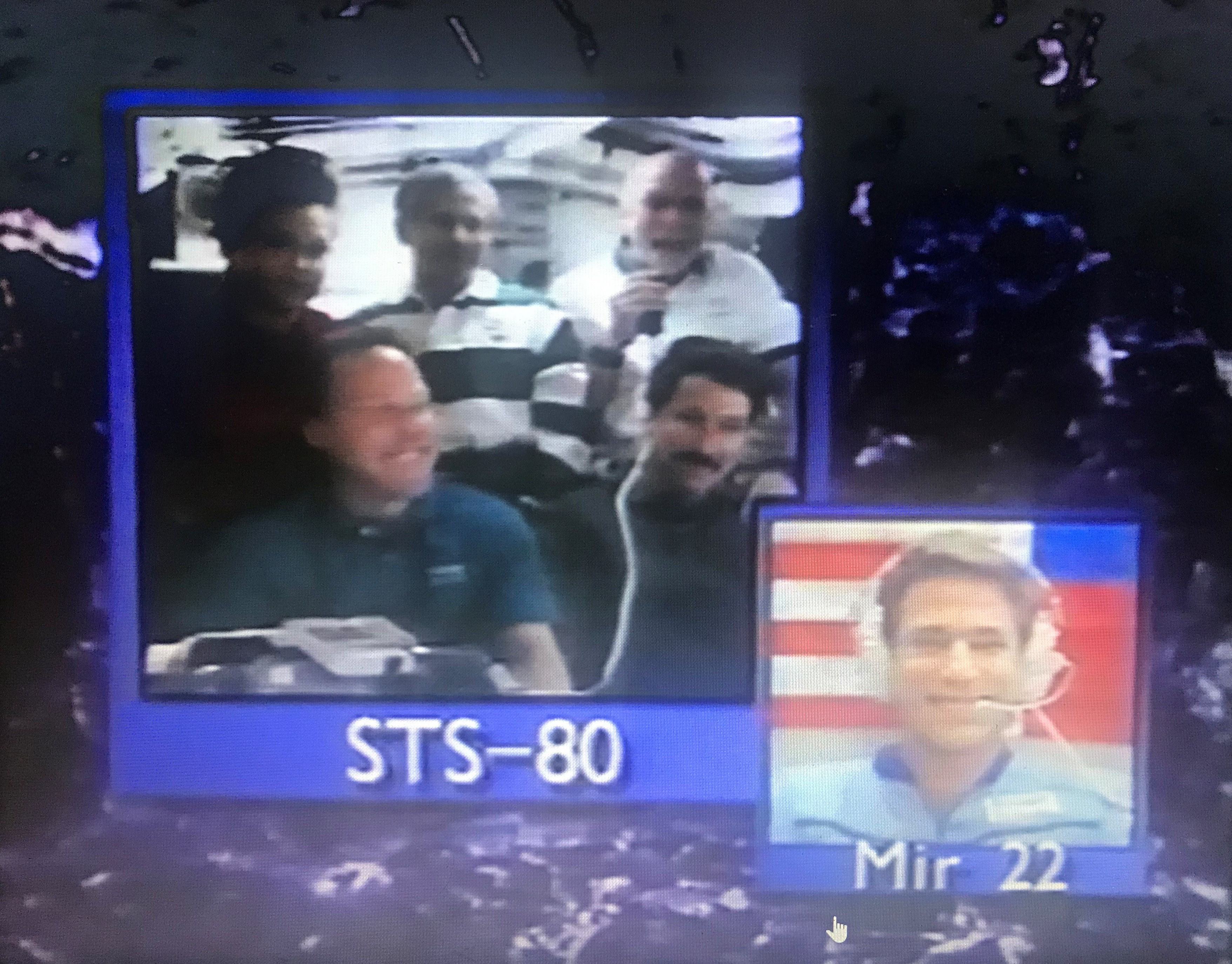
STS-80 astronauts Tamara E. Jernigan, left, Kent V. Rominger, and Thomas D. Jones enjoy Thanksgiving dinner in Columbia’s middeck The STS-80 crew during aboard Columbia exchanging Thanksgiving greetings with John E. Blaha aboard the Mir space station
Thanksgiving 1996. Left: STS-80 astronauts Tamara E. Jernigan, left, Kent V. Rominger, and Thomas D. Jones enjoy Thanksgiving dinner in Columbia’s middeck. Right: The STS-80 crew during aboard Columbia exchanging Thanksgiving greetings with John E. Blaha aboard the Mir space station.

In 1996, Blaha celebrated his second Thanksgiving in space with Russian cosmonauts Valeri G. Korzun and Aleksandr Y. Kaleri aboard the space station Mir. Blaha watched the beautiful Earth through the Mir windows rather than his usual viewing fare of football. The STS-80 crew of NASA astronauts Kenneth D. Cockrell, Kent V. Rominger, Tamara E. Jernigan, Thomas D. Jones, and Musgrave, now on his third turkey day holiday in orbit, celebrated Thanksgiving aboard space shuttle Columbia. Although the eight crew members were in different spacecraft in different orbits, they exchanged holiday greetings via space-to-space radio. This marked the largest number of people in space on Thanksgiving Day up to that time. One year later, NASA astronaut David A. Wolf celebrated Thanksgiving with his Russian crewmates Anatoli Y. Solovev, who translated the holiday into Russian as den blagodarenia, and Pavel V. Vinogradov aboard Mir. They enjoyed smoked turkey, freeze-dried mashed potatoes, peas, and milk. Also in orbit at the time was the crew of STS-87, NASA astronauts Kevin R. Kregel, Steven W. Lindsey, Kalpana Chawla, and Winston E. Scott, Takao Doi of the Japan Aerospace Exploration Agency, and Leonid K. Kadenyuk of Ukraine, aboard Columbia. The nine crew members aboard the two spacecraft broke the one-year-old record for the largest number of people in space at one time for Thanksgiving, also setting the record for the most nations represented, four.
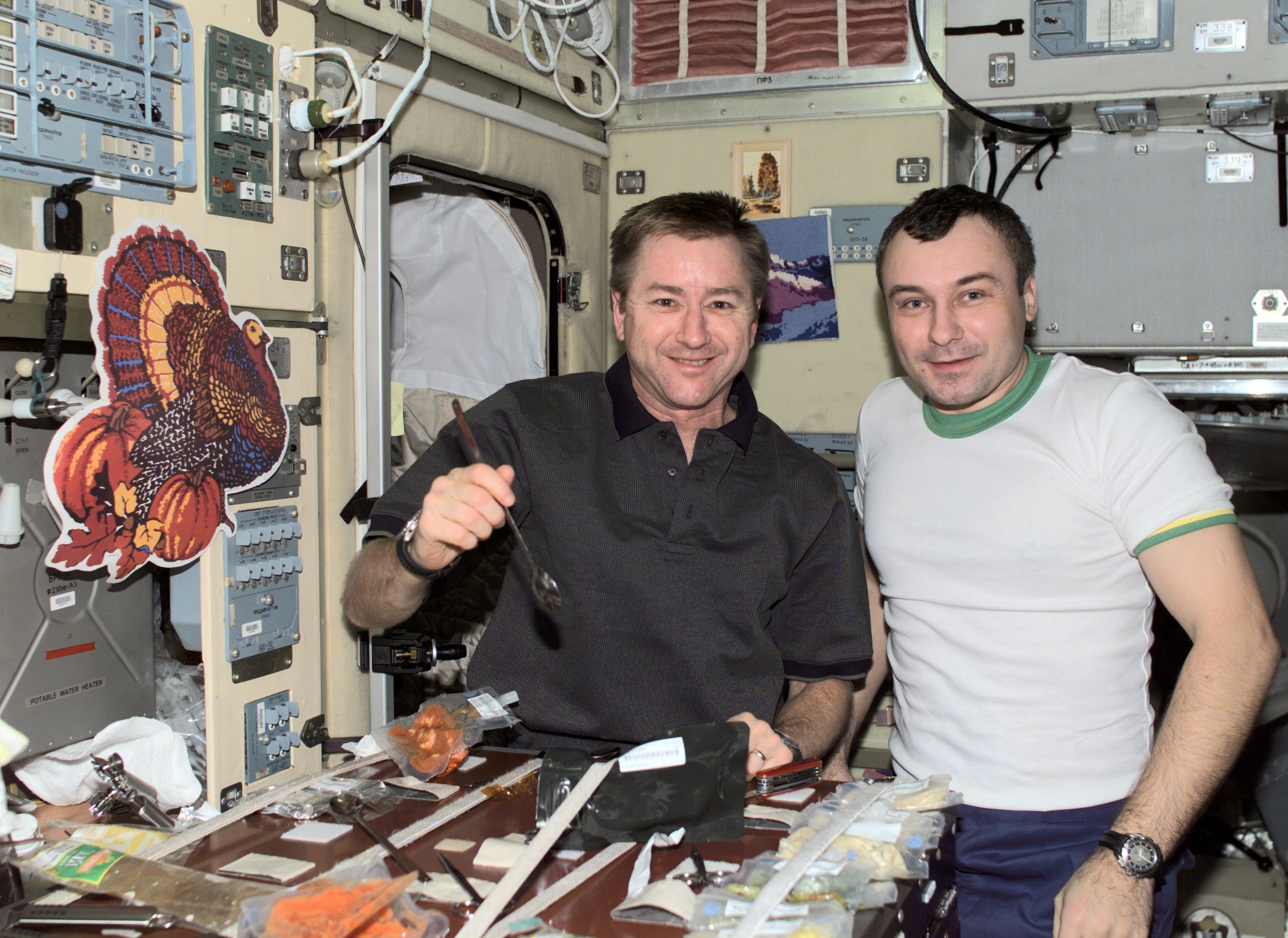
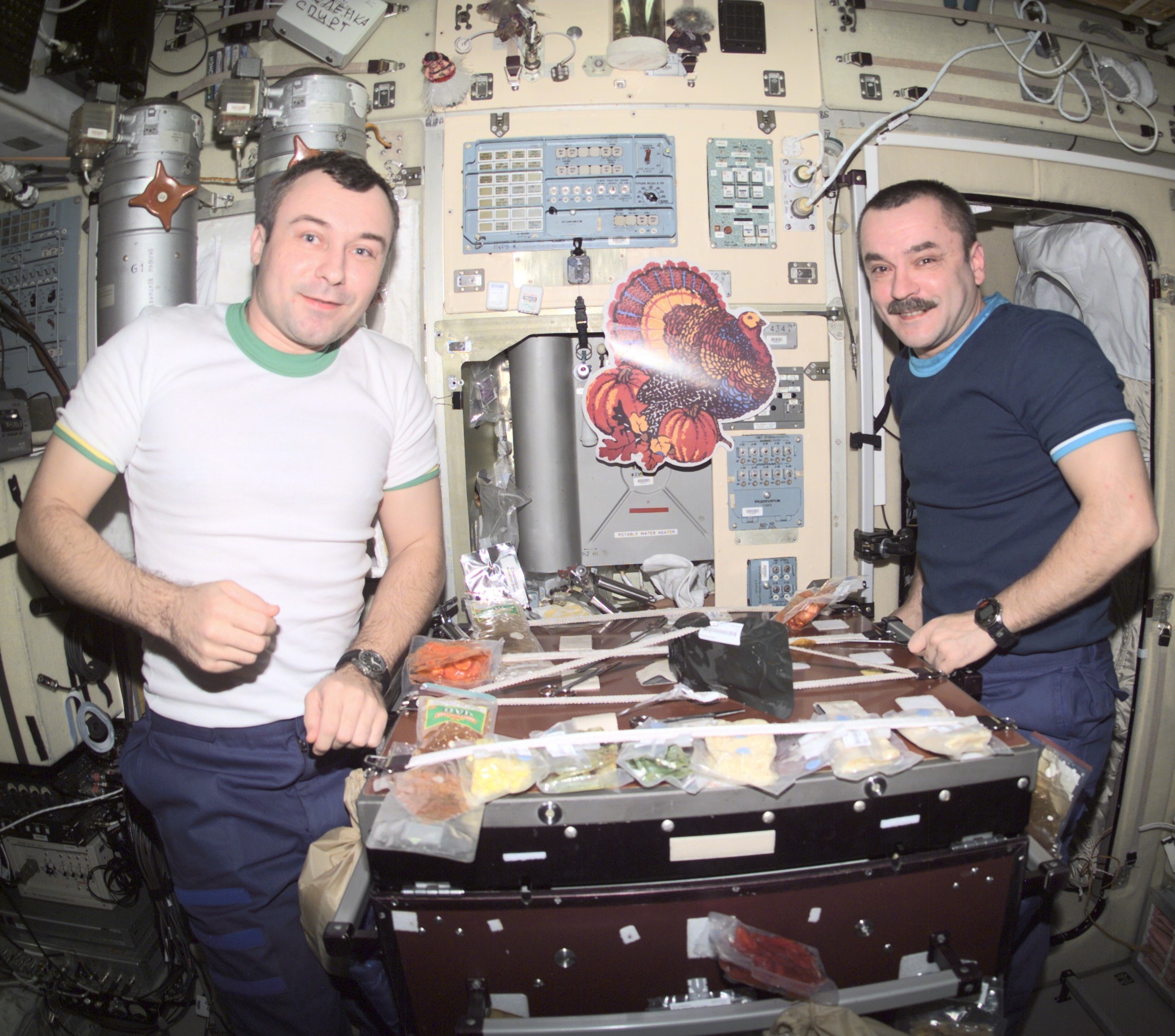
NASA astronaut Frank L. Culbertson, left, and Vladimir N. Dezhurov of Roscosmos Dezhurov and Mikhail V. Tyurin of Roscosmos Mikhail V. Tyurin and Frank L. Culbertson
Thanksgiving 2001, Expedition 3 crewmembers enjoying Thanksgiving dinner aboard the space station. Left: NASA astronaut Frank L. Culbertson, left, and Vladimir N. Dezhurov of Roscosmos. Middle: Dezhurov, left, and Mikhail V. Tyurin of Roscosmos. Right: Tyurin, left, and Culbertson.

The Expedition 1 crew of NASA astronaut William M. Shepherd, and Yuri P. Gidzenko and Sergei K. Krikalev of Roscosmos celebrated the first Thanksgiving aboard the International Space Station on Nov. 23, 2000, three weeks after their arrival aboard the facility. The crew took time out of their busy schedule to enjoy ham and smoked turkey and send words of thanks to people on the ground who provided excellent support to their flight. Crews have celebrated Thanksgiving in space every November since then. In 2001, Expedition 3 crew members NASA astronaut Frank L. Culbertson, and Vladimir N. Dezhurov and Mikhail V. Tyurin of Roscosmos enjoyed the first real Thanksgiving aboard the space station, complete with a cardboard turkey as decoration. The following year’s orbital Thanksgiving celebration included the largest number of people to that time, the combined 10 crewmembers of Expedition 5, STS-113, and Expedition 6.  After a busy day that included the first Thanksgiving Day spacewalk aboard the space station, the crews settled down to a dinner of smoked turkey, mashed potatoes, and green beans with mushrooms. Blueberry-cherry cobbler rounded out the meal.
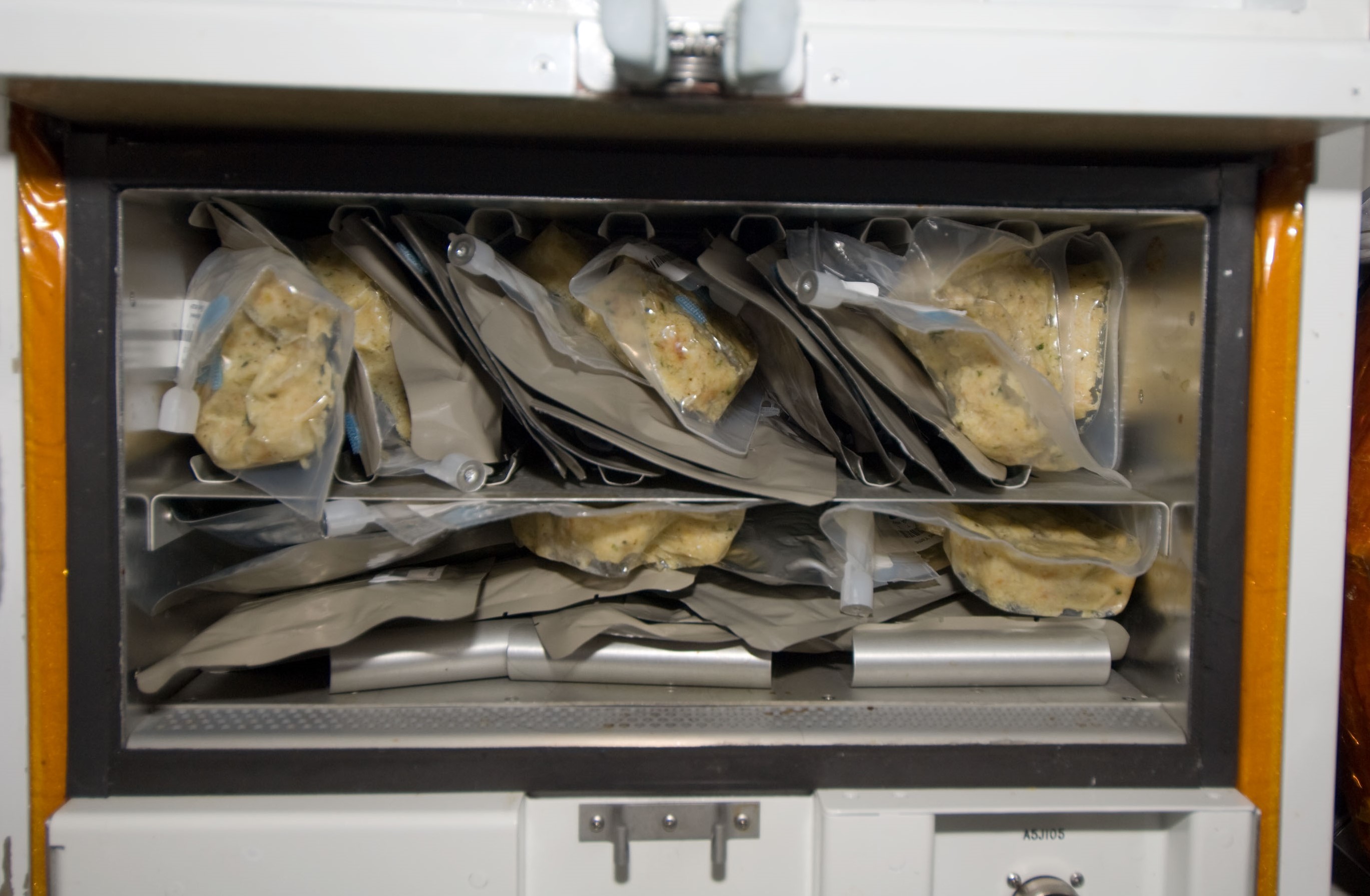
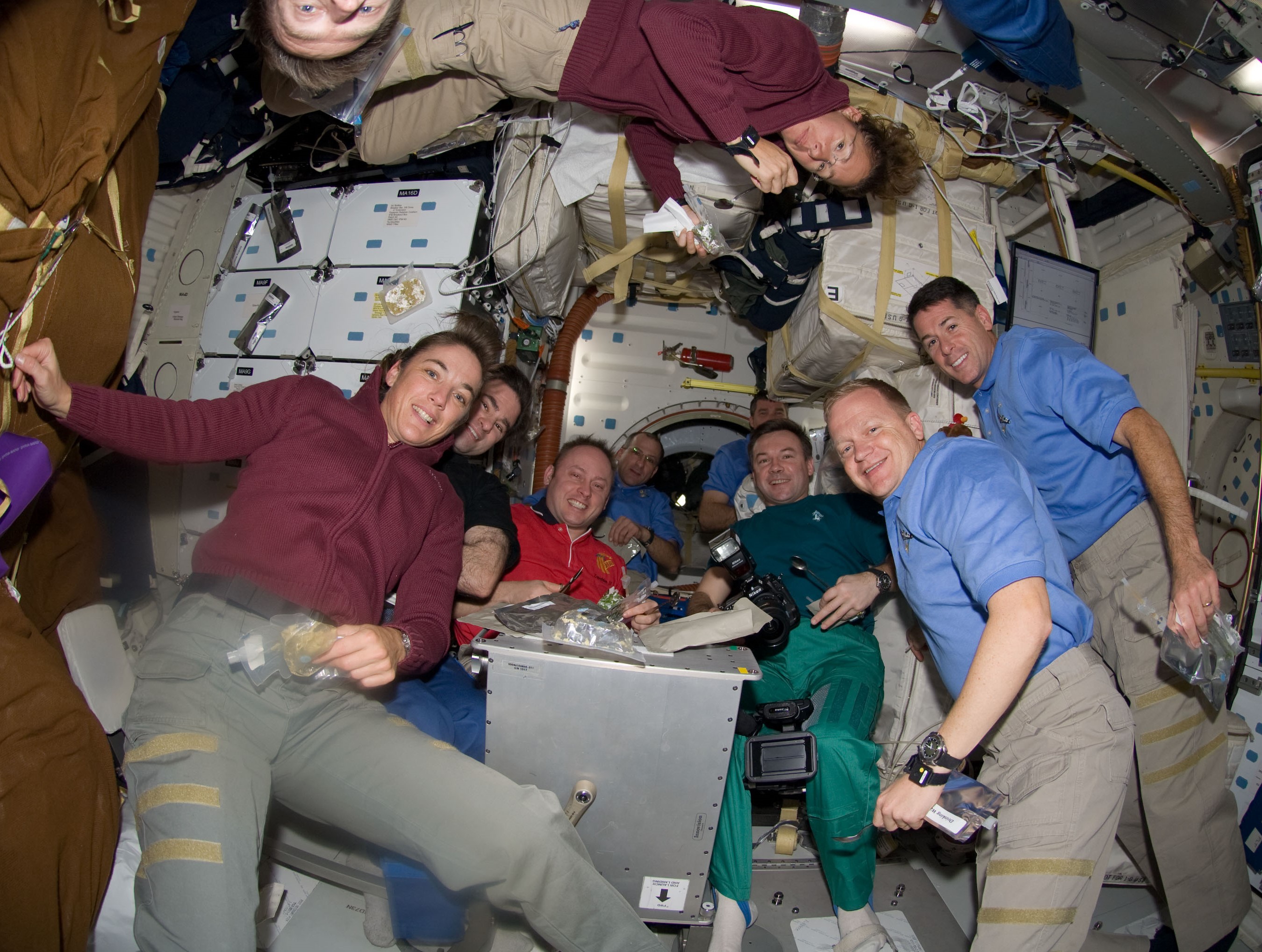
Photo of the Thanksgiving dinner reheating in space shuttle Endeavour’s food warmer The crews of Expedition 18 and STS-126 share a meal in the space shuttle middeck
Thanksgiving 2008. Left: The Thanksgiving dinner reheating in space shuttle Endeavour’s food warmer. Right: The crews of Expedition 18 and STS-126 share a meal in the space shuttle middeck.

Expedition 18 crew members NASA astronauts E. Michael Fincke and Gregory E. Chamitoff and Yuri V. Lonchakov representing Roscosmos, welcomed the STS-126 crew of NASA astronauts Christopher J. Ferguson, Eric A. Boe, Heidemarie M. Stefanyshyn-Piper, Donald R. Pettit, Stephen G. Bowen, R. Shane Kimbrough, and Sandra H. Magnus during Thanksgiving in 2008. They dined in the space shuttle Endeavour’s middeck on smoked turkey, candied yams, green beans and mushrooms, cornbread dressing and a cranapple dessert. 
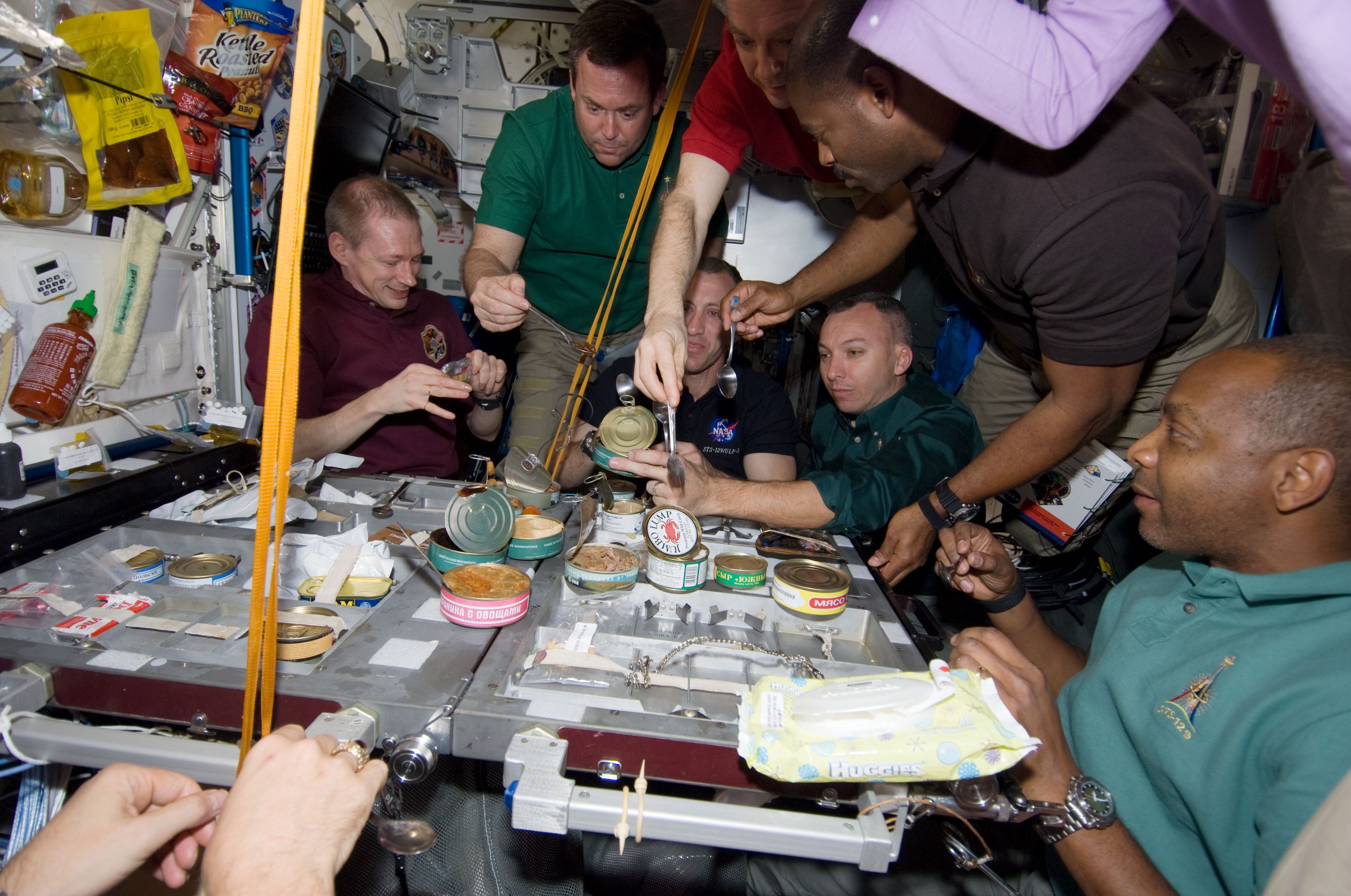
Crew members from Expedition 21 and STS-129 share an early Thanksgiving meal The Thanksgiving dinner for the Expedition 21 and STS-129 crews
Thanksgiving 2009. Left: Crew members from Expedition 21 and STS-129 share an early Thanksgiving meal. Right: The Thanksgiving dinner for the Expedition 21 and STS-129 crews.

The following year saw the largest and an internationally diverse group celebrating Thanksgiving in space. The six Expedition 21 crew members, NASA astronauts Jeffrey N. Williams and Nicole P. Stott, Roman Y. Romanenko and Maksim V. Suraev of Roscosmos, Frank L. DeWinne of the European Space Agency, and Robert B. Thirsk of the Canadian Space Agency hosted the six members of the STS-129 crew, NASA astronauts Charles O. Hobaugh, Barry E. Wilmore, Michael J. Foreman, Robert L. Satcher, Randolph J. Bresnik, and Leland D. Melvin. The twelve assembled crew members represented the United States, Russia, Belgium, and Canada. The celebration took place two days early, since the shuttle undocked from the space station on Thanksgiving Day.
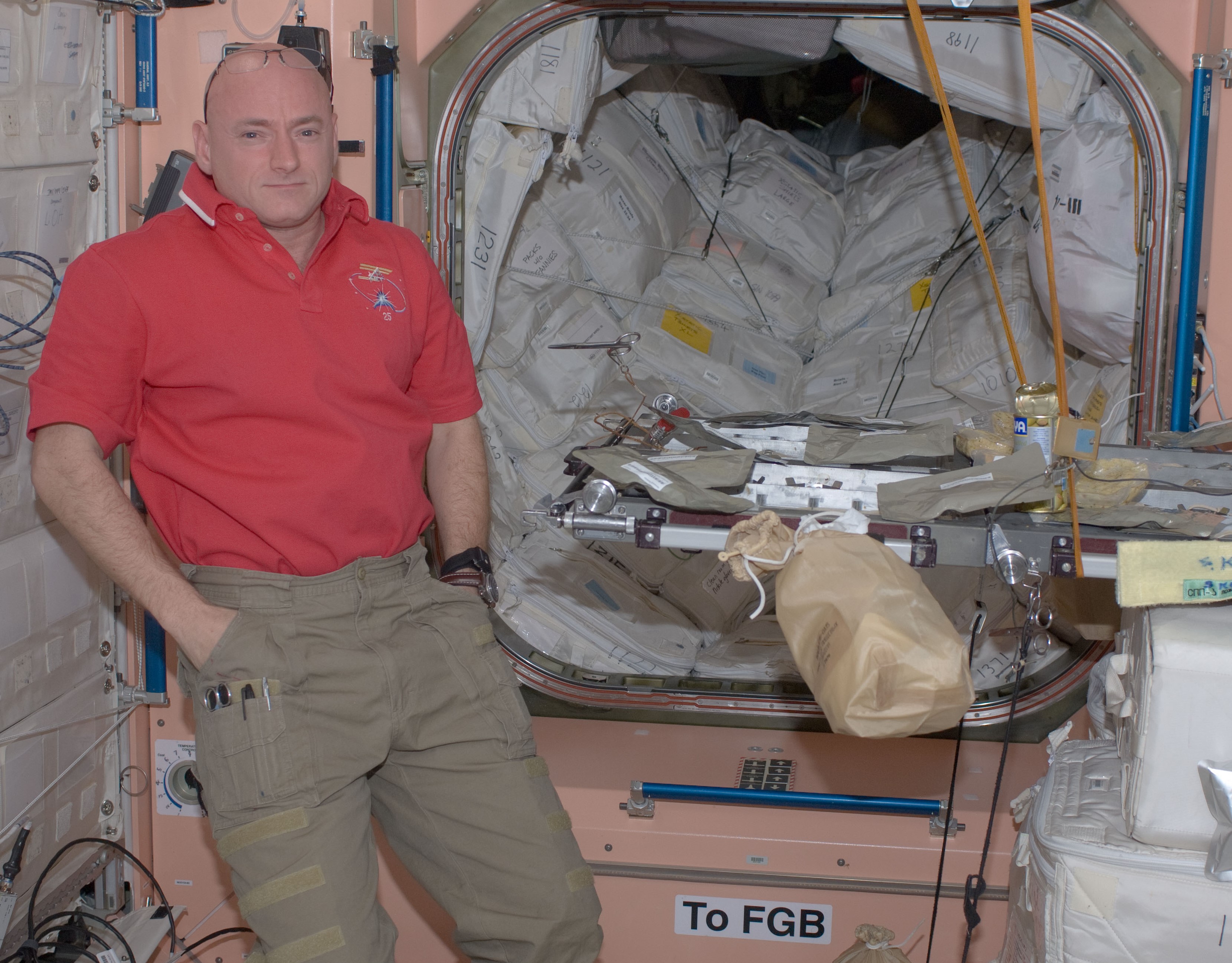
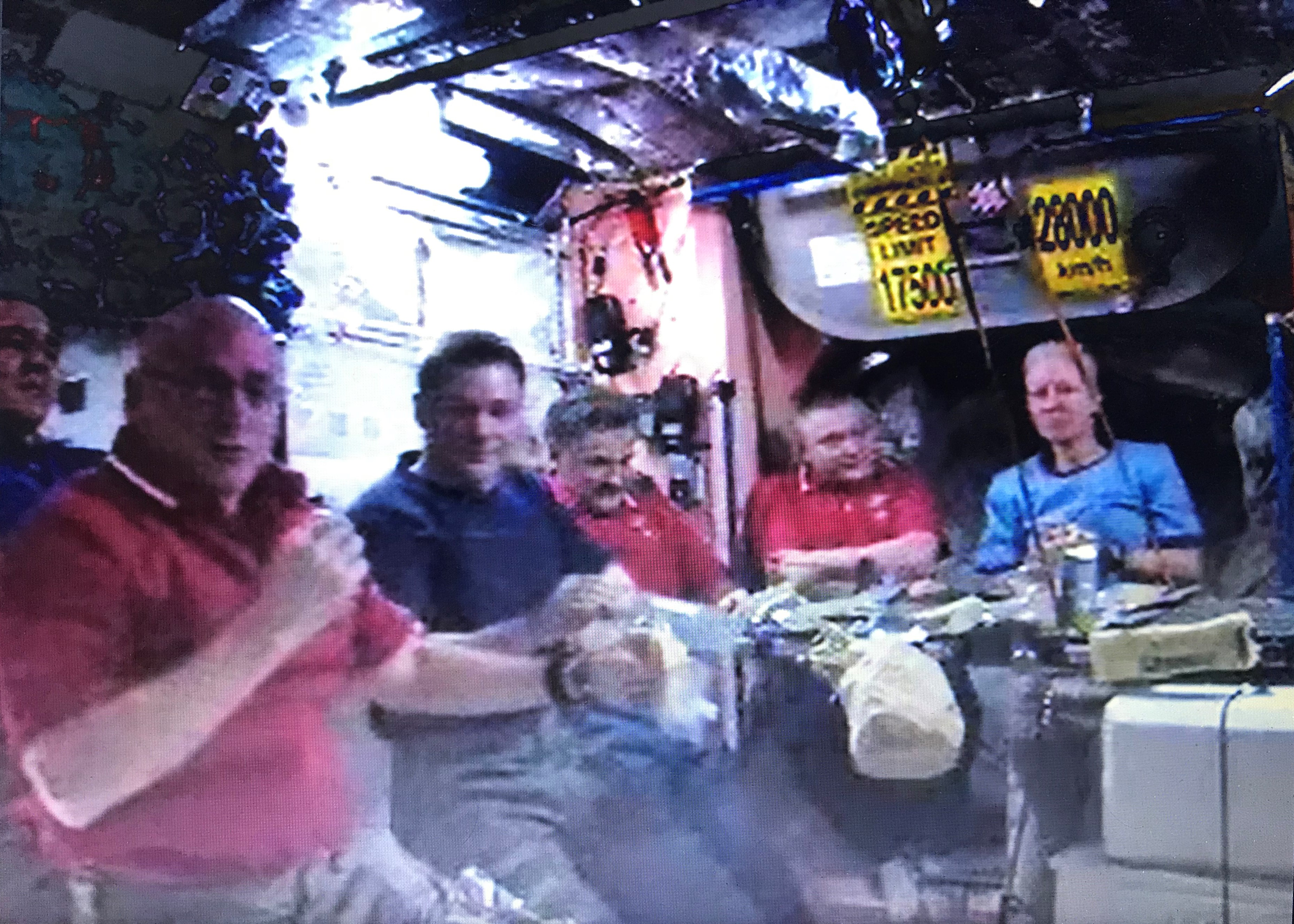
Expedition 25 commander and NASA astronaut Scott J. Kelly awaits his crewmates at the Thanksgiving dinner table The Expedition 25 crew of Oleg I. Skripochka of Roscosmos, left, Kelly, NASA astronaut Douglas H. Wheeler, Aleksandr Y. Kaleri and Fyodor N. Yurchikhin of Roscosmos, and NASA astronaut Shannon Walker sending Thanksgiving greetings to the ground before digging into their dinner
Thanksgiving 2010. Left: Expedition 25 commander and NASA astronaut Scott J. Kelly awaits his crewmates at the Thanksgiving dinner table. Right: The Expedition 25 crew of Oleg I. Skripochka of Roscosmos, left, Kelly, NASA astronaut Douglas H. Wheeler, Aleksandr Y. Kaleri and Fyodor N. Yurchikhin of Roscosmos, and NASA astronaut Shannon Walker sending Thanksgiving greetings to the ground before digging into their dinner.
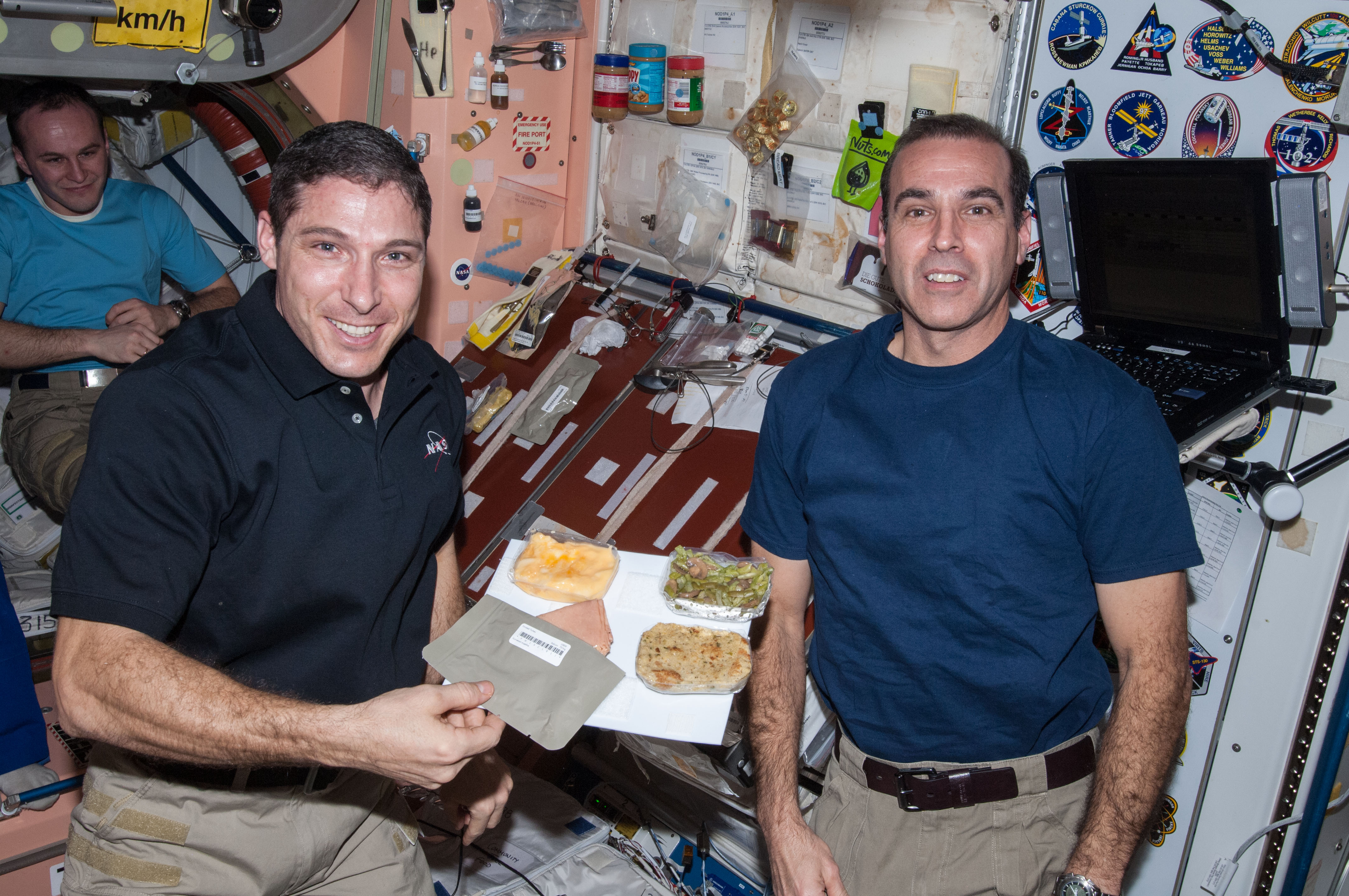
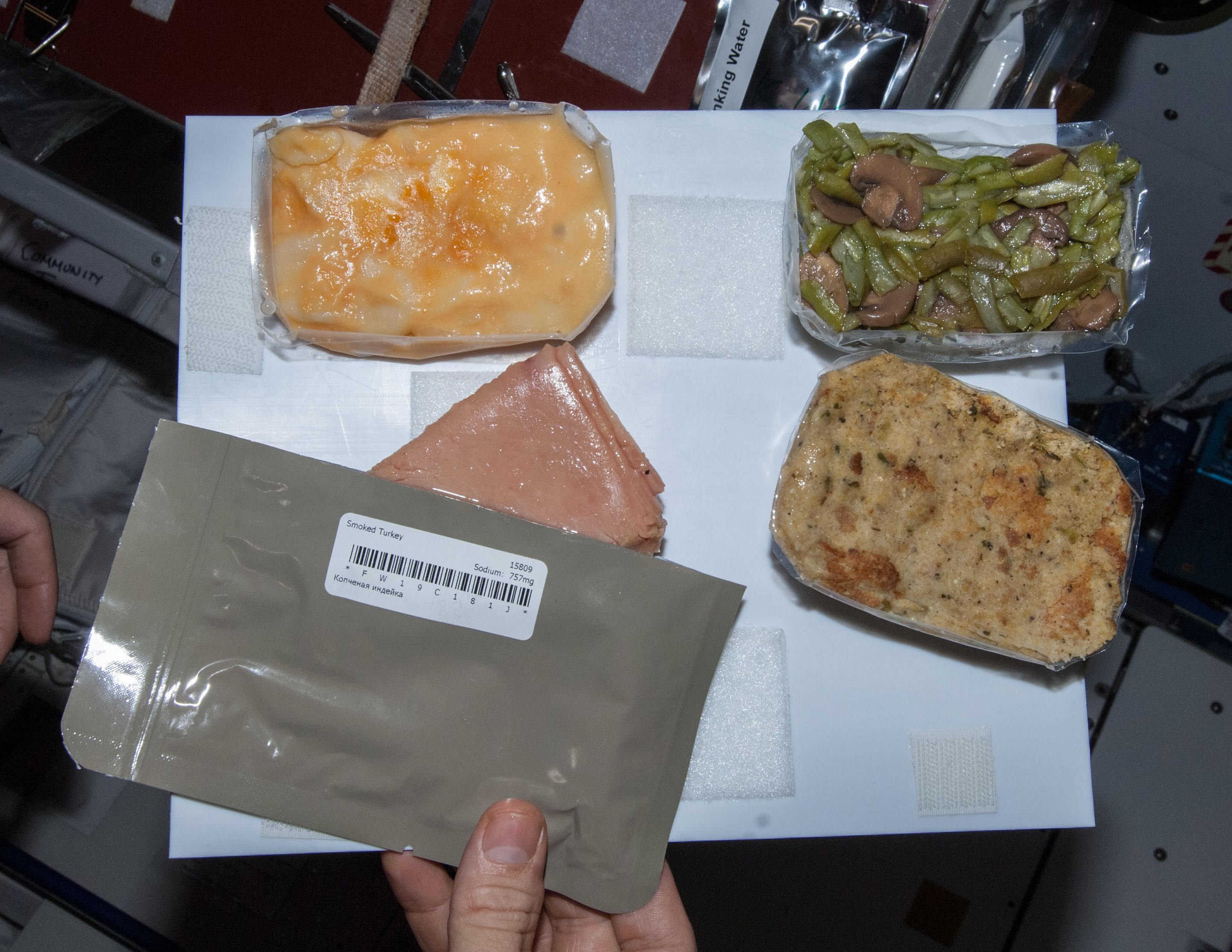
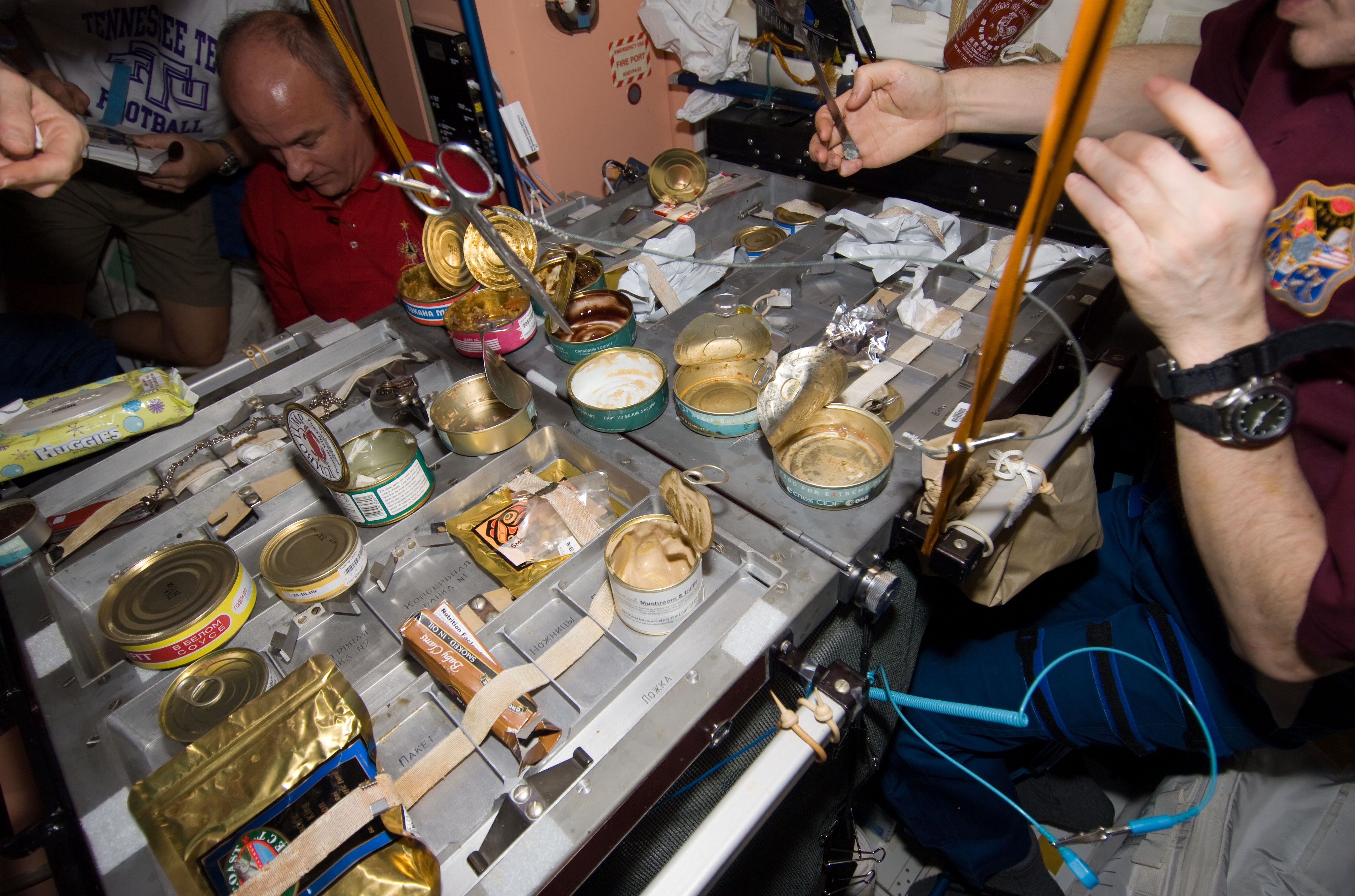
Expedition 38 NASA astronauts Michael S. Hopkins, left, and Richard A. Mastracchio showing off food items destined for the Thanksgiving Day dinner Close-up of the Thanksgiving dinner items, including turkey, ham, macaroni and cheese, green beans and mushrooms, and dressing
Thanksgiving 2013. Left: Expedition 38 NASA astronauts Michael S. Hopkins, left, and Richard A. Mastracchio showing off food items destined for the Thanksgiving Day dinner. Right: Close-up of the Thanksgiving dinner items, including turkey, ham, macaroni and cheese, green beans and mushrooms, and dressing.
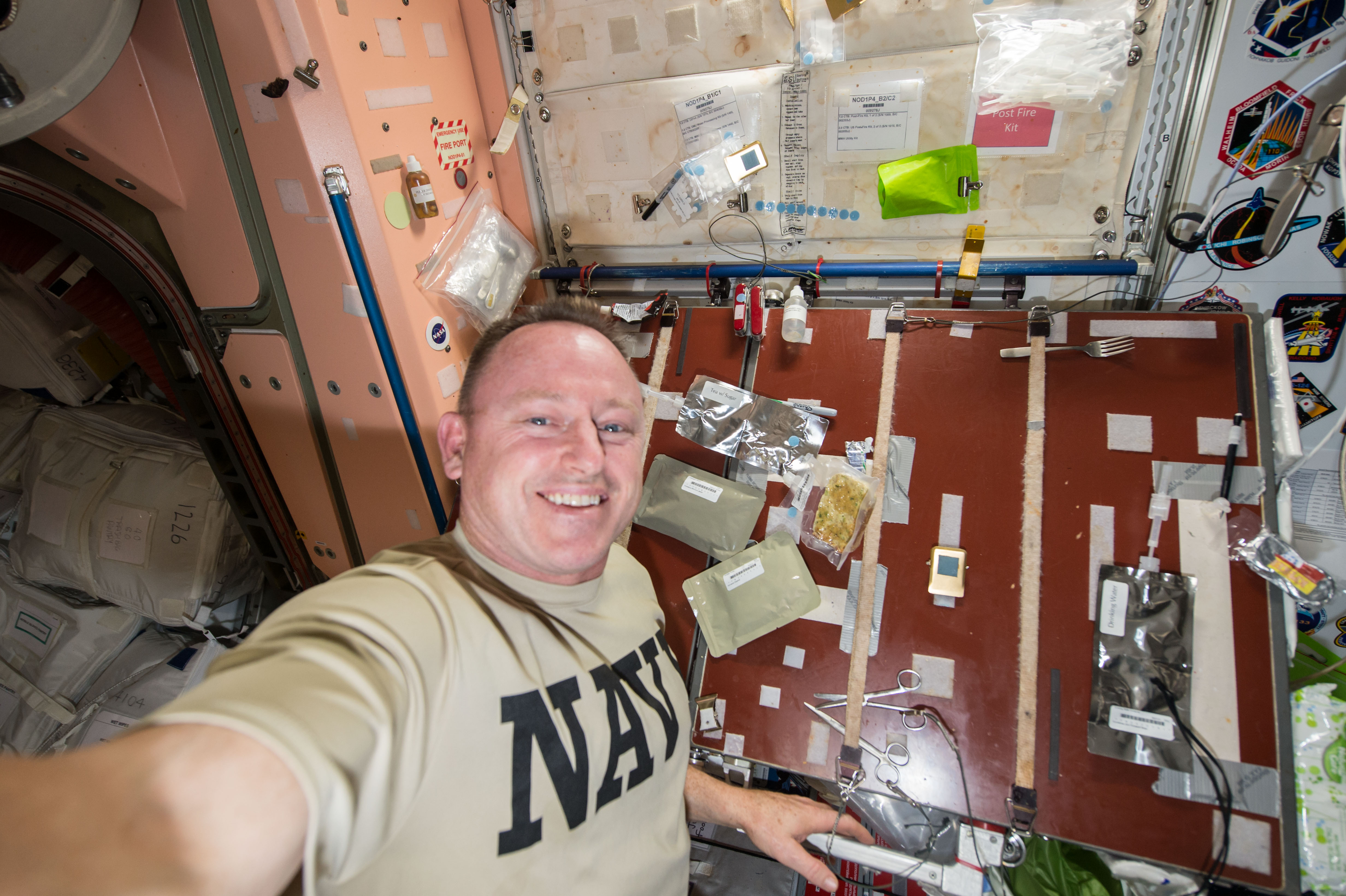
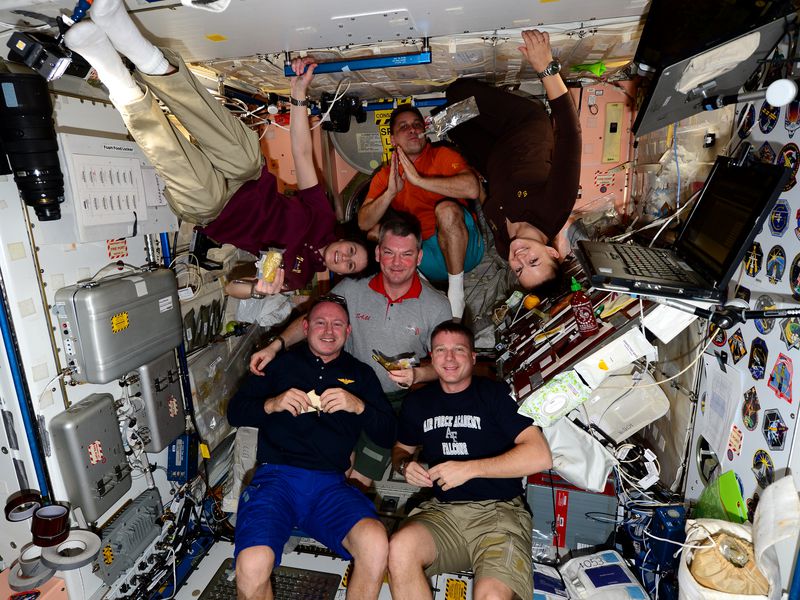
Expedition 42 commander and NASA astronaut Barry E. “Butch” Wilmore sets out his meal several days in advance Expedition 42 crew members Wilmore, left, Samantha Cristoforetti of the European Space Agency, Aleksandr M. Samokutyayev and Anton N. Shkaplerov of Roscosmos, NASA astronaut Terry W. Virts, and Elena O. Serova of Roscosmos enjoy the Thanksgiving Day dinner
Thanksgiving 2014. Left: Eager for Thanksgiving, Expedition 42 commander and NASA astronaut Barry E. “Butch” Wilmore sets out his meal several days in advance. Right: Expedition 42 crew members Wilmore, left, Samantha Cristoforetti of the European Space Agency, Aleksandr M. Samokutyayev and Anton N. Shkaplerov of Roscosmos, NASA astronaut Terry W. Virts, and Elena O. Serova of Roscosmos enjoy the Thanksgiving Day dinner.
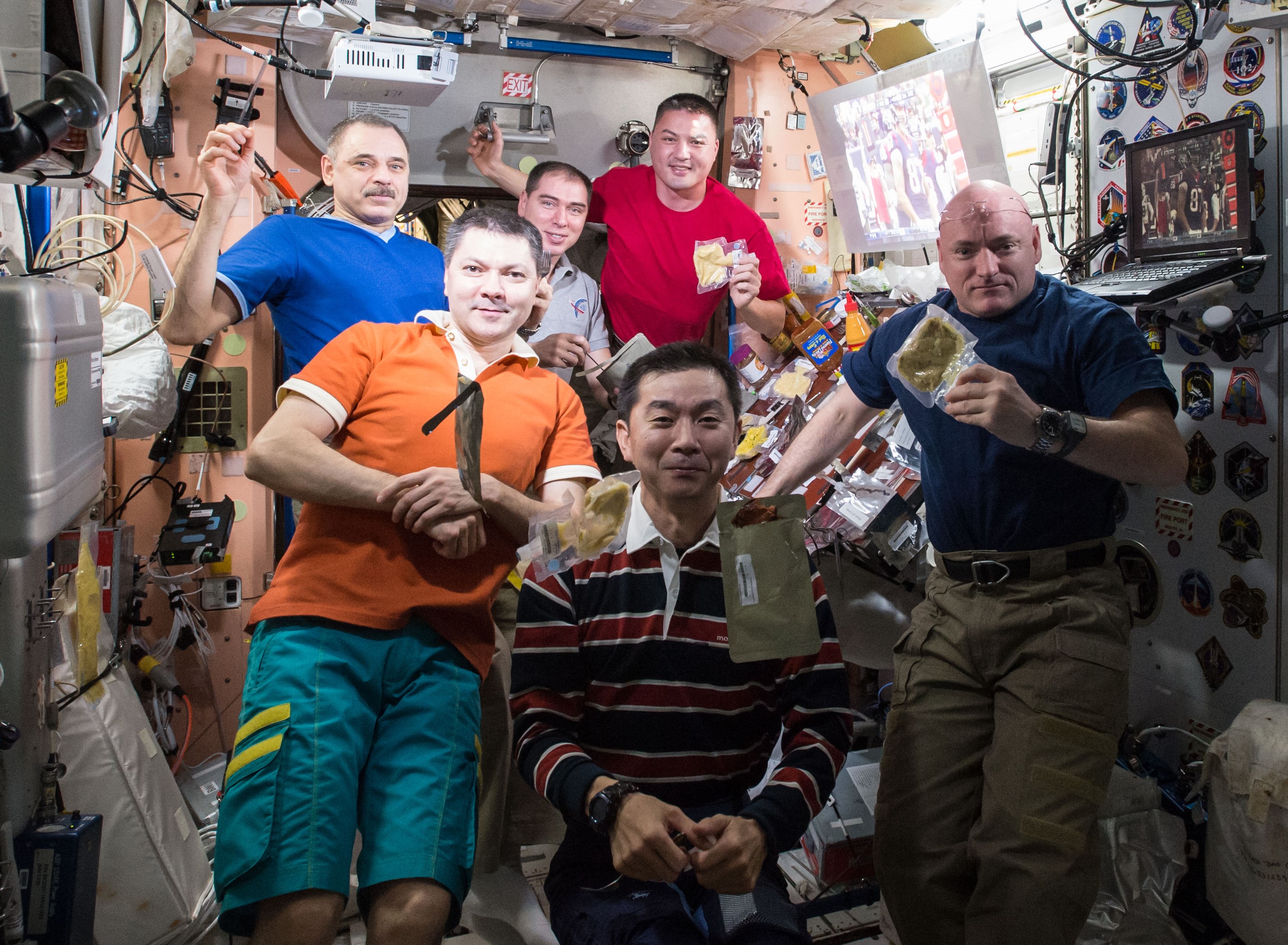
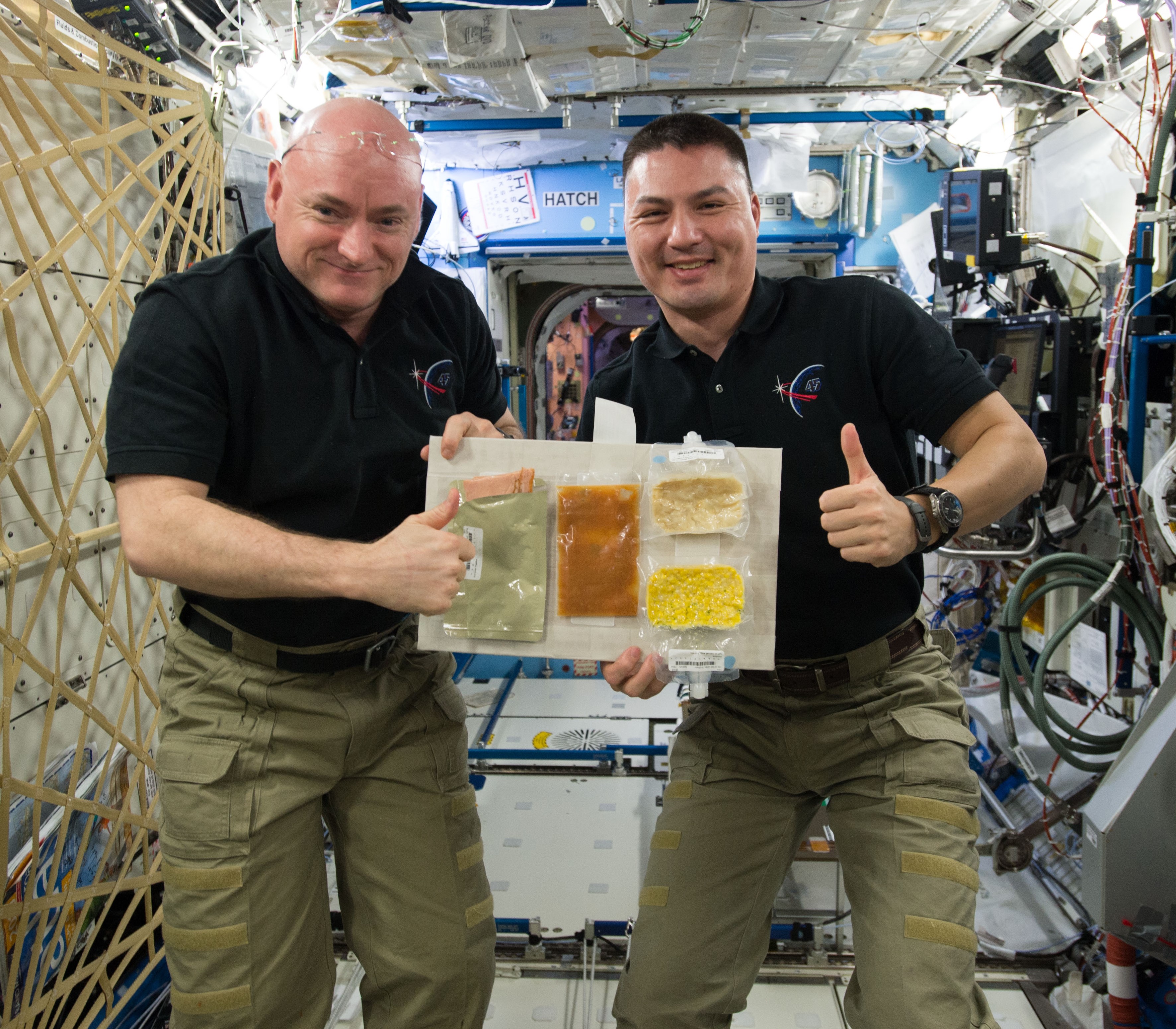
Expedition 45 crew members Mikhail B. Korniyenko, left, Oleg D. Kononenko, and Sergei A. Volkov of Roscosmos, NASA astronaut Kjell N. Lindgren, Kimiya Yui of the Japan Aerospace Exploration Agency, and NASA astronaut Scott J. Kelly pose before the Thanksgiving dinner table Kelly, left, and Lindgren show off the Thanksgiving dinner items
Thanksgiving 2015. Left: Expedition 45 crew members Mikhail B. Korniyenko, left, Oleg D. Kononenko, and Sergei A. Volkov of Roscosmos, NASA astronaut Kjell N. Lindgren, Kimiya Yui of the Japan Aerospace Exploration Agency, and NASA astronaut Scott J. Kelly pose before the Thanksgiving dinner table. Right: Kelly, left, and Lindgren show off the Thanksgiving dinner items.
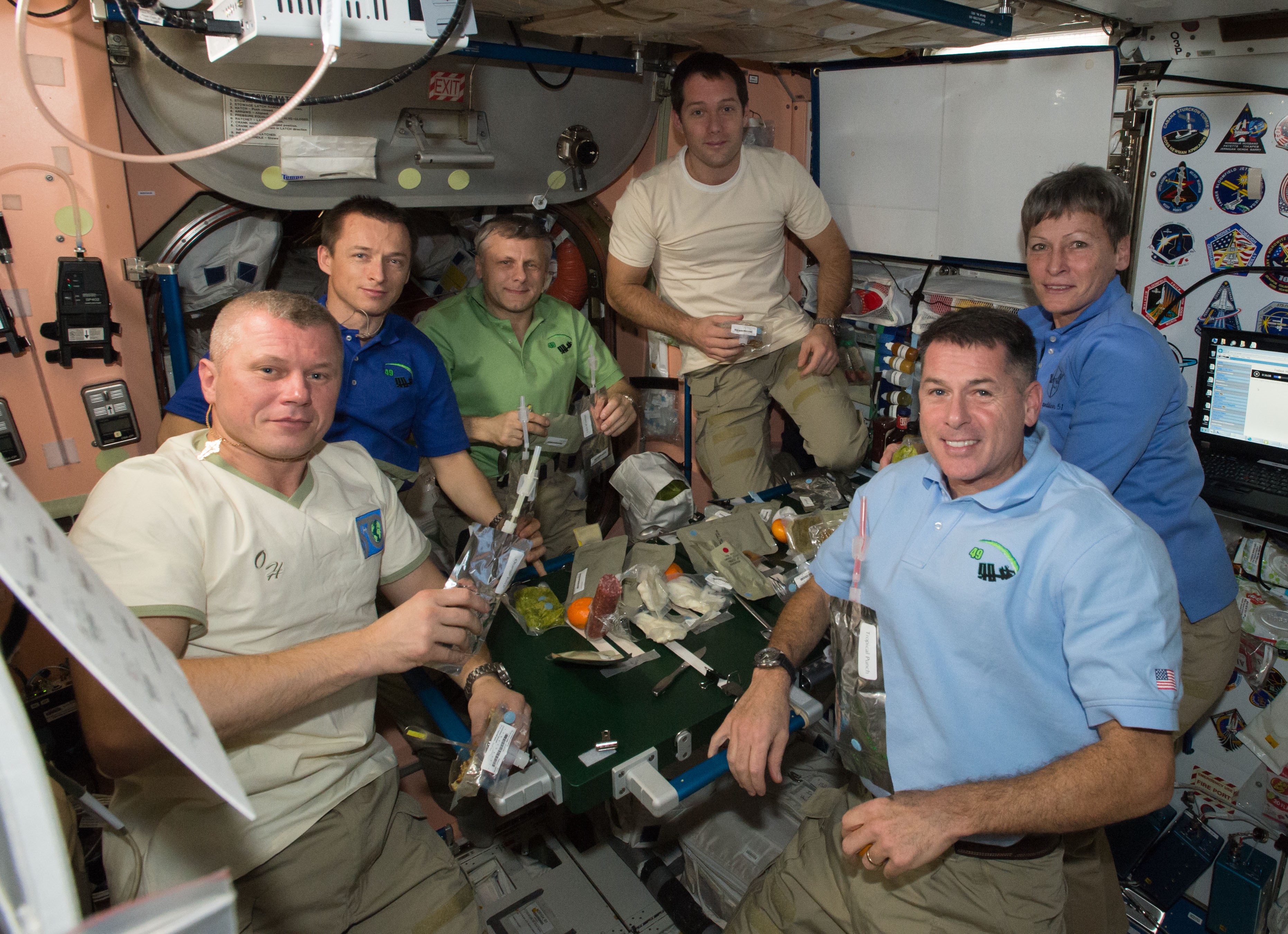
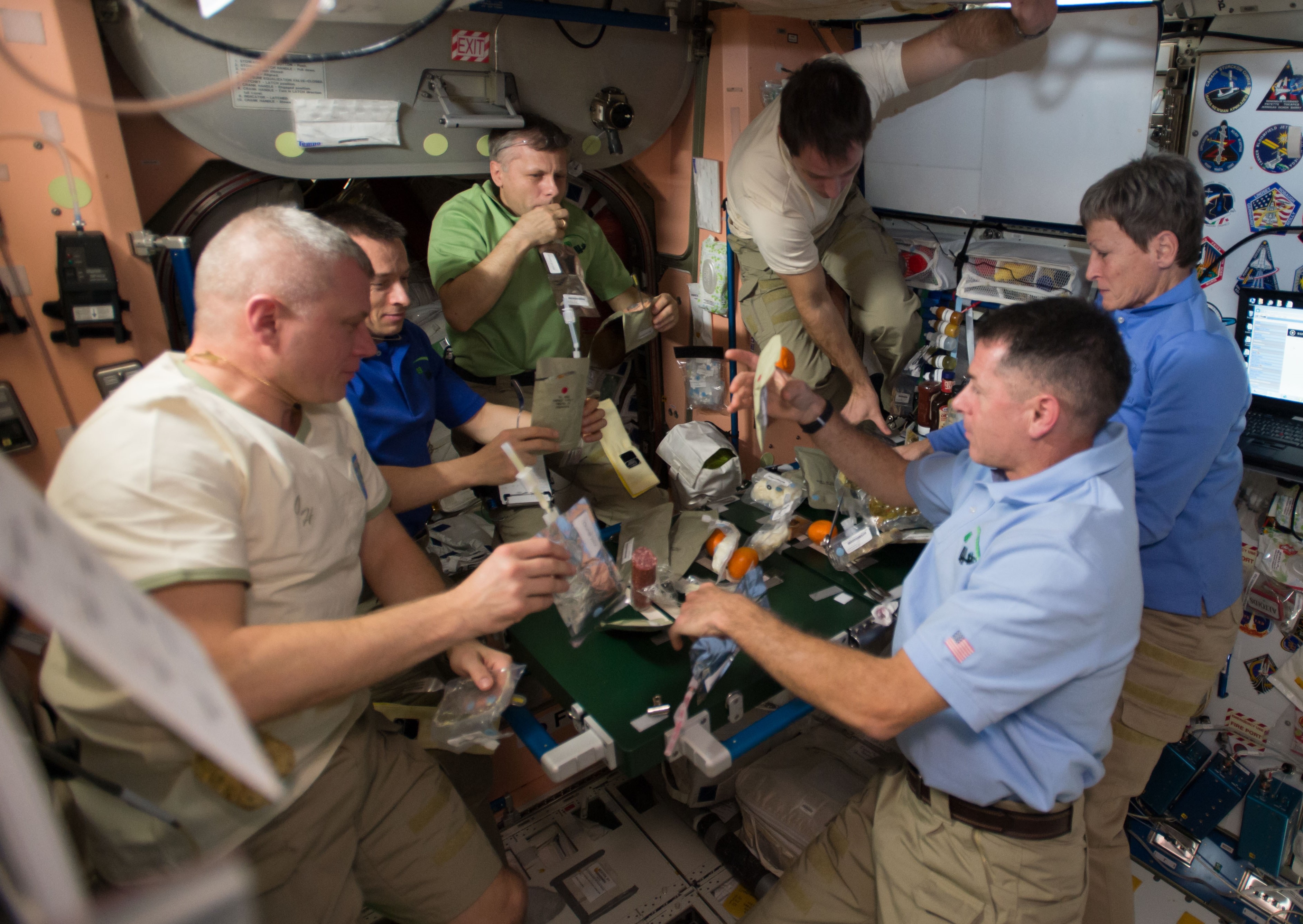
Expedition 50 crew members Oleg V. Novitsky, left, Sergei N. Ryzhikov, and Andrei I. Borisenko of Roscosmos, Thomas G. Pesquet of the European Space Agency, and NASA astronauts R. Shane Kimbrough and Peggy A. Whitson pose before the Thanksgiving dinner table Image of the Expedition 50 crew enjoying Thanksgiving feast
Thanksgiving 2016. Left: Expedition 50 crew members Oleg V. Novitsky, left, Sergei N. Ryzhikov, and Andrei I. Borisenko of Roscosmos, Thomas G. Pesquet of the European Space Agency, and NASA astronauts R. Shane Kimbrough and Peggy A. Whitson pose before the Thanksgiving dinner table. Right: The Expedition 50 crew tucks into the feast.
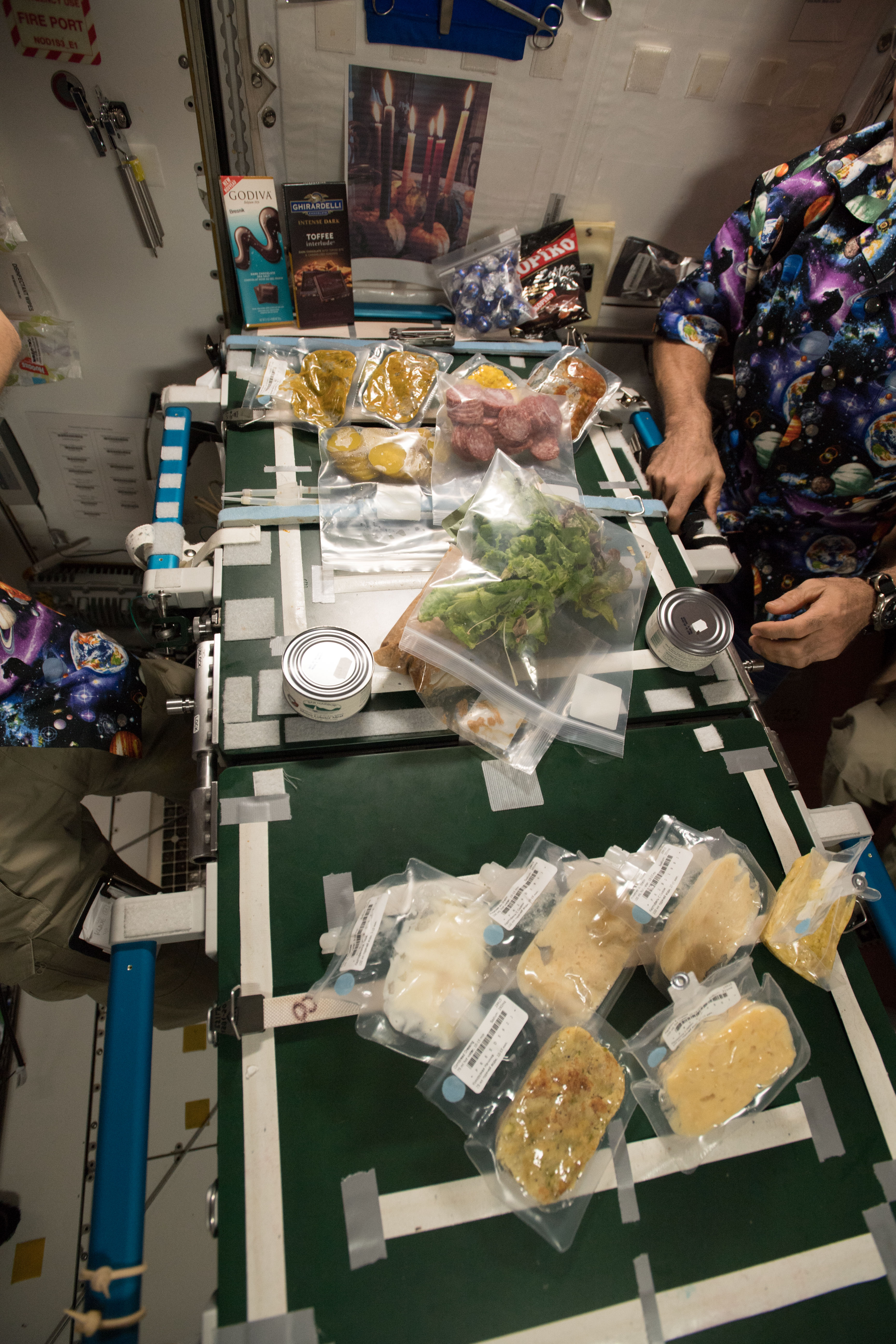
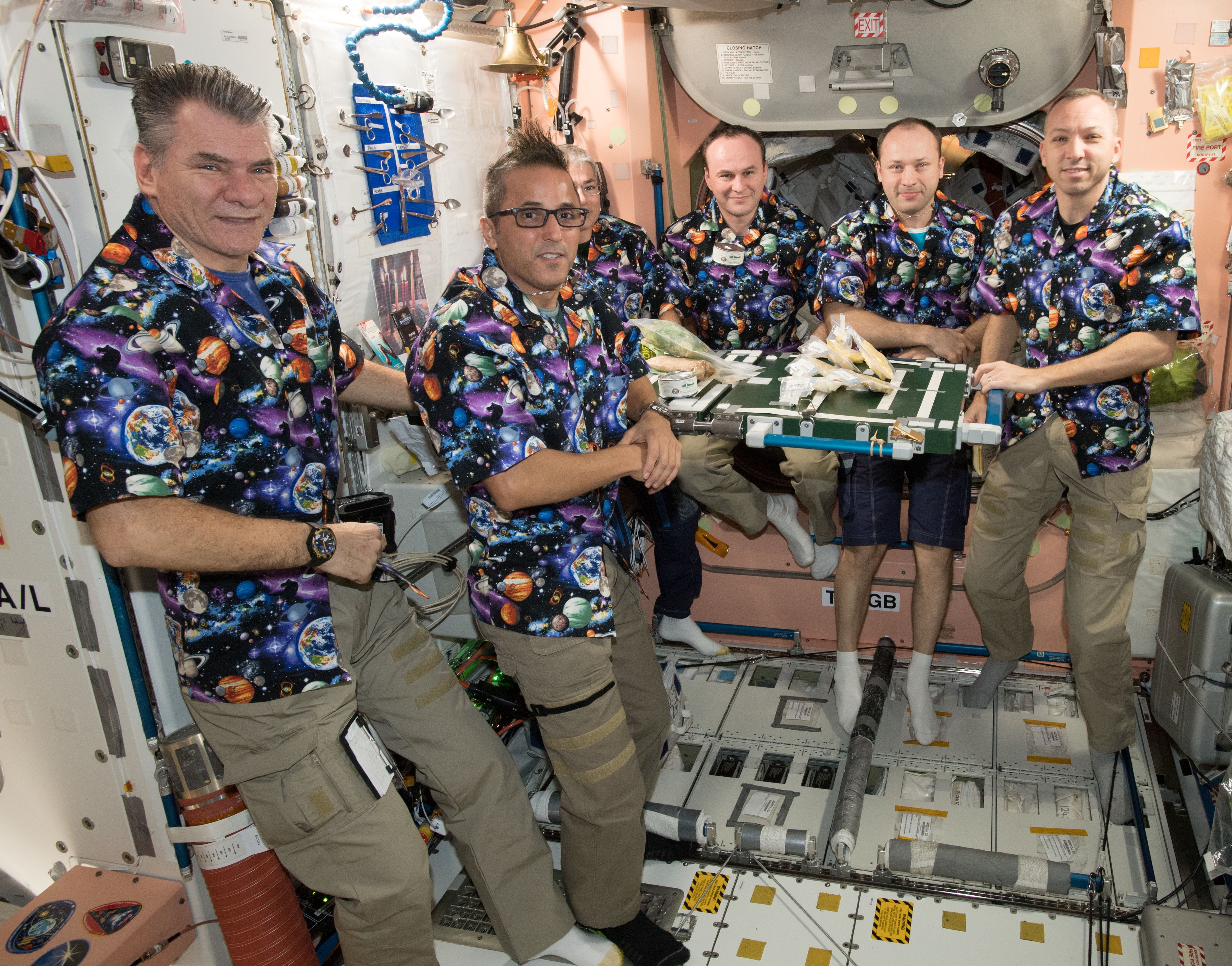
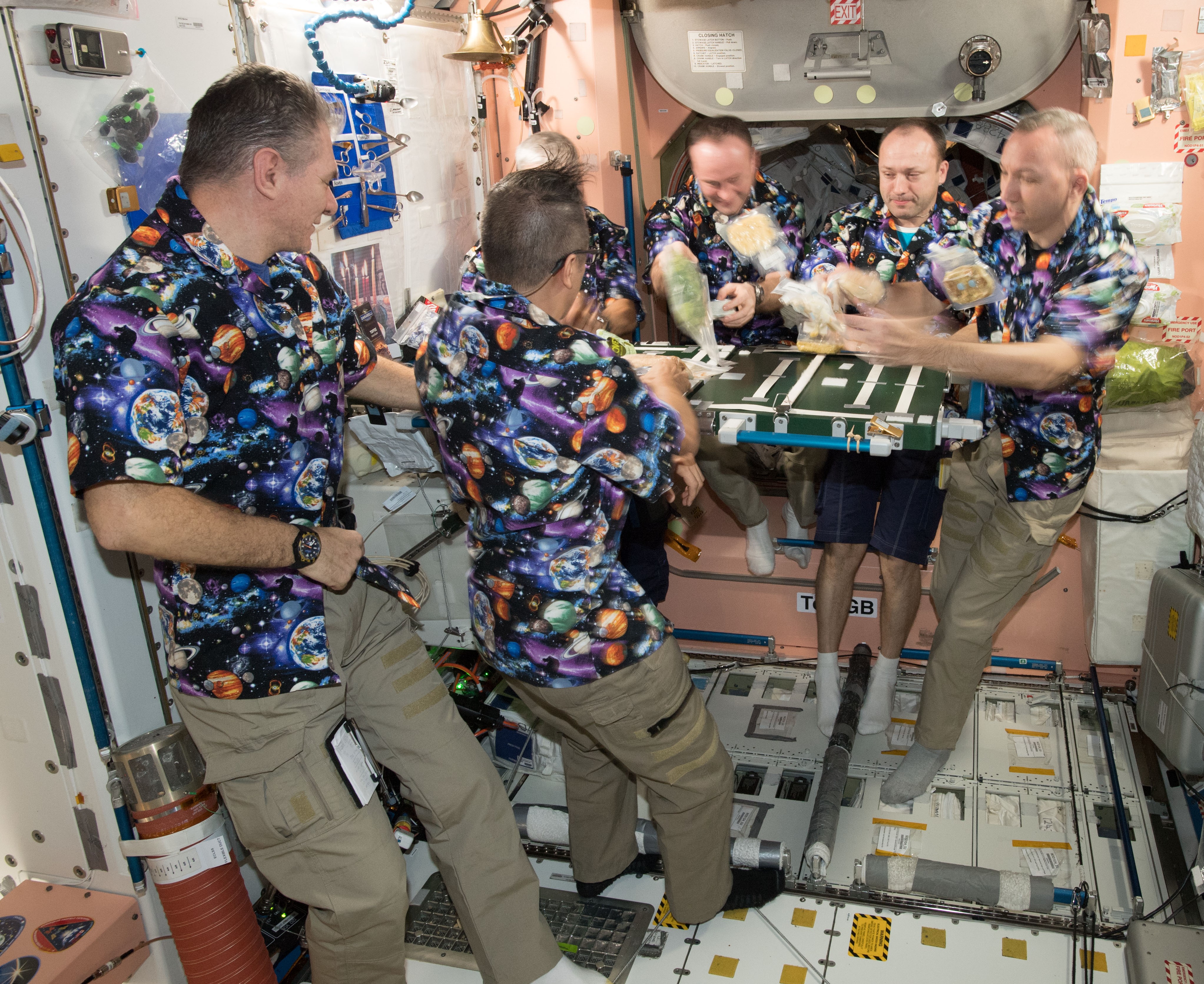
Thanksgiving table The Expedition 53 crew of Paolo A. Nespoli of the European Space Agency, left, NASA astronauts Joseph M. Acaba and Mark T. Vande Hei, Sergei N. Ryazansky and Aleksandr A. Misurkin of Roscosmos, and NASA astronaut Randolph J. Bresnik patiently awaits the start of the dinner The Expedition 53 crew eating Thanksgiving dinner
Thanksgiving 2017. Left: The Thanksgiving table is set. Middle: The Expedition 53 crew of Paolo A. Nespoli of the European Space Agency, left, NASA astronauts Joseph M. Acaba and Mark T. Vande Hei, Sergei N. Ryazansky and Aleksandr A. Misurkin of Roscosmos, and NASA astronaut Randolph J. Bresnik patiently awaits the start of the dinner. Right: The Expedition 53 crew digs in.
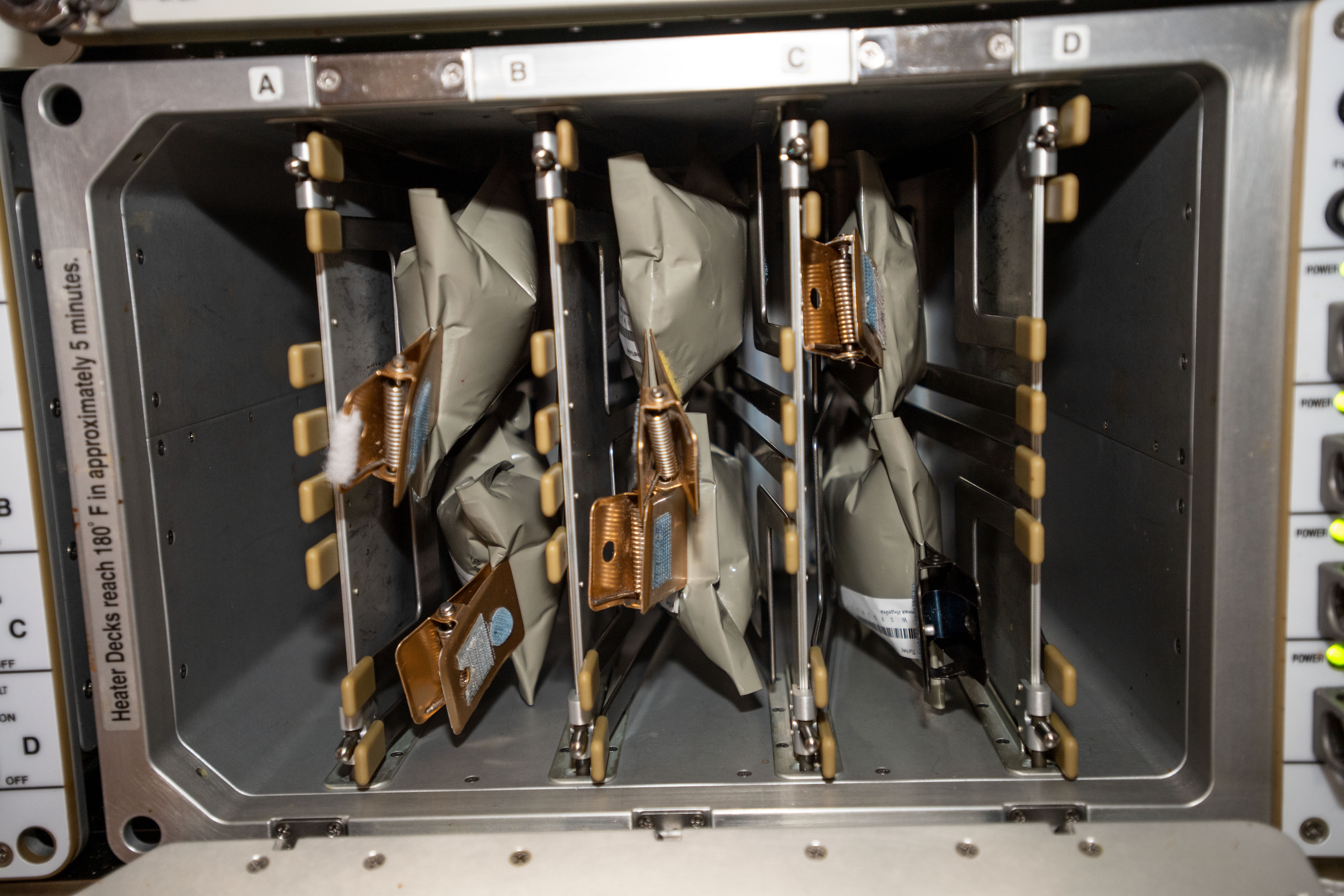
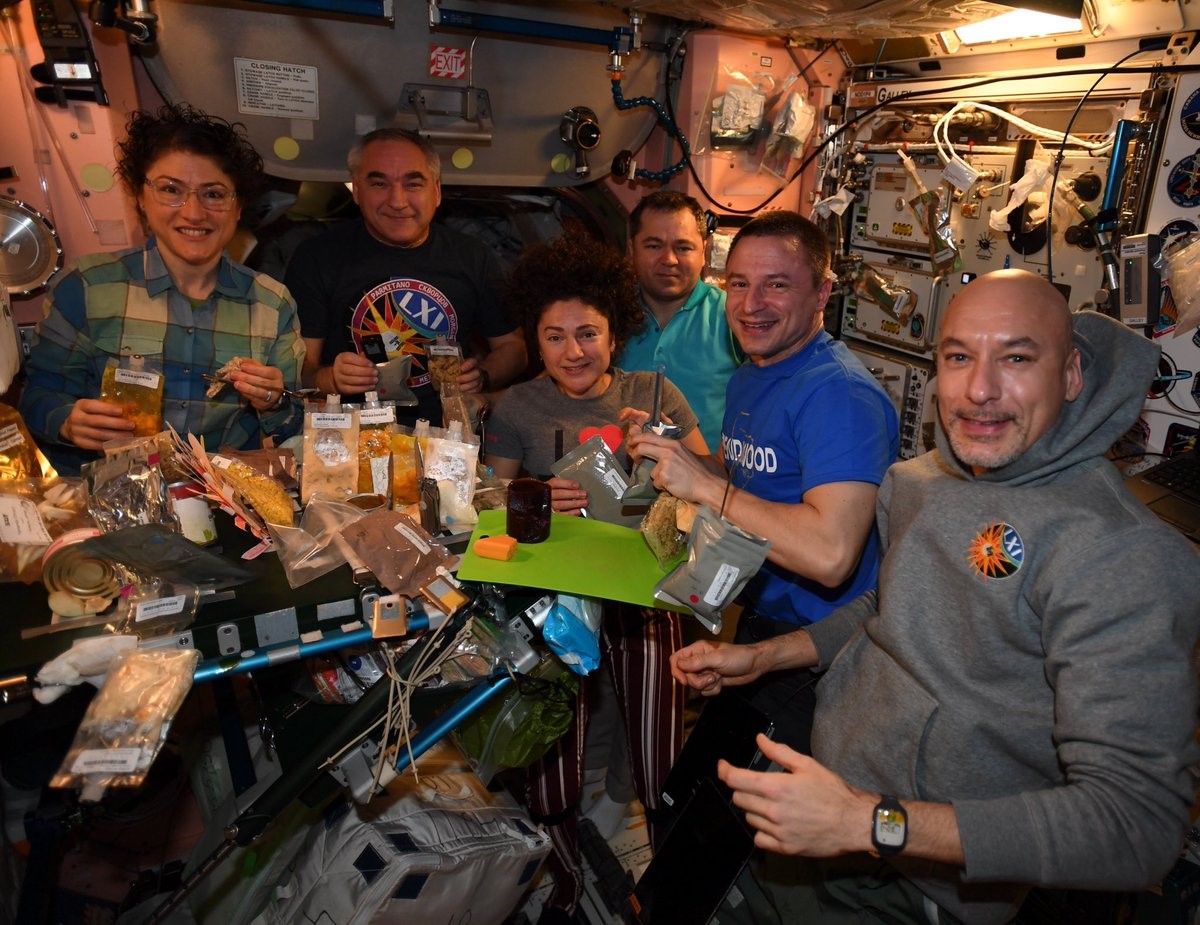
Image of turkey packages in the Galley Food Warmer Expedition 61 crew members NASA astronaut Christina H. Koch, left, Aleksandr A. Skvortsov of Roscosmos, NASA astronaut Jessica U. Meir, Oleg I. Skripochka of Roscosmos, NASA astronaut Andrew R. Morgan, and Luca S. Parmitano of the European Space Agency celebrate Thanksgiving aboard the space station
Thanksgiving 2019. Left: The turkey is in the oven, or more precisely the smoked turkey packages are in the Galley Food Warmer. Right: Expedition 61 crew members NASA astronaut Christina H. Koch, left, Aleksandr A. Skvortsov of Roscosmos, NASA astronaut Jessica U. Meir, Oleg I. Skripochka of Roscosmos, NASA astronaut Andrew R. Morgan, and Luca S. Parmitano of the European Space Agency celebrate Thanksgiving aboard the space station.
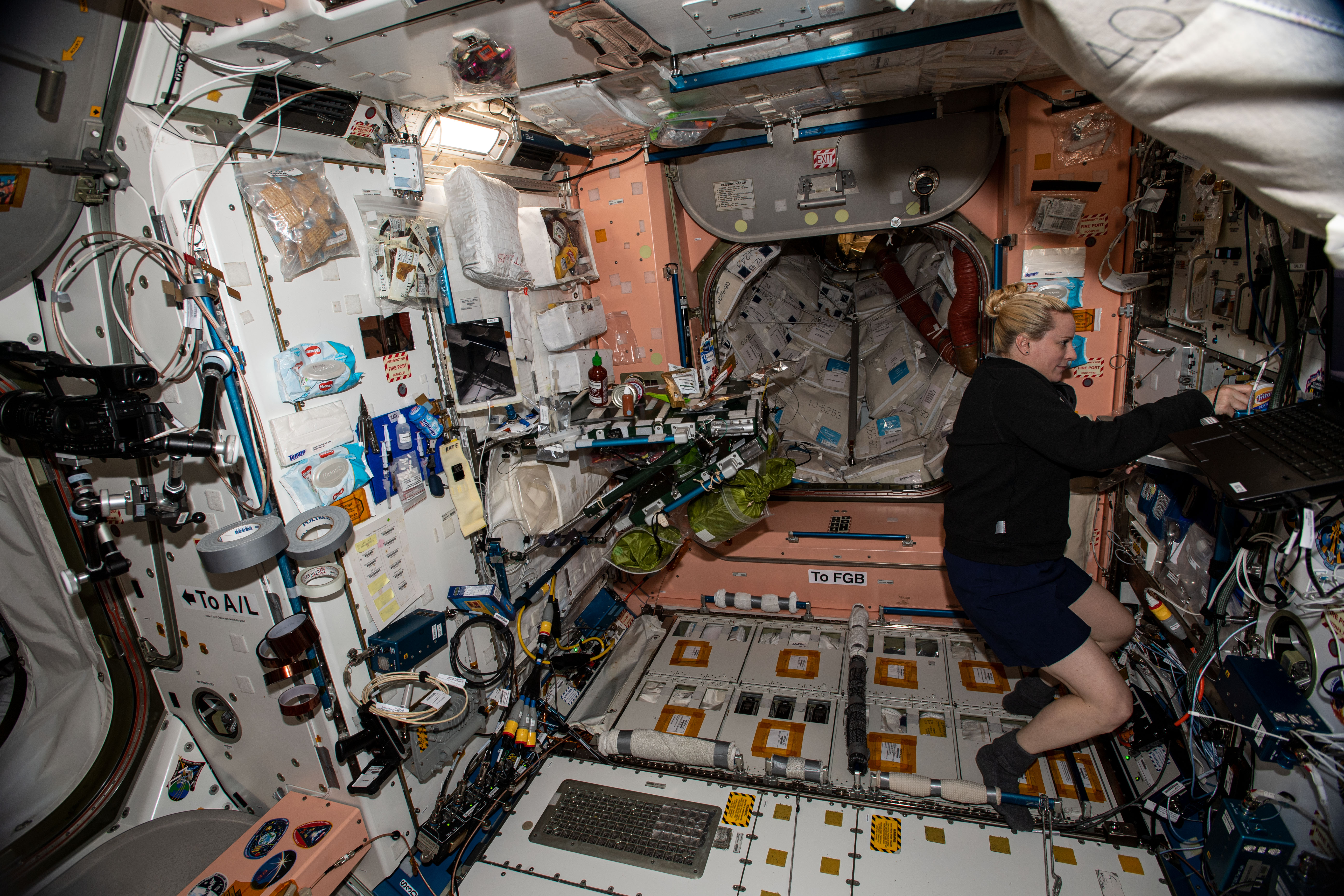
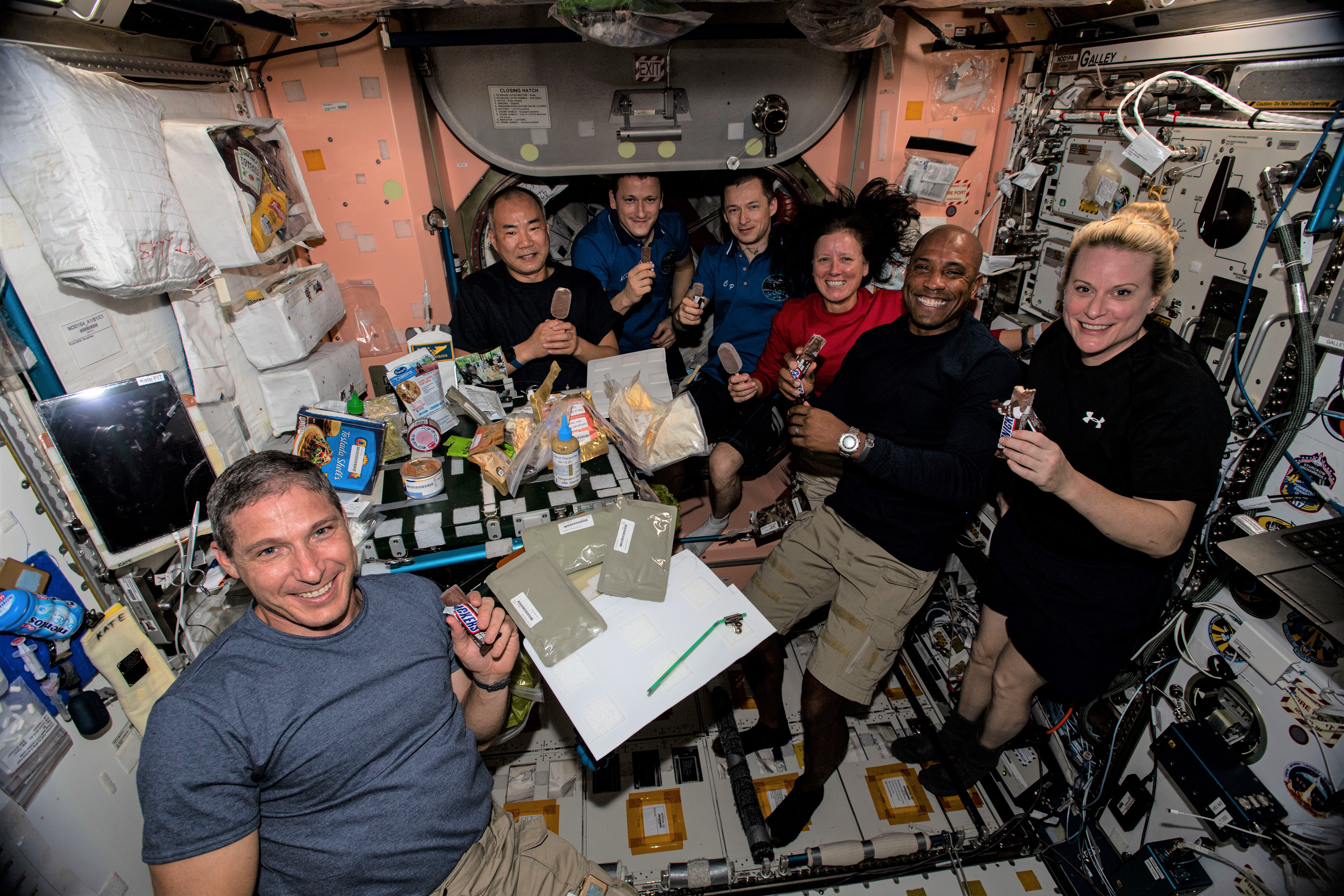
Expedition 64 NASA astronaut Kathleen H. “Kate” Rubins prepares the Thanksgiving dinner The Expedition 64 crew of NASA astronaut Michael S. Hopkins, Soichi Noguchi of the Japan Aerospace Exploration Agency, Sergei V. Kud-Sverchkov and Sergei N. Ryzhikov of Roscosmos, and NASA astronauts K. Meghan McArthur, Victor J. Glover, and Rubins enjoying the Thanksgiving meal including frozen treats for dessert
Thanksgiving 2020. Left: Expedition 64 NASA astronaut Kathleen H. “Kate” Rubins prepares the Thanksgiving dinner. Right: The Expedition 64 crew of NASA astronaut Michael S. Hopkins, Soichi Noguchi of the Japan Aerospace Exploration Agency, Sergei V. Kud-Sverchkov and Sergei N. Ryzhikov of Roscosmos, and NASA astronauts K. Meghan McArthur, Victor J. Glover, and Rubins enjoying the Thanksgiving meal including frozen treats for dessert.
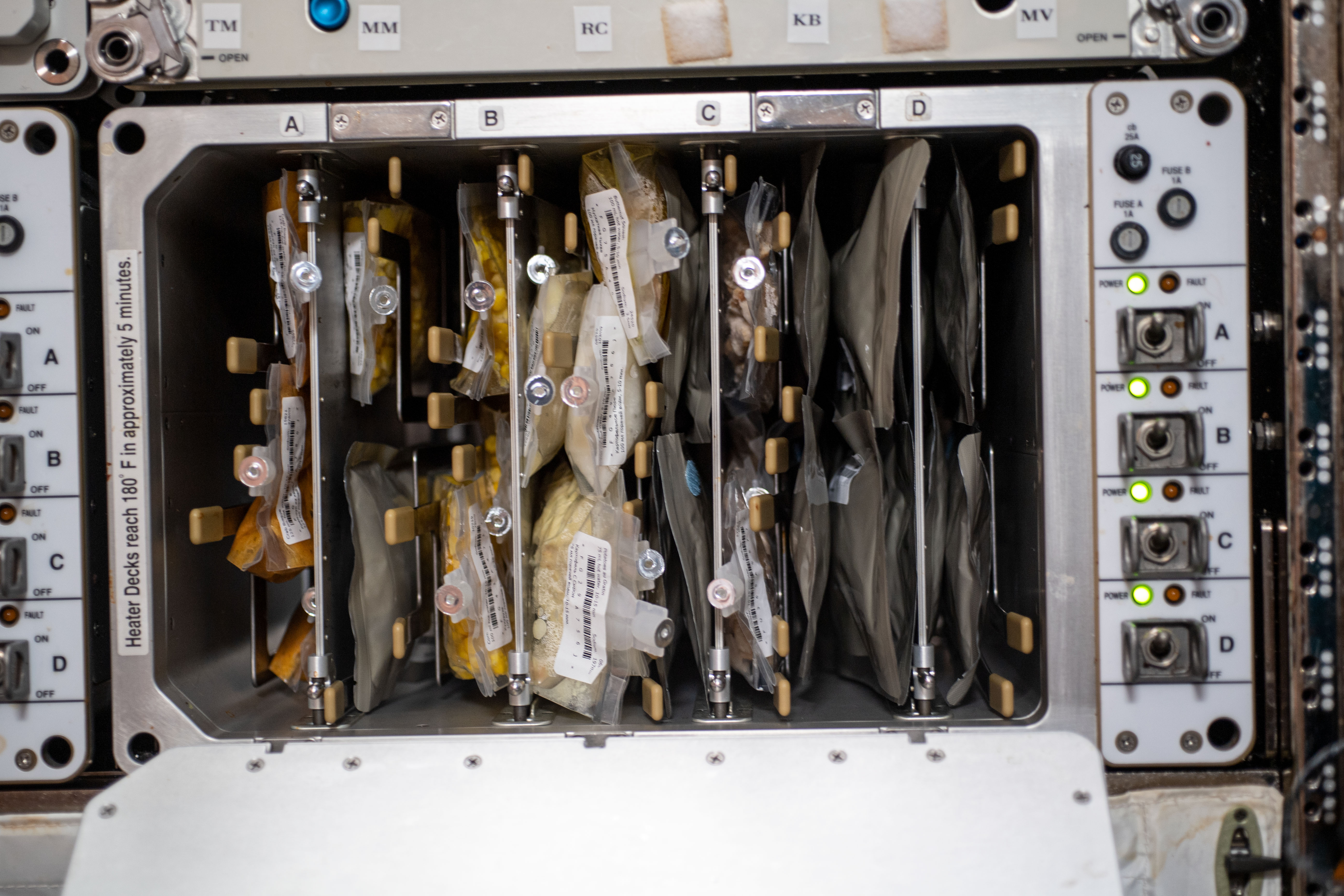
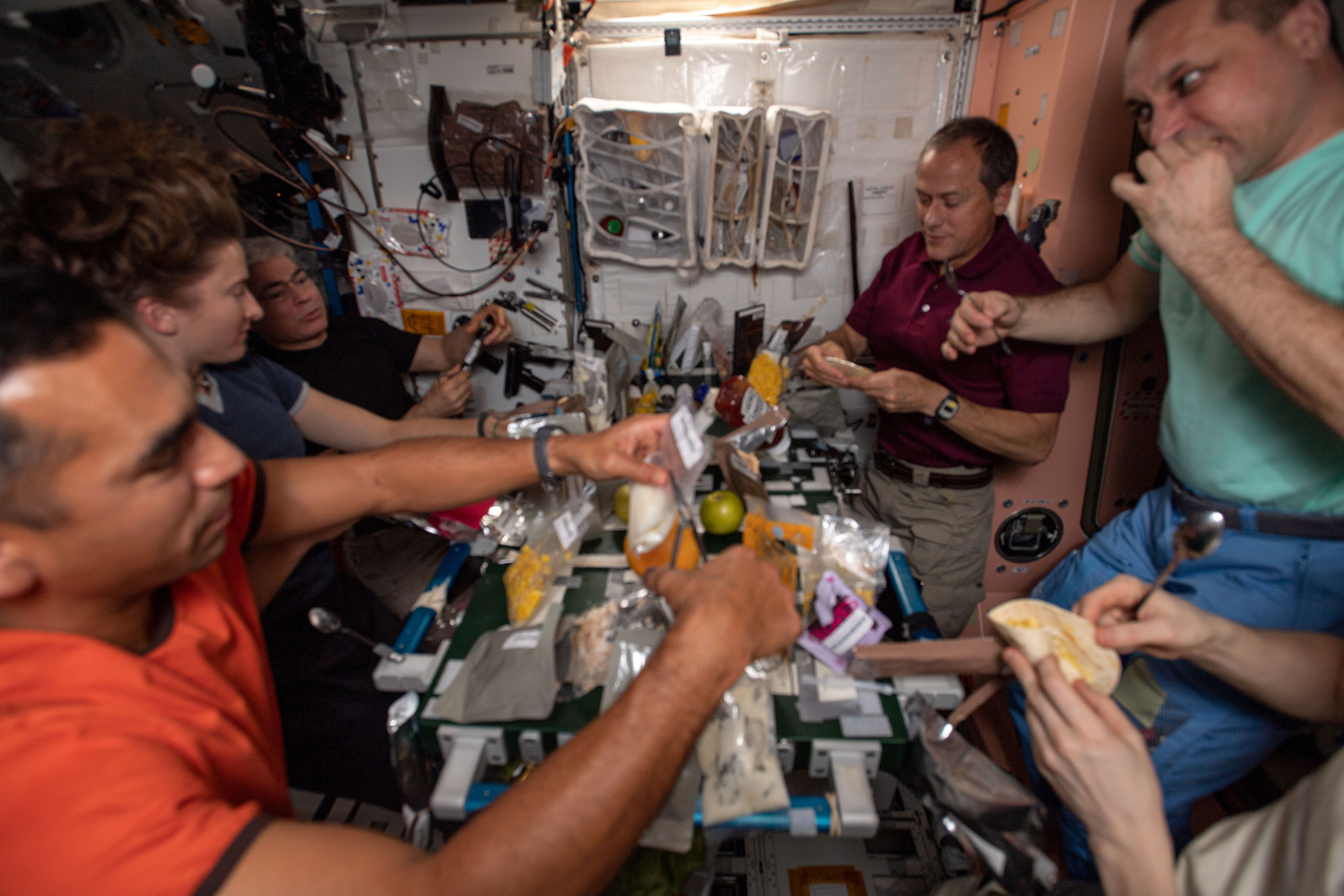
Thanksgiving dinner cooking in the “oven” aboard the space station Expedition 66 crew members NASA astronauts Raja J. Chari, left, Kayla S. Barron, Mark T. Vande Hei, Thomas H. Marshburn, Russian cosmonauts Anton N. Shkaplerov and Pyotr V. Dubrov (partially visible), and European Space Agency astronaut Matthias J. Maurer (taking the photo) enjoy the Thanksgiving feast
Thanksgiving 2021. Left: Thanksgiving dinner cooking in the “oven” aboard the space station. Right: Expedition 66 crew members NASA astronauts Raja J. Chari, left, Kayla S. Barron, Mark T. Vande Hei, Thomas H. Marshburn, Russian cosmonauts Anton N. Shkaplerov and Pyotr V. Dubrov (partially visible), and European Space Agency astronaut Matthias J. Maurer (taking the photo) enjoy the Thanksgiving feast.
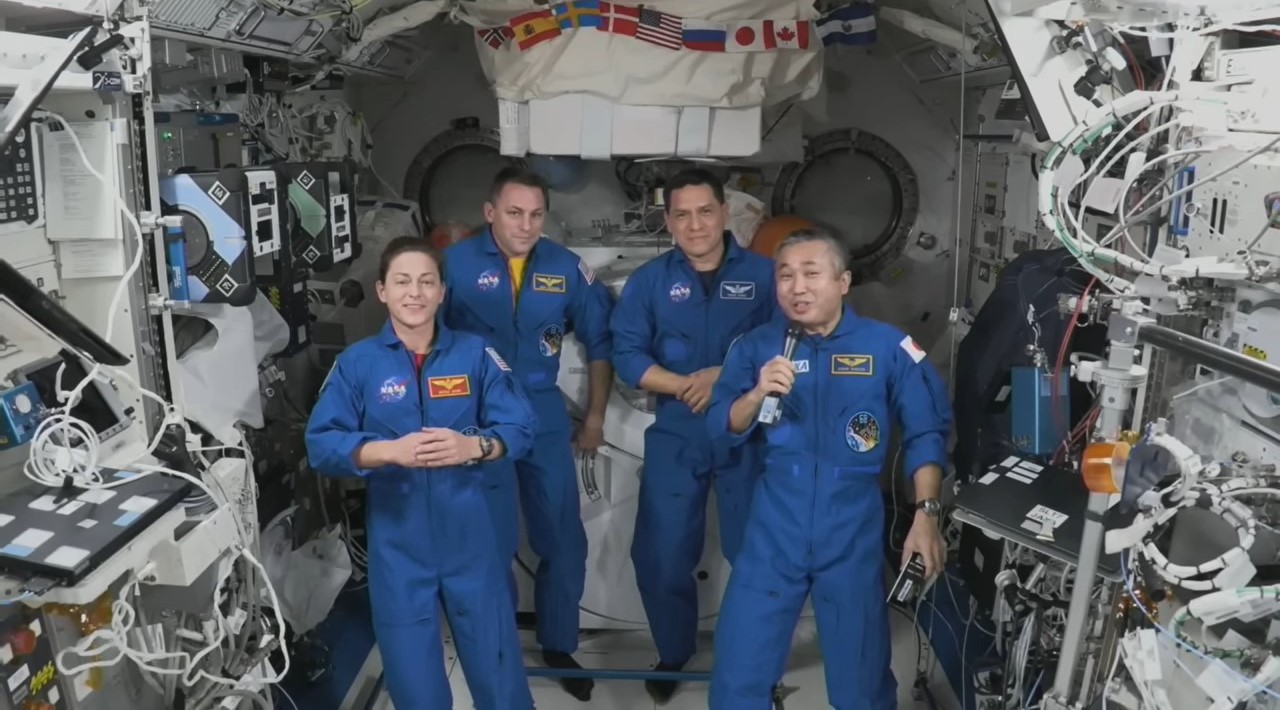
Expedition 68 crew members NASA astronauts Nicole A. Mann, left, Josh A. Cassada, and Francisco “Frank” C. Rubio, and Koichi Wakata of the Japan Aerospace Exploration Agency send Thanksgiving Day greetings
Thanksgiving 2022. Expedition 68 crew members NASA astronauts Nicole A. Mann, left, Josh A. Cassada, and Francisco “Frank” C. Rubio, and Koichi Wakata of the Japan Aerospace Exploration Agency send Thanksgiving Day greetings.
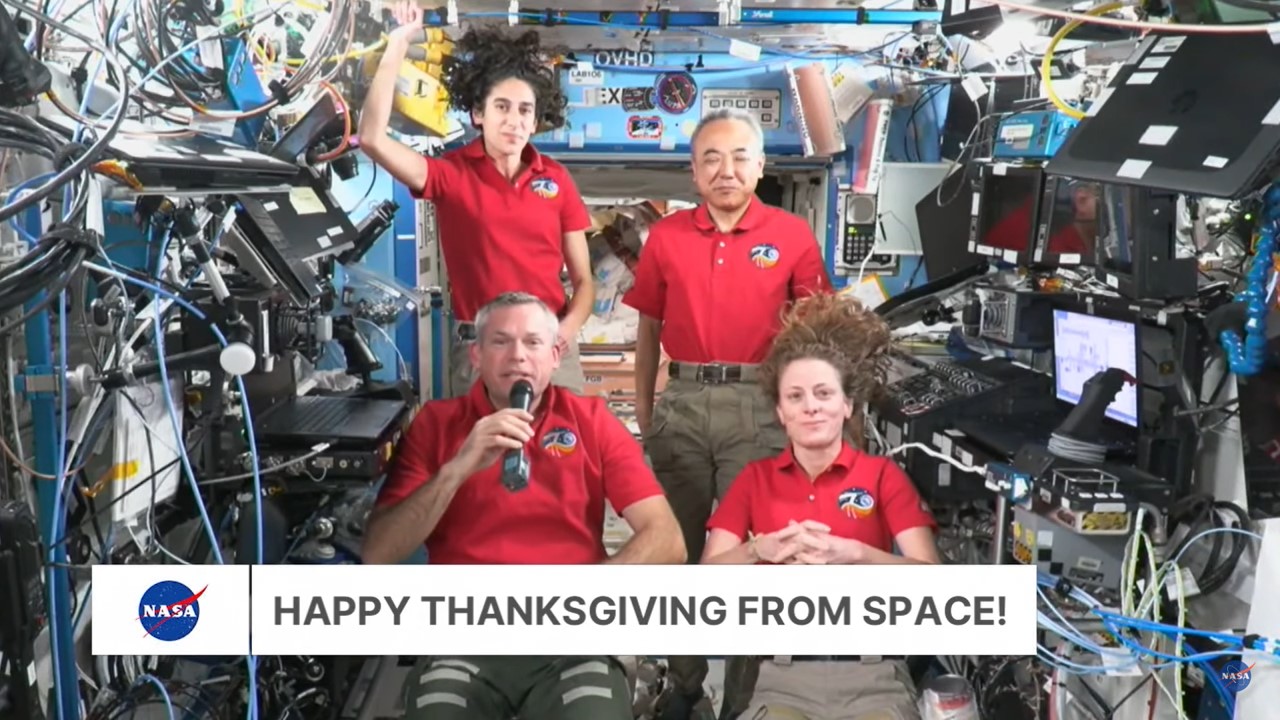
Expedition 70 crew members Andreas E. Mogensen, of the European Space Agency, front left, NASA astronauts Loral A. O’Hara and Jasmin Moghbeli, and Satoshi Furukawa of the Japan Aerospace Exploration Agency beam down their Thanksgiving message to everyone on the ground
Thanksgiving 2023. Expedition 70 crew members Andreas E. Mogensen, of the European Space Agency, front left, NASA astronauts Loral A. O’Hara and Jasmin Moghbeli, and Satoshi Furukawa of the Japan Aerospace Exploration Agency beam down their Thanksgiving message to everyone on the ground.

We hope you enjoyed these stories, photographs, and videos from Thanksgivings celebrated in space. We would like to wish everyone here on the ground and the seven-member crew of Expedition 70 aboard the space station a very happy Thanksgiving!

Share

Details

Last Updated

Nov 22, 2023

Related Terms

Powered by WPeMatico

Get The Details…
Kelli Mars

‘Digital Winglets’ for Real Time Flight Paths 

‘Digital Winglets’ for Real Time Flight Paths 

5 min read

‘Digital Winglets’ for Real Time Flight Paths 

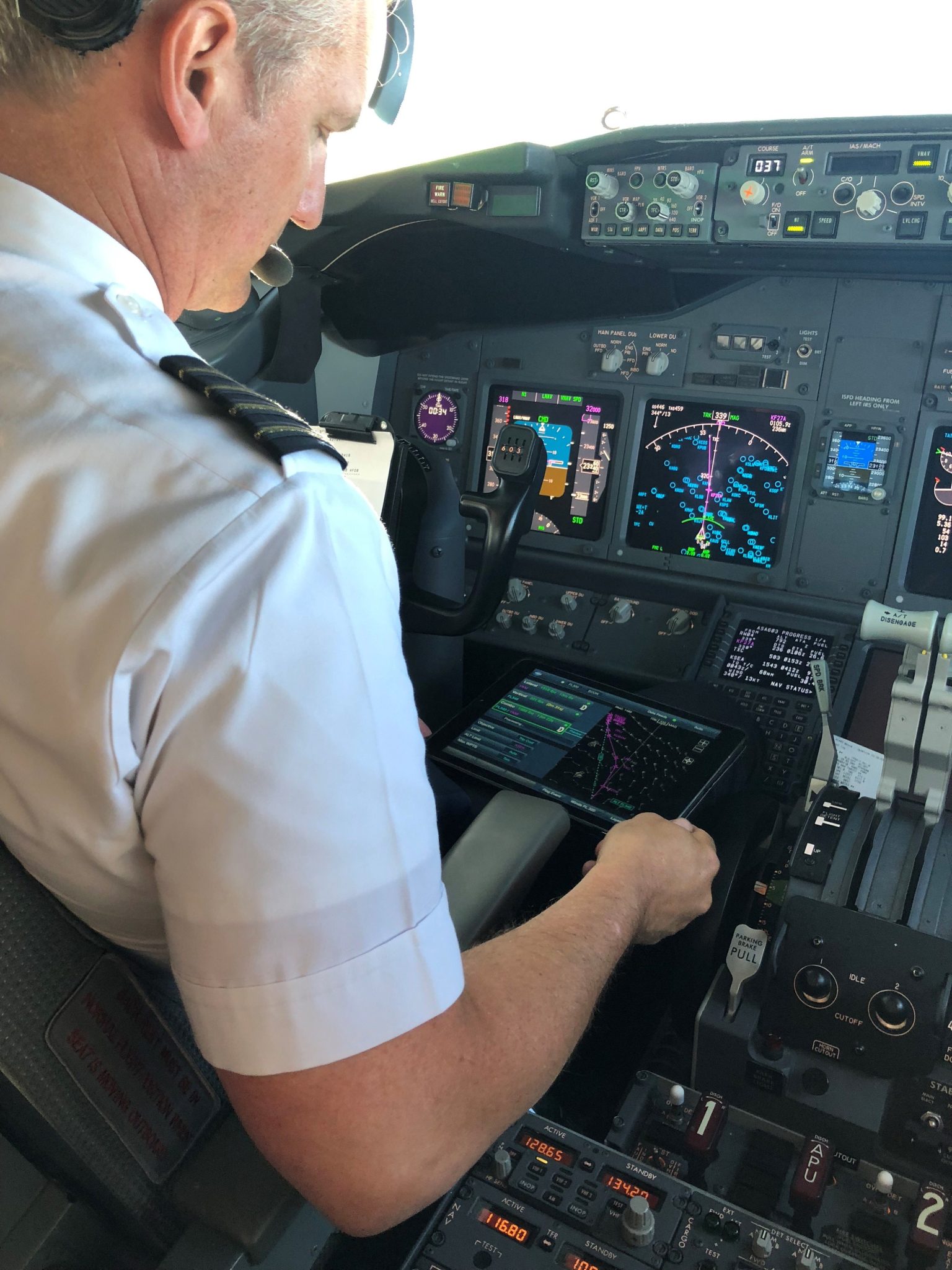
Alaska Airlines Captain Bret Peyton looks at route options presented on an Electronic Flight Bag.
Alaska Airlines Captain Bret Peyton looks at route options presented by Traffic Aware Strategic Aircrew Requests (TASAR) during a test of the software at Langley Research Center. The program connects to onboard systems and runs on a tablet called an Electronic Flight Bag.
Credit: David Wing

Before airplanes even reach the runway, pilots must file a plan to inform air traffic controllers where they’re going and the path they are going to take. When planes are in the air, however, that plan often changes. From turbulence causing passenger discomfort and additional fuel use to unexpected weather patterns blocking the original path, pilots have to think on the fly and inform air traffic controllers of any modifications to their routes.

In the past, these changes would have to happen suddenly and with little lead time. But as airplanes have become more digitally connected, the flying machines can take advantage of the additional data they receive, and a NASA-developed technology can help pilots find the best path every time. 

NASA has explored methods to improve aircraft efficiency since its inception. Among the agency’s most famous contributions are winglets, upturned vertical flanges at the ends of airplane wings that eliminate turbulence at the wingtip and significantly save fuel. Fuel efficiency is critical to future aircraft development, as it not only improves performance and the weight it can carry but also reduces the amount of greenhouse gases released into the atmosphere.

David Wing, principal researcher of air traffic management at NASA’s Langley Research Center in Hampton, Virginia, develops advanced autonomy systems for aircraft, allowing operators to directly manage flight paths in crowded skies. He noticed some of the same technology used for safe routing could also optimize routes for flights already in the air. Allowing pilots to identify a better path as soon as it’s available could save time and money.

“Air traffic control is there to keep the aircraft safely separated from other aircraft,” said Wing. “So, the trick is, when you need to change your routing, what route do you ask for, and how much will it save you?”

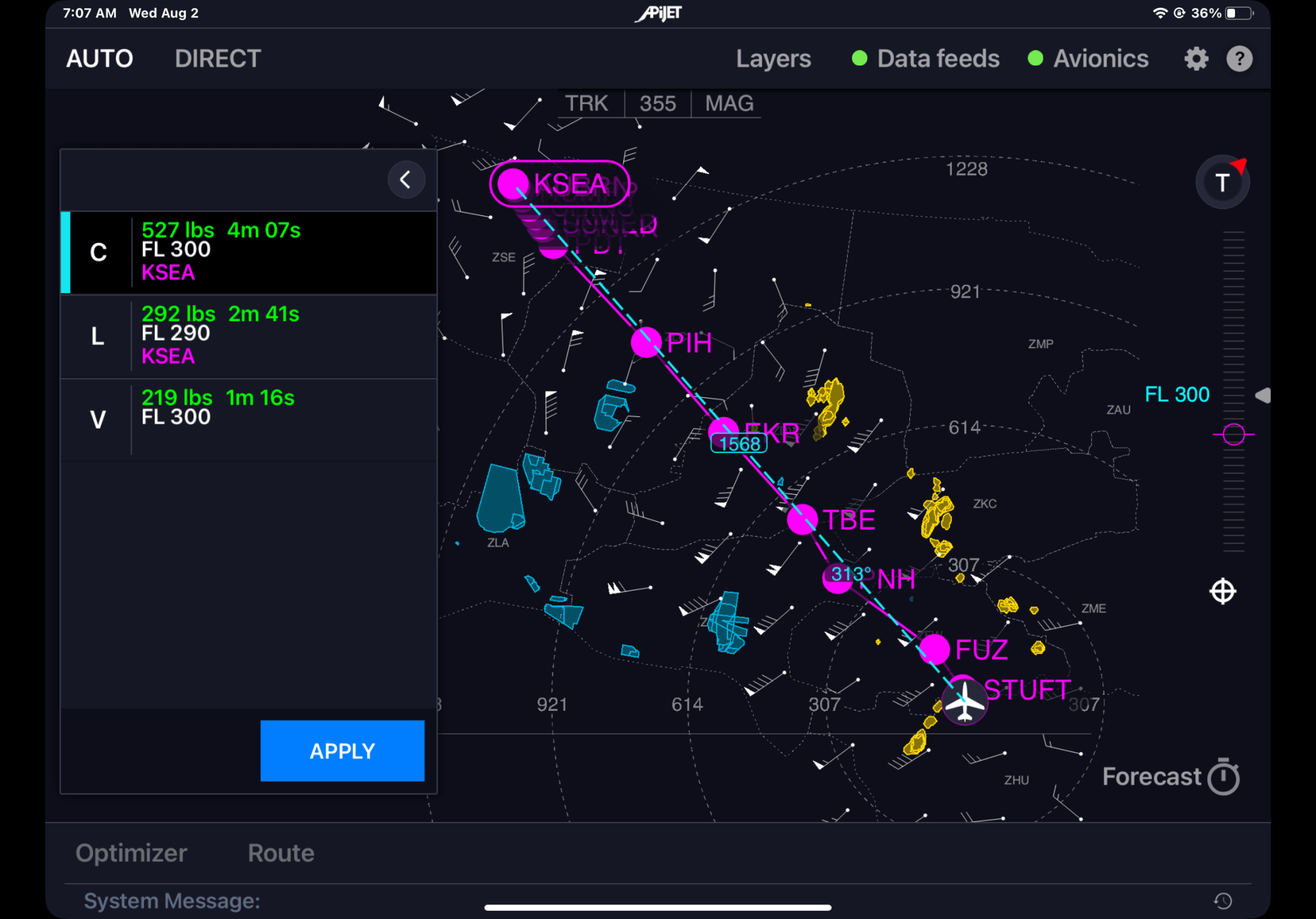
A screenshot of the APiJET Digital Winglets software.
In this screenshot of the APiJET Digital Winglets software based on NASA technology, a route is plotted along navigational waypoints, presenting three options that would save fuel and time based on real-time information.
Credit: APiJET LLC

Under Wing’s lead, NASA developed Traffic-Aware Strategic Aircrew Requests (TASAR), a piece of software pilots and ground operations teams can use to find better routes in transit. TASAR uses a genetic algorithm, a machine learning system that finds the optimal answer by pitting hundreds of route changes against each other and seeing which one comes out on top. TASAR takes a map of the area and draws hundreds of lines radiating from the airplane. These lines represent potential routes the plane could take. The software whittles down every route it generates, avoiding ones that stray into no-fly zones or dangerous weather systems or get too close to other aircraft until it’s found the most efficient route the airplane can take. Then, it’s up to the pilot to take the computer’s advice. Information is constantly updated using sensors on the airplane and connections to ground-based services, which TASAR takes into account.

“The algorithms had been tested and matured already for many years in our research, so they were in pretty good shape,” Wing said. “But we had to connect this system to a real aircraft, which meant that we needed to be able to access data from the onboard avionics.”

On NASA test flights, the software worked perfectly, but for TASAR to break into more flights, commercial planes needed to be able to access large amounts of data. As it turned out, a solution was close at hand.

The company iJET originally built components that could keep planes connected to the latest information available on the ground, which often wasn’t available in the sky. After developing better antennas, the company soon began working on a new integrated computer system for airplanes to collect data and stay connected to ground-based information sources. When looking for a “killer app” for the system, the company discovered TASAR.

“We saw that NASA was getting to the conclusion of this work, and we took a business decision to pick up the baton,” said Rob Green, CEO of the company.

After being acquired by another company called Aviation Partners, the Seattle-based company was renamed APiJET in 2018 and became the first company to license TASAR from NASA. APiJET proceeded to tie the software to the in-flight computer system. The company’s version of TASAR is called Digital Winglets, named after the NASA invention.

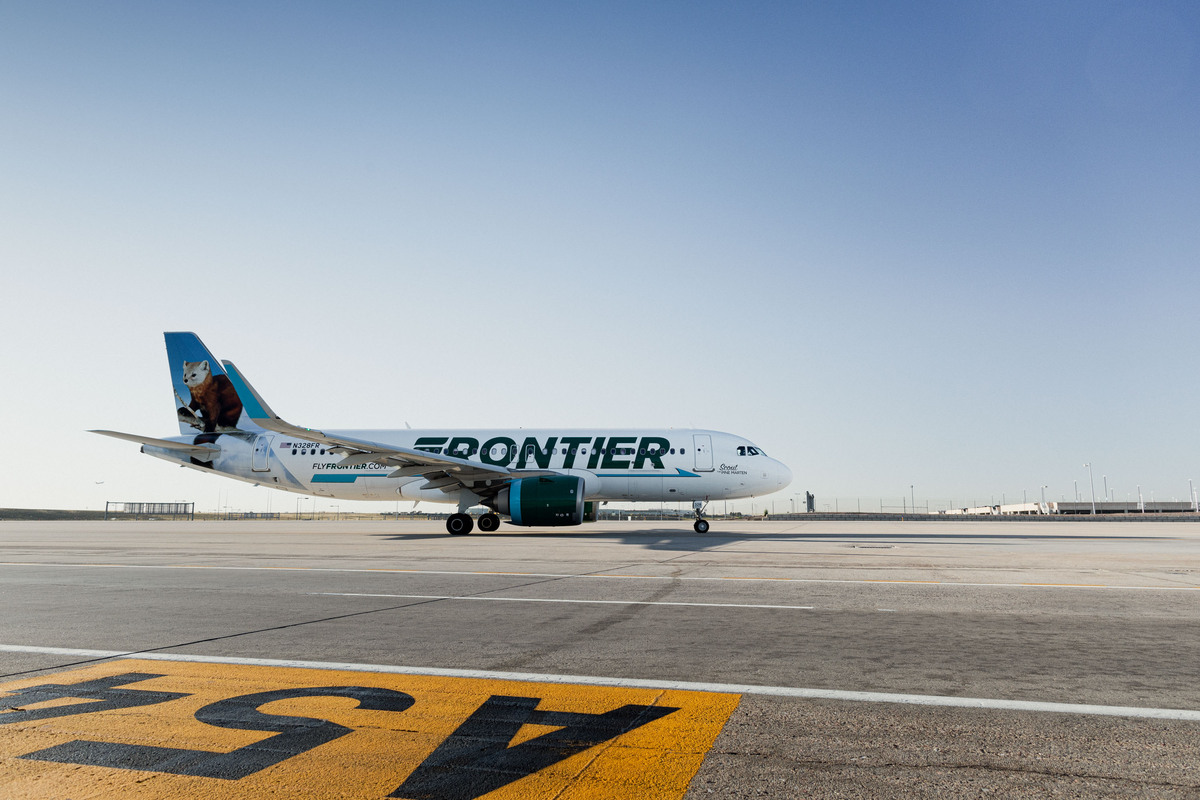
Frontier Airlines passenger plane on runway.
Frontier Airlines was among the first companies to test Digital Winglets for its fleet of aircraft. In testing, the commercial implementation of NASA’s TASAR technology provided fuel savings of 2%, which adds up at airline scale.
Credit: Frontier Airlines

The app runs on electronic flight bags, computer devices approved for use in flight operations by the Federal Aviation Administration, most commonly Apple iPads. Green said there are no plans to integrate it directly into a cockpit instrument panel because updating an app is easier. In testing with Alaska Airlines, Green said the program saved 2% on fuel, working out to approximately 28,000 pounds of fuel per hundred flights.

“Two percent may not sound like much, but little savings can really add up at airline scale,” Green said. 

Several more airlines have tested the technology, and Frontier Airlines is currently field testing for a potential deployment of Digital Winglets across its fleet. APiJET still keeps in touch with the developers at NASA to further research TASAR’s benefits and build out its commercial capabilities.

“Everybody that worked on TASAR at NASA should be really proud of their direct impact on fuel savings and carbon reduction,” Green said. “It’s a lot to wrap your head around, but it works.”

NASA has a long history of transferring technology to the private sector. The agency’s Spinoff publication profiles NASA technologies that have transformed into commercial products and services, demonstrating the broader benefits of America’s investment in its space program. Spinoff is a publication of the Technology Transfer program in NASA’s Space Technology Mission Directorate (STMD).

For more information on how NASA brings space technology down to Earth, visit:

www.spinoff.nasa.gov

Share

Details

Last Updated

Nov 22, 2023

Powered by WPeMatico

Get The Details…
Andrew Wagner

Science on Station: November 2023

Science on Station: November 2023

7 min read

Science on Station: November 2023

Inspiring Students with Ham Radio, Other Educational Programs

As an orbiting microgravity laboratory, the International Space Station hosts experiments from almost every scientific field. It also is home to educational programs to encourage young people worldwide to study science, technology, engineering, and mathematics (STEM). These programs aim to inspire the next generation of space scientists and explorers and experts who can solve problems facing people on Earth.

The first and longest running educational outreach program on the space station is ISS Ham Radio. An organization known as Amateur Radio on the International Space Station, or ARISS, helps run the program. ARISS is a partnership between NASA, the American Radio Relay League, the Radio Amateur Satellite Corporation, amateur radio organizations, and multiple international space agencies. Students use amateur or ham radio to talk with astronauts, asking them questions about life in space, career opportunities, and other space-related topics. Three contacts with schools in Australia and Canada were scheduled during the month of November 2023.

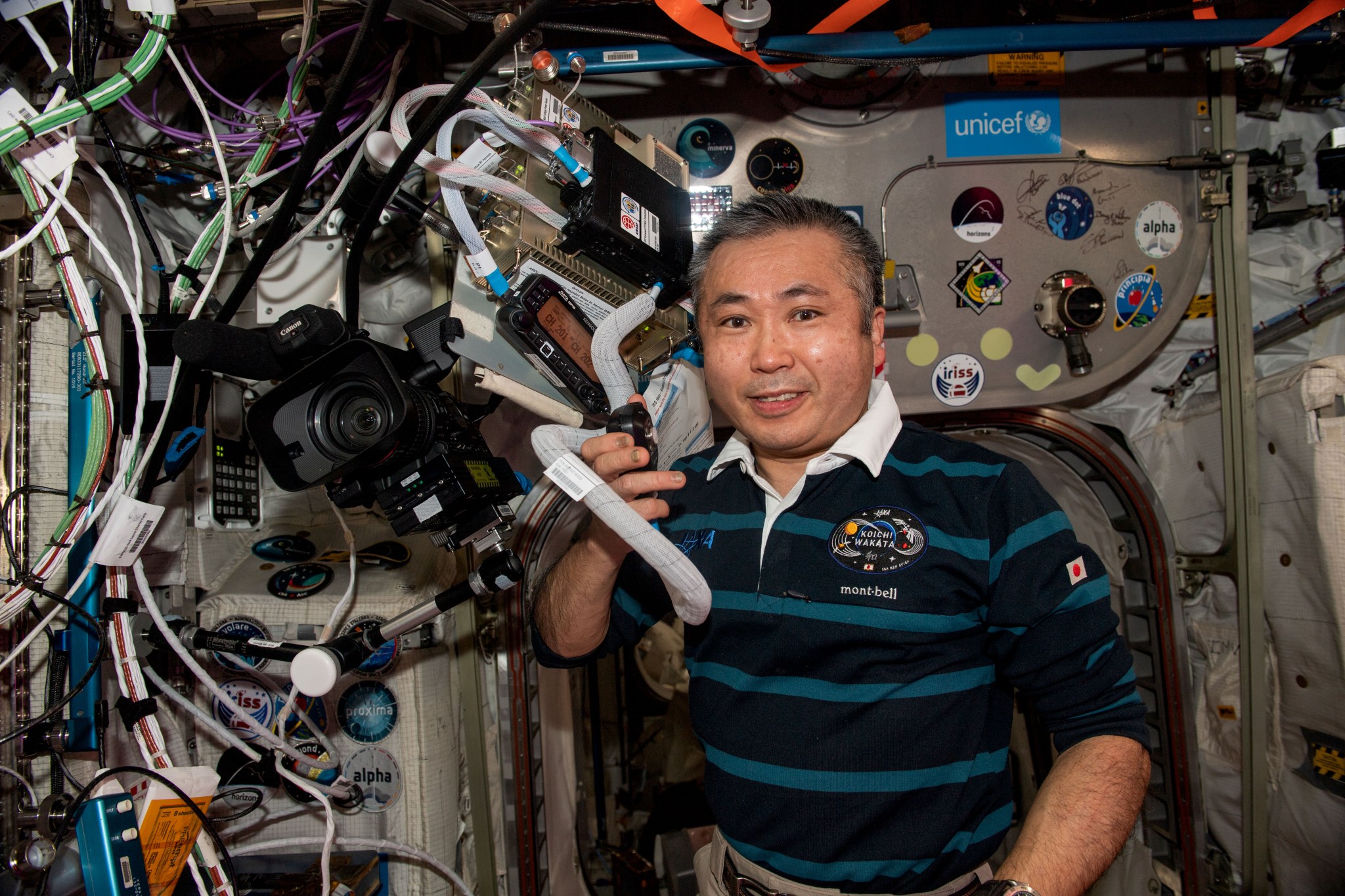
Koichi Wakata, wearing a striped shirt, faces the camera, holding the ham radio mic in his right hand. It is attached by a large grey cable to the radio set above his head. A large camera and tangles of wires are next to him.
JAXA astronaut Koichi Wakata during a ham radio session.
NASA

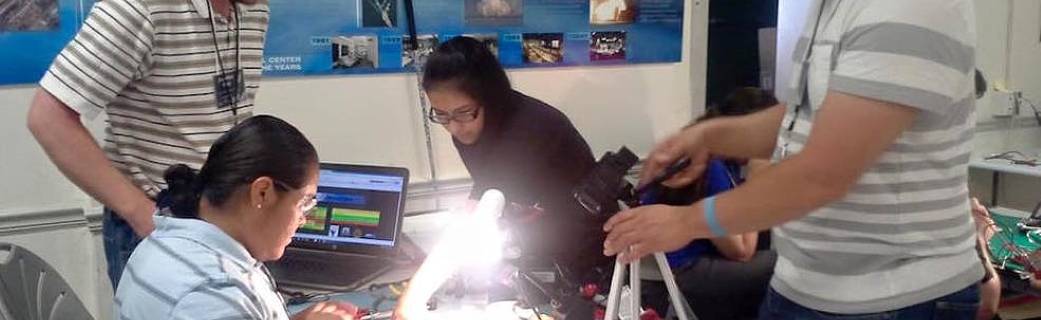
Before a contact, students help set up a ground radio station and study radio waves, space technology, the space station, geography, and the space environment. Contact events have been held with schools from kindergarten through 12th grade, universities, scout groups, museums, libraries, and after school programs, and at national and international events. Approximately 15,000 to 100,000 students are involved directly each year and thousands more people in their communities witness these contacts directly or through the news media.

Rita Wright, a teacher at Burbank School in Burbank, IL, one of the first to have a contact with the space station, reported on the extensive study and preparation by the students there.1 She noted that their contact was “an interdisciplinary learning experience for all grades across a variety of academic concentrations that included math, science, reading, writing and art…. The transformation that took place was quite revolutionary. We came closer together as a school.” Students talked extensively about the experiment and parents pitched in and helped because they sensed how special the event was and wanted to be a part of it.

Wright adds that ripple effects continued long after the December 2000 contact with astronaut William Shepherd. Staff members were inspired to look for other interdisciplinary projects and many students talked about pursuing careers associated with the space industry.

After a contact at Sonoran Sky Elementary School in Scottsdale, AZ, teacher Carrie Cunningham reported that the students started an after-school Amateur Radio Club and that, “sparked by the excitement of the ARISS contact, many students have shown an interested in pursuing their own Amateur Radio experience.”2

“There is a sense of accomplishment that results from the school and the students setting up and conducting the ISS ham contact themselves,” Cunningham reported. “The students better understand how NASA and the other international space agencies conduct science in space. The unique, hands-on nature of the amateur radio contact provides the incentive to learn about orbital mechanics, space flight, and radio operations.”

In a 2018 conference presentation, members of the ARISS staff noted that the program and its predecessors have jump-started countless careers, touched millions of people from all walks of life, and even become local and international phenomena. Participants have ranged from disadvantaged students to heads of states, and the program has been mentioned in IMAX films, numerous television shows, and commercials.3

A group of educators from Australia recently looked at how ham radio affected student interest in STEM subjects. They found that the program has a significant and positive impact on students and that interest in all STEM areas increases as a direct result of contacts.4

That research also reported a strong belief among teachers that astronauts provide outstanding examples of role models for their students. While the greatest changes in student interests occurs with primary school age students, the program also creates strong change in the interests of high school students.

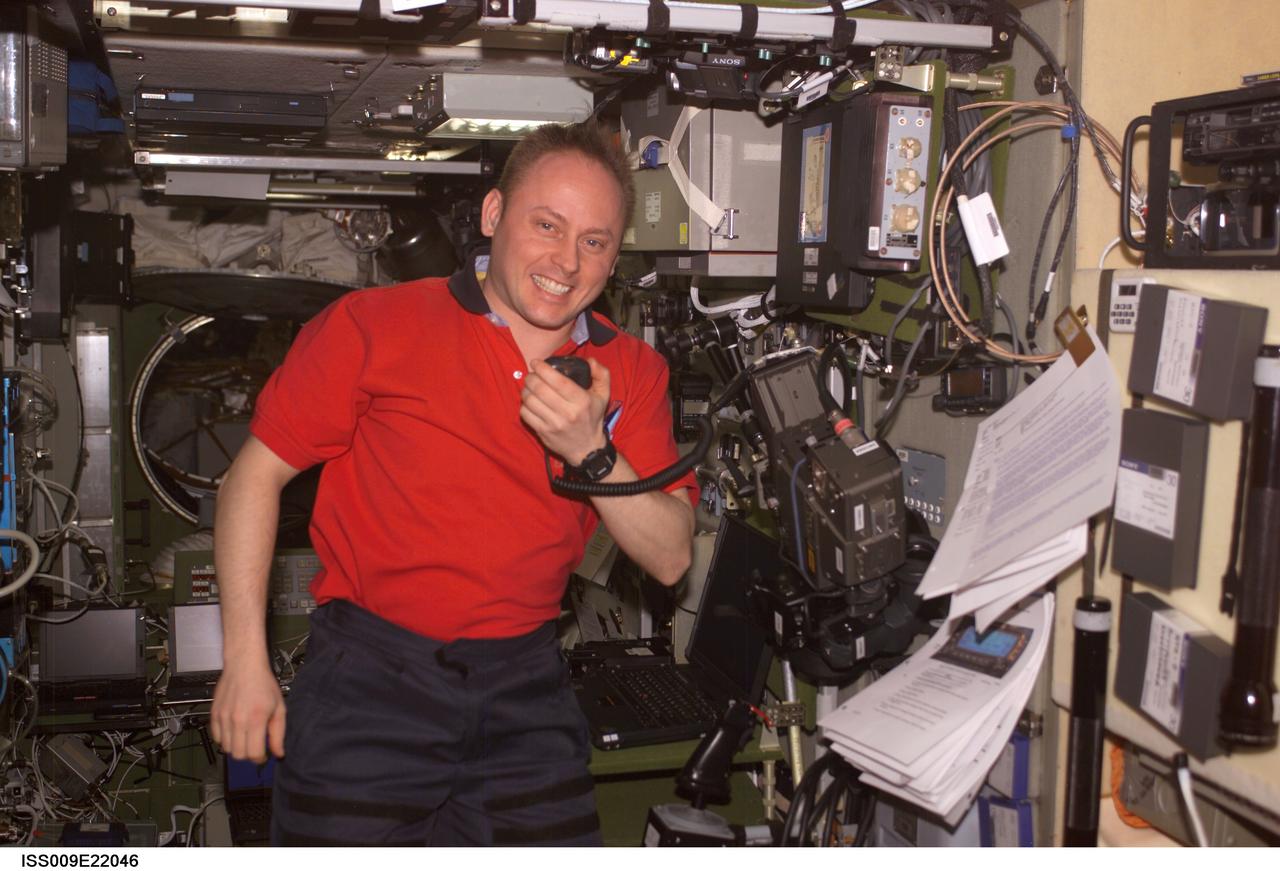
Mike Fincke wears a red shirt and smiles at the camera as he holds the ham radio mic in his left hand next to the radio set. Sheafs of paper are clipped to the wall in front of him and equipment covers the wall behind him.
NASA astronaut Edward M. (Mike) Fincke uses the station’s ham radio set during Expedition 9.
NASA

Patricia Palazzolo was the coordinator for gifted education in the Upper St. Clair School District in Pennsylvania during a 2004 contact with NASA astronaut Mike Fincke. She wrote a report about the event, noting that the positive impact of the program goes far beyond the numbers. “All of my students who have participated … have gone on to phenomenal accomplishments and careers that contribute much to society. Almost all have opted for careers in science, technology, or science-related fields.”

Ham radio experiences help students make real-world connections among disciplines, teach problem-solving under the pressure of deadlines, hone communication skills, and illustrate the importance of technology.5 For the adults involved, contacts highlight the significance of sharing skills with others and provide an opportunity to model the power of passion, partnership, and persistence.

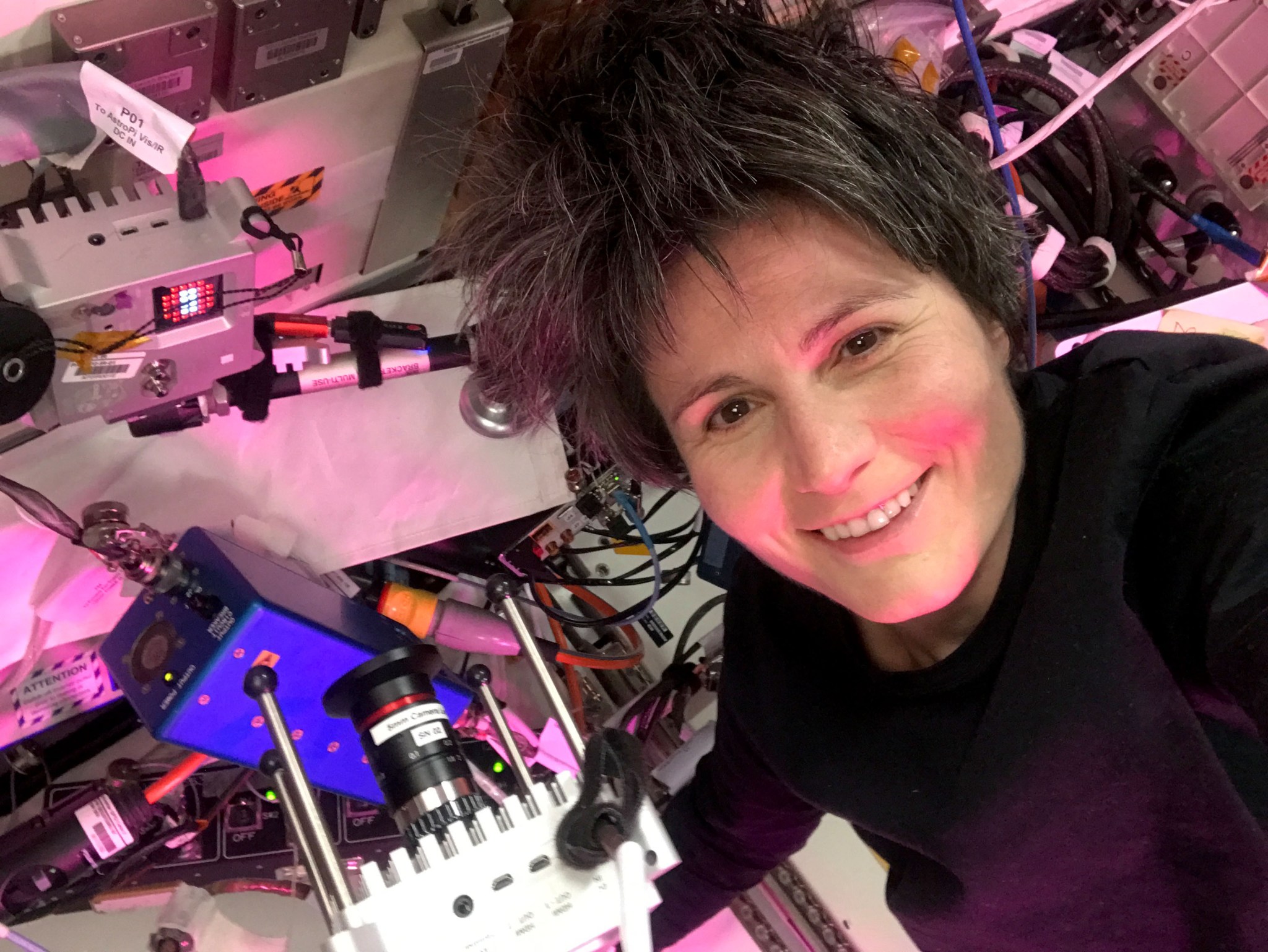
AstroPi is an educational program from ESA (European Space Agency) where primary and secondary school students design experiments and write computer code for one of two Raspberry Pi computers on the space station. The computers are equipped with sensors to measure the environment inside the spacecraft, detect how the station moves through space, and pick up the Earth’s magnetic field. One of them has an infrared camera and the other a standard visible-spectrum camera. 

One student project used the visible camera to observe small-scale gravity waves in different regions in the northern hemisphere.6 Atmospheric gravity waves transport energy and momentum to the upper layers of the atmosphere. These phenomena can be detected by visual patterns such as meteor trails, airglow, and clouds.

Samantha Cristoforetti, wearing a long-sleeved purple shirt, smiles at the camera. Hardware floating next to her includes a partly visible AstroPi with a black camera attached and a silver AstroPi with red and white lights.
ESA astronaut Samantha Cristoforetti poses with the AstroPi equipped with a visual camera.
NASA

YouTube Space Lab was a world-wide contest for students ages 14 to 18 to design an experiment about physics or biology using video. Two proposals were selected from 2,000 entries received from around the world. One of those documented the ability of the Phidippus jumping spider to walk on surfaces and make short, direct jumps to capture small flies in microgravity.7

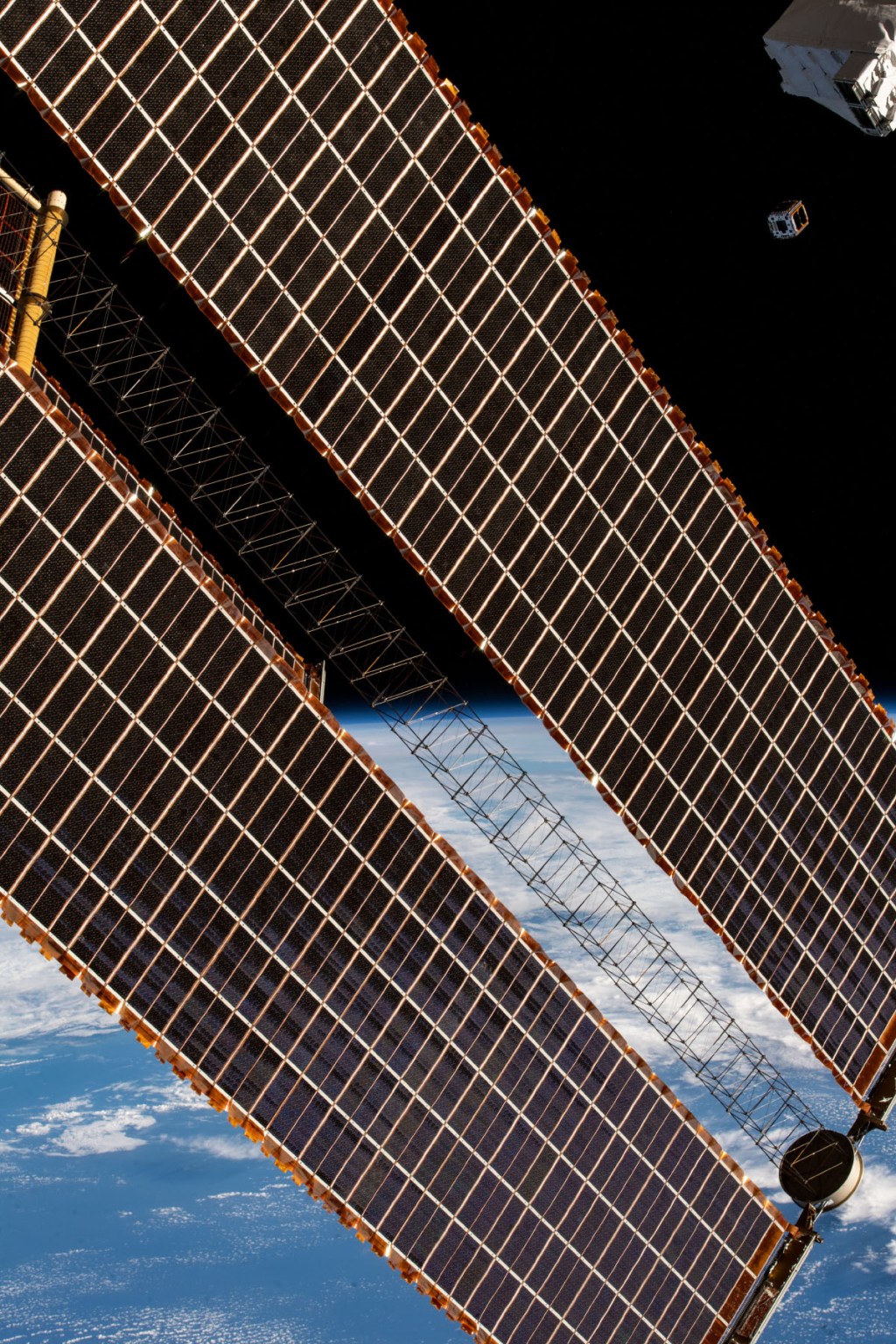
Other space station facilities that host student-designed projects include CubeSat small satellites, TangoLab, the Nanoracks platform, and Space Studio Kibo, a JAXA (Japan Aerospace Exploration Agency) broadcasting studio.

NASA is committed to engaging, inspiring, and attracting future explorers and building a diverse future STEM workforce through a broad set of programs and opportunities. The space station is an important part of that commitment.

John Love, ISS Research Planning Integration Scientist
Expedition 70

Search this database of scientific experiments to learn more about those mentioned above. Space Station Research Explorer.

Citations:

  1. Wright RL. Remember, We’re Pioneers! The First School Contact with the International Space Station. AMSAT-NA Space Symposium. Arlington, VA. 2004 9pp.
  2. Cunningham C. NA1SS, NA1SS, This is KA7SKY Calling…… AMSAT-NA Space Symposium, Arlington, VA. 2004
  3. Bauer F, Taylor D, White R. Educational Outreach and International Collaboration Through ARISS: Amateur Radio on the International Space Station. 2018 SpaceOps Conference, Marseille, France. 2018 28 May – 1 June; 14 pp. DOI: 10.2514/6.2018-2437.
  4. Diggens, M., Williams, J., Benedix, G. (2023). No Roadblocks in Low Earth Orbit: The Motivational Role of the Amateur Radio on the International Space Station (ARISS) School Program in STEM Education. Space Education & Strategic Applications. https://doi.org/10.18278/001c.89715
  5. Palazzolo P. Launching Dreams: The Long-term Impact of SAREX and ARISS on Student Achievement. AMSAT-NA Space Symposium, Pittsburgh, PA. 2007 18pp.
  6. Magalhaes TE, Silva DE, Silva CE, Dinis AA, Magalhaes JP, Ribeiro TM. Observation of atmospheric gravity waves using a Raspberry Pi camera module on board the International Space Station. Acta Astronautica. 2021 May 1; 182416-423. DOI: 10.1016/j.actaastro.2021.02.022
  7. Hill DE. Jumping spiders in outer space (Araneae: Salticidae). PECKHAMIA. 2016 September 17; 146(1): 7 pp.

Powered by WPeMatico

Get The Details…
aclloyd

What Is the Artemis Program? (Grades 5-8)

What Is the Artemis Program? (Grades 5-8)

This article is for students grades 5-8.

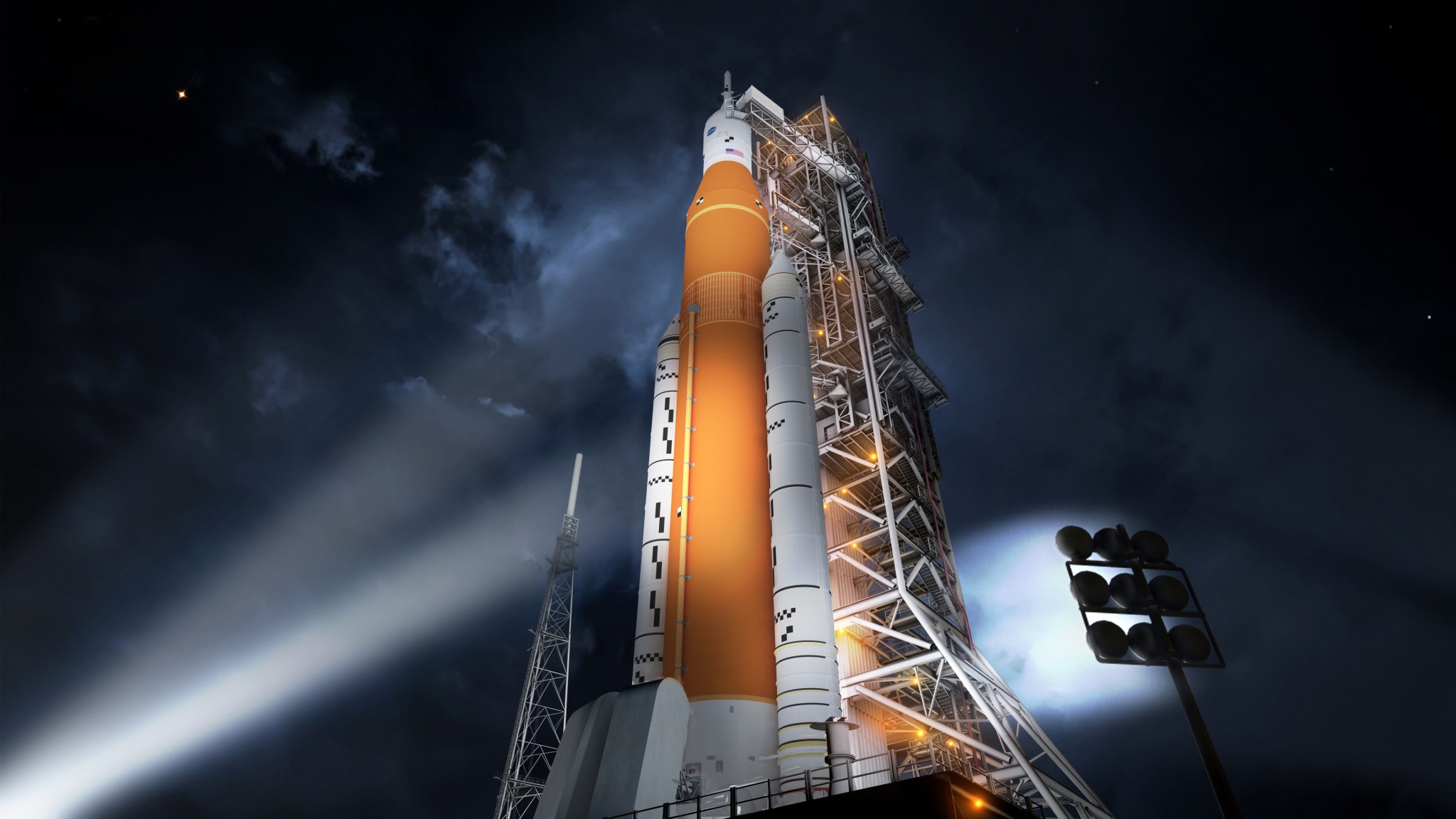
sls orion em-1 block 1 night launch pad

Artemis is NASA’s new lunar exploration program, which includes sending the first woman and first person of color on the Moon. Through the Artemis missions, NASA will use new technology to study the Moon in new and better ways, and prepare for human missions to Mars.

Why Is This Program Called Artemis?

The first missions to take astronauts to the Moon were called the Apollo Program. In 1961, President John F. Kennedy challenged the nation to land astronauts on the Moon by the end of the decade. NASA met that challenge with the Apollo program, landing the first man on the Moon on July 20, 1969. That program was named after a god of Greek mythology, Apollo.
Artemis was Apollo’s twin sister and the goddess of the Moon in Greek mythology. When they land, Artemis astronauts will stand where no human has ever stood: the Moon’s South Pole.

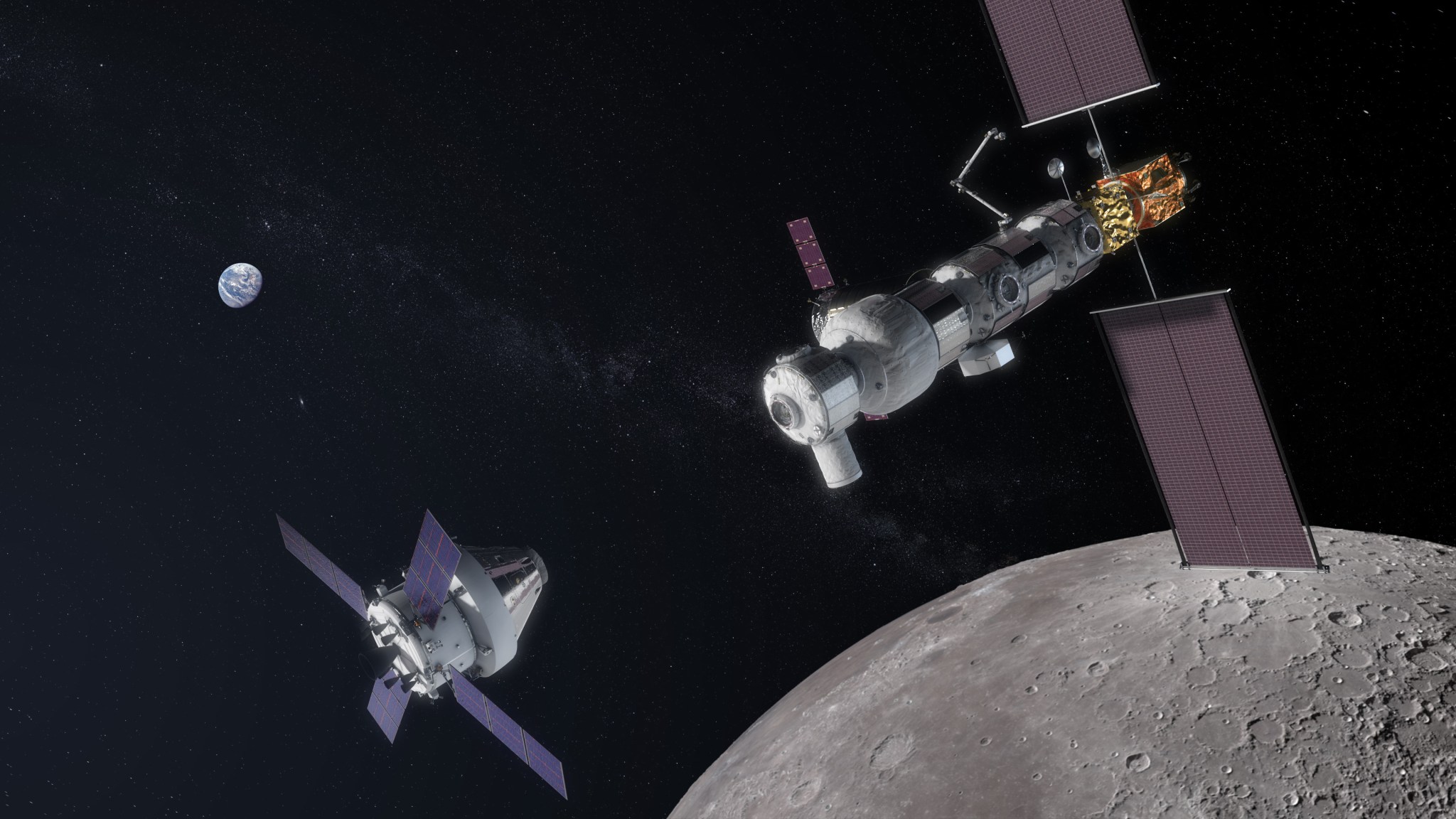
Illustration of Orion preparing to dock at Gateway

What Spacecraft Will Be Used for the Artemis Program?

NASA’s new rocket is the Space Launch System (SLS). It is the most powerful rocket ever in the world. SLS will carry the Orion spacecraft with up to four astronauts riding aboard to lunar orbit. Then, astronauts will dock Orion at a small spaceship called the Gateway. This is where astronauts will prepare for missions to the Moon and beyond. The crew will take trips from the Gateway to the lunar surface in a new human landing system, and then return to the Gateway. When their work is finished, the crew will return to Earth aboard Orion.

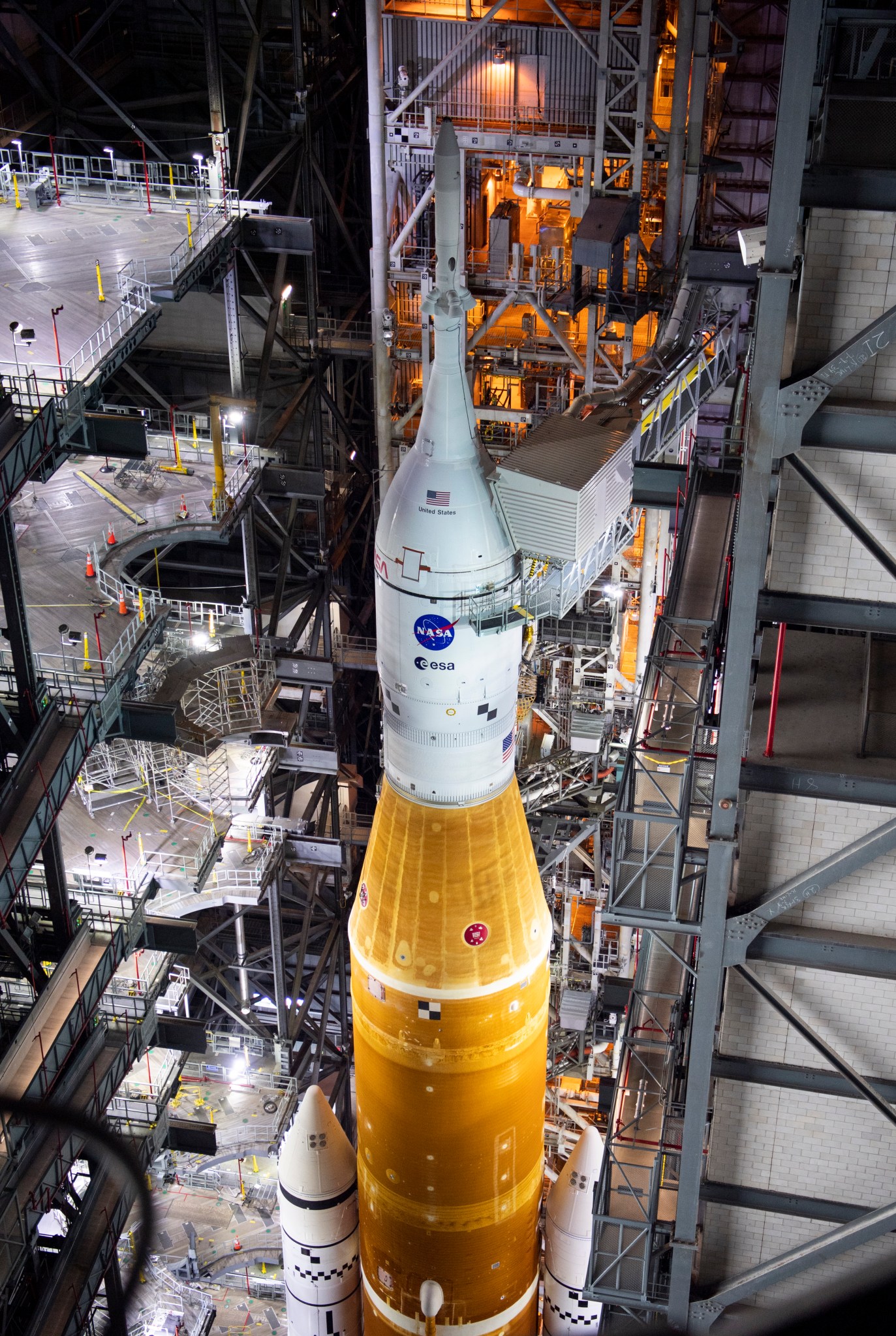
NASA’s Space Launch System (SLS) rocket with the Orion spacecraft aboard is seen atop a mobile launcher in High Bay 3 of the Vehicle Assembly Building before rolling out to Launch Complex 39B for the first time, Wednesday, March 16, 2022

When Will Artemis Go to the Moon?

Before Apollo put the first human on the Moon, the first Apollo missions launched to test the rocket and equipment. Before Artemis carries a crew to the Moon, NASA will test the rocket and spacecraft in flight then send a crew for a test flight:

  • Artemis 1 will be a test flight of the SLS rocket with the Orion spacecraft with no crew.
  • Artemis 2 will fly SLS and Orion with a crew past the Moon, then circle it and return to Earth. This trip will be the farthest any human has gone into space.
  • Artemis 3 will send a crew with the first woman and the next man to land on the Moon.

What Will Artemis Astronauts Do on the Moon?

The Artemis 3 crew will visit the Moon’s South Pole. No one has ever been there. At the Moon, astronauts will:

  • Search for the Moon’s water and use it.
  • Study the Moon to discover its mysteries.
  • Learn how to live and work on the surface of another celestial body where astronauts are just three days from home.
  • Test the technologies we need before sending astronauts on missions to Mars, which can take up to three years roundtrip.
Animated Artemis identity with the Earth and Moon
Artemis will light our way to Mars. The new Artemis identity draws bold inspiration from the Apollo program and forges its own path, showing how it will pursue lunar exploration like never before and pave the way to Mars.

Why Is the Artemis Program Important?

The Moon is a good place to learn new science. When astronauts study new places on the lunar surface, NASA will learn more about the Moon, Earth and even the Sun. The Moon is a “test bed” for Mars. A test bed is a place to prove that a technology or idea will work. The Moon is a place to demonstrate that astronauts will one day be able to work away from Earth on Mars for long periods of time.
The first missions to the Moon required NASA to develop new technology. Many of those technologies have been made into items people use on Earth in their everyday lives. NASA is working with businesses and companies to create new technology for Artemis missions. Making new technology helps businesses grow and create more jobs on Earth. Other nations will work with NASA as partners. Just as partners work together on the International Space Station, they will work on Artemis to bring the world together for a mission to Earth’s nearest neighbor in space.

 
More About Artemis
Puzzle Book
Poster: SLS: Meet the Rocket
Pencil and Paper Puzzles: Orion Activities and Coloring Sheets For Kids
Video: Rocket Science in 60 Seconds: What Is the Space Launch System?
Video: We Are Going
Article: What Is the Space Launch System?
Article: What Is Orion?
Article: What Was the Apollo Program?
Article: What Is the International Space Station?
 

Read What Is the Artemis Program? (Grades K-4)

Powered by WPeMatico

Get The Details…
Jennifer B. Adams