Advanced Tech and Heart Health Top Monday’s Research Schedule

Advanced Tech and Heart Health Top Monday’s Research Schedule

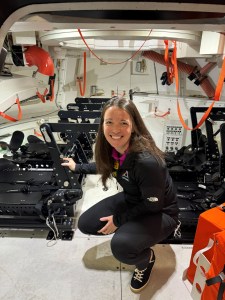
NASA astronaut and Expedition 73 Flight Engineer Zena Cardman installs sample cassettes into the ADSEP-4 (Advanced Space Experiment Processor) located inside the International Space Station's Destiny laboratory module. She was conducting research operations for the Pharmaceutical In-space Laboratory biotechnology experiment, which is investigating methods to advance pharmaceutical manufacturing in microgravity.
NASA astronaut Zena Cardman processes samples and conducting research operations for a biotechnology experiment investigating methods to advance pharmaceutical manufacturing in microgravity.
NASA

Expedition 74 kicked off the week exploring robotics, physics, and heart health aboard the International Space Station. The orbital residents also continued packing a Japanese cargo craft while servicing and inspecting lab hardware.

NASA Flight Engineer Zena Cardman swapped a memory card and verified the functionality of the docking interface that supports the Astrobee free-flying robotic helpers. The cube-shaped, toaster-sized Astrobees—being tested for their ability to assist astronauts with routine tasks—are attached to the docking station for recharging, data transfers, and systems monitoring. The maintenance work sets up the Astrobees for a test run of an educational robotic challenge that allows students to create programs that control the robotic devices on the station.

Cardman also set up hardware for an experiment that will demonstrate how Indium, a liquid metal, flows in space. The investigation takes place in an EXPRESS rack located inside the Destiny laboratory module, heats the Indium samples to between 200 and 400 degrees Celsius, and observes the metal’s behavior. Results may lead to advanced space repair techniques such as soldering metal parts and improved satellite thrusters for longer service life.

Roscosmos cosmonaut Oleg Platonov began his shift exploring how microgravity and space radiation affect the thin layer of cells lining a crew member’s blood vessels, also called the endothelium. He wore electrodes on his chest and finger cuffs that measured his blood flow and blood pressure to help doctors protect crew health and advance cardiac research on Earth. At the end of his shift, Platonov installed a camera and programmed it to automatically photograph Earth landmarks from Asia to South America in a variety of wavelengths during the crew’s sleep shift.

Station Commander Mike Fincke spent his shift moving decommissioned life support station hardware from the Tranquility module and into the HTV-X1 cargo spacecraft from JAXA (Japan Aerospace Exploration Agency). Cardman, NASA Flight Engineer Chris Williams, and JAXA Flight Engineer Kimiya Yui assisted Fincke with the hardware transfers that will see the obsolete gear disposed of when HTV-X1 departs the orbital outpost in late January.

Afterward, Williams peered at stem cell samples using the KERMIT fluorescence microscope for a study that may enable superior stem cell manufacturing in space and advance regenerative medicine for patients on Earth. When the stem cell observations were complete, Yui turned off the microscope and temporarily stowed the research components for a later experiment run.

Roscosmos Flight Engineer Sergey Kud-Sverchkov spent the first half of his shift inside the Zvezda service module replacing orbital plumbing gear. He spent the last half of his shift inspecting module hatches, cleaning smoke detectors, and inventorying personal hygiene items. Flight Engineer Sergei Mikaev also started his shift in Zvezda but worked on ventilation system maintenance, then wrapped up his day photographing flow converters—instrumentation that manages water, air, coolant, and experimental fluids—for inspection and analysis.

Learn more about station activities by following the space station blog, @space_station on X, as well as the ISS Facebook and ISS Instagram accounts.

Get the latest from NASA delivered every week. Subscribe here.

Powered by WPeMatico

Get The Details…

Mark A. Garcia

NextSTEP-3 B: Moon to Mars Architecture Studies

NextSTEP-3 B: Moon to Mars Architecture Studies

Notice ID: M2M-MSFC-0001

NAICS Codes:

  • 541715 – Research and Development in the Physical, Engineering, and Life Sciences (except Nanotechnology and Biotechnology)

NASA seeks industry-led architecture concept development, concept refinement studies, and risk-reduction activities that address Moon to Mars Architecture gaps through the Next Space Technologies for Exploration Partnerships-3 (NextSTEP-3). NASA plans to release this solicitation — NextSTEP-3 Appendix B: Moon to Mars Architectural Studies — near the beginning of calendar year 2026. For full details, consult the links under the notice ID above.

NASA’s Moon to Mars Architecture defines capabilities needed for long-term, human-led scientific discovery in deep space. The agency’s architecture approach distills agency-developed objectives into capabilities and elements that support exploration and science goals. NASA continuously evolves that blueprint for crewed exploration, setting humanity on a path to the Moon, Mars, and beyond by collaborating with experts across industry, academia, and the international community.

This proposed solicitation seeks partner participation on a recurring basis, targeting several calls per year for proposal submissions. The proposals should focus on topics addressing infrastructure, transportation, habitation, concepts of operations, and planetary science capabilities identified in the latest revision of the Architecture Definition Document. The solicitation establishes a flexible acquisition strategy that accommodates both directed-topic calls on specific areas of government interest, as well as open topic calls.

NASA anticipates the first Appendix B directed-topic study calls will focus on lunar and Mars mission concepts. NASA intends to issue a directed call for research into an integrated surface power infrastructure (or power grid) that can evolve to support increasingly ambitious lunar missions. (Note: this call excludes proposals addressing the Fission Surface Power System Announcement for Partnership Proposal but may include all technology solutions including alternate fission, solar hybrid, or other power grid approaches.)

Concurrently, NASA will issue a directed call for Mars crew transportation concept development, trade studies, and identification of risk reduction activities. This call would include in-space transportation, Mars surface access, and Mars ascent options for crew and cargo.

Powered by WPeMatico

Get The Details…
Danny Baird

Bassac River, Southern Vietnam

Bassac River, Southern Vietnam

A view of a brown river and an islet from the International Space Station. The land visible on the right is mostly dark green, while the land on the left is brown with green edges along the river. Clumps of smaller white clouds dot the photo, almost like lines of dots. Wispier clouds are visible along the right side of the image.
NASA

A camera on the International Space Station captured this Oct. 2, 2025, photo of the Bassac River in Cù Lao Dung, a river islet district in southern Vietnam. The Bassac River surrounds the district before emptying into the South China Sea. The river’s brown waters at its mouth result from massive amounts of silt, clay, and organic matter carried from upstream regions of the Mekong River Basin, combined with tidal forces from the sea that stir up sediment. This photograph was taken from as the space station orbited 260 miles above Earth.

Image credit: NASA

Powered by WPeMatico

Get The Details…
Monika Luabeya

NASA’s Roman Telescope Will Observe Thousands of Newfound Cosmic Voids

NASA’s Roman Telescope Will Observe Thousands of Newfound Cosmic Voids

Lee esta nota de prensa en español aquí.

Our universe is filled with galaxies, in all directions as far as our instruments can see. Some researchers estimate that there are as many as two trillion galaxies in the observable universe. At first glance, these galaxies might appear to be randomly scattered across space, but they’re not. Careful mapping has shown that they are distributed across the surfaces of giant cosmic “bubbles” up to several hundred million light-years across. Inside these bubbles, few galaxies are found, so those regions are called cosmic voids. NASA’s Nancy Grace Roman Space Telescope will allow us to measure these voids with new precision, which can tell us about the history of the universe’s expansion.

This narrated video sequence illustrates how NASA’s Nancy Grace Roman Space Telescope will be able to observe cosmic voids in the universe. These highly detailed measurements will help constrain cosmological models.
Credit: Video: NASA, STScI; Visualization: Frank Summers (STScI); Script Writer: Frank Summers (STScI); Narration: Frank Summers (STScI); Audio: Danielle Kirshenblat (STScI); Science: Giulia Degni (Roma Tre University), Alice Pisani (CPPM), Giovanni Verza (Center for Computational Astrophysics/Flatiron Inst.)

“Roman’s ability to observe wide areas of the sky to great depths, spotting an abundance of faint and distant galaxies, will revolutionize the study of cosmic voids,” said Giovanni Verza of the Flatiron Institute and New York University, lead author on a paper published in The Astrophysical Journal.

Cosmic Recipe

The cosmos is made of three key components: normal matter, dark matter, and dark energy. The gravity of normal and dark matter tries to slow the expansion of the universe, while dark energy opposes gravity to speed up the universe’s expansion. The nature of both dark matter and dark energy are currently unknown. Scientists are trying to understand them by studying their effects on things we can observe, such as the distribution of galaxies across space.

“Since they’re relatively empty of matter, voids are regions of space that are dominated by dark energy. By studying voids, we should be able to put powerful constraints on the nature of dark energy,” said co-author Alice Pisani of CNRS (the French National Centre for Scientific Research) in France and Princeton University in New Jersey.

To determine how Roman might study voids, the researchers considered one potential design of the Roman High-Latitude Wide-Area Survey, one of three core community surveys that Roman will conduct. The High-Latitude Wide-Area Survey will look away from the plane of our galaxy (hence the term high latitude in galactic coordinates). The team found that this survey should be able to detect and measure tens of thousands of cosmic voids, some as small as just 20 million light-years across. Such large numbers of voids will allow scientists to use statistical methods to determine how their observed shapes are influenced by the key components of the universe.

To determine the actual, 3D shapes of the voids, astronomers will use two types of data from Roman — the positions of galaxies in the sky and their cosmological redshift, the latter of which is determined using spectroscopic data. To convert redshift to a physical distance, astronomers make assumptions about the components of the universe, including the strength of dark energy and how it might have evolved over time.

Pisani compared it to trying to infer a cake recipe (i.e., the universe’s makeup) from the final dessert served to you. “You try to put in the right ingredients — the right amount of matter, the right amount of dark energy — and then you check whether your cake looks as it should. If it doesn’t, that means you put in the wrong ingredients.”

In this case, the appearance of the “cake” is the shape found by statistically stacking all of the voids detected by Roman on top of each other. On average, voids are expected to have a spherical shape because there is no “preferred” location or direction in the universe (i.e., the universe is both homogeneous and isotropic on large scales). This means that, if the stacking is done correctly, the resulting shape will be perfectly round (or spherically symmetric). If not, then you have to adjust your cosmic recipe.

Power of Roman

The researchers emphasized that to study cosmic voids in large numbers, an observatory must be able to probe a large volume of the universe, because the voids themselves can be tens or hundreds of millions of light-years across. The spectroscopic data necessary to study voids will come from a portion of the Roman High-Latitude Wide-Area Survey that will cover on the order of 2,400 square degrees of the sky, or 12,000 full moons. It will also be able to see fainter and more distant objects, yielding a greater density of galaxies than complementary missions like ESA’s (European Space Agency’s) Euclid.

“Voids are defined by the fact that they contain so few galaxies. So to detect voids, you have to be able to observe galaxies that are quite sparse and faint. With Roman, we can better look at the galaxies that populate voids, which ultimately will give us greater understanding of the cosmological parameters like dark energy that are sculpting voids,” said co-author Giulia Degni of Roma Tre University and INFN (the National Institute of Nuclear Physics) in Rome.

The Nancy Grace Roman Space Telescope is managed at NASA’s Goddard Space Flight Center in Greenbelt, Maryland, with participation by NASA’s Jet Propulsion Laboratory in Southern California; Caltech/IPAC in Pasadena, California; the Space Telescope Science Institute in Baltimore; and a science team comprising scientists from various research institutions. The primary industrial partners are BAE Systems, Inc. in Boulder, Colorado; L3Harris Technologies in Melbourne, Florida; and Teledyne Scientific & Imaging in Thousand Oaks, California.

By Christine Pulliam
Space Telescope Science Institute, Baltimore, Md.
cpulliam@stsci.edu

Share

Details

Last Updated

Dec 15, 2025

Editor
Ashley Balzer
Contact
Ashley Balzer
Location
Goddard Space Flight Center

Powered by WPeMatico

Get The Details…
Ashley Balzer

Unexpected Trajectory: Erin Sholl’s Path to Human Spaceflight Safety

Unexpected Trajectory: Erin Sholl’s Path to Human Spaceflight Safety

Career paths are rarely a straight line and often include some unexpected curves. That is certainly true for Erin Sholl, deputy chief of the Space Transportation Systems Division within the Safety and Mission Assurance Directorate at NASA’s Johnson Space Center in Houston. From struggling with multiplication tables in elementary school to supporting the International Space Station from the Mission Control Center, her journey has been full of twists and turns.

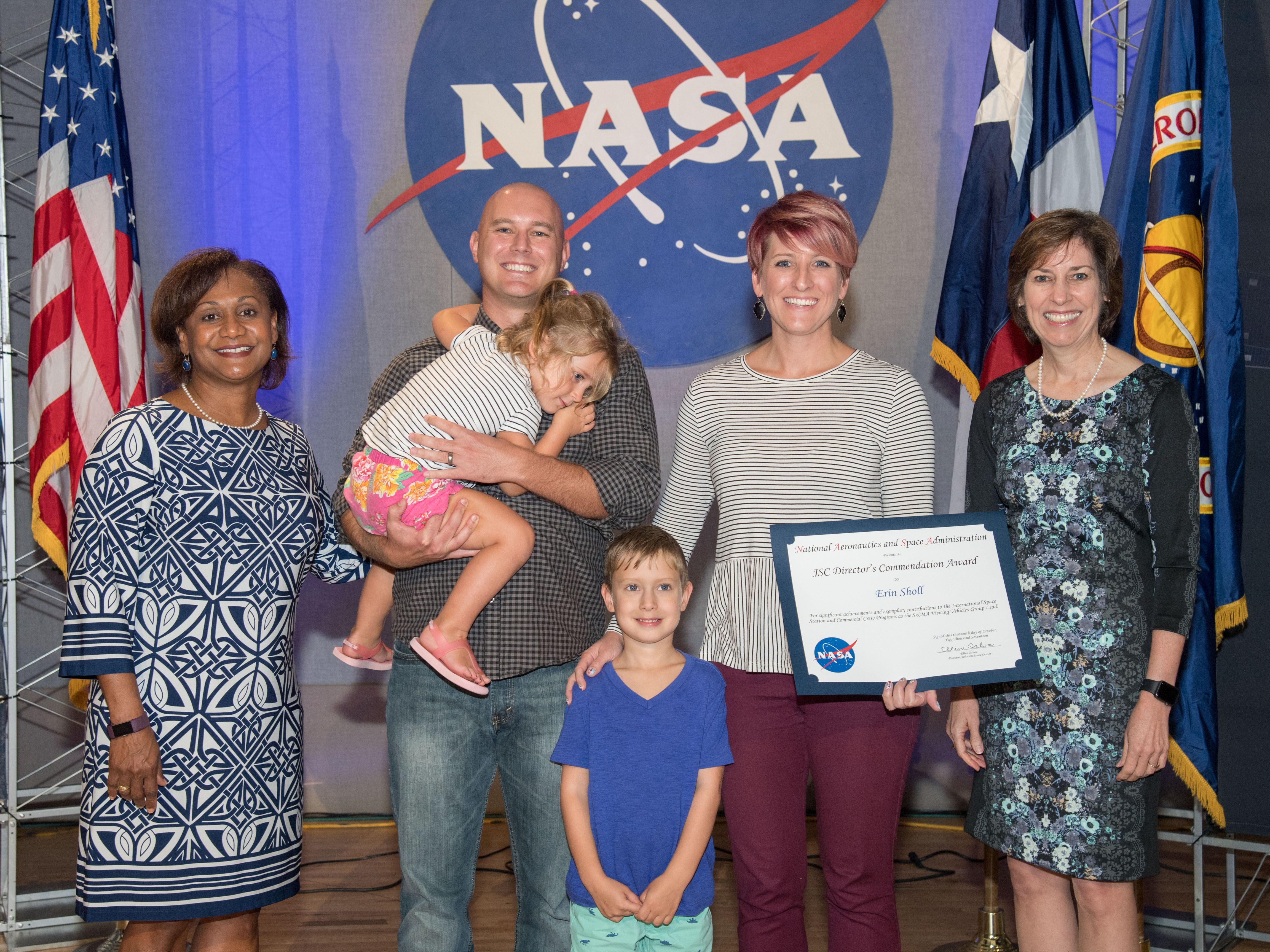
A woman receives a paper certificate on a stage with the American, Texas, and NASA flags. She stands with her husband, two children, and two other women in professional attire.
Erin Sholl (second from right) received the Johnson Space Center Director’s Commendation Award in 2017 for significant achievements and exemplary contributions to the International Space Station and Commercial Crew Programs as the Safety and Mission Assurance Visiting Vehicles Group lead.
NASA/James Blair

Despite her early difficulties in math and science, Sholl eventually grew to love and excel in both subjects. She planned to study chemical engineering in college – inspired by a love of chemistry and a favorite high school teacher – but discovered a greater affinity for physics once she arrived at Pennsylvania State University. She switched her major to aerospace engineering and soon met a classmate who had interned at Johnson. After that, Sholl declared, “The dream was born!”

Her first position at Johnson was as a trajectory operations officer for the Flight Operations Directorate. She spent six years supporting the space station on console in the Mission Control Center, describing the experience as “something out of the movies.” When Sholl went looking for a new challenge, she landed in the Safety and Mission Assurance Directorate.

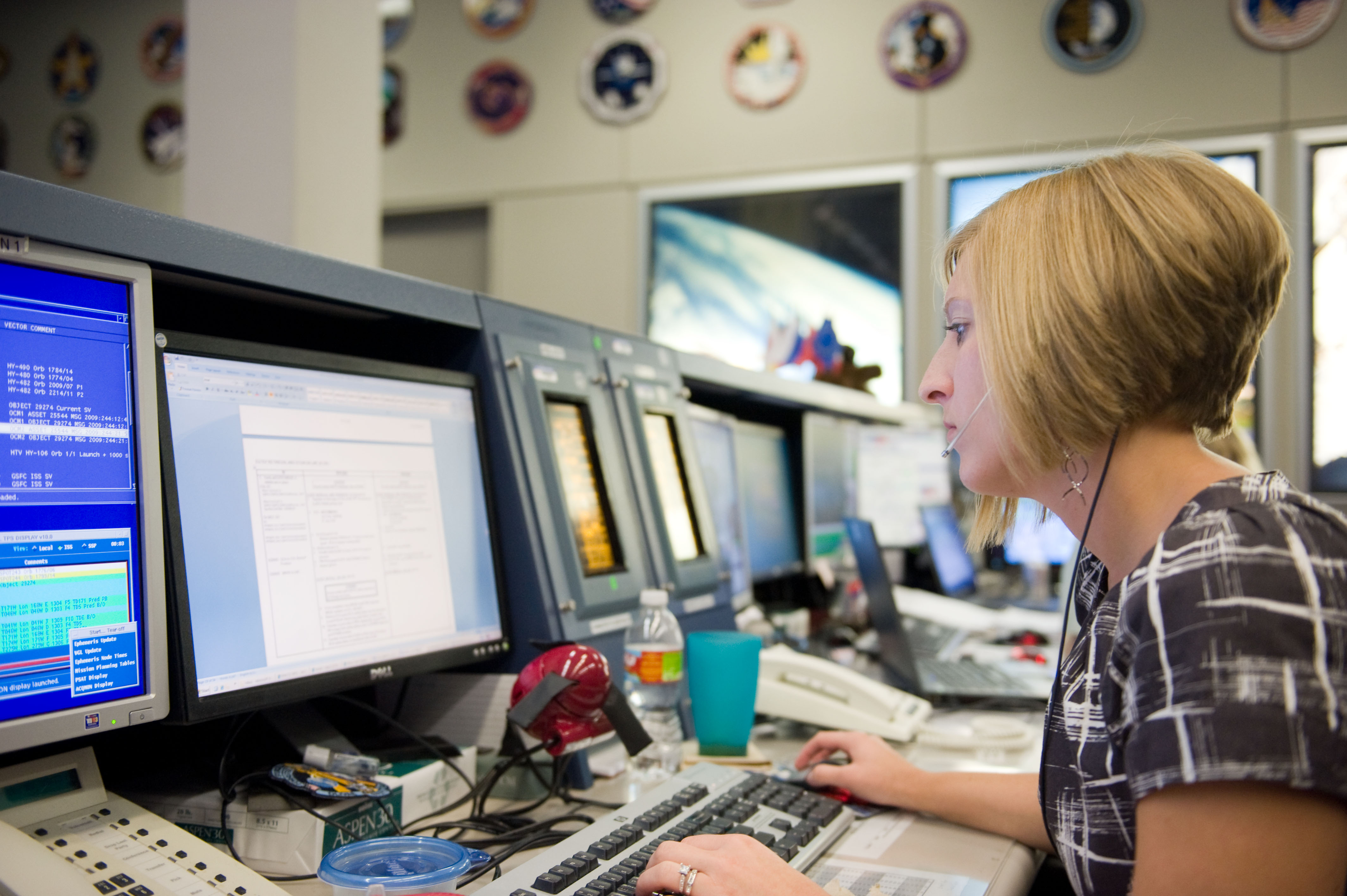
A woman sits in front of a bank of computer screens in the Mission Control Center at Johnson Space Center.
Erin Sholl working on console as a trajectory operations officer in the Mission Control Center during the STS-128/17A mission in 2009.
NASA/Lauren Harnett

“I was drawn to the Operations and Visiting Vehicles Branch because it had many similar aspects to my previous position – real-time operations and visiting vehicles,” she said. “I worked various roles over the next 12 years, gradually taking on more responsibility, and eventually becoming a group lead, then branch chief.” Sholl also served as acting deputy chief for the Space Habitation Systems Division, which oversees the Operations and Visiting Vehicles Branch. Her performance drew the attention of the Space Transportation Systems Division’s chief. “He asked me to come be his deputy, and that is where I still am today!”

The Space Transportation Systems Division provides system safety, reliability, and risk analysis for human spaceflight programs. The division works with the different program offices to reduce risk through technical assessments and guidance on Safety and Mission Assurance requirements throughout program and project lifecycles.

Sholl works closely with the division chief to support strategic planning, budgeting, and operations. “A key part of my role is connecting with people – both inside and outside the division – to ensure smooth communication and representation of the team’s needs,” she said. She leverages her relationship-building and strategic thinking skills to lead initiatives that advance the division’s and the directorate’s goals and to mentor employees.

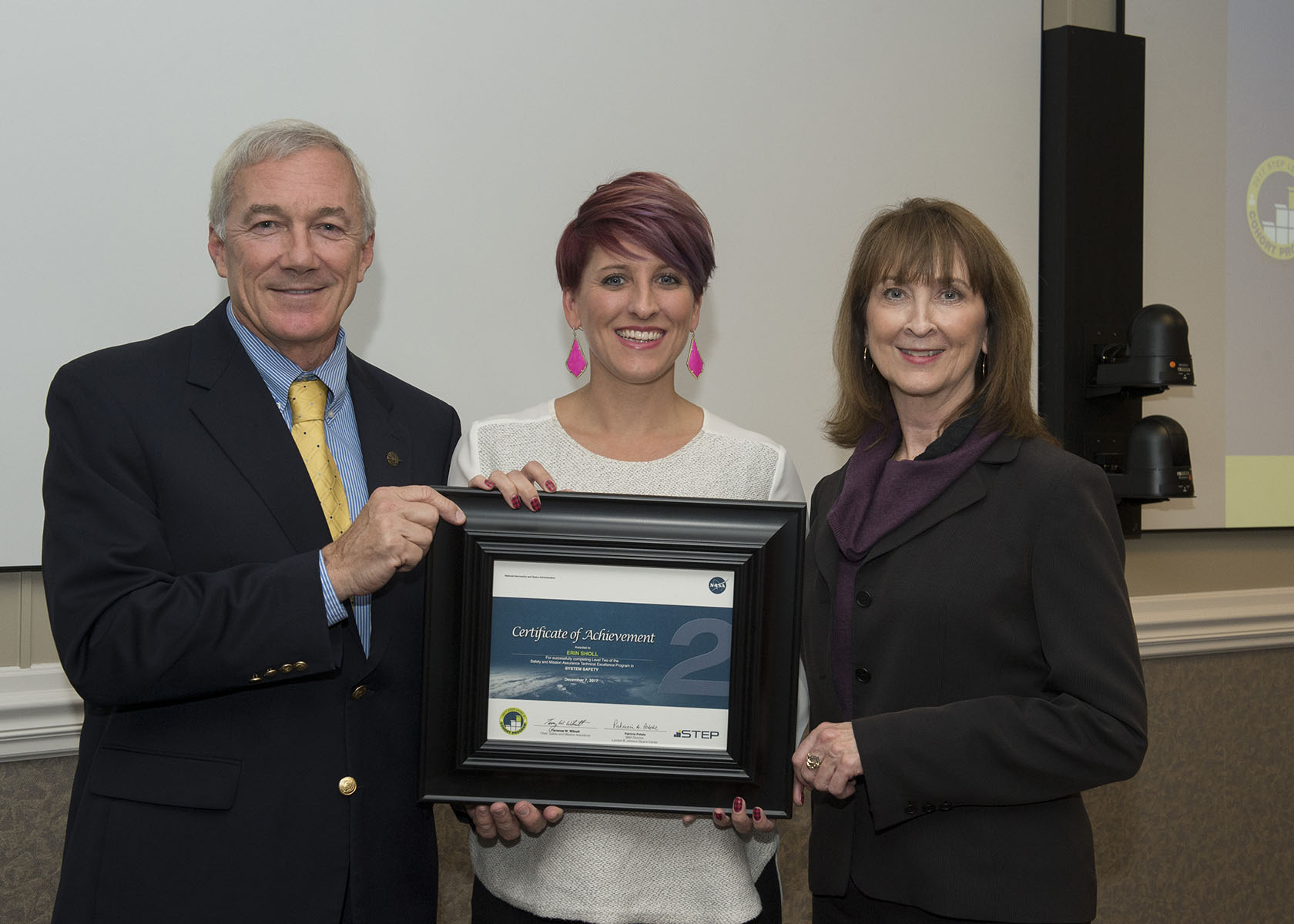
A woman receives a framed honor from two colleagues, a man and a woman.
Erin Sholl (center) receives a certificate of achievement from Terrence Wilcutt, former director of the Office of Safety and Mission Assurance (SMA) at NASA Headquarters, and Patricia Petete, former director of SMA at Johnson, after completing requirements for the Safety and Mission Assurance Technical Excellence Program in System Safety.
Image courtesy of Erin Sholl

Sholl believes strongly in the power of mentorship. “Having various mentors, both formal and informal, has been so important throughout my career,” she said. “Listening to what these people were saying about my strengths led me to a path I’d never considered because I hadn’t seen those things in myself.” Being a mentor and advocate for team members is one of Sholl’s favorite parts of the leadership positions she has held, particularly as branch chief. “I really felt like I could connect with my people and advocate for them in a way that felt meaningful,” she said.

She encourages young professionals to seek out mentors or opportunities to shadow colleagues in different roles. “Relationships are the key to everything,” she said. “The more people you meet and the more you learn about different paths in space exploration, the better off you will be in your career.”

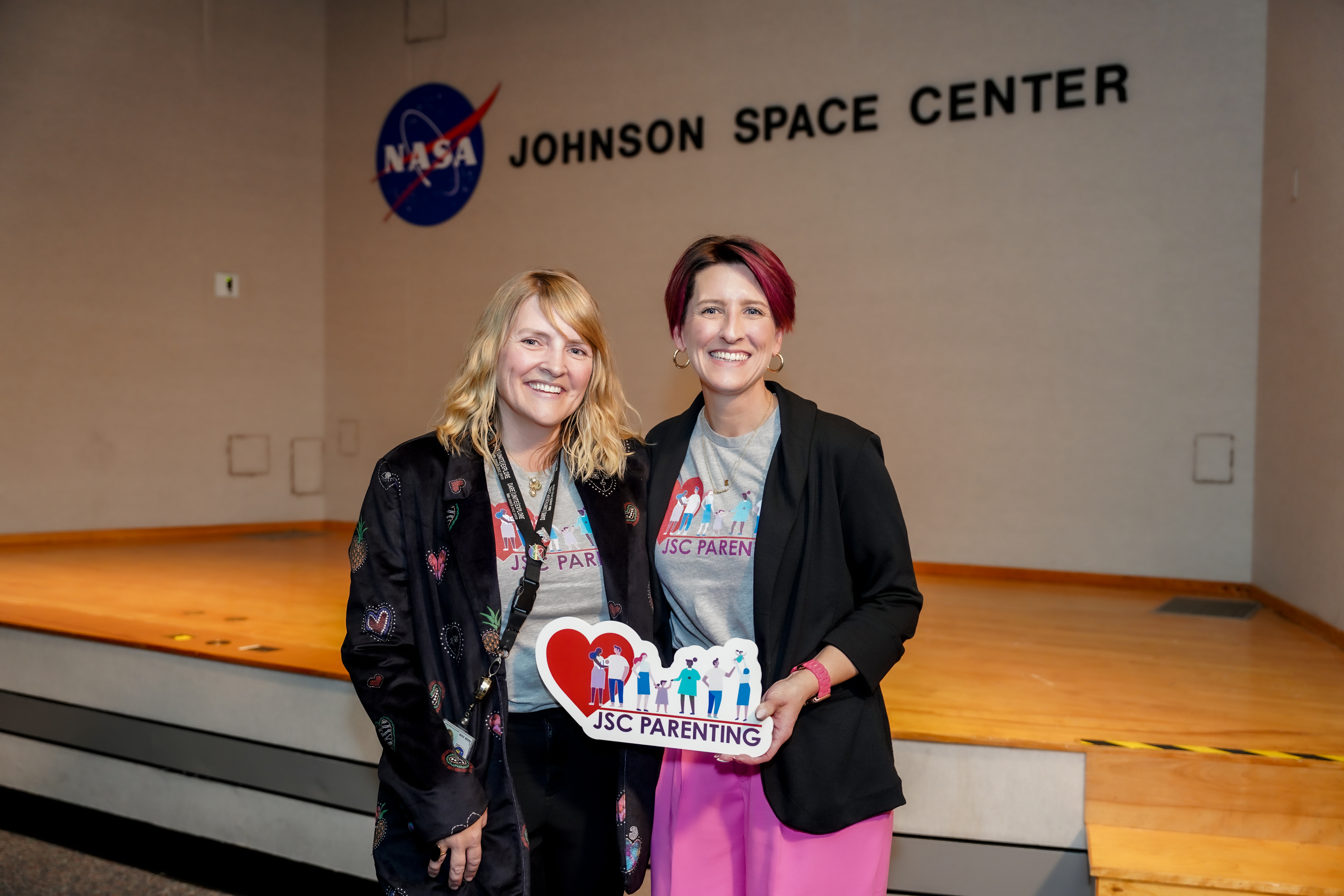
Two women hold a sign reading JSC Parenting while standing in front of a wooden stage.
Susan Schuh, Flight Crew Integration Operational Habitability (OpsHab) team lead and Erin Sholl host a JSC Parenting community event in 2023.
Image courtesy of Erin Sholl

Sholl noted that professional relationships can be bolstered by activities outside of the office. She played a key role in establishing and growing JSC Parenting, a virtual community of about 600 employees who share information and support each other on issues related to caregiving, schooling, and balancing work with family life. “My leadership within the community enhances my professional leadership and positively impacts my colleagues,” she said.

Sholl also emphasized the importance of being open to trying new things, even if an opportunity seems to diverge from your expected career path. “I volunteer for everything because I am always eager to learn more and find out what else I might be good at and how else I can serve my team,” she said. “I think it’s easy to feel intimidated hearing about other people’s career paths, because they often sound so perfectly planned and successful. You rarely hear about the pivots, setbacks, or decisions made for personal reasons.”

The reality, she added, is more complex. “I tried for many roles I didn’t get, and it took a lot of trial and error to find my path to a career I really love.”

Powered by WPeMatico

Get The Details…
Linda E. Grimm