Expanded Crew Works Science, Microgravity Adaptation, and Next Crew Departure
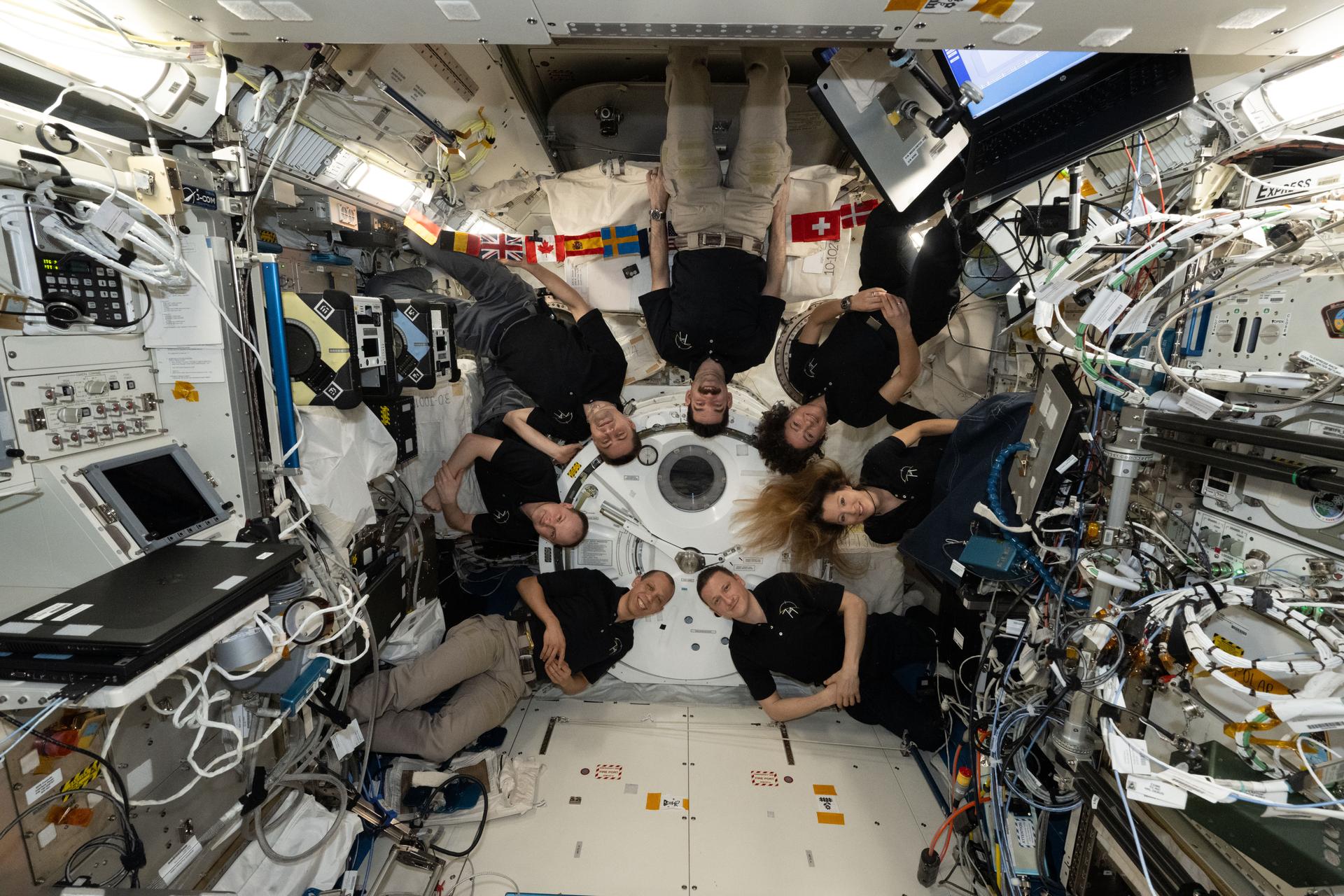
The seven-member Expedition 74 crew poses together for a fun portrait before the arrival of three new crewmates on June 14. Clockwise from bottom left, are Chris Williams, Sergei Mikaev, Andrey Fedyaev, Jack Hathaway, Jessica Meir, Sophie Adenot, and Sergey Kud-Sverchkov.
NASA/Chris Williams
The International Space Station is a busy place hosting ten crewmates from NASA, Roscosmos, and ESA (European Space Agency) through the end of July. The expanded Expedition 74 crew is continuing its microgravity research, helping three new arrivals adjust to life in space, and preparing for the departure of another three crew members.
NASA flight engineer Anil Menon spent Thursday on station adaptation activities unpacking his personal items, familiarizing himself with lab systems, and adjusting to life in weightlessness. Menon also attached thermo-mini-sensors to his body that measure how his body temperature and sleep patterns are affected by weightlessness.
The two newly-arrived flight engineers from Roscosmos, veteran cosmonauts Pyotr Dubrov and Anna Kikina who are on their second station mission, wore virtual reality goggles and electrodes tracking their brain signals and eye movement. The Virtual experiment is testing how a crew member’s sense of balance and direction adapts to weightlessness. The pair also resumed unpacking cargo from the new Soyuz MS-29 spacecraft and getting used to station life.
NASA flight engineer Chris Williams and cosmonauts Sergey Kud-Sverchkov and Sergei Mikaev are nearing the end of their mission that began on Nov. 27, 2025. The trio performed leak checks on the Sokol suits they will wear on the ride back to Earth inside the Soyuz MS-28 spacecraft. The homebound crewmates are also reviewing their Soyuz descent and landing procedures, packing cargo and personal items for return, and preparing to hand over their responsibilities to the new arrivals.
Flight engineer Jessica Meir of NASA continued testing how to make saline solution in microgravity using the station’s water supply. Flight engineers Jack Hathaway of NASA and Sophie Adenot of ESA took turns swapping cargo in and out of the Cygnus XL spacecraft then split their day servicing life support gear, recording educational videos for students on the ground, and training the new crew to use station exercise equipment. Roscosmos flight engineer Andrey Fedyaev spent his shift photographing and nourishing microbe samples for the Aseptic biotechnology study exploring ways to keep spacecraft safe and sterile during research operations.
NASA Welcomes Serbia as Newest Artemis Accords Signatory
Serbia’s Minister of Foreign Affairs Marko Đurić, right, shakes hands with NASA Deputy Administrator Matt Anderson, left, after signing the Artemis Accords Thursday, July 16, at NASA Headquarters in Washington.
NASA/Keegan Barber
The Republic of Serbia signed the Artemis Accords Thursday during a ceremony hosted by NASA at the agency’s Headquarters in Washington, becoming the 69th nation to join a large community of like-minded nations committed to the peaceful, transparent, and responsible exploration of space.
“Serbia’s connection to NASA reaches back to the Apollo program, when the work of Serbian engineers helped make some of humanity’s greatest achievements in space possible,” said NASA Deputy Administrator Matt Anderson. “Among them was Milojko ‘Mike’ Vučelić, who was awarded the Presidential Medal of Freedom for the critical role he played in bringing the Apollo 13 crew safely home. Their story stands as a reminder that the greatest achievements in space are made possible by talented people working together.”
The broader team of Serbian American engineers played key roles during the Apollo era across systems engineering, propulsion, power systems, spacecraft docking, electronics reliability, and mission coordination. Their expertise supported critical functions ranging from lunar landing analysis to safe spacecraft docking.
Serbia’s Minister of Foreign Affairs Marko Đurić signed the Artemis Accords on behalf of the country.
“The great beyond has always inspired humanity to achieve its greatest feats — from the Roman ‘per aspera ad astra’ to Norman Vincent Peale’s belief that if we aim for the Moon, we will at least land among the stars,” said Đurić. “Those words feel especially fitting today. We come from a nation of great minds like Nikola Tesla and Milutin Milanković, but also from the legacy of David Vujic, one of the pioneers of the Apollo missions and a member of the ‘Serbian Seven,’ a group of engineers and technicians whose contributions to NASA helped make the Moon landing possible. In that spirit, we owe it to both our brave ancestors and our children to keep pushing toward new frontiers — to explore, to inspire one another, and to dare even greater things.”
By signing the Artemis Accords, nations open the door to opportunities for future lunar exploration with NASA, such as providing science and technology payloads for the U.S.-led Moon Base and CubeSats for upcoming Artemis missions, advancing humanity’s return to the Moon, and shaping the Golden Age of space exploration and innovation.
Ambassador of the Republic of Serbia to the United States Dragan Šutanovac; State Secretary for Serbia’s Ministry of Science, Technological Development and Innovation Marija Gnjatović; and U.S. Department of State Assistant Secretary for Oceans and International Environmental and Scientific Affairs Wesley Brooks all participated in Serbia’s signing ceremony.
In 2020, NASA and the Department of State joined with seven other founding nations to establish the Artemis Accords, responding to the growing interest in lunar activities by both governments and private companies. They introduced the first set of practical principles aimed at enhancing the safety and coordination between nations as they explore the Moon, Mars, and beyond, committing nations to:
explore peaceably and transparently
render aid to those in need
enable access to scientific data
ensure activities do not interfere with those of others
preserve historically significant sites and artifacts by developing best practices
Five years later, President Donald J. Trump’s National Space Policy directed NASA to establish a sustained lunar outpost. With this Moon Base, NASA is putting the principles of the Artemis Accords into practice, inviting every signatory to take part in the endeavor.
More countries are expected to sign the Artemis Accords in the months and years ahead, as NASA continues its work to establish a safe, peaceful, and prosperous future in space.
NASA Study Finds Near-Earth Asteroid Is Actually Comet
5 min read
Preparations for Next Moonwalk Simulations Underway (and Underwater)
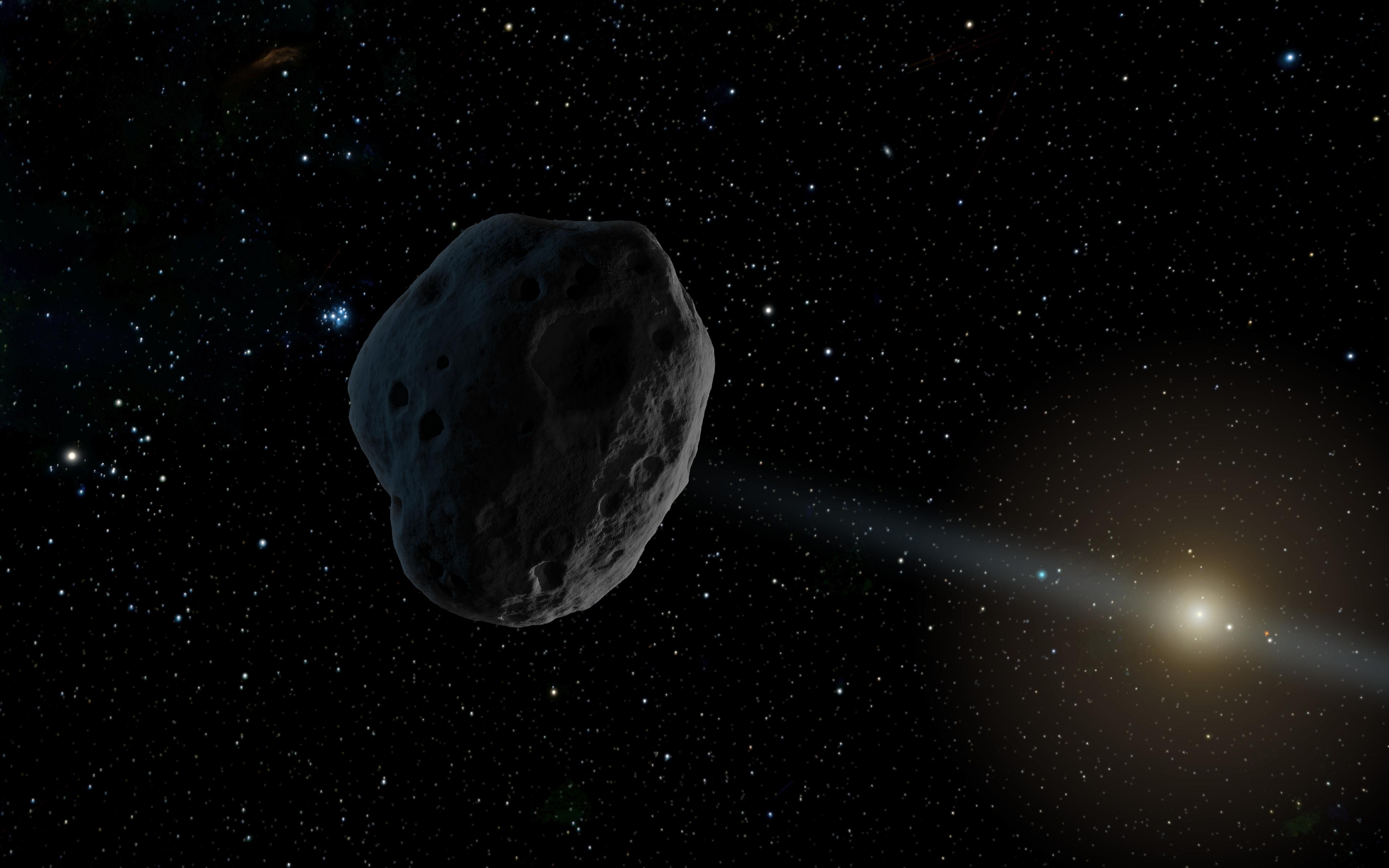
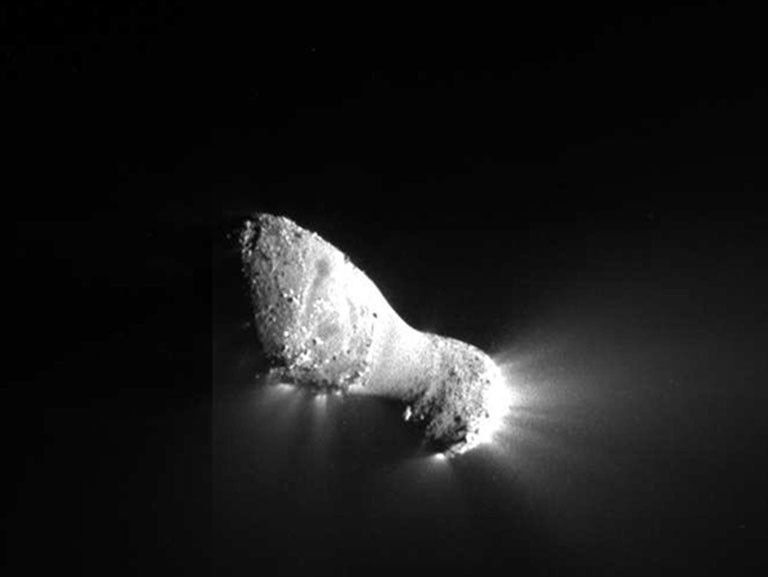
This artist’s concept depicts a near-Earth asteroid with an elongated orbit. A few objects such as these can exhibit significant perturbations in their motion around the Sun and, like the asteroid 1998 SH2, could turn out to be regular comets with a weak tail and coma (the gas and dust around a comet’s nucleus).
NASA/JPL-Caltech
New research led by scientists at NASA’s Jet Propulsion Laboratory in Southern California has revealed the identity of a puzzling near-Earth object by precisely tracking its motion through space and using powerful observatories that image faint celestial objects.
This object has a dual personality: Past images hadn’t revealed obvious cometlike activity, suggesting it might be an asteroid, but its motion recently proved to be irregular like that of a comet. The scientists detailed their findings in a study published in the journal Nature Astronomy.
The puzzle began on Aug. 28, 2025, when the object, provisionally known as the asteroid 1998 SH2, passed safely within 2 million miles (3 million kilometers) of our planet during its 4½-year orbit around the Sun. Researchers looking to observe 1998 SH2 with NASA’s Deep Space Network (DSN) planetary radar system had calculated its position using data from previous orbits and factored in the effects that the gravity of the Sun and planets would have on its path. But when 1998 SH2 didn’t show up where they expected, they realized that something unanticipated had been influencing the object’s motion.
Object tracking
By using optical astrometry to precisely measure the object’s position in the sky, the researchers were able to identify the cause.
“After we measured the nongravitational perturbations affecting the motion of 1998 SH2 and recognized they weren’t compatible with the object being an asteroid, we suspected the object could be an active comet,” said Davide Farnocchia, a navigation engineer with NASA’s Center for Near-Earth Object Studies at JPL and study lead.
Although 1998 SH2’s orbit around the Sun had been well-tracked from 1998 to 2016, the object had completed two solar orbits without additional observations by telescopes until the 2025 DSN attempts. Analyzing all observations collected since the object’s discovery in 1998, researchers determined the perturbations to 1998 SH2’s motion and hypothesized that the object may be generating a small thrust by venting gas into space, causing it to deviate from its predicted path.
This venting results from the Sun heating ice mixed with rocky material, turning the ice into a gas. With regular comets, this activity forms a trademark bright tail and coma — the gas and dust surrounding a comet’s nucleus. But when an object produces gas and dust in much smaller quantities, its tail and coma may not be detectable to most observatories.
Tail, coma emerge
The August 2025 close approach to Earth of 1998 SH2 provided the perfect opportunity for the paper’s authors to gather observational evidence of visible cometary activity. They reached out to astronomers at the Canada-France-Hawaii Telescope, a 3.6-meter (12-foot) optical/infrared telescope near the summit of Mauna Kea, Hawaii, and the 1.5-meter (5-foot) European Southern Observatory’s Danish Telescope in La Silla, Chile, to observe. Astronomers at the powerful European Southern Observatory’s 8.2-meter (27-foot) Very Large Telescope on the Chilean mountain Cerro Paranal also tracked the object.
“The images we collected from these observatories showed a weak but clear tail, thus confirming that 1998 SH2 is, in fact, a comet,” said Olivier Hainaut, an astronomer with the European Southern Observatory and coauthor of the study. “That’s how science works — you form a hypothesis, and you set out to test it. This data is exactly what was needed to confirm our hypothesis that 1998 SH2 was a comet.”
As an outcome of the investigation, 1998 SH2 will receive an additional comet provisional designation, P/1998 SH2.
Planetary defense implications
The research also sheds light on another, even more unusual, class of objects called dark comets. Like 1998 SH2, dark comets exhibit significant irregularities, or perturbations, in their trajectory but lack other visible evidence of comet activity — there’s no coma, tail, or visible outgassing. These enigmatic objects fall into two distinct populations: larger ones with orbits similar to those of Jupiter-family comets (short period comets with highly elliptical, or eccentric, orbits), and smaller ones that orbit closer to the Sun. Since the 2016 discovery of the first dark comet, about a dozen more have been identified.
The paper’s authors suggest that many of the larger dark comets, which have orbits like 1998 SH2’s, could turn out to be regular comets if astronomers get the right opportunity to observe them with powerful telescopes capable of imaging incredibly faint objects. And by analyzing the motion of all near-Earth objects using precision astrometry data, researchers may reveal more comets that were previously designated as asteroids if they exhibit cometlike nongravitational perturbations.
“This work shows the importance of continuously tracking near-Earth objects,” said Farnocchia. “Because of outgassing, the motion of comets is more significantly perturbed than that of asteroids. Detecting these perturbations can be an important diagnostic tool for planetary defense that will help understand which objects may be comets rather than asteroids, how their orbits evolve, and how that influences their Earth impact risks.”
Hunting for near-Earth objects
NASA’s upcoming Near-Earth Object (NEO) Surveyor will collect data that can be used to support this effort. The first space survey telescope to be built for planetary defense, this next-generation mission will seek out some of the hardest-to-find near-Earth objects, such as dark asteroids and comets that don’t reflect much visible light.
NASA’s Center for Near Earth Object Studies, the Goldstone Solar System Radar Group, and NEO Surveyor all are managed by JPL and supported by the agency’s Planetary Defense Coordination Office in Washington. Caltech in Pasadena manages JPL for NASA. The DSN receives programmatic oversight from the SCaN (Space Communications and Navigation) program office, also at NASA headquarters.
More information about planetary radar, NASA’s Center for Near Earth Object Studies, and near-Earth objects can be found at:
NASA’s James Webb Space Telescope takes us 4.4 billion years in the past with this July 3, 2026, image of a young galaxy cluster, MACS J0553.4-3342. The cluster is composed of two actively merging sub-clusters, roughly equal in mass. Each sub-cluster is anchored on an immensely bright and massive elliptical galaxy, easily identifiable as the two brightest points in the center of this scene with the largest glowing halos around them.
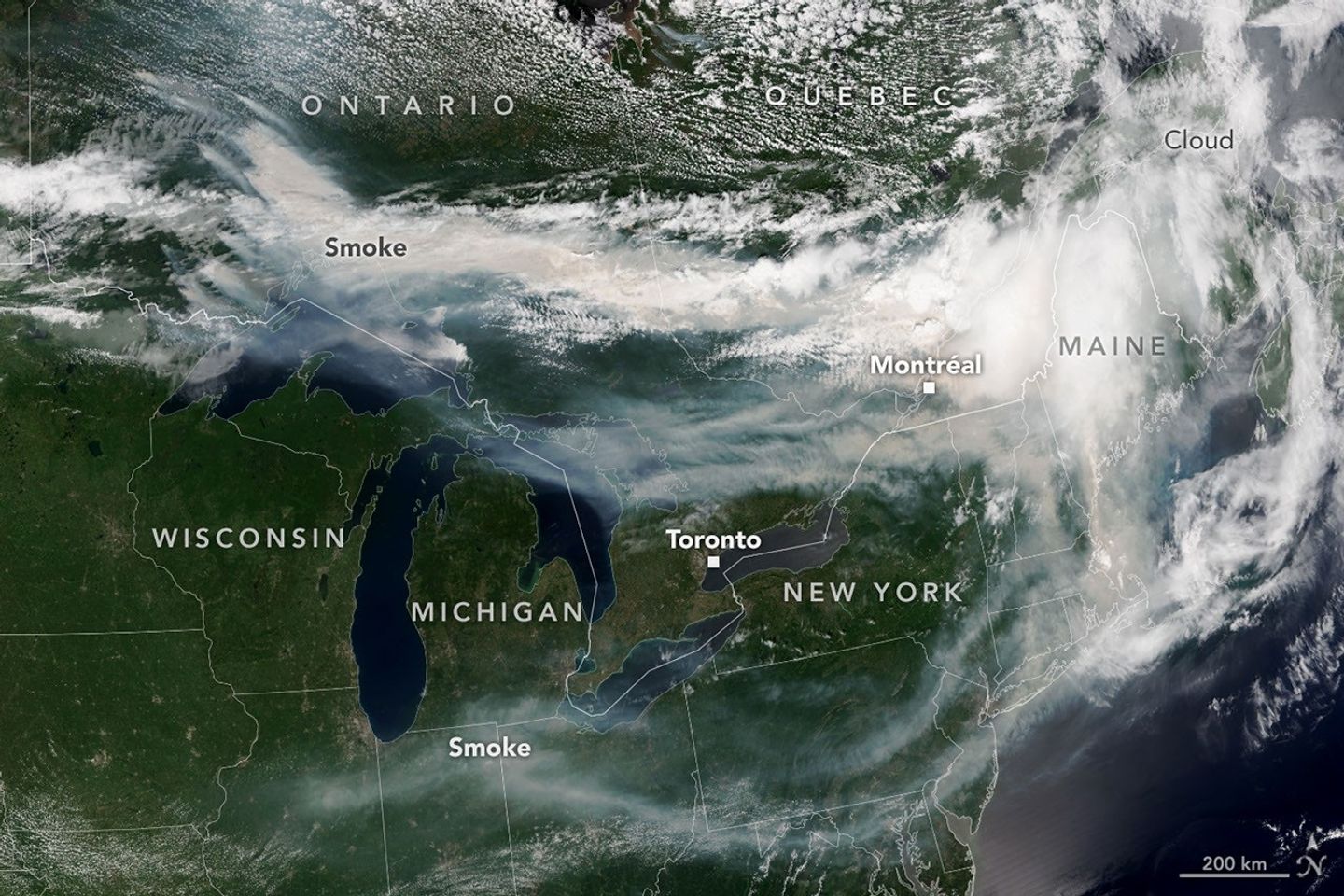
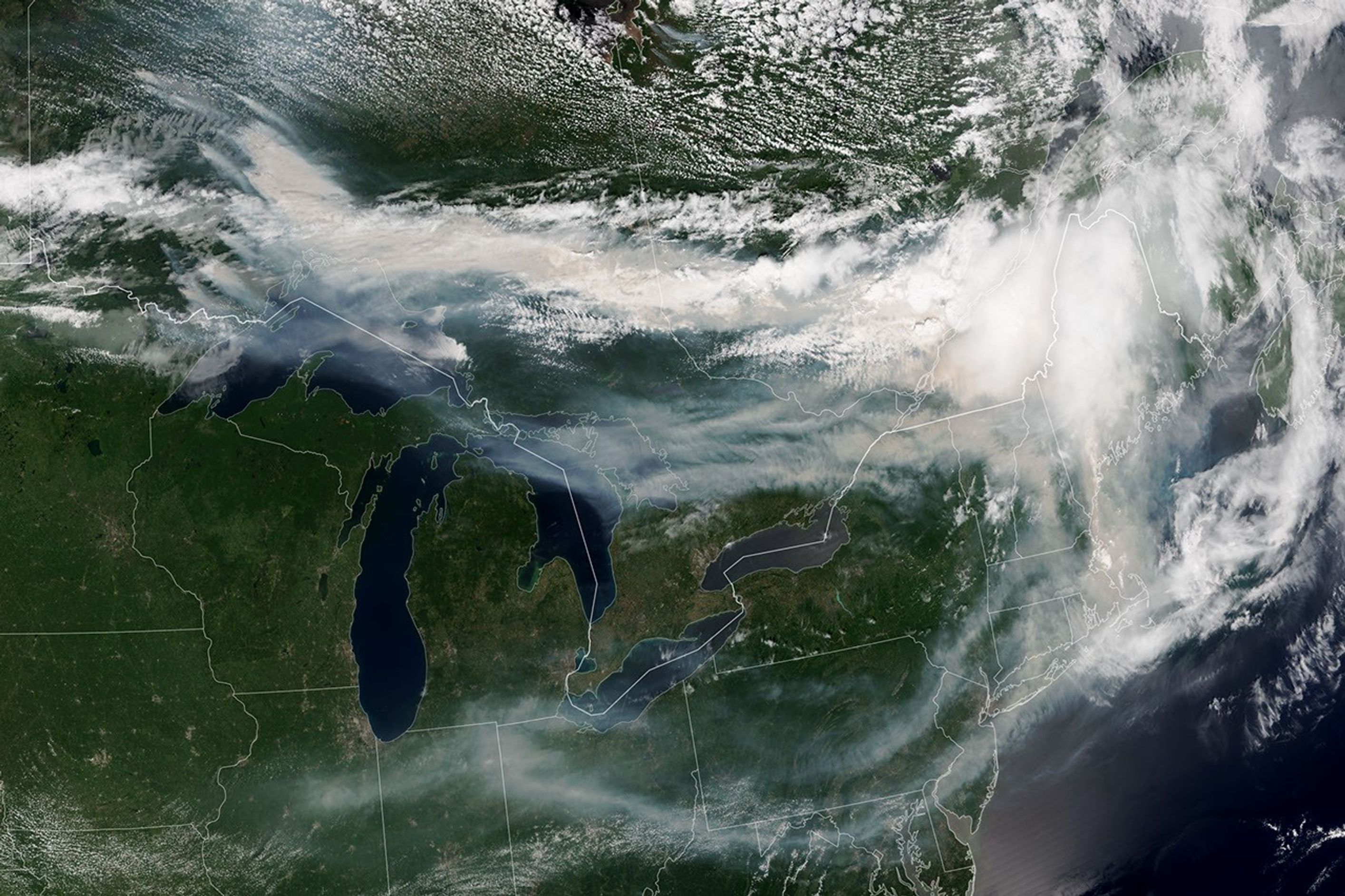
Smoke from wildland fires pours eastward over Canada and the U.S. in an image captured on the afternoon of July 14, 2026, by the VIIRS (Visible Infrared Imaging Radiometer Suite) on the NOAA-21 satellite.
NASA Earth Observatory/Lauren Dauphin
After a slow start to Canada’s 2026 fire season, activity picked up by the end of June amid dry, warm conditions and returned closer to the 25-year average. By mid-July, almost 850 fires were actively burning across the country, according to the Canadian Interagency Forest Fire Centre. More than 180 of those were burning in Ontario.
This NOAA-21 image, acquired on the afternoon of July 14, 2026, shows smoke billowing from the Ontario fires. Winds carried the smoke primarily southeast over much of the southern part of the province, as well as parts of Quebec and the U.S. Midwest and Northeast, tinting the sky shades of gray and yellow and the Sun orange in many areas.
The smoke’s impact on air quality varied, depending largely on altitude. In areas where smoke was high in the atmosphere, air quality impacts were negligible; where it drifted closer to the ground, conditions worsened. Air quality in Toronto, for instance, reached unhealthy levels, according to AirNow. People in the southern parts of the province were also grappling with a heat wave, compounding the health risks.
Much of the smoke came from fires in Northwestern Ontario, where eight blazes saw significant growth on July 13 and 14. The fires prompted officials to issue evacuation orders for several communities in this part of the province, according to news reports.
As of July 14, fires across Canada have burned 1.9 million hectares (4.7 million acres) since the start of the year—still well below the season totals from the extreme fire years of 2023 and 2025. How the rest of the season plays out remains to be seen. A seasonal fire outlook—compiled by wildland fire experts from the U.S., Canada, and Mexico—shows where fire conditions are more or less likely through July, August, and September.
NASA Earth Observatory image by Lauren Dauphin, using VIIRS data from NASA EOSDIS LANCE , GIBS/Worldview , and the Joint Polar Satellite System (JPSS). Story by Kathryn Hansen.
Downloads
July 14, 2026
JPEG (3.96 MB)
References & Resources
AirNow (2026, July 15) Wildfires. Accessed July 15, 2026.