NASA’s Hubble Presents a Holiday Globe of Stars

NASA’s Hubble Presents a Holiday Globe of Stars

2 min read

NASA’s Hubble Presents a Holiday Globe of Stars

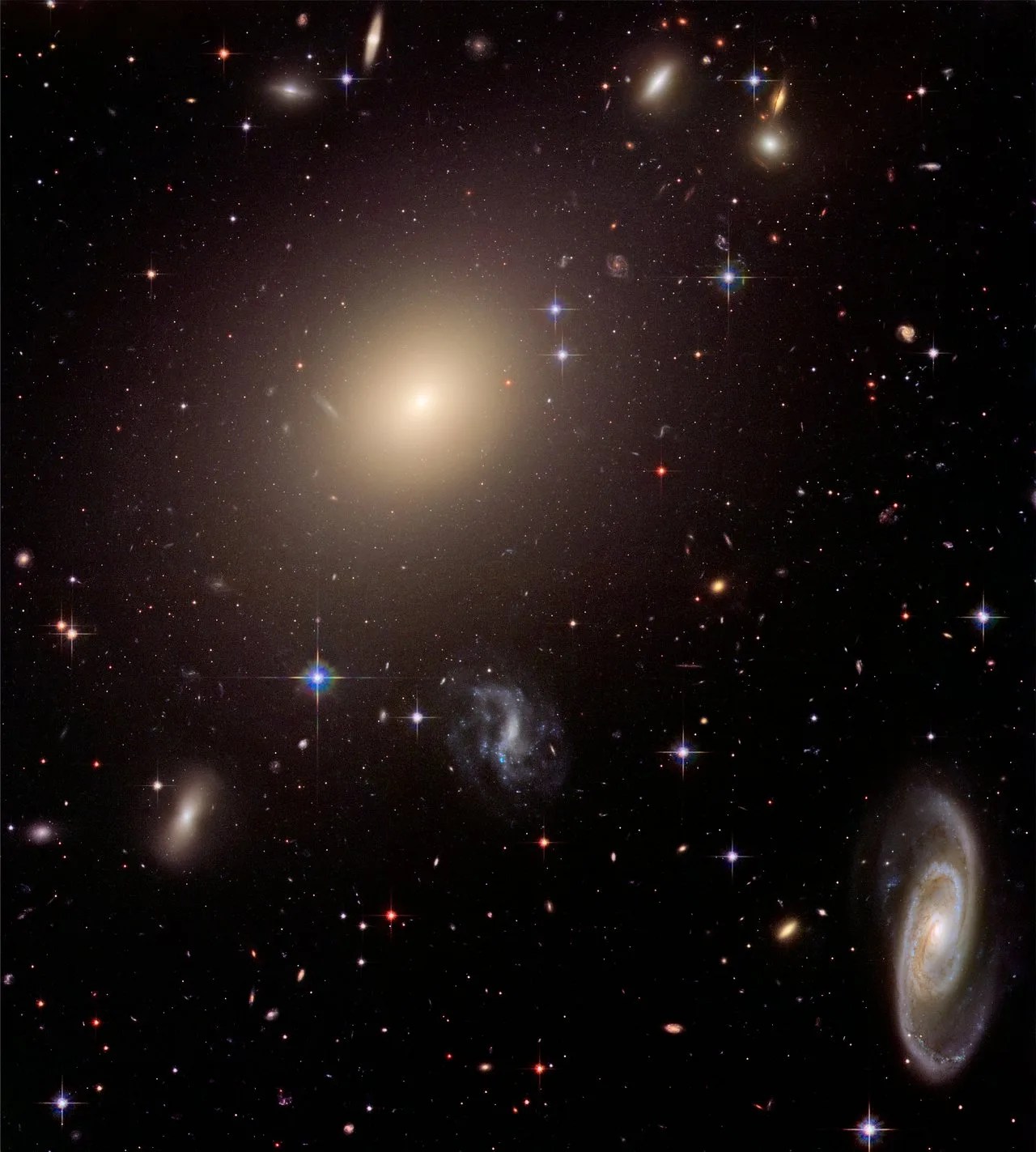
A field of galaxies. UGC 8091 is at the top and center of the image. It appears as a haze of stars through which more distant galaxies are visible. Two
This image of the dwarf irregular galaxy, UGC 8091, was created using data from the Wide Field Camera 3 and the Advanced Camera for Surveys on NASA’s Hubble Space Telescope.
ESA/Hubble, NASA, ESA, Yumi Choi (NSF’s NOIRLab), Karoline Gilbert (STScI), Julianne Dalcanton (Center for Computational Astrophysics/Flatiron Inst., UWashington)

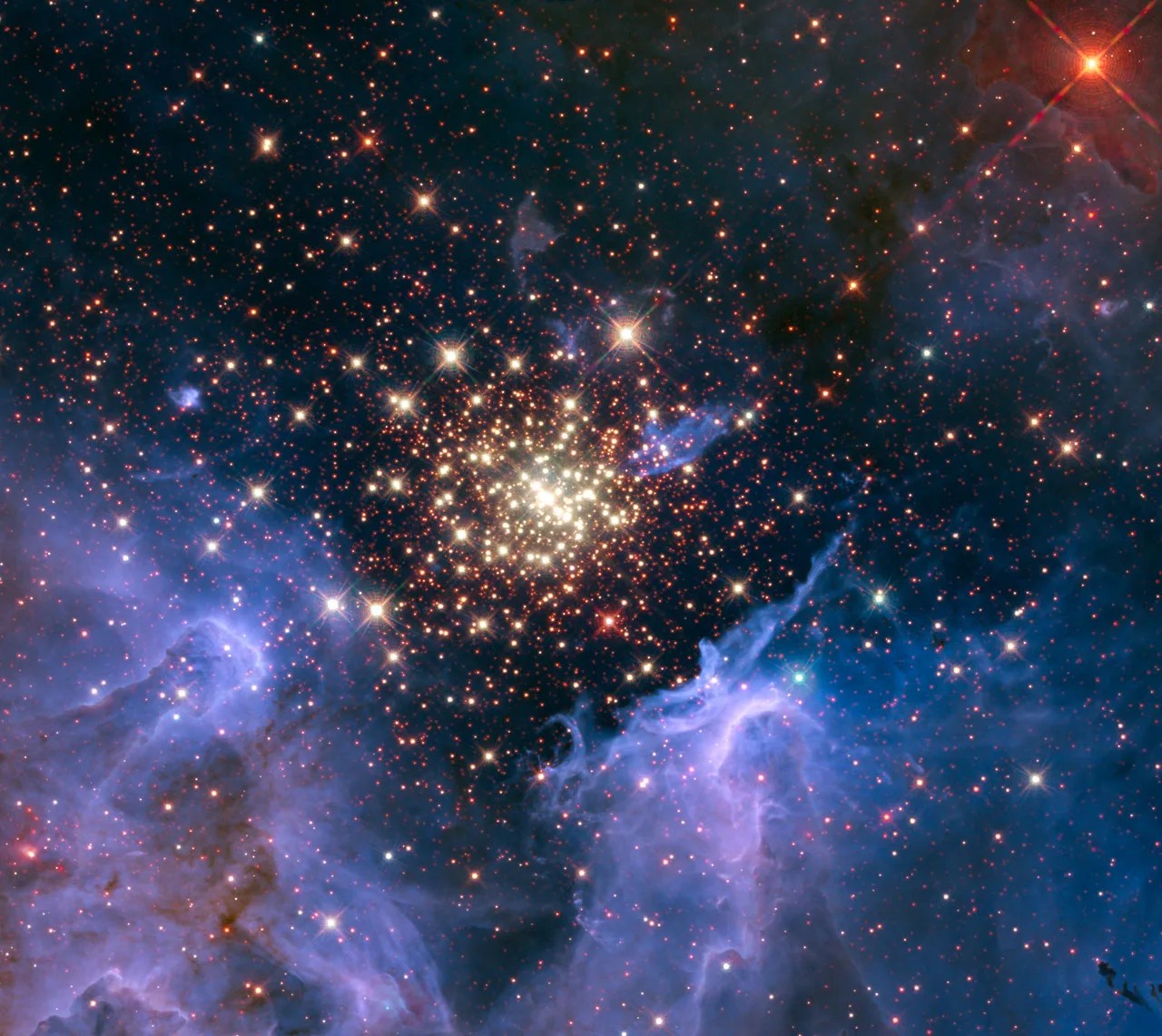
The billion stars in galaxy UGC 8091 resemble a sparkling snow globe in this festive Hubble Space Telescope image from NASA and ESA (European Space Agency).

The dwarf galaxy is approximately 7 million light-years from Earth in the constellation Virgo. It is considered an “irregular galaxy” because it does not have an orderly spiral or elliptical appearance. Instead, the stars that make up this celestial gathering look more like a brightly shining tangle of string lights than a galaxy.

Some irregular galaxies may have become tangled by tumultuous internal activity, while others have formed by interactions with neighboring galaxies. The result is a class of galaxies with a diverse array of sizes and shapes, including the diffuse scatter of stars that is this galaxy.

Twelve camera filters were combined to produce this image, with light from the mid-ultraviolet through to the red end of the visible spectrum. The red patches are likely interstellar hydrogen molecules that are glowing because they have been excited by the light from hot, energetic stars. The other sparkles on show in this image are a mix of older stars. An array of distant, diverse galaxies appear in the background, captured by Hubble’s sharp view.

The data used in this image were taken by Hubble’s Wide Field Camera 3 and the Advanced Camera for Surveys from 2006 to 2021.

Among other things, the observing programs involved in this image sought to investigate the role that dwarf galaxies many billions of years ago had in re-heating the hydrogen that had cooled as the universe expanded after the big bang.

Astronomers are also investigating the composition of dwarf galaxies and their stars to uncover the evolutionary links between these ancient galaxies and more modern galaxies like our own.

The Hubble Space Telescope is a project of international cooperation between NASA and ESA. NASA’s Goddard Space Flight Center in Greenbelt, Maryland, manages the telescope. The Space Telescope Science Institute (STScI) in Baltimore, Maryland, conducts Hubble and Webb science operations. STScI is operated for NASA by the Association of Universities for Research in Astronomy, in Washington, D.C.

Media Contacts:

Claire Andreoli
NASA’s Goddard Space Flight CenterGreenbelt, MD
claire.andreoli@nasa.gov

Ray Villard
Space Telescope Science Institute, Baltimore, MD

Bethany Downer
ESA/Hubble

Share

Details

Last Updated
Dec 19, 2023
Editor
Andrea Gianopoulos

Powered by WPeMatico

Get The Details…

New NASA Glenn Exhibit Spotlights Microgravity Research

New NASA Glenn Exhibit Spotlights Microgravity Research

2 min read

Preparations for Next Moonwalk Simulations Underway (and Underwater)

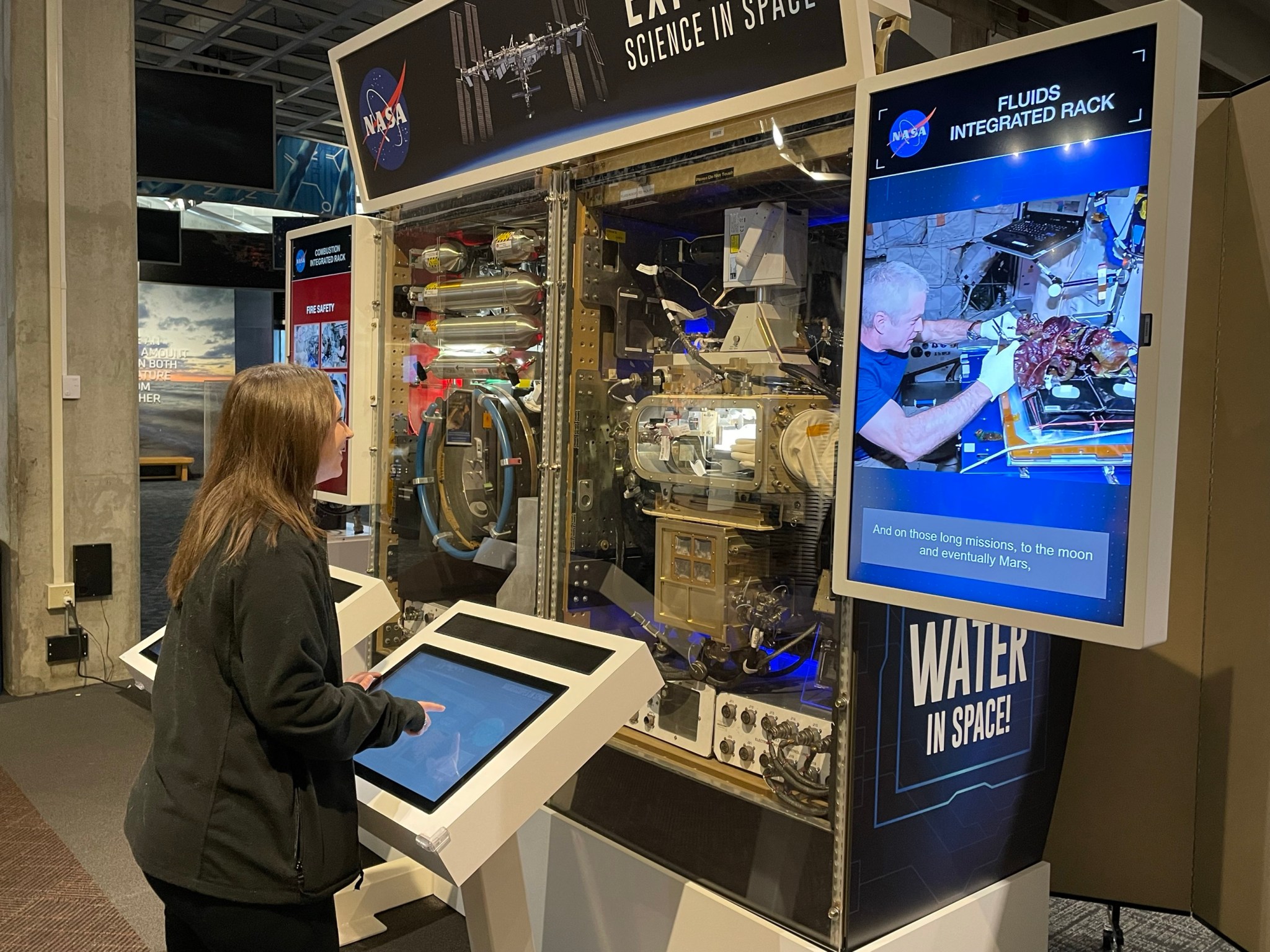
A woman visitor smiles as she operates an interactive space science exhibit using a colorful touch screen. Real International Space Station hardware can be seen between two video monitors in front of her and next to the exhibit.
A visitor operates the new exhibit at the NASA Glenn Visitor Center that features motion sensors, touch screens, and videos.
Credit: NASA/Christopher Hartenstine

The Fluids and Combustion Facility, or FCF, on the International Space Station was designed and built at NASA’s Glenn Research Center in Cleveland and has been supporting microgravity research for over a decade. A new exhibit at the NASA Glenn Visitor Center, located in the Great Lakes Science Center, brings that research down to Earth in a fun and user-friendly way. 

The exhibit replicates the FCF, which houses two research facilities—the Combustion Integrated Rack, or CIR, and the Fluids Integrated Rack, or FIR. Both were developed at NASA Glenn with prime contractor ZIN Technologies and are operated remotely from Glenn’s ISS Payloads Operation Center. The FCF supports physical and biological experiments to advance technology development while bringing many benefits back here to Earth.

“Gravity on Earth affects everything from flames to fluids,” said Kelly Bailey, Physical Sciences Research Program manager at NASA Glenn. “Because gravity can mask other forces in play on Earth, it’s important to conduct science on the space station and remove gravity as a variable.” 

An exhibit with two touch-screen monitors and colorful video screens that feature animations and read “Combustion Integrated Rack” and “Fluids Integrated Rack” on either side. Text on a sign at the top of the exhibit reads, “Explore Science in Space.” A NASA meatball logo and an image of the International Space Station are also on the sign. Real space station hardware can be seen between the video monitors and on either side of the exhibit.
A new interactive exhibit at the NASA Glenn Visitor Center replicates the Fluids and Combustion Facility on the International Space Station, enabling users to see how microgravity experiments operate.
Credit: NASA/Christopher Hartenstine

Bailey worked with a design team to create an interactive educational tool for the new exhibit that features motion sensors, touch screens, and videos. Colorful graphic characters depicting fire and water guide users through many Glenn-developed experiments successfully operated within the FCF. Each rack on the exhibit contains an introduction along with two to three experiments for visitors to learn about.

The CIR rack focuses on combustion (fire) research. Users can pick from Flames in Space (Flame Extinguishment Experiment) and Cool Flames (Advanced Combustion via Microgravity Experiments) modules.

The FIR focuses on fluids research and highlights the Light Microscopy Module, or LMM, a light imaging microscope facility that provides researchers with powerful diagnostic hardware and software. Within the FIR rack, users receive an introduction to LMM and can choose from Plants in Space (Advanced Plant Experiment), Bubbles in Space (Constrained Vapor Bubble), and Particles in Space (Advanced Colloids Experiments) modules.

“People may not realize the volume of science performed daily in space, and the importance of that research truly impacts their lives,” Bailey said. “This interactive exhibit offers an immersive experience into the world of microgravity science research and the important work happening at NASA.”

Powered by WPeMatico

Get The Details…
Kelly M. Matter

55 Years Ago: Seven Months Before the Moon Landing

55 Years Ago: Seven Months Before the Moon Landing

December 1968 ended a year more turbulent than most. For the American space program, however, it brought the Moon landing one giant step closer. The successful first lunar orbital flight by Apollo 8 astronauts Frank Borman, James A. Lovell, and William A. Anders proved the space worthiness of the Apollo Command and Service Modules (CSM) at lunar distances and demonstrated navigation beyond low Earth orbit. Preparations continued for the next two missions – Apollo 9 to test the Lunar Module (LM) in Earth orbit in February or March 1969, and Apollo 10 to repeat the test in lunar orbit in May. If those missions proved successful, NASA hoped to achieve the first Moon landing by the summer of 1969.
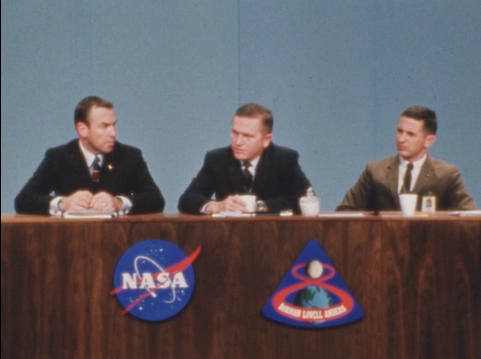
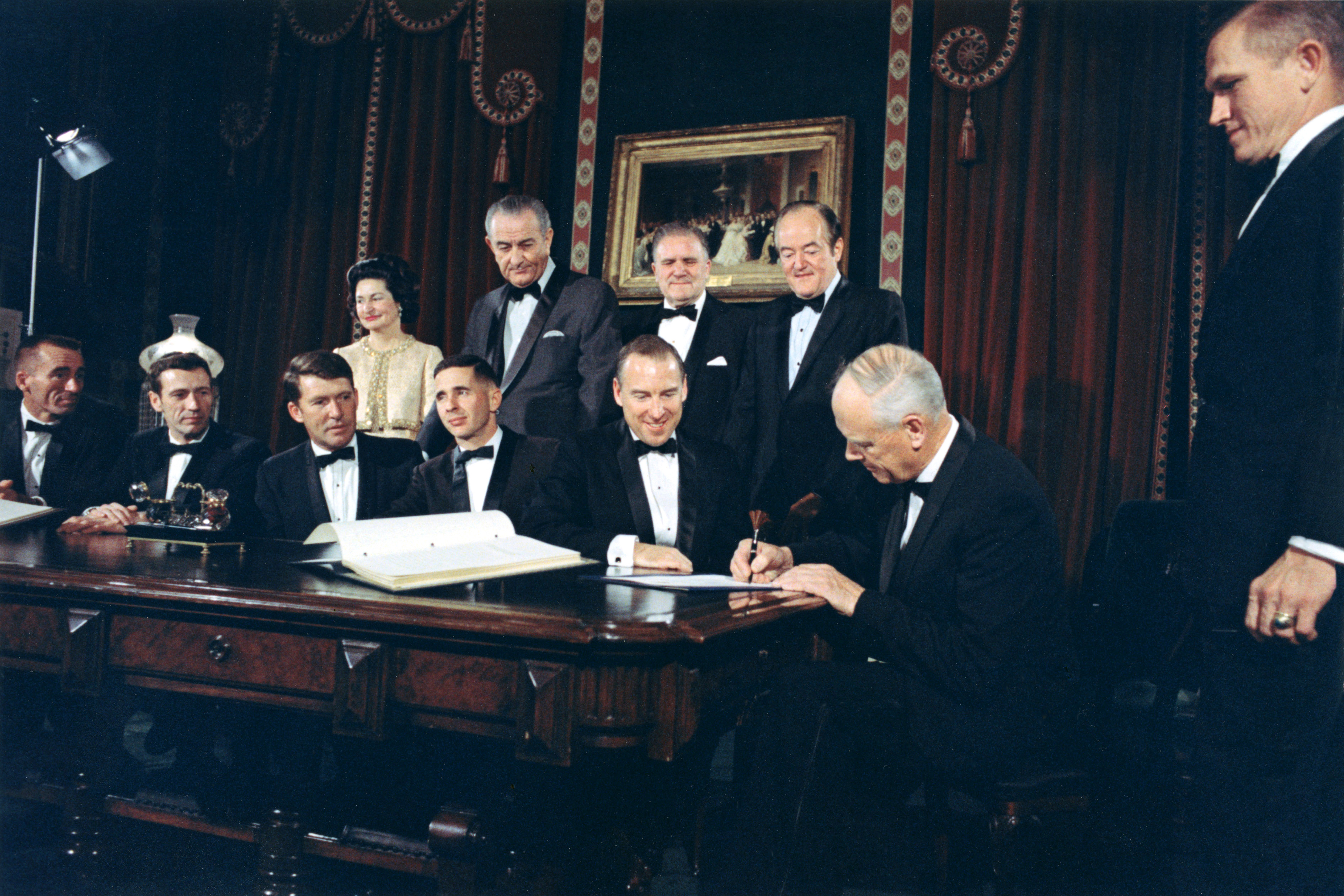
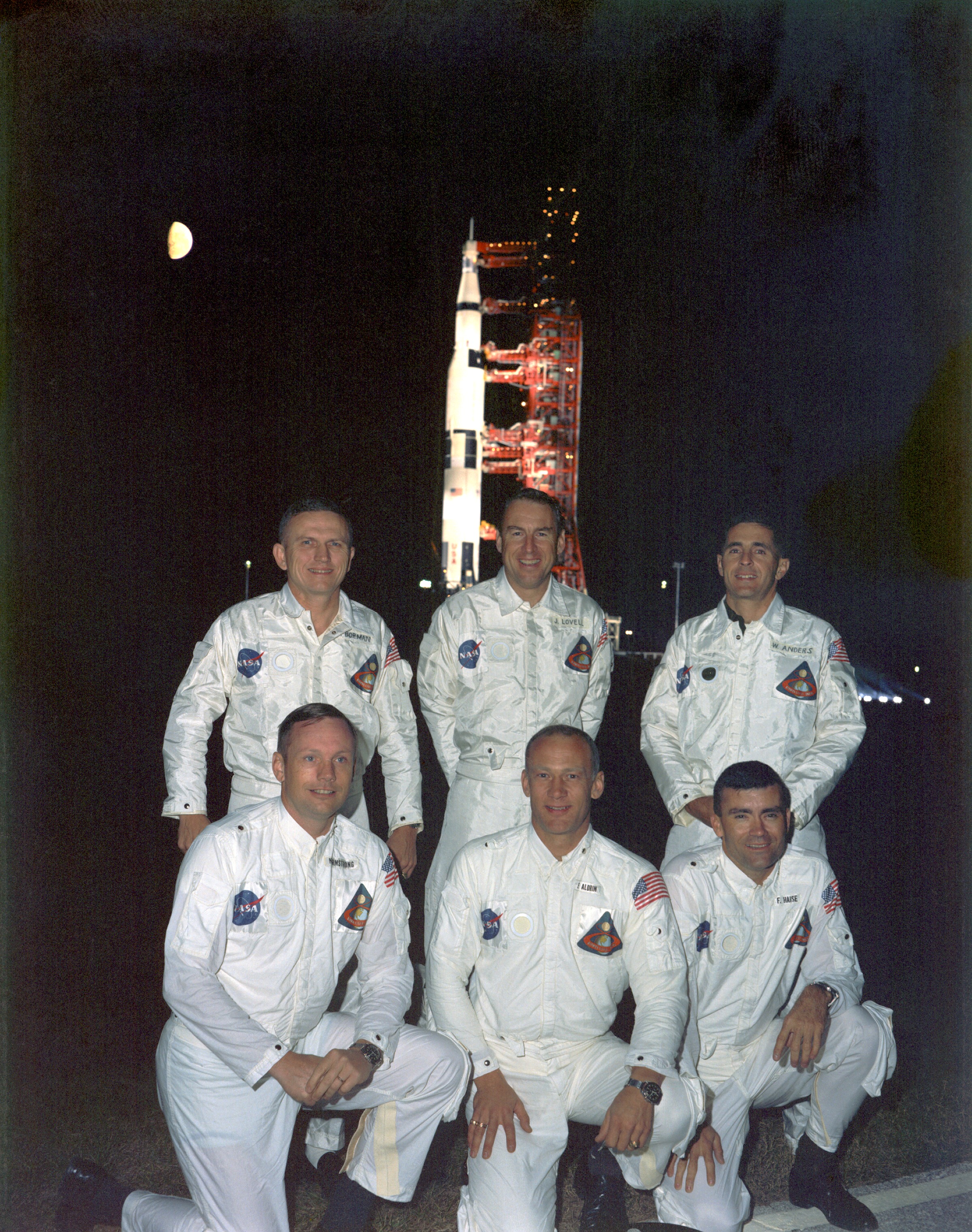
Apollo 8 astronauts James A. Lovell, left, Frank Borman, and William A. Anders during the preflight crew press conference At the White House, Apollo 7 astronauts R. Walter Cunningham, left, Donn F. Eisele, and Walter M. Schirra, Apollo 8 astronauts Anders, Lovell, and Borman, standing at right, watch aviation pioneer Charles A. Lindberg sign a commemorative document, as First Lady “Lady Bird” Johnson, President Lyndon B. Johnson, former NASA Administrator James E. Webb, and Vice President Hubert H. Humphrey look on During the countdown demonstration test, Borman, standing left, Lovell, and Anders pose with their backups Neil A. Armstrong, kneeling left, Edwin E. “Buzz” Aldrin, and Fred W. Haise
Left: Apollo 8 astronauts James A. Lovell, left, Frank Borman, and William A. Anders during the preflight crew press conference. Middle: At the White House, Apollo 7 astronauts R. Walter Cunningham, left, Donn F. Eisele, and Walter M. Schirra, Apollo 8 astronauts Anders, Lovell, and Borman, standing at right, watch aviation pioneer Charles A. Lindberg sign a commemorative document, as First Lady “Lady Bird” Johnson, President Lyndon B. Johnson, former NASA Administrator James E. Webb, and Vice President Hubert H. Humphrey look on. Right: During the countdown demonstration test, Borman, standing left, Lovell, and Anders pose with their backups Neil A. Armstrong, kneeling left, Edwin E. “Buzz” Aldrin, and Fred W. Haise.

On Dec. 2, Borman, Lovell, and Anders held their preflight press conference at the Manned Spacecraft Center (MSC), now NASA’s Johnson Space Center in Houston. Borman summed up the crew’s readiness, “I think we can say we’re ready two weeks before” the flight. President Lyndon B. Johnson invited Apollo 7 astronauts Walter M. Schirra, Donn F. Eisele, and R. Walter Cunningham to a state dinner at the White House on Dec. 9, 1968. He also invited Apollo 8 astronauts Borman, Lovell, and Anders, just 12 days from their historic launch to the Moon, as well as aviation pioneer Charles A. Lindberg to sign a commemorative document to hang in the White House Treaty Room. Two days later, Borman, Lovell, and Anders and their backups Neil A. Armstrong, Edwin E. “Buzz” Aldrin, and Fred W. Haise participated in the countdown demonstration test at NASA’s Kennedy Space Center (KSC) in Florida.
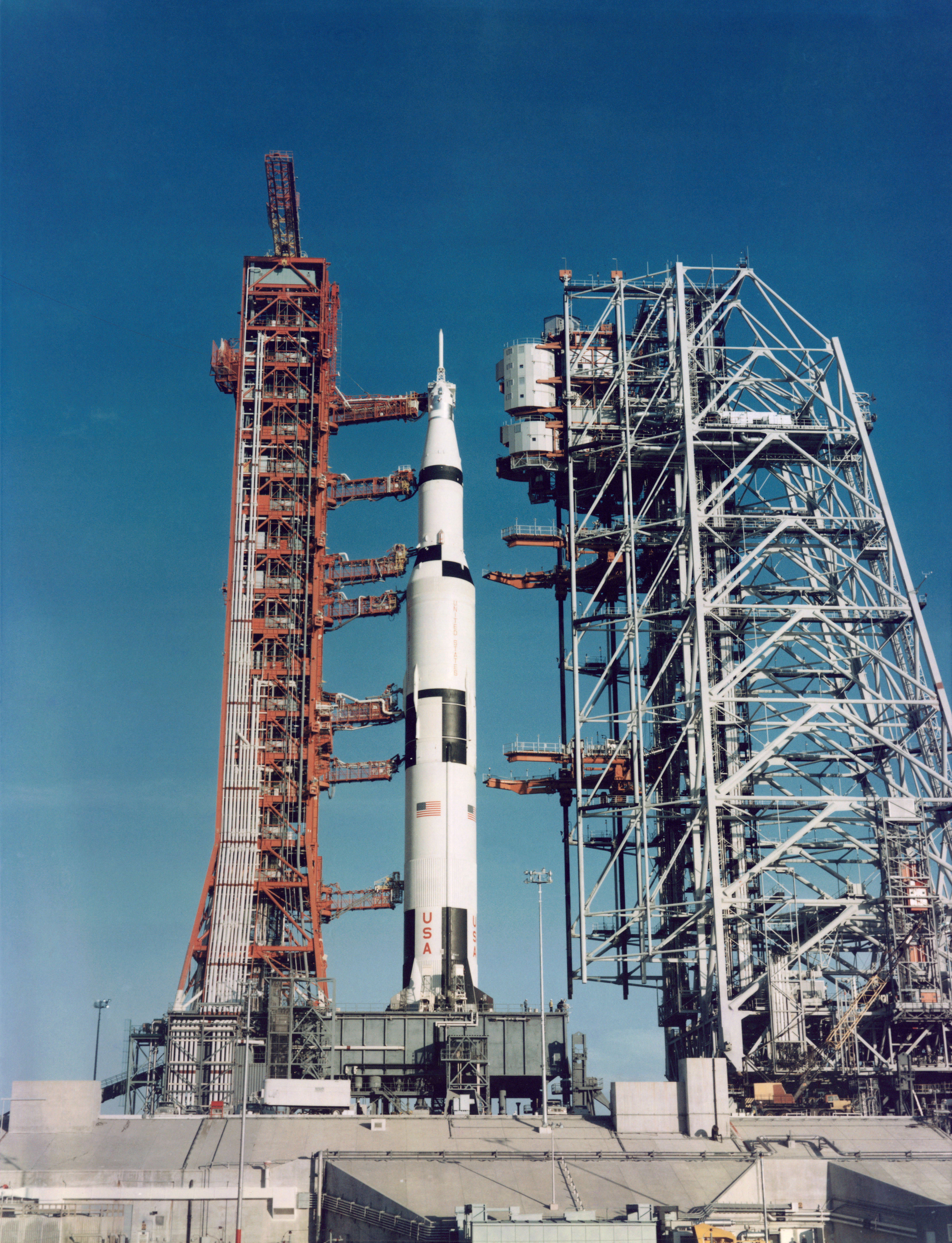
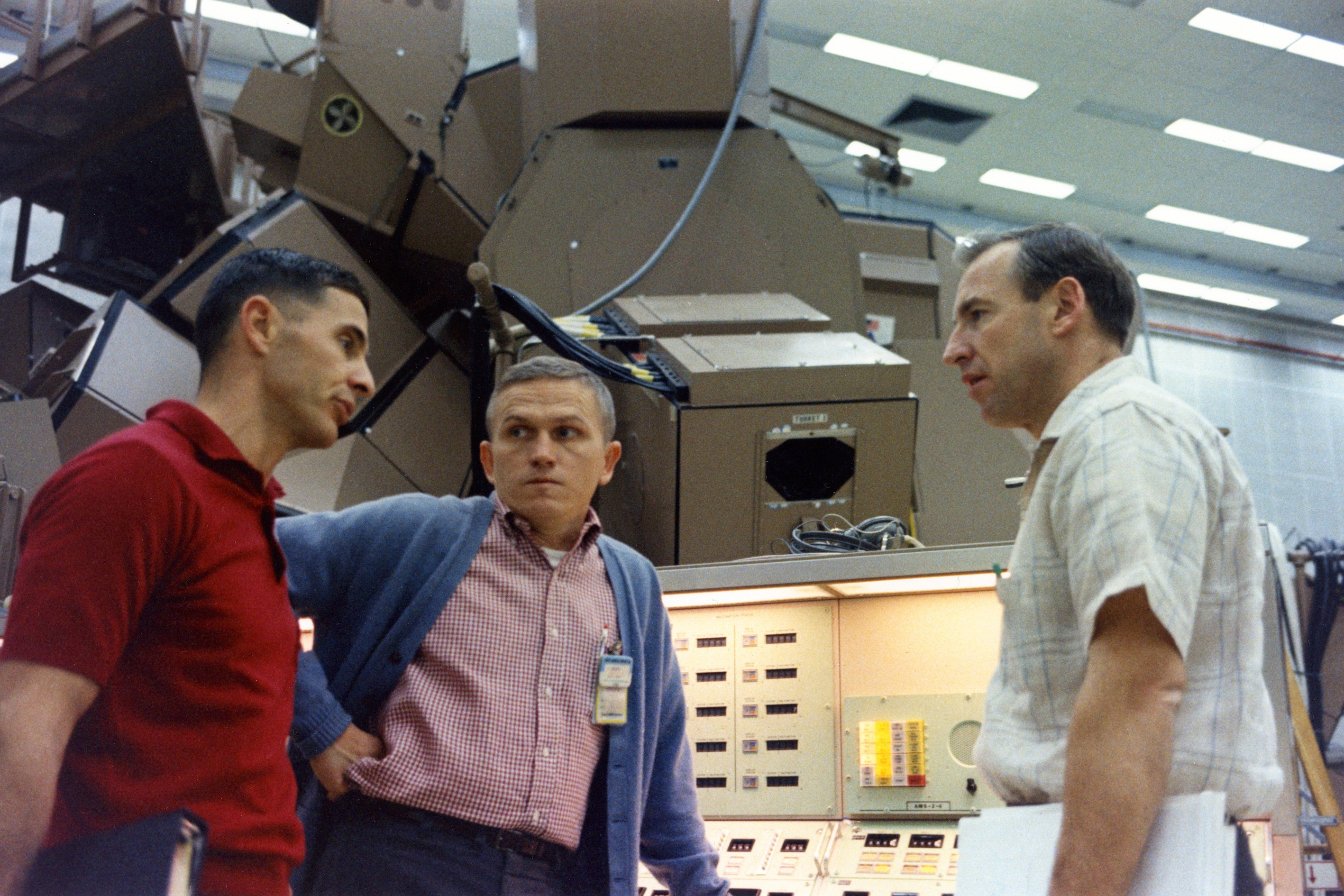
The Apollo 8 launch vehicle at Launch Pad 39A during the countdown demonstration test Apollo 8 crew of William A. Anders, left, Frank Borman, and James A. Lovell at the Command Module simulator at NASA’s Kennedy Space Center in Florida Lovell, left, Borman, and Anders enjoy some pre-holiday cheer on the eve of their launch to the Moon
Left: The Apollo 8 launch vehicle at Launch Pad 39A during the countdown demonstration test. Middle: Apollo 8 crew of William A. Anders, left, Frank Borman, and James A. Lovell at the Command Module simulator at NASA’s Kennedy Space Center in Florida. Right: Lovell, left, Borman, and Anders enjoy some pre-holiday cheer on the eve of their launch to the Moon.

Engineers at KSC’s Launch Complex 39 completed the Apollo 8 Countdown Demonstration Test (CDDT) between Dec. 5 and 11, consisting of “wet” and “dry” phases. In the first wet phase, they simulated the entire countdown including the loading of propellant in the rocket’s three stages, down to T minus 8.9 seconds, the time when the first stage’s five F-1 engines ignite. For safety reasons, the crew did not participate in the wet countdown. At the end of the wet phase on Dec. 10, workers drained the fuel from the rocket and recycled the countdown. The next day, the countdown again proceeded to the point of first stage ignition, but for this dry phase the astronauts suited up and strapped into the capsule as they would on launch day. The CDDT also tied in the Mission Control Center (MCC) at MSC, and the Manned Space Flight Network, a series of tracking stations around the world used to monitor the mission. With the CDDT completed, the countdown for Apollo 8 began on Dec. 15.

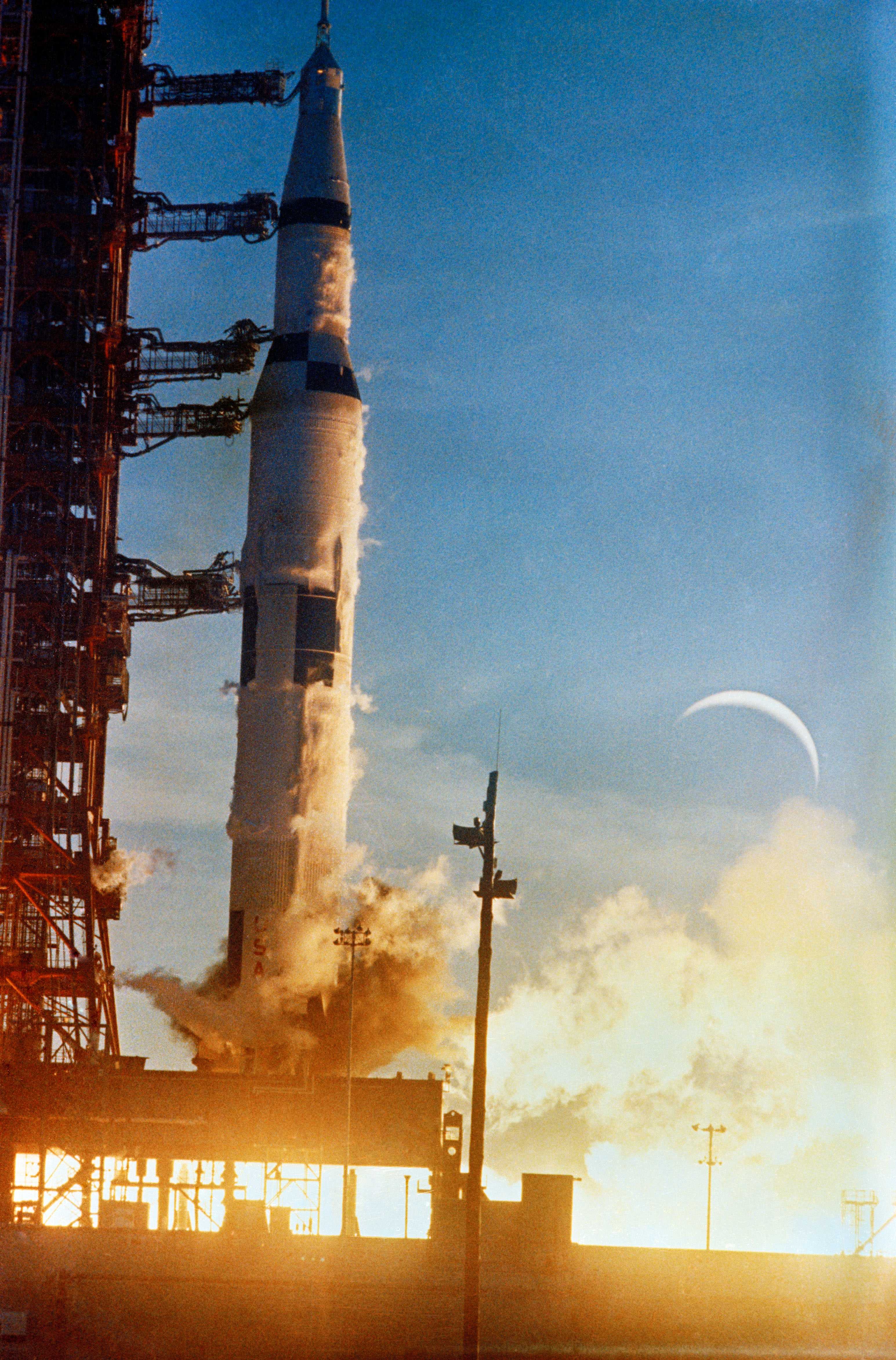
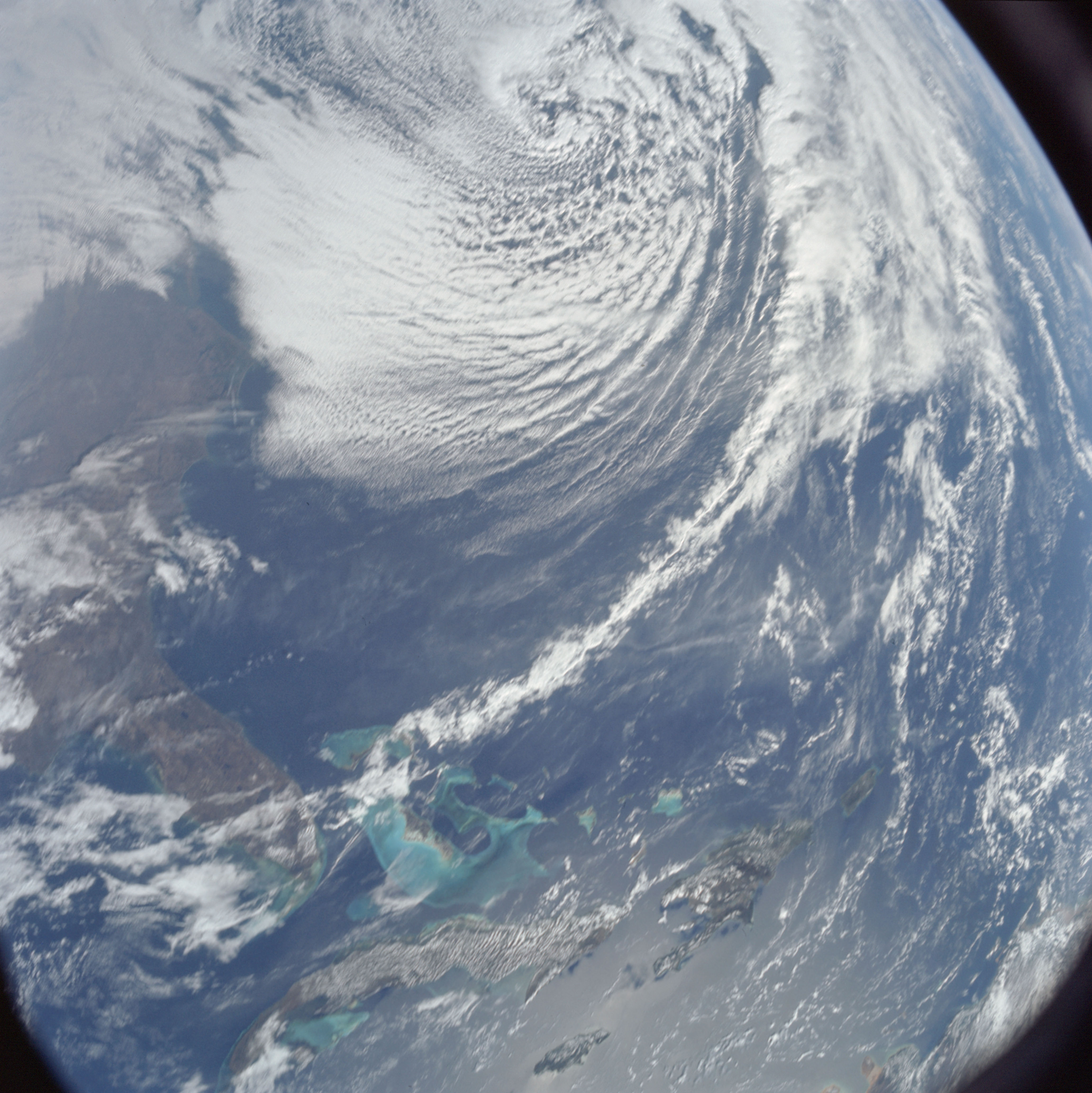
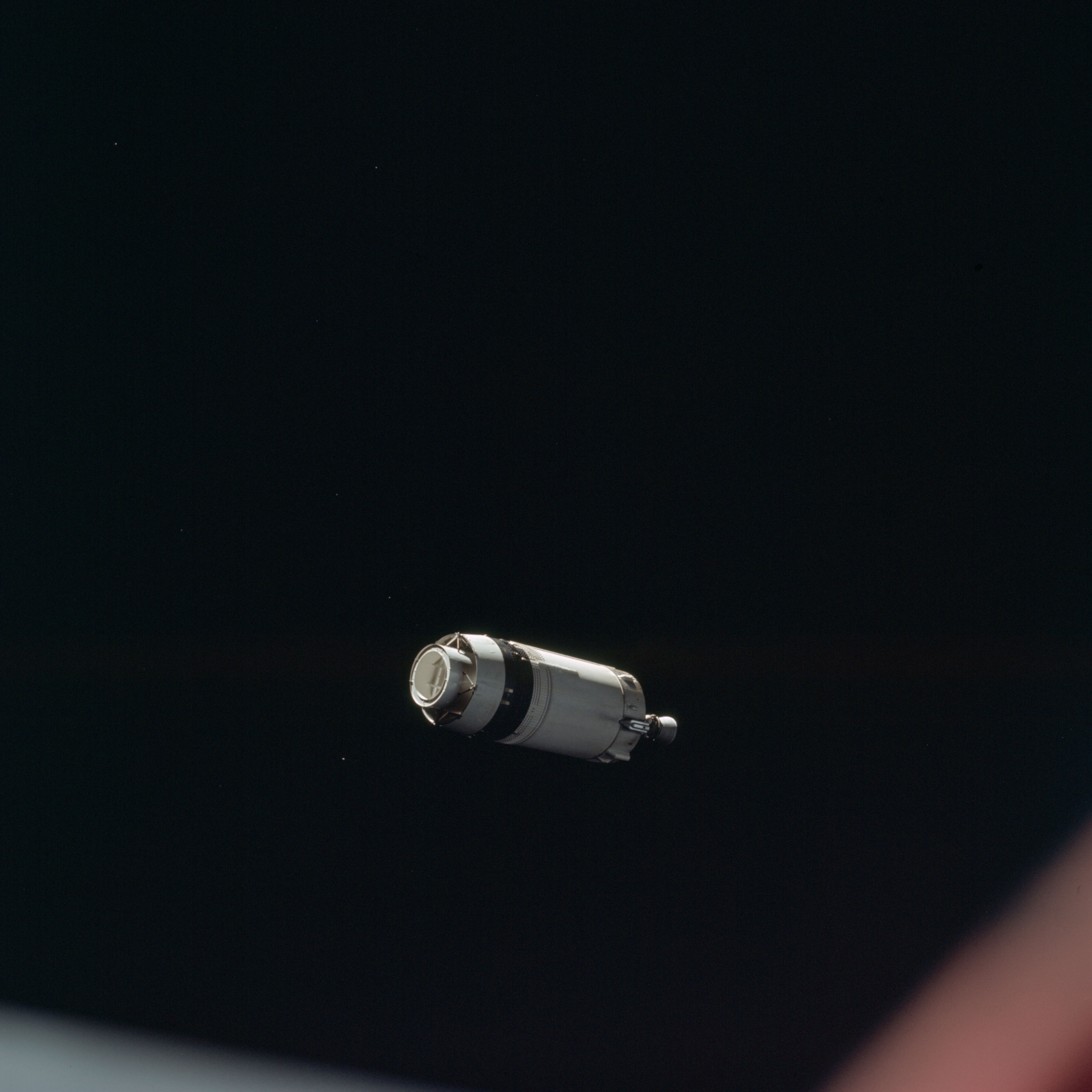
Liftoff of Apollo 8 A rapidly receding Earth shortly after Trans-Lunar Injection The spent S-IVB third stage with the Lunar Module (LM) Test Article-B (LTA-B) visible where a LM would normally reside
Left: Liftoff of Apollo 8. Middle: A rapidly receding Earth shortly after Trans-Lunar Injection. Right: The spent S-IVB third stage with the Lunar Module (LM) Test Article-B (LTA-B) visible where a LM would normally reside.

On Dec. 21, 1968, at precisely 7:51 a.m. EST, at Launch Pad 39A the five engines of the Saturn V’s first stage came to life, powering up to their full 7.5 million pounds of thrust. The brilliance of the flame rivaled the sunrise. At the top of the rocket, strapped inside their Command Module (CM), Borman, Lovell, and Anders experienced firsthand the power of a Saturn V launch. As soon as the rocket cleared the launch tower, control of the mission transferred from the Launch Control Center at Launch Complex 39 to MCC at MSC. From there, three teams of controllers, led by Lead Flight Director Clifford E. Charlesworth and Flight Directors Glynn S. Lunney and Milton L. Windler, working in eight-hour shifts, monitored the mission until splashdown. During the launch and early phases of the flight, Michael Collins served as the capsule communicator, or capcom, the astronaut in MCC who spoke directly with the crew. Within 11 and a half minutes, the three stages of the Saturn V placed Apollo 8 into Earth orbit. For the next 90 minutes, MCC and the astronauts thoroughly checked out the spacecraft’s systems, and capcom Collins informed the crew, “You are go for TLI,” or Trans-Lunar Injection, a less than dramatic way of saying “You’re off to the Moon!” Those words committed the mission to break the bonds of Earth’s gravity and set a course for the Moon. Near the end of the second revolution around the Earth, the rocket’s third stage engine fired for a second time, for more than five minutes, increasing Apollo 8’s speed from 17,400 miles per hour to 24,226 miles per hour, enough to overcome Earth’s gravity and send it on a Moonward trajectory. Soon after the burn ended, the astronauts separated their spacecraft from the spent stage and began their three-day cruise to the Moon.

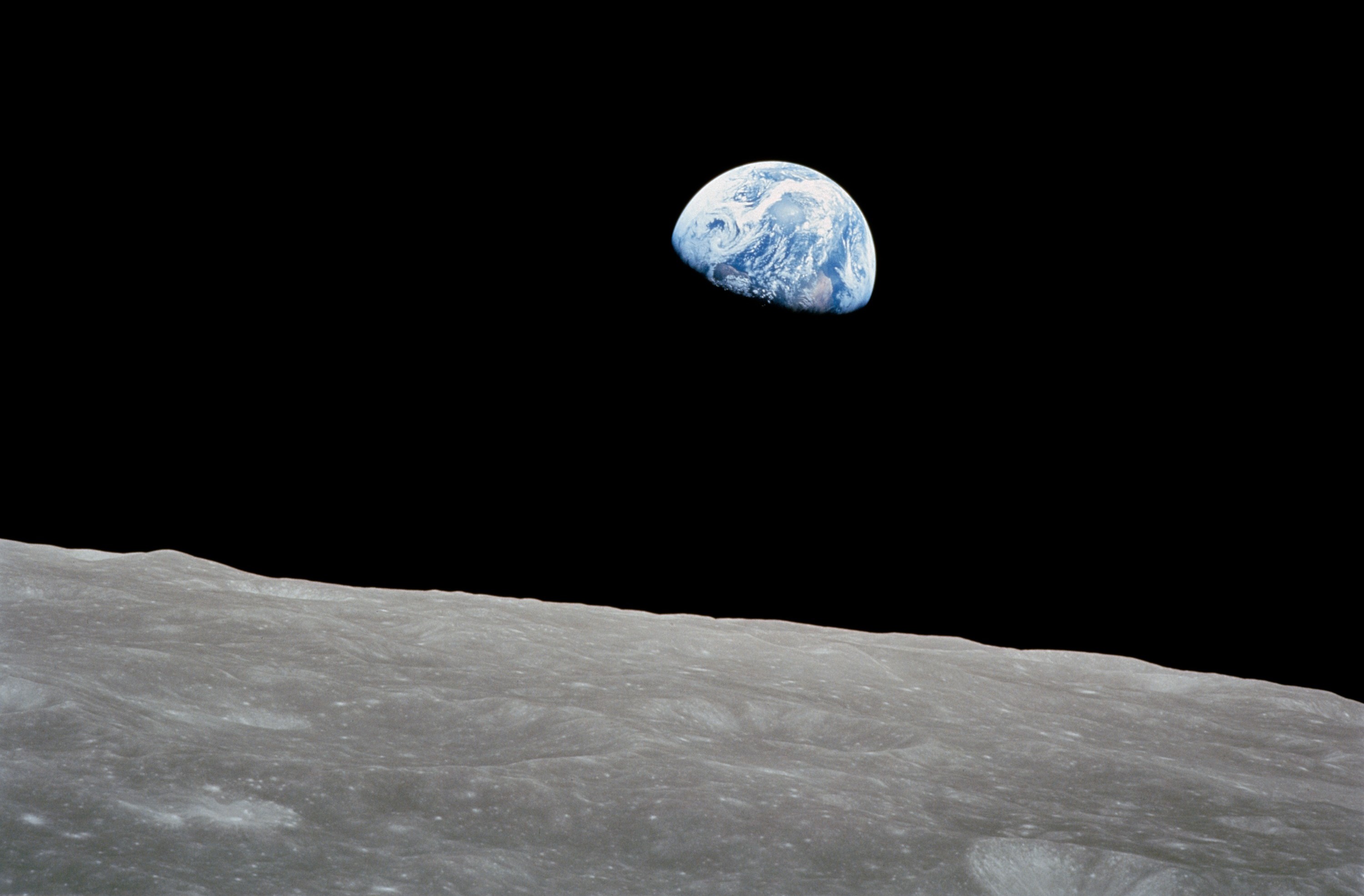
The famous Earthrise photograph from Apollo 8
The famous Earthrise photograph from Apollo 8.

During the journey, Borman, Lovell, and Anders passed through the Earth’s Van Allen radiation belts and crossed into the Moon’s gravitational sphere of influence. About 69 hours after launch, Apollo 8 passed the leading edge of the Moon and disappeared behind it, all communications with Earth cut off. While behind the Moon, the astronauts performed the Lunar Orbit Insertion maneuver, but for a few anxious minutes, only they knew that their spacecraft’s engine had performed as expected. As they emerged on the Moon’s other side precisely at the predicted time, MCC confirmed that Apollo 8 had achieved lunar orbit. The astronauts began to describe the Moon as no other humans had seen it before.

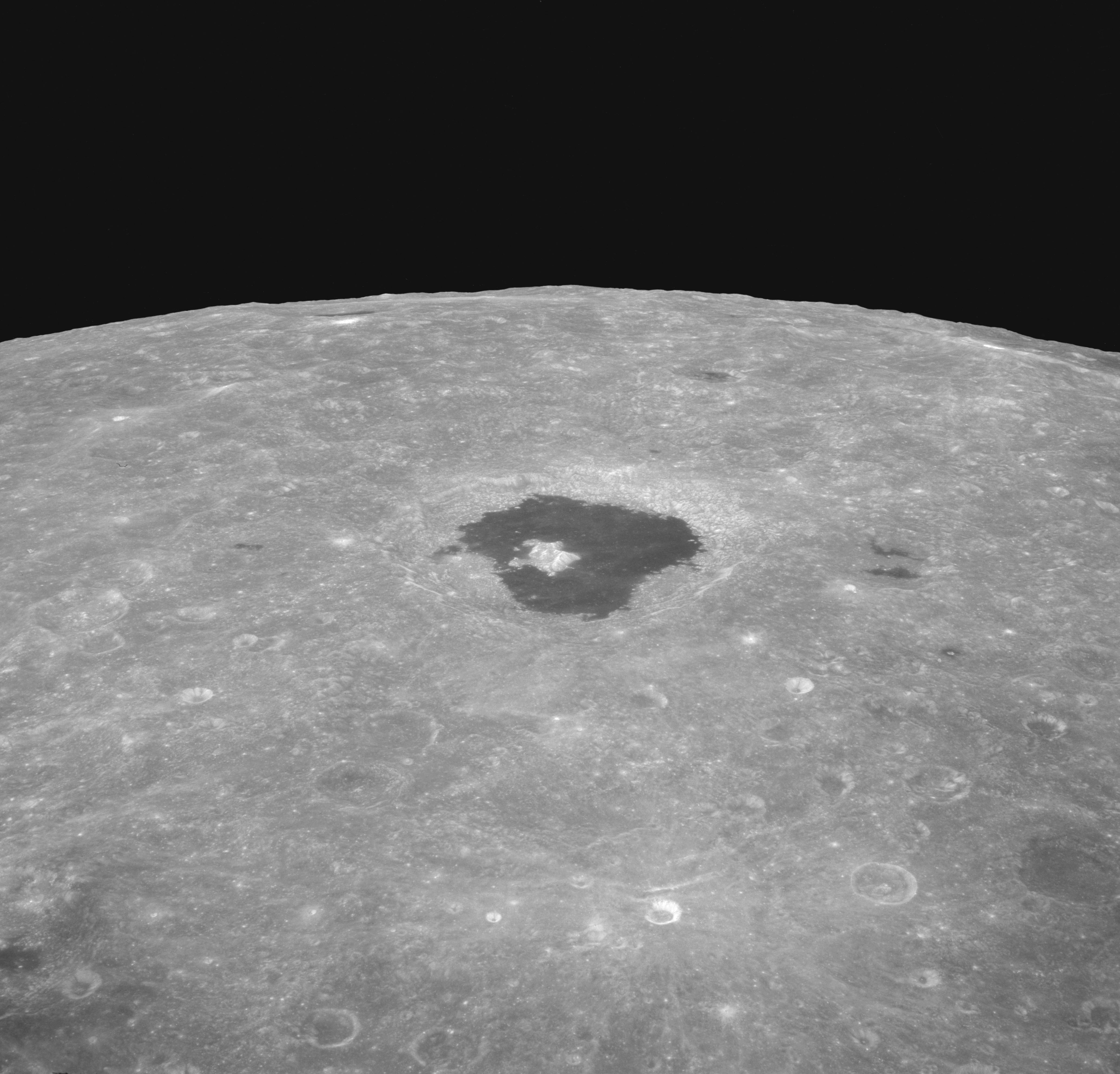
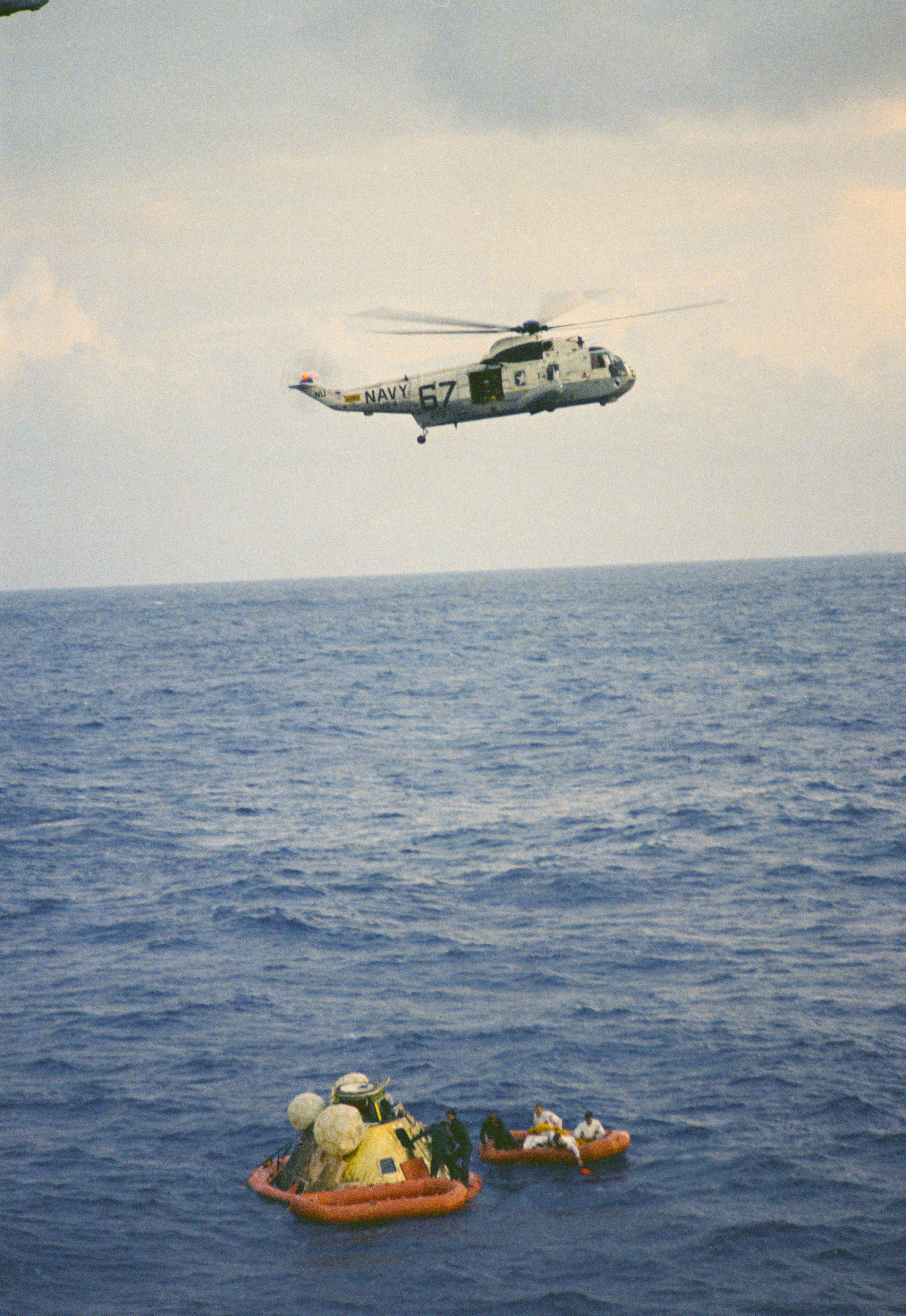
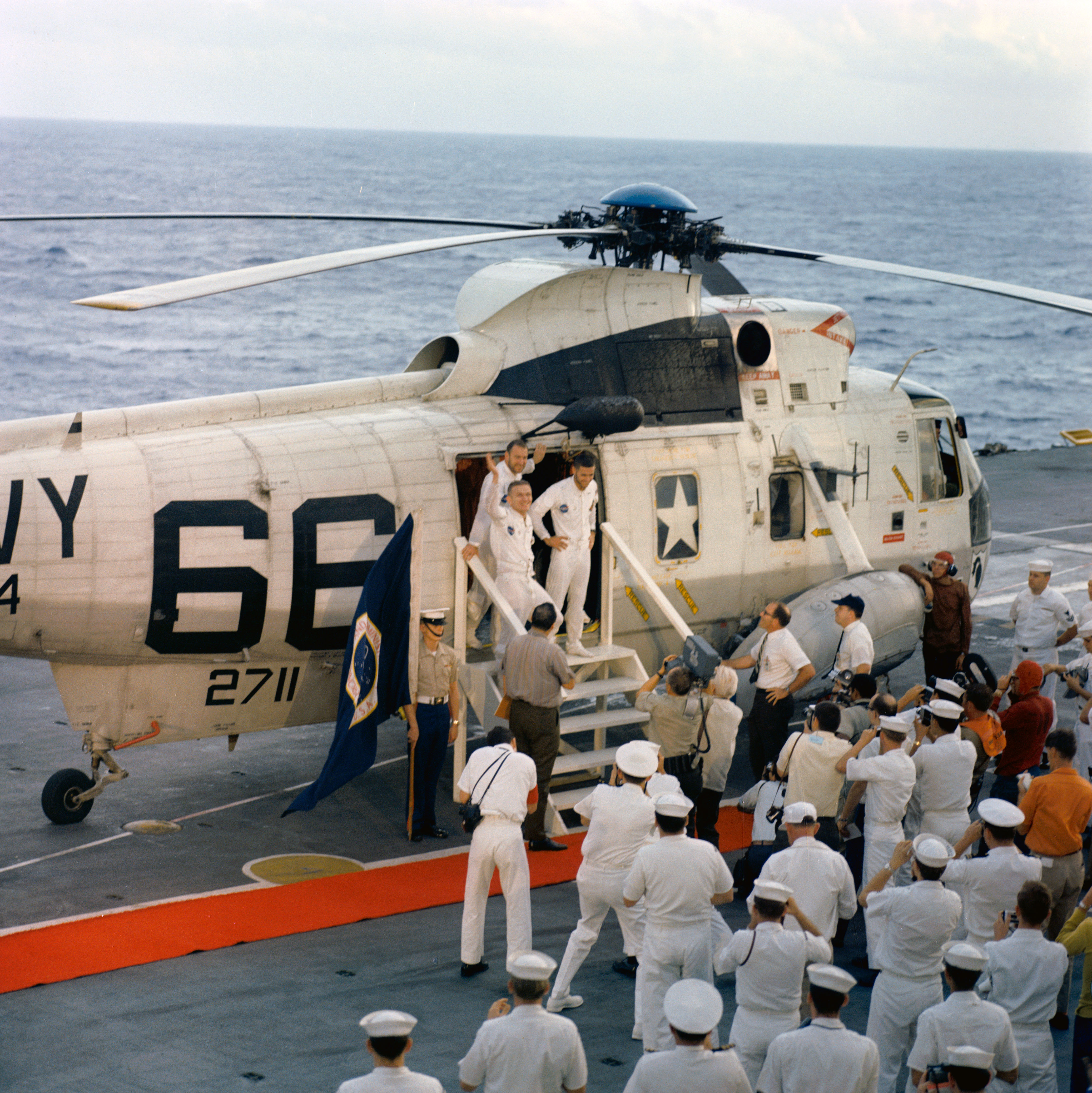
The Tsiolkovski Crater on the Moon’s farside, seen directly by human eyes for the first time during Apollo 8 Apollo 8 shortly after splashdown, with the astronauts in the life raft awaiting pick up by the recovery helicopter Apollo 8 astronauts arrive on the prime recovery ship U.S.S. Yorktown
Left: The Tsiolkovski Crater on the Moon’s farside, seen directly by human eyes for the first time during Apollo 8. Middle: Apollo 8 shortly after splashdown, with the astronauts in the life raft awaiting pick up by the recovery helicopter. Right: Apollo 8 astronauts arrive on the prime recovery ship U.S.S. Yorktown.

For the next 20 hours, they orbited the Moon 10 times. On their ninth revolution, knowing that Christmas Eve had turned to Christmas Day, Borman, Lovell, and Anders read from The Bible’s Book of Genesis and wished everyone on “the good Earth” a Merry Christmas. On their final revolution, they disappeared behind the Moon one last time and fired their spacecraft’s engine to propel them out of lunar orbit to head back toward Earth. Once they reestablished contact at the predicted time, Lovell proclaimed, “Please be informed there is a Santa Claus,” his way of saying that the engine burned as expected. The astronauts spent the next three days coasting back toward Earth, ending their historic six-day mission with a predawn splashdown in the Pacific Ocean. Teams from the prime recovery ship U.S.S. Yorktown (CV-10) recovered them from the water and brought them aboard the carrier.

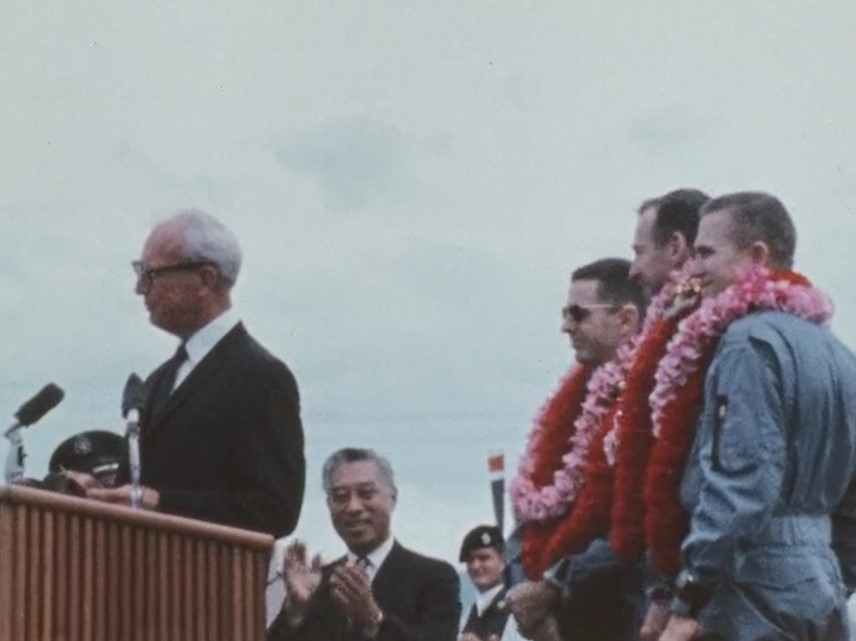
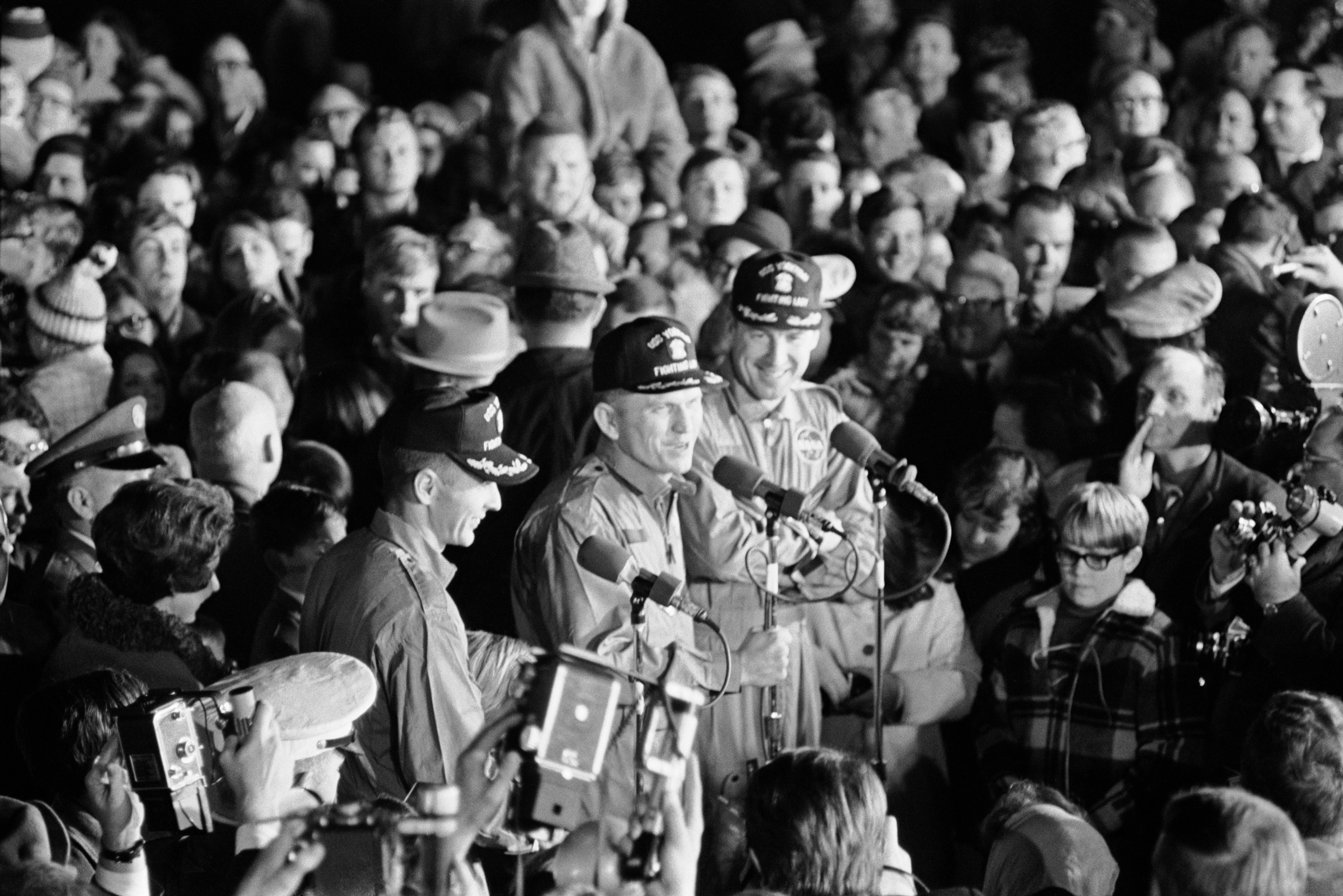
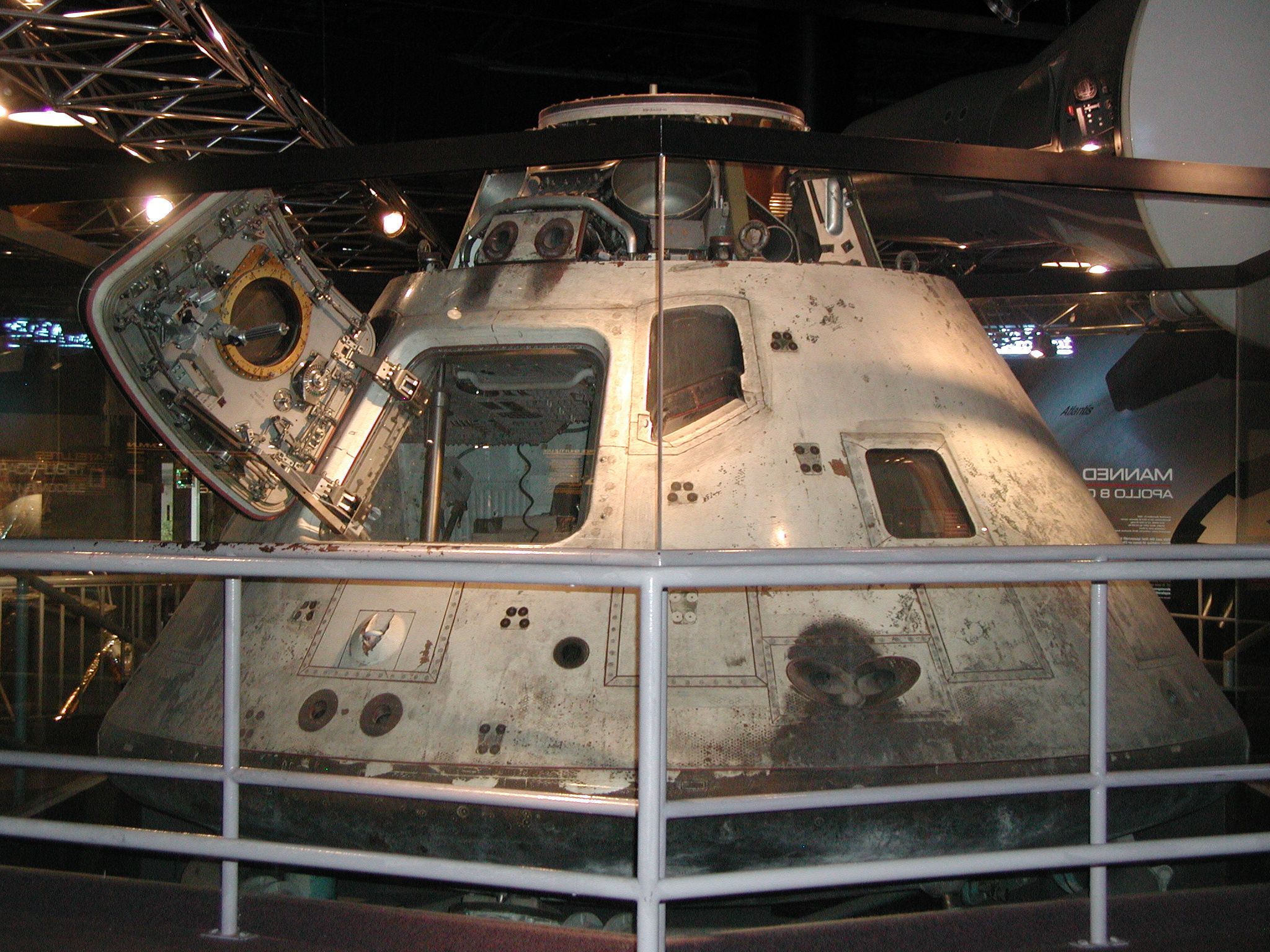
Apollo 8 astronauts (wearing leis) William A. Anders, left, James A. Lovell, and Frank Borman listen to Hawaii Governor John A. Burns during their brief stopover at Hickam Air Force Base (AFB) in Honolulu Anders, left, Borman, and Lovell give short speeches to the crowd gathered to welcome them home at Ellington AFB in Houston The Apollo 8 Command Module on display at the Museum of Science and Industry in Chicago
Left: Apollo 8 astronauts (wearing leis) William A. Anders, left, James A. Lovell, and Frank Borman listen to Hawaii Governor John A. Burns during their brief stopover at Hickam Air Force Base (AFB) in Honolulu. Middle: Anders, left, Borman, and Lovell give short speeches to the crowd gathered to welcome them home at Ellington AFB in Houston. Right: The Apollo 8 Command Module on display at the Museum of Science and Industry in Chicago. Image credit: courtesy Museum of Science and Industry.

From the Yorktown, Borman, Lovell, and Anders flew to Hickam Air Force Base (AFB) in Honolulu. Following a brief welcome ceremony hosted by Hawaii Governor John A. Burns, their boarded a transport jet bound for Texas. Upon their arrival back in Houston on Dec. 29, more than 2,000 people greeted them at Ellington AFB despite the pre-dawn chill. Meanwhile, after the Yorktown arrived in Honolulu on Dec. 29, workers removed the CM to begin safing its systems. They flew it to Long Beach, California, and from there trucked it to its manufacturer, the North American Rockwell Space Division in Downey, California, where it arrived on Jan. 1, 1969, for a thorough postflight inspection. Since 1971, the Apollo 8 CM has been on display at the Museum of Science and Industry in Chicago. TIME magazine named Borman, Lovell, and Anders Men of the Year for 1968. Apollo 8 brought the Moon landing one giant step closer.


Apollo 9 astronauts James A. McDivitt, left, David R. Scott, and Russell L. Schweickart pose in front of the Apollo 8 Saturn V during its terminal countdown demonstration test at Launch Pad 39A at NASA’s Kennedy Space Center in Florida
Apollo 9 astronauts James A. McDivitt, left, David R. Scott, and Russell L. Schweickart pose in front of the Apollo 8 Saturn V during its terminal countdown demonstration test at Launch Pad 39A at NASA’s Kennedy Space Center in Florida.

Due to delays in its development, the LM remained one component of the lunar mission architecture that Apollo 8 did not test. The task of conducting the first crewed evaluation of the LM fell to Apollo 9, scheduled for late February 1969. As the prime crew for the 10-day Earth orbital mission, NASA assigned James A. McDivitt, David R. Scott, and Russell L. Schweickart, with Charles “Pete” Conrad, Richard F. Gordon, and Alan L. Bean as their backups. McDivitt and Schweickart planned to enter the LM while Scott remained in the CM. Before the two spacecraft undocked, Schweickart planned to conduct a roughly 2-hour spacewalk, using prepositioned handholds to translate from the LM to the CM, where Scott awaited him in the open hatch. The dual spacewalk served to demonstrate a backup transfer capability should a problem arise with the internal transfer tunnel. The spacewalk would also serve as the only in-space test of the new Apollo A7L spacesuit before the Moon landing. Following the spacewalk, McDivitt and Schweickart planned to undock the LM and conduct an independent flight up to a distance of 100 miles, and test both the descent and ascent stage engines, before rejoining Scott in the CM.

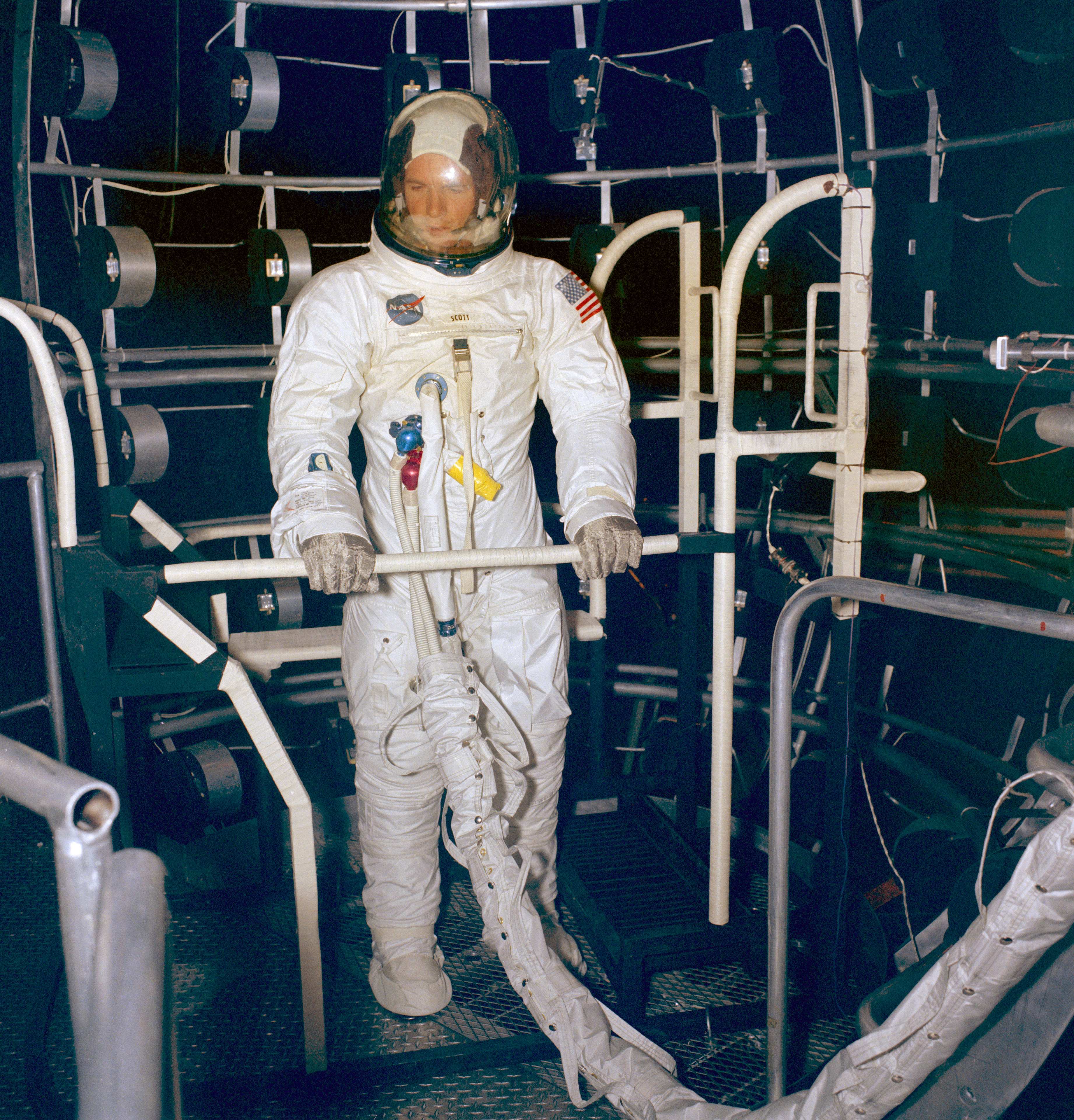
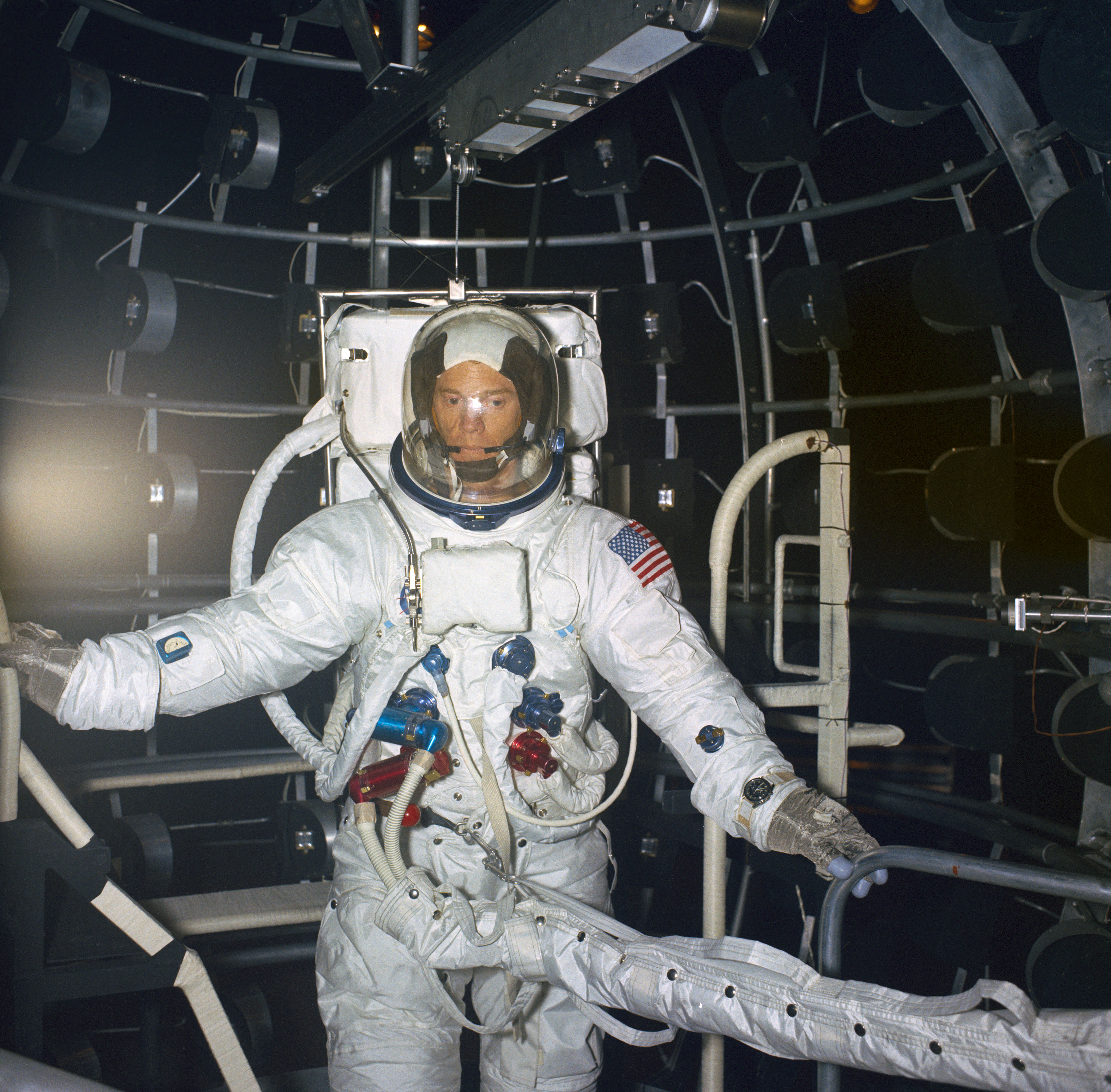
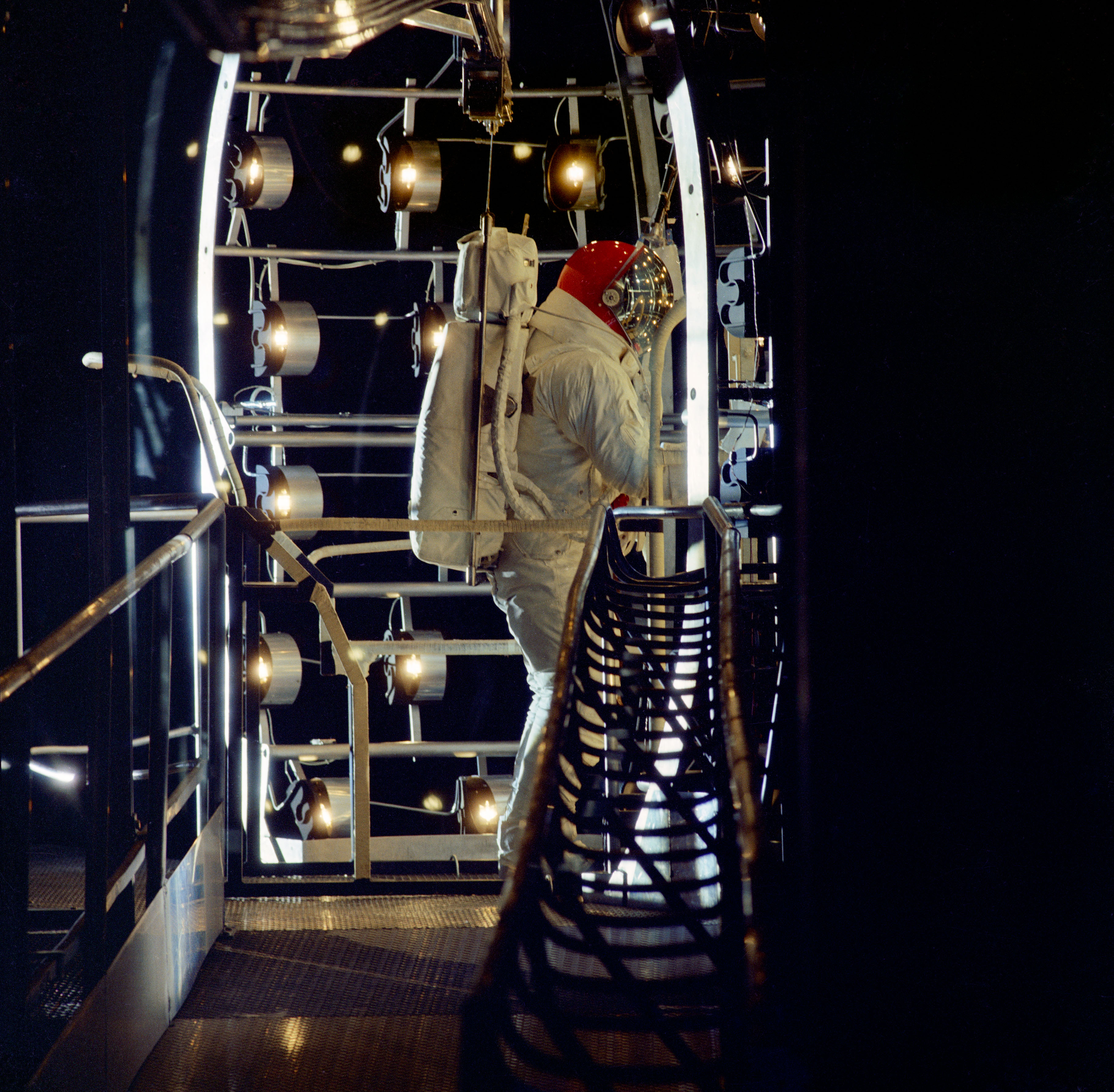
Apollo 9 prime and backup astronauts test the new Apollo A7L spacesuit in the Space Environment Simulation Laboratory at the Manned Spacecraft Center, now NASA’s Johnson Space Center in Houston. David R. Scott Apollo 9 prime and backup astronauts test the new Apollo A7L spacesuit in the Space Environment Simulation Laboratory at the Manned Spacecraft Center, now NASA’s Johnson Space Center in Houston. Russell L. Schweickart Apollo 9 prime and backup astronauts test the new Apollo A7L spacesuit in the Space Environment Simulation Laboratory at the Manned Spacecraft Center, now NASA’s Johnson Space Center in Houston. Alan L. Bean
Apollo 9 prime and backup astronauts test the new Apollo A7L spacesuit in the Space Environment Simulation Laboratory at the Manned Spacecraft Center, now NASA’s Johnson Space Center in Houston. David R. Scott, left, Russell L. Schweickart, and Alan L. Bean.

International Latex Corporation (ILC) of Dover, Delaware, developed two versions of the Apollo A7L space suit for NASA – one for use exclusively inside the spacecraft, such as during launch, and the other that astronauts can also use during spacewalks, using the Portable Life Support System (PLSS) backpack. Both types of the suit could operate under vacuum conditions, but crew members wearing the inside version remained attached to the spacecraft via hoses that provided life support such as oxygen. The external version’s PLSS provided the required oxygen and communications during spacewalks outside the vehicle, for example on the lunar surface. For Apollo 9, McDivitt and Schweickart wore the external versions (even though McDivitt did not plan to do a spacewalk) while Scott wore the internal version. McDivitt, Scott, Schweickart, and Bean tested their A7L spacesuits with the PLSS under vacuum conditions in Chamber A of the Space Environment Simulation Laboratory at MSC.

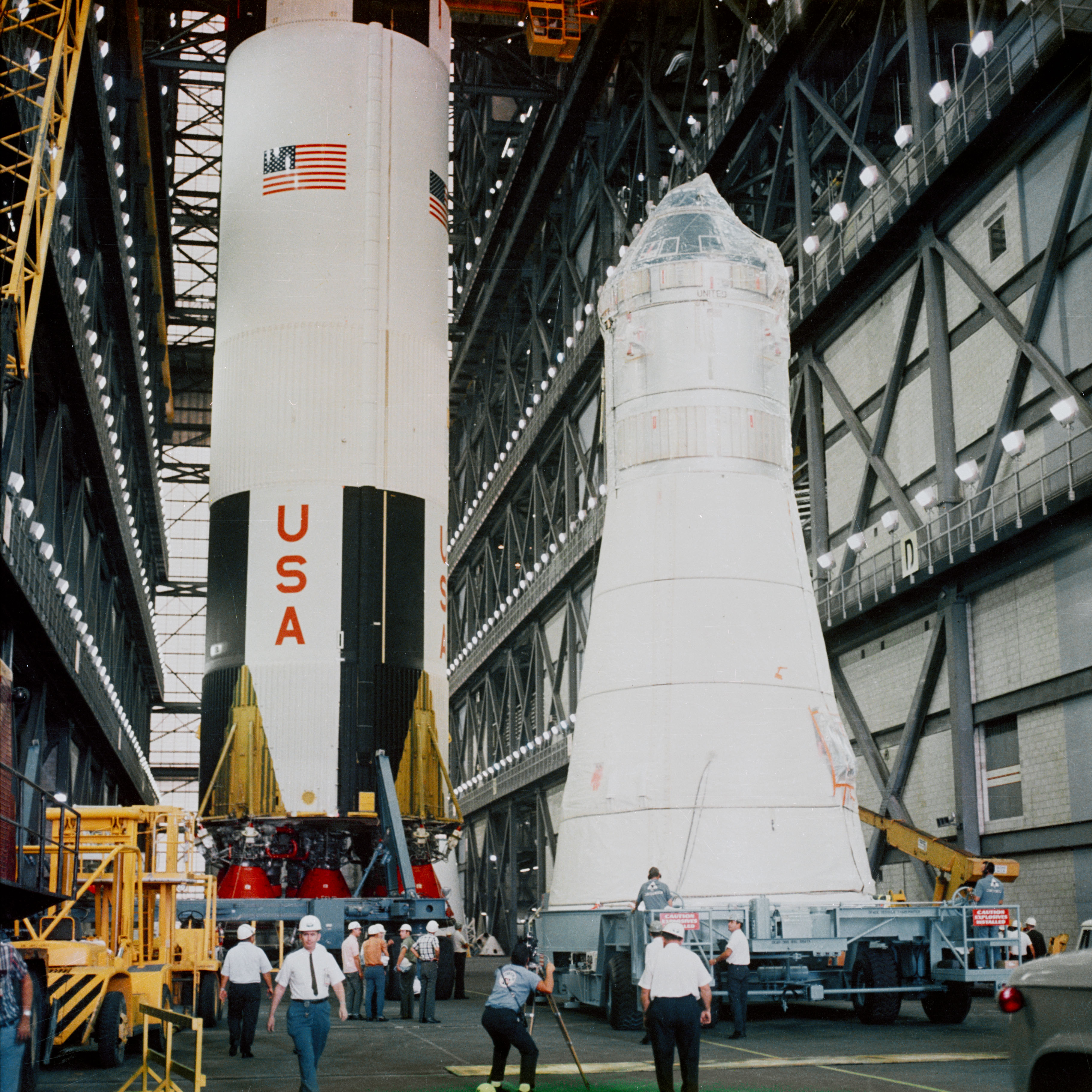
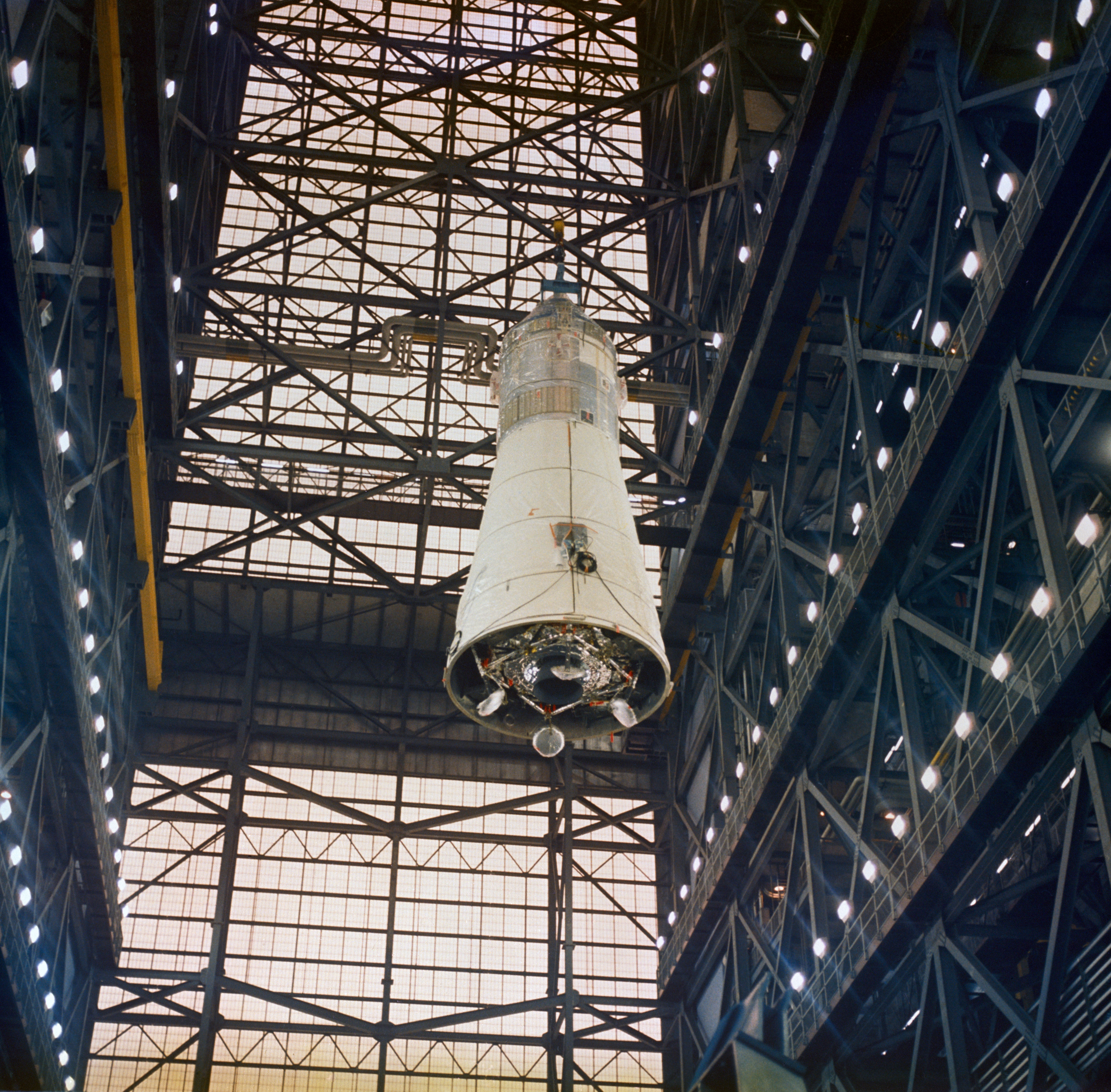
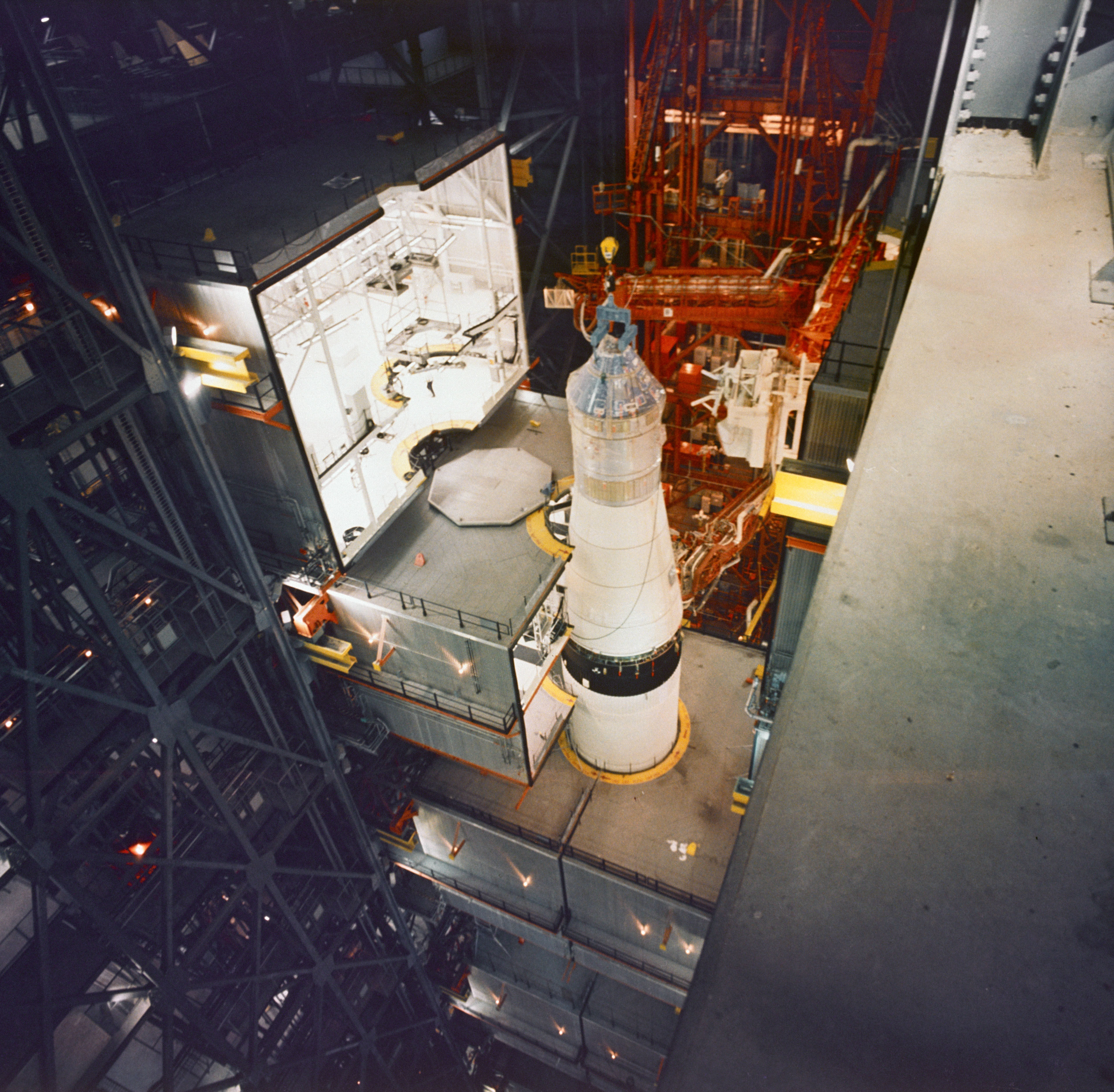
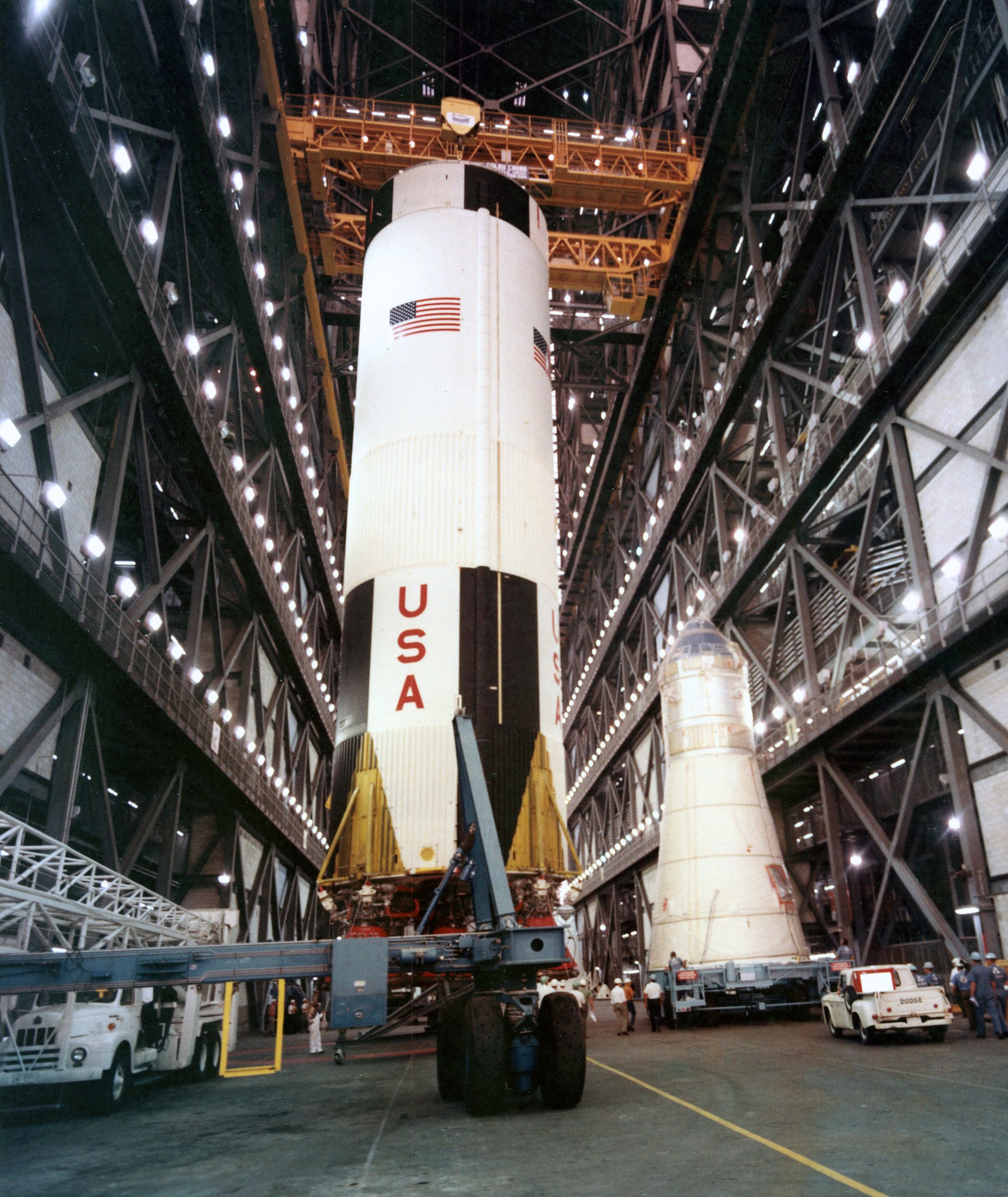
The assembled Apollo 9 spacecraft arrives from the Manned Spacecraft Operations Building, and shares space in the transfer aisle with the recently arrived Apollo 10 first stage Workers hoist the Apollo 9 spacecraft in preparation for stacking onto the Saturn V rocket, with the Lunar Module’s landing gear visible Workers stack the Apollo 9 spacecraft onto its Saturn V rocket
In the Vehicle Assembly Building at NASA’s Kennedy Space Center in Florida. Left: The assembled Apollo 9 spacecraft arrives from the Manned Spacecraft Operations Building, and shares space in the transfer aisle with the recently arrived Apollo 10 first stage. Middle: Workers hoist the Apollo 9 spacecraft in preparation for stacking onto the Saturn V rocket, with the Lunar Module’s landing gear visible. Right: Workers stack the Apollo 9 spacecraft onto its Saturn V rocket.

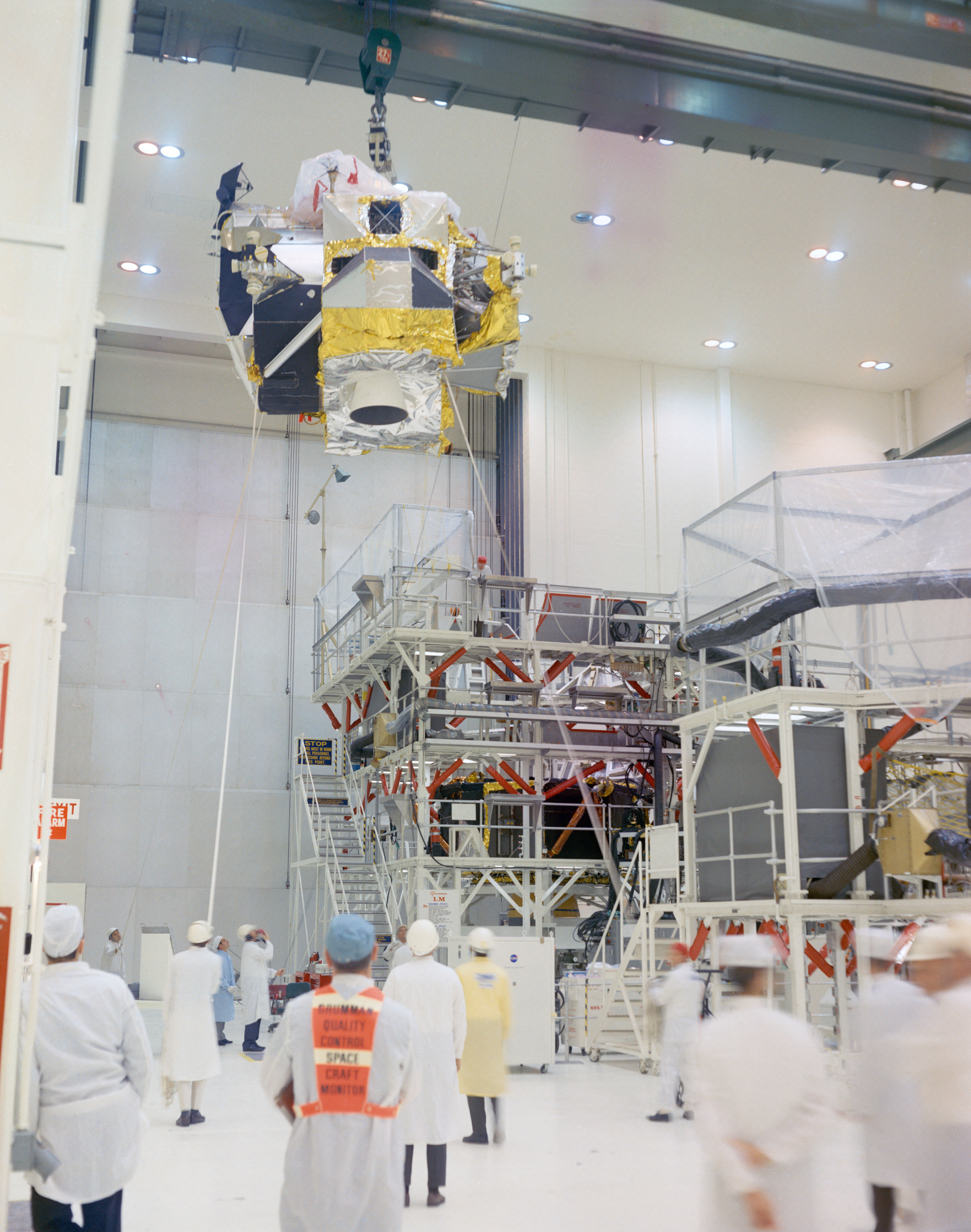
On Nov. 30, workers in KSC’s Manned Spacecraft Operations Building (MSOB) installed the Apollo 9 LM in its Spacecraft LM Adapter (SLA) and then stacked the CSM on top. They transferred the assembled spacecraft to the Vehicle Assembly Building (VAB) three days later where engineers stacked it atop its Saturn V rocket in High Bay 3. Rollout to Launch Pad 39A occurred in early January 1969. 

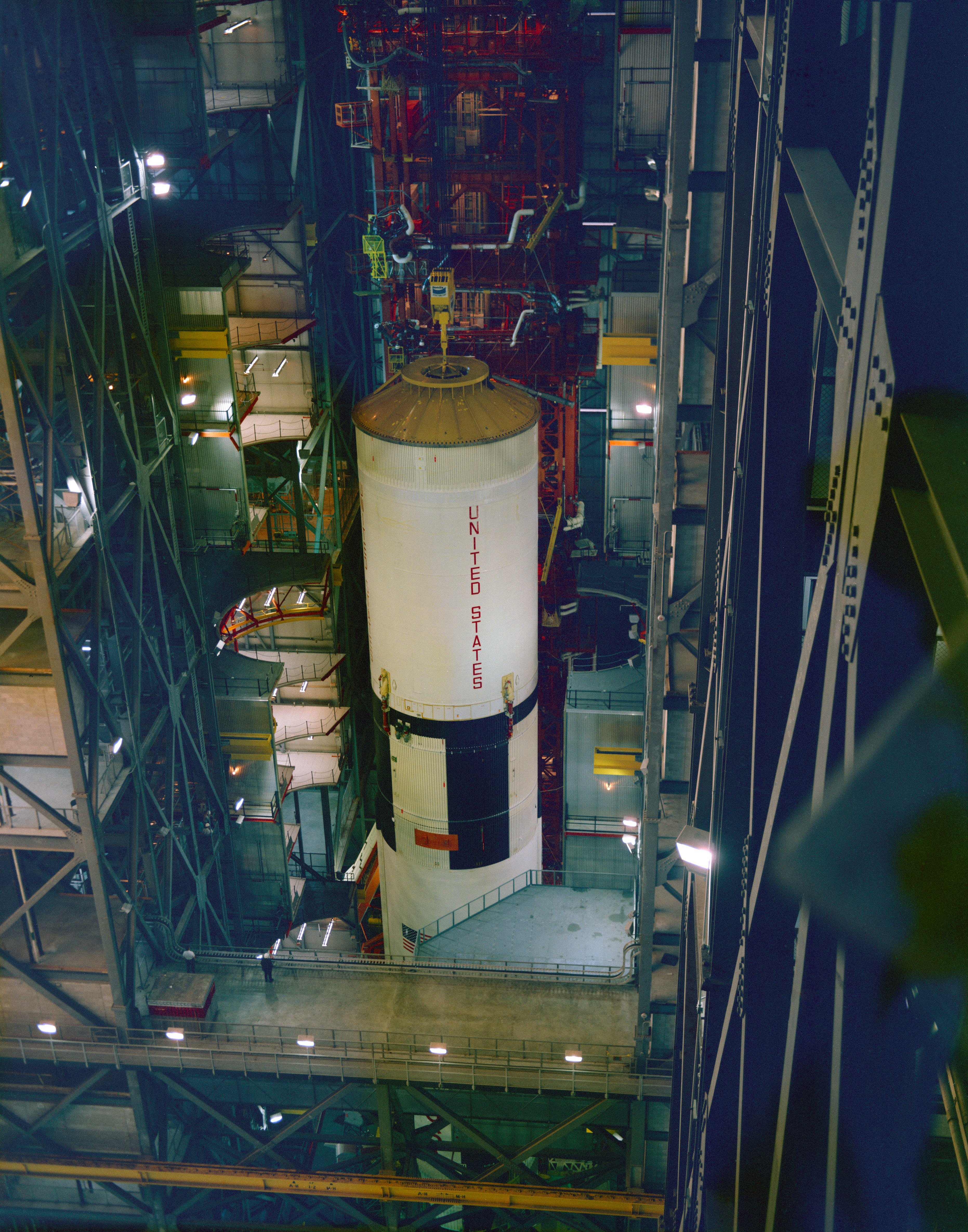
Workers ready the Apollo 10 S-IC first stage for stacking onto the Mobile Launcher in the Vehicle Assembly Building at NASA’s Kennedy Space Center (KSC) in Florida Workers stack the Apollo 10 S-II second stage The S-IVB third stage for Apollo 10 arrives at KSC
Left: Workers ready the Apollo 10 S-IC first stage for stacking onto the Mobile Launcher in the Vehicle Assembly Building at NASA’s Kennedy Space Center (KSC) in Florida. Middle: Workers stack the Apollo 10 S-II second stage. Right: The S-IVB third stage for Apollo 10 arrives at KSC.
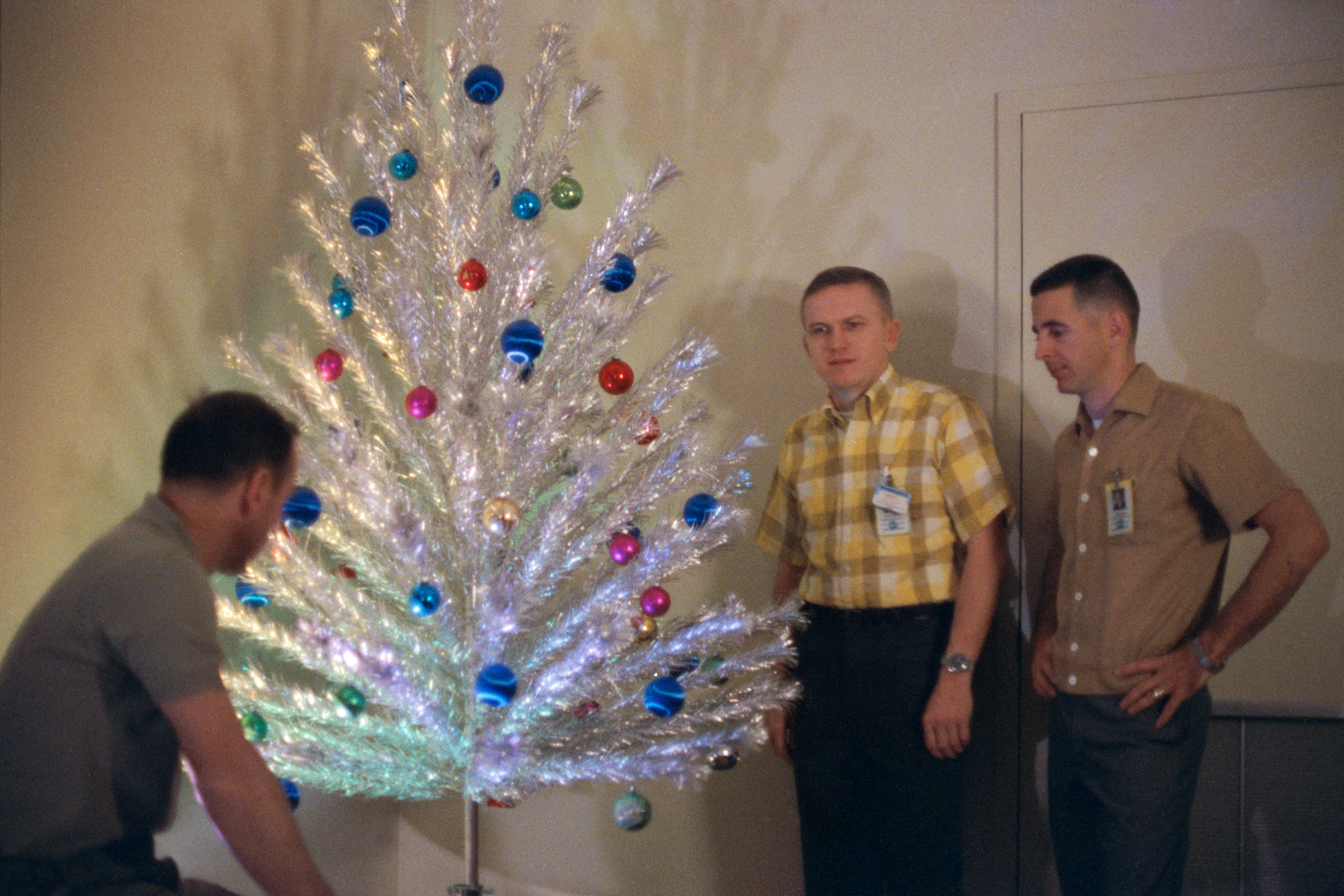
Preparations continued for Apollo 10, the mission planned for May 1969 to test all the spacecraft components in lunar orbit as a possible dress rehearsal for the Moon landing. The Apollo 10 prime crew consisted of Thomas P. Stafford, John W. Young, and Eugene A. Cernan, the first all-veteran three-person crew, with L. Gordon Cooper, Donn F. Eisele, and Edgar D. Mitchell assigned as their backups. Stafford and Cernan planned to undock their LM and fly it to within nine miles of the lunar surface before rejoining Young in the CM. At KSC, in the VAB’s High Bay 2, by Dec. 7 workers had stacked the first two stages of the Apollo 10 Saturn V. The third stage arrived at KSC on Dec. 10 and workers stacked it atop the rocket on Dec. 29.
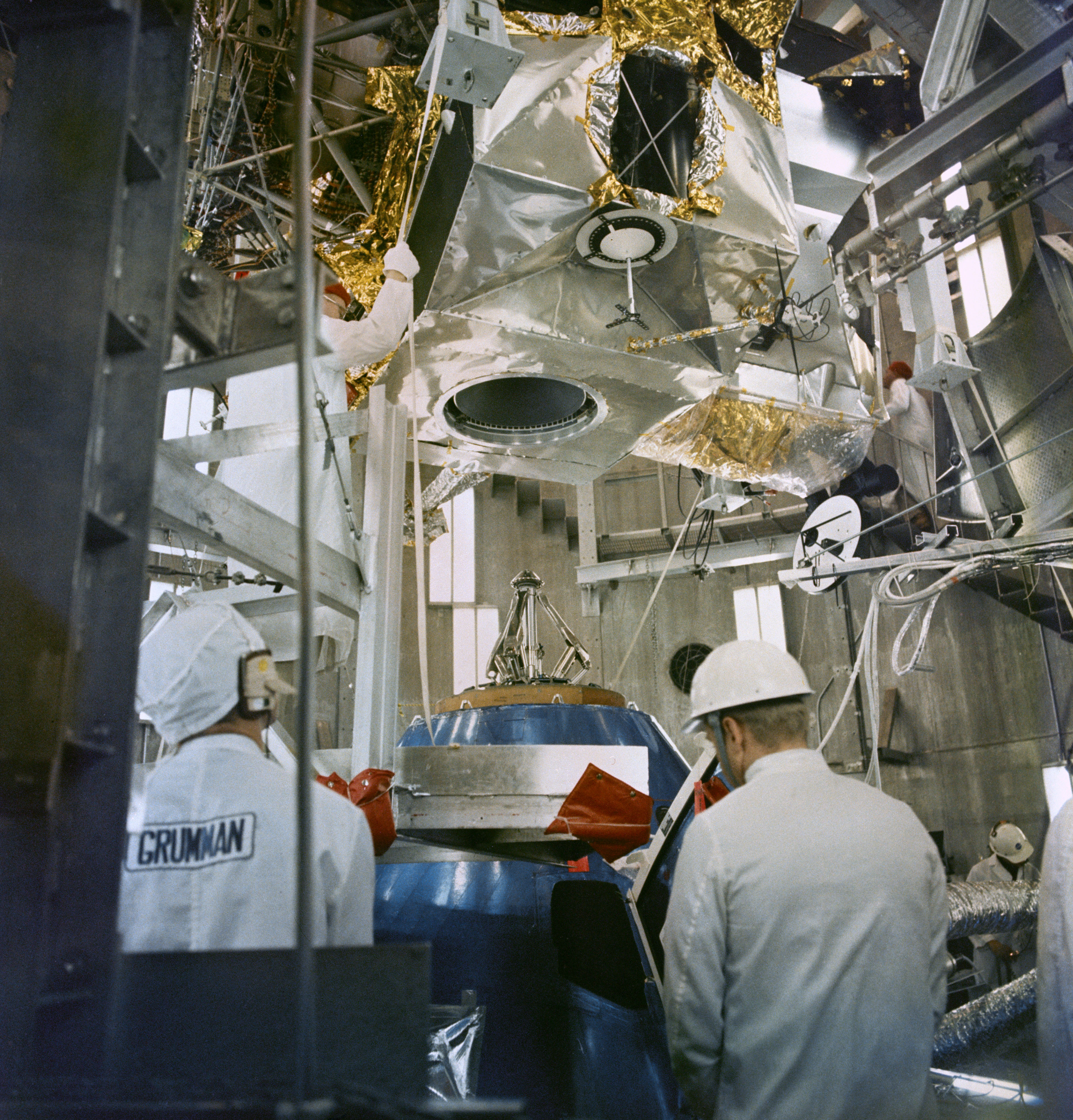
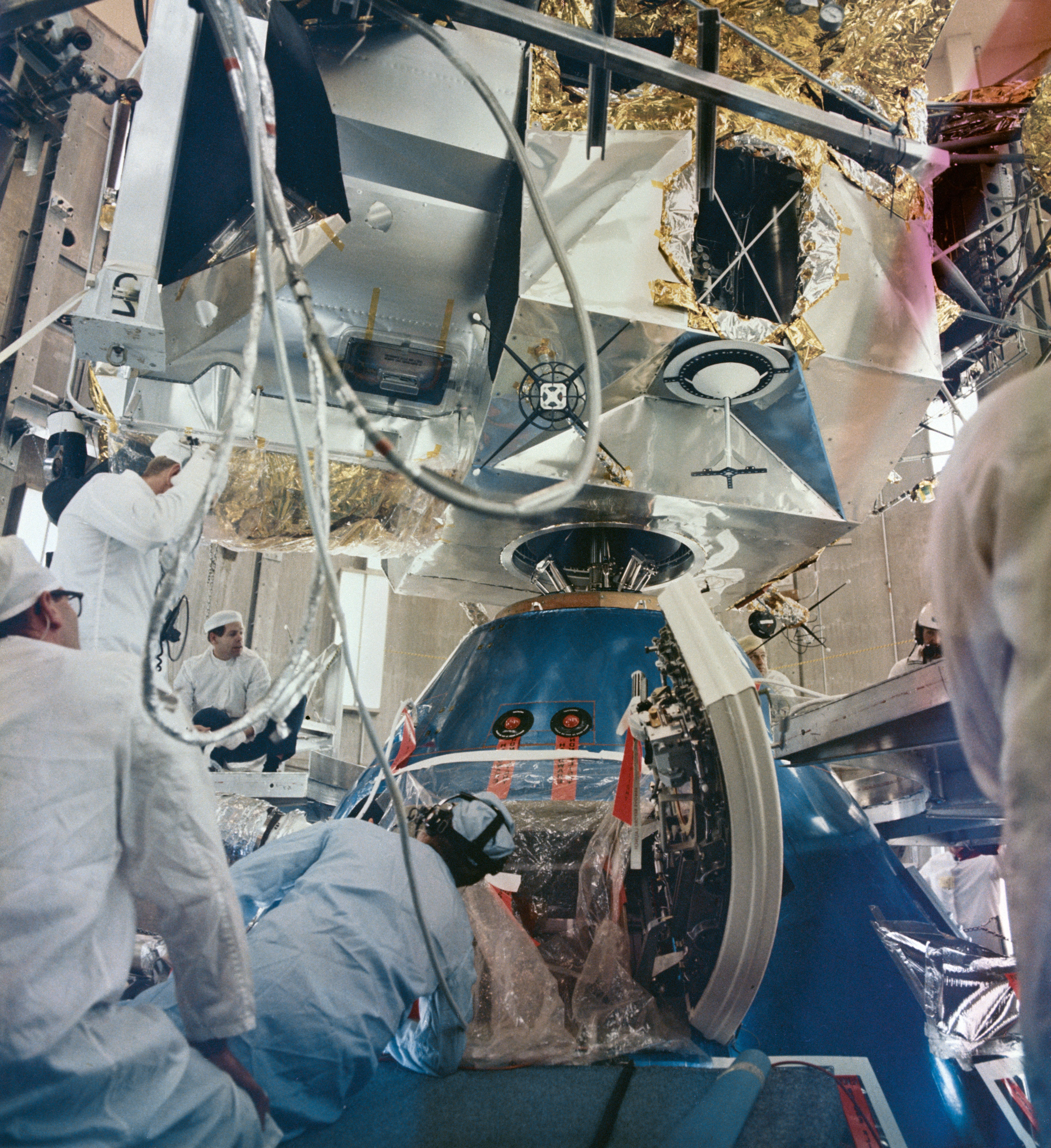
Simulated docking test between the Apollo 10 Lunar Module (LM), top, and Command Module Simulated docking test between the Apollo 10 Lunar Module (LM), top, and Command Module Joining the LM’s ascent stage to the descent stage
Apollo 9 spacecraft testing in the Manned Spacecraft Operations Building at NASA’s Kennedy Space Center in Florida. Left and middle: Simulated docking test between the Apollo 10 Lunar Module (LM), top, and Command Module. Right: Joining the LM’s ascent stage to the descent stage.

In the nearby MSOB, engineers performed a docking test of the Apollo 10 CSM and LM on Dec. 11. Following the test, workers mated the LM’s ascent and descent stages in a vacuum chamber in preparation for altitude tests in January 1969. In parallel, engineers conducted altitude tests with the CM, with prime and backup crews participating.
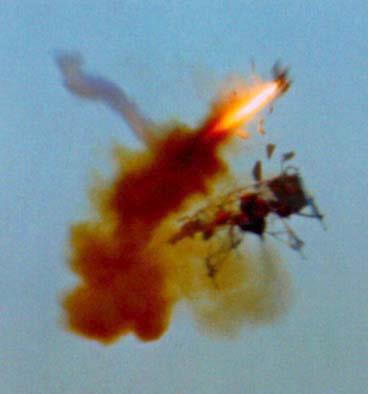
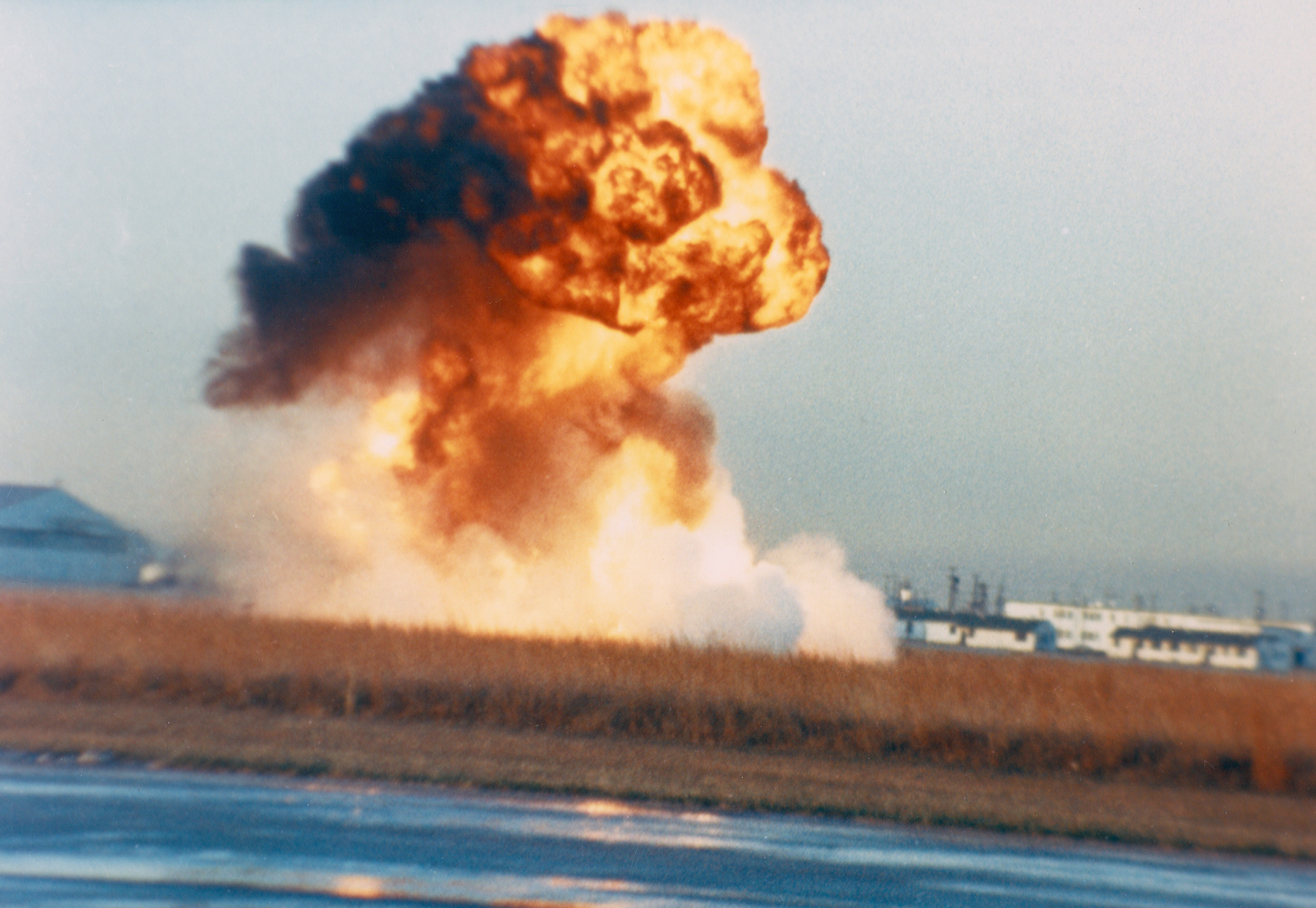
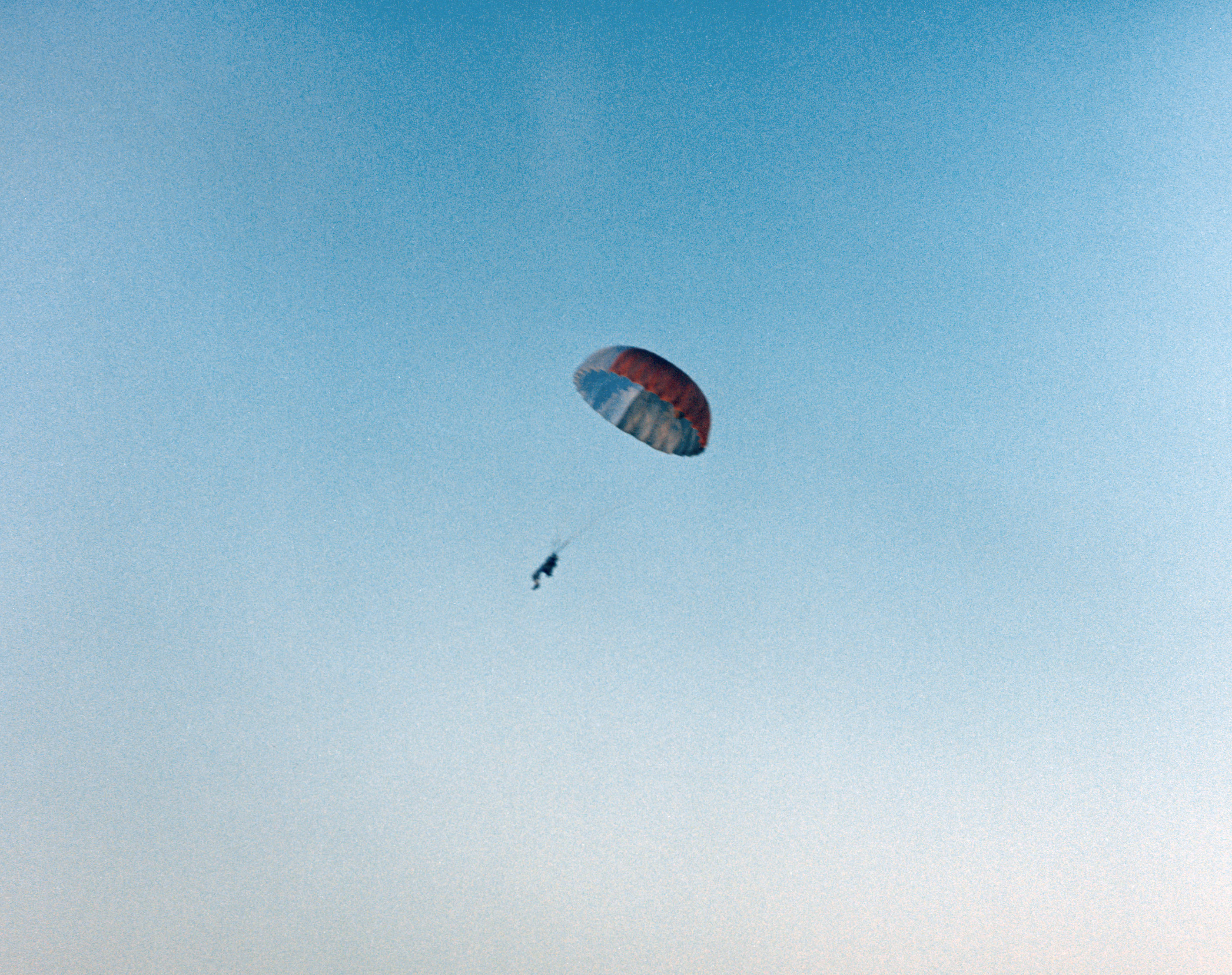
Chief test pilot Joseph S. “Joe” Algranti ejects from the Lunar Landing Training Vehicle-1 (LLTV-1) with seconds to spare The LLTV-1 explodes as it crashes to the ground Algranti floats safely to the ground under his parachute
Left: Chief test pilot Joseph S. “Joe” Algranti ejects from the Lunar Landing Training Vehicle-1 (LLTV-1) with seconds to spare. Middle: The LLTV-1 explodes as it crashes to the ground. Right: Algranti floats safely to the ground under his parachute.

Apollo commanders used the Lunar Landing Training Vehicle (LLTV) to simulate flying the LM, especially the final 200 feet of the descent. Following Armstrong’s May 6, 1968, crash in an earlier version of the training aircraft, NASA grounded the fleet until engineers could take corrective action. Flights with LLTV-1 resumed at Ellington on Oct. 3, 1968, with MSC chief test pilot Joseph S. “Joe” Algranti at the controls. During the next two months, Algranti and fellow MSC pilot H.E. “Bud” Ream completed 14 test flights with LLTV-1 to check out the vehicle. Ream also piloted LLTV-2’s first two flights beginning Dec. 5. During LLTV-1’s 15th flight on Dec. 8, the final certification flight before resuming astronaut training, Algranti took the vehicle to 680 feet altitude and began a lunar landing simulation run. The vehicle began to oscillate in all three axes, which Algranti tried to control. But unexpected wind gusts exceeded the craft’s aerodynamic control limits and it began a sudden descent. At 100 feet altitude, and with less than a second to spare, Algranti ejected and safely parachuted to the ground with only minor bruises, but LLTV-1 crashed and burned beyond repair.
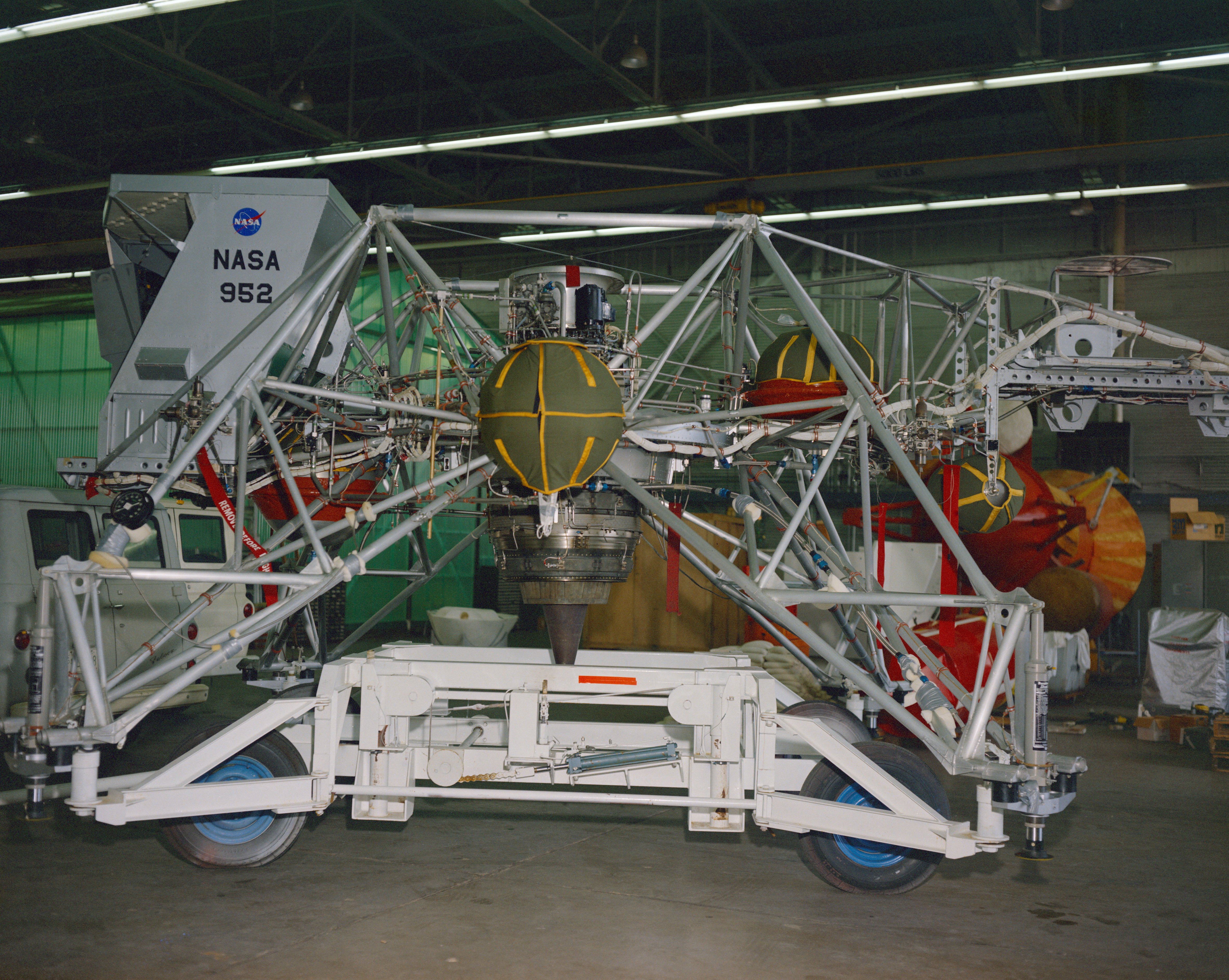
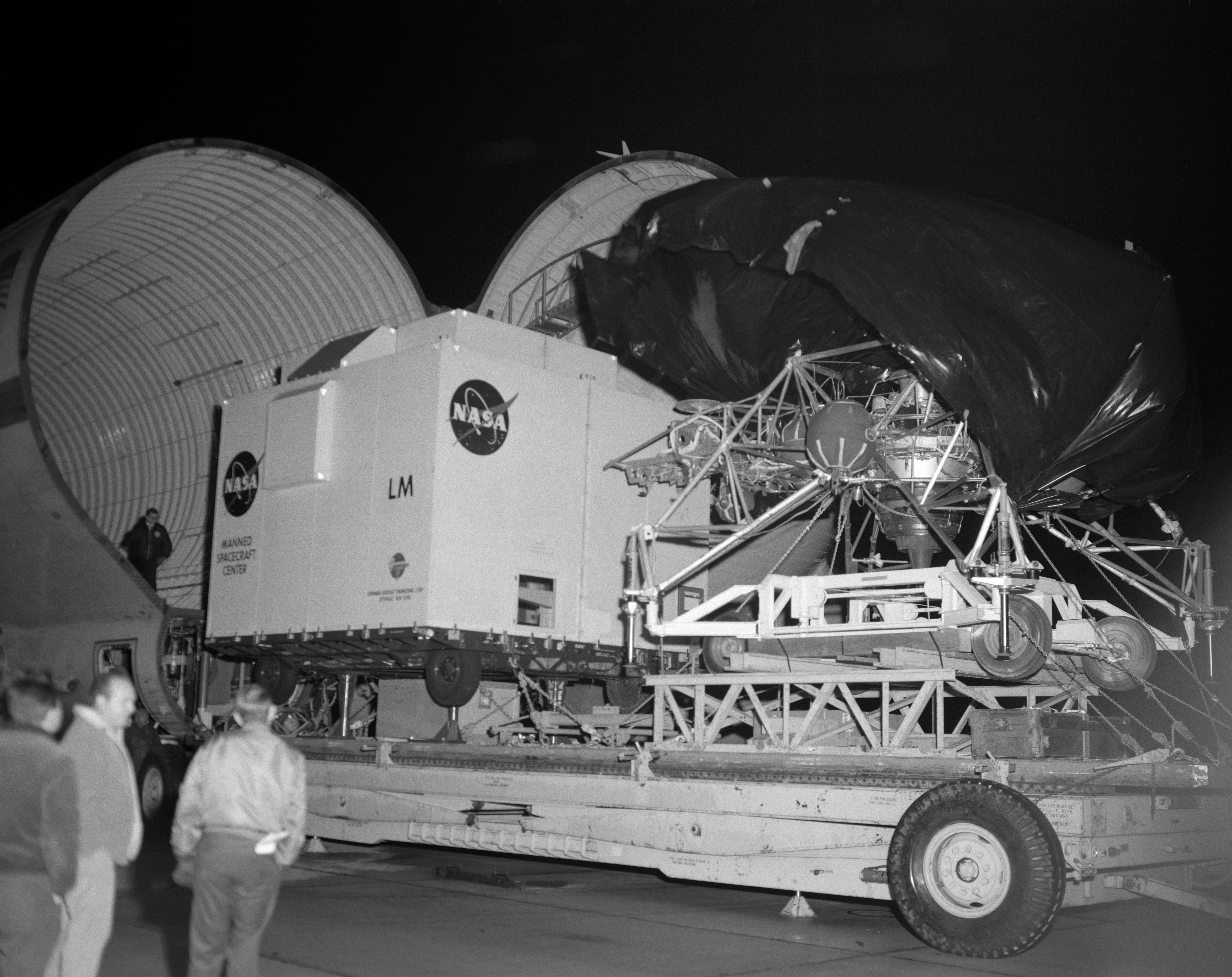
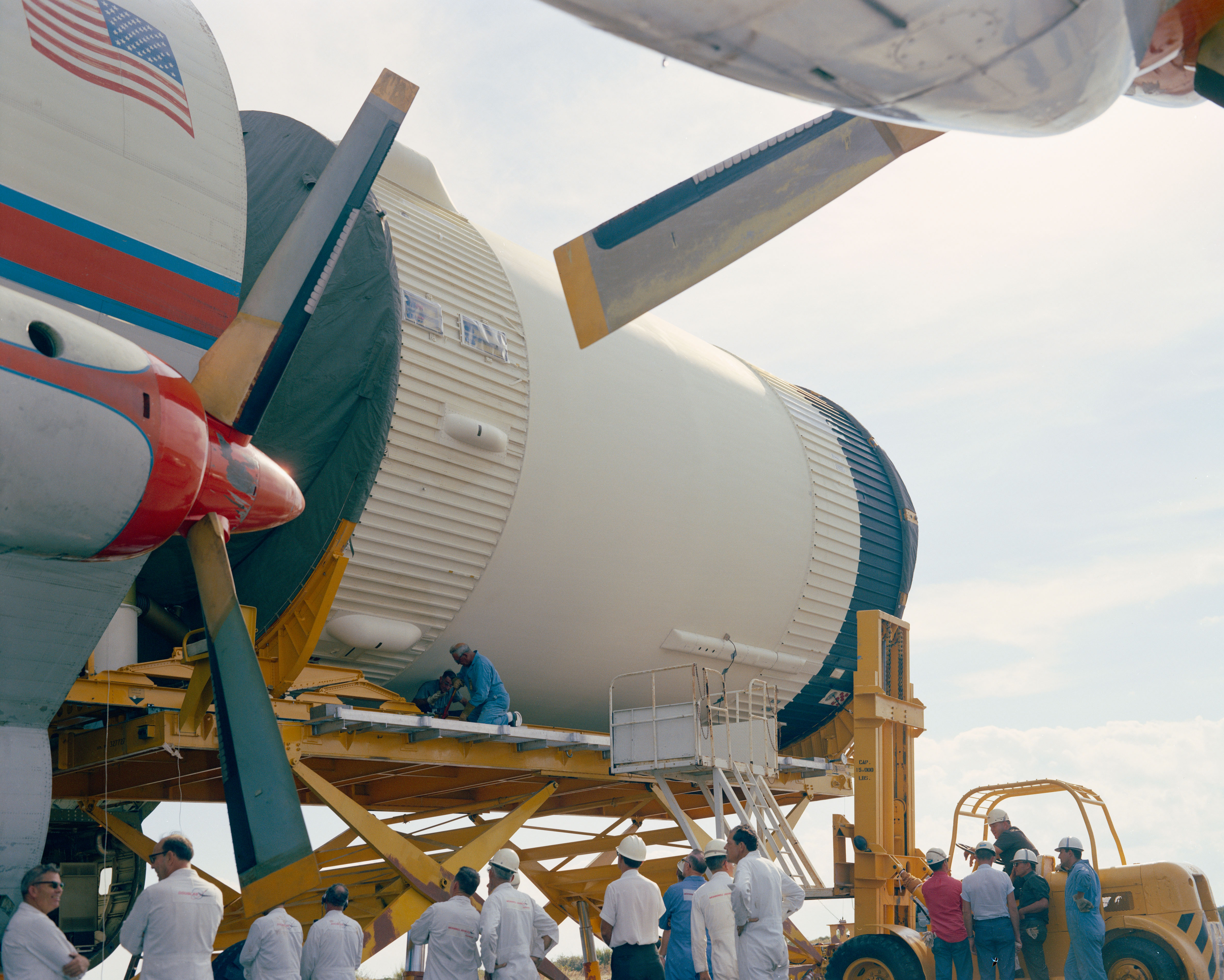
At Houston’s Ellington Air Force Base, workers prepare the LLTV-3 for packing into the Super Guppy cargo plane Workers at Ellington load the LLTV-3 into the Super Guppy for shipping to NASA’s Langley Research Center in Hampton, Virginia, for wind tunnel tests
Left: At Houston’s Ellington Air Force Base, workers prepare the LLTV-3 for packing into the Super Guppy cargo plane. Right: Workers at Ellington load the LLTV-3 into the Super Guppy for shipping to NASA’s Langley Research Center in Hampton, Virginia, for wind tunnel tests.

Once again, NASA grounded the LLTVs and MSC Director Robert R. Gilruth set up an investigation board, chaired by NASA astronaut Walter M. Schirra. To better understand the vehicle’s aerodynamic characteristics, in late December NASA shipped LLTV-3 to the Langley Research Center in Hampton, Virginia, where engineers tested it in the wind tunnel. Findings from the board and from the Langley tests indicated that a gust of wind that overwhelmed the vehicle’s control limits caused the LLTV-1 crash, unrelated to Armstrong’s accident. Recommendations included increasing the level of thrust in the craft’s thrusters by 50 percent to provide an additional margin of safety. 

News from around the world in December 1968:

Dec. 6 – The Rolling Stones release their album “Beggars Banquet.”

Dec. 7 – The United States launches the Orbiting Astronomical Observatory-2 space telescope.

Dec. 11 – President-elect Richard M. Nixon introduces his 12 Cabinet nominees.

Dec. 11 – The film “Oliver!” opens in the U.S.

Dec. 16 – Musical-fantasy film “Chitty Chitty Bang Bang” premieres in London and two days later in New York City.

Dec. 16 – Led Zeppelin’s concert debut in Denver, as opener for Vanilla Fudge.

Dec. 30 – Frank Sinatra first records “My Way.”

Share

Details

Last Updated

Dec 19, 2023

Related Terms

Powered by WPeMatico

Get The Details…
Kelli Mars

Crew Packs Dragon for Departure, Keeps Up Advanced Research, and a Cygnus Unberthing is Adjusted

Crew Packs Dragon for Departure, Keeps Up Advanced Research, and a Cygnus Unberthing is Adjusted

Thrusters on the SpaceX Dragon cargo spacecraft fire adjusting the vehicle's approach toward the station for a docking to the Harmony module's forward port on Nov. 11, 2023.
Thrusters on the SpaceX Dragon cargo spacecraft fire adjusting the vehicle’s approach toward the station for a docking to the Harmony module’s forward port on Nov. 11, 2023.

The Expedition 70 crew is packing a U.S. cargo craft ahead of its planned Wednesday departure. The seven residents aboard the International Space Station are also keeping up their regularly scheduled research and maintenance activities.

NASA astronauts Loral O’Hara and Jasmin Moghbeli worked together Tuesday morning removing biological specimens from the Destiny laboratory module, stowing them in transporters, then installing the science cargo inside the SpaceX Dragon cargo spacecraft. Afterward, O’Hara wrapped up her day with a vision test reading characters off a standard eye chart found in a doctor’s office on Earth. Moghbeli treated brain cell-like samples to understand neurodegenerative processes at a molecular and cellular level.

Astronauts Andreas Mogensen and Satoshi Furukawa continued the cargo transfers during the afternoon packing and securing a variety of hardware inside Dragon for analysis and retrieval on Earth. Mogensen from ESA (European Space Agency) earlier serviced numerous science components including charging virtual reality hardware, loading software on a fluorescence microscope, and setting up the Life Science Glovebox for Moghbeli’s sampling work. Furukawa from JAXA (Japan Aerospace Exploration Agency) installed new gas bottles on combustion research gear located inside the Kibo laboratory module.

Working in the Roscosmos segment of the orbital outpost, cosmonaut Oleg Kononenko activated a 3D printer to explore printing tools and supplies in microgravity. Flight Engineer Nikolai Chub tested a radio communications antenna then studied ways space crews and ground controllers from around the world can communicate more effectively. Flight Engineer Konstantin spent his morning on orbital plumbing tasks then worked during the afternoon inspecting windows in the Zvezda service module and disinfecting surfaces inside the Nauka science module.

Following a weather review about 24 hours prior to undocking, NASA and SpaceX now are targeting no earlier than 9:05 p.m. EST Wednesday, Dec. 20, for the undocking of the company’s 29th Dragon commercial resupply services mission from the International Space Station.

Coverage of Dragon’s departure Wednesday will begin at 8:45 p.m. on the NASA+ streaming service via the web or the NASA app. Coverage also will air live on NASA Television, YouTube, and on the agency’s website. Learn how to stream NASA TV through a variety of platforms including social media.

Additional undock and return opportunities are continuing to be considered as joint teams work to identify the best autonomous undocking and return weather conditions as a cold front passes through the splashdown zones off the coast of Florida. More updates will be made following the next weather review about 12 hours prior to Dragon undocking from the space station.

After re-entering Earth’s atmosphere, the spacecraft will splash down off the coast of Florida, which will not be broadcast on NASA TV. Follow updates on return plans on the agency’s space station blog.

With the changes to Dragon’s space station operations, NASA and Northrop Grumman now are targeting a Friday, Dec. 22, for the departure of the Cygnus spacecraft from the orbital complex.

Coverage of Cygnus departure Friday will begin at 7:45 a.m. ahead of the robotic release of the spacecraft at 8:05 a.m. on the NASA+ streaming service via the web or the NASA app. Coverage also will air live on NASA Television, YouTube, and on the agency’s website.

Cygnus will conduct secondary payload operations following unberthing and complete a safe and harmless re-entry into the Earth’s atmosphere where it will harmlessly burn up over the Pacific Ocean.


Learn more about station activities by following the space station blog@space_station and @ISS_Research on X, as well as the ISS Facebook and ISS Instagram accounts.

Get weekly video highlights at: https://roundupreads.jsc.nasa.gov/videoupdate/

Get the latest from NASA delivered every week. Subscribe here: www.nasa.gov/subscribe

Powered by WPeMatico

Get The Details…

Mark Garcia

NASA, Partners Continue to Advance Space Tech on Suborbital Flights

NASA, Partners Continue to Advance Space Tech on Suborbital Flights

5 min read

Preparations for Next Moonwalk Simulations Underway (and Underwater)

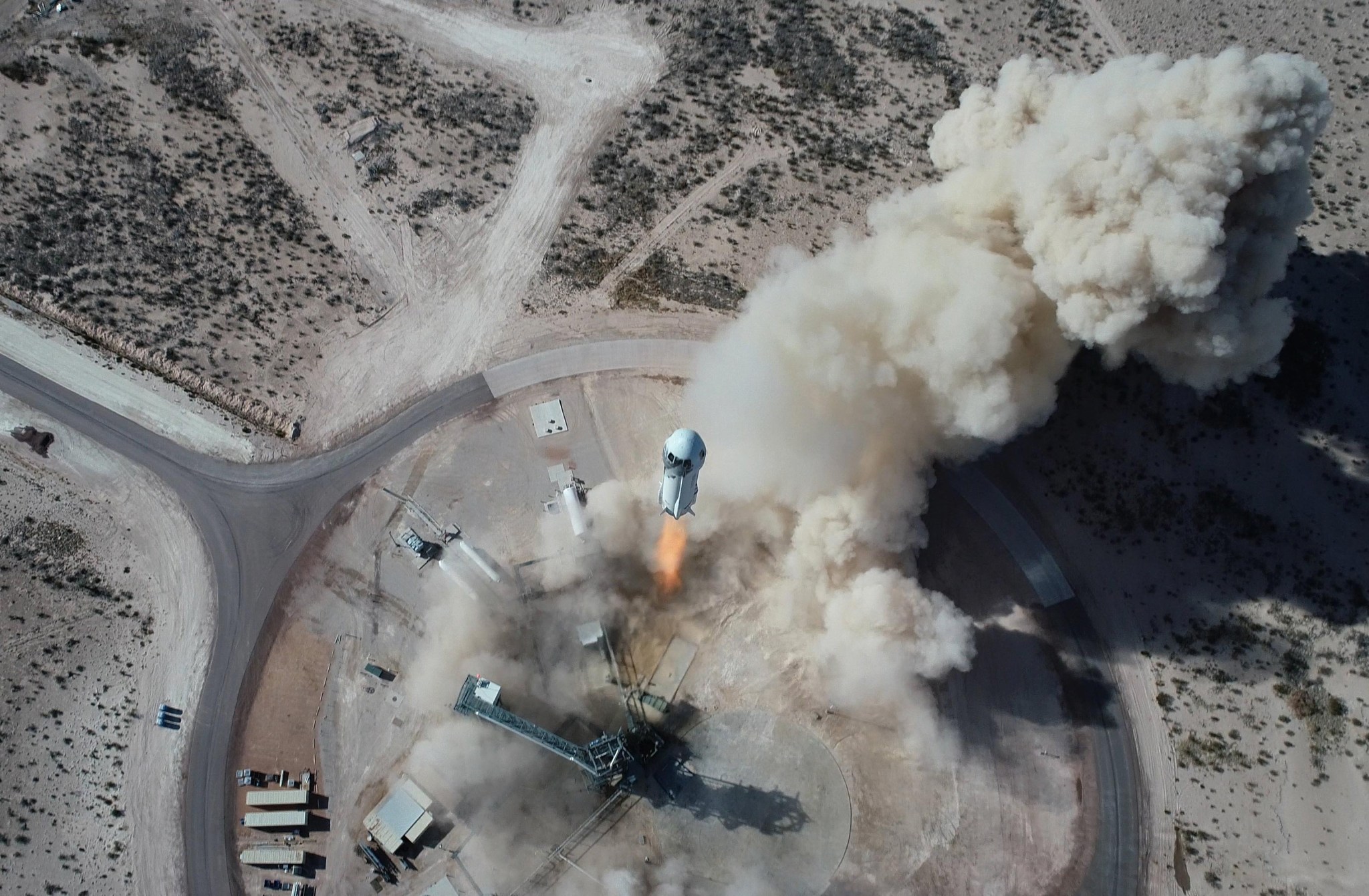
Aerial view of a desert area. Fire emerges from bottom of rocket rising from launchpad. Smoke and dust billow skyward.
New Shepard, Blue Origin’s reusable suborbital rocket, rising from the company’s Launch Site One in West Texas, on a previous flight in 2021. The vehicle returned to flight on Dec. 19, 2023, carrying payloads supported by NASA’s Flight Opportunities, enabling researchers to test disruptive solutions for space applications.
Blue Origin

Living and working in space requires getting ready a bit closer to Earth. Through a suborbital flight test on Dec. 19, 2023 with industry provider Blue Origin, NASA’s Flight Opportunities program is helping 14 research payloads move one step toward future space missions and commercial applications. The flown technologies aim to address some of the opportunities and obstacles presented by humanity’s sustained presence in space.

Launched aboard Blue Origin’s New Shepard reusable suborbital rocket from the company’s Launch Site One in West Texas, the payloads reached an altitude of 351,248 feet. During the flight, those payloads experienced about three minutes of microgravity, providing insight into the effect of reduced gravity on both technologies and living things.  

“NASA relies on emerging commercial spaceflight capabilities to rapidly test disruptive solutions for space applications,” said Danielle McCulloch, program manager for Flight Opportunities at NASA’s Armstrong Flight Research Center in Edwards, California. “Working with commercial flight providers like Blue Origin allows the agency to make space exploration and commerce more accessible to a broader range of researchers.”

A strong commercial space industry also helps NASA move forward with scientific exploration of the moon, Mars, and beyond. In addition to the NASA supported research teams, this flight was also a significant milestone for Blue Origin, serving as the return to flight with their New Shepard rocket.

NASA-Supported Technologies Aboard New Shepard

Sometimes, everyday products can be the key to advancing space objectives. For example, paraffin and beeswax aren’t just for cosmetics and candles. Researchers are using this flight to evaluate these common materials to determine if they might be keys to safer and cheaper fuel for spacecraft. Researchers from the Massachusetts Institute of Technology are evaluating in-space manufacturing techniques to turn these wax-based products into alternative options for propelling small spacecraft.

Also aboard the flight was a project from small business Ecoatoms Inc. in Reno, Nevada, designed to advance the production of biosensors in low Earth orbit. Earth’s gravity often causes the sensors to have rough and uneven layers that adversely affect performance. Fabrication in microgravity could allow for smoother and more uniform development, resulting in improved sensing. The startup expects the flight test with Blue Origin will be a step toward space-based manufacturing of health care tools for patients on Earth and astronauts on long-duration missions, improving crew safety while also leveraging the expanding space economy to benefit life on Earth.

“We are excited to test at-scale manufacturing of biosensors in space. Coating hundreds of sensors in microgravity will provide us with extremely valuable information to advance our technology,” said Solange Massa, Ecoatoms founder and CEO. “Preparing for suborbital flight with Flight Opportunities gave us experience we will apply to future flights for our clients.”

In another example of how a common substance can help pave the way to our understanding of space, researchers at Montana State University and the University of Colorado Boulder will use a yeast variant (Candida albicans) as a stepping stone to further understand how microgravity affects humans. Observations of how several minutes of microgravity affect this simple biological organism, made possible by the team’s unique sampling system, may provide a window into the cellular and physiological adaptations of the human body, which will be critical knowledge for planning extended human space missions.

 Other technologies benefiting from this flight testing include:

Flight Opportunities is managed at NASA Armstrong and funded by NASA’s Space Technology Mission Directorate. This program provides funding for flight tests and technology payload development as well as subject matter expertise to help researchers maximize the impact of their commercial flight tests. The program enables innovators to gather the data they need to advance their work ahead of larger, more expensive missions and applications.

Powered by WPeMatico

Get The Details…
Cody S. Lydon