STEMonstrations, Station Upkeep, and Hearing Assessments Top Wednesday’s Schedule

STEMonstrations, Station Upkeep, and Hearing Assessments Top Wednesday’s Schedule

 The sun's first rays begin illuminating Earth's atmosphere in this photograph from the International Space Station as it orbited 262 miles above the Pacific Ocean off the coast of California.
The sun’s first rays begin illuminating Earth’s atmosphere in this photograph from the International Space Station as it orbited 262 miles above the Pacific Ocean off the coast of California.

A STEMonstration, station upkeep, and routine hearing assessments kept the Expedition 70 crew busy on Wednesday. The seven orbital residents split up duties aboard the International Space Station as they continue their microgravity research missions into the new year.

NASA Flight Engineer Jasmin Moghbeli began her day recording a STEMonstration for teachers and students grades 5-8, demonstrating how to use a microscope for cell research aboard the station. To connect with students and teachers around the world, crew members will routinely record short three- to five-minute educational videos that demonstrate popular STEM topics in microgravity. Afterward, Moghbeli moved onto some station and spacesuit upkeep to install restraint straps and stowage bags on spacesuits that will be used for upcoming spacewalks this year, and perform inspections of various modules around the station.

Experiencing 16 sunrises and sunsets per day can affect crew members’ circadian rhythms while in low-Earth orbit. To counter this, the Circadian Light investigation tests a new lighting system to help astronauts maintain an acceptable circadian rhythm, which could in turn boost cognitive performance. ESA (European Space Agency) Commander Andreas Mogensen began his day performing a Circadian Light assessment before moving into surveying various station segments to send to grounds teams for assessments of station configuration.

JAXA (Japan Aerospace Exploration Agency) Flight Engineer Satoshi Furukawa focused his day on prepping the Life Sciences Glovebox for upcoming research and measuring acoustic levels within the orbiting laboratory.

Near the end of the day, NASA Flight Engineer Loral O’Hara was joined by cosmonauts Oleg Kononenko, Nikolai Chub, and Konstantin Borisov to complete routine hearing assessments using specially designed space software to measure auditory function while exposed to the microgravity environment.

Kononenko also spent part of his day removing and replacing hardware in the Zvezda service module and running the 3D printer once more, while Borisov picked back up on inventory audits that began yesterday.


Learn more about station activities by following the space station blog, @space_station and @ISS_Research on X, as well as the ISS Facebook and ISS Instagram accounts.

Get weekly video highlights at: https://roundupreads.jsc.nasa.gov/videoupdate/

Get the latest from NASA delivered every week. Subscribe here: www.nasa.gov/subscribe

Powered by WPeMatico

Get The Details…

Abby Graf

NASA’s Crew-4 Q&A With Students at Martin Luther King Jr Memorial Library

NASA’s Crew-4 Q&A With Students at Martin Luther King Jr Memorial Library

NASA astronauts Kjell Lindgren, Jessica Watkins, and Robert Hines participate in STEM demonstrations with local students at the Martin Luther King Jr Memorial Library, Thursday, March 30, 2023, in Washington. Lindgren, Hines, and Watkins spent 170 days in space as part of Expeditions 67 and 68 aboard the International Space Station.

Powered by WPeMatico

Get The Details…

Joshua Schlieder: Feet on the Ground, Head in the Stars

Joshua Schlieder: Feet on the Ground, Head in the Stars

8 min read

Preparations for Next Moonwalk Simulations Underway (and Underwater)

Name: Joshua Schlieder

Title: Wide Field Instrument Scientist for the Nancy Grace Roman Space Telescope and Operations Project Scientist for the Neil Gehrels Swift Observatory

Formal Job Classification: Research Astrophysicist

Organization: Stellar Astrophysics and Exoplanets Laboratory, Astrophysics Division, Sciences and Exploration Directorate (Code 667)

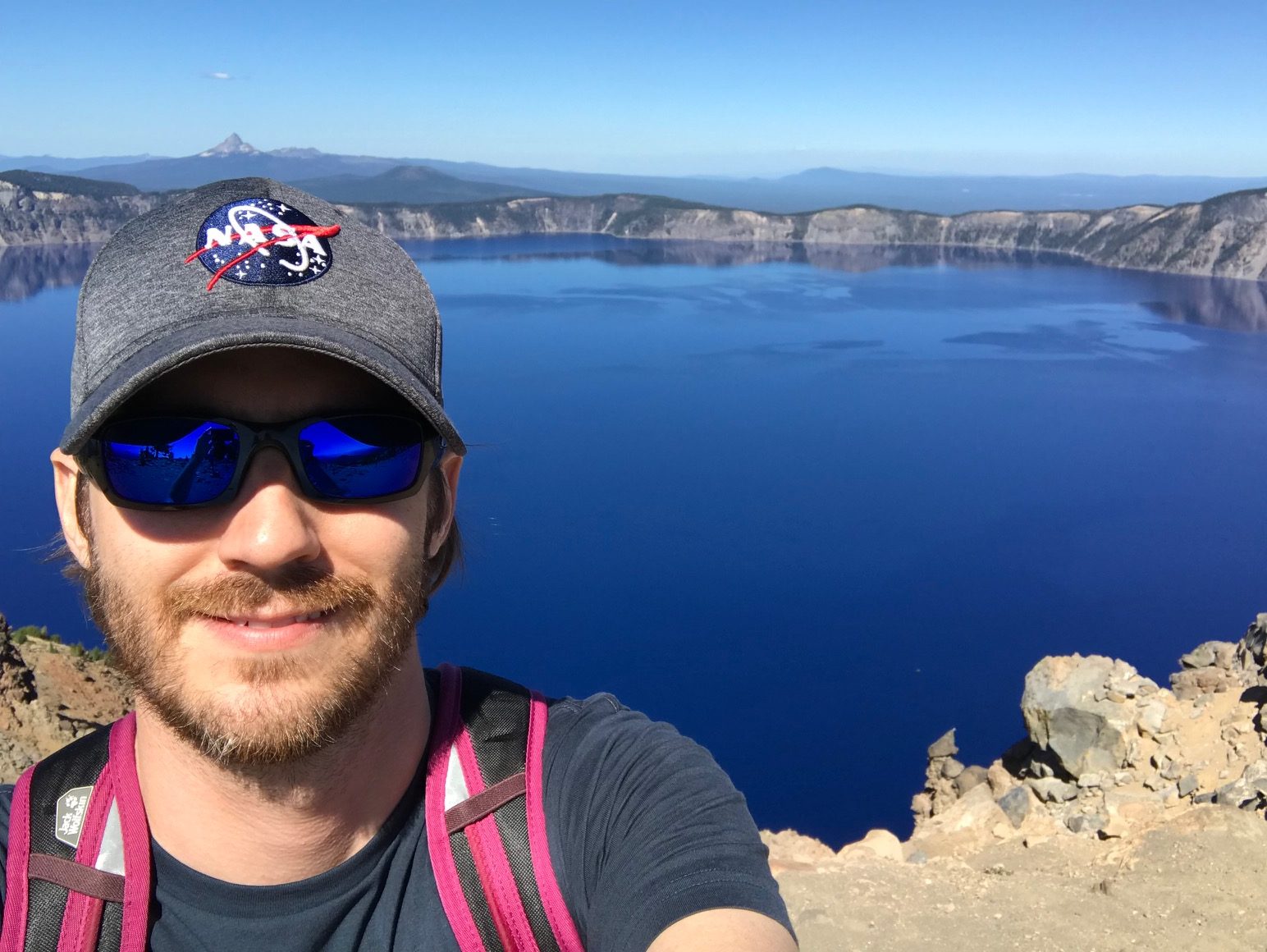
Joshua Schlieder, a man with a short brown beard, smiles and holds the camera up in a selfie outdoors near Crater Lake, Oregon. Joshua wears blue reflective sunglasses, a gray baseball cap with the NASA logo, and a navy T-shirt, and carries a backpack with pink straps. He takes up part of the left side of the image, with the still, deep blue lake visible in the background. Tan rocks and dirt are visible in the foreground, and the lake's rocky opposite shore is visible in the distance, with blue mountains on the horizon. It is a bright sunny day and the sky is cloudless and blue.
Joshua Schlieder is the Wide Field Instrument scientist for NASA’s Nancy Grace Roman Space Telescope. “I am never bored (but sometimes stressed),” he said. “Every day is a new adventure.”
Courtesy of Joshua Schlieder

What do you do and what is most interesting about your role here at Goddard? How do you help support Goddard’s mission?

As the Wide Field Instrument scientist for the Roman Space Telescope, I am a member of the project science team and work with other scientists, engineers, and managers to ensure that the Wide Field Instrument, the primary wide field survey camera on Roman, meets its science requirements.

As the operations project scientist for NASA’s Swift Observatory, I work with the principal investigator and project team to ensure that Swift is operating efficiently and obtaining data to meet our science goals and the needs of the astrophysics community.

I also do fundamental astrophysics research focusing on low-mass stars and their exoplanets.

What is your educational background?

From a very young age I was fascinated by the natural world and was constantly trying to understand how it worked. There wasn’t a question I wouldn’t ask or a rock I wouldn’t turn over to understand a little more. This curiosity led me to a B.S. in physics from Bloomsburg University in Pennsylvania. I then received an M.A. and Ph.D. in physics with a concentration in astrophysics from Stony Brook University in New York.

How did you come to Goddard? Why do you stay?

From 2014 – 2016, I had a postdoctoral fellowship at NASA’s Ames Research Center in California to develop science programs for the James Webb Space Telescope and analyze data from the exoplanet hunting K2 mission. In 2016, I went to the NASA Exoplanet Science Institute at the California Institute of Technology as a member of the Exoplanet Archive team. In 2017, I came to Goddard to work on the latest exoplanet hunting mission, TESS, the Transiting Exoplanet Survey Satellite.

Goddard is truly unique compared to other academic institutions. It has an outstanding scientific environment where you can perform cutting edge astrophysics research and directly contribute to developing and implementing NASA missions.

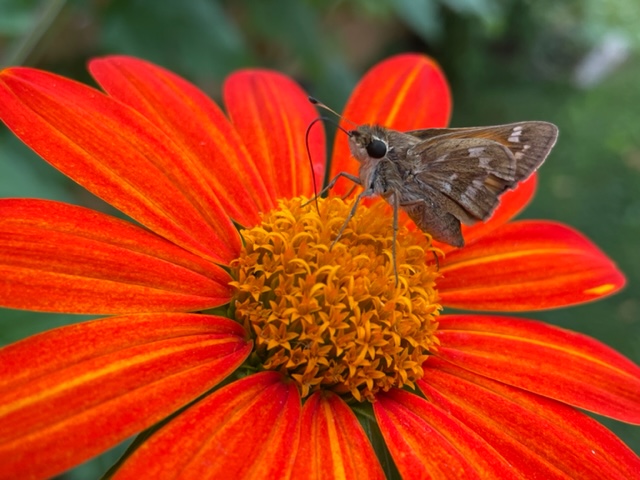
A close-up photo of a reddish-orange flower with a brown butterfly perched on its fuzzy golden center.
Goddard astrophysicist Joshua Schlieder helps make sure the Roman Space Telescope’s Wide Field Instrument meets its science requirements. He also gardens, spends time outdoors, and goes to minor league baseball games in his spare time.
Courtesy of Joshua Schlieder

What is most interesting about your role on Roman?

We are working to build and test a new scientific instrument that will fly on a space telescope. I have the privilege of contributing to this effort and working with really excellent people from all disciplines. We combine our different scientific and technical backgrounds to solve difficult problems.

I am never bored (but sometimes stressed). Every day is a new adventure.

What is most interesting about your role on Swift?

Swift has been operating for many years. I enjoy working on a team that is a well-oiled machine. The observatory is dynamic, it is always doing something new and can observe about 100 targets each day. Unlike many space telescopes, it can rapidly respond to astronomical events and re-point very quickly, delivering new science on short notice. Swift was designed in a way that enables it to observe many different types of targets over a wide range of wavelengths and it is exciting to be a part of the planning and execution of its diverse science program.

What basic astrophysics research do you do? What is the one, big discovery you would like to make?

I study red dwarf stars and the exoplanets that orbit them. Red dwarfs are a class of star that are generally about half the size of the Sun or smaller, very faint, and have red colors because of their relatively low temperatures. Red dwarfs are everywhere, they make up more than 70% of the stars in our galaxy! But, because they are not very bright, you cannot see them with the naked eye. I also study exoplanets. Exoplanets are planets that are outside our solar system orbiting other stars. We know of many exoplanets that orbit red dwarf stars. It is common to find a red dwarf with several Earth sized planets in a compact system that would easily fit inside the orbit of Mercury in our solar system.

I hope someday that the astrophysics community will detect enough planets around red dwarf stars to truly understand the population and disentangle how such small stars can form so many planets. Since red dwarfs are the most common type of star, most planets in the galaxy orbit them. They may be our best opportunity to find planets that are similar to Earth and are close enough to study in great detail.

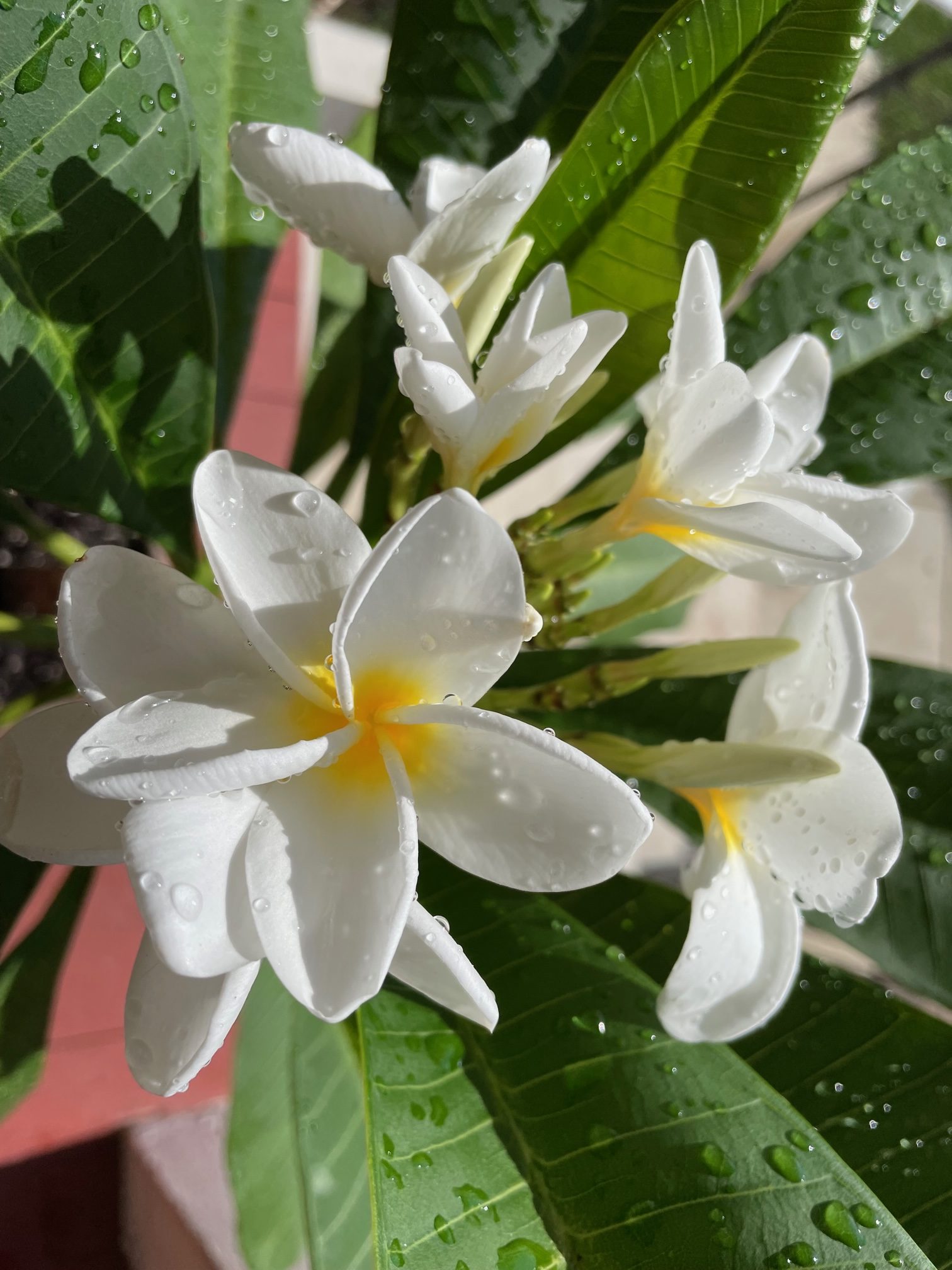
A close-up shot of white plumeria flowers with yellow centers, covered in dewdrops and shining in the sun. Green leaves and a pink background are out of focus behind the flowers.
Goddard astrophysicist Joshua Schlieder grows tropical plants indoors when he isn’t working on the Roman Space Telescope’s Wide Field Instrument. “Research is never done, but that does not mean you should be doing it all the time. Having aspects of your life that are separate from astrophysics will keep you healthy and happy.”
Courtesy of Joshua Schlieder

What makes a good astrophysicist?

You have to be imaginative and think outside the box but also learn from criticism. You have to enjoy collaborating with many people because the best ideas come from the combined efforts of people with different backgrounds and different experiences.

You need a deep desire to push forward to understand the unknown, even if you do not know what path you may follow. You need to have a drive for new knowledge and an ability to go in different directions at the same time to solve a problem.

You have to embrace big ideas. What in the universe is waiting to be understood? How do I take what I know and work with other people to try to figure it out? Astrophysicists are both linear and abstract thinkers. In general, we have to be abstract in coming up with ideas and linear in solving them but many times we rely on both ways of thinking.

We also have to be able to explain these ideas to others in the community and the public. Communicating our work and explaining why it is important is a critical skill.

As a mentor, what is the most important advice you give?

Trust in your own ideas and abilities. You will run into setbacks and difficult times when projects are slow to move forward or even regress, but every day is progress and you will get there.

You have to expect, accept, and learn from constructive criticism. When someone pushses back on an idea, an approach, or a result, know that you are capable and use it as an opportunity to improve.  

Ask questions, meet people, and build your community. Seek out those who may have the answers you need. You are not alone. Many people will be working on similar ideas, so work with them to see how everyone can build on an idea together. Being a scientist is tough, it is very competitive and everyone, whether they admit it or not, needs support. These people will be your support network.

Most importantly, take time for yourself. Research is never done, but that does not mean you should be doing it all the time. Having aspects of your life that are separate from astrophysics will keep you healthy and happy.

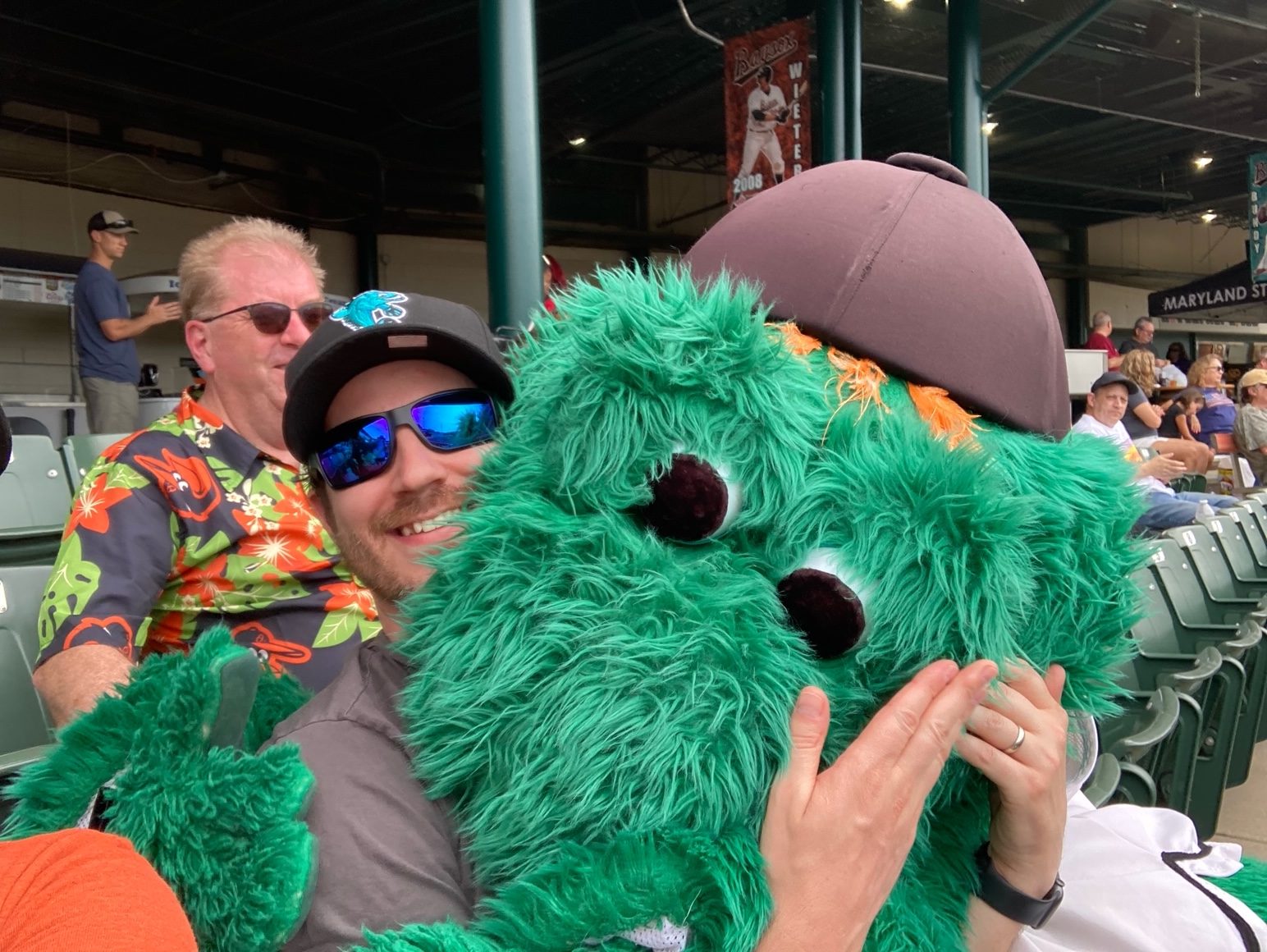
Joshua Schlieder, a man with a short brown beard, grins and hugs a fluffy green mascot at a baseball game. Joshua wears blue reflective sunglasses, a gray baseball cap, and a gray T-shirt. The mascot wears a white baseball jersey and backwards gray baseball cap.
Goddard astrophysicist Joshua Schlieder relaxes at a Bowie Baysox game. “I also really enjoy minor league baseball, I try to see the local team in every city I visit. I have several dozen minor league team hats.”
Courtesy of Joshua Schlieder

Who inspires you?

The early career scientists that I work with. They bring huge enthusiasm and new ideas to projects and are willing and able to dive into big problems. I am always impressed with their ingenuity, capability, and resilience. It is a privilege to work with people that are bound to be future leaders in the field.

What is your hobby?

I like to garden and grow outdoor plants. I like plants that produce fruit. I am growing several fig trees, a plum tree, a paw paw, and raspberry, blueberry, and goji berry bushes. I also grow tropical plants indoors including orchids, which can be difficult but rewarding.

I enjoy going on long distance bicycle rides and recently completed a 100 km “metric century.” I also love being outdoors hiking, camping, and fishing.

I also really enjoy minor league baseball, I try to see the local team in every city I visit. I have several dozen minor league team hats.

Who is your favorite author?

I read a lot of science fiction and fantasy novels. I especially enjoy books by N. K. Jemisin and Alastair Reynolds.

What is your “six-word memoir”? A six-word memoir describes something in just six words.

Feet on the Ground, Head in the Stars. (I know this is eight words, but I was struggling to fit one to six.)

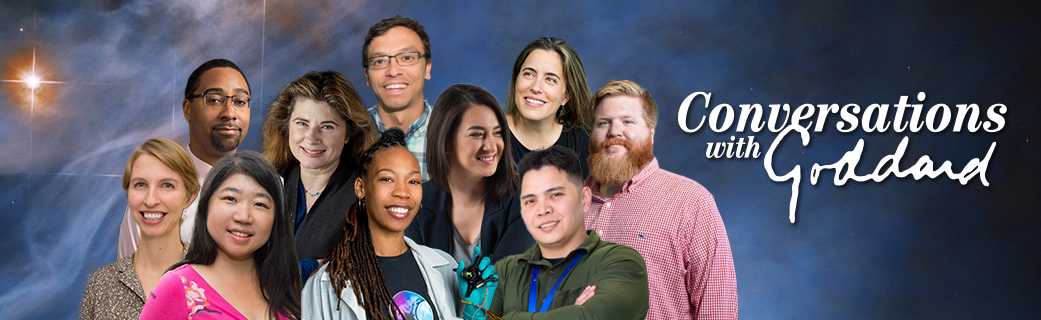
A banner graphic with a group of people smiling and the text "Conversations with Goddard" on the right. The people represent many genders, ethnicities, and ages, and all pose in front of a soft blue background image of space and stars.

Conversations With Goddard is a collection of Q&A profiles highlighting the breadth and depth of NASA’s Goddard Space Flight Center’s talented and diverse workforce. The Conversations have been published twice a month on average since May 2011. Read past editions on Goddard’s “Our People” webpage.

By Elizabeth M. Jarrell
NASA’s Goddard Space Flight Center, Greenbelt, Md.

Share

Details

Last Updated

Jan 03, 2024

Editor
Jessica Evans
Contact
Rob Garner

Powered by WPeMatico

Get The Details…
Jessica Evans

Foggy Fun with STEM

Foggy Fun with STEM

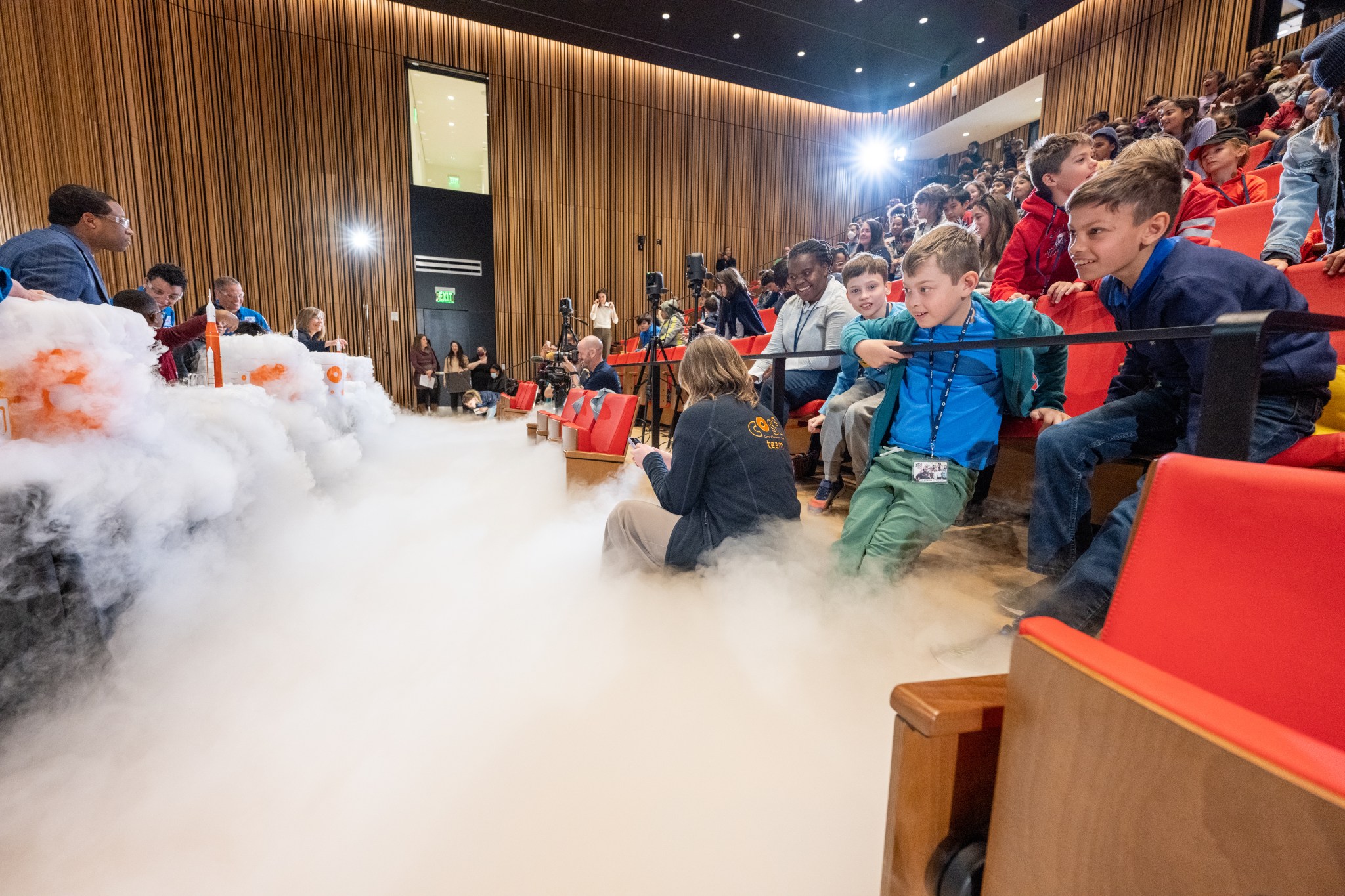
Fog rolls across the floor of an auditorium full of students and teachers. In the background at left are NASA astronauts Jessica Watkins and Bob Hines, along with students and teachers. To the right are rows of orange seats, where the audience sits, watching the experiment underway.
NASA / Keegan Barber

On March 30, 2023, NASA astronauts Kjell Lindgren, Jessica Watkins, and Robert Hines took part in STEM demonstrations with local students in Washington. Lindgren, Hines, and Watkins spent 170 days in space as part of Expeditions 67 and 68 aboard the International Space Station. While aboard, the crew studied ways to reverse the aging of immune cells, how wounds heal in microgravity, and cardiovascular health. They also participated in spacewalks, tested new technology to diagnose medical conditions, explored the development of new construction materials in space, grew red dwarf tomatoes, and observed liquid behavior in artificial gravity to support missions to the Moon, Mars, and beyond.

The NASA Headquarters photographers chose this photo as one of the best images from 2023. See the rest on Flickr.

Image Credit: NASA/Keegan Barber

Powered by WPeMatico

Get The Details…
Monika Luabeya

NASA Telescopes Start the Year With a Double Bang

NASA Telescopes Start the Year With a Double Bang

X-ray: NASA/CXC/Penn State Univ./L. Townsley et al.; Optical: NASA/STScI/HST; Infrared: NASA/JPL/CalTech/SST; Image Processing: NASA/CXC/SAO/J. Schmidt, N. Wolk, K. Arcand

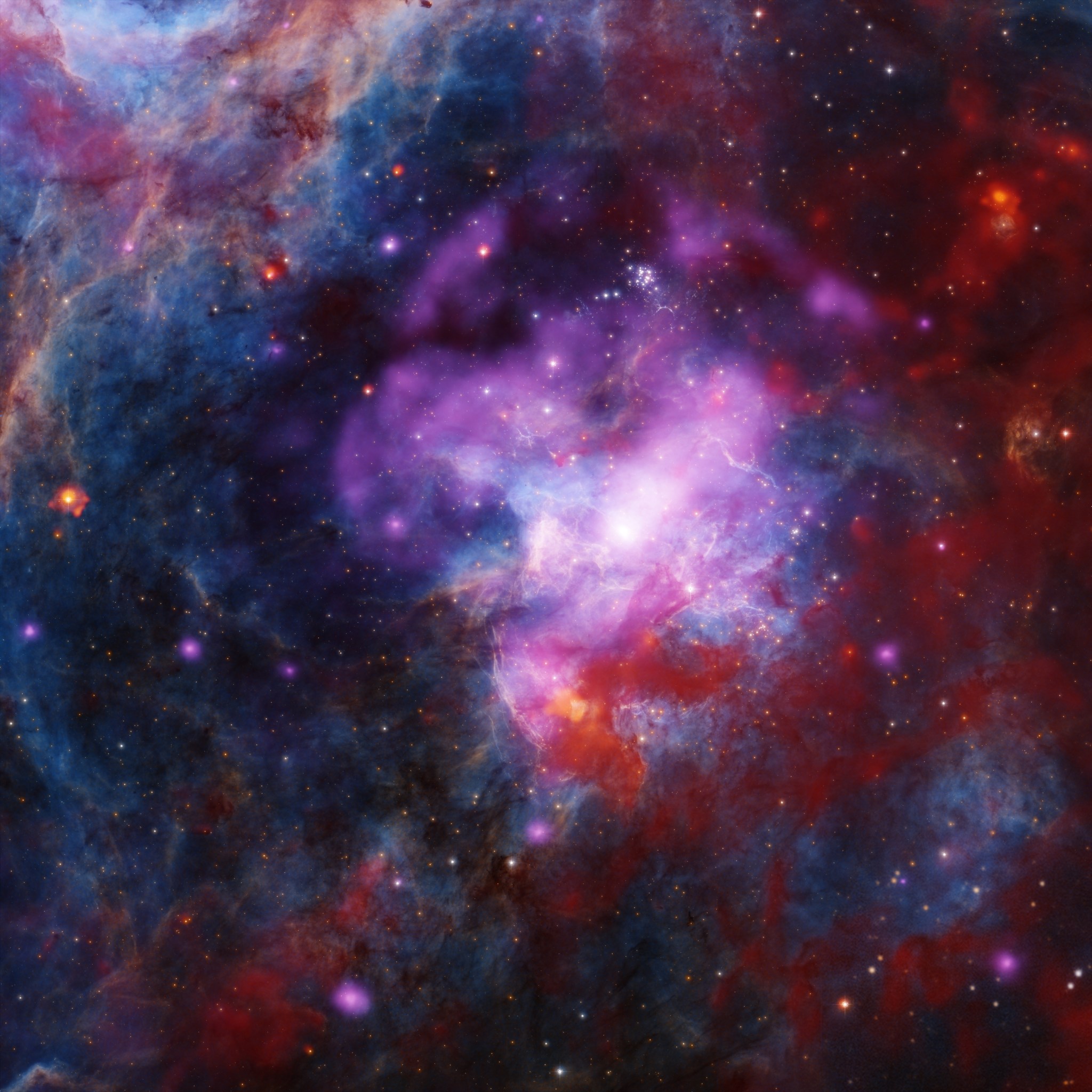
A colorful, festive image shows different types of light containing the remains of not one, but at least two, exploded stars. This supernova remnant is known as 30 Doradus B (30 Dor B for short) and is part of a larger region of space where stars have been continuously forming for the past 8 to 10 million years. It is a complex landscape of dark clouds of gas, young stars, high-energy shocks, and superheated gas, located 160,000 light-years away from Earth in the Large Magellanic Cloud, a small satellite galaxy of the Milky Way.

The new image of 30 Dor B was made by combining X-ray data from NASA’s Chandra X-ray Observatory (purple), optical data from the Blanco 4-meter telescope in Chile (orange and cyan), and infrared data from NASA’s Spitzer Space Telescope (red). Optical data from NASA’s Hubble Space Telescope was also added in black and white to highlight sharp features in the image.

A team of astronomers led by Wei-An Chen from the National Taiwan University in Taipei, Taiwan, have used over two million seconds of Chandra observing time of 30 Dor B and its surroundings to analyze the region. They found a faint shell of X-rays that extends about 130 light-years across. (For context, the nearest star to the Sun is about 4 light-years away). The Chandra data also reveals that 30 Dor B contains winds of particles blowing away from a pulsar, creating what is known as a pulsar wind nebula.

When taken together with data from Hubble and other telescopes, the researchers determined that no single supernova explosion could explain what is being seen. Both the pulsar and the bright X-rays seen in the center of 30 Dor B likely resulted from a supernova explosion after the collapse of a massive star about 5,000 years ago. The larger, faint shell of X-rays, however, is too big to have resulted from the same supernova. Instead, the team thinks that at least two supernova explosions took place in 30 Dor B, with the X-ray shell produced by another supernova more than 5,000 years ago. It is also quite possible that even more happened in the past.

This result can help astronomers learn more about the lives of massive stars, and the effects of their supernova explosions.

The paper led by Wei-An Chen describing these results was recently published in the Astronomical Journal. The co-authors of the paper are Chuan-Jui Li, You-Hua Chu, Shutaro Ueda, Kuo-Song Wang, Sheng-Yuan Liu, all from the Institute of Astronomy and Astrophysics, Academia Sinica, in Taipei, Taiwan, and Bo-An Chen from National Taiwan University.

NASA’s Marshall Space Flight Center manages the Chandra program. The Smithsonian Astrophysical Observatory’s Chandra X-ray Center controls science operations from Cambridge, Massachusetts, and flight operations from Burlington, Massachusetts.

Read more from NASA’s Chandra X-ray Observatory.

For more Chandra images, multimedia and related materials, visit:

https://www.nasa.gov/mission/chandra-x-ray-observatory/

Visual Description:

Today’s release features a spectacular composite image of a large region of space where stars have been continuously forming for the past eight to ten million years. At the center of this complex landscape of brilliant, colorful gas clouds is a supernova remnant. Known as 30 Doradus B, the remnant likely contains the remains of at least two exploded stars.

The entire image is awash in intricate clouds, and swathes of superheated gas. At our upper lefthand corner is a thick, coral pink and wine-colored cloud with a texture resembling cotton candy. At our lower and upper right is a network of deep red clouds that resemble streaks of thick red syrup floating in water. A layer of wispy blue cloud appears to be present across the entire image, but is most evident at our lower left which is free of overlapping gas. Glowing pink, orange, and purple specks of light, which are stars, dot the image.

In the center of the frame is a bright purple and pink cloud, aglow with brilliant white dots, and streaked with lightning-like veins. This is 30 Doradus B, which is delineated by a faint shell of X-rays identified by Chandra. Within this supernova remnant are high energy shocks and winds of particles blowing away from a pulsar.

News Media Contact

Megan Watzke
Chandra X-ray Center
Cambridge, Mass.
617-496-7998

Jonathan Deal
Marshall Space Flight Center
Huntsville, Ala.
256-544-0034

Powered by WPeMatico

Get The Details…
Lee Mohon