NASA’s Fission Surface Power Project Energizes Lunar Exploration

NASA’s Fission Surface Power Project Energizes Lunar Exploration

4 min read

Preparations for Next Moonwalk Simulations Underway (and Underwater)
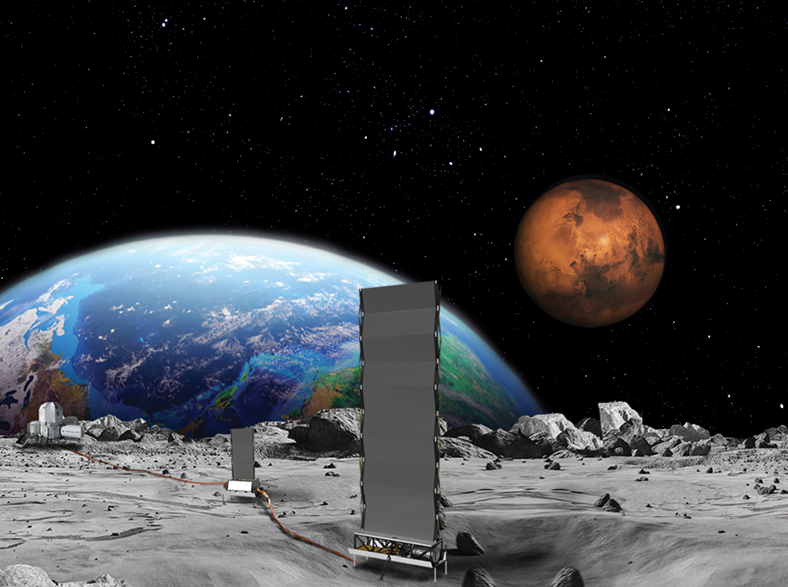
A concept image of the Fission Surface Power Project on the lunar surface. Earth and Mars can be seen in the background. The lunar surface is grey and rocky.
A concept image of NASA’s Fission Surface Power Project.
Credit: NASA

NASA is wrapping up the initial phase of its Fission Surface Power Project, which focused on developing concept designs for a small, electricity-generating nuclear fission reactor that could be used during a future demonstration on the Moon and to inform future designs for Mars.

NASA awarded three $5 million contracts in 2022, tasking each commercial partner with developing an initial design that included the reactor; its power conversion, heat rejection, and power management and distribution systems; estimated costs; and a development schedule that could pave the way for powering a sustained human presence on the lunar surface for at least 10 years.

“A demonstration of a nuclear power source on the Moon is required to show that it is a safe, clean, reliable option,” said Trudy Kortes, program director, Technology Demonstration Missions within NASA’s Space Technology Mission Directorate at NASA Headquarters in Washington. “The lunar night is challenging from a technical perspective, so having a source of power such as this nuclear reactor, which operates independent of the Sun, is an enabling option for long-term exploration and science efforts on the Moon.”

While solar power systems have limitations on the Moon, a nuclear reactor could be placed in permanently shadowed areas (where there may be water ice) or generate power continuously during lunar nights, which are 14-and-a-half Earth days long.

NASA designed the requirements for this initial reactor to be open and flexible to maintain the commercial partners’ ability to bring creative approaches for technical review.

“There was a healthy variety of approaches; they were all very unique from each other,” said Lindsay Kaldon, Fission Surface Power project manager at NASA’s Glenn Research Center in Cleveland. “We didn’t give them a lot of requirements on purpose because we wanted them to think outside the box.”

However, NASA did specify that the reactor should stay under six metric tons and be able to produce 40 kilowatts (kW) of electrical power, ensuring enough for demonstration purposes and additional power available for running lunar habitats, rovers, backup grids, or science experiments. In the U.S., 40 kW can, on average, provide electrical power for 33 households.
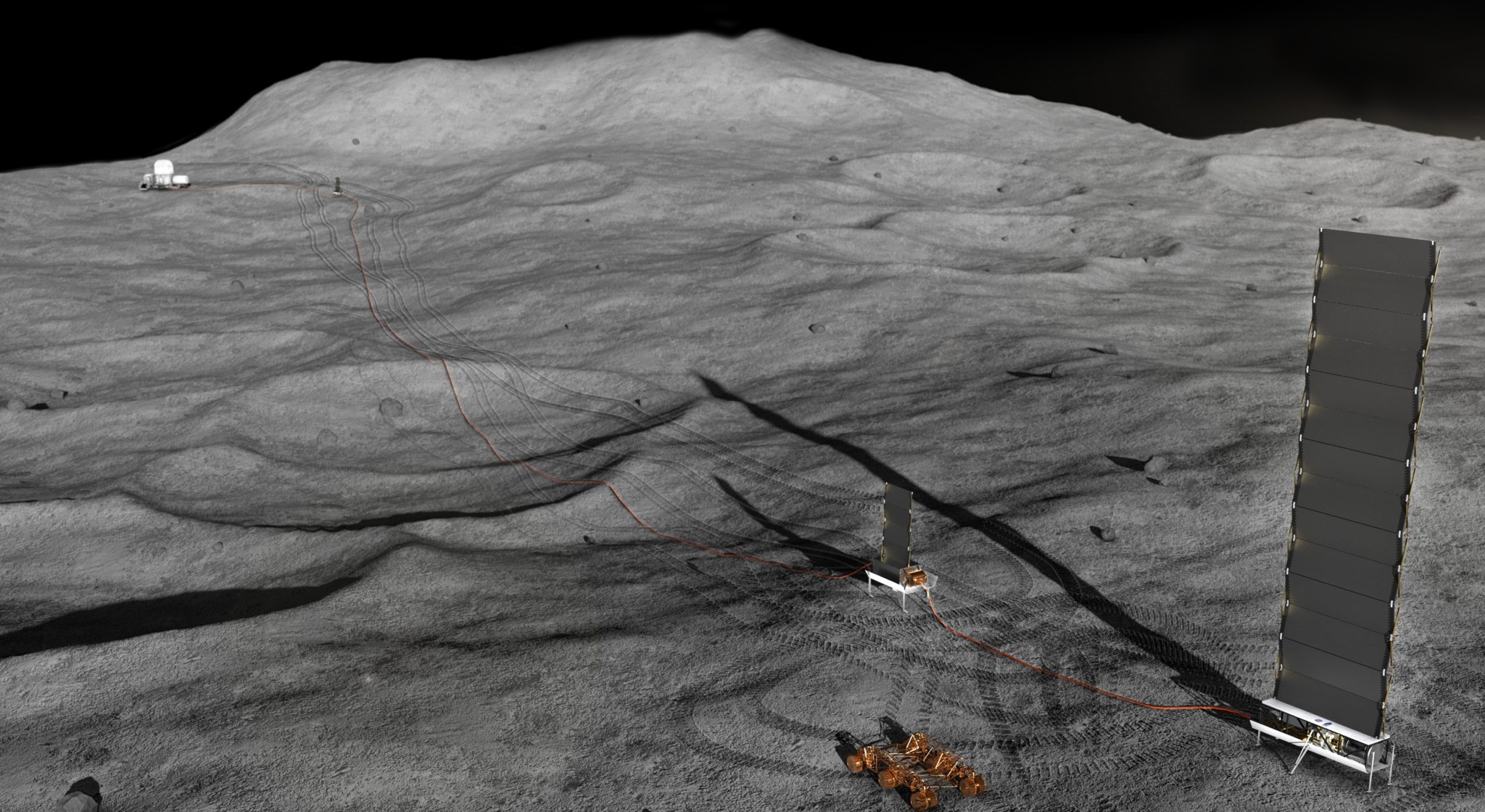
A concept image of the Fission Surface Power Project on the lunar surface. The lunar surface is grey and is filled with craters and rover tracks.
NASA plans a sustained presence on the Moon and eventually Mars. Safe, efficient, reliable energy will be key to future robotic and human exploration.
Credit: NASA

NASA also set a goal that the reactor should be capable of operating for a decade without human intervention, which is key to its success. Safety, especially concerning radiation dose and shielding, is another key driver for the design.

Beyond the set requirements, the partnerships envisioned how the reactor would be remotely powered on and controlled. They identified potential faults and considered different types of fuels and configurations. Having terrestrial nuclear companies paired with companies with expertise in space made for a wide range of ideas.

NASA plans to extend the three Phase 1 contracts to gather more information before Phase 2, when industry will be solicited to design the final reactor to demonstrate on the Moon. This additional knowledge will help the agency set the Phase 2 requirements, Kaldon says.

“We’re getting a lot of information from the three partners,” Kaldon said. “We’ll have to take some time to process it all and see what makes sense going into Phase 2 and levy the best out of Phase 1 to set requirements to design a lower-risk system moving forward.”

Open solicitation for Phase 2 is planned for 2025.

After Phase 2, the target date for delivering a reactor to the launch pad is in the early 2030s. On the Moon, the reactor will complete a one-year demonstration followed by nine operational years. If all goes well, the reactor design may be updated for potential use on Mars.

Beyond gearing up for Phase 2, NASA recently awarded Rolls Royce North American Technologies, Brayton Energy, and General Electric contracts to develop Brayton power converters.

Thermal power produced during nuclear fission must be converted to electricity before use. Brayton converters solve this by using differences in heat to rotate turbines within the converters. However, current Brayton converters waste a lot of heat, so NASA has challenged companies to make these engines more efficient.

The Technology Demonstration Missions program manages Fission Surface Power under NASA’s Space Technology Mission Directorate. 

Powered by WPeMatico

Get The Details…
Kelly M. Matter
Hubble Observes a Galactic Distortion

Hubble Observes a Galactic Distortion

1 min read

Hubble Observes a Galactic Distortion

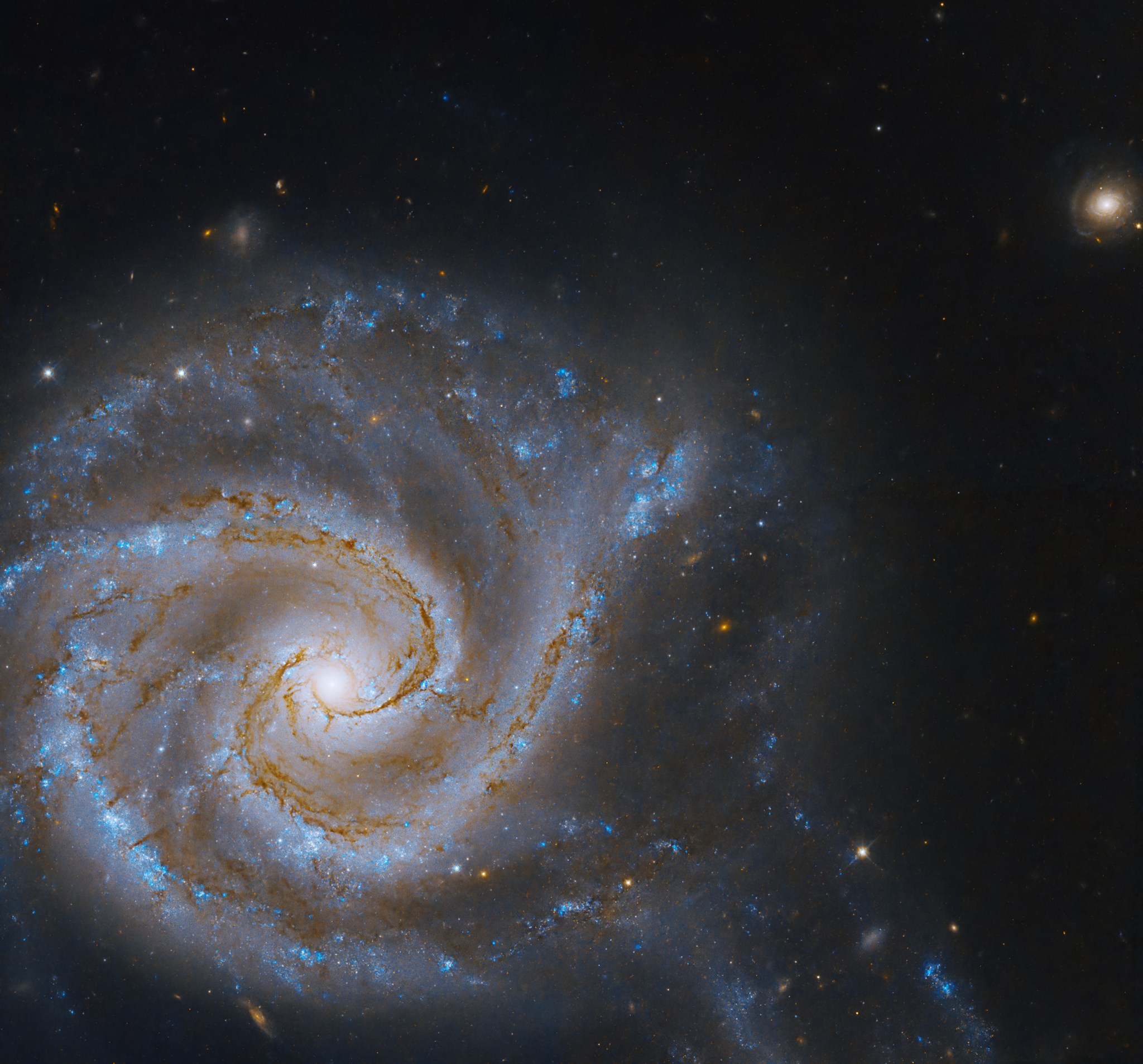
A massive spiral galaxy fills the lower left of the image. Spiral arms full of dark brown dust and bright blue stars extend out from the yellow galactic core, all against black space dotted with more distant galaxies and stars.
The galaxy NGC 5427 shines in this new NASA Hubble Space Telescope image.
NASA, ESA, and R. Foley (University of California – Santa Cruz); Processing: Gladys Kober (NASA/Catholic University of America)

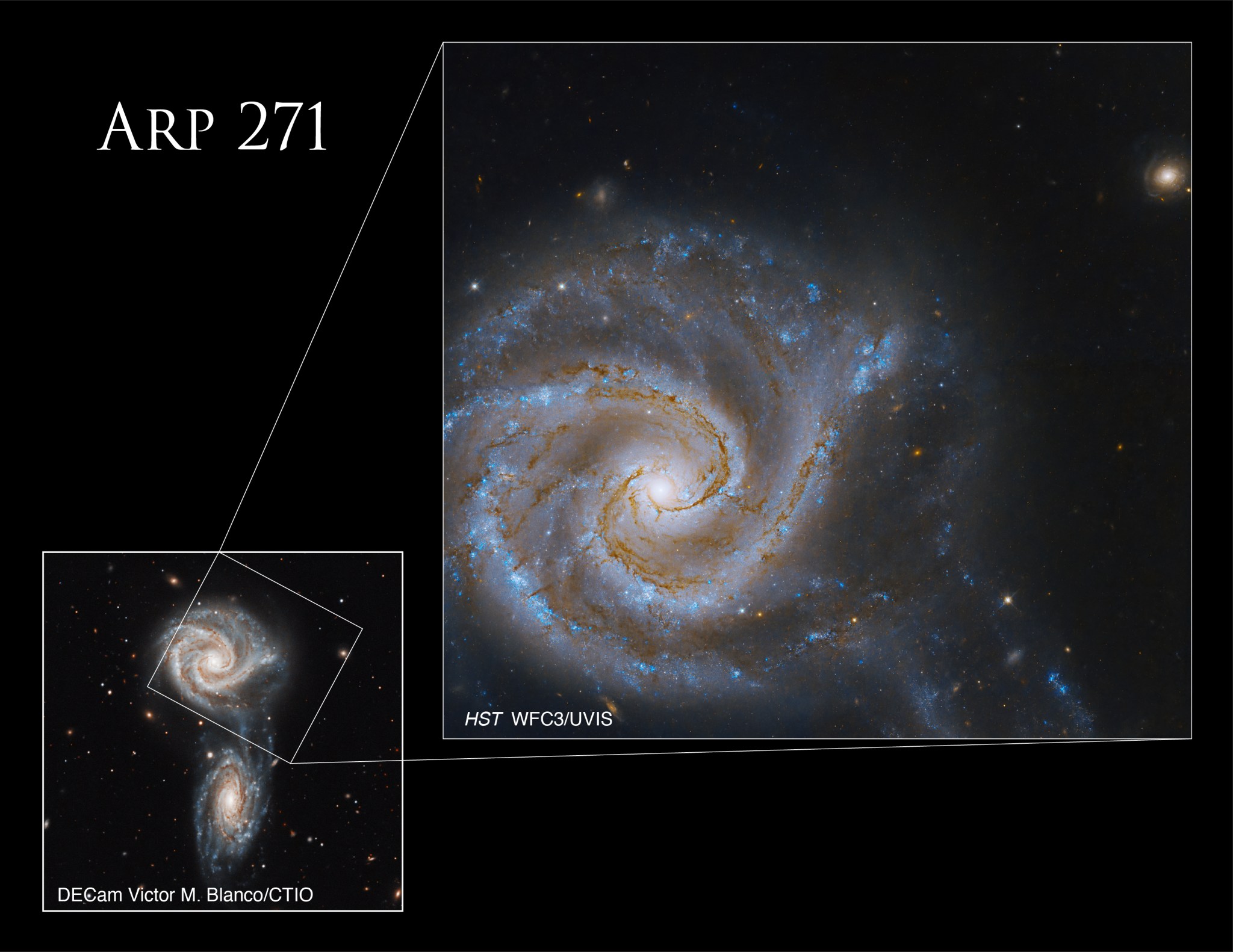
The galaxy NGC 5427 shines in this new NASA Hubble Space Telescope image. It’s part of the galaxy pair Arp 271, and its companion NGC 5426 is located below this galaxy and outside of this image’s frame. However, the effects of the pair’s gravitational attraction is visible in the galactic distortion and cosmic bridge of stars seen in the lower-right region of the image.

In 1785, British astronomer William Herschel discovered the pair, which is locked in an interaction that will last for tens of millions of years. Whether they will ultimately collide and merge is still uncertain, but their mutual gravitational attraction has already birthed many new stars. These young stars are visible in the faint bridge connecting the two galaxies, located at the bottom of the image. Such a bridge provides an avenue for the two galaxies to continue sharing the gas and dust that becomes new stars. Scientists believe Arp 271 can serve as a blueprint for future interactions between our Milky Way Galaxy and our neighbor the Andromeda Galaxy, expected to happen in about 4 billion years. 

The rightmost image in this inset graphic shows a massive spiral galaxy. To its left, white text reads “Arp 271” and a more zoomed-out image below shows two interacting spiral galaxies with a white box designating the portion that is the rightmost image.
The galaxy NGC 5427 shines in the large image from Hubble, with ground-based observations showing its companion galaxy NGC 5426. Together, this pair is known as Arp 271.
Ground-based image: DECam Victor M. Blanco/CTIO; Hubble image: NASA, ESA, and R. Foley (University of California – Santa Cruz); Processing: Gladys Kober (NASA/Catholic University of America)

LEARN MORE:

Media Contact:

Claire Andreoli
NASA’s Goddard Space Flight CenterGreenbelt, MD
claire.andreoli@nasa.gov

Share

Details

Last Updated
Jan 31, 2024
Editor
Andrea Gianopoulos
Location
Goddard Space Flight Center

Powered by WPeMatico

Get The Details…

NASA Releases STEM Toolkit for Advanced Air Mobility

NASA Releases STEM Toolkit for Advanced Air Mobility

2 min read

Preparations for Next Moonwalk Simulations Underway (and Underwater)

A graphic showing various aviation careers that could be part of Advanced Air Mobility.
Students who pursue careers in these areas, among many others, could contribute to transforming aviation by developing and deploying Advanced Air Mobility solutions to the challenges of 21st century flight.
NASA / Lillian Gipson

NASA Aeronautics has released a new STEM toolkit focusing on Advanced Air Mobility for educators and students of all ages.

The toolkit, comprised of numerous educational activities, is a free resource for anyone who is interested in learning more about the Advanced Air Mobility mission’s goal of enabling the use of drones and other new aircraft in our skies.

Students can engage with the principles of Advanced Air Mobility in a variety of ways – including hands-on activities on topics such as coding, math, energy, the environment, and more. It is one of three STEM toolkits focusing on NASA’s aeronautics research – the others being Sustainable Aviation and the Quesst mission.

The Advanced Air Mobility STEM toolkit provides excellent, cross-curricular ways to learn about the scientific concepts behind drone flight…

April Lanotte

April Lanotte

NASA Aeronautics STEM Lead

The Advanced Air Mobility STEM toolkit provides excellent, cross-curricular ways to learn about the scientific concepts behind drone flight without even needing to have a drone,” said April Lanotte, NASA Aeronautics’ lead for STEM integration. “The toolkit has something for people of all ages in all types of educational environments.”

For example, one activity in the toolkit involves creating an art poster to explore and highlight original ideas for drone safety and the safe use of drones.

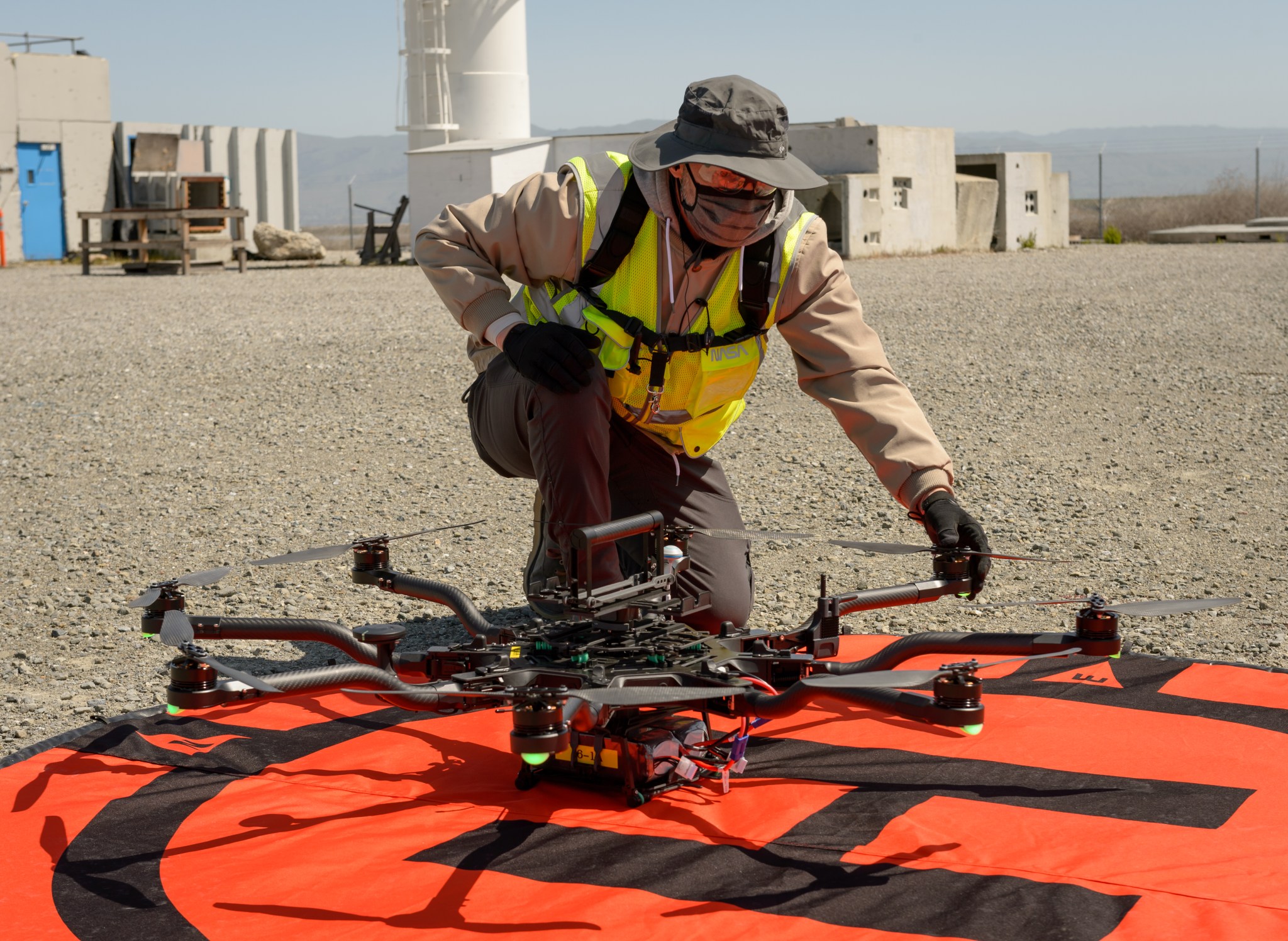
Zach Roberts completes a pre-flight check of a drone during Scalable Traffic Management for Emergency Response Operations, or STEReO, testing at the Disaster Assistance and Rescue Team, or DART, training facility, NA303.
NASA

An activity named Robotic Search and Rescue has students interact with real-world uses for drones – in this case, emergency response operations. As part of the activity, a team of students create and test their own responses to challenges first responders may face.

In another activity, students engage in cooperative game play to simulate a drone navigating around obstacles to deliver their lunch to school. The simulation engages students in computational thinking, problem solving, and real-world application of mathematics.

What’s more, many of these activities are aligned with national standards to meet educational requirements in the classroom. The toolkit also includes levelled readers, videos, and e-books, and is updated regularly with new material.

“It’s really a living toolkit. Advanced Air Mobility is a constantly evolving field, so we’re always adding new things to keep up with it,” said Lanotte. “Not just related to drones themselves, but also the infrastructure, coding, and other engineering challenges needed to support those vehicles in the future.”

The Advanced Air Mobility toolkit, along with the rest of NASA Aeronautics’ comprehensive STEM resources, is available on the Aeronautics STEM webpage.

About the Author

John Gould

John Gould

Aeronautics Research Misson Directorate

Share

Details

Last Updated

Jan 31, 2024

Editor
Jim Banke
Contact
Jim Banke

Powered by WPeMatico

Get The Details…
Jim Banke

Cygnus Deploys Solar Arrays, Arrives at Station on Thursday

Cygnus Deploys Solar Arrays, Arrives at Station on Thursday

Northrop Grumman’s Cygnus cargo craft launches from Space Launch Complex 40 at Cape Canaveral Space Force Station in Florida atop a SpaceX Falcon 9 rocket. Credit: SpaceX

Northrop Grumman’s Cygnus cargo spacecraft has successfully deployed its two solar arrays after launching earlier today, Jan. 30, on a SpaceX Falcon 9 rocket.

Cygnus is scheduled to arrive at the International Space Station around 4:20 a.m. Thursday, Feb. 1.

NASA+, NASA Television, the NASA app, and agency’s website will provide live coverage of the spacecraft’s approach and arrival beginning at 2:45 a.m.

NASA astronaut Jasmin Moghbeli will capture Cygnus using the station’s Canadarm2 robotic arm, and NASA astronaut Loral O’Hara will be acting as a backup. After capture, the spacecraft will be installed on the Unity module’s Earth-facing port.


Learn more about station activities by following the space station blog@space_station and @ISS_Research on X, as well as the ISS Facebook and ISS Instagram accounts.

Get weekly video highlights at: https://roundupreads.jsc.nasa.gov/videoupdate/

Get the latest from NASA delivered every week. Subscribe here: www.nasa.gov/subscribe

Powered by WPeMatico

Get The Details…

Mark Garcia

Cygnus Deploys Solar Arrays, Arriving at Station on Thursday

Cygnus Deploys Solar Arrays, Arriving at Station on Thursday

Northrop Grumman’s Cygnus cargo craft launches from Space Launch Complex 40 at Cape Canaveral Space Force Station in Florida atop a SpaceX Falcon 9 rocket. Credit: SpaceX

Northrop Grumman’s Cygnus cargo spacecraft has successfully deployed its two solar arrays after launching earlier today, Jan. 30, on a SpaceX Falcon 9 rocket.

Cygnus is scheduled to arrive at the International Space Station around 4:20 a.m. Thursday, Feb. 1.

NASA+, NASA Television, the NASA app, and agency’s website will provide live coverage of the spacecraft’s approach and arrival beginning at 2:45 a.m.

NASA astronaut Jasmin Moghbeli will capture Cygnus using the station’s Canadarm2 robotic arm, and NASA astronaut Loral O’Hara will be acting as a backup. After capture, the spacecraft will be installed on the Unity module’s Earth-facing port.


Learn more about station activities by following the space station blog@space_station and @ISS_Research on X, as well as the ISS Facebook and ISS Instagram accounts.

Get weekly video highlights at: https://roundupreads.jsc.nasa.gov/videoupdate/

Get the latest from NASA delivered every week. Subscribe here: www.nasa.gov/subscribe

Powered by WPeMatico

Get The Details…

Mark Garcia