55 Years Ago: President Nixon Establishes Space Task Group to Chart Post-Apollo Plans

55 Years Ago: President Nixon Establishes Space Task Group to Chart Post-Apollo Plans

In early 1969, the goal set by President John F. Kennedy to land a man on the Moon seemed within reach. A new president, Richard M. Nixon, now sat in the White House and needed to chart America’s course in space in the post-Apollo era. President Nixon directed his science advisor to evaluate proposals for America’s next steps in space. He established a Space Task Group (STG), chaired by Vice President Spiro T. Agnew, to report back to him with their recommendations. The STG delivered its report to President Nixon on Sept. 15, 1969, who declined to select any of the options proposed. Instead, more than two years later, he directed NASA to build the space shuttle, just one element of the ambitious plans the STG had proposed.

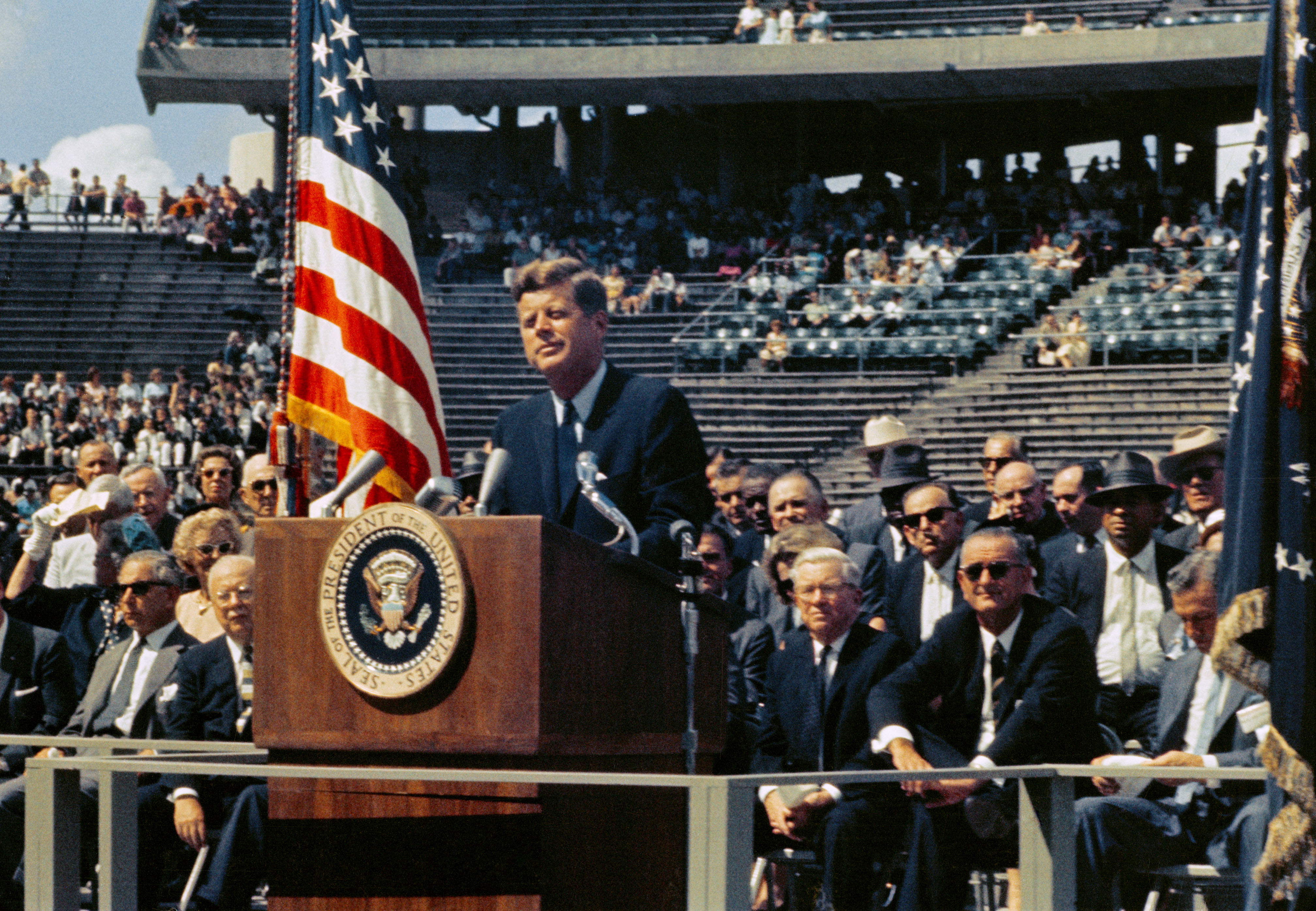
President John F. Kennedy announces his goal of a Moon landing during a Joint Session of Congress in May 1961 President Kennedy reaffirms the goal during his address at Rice University in Houston in September 1962
Left: President John F. Kennedy announces his goal of a Moon landing during a Joint Session of Congress in May 1961. Right: President Kennedy reaffirms the goal during his address at Rice University in Houston in September 1962.

On May 25, 1961, President Kennedy, before a Joint Session of Congress, committed the United States to the goal, before the decade was out, of landing a man on the Moon and returning him safely to the Earth. President Kennedy reaffirmed the commitment during an address at Rice University in Houston in September 1962. Vice President Lyndon B. Johnson, who played a key role in establishing NASA in 1958, and under Kennedy served as the Chair of the National Aeronautics and Space Council, worked with members of Congress to ensure adequate funding for the next several years to provide NASA with the proper resources to meet that goal. Following Kennedy’s assassination in November 1963, now President Johnson continued his strong support of the space program to ensure that his predecessor’s goal of a Moon landing could be achieved within the stipulated time frame. But with increasing competition for scarce federal resources from the conflict in southeast Asia and from domestic programs, Johnson showed less interest in any space endeavors that might follow the Moon landing. The space agency’s annual budget peaked in 1966 and began a steady decline three years before Kennedy’s goal was met. From a budgetary standpoint, the prospects of a vibrant post-Apollo space program did not look too rosy, the Apollo triumphs of 1968 and 1969 notwithstanding.
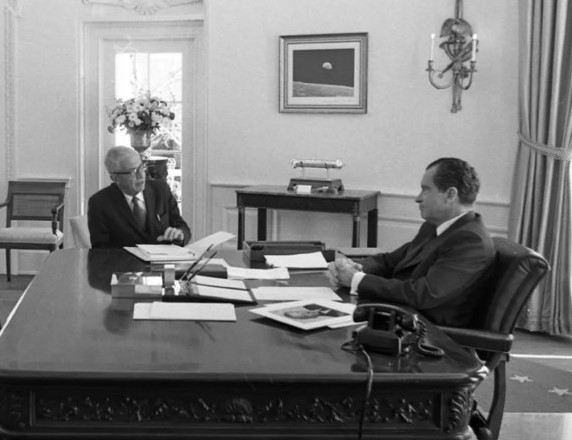
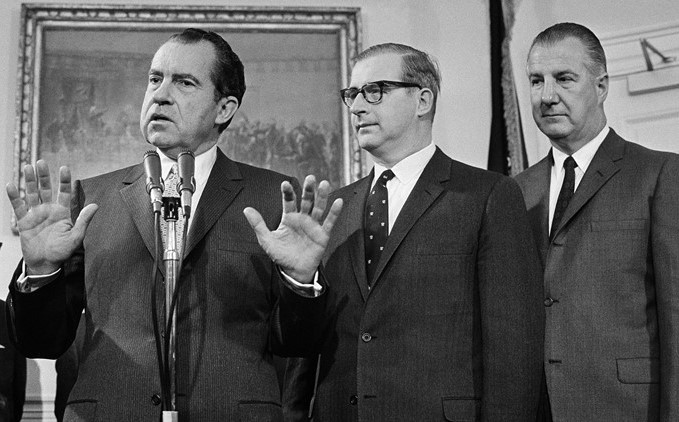
President Richard M. Nixon, right, meets with his science advisor Lee DuBridge in the Oval Office President Nixon, left, and Vice President Spiro T. Agnew, right, introduce Thomas O. Paine as the nominee to be NASA administrator on March 5, 1969
Left: President Richard M. Nixon, right, meets with his science advisor Lee DuBridge in the Oval Office – note the Apollo 8 Earthrise photo on the wall. Right: President Nixon, left, and Vice President Spiro T. Agnew, right, introduce Thomas O. Paine as the nominee to be NASA administrator on March 5, 1969.

On Feb. 4, just two weeks after taking office, President Nixon directed his Science Advisor Lee A. DuBridge to appoint an interagency committee to advise him on a post-Apollo space program. Nine days later, the President announced the formation of the STG to develop a strategy for America’s space program for the next decade. Vice President Agnew, as the Chair of the National Aeronautics and Space Council, led the group. Other members of the STG included NASA Acting Administrator Thomas O. Paine (the Senate confirmed him as administrator on March 20), the Secretary of Defense, and the Director of the Office of Science and Technology.
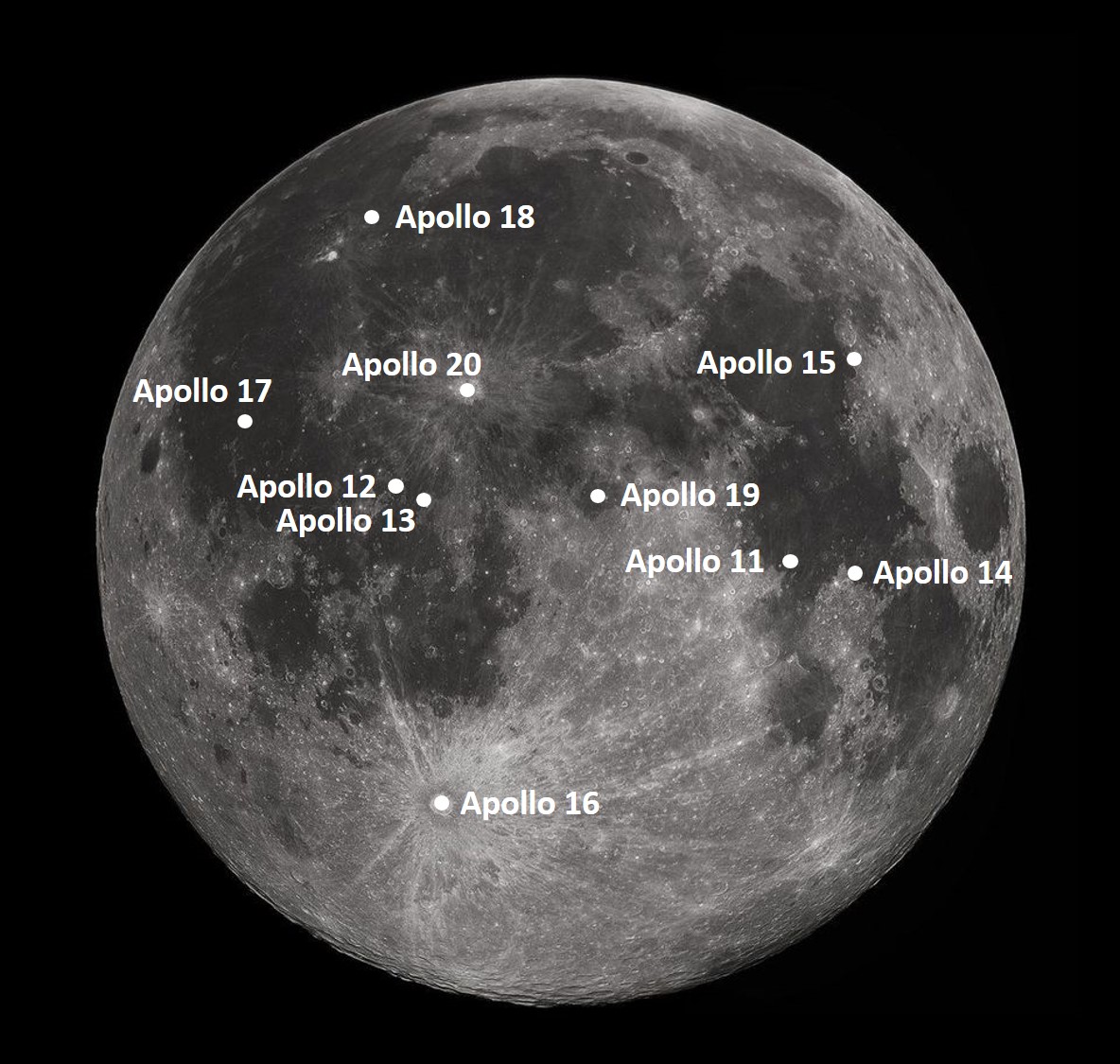
Proposed lunar landing sites through Apollo 20, per NASA planning in August 1969 Illustration of the Apollo Applications Program experimental space station
Left: Proposed lunar landing sites through Apollo 20, per NASA planning in August 1969. Right: Illustration of the Apollo Applications Program experimental space station.

At the time, the only approved human space flight programs included lunar missions through Apollo 20 and the Apollo Applications Program (AAP), later renamed Skylab, that involved three flights to an experimental space station based on Apollo technology. Beyond a general vague consensus that the United States human space flight program should continue, no approved projects existed to follow these missions when they ended by about 1975.
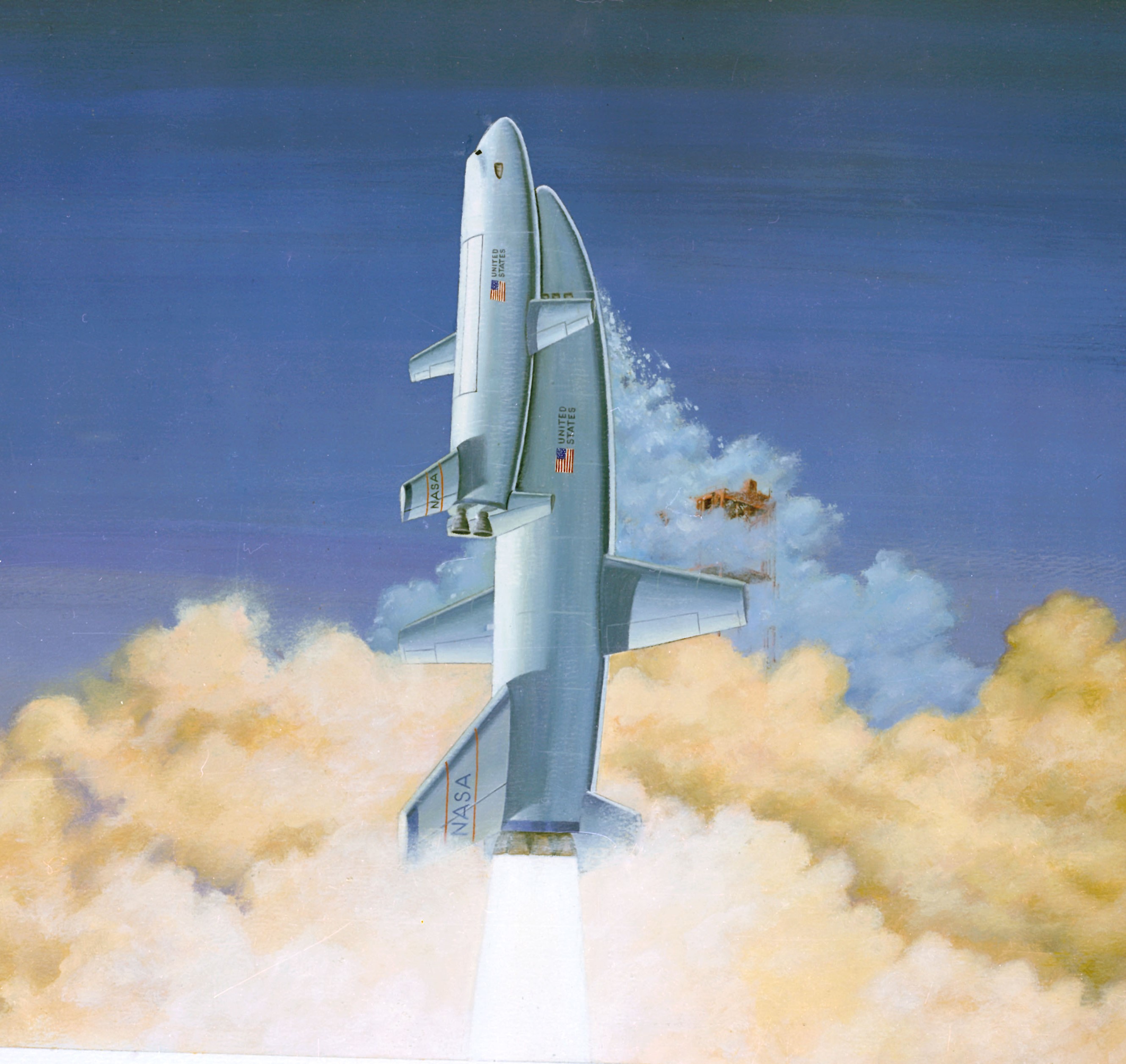
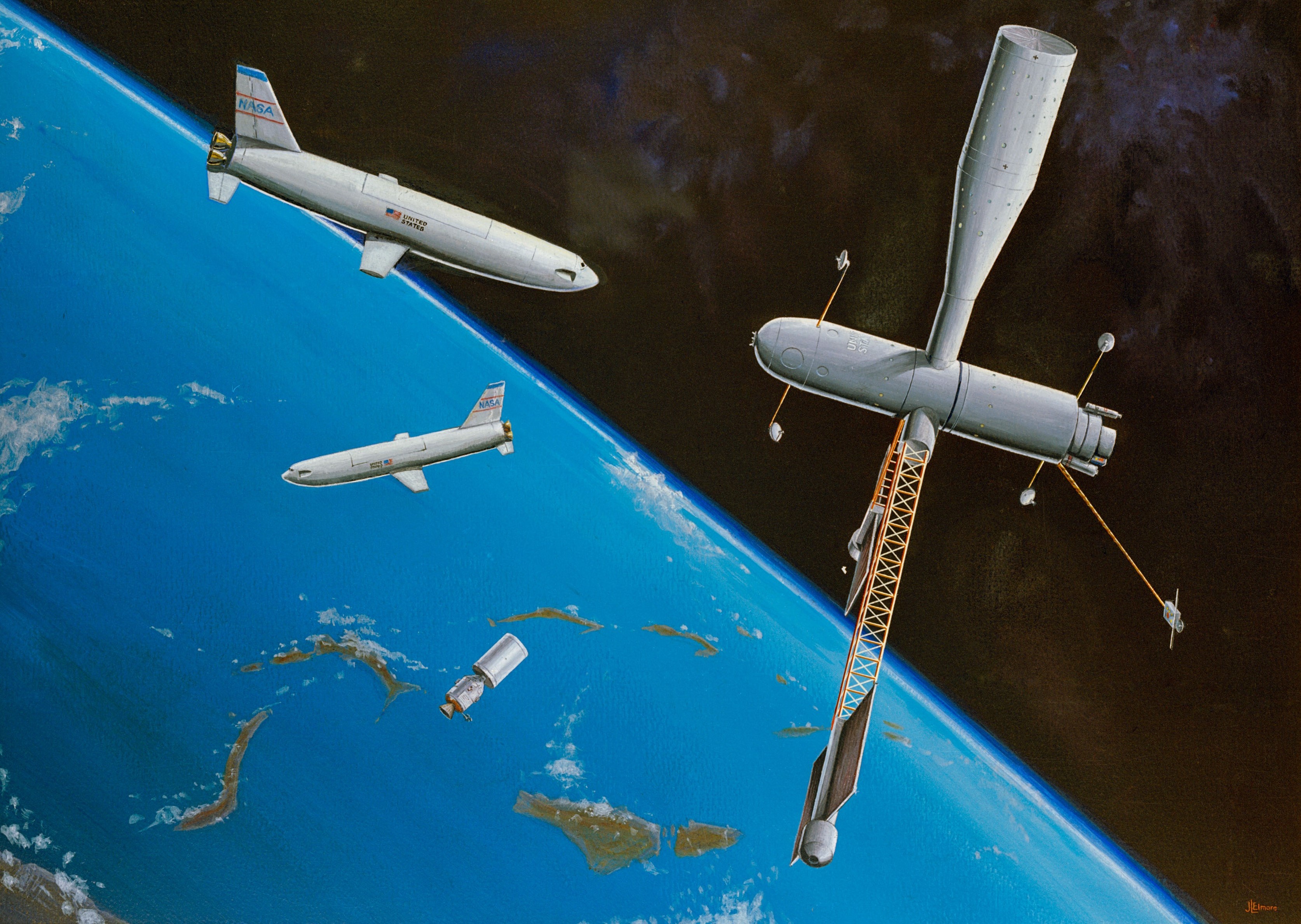
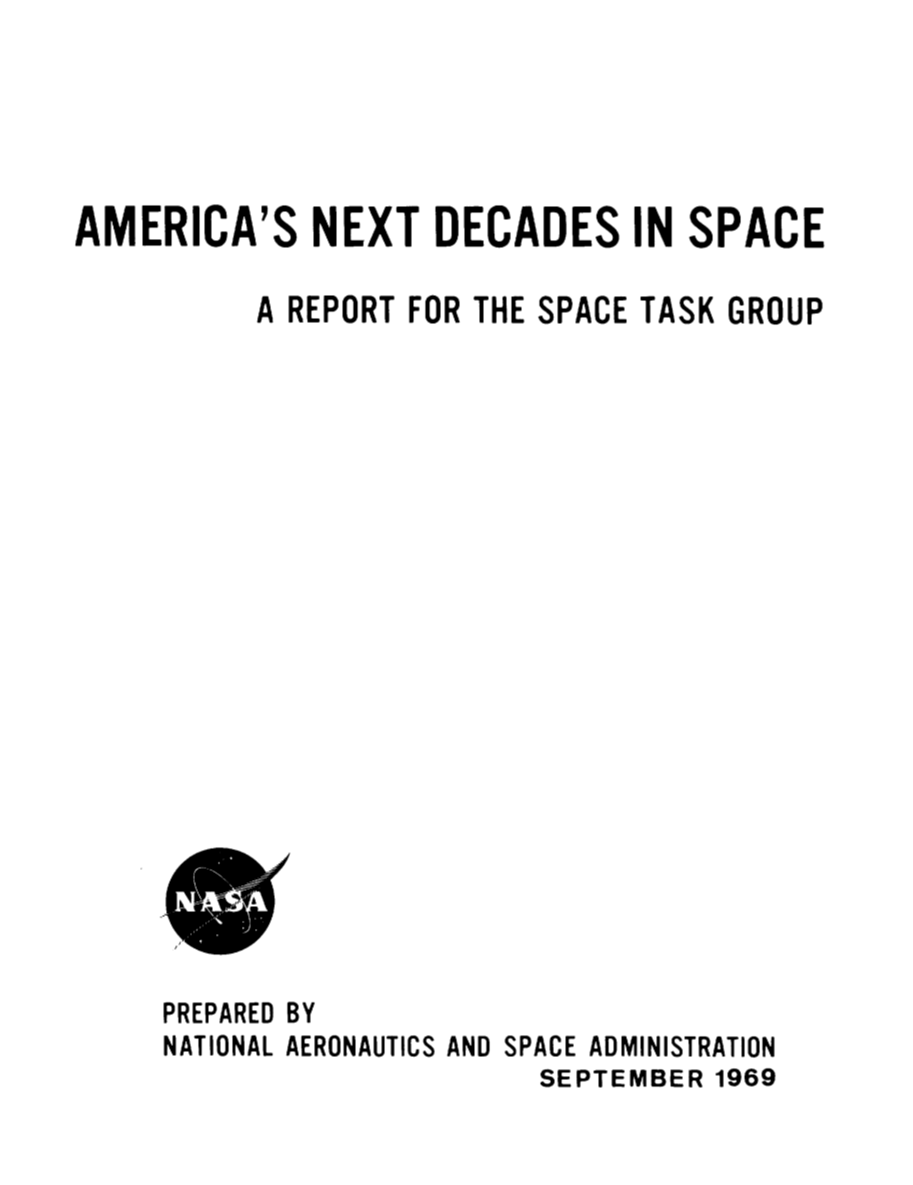
Concept of a fully reusable space shuttle system from early 1969 Illustration from early 1969 of low Earth orbit infrastructure, including a large space station supported by space shuttles Cover page of NASA’s report to the interagency Space Task Group
Left: Concept of a fully reusable space shuttle system from early 1969. Middle: Illustration from early 1969 of low Earth orbit infrastructure, including a large space station supported by space shuttles. Right: Cover page of NASA’s report to the interagency Space Task Group.

Within NASA, given the intense focus on achieving the Moon landing within President Kennedy’s time frame, officials paid less attention to what would follow the Apollo Program and AAP. During a Jan. 27, 1969 meeting at NASA chaired by Paine, a general consensus evolved that the next step after the Moon landing should involve the development of a 12-person earth-orbiting space station by 1975, followed by an even larger outpost capable of housing up to 100 people “with a multiplicity of capabilities.” In June, with the goal of the Moon landing about to be realized, NASA’s internal planning added the development of a space shuttle by 1977 to support the space station, and truly optimistically, the development of a lunar base by 1976, among other highly ambitious endeavors that included the idea that the U.S. should begin preparing for a human mission to Mars as early as the 1980s. These proposals were presented to the STG for consideration in early July in a report titled “America’s Next Decade in Space.”
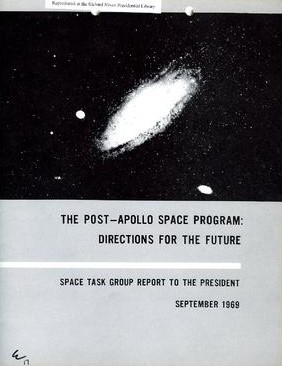
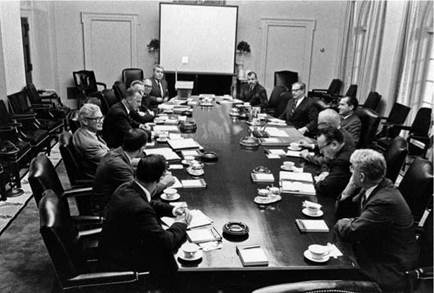
The Space Task Group’s (STG) Report to President Nixon Meeting in the White House to present the STG Report to President Nixon
Left: The Space Task Group’s (STG) Report to President Nixon. Right: Meeting in the White House to present the STG Report to President Nixon. Image credit: courtesy Richard Nixon Presidential Library and Museum.

Still bathing in the afterglow of the successful Moon landing, the STG presented its 29-page report “The Post-Apollo Space Program:  Directions for the Future” to President Nixon on Sep. 15, 1969, during a meeting in the White House Cabinet Room. In its Conclusions and Recommendations section, the report noted that the United States should pursue a balanced robotic and human space program but emphasized the importance of the latter, with a long-term goal of a human mission to Mars before the end of the 20th century. The report proposed that NASA develop new systems and technologies that emphasized commonality, reusability, and economy in its future programs. To accomplish these overall objectives, the report presented three options:

Option I – this option required more than a doubling of NASA’s budget by 1980 to enable a human Mars mission in the 1980s, establishment of a lunar orbiting space station, a 50-person Earth orbiting space station, and a lunar base. A decision would be required by 1971 on development of an Earth-to-orbit transportation system to support the space station. A strong robotic scientific and exploration program would be maintained.

Option II – this option maintained NASA’s budget at then current levels for a few years then anticipated a gradual increase to support the parallel development of both an earth orbiting space station and an Earth-to-orbit transportation system, but deferred a Mars mission to about 1986. A strong robotic scientific and exploration program would be maintained, but smaller than in Option I.

Option III – essentially the same as Option II but deferred indefinitely the human Mars mission.

In separate letters, both Agnew and Paine recommended to President Nixon to choose Option II. 
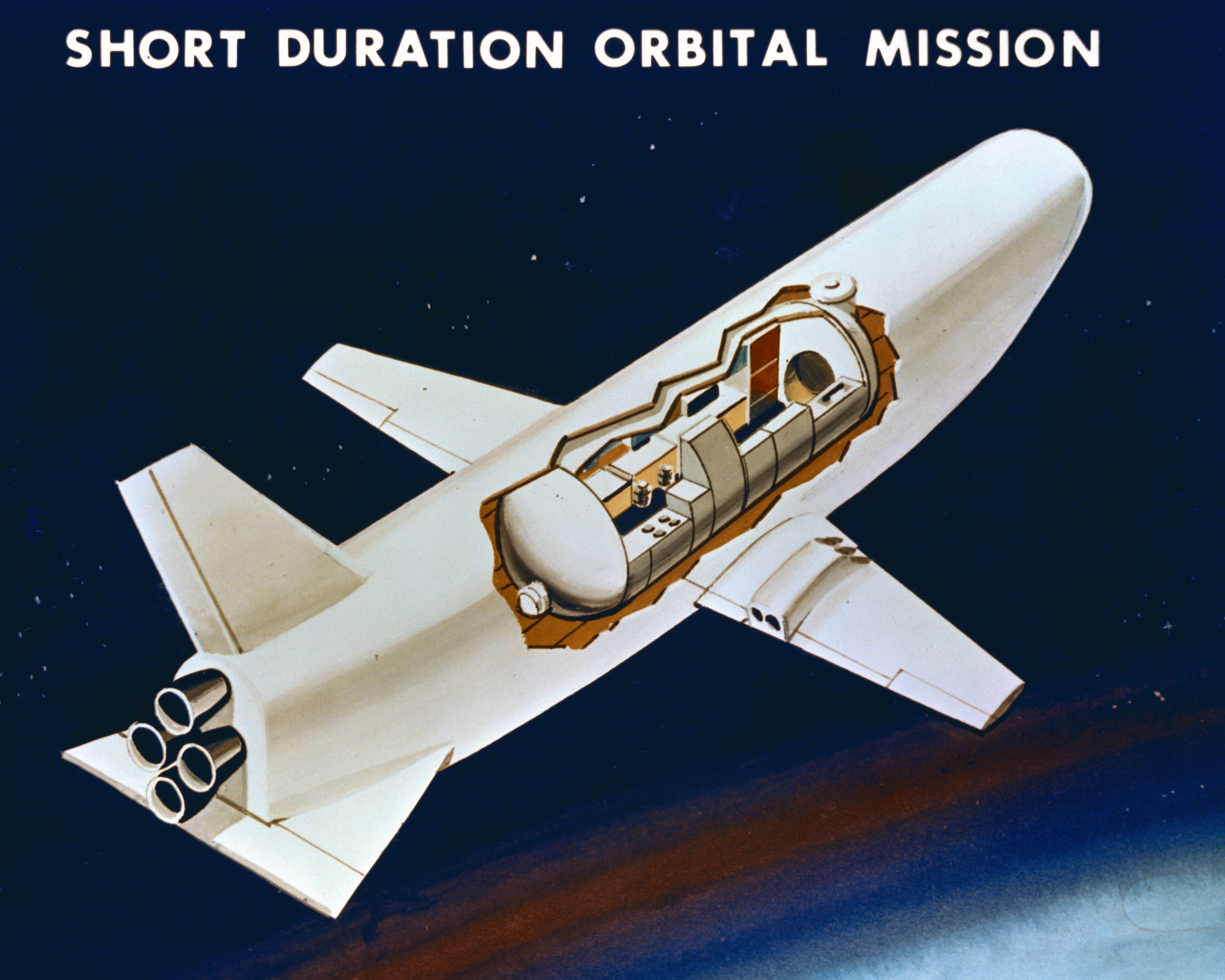
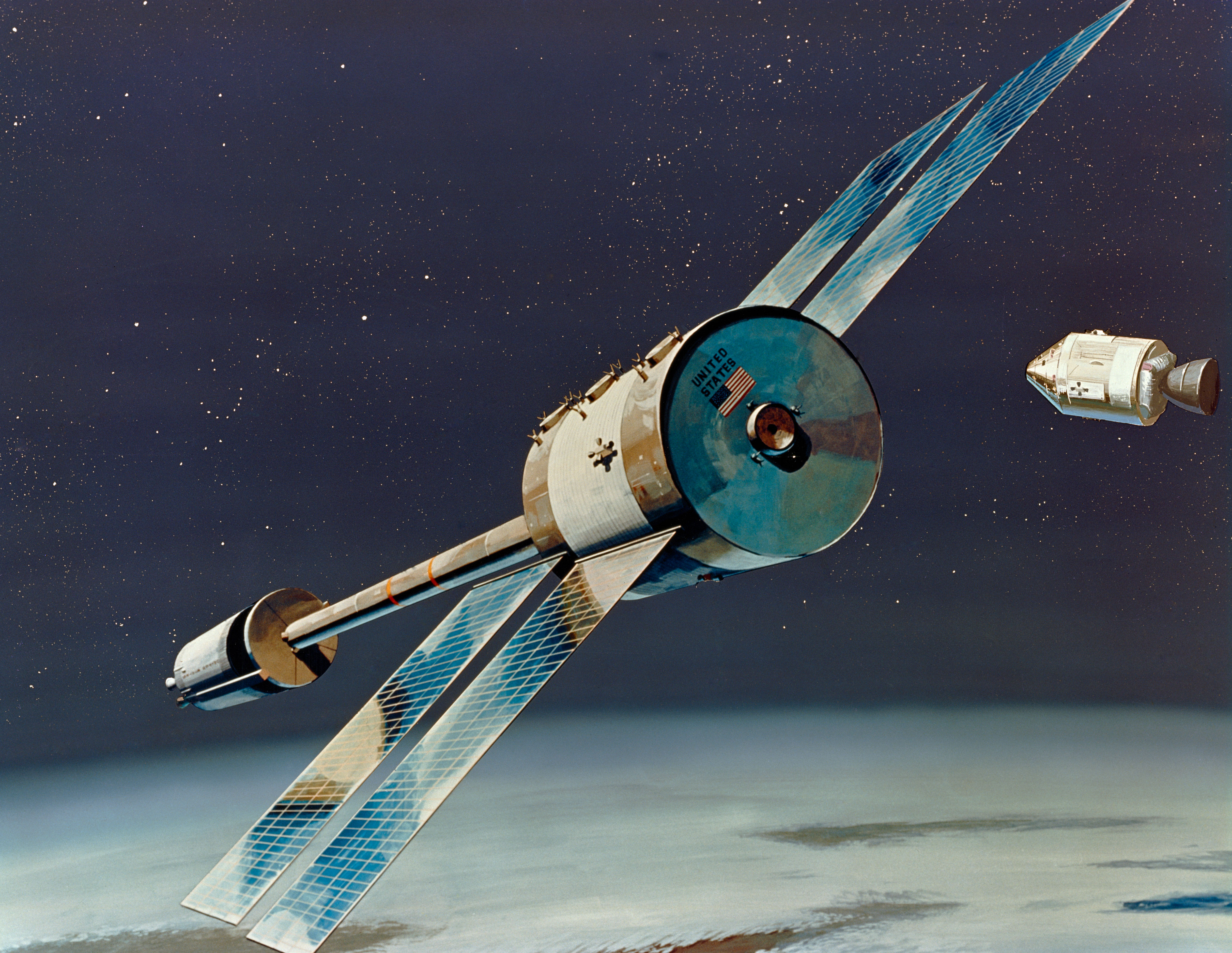
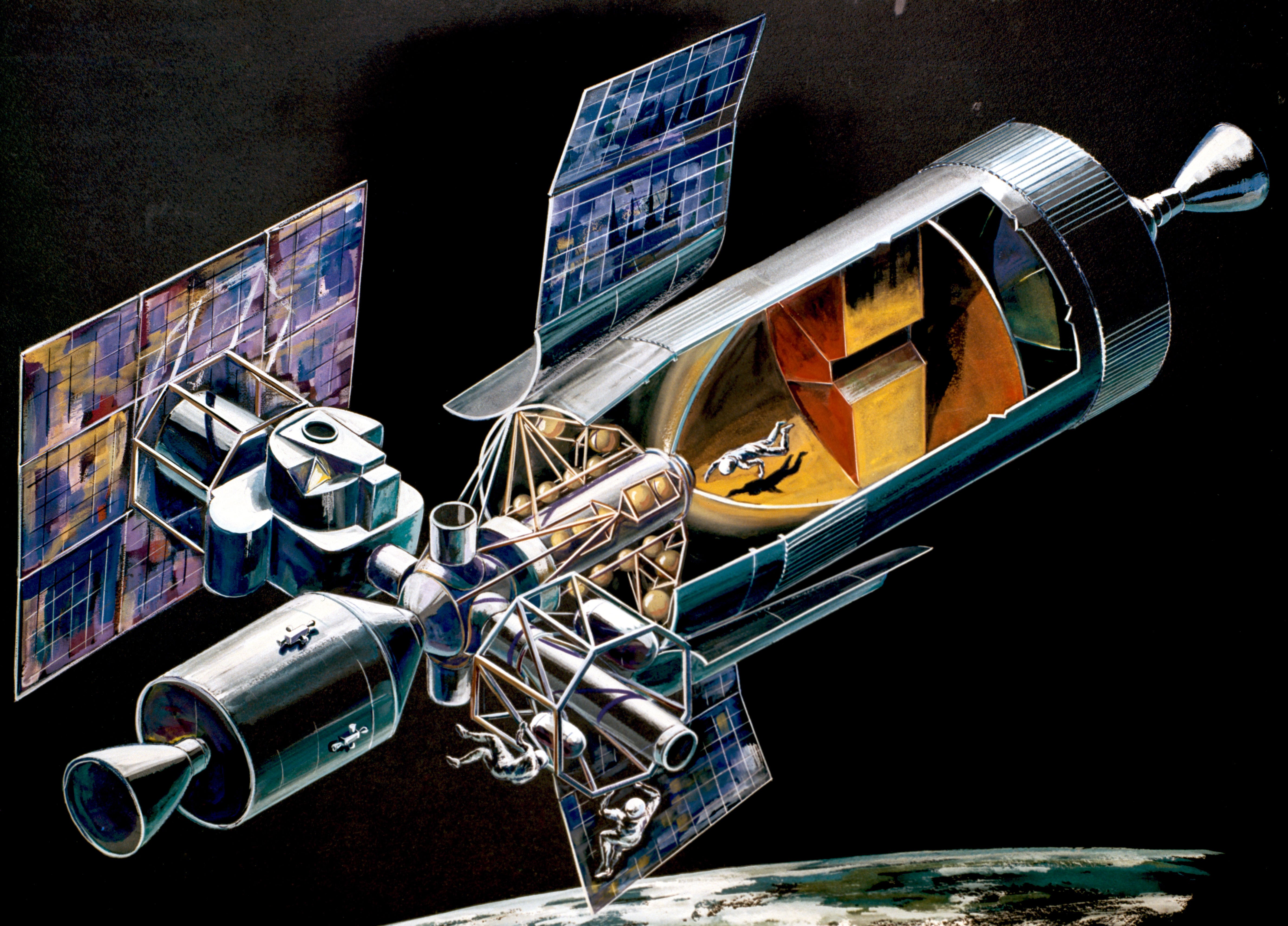
Illustration of a possible space shuttle orbiter from 1969 Illustration of a possible 12-person space station from 1969
Left: Illustration of a possible space shuttle orbiter from 1969. Right: Illustration of a possible 12-person space station from 1969.

The White House released the report to the public at a press conference on Sep. 17 with Vice President Agnew and Administrator Paine in attendance. Although he publicly supported a strong human spaceflight program and enjoyed the positive press he received when photographed with Apollo astronauts, and initially sounding positive about the STG options, President Nixon ultimately chose not to act on the report’s recommendations. Faced with the still ongoing conflict in southeast Asia and domestic programs competing for scarce federal dollars, the fiscally conservative Nixon decided these plans were just too grandiose and far too expensive. He also believed that NASA should be considered as one America’s domestic programs without the special status it enjoyed during the 1960s, one of the lasting legacies of the Nixon space doctrine. Even some of the already planned remaining Moon landing missions fell victim to the budgetary axe. On Jan. 4, 1970, NASA canceled Apollo 20 since it needed its Saturn V rocket to launch the Skylab experimental space station – NASA Administrator James E. Webb had turned off the Saturn V assembly line in 1968 and none remained beyond the original 15 built under contract. In September 1970, reductions in NASA’s budget forced the cancellation of two more Apollo missions, and for a time in 1971 President Nixon considered cancelling two more but he relented, and they flew as the final two Apollo Moon landing missions in 1972.
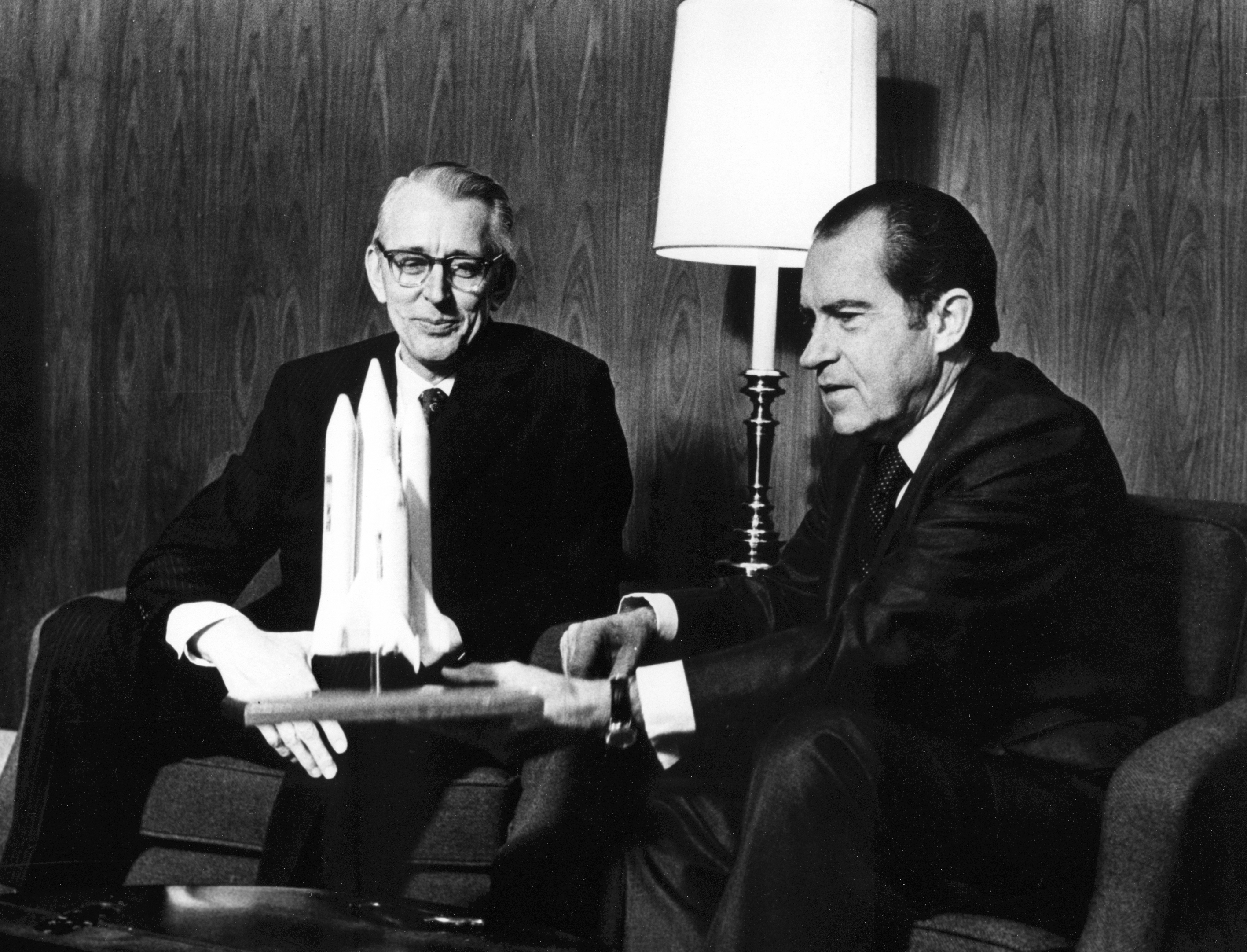
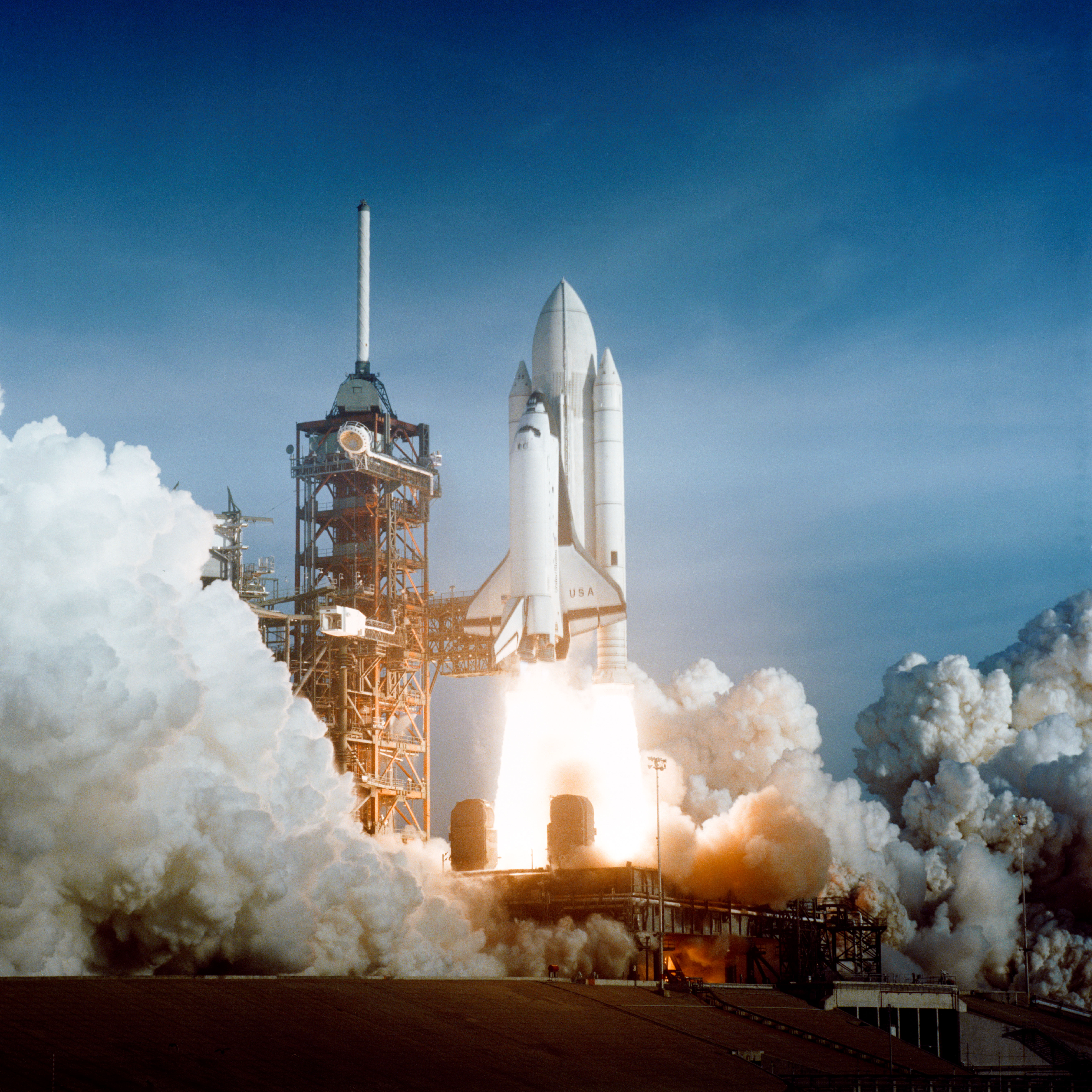
NASA Administrator James C. Fletcher, left, and President Richard M. Nixon announce the approval to proceed with space shuttle development in 1972 First launch of the space shuttle in 1981
Left: NASA Administrator James C. Fletcher, left, and President Richard M. Nixon announce the approval to proceed with space shuttle development in 1972. Right: First launch of the space shuttle in 1981.

More than two years after the STG submitted its report, in January 1972 President Nixon directed NASA Administrator James C. Fletcher to develop the Space Transportation System, the formal name for the space shuttle, the only element of the recommendations to survive the budgetary challenges. At that time, the first flight of the program was expected in 1979; in actuality, the first flight occurred two years later. It would be 12 years after Nixon’s shuttle decision before President Ronald W. Reagan approved the development of a space station, the second major component of the STG recommendation, and another 14 years after that before the first element of that program reached orbit. In those intervening years, the original American space station had been redesigned and evolved into the multinational partnership called the International Space Station.
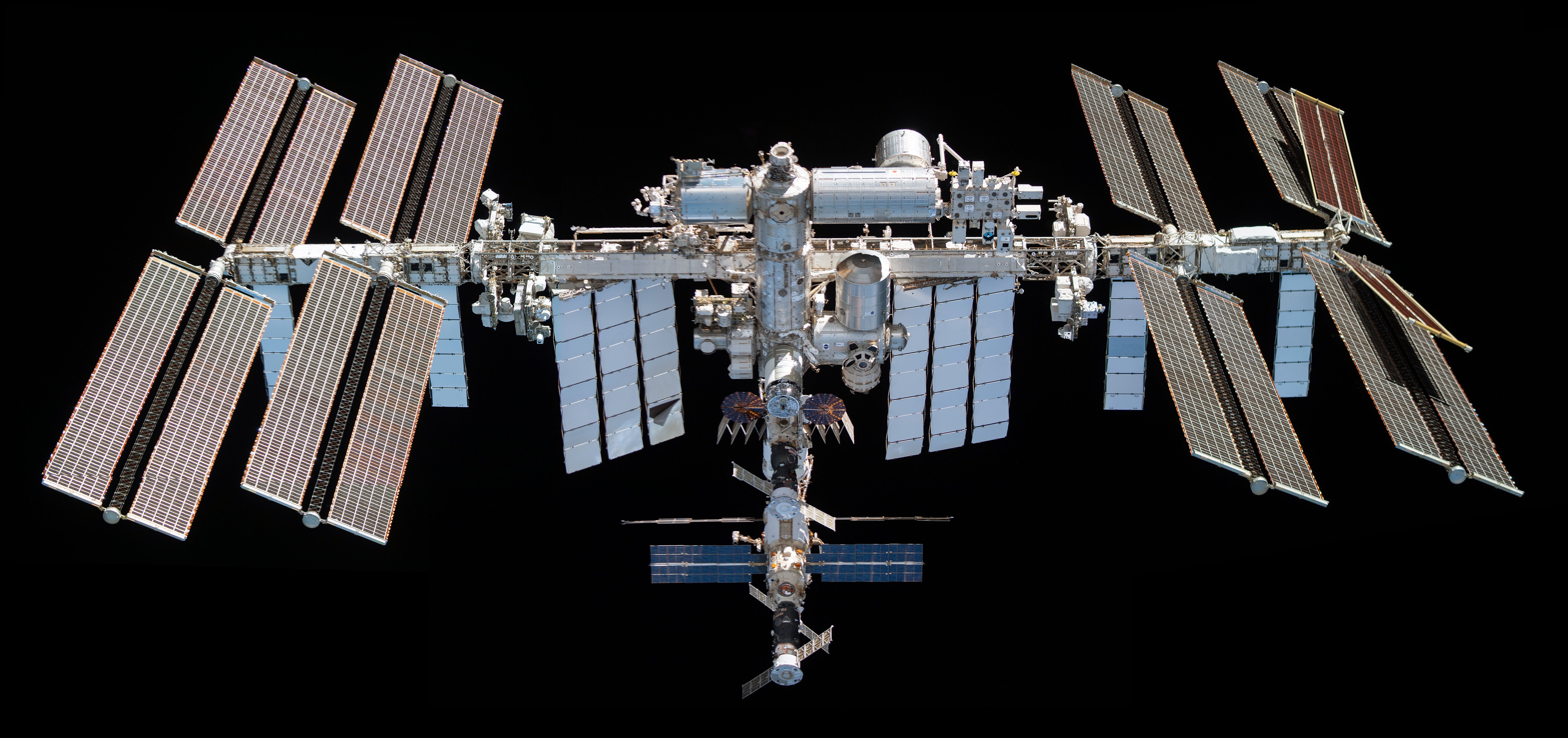
The International Space Station as it appeared in 2021
The International Space Station as it appeared in 2021.

Share

Details

Last Updated

Feb 13, 2024

Related Terms

Powered by WPeMatico

Get The Details…
Kelli Mars
NASA Invites Media to SpaceX’s 30th Resupply Launch to Space Station

NASA Invites Media to SpaceX’s 30th Resupply Launch to Space Station

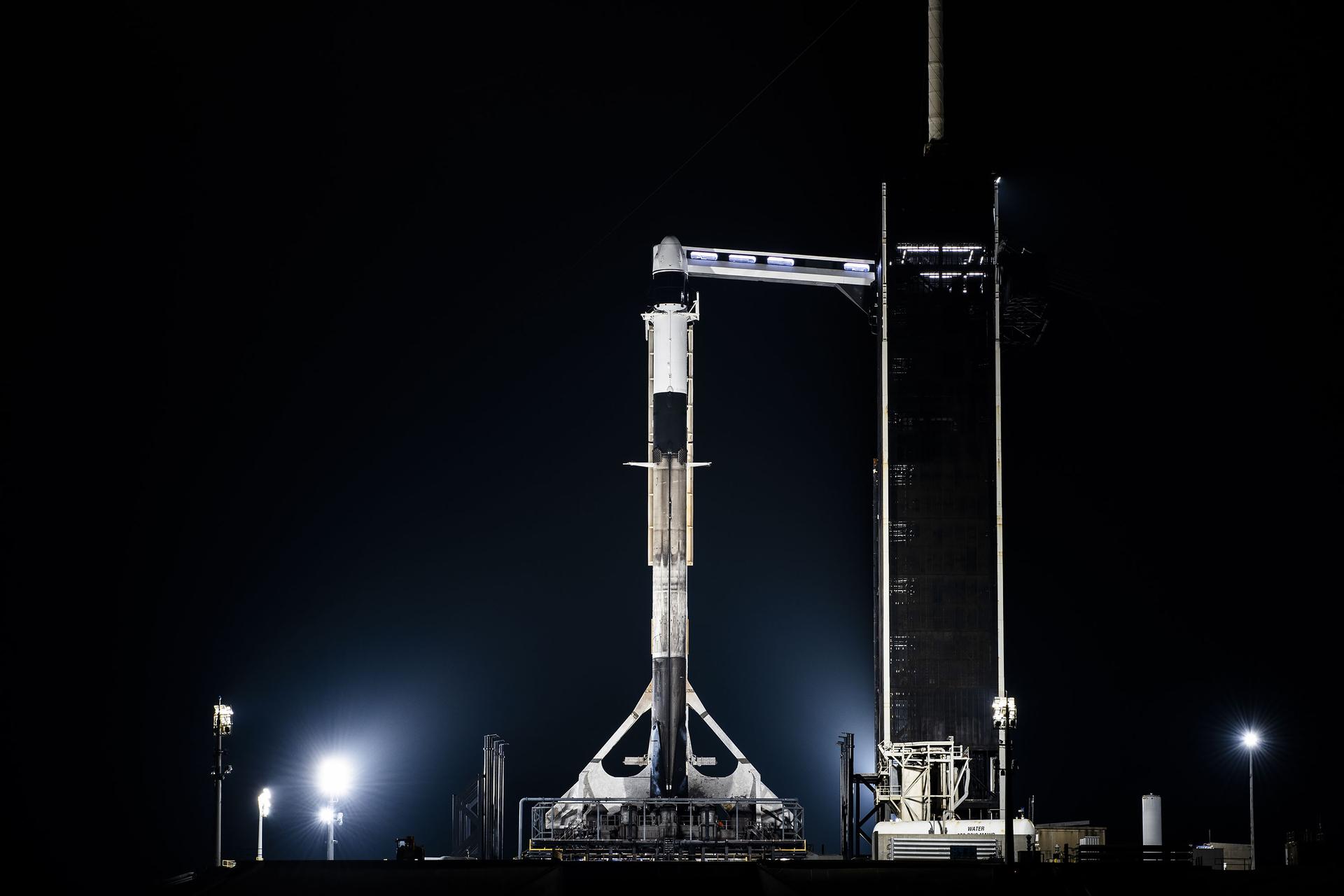
The SpaceX Falcon 9 rocket, with the company’s Dragon cargo spacecraft atop, pictured at Launch Complex 39A at NASA’s Kennedy Space Center in Florida on March 13, 2023.
SpaceX

Media accreditation is open at NASA’s Kennedy Space Center in Florida for SpaceX’s 30th Commercial Resupply Services (CRS-30) mission to the International Space Station for the agency.

Liftoff of the SpaceX Dragon cargo spacecraft on the company’s Falcon 9 rocket is targeted no earlier than mid-March from Launch Complex 39A at NASA’s Kennedy Space Center in Florida.

Media prelaunch and launch activities will take place at NASA Kennedy. Attendance for this launch is open to U.S. citizens. The application deadline for U.S. media is 11:59 p.m. EST Tuesday, Feb. 27.

All accreditation requests should be submitted online at:

https://media.ksc.nasa.gov

Credentialed media will receive a confirmation email upon approval. NASA’s media accreditation policy is online. For questions about accreditation, or to request special logistical needs, please email ksc-media-accreditat@mail.nasa.gov. For other questions, please contact Kennedy’s newsroom at: 321-867-2468.

Para obtener información sobre cobertura en español en el Centro Espacial Kennedy o si desea solicitor entrevistas en español, comuníquese con Antonia Jaramillo o Messod Bendayan a: antonia.jaramillobotero@nasa.gov o messod.c.bendayan@nasa.gov.

SpaceX’s Dragon will deliver new science investigations, food, supplies, and equipment to the international crew. NASA and partner research flying aboard the CRS-30 mission includes a look at plant metabolism in space, a set of new sensors for free-flying Astrobee robots to provide 3D mapping capabilities, and a fluid physics study that could benefit solar cell technology. Other studies launching include JAXA’s (Japan Aerospace Exploration Agency) FLARE, which continues flame behavior studies in space, and a university project from CSA (Canadian Space Agency) that will monitor sea ice and ocean conditions.

Commercial resupply by U.S. companies significantly increases NASA’s ability to conduct more investigations aboard the orbiting laboratory. These investigations lead to new technologies, medical treatments, and products that improve life on Earth. Other U.S. government agencies, private industry, and academic and research institutions can also conduct microgravity research through the agency’s partnership with the International Space Station National Laboratory.

Humans have occupied the space station continuously since November 2000. In that time, 276 people and a variety of international and commercial spacecraft have visited the orbital outpost. It remains the springboard to NASA’s next great leap in exploration, including future missions to the Moon under Artemis, and ultimately, human exploration of Mars.

For more information about commercial resupply missions, visit:

https://www.nasa.gov/commercialresupply

-end-

Josh Finch / Claire O’Shea
Headquarters, Washington
202-358-1100
joshua.a.finch@nasa.gov / claire.a.o’shea@nasa.gov

Stephanie Plucinsky / Steven Siceloff
Kennedy Space Center, Florida
321-876-2468
stephanie.n.plucinsky@nasa.gov / steven.p.siceloff@nasa.gov

Sandra Jones
Johnson Space Center, Houston
281-483-5111
sandra.p.jones@nasa.gov

Powered by WPeMatico

Get The Details…
Abbey A. Donaldson

Sujung Go: Helping Humanity and the Environment

Sujung Go: Helping Humanity and the Environment

Research scientist Sujung Go analyzes atmospheric data to help humanity and the environment.

Name: Sujung Go

Title: Research scientist

Organization: Climate and Radiation Laboratory, Earth Sciences Division, Science Directorate (Code 613)

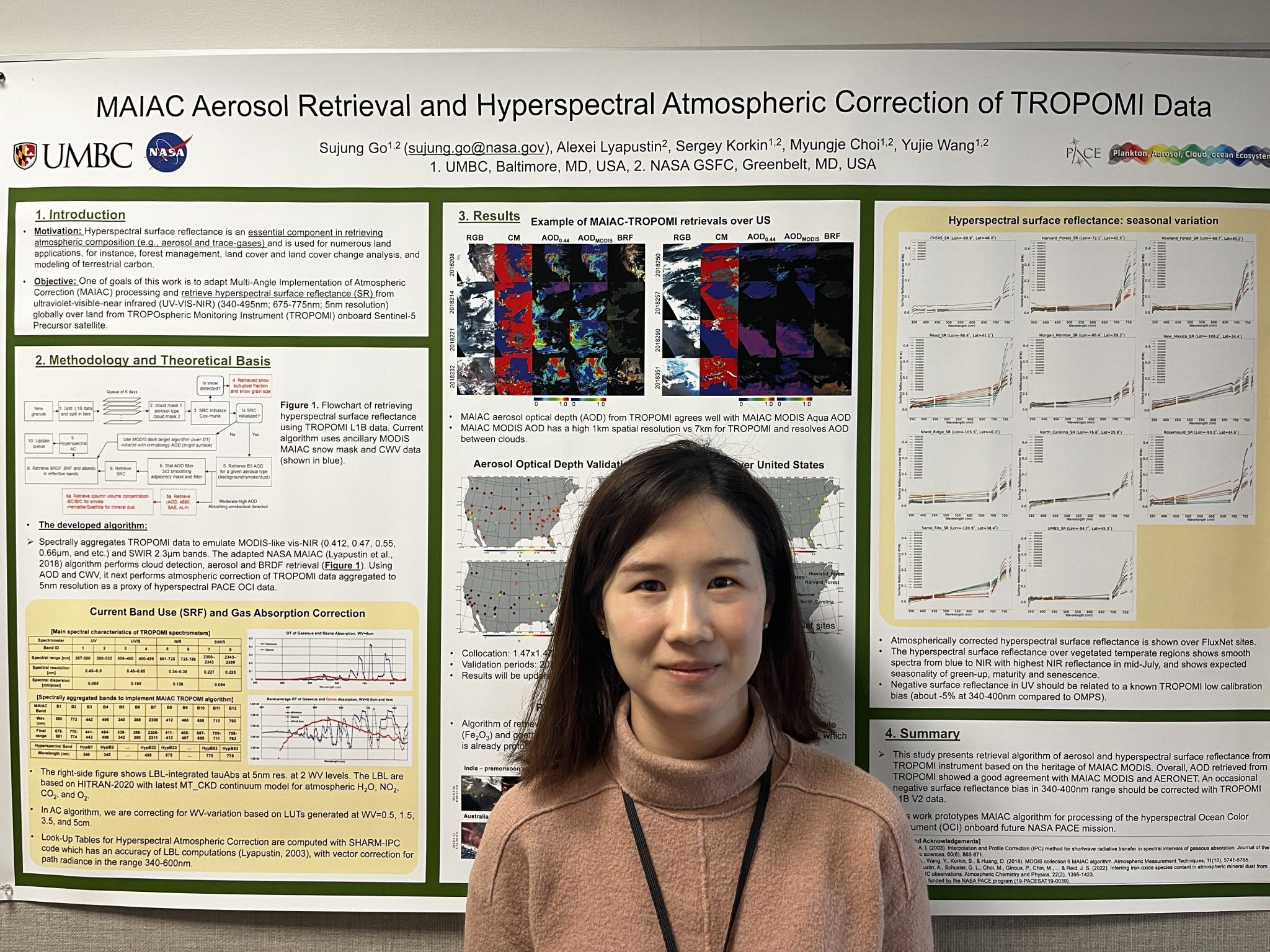
Sujung Go stands smiling in front of a research poster titled "MAIAC Aerosol Retrieval and Hyperspectral Atmospheric Correction of TROPOMI Data
Sujung Go is a research scientist at NASA’s Goddard Space Flight Center in Greenbelt, Maryland.
Courtesy of Sujung Go

What do you do and what is most interesting about your role here at Goddard?

I work in the team of Dr. Alexei Lyapustin and support data analysis and processing algorithms for different missions including DSCOVR EPIC, TROPOMI and PACE. I focus on aerosol retrievals and further analysis of absorbing aerosol composition in mineral dust. I also work on hyperspectral atmospheric correction of TROPOMI and PACE OCI data. These subjects are quite novel for the remote sensing community at large – that’s what makes it so interesting.

What is your educational background?

I got a bachelor’s, master’s, and, in 2020, a Ph.D. in atmospheric science from Yonsei University in South Korea.

Sujung Go stands in front of a courtyard and building at Yonsei University in South Korea wearing a graduation cap and gown, holding flowers and a stuffed bear
Sujung Go recieved her Ph.D. in atmospheric science from Yonsei University in South Korea in 2020.
Courtesy of Sujung Go

What brought you to Goddard?

When I was getting my Ph.D., I was working on the Geostationary Environment Monitoring Spectrometer (GEMS) satellite for the Ministry of Environment of South Korea. During my final year, my professor, who was the principal investigator of the GEMS project, invited my current supervisor at Goddard, Alexei Lyapustin, to visit our laboratory to foster collaborations on satellite aerosol retrievals. Several months later, Alexei offered me a research scientist position in his group. I came to Goddard in March 2020.  

Did you continue working on GEMS after you arrived at Goddard?

GEMS is a South Korean instrument which is identical to NASA’s Tropospheric Emissions: Monitoring of Pollution (TEMPO) mission. GEMS was launched in February 2020. Since I had worked on GEMS while getting my Ph.D., the GEMS project asked me to help with the initial in-orbit test period for about a month. TEMPO was launched in 2023, and I hope to also be involved with their data analysis both on aerosol and surface reflectance retrievals.

What was most fascinating about your first project at Goddard, determining the mineral composition of atmospheric dust?

Hematite (Fe2O3) and goethite (FeOOH) are the two major absorbers of visible solar radiation in atmospheric dust. Variations in their concentration control dust radiative (climate) effect defining how much  of sunlight dust scatters back to space versus how much it absorbs. Most climate models assume the same distribution of iron oxides in airborne dust globally, and thus knowledge of the real distributions, which we can get from satellites, would be very valuable.

Alexei developed the algorithm to retrieve aerosol loading, spectral absorption and even average height of aerosols from the DSCOVR EPIC instrument, which observes the entire illuminated part of the Earth multiple times a day from its orbit at Lagrange point 1, a spot between Earth and the Sun about 900,000 miles away from our planet. He suggested that I look into how we can use this information to derive hematite and goethite concentrations based on ideas from the earlier works of Dr. Greg Schuster from NASA’s Langley Research Center in Virginia. Greg pioneered such aerosol composition analysis based on AERONET data. It was a pleasure to work with Greg who helped me to fully understand the problem.

It took a while, and I was so happy when in the end it worked. It was fascinating! So exciting!

What is special about your work on hyperspectral atmospheric correction for the PACE mission?

Technically, it’s a very challenging problem and it was never done before in operational settings. We are dealing with very large volume of data, and need to have an accurate radiative transfer across the full UV-visible-shortwave IR spectral range and a very efficient algorithm. From well-calibrated PACE OCI (Ocean Color Imager), we expect to produce high quality land surface reflectance spectra while the PACE ocean team will deliver spectra of the ocean water-leaving reflectance.  These data will provide a wealth of information for the ocean biology community, like composition and life cycles of ocean microorganisms, and for the land vegetation community to help better characterize the state and function of vegetation and improve the knowledge of the global carbon cycle as a result.

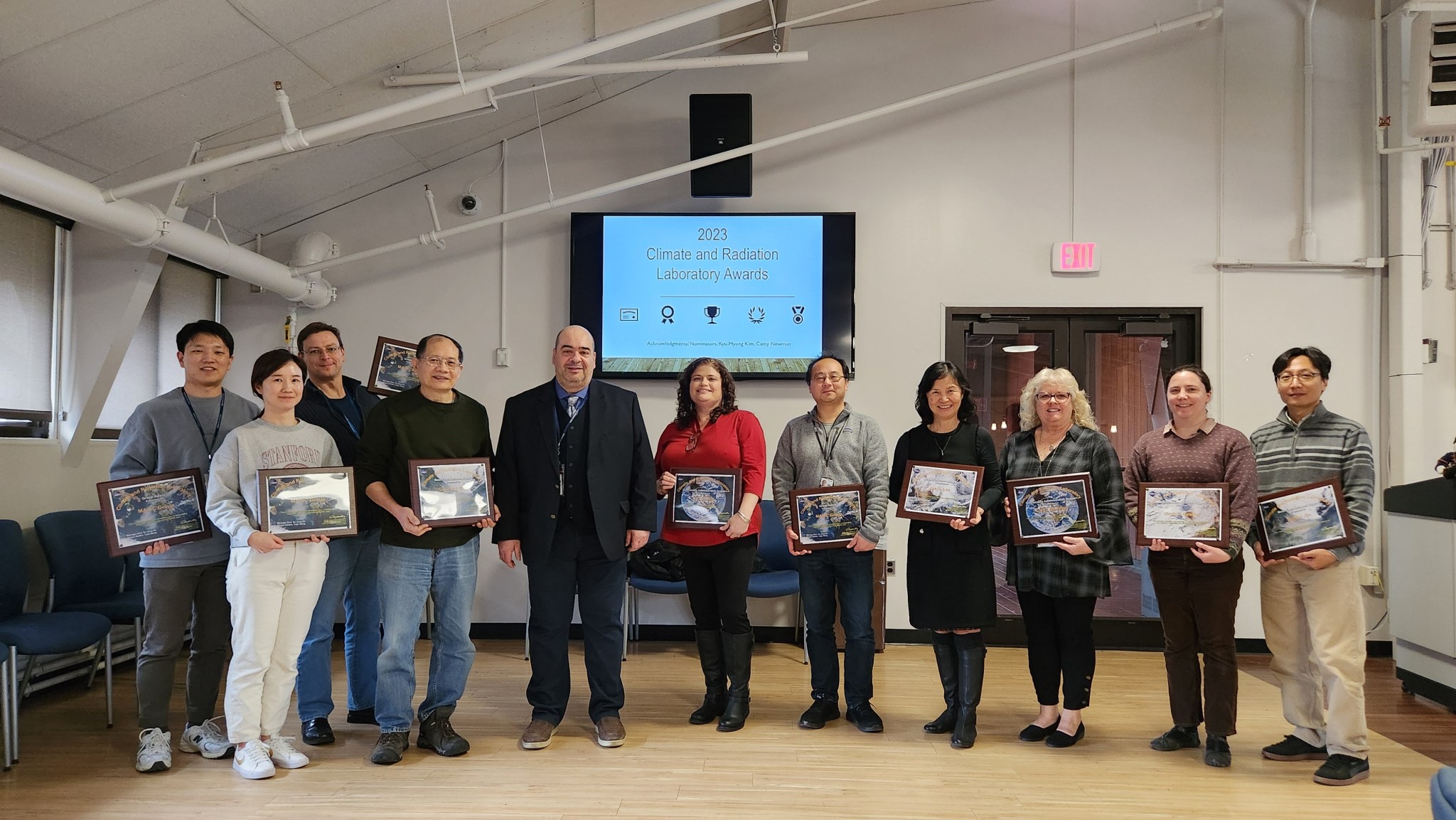
A group of people holding awards stand side by side in front of a screen that says "2023 Climate and Radiation Laboratory Awards"
Sujung Go (second from left) is driven by her passion for her work. “I want to be a scientist who can provide or suggest what we really need to help human beings and the environment,” she says.
Courtesy of Sujung Go

What makes your research interdisciplinary?

What we measure from space is a contribution from both atmosphere and the surface. We need to know surface properties to get information about aerosols, and we need aerosol information to retrieve spectral surface reflectance. The problems are inter-related and rooted in how we separate atmospheric and surface signals in satellite measurements. To do both aerosol and surface retrievals accurately, and especially working with applications like composition of absorbers in aerosols, or assessing vegetation greenness and other properties, I need to be truly interdisciplinary.  

What has your mentor, Alexei Lyapustin, taught you?

I am always motivated by his scientific insights. I am really happy that I can learn such high-level science from him and help contribute to scientific findings that help humanity.

I started working at Goddard only two weeks before the lockdown, so I hardly knew any of my colleagues. During that time, Alexei kept our team together, helped us form connections with each other, and made sure that everyone was safe. All of my family is in South Korea, and Alexei made me feel like part of his lab’s family.

I sincerely thank Alexei for all he has done for me and for our lab.

Who inspires you?

I have had several different mentors in my life. First of all, my mother was always dedicated to my education. Second, when I was in middle school, one of my teachers, who taught me science for three years, made it possible for me to attend a science high school in South Korea, which changed my perspective toward life totally. She felt that I had a talent for science, and I was very interested in science. Lastly, my Ph.D. advisor inspired me to have job responsibility as a scientist as well as getting my Ph.D. I am grateful for everyone’s help.

What do you do for fun?

I enjoy hiking. I am also trying to improve my cooking skills by watching online cooking channels. I am working on American and Korean recipes. I make something new every weekend. Some of my friends who are good cooks are coaching me. We get together over holidays to enjoy delicious food together.

What is your “six-word memoir”? A six-word memoir describes something in just six words.

Optimistic. Life-long learner. Thoughtful. Visionary. Prudent. Persistent.

Do you have a favorite saying?

Life is about doing whatever you want to do. Alexei often says learn something! Our team is always optimistic and enthusiastic.

What is your goal as a scientist?

I want to be a scientist who can provide or suggest what we really need to help human beings and the environment. Working at Goddard is a great opportunity to become a scientist who can provide essential research to help humanity. Goddard has an unparalleled expertise in satellite data processing, in particular in atmospheric and biospheric sciences, and this helps and motivates me.

By Elizabeth M. Jarrell
NASA’s Goddard Space Flight Center, Greenbelt, Md.

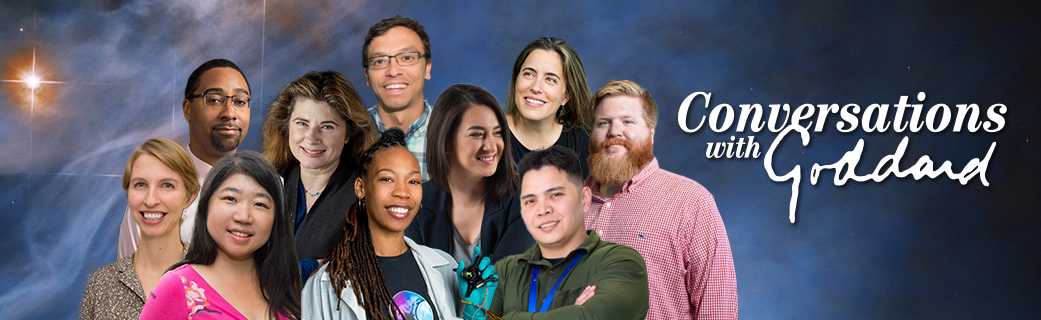
A banner graphic with a group of people smiling and the text "Conversations with Goddard" on the right. The people represent many genders, ethnicities, and ages, and all pose in front of a soft blue background image of space and stars.

Conversations With Goddard is a collection of Q&A profiles highlighting the breadth and depth of NASA’s Goddard Space Flight Center’s talented and diverse workforce. The Conversations have been published twice a month on average since May 2011. Read past editions on Goddard’s “Our People” webpage.

Share

Details

Last Updated

Feb 13, 2024

Editor
Madison Olson
Contact
Rob Garner
Location
Goddard Space Flight Center

Powered by WPeMatico

Get The Details…
Madison Olson

Career Journey: Building Strength as an Astronaut Fitness Trainer

Career Journey: Building Strength as an Astronaut Fitness Trainer

NASA astronauts must prepare their bodies for the physical stresses of living and working in microgravity before they launch on a spaceflight. Fortunately, they get customized training programs and plenty of help from astronaut fitness trainer Corey Twine, who shares decades of strength and conditioning expertise with astronauts every day at NASA’s Johnson Space Center in Houston.

Twine’s official title is “astronaut strength, conditioning, and rehabilitation specialist.” He works with a team dedicated to ensuring NASA’s space explorers are in top shape before launch day and know how to stay physically healthy throughout their mission, whether they’re flying to the International Space Station or journeying around the Moon.

We sat down with Twine to find out how he launched his career – and what it’s like to get a phone call from an astronaut in space.

Corey Twine as a young child in a football uniform.

An Aspiring Athlete

“When I was a kid, I never pictured myself working at NASA,” Twine said. “I pictured myself working in the NFL or professional baseball or all of those other dreams that many kids have.”

Twine was an athlete in high school and planned to play at the collegiate level. But things changed after he began classes at Norfolk State University in Virginia.

“One of my professors was the first strength and conditioning specialist I ever knew,” Twine said. “I learned there are people who just train other people to improve their performance. And from that moment on, I knew exactly what I wanted to do.”

Energized by his passion for strength and conditioning, Twine earned a bachelor’s degree in kinesiology and exercise science at Norfolk State and a master’s of kinesiology from Michigan State. He worked with several collegiate and professional teams while taking his career to new heights.

Corey Twine blowing a whistle. He is an Astronaut Fitness Trainer

From Weight Benches to Weightlessness

Twine was a graduate assistant coach for the Michigan State football team when he first learned NASA was looking for a strength and conditioning coach. Until that moment, he’d been entirely focused on sports, but he was excited by the new opportunity, and applied. He went to work with NASA in 2002 and trained space shuttle astronauts for their missions. Then, his path shifted again.

He spent the next 15 years as a conditioning coach in college football, first with West Virginia University and then the University of Michigan. From there, he went to work with the U.S. Army.

“It was an amazing opportunity to work with the soldiers who were doing so much to protect and serve,” Twine said.

Twine returned to Johnson Space Center in 2018. Today, he prepares astronauts for flights to the space station and for the Artemis missions to come, which will carry crews – including the first woman and first person of color – to the Moon.

Astronauts know Twine is always willing to provide guidance. He took that assistance to a new level one day when he received a mysterious call from “U.S. Government” on his cell phone. To his surprise, it turned out to be an astronaut about 250 miles above Earth aboard the space station.

“They had a question about their training,” said Twine, who chatted with the astronaut. Together, they worked out a solution in real time. “It was a great asset because we were able to adjust and do some things to help their training instead of just going through email.”

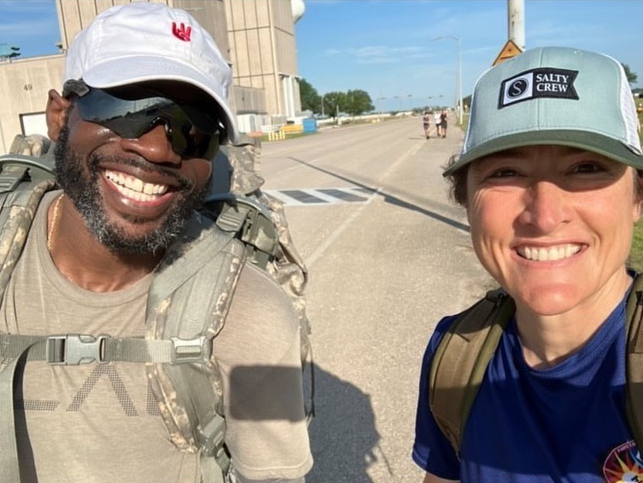
Corey Twine wearing a backpack standing next to  astronaut CHristin Koch

Advice to Students: Success Takes Effort – But You Can Do It

Twine recalls struggling academically during middle and high school and feeling intimidated about college. Fortunately, a friend who was a few years ahead of him shared some simple but meaningful advice: “No test is hard if you study for it.” If you put in the effort until you know the material, you’ll succeed.

“I remember to this day, the first test in my freshman year in college, I studied for a test for the first time,” Twine said. “I read every single thing in the chapter. I read everything in the back of the book. I read all of the information the professor gave.”

His hard work paid off with that test and he vowed to keep up that level of effort.

“I continued that behavior all through undergrad and also through grad school, and it worked every single time,” he said.

Twine cautions against believing you’re not smart enough and says you just need to put in the hard work.

Study, find resources, find help, continue, and don’t give up.

Corey Twine

Corey Twine

Astronaut Fitness Trainer

Learn more about Corey Twine and how he helps NASA astronauts stay in spaceflight-ready shape in this episode of Surprisingly STEM.

Powered by WPeMatico

Get The Details…
Sandra May

How NASA Uses Simple Technology to Track Lunar Missions

How NASA Uses Simple Technology to Track Lunar Missions

NASA is using a simple but effective technology called Laser Retroreflective Arrays (LRAs) to determine the locations of lunar landers more accurately. They will be attached to most of the landers from United States companies as part of NASA’s Commercial Lunar Payload Service (CLPS) initiative. LRAs are inexpensive, small, and lightweight, allowing future lunar orbiters or landers to locate them on the Moon.

NASA is using a simple but effective technology called Laser Retroreflective Arrays (LRAs) to determine the locations of lunar landers more accurately. They will be attached to landers sent to the Moon as part of NASA’s Commercial Lunar Payload Service (CLPS) initiative. LRAs are inexpensive, small, and lightweight.
Credit: NASA’s Goddard Space Flight Center/Scientific Visualization Studio James Tralie (ADNET Systems, Inc.). Lead Producer Xiaoli Sun (NASA/GSFC): Scientist
This video can be freely shared and downloaded at https://svs.gsfc.nasa.gov/14517.

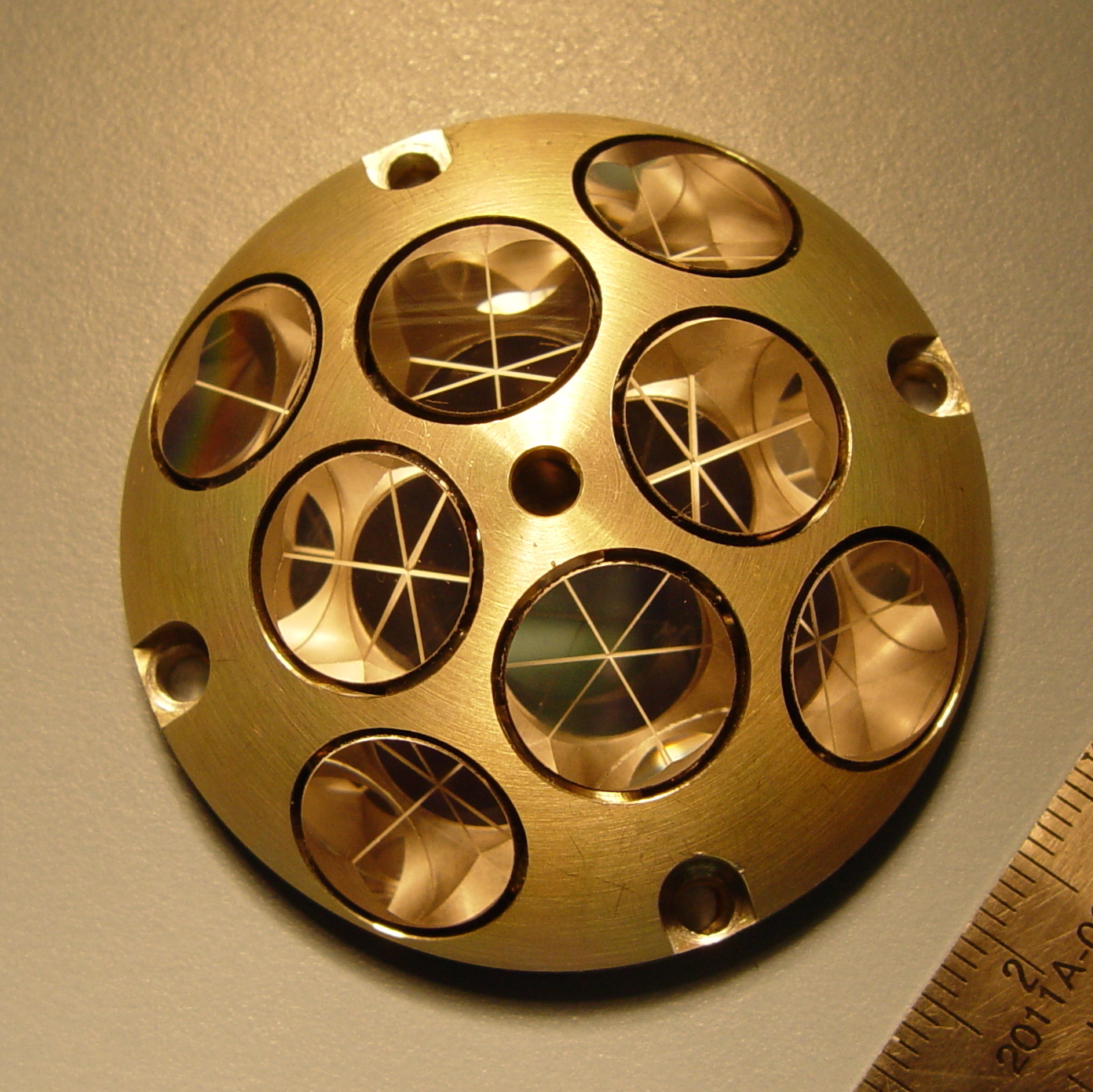
These devices consist of a small aluminum hemisphere, 2 inches (5 centimeters) in diameter and 0.7 ounces (20 grams) in weight, inset with eight 0.5-inch-diameter (1.27-centimeter) corner cube retroreflectors made of fused silica glass. LRAs are targeted for inclusion on most of the upcoming CLPS deliveries headed to the lunar surface.

Photo of a Laser Retroreflector Array (LRA).
This photograph shows a mockup laser retroreflector array (LRA) at NASA’s Goddard Space Flight Center, Greenbelt, Maryland, demonstrating the basic design: a metallic semi-hemispheric disc, with eight silica glass cubes embedded in its surface.
NASA/Goddard

LRAs are designed to reflect laser light shone on them from a large range of angles. Dr. Daniel Cremons of NASA’s Goddard Space Flight Center in Greenbelt, Maryland, deputy principal investigator for the LRA project, describes this as being similar to the reflective strips featured on road signs to aid in nighttime driving here on Earth. “Unlike a mirror where it has to be pointed exactly back at you, you can come in at a wide variety of angles and the light will head directly back to the source,” he said.

By shining a laser beam from one spacecraft toward the retroreflectors on another and measuring how long it takes for the light to get back to its source, scientists can determine the distance between them.

“We have been putting these on satellites and ranging to them from ground-based lasers for years,” said Dr. Xiaoli Sun, also of NASA Goddard and principal investigator for the LRA project. “Then, twenty years ago, someone got the idea to put them on the landers. Then you can range to those landers from orbit and know where they are on the surface.”

Image of the laser-ranging facility at NASA Goddard Space Flight Center.
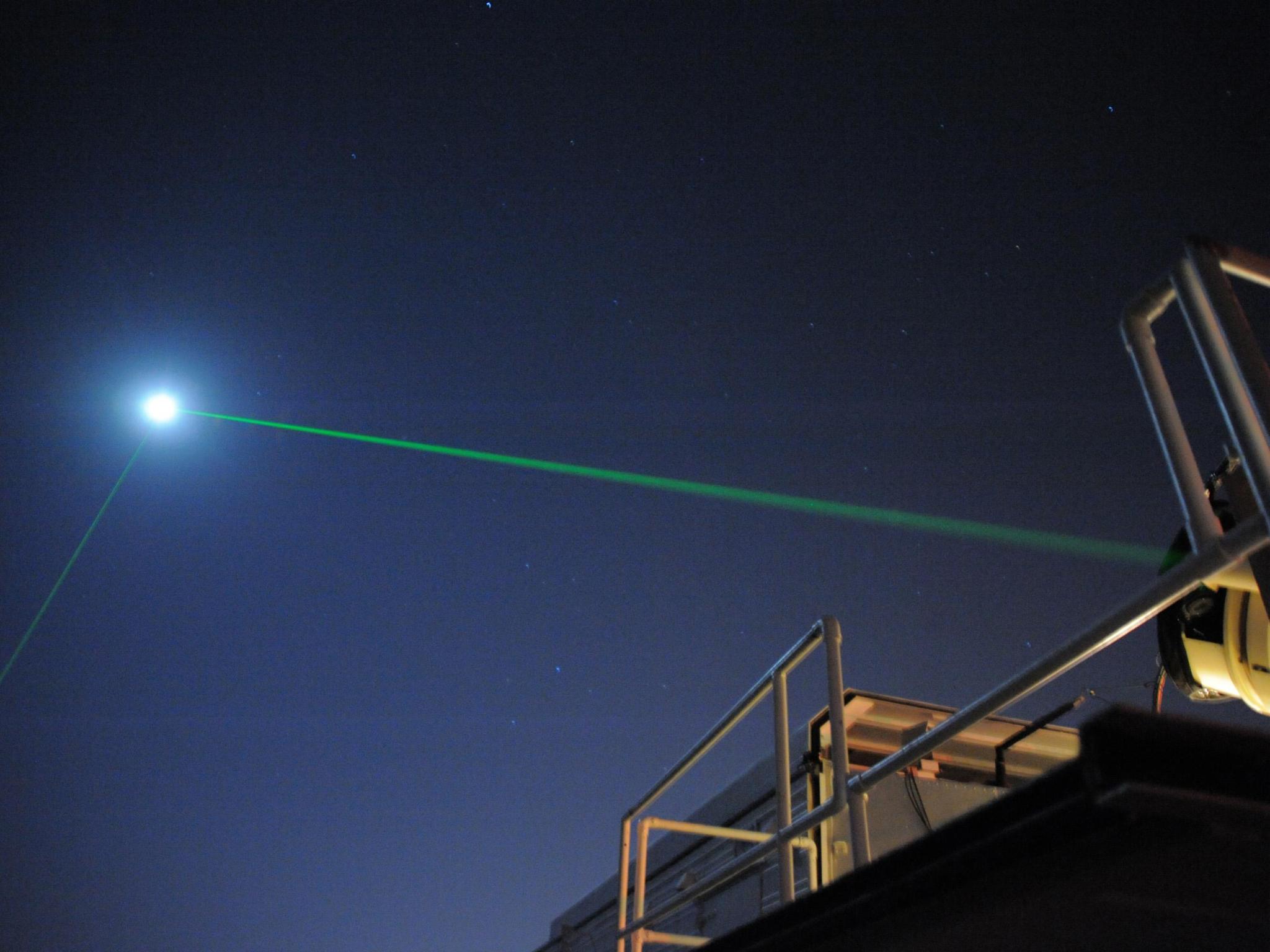
This photograph shows the Laser Ranging Facility at the Geophysical and Astronomical Observatory at NASA’s Goddard Spaceflight Center, Greenbelt, Maryland, shining ranging lasers at NASA’s Lunar Reconnaissance Orbiter spacecraft.
NASA

It is important to know the location of landers on the surface of another planetary body and these LRAs act as markers that work with orbiting satellites to establish a navigation aid like the global positioning system (GPS) we take for granted here on Earth.

Laser ranging is also used for docking spacecraft, like the cargo spacecraft that are used for the International Space Station, pointed out Cremons. The LRAs light up when you shine light on them which helps to guide precision docking. They can also be detected by lidars on spacecraft from far away to determine their range and approach speed down to very tight accuracy ratings, and free from the need for illumination from the Sun, which allows docking to happen at nighttime. He adds that the reflectors could allow spacecraft to accurately range-find their way to a landing pad, even without the aid of external light to guide the approach. This means that LRAs can eventually be used to help spacecraft land in otherwise pitch-dark places close to permanently shadowed regions near the lunar South Pole, which are prime target areas for crewed missions because of the resources that might exist there, such as water ice.

Since LRAs are small and made of simple materials, they can fly on scientific missions as a beneficial but low-risk add-on. “By itself, it’s completely passive,” said Cremons. “LRAs will survive the harsh lunar environment and continue to be usable on the surface for decades. Additionally, besides navigating and finding out where your landers are, you can also use laser ranging to tell where your orbiter is around the Moon.”

This means that, as more landers, rovers, and orbiters are sent to the Moon bearing one or more LRAs, our ability to accurately gauge the location of each will only improve. As such, as we deploy more LRAs to the lunar surface, this growing network will allow scientists to gauge the location of key landers and other points of interest more and more accurately, allowing for bigger, better science to be accomplished.

NASA’s Lunar Reconnaissance Orbiter (LRO) is currently the only NASA spacecraft orbiting the Moon with laser-ranging capability. LRO has already succeeded in ranging to the LRA on the Indian Space Research Organization’s Vikram lander on the lunar surface and will continue to range to LRAs on future landers.

Under Artemis, CLPS deliveries will perform science experiments, test technologies, and demonstrate capabilities to help NASA explore the Moon and prepare for human missions. With Artemis missions, NASA will land the first woman and first person of color on the Moon, using innovative technologies to explore more of the lunar surface than ever before. The agency will collaborate with commercial and international partners and establish the first long-term presence on the Moon. Then, NASA will use what we learn on and around the Moon to take the next giant leap: sending the first astronauts to Mars.

By Nick Oakes

NASA Goddard Space Flight Center

Share

Details

Last Updated

Feb 13, 2024

Editor
William Steigerwald
Contact
Nancy N. Jones
Location
Goddard Space Flight Center

Powered by WPeMatico

Get The Details…
William Steigerwald