A Look at Key Milestones for NASA’s SpaceX Crew-8 Mission

A Look at Key Milestones for NASA’s SpaceX Crew-8 Mission

A SpaceX Falcon 9 rocket with the company’s Dragon spacecraft on top is seen on the launch pad at Launch Complex 39A at Kennedy Space Center.
A SpaceX Falcon 9 rocket with the company’s Dragon spacecraft on top is seen on the launch pad ahead of launch from Launch Complex 39A at Kennedy Space Center. Photo credit: NASA Television

Below are some of the key milestones leading up to the launch of NASA’s SpaceX Crew-8 mission, as well as some critical events that occur after liftoff. The SpaceX Falcon 9 rocket and Dragon spacecraft are scheduled to lift off a little more than four hours from now at 11:16 p.m. EST from Kennedy Space Center’s historic Launch Complex 39A in Florida.

Time             Event (All times approximate)
6:56 p.m.    Crew weather brief
7:11 p.m.      Crew handoff to SpaceX
7:16 p.m.     Suit donning and checkouts
7:56 p.m.    Crew walkout from Neil A. Armstrong Operations & Checkout Building
8:01 p.m.    Crew transportation to Launch Complex 39A
8:21 p.m.    Crew arrives at pad and ascends tower
8:41 p.m.    Crew ingress
8:46 p.m.    Communication check
8:47 p.m.    Seat rotation
8:48 p.m.    Suit leak checks
9:21 p.m.      Hatch close
10:31 p.m.    SpaceX Launch Director verifies go for propellant load
10:34 p.m.    Crew access arm retracts
10:37 p.m.    Dragon’s launch escape system is armed
10:41 p.m.    RP-1 (rocket grade kerosene) loading begins
10:41 p.m.    1st stage LOX (liquid oxygen) loading begins
11:00 p.m.    2nd stage LOX loading begins
11:09 p.m.    Falcon 9 begins engine chill prior to launch
11:11 p.m.    Dragon transitions to internal power
11:15 p.m.    Command flight computer to begin final prelaunch checks
11:15 p.m.    Propellant tank pressurization to flight pressure begins
11:15 p.m.    SpaceX Launch Director verifies go for launch
11:16 p.m.    Falcon 9 liftoff
11:17 p.m.    Max Q (moment of peak mechanical stress on the rocket)
11:18 p.m.    1st stage main engine cutoff (MECO)
11:18 p.m.    1st and 2nd stages separate
11:18 p.m.    2nd stage engine starts
11:19 p.m.    Boostback Burn Starts
11:22 p.m.    Boostback Burn Ends
11:22 p.m.    1st stage entry burn starts
11:23 p.m.    1st stage entry burn ends
11:23 p.m.    1st stage landing burn starts
11:23 p.m.    1st stage landing
11:25 p.m.    2nd stage engine cutoff (SECO-1)
11:28 p.m.    Dragon separates from 2nd stage
11:29 p.m.    Dragon nosecone open sequence begins

NASA’s live coverage of the Crew-8 launch is airing now on NASA+, NASA Television, the NASA app, YouTube, and the agency’s website, and you can follow along on the mission blog, the commercial crew blog, X, and Facebook for continuous coverage of important Crew-8 launch activities.

Powered by WPeMatico

Get The Details…

Jason Costa

NASA’s SpaceX Crew-8 Mission Coverage is Underway!

NASA’s SpaceX Crew-8 Mission Coverage is Underway!

A SpaceX Falcon 9 rocket with the company's Dragon spacecraft on top is seen at sunset on the launch pad at Launch Complex 39A on Wednesday, Feb. 28, 2024, as preparations continue for NASA’s SpaceX Crew-8 mission at NASA’s Kennedy Space Center in Florida. The eighth crew rotation mission with SpaceX and the ninth flight of Dragon with people as part of the agency’s Commercial Crew Program is slated to carry NASA astronauts Matthew Dominick, Michael Barratt, and Jeanette Epps, and Roscosmos cosmonaut Alexander Grebenkin to the International Space Station from Launch Complex 39A at 11:16 p.m. EST on Saturday, March 2.
A SpaceX Falcon 9 rocket with the company’s Dragon spacecraft on top is seen on the launch pad at Launch Complex 39A at Kennedy Space Center on Wednesday, Feb. 28, 2024. Photo credit: SpaceX

Good evening and welcome to live coverage of NASA’s SpaceX Crew-8 mission – the eighth crew rotation flight and the ninth human spaceflight mission on SpaceX’s Dragon spacecraft to the International Space Station for NASA’s Commercial Crew Program.

Launch weather officers from the U.S. Space’s Force 45th Weather Squadron predict a 40% chance of favorable weather conditions at the launch pad for liftoff. The primary weather concerns for the launch area are flight through precipitation and the thick cloud cover.

Launch is scheduled for 11:16 p.m. EST on Saturday, March 2, from Launch Complex 39A at the agency’s Kennedy Space Center in Florida.

Here at Kennedy, a SpaceX Falcon 9 rocket, topped by the company’s Dragon spacecraft, named Endeavour, awaits liftoff just after midnight. NASA astronauts Matthew Dominick, commander; Michael Barratt, pilot; Jeanette Epps, mission specialist; along with Roscosmos cosmonaut Alexander Grebenkin, mission specialist, will fly to the space station aboard Dragon, which previously flew NASA’s SpaceX Demo Mission-2, Crew-2 and Crew-6, in addition to Axiom Mission 1, the first commercial astronaut mission to the microgravity laboratory.

The countdown is proceeding according to schedule. At Kennedy’s Neil A. Armstrong Operations and Checkout Building, the astronauts have eaten and will undergo medical checks and get a final weather briefing before suiting up.

Starting at 7:15 p.m. EST, on NASA+, NASA Television, the NASA app, YouTube, and the agency’s website there will be continuous live coverage of important Crew-8 activities.

Stay with us as the countdown continues. We’ll keep you updated on the key milestones throughout this mission. Details about the mission and NASA’s Commercial Crew Program can be found by following the Crew-8 blog, the commercial crew blog, X, and Facebook.

Powered by WPeMatico

Get The Details…

Jason Costa

ARMD Solicitations

ARMD Solicitations

6 min read

Preparations for Next Moonwalk Simulations Underway (and Underwater)

Several future aircraft concepts flying over a mid-sized city with a handful of skyscrapers.
Illustration showing multiple future air transportation options NASA researchers are studying or working to enable.
NASA

This ARMD solicitations page compiles the opportunities to collaborate with NASA’s aeronautical innovators and/or contribute to their research to enable new and improved air transportation systems. A summary of available opportunities with key dates requiring action are listed first. More information about each opportunity is detailed lower on this page.

University Student Research Challenge
Key date: March 21, 2024, at 5 p.m. ET (This is a change from Feb. 22.)

AAVP Fellowship
Key date: April 30, 2024

University Leadership Initiative
Key date: May 29, 2024

Advanced Air Mobility
Key date: Feb. 1, 2025, at 6 p.m. EST

Advanced Capabilities for Emergency Response Operations

GENERAL ANNOUNCEMENT OF REQUEST FOR INFORMATION

Advanced Capabilities for Emergency Response Operations is using this request for information to identify technologies that address current challenges facing the wildland firefighting community. NASA is seeking information on data collection, airborne connectivity and communications solutions, unmanned aircraft systems traffic management, aircraft operations and autonomy, and more. This will support development of a partnership strategy for future collaborative demonstrations.

Interested parties were requested to respond to this notice with an information package no later than 4 pm ET, October 15, 2023, that shall be submitted via https://nari.arc.nasa.gov/acero-rfi. Any proprietary information must be clearly marked. Submissions will be accepted only from United States companies.

View the full RFI Announcement here.

Advanced Air Mobility Mission

GENERAL ADVANCED AIR MOBILITY
ANNOUNCEMENT OF REQUEST FOR INFORMATION

This request for information (RFI) is being used to gather market research for NASA to make informed decisions regarding potential partnership strategies and future research to enable Advanced Air Mobility (AAM). NASA is seeking information from public, private, and academic organizations to determine technical needs and community interests that may lead to future solicitations regarding AAM research and development.

This particular RFI is just one avenue of multiple planned opportunities for formal feedback on or participation in NASA’s AAM Mission-related efforts to develop these requirements and help enable AAM. 

The current respond by date for this RFI is Feb. 1, 2025, at 6 p.m. EST.

View the full RFI announcement here.

NASA Research Opportunities in Aeronautics

NASA’s Aeronautics Research Mission Directorate (ARMD) uses the NASA Research Announcement (NRA) process to solicit proposals for foundational research in areas where ARMD seeks to enhance its core capabilities.

Competition for NRA awards is open to both academia and industry.

The current open solicitation for ARMD Research Opportunities is ROA-2023 and ROA-2024.

Here is some general information to know about the NRA process.

  • NRA solicitations are released by NASA Headquarters through the Web-based NASA Solicitation and Proposal Integrated Review and Evaluation System (NSPIRES).
  • All NRA technical work is defined and managed by project teams within these four programs: Advanced Air Vehicles Program, Airspace Operations and Safety Program, Integrated Aviation Systems Program, and Transformative Aeronautics Concepts Program.
  • NRA awards originate from NASA’s Langley Research Center in Virginia, Ames Research Center in California, Glenn Research Center in Cleveland, and Armstrong Flight Research Center in California.
  • Competition for NRA awards is full and open.
  • Participation is open to all categories of organizations, including educational institutions, industry, and nonprofits.
  • Any updates or amendments to an NRA is posted on the appropriate NSPIRES web pages as noted in the Amendments detailed below.
  • ARMD sends notifications of NRA updates through the NSPIRES email system. In order to receive these email notifications, you must be a Registered User of NSPIRES. However, note that NASA is not responsible for inadvertently failing to provide notification of a future NRA. Parties are responsible for regularly checking the NSPIRES website for updated NRAs.

ROA-2024 NRA Amendments

Amendment 1
NEW FEB. 29, 2021

(Full text here.)

Amendment 1 to the NASA ARMD Research Opportunities in Aeronautics (ROA) 2024 NRA has been posted on the NSPIRES web site at https://nspires.nasaprs.com.

The announcement solicits proposals from accredited U.S. institutions for research training grants to begin the academic year. This NOFO is designed to support independently conceived research projects by highly qualified graduate students, in disciplines needed to help advance NASA’s mission, thus affording these students the opportunity to directly contribute to advancements in STEM-related areas of study. AAVP Fellowship Opportunities are focused on innovation and the generation of measurable research results that contribute to NASA’s current and future science and technology goals.

Research proposals are sought to address key challenges provided in Elements of Appendix A.8.

Notices of Intent (NOIs) are not required.

A budget breakdown for each proposal is required, detailing the allocation of the award funds by year. The budget document may adhere to any format or template provided by the applicant’s institution.

Two pre-proposal teleconferences for potential proposers will be held and meeting links will be posted on NSPIRES.

Proposals are due by April 30, 2024, at 5 PM ET.

Amendment 2
NEW FEB. 29, 2024

(Full text here.)

University Leadership Initiative (ULI) provides the opportunity for university teams to exercise technical and organizational leadership in proposing unique technical challenges in aeronautics, defining multi-disciplinary solutions, establishing peer review mechanisms, and applying innovative teaming strategies to strengthen the research impact.

Research proposals are sought in six ULI topic areas in Appendix D.4.

Topic 1: Safe, Efficient Growth in Global Operations (Strategic Thrust 1)

Topic 2: Innovation in Commercial High-Speed Aircraft (Strategic Thrust 2)

Topic 3: Ultra-Efficient Subsonic Transports (Strategic Thrust 3)

Topic 4: Safe, Quiet, and Affordable Vertical Lift Air Vehicles (Strategic Thrust 4)

Topic 5: In-Time System-Wide Safety Assurance (Strategic Thrust 5)

Topic 6: Assured Autonomy for Aviation Transformation (Strategic Thrust 6)

This NRA will utilize a two-step proposal submission and evaluation process. The initial step is a short mandatory Step-A proposal due May 29, 2024. Those offerors submitting the most highly rated Step-A proposals will be invited to submit a Step-B proposal. All proposals must be submitted electronically through NSPIRES at https://nspires.nasaprs.com. An Applicant’s Workshop will be held on Thursday April 3, 2024; 1:00-3:00 p.m. ET (https://uli.arc.nasa.gov/applicants-workshops/workshop8)

ROA-2023 NRA Amendments

Amendment 5
UPDATED JAN. 30, 2024

(Full text here)

Amendment 5 to the NASA ARMD Research Opportunities in Aeronautics (ROA) 2023 NRA has been posted on the NSPIRES web site.

University Student Research Challenge (solicitation NNH23ZEA001N-USRC) seeks to challenge students to propose new ideas/concepts that are relevant to NASA Aeronautics. USRC will provide students, from accredited U.S. colleges or universities, with grants for their projects and with the challenge of raising cost share funds through a crowdfunding campaign. The process of creating and implementing a crowdfunding campaign acts as a teaching accelerator – requiring students to act like entrepreneurs and raise awareness about their research among the public.

The solicitation goal can be accomplished through project ideas such as advancing the design, developing technology or capabilities in support of aviation, by demonstrating a novel concept, or enabling advancement of aeronautics-related technologies.

Notices of Intent (NOIs) are not required for this solicitation. Three-page proposals for the next USRC cycle were due November 9, 2023.

Proposals also can be submitted later and evaluated during the third (due March 21, 2024 — this is a date change from Feb. 22) and fourth (due June 20, 2024) cycles.

Amendment 4 (Expired)
(Full text here)

Amendment 3 (Expired)
(Full text here)

Amendment 2 (Expired)
(Full text here)

Amendment 1 (Expired)
(Full text here)

Share

Details

Last Updated

Mar 02, 2024

Editor
Jim Banke
Contact
Jim Banke

Powered by WPeMatico

Get The Details…
Jim Banke

Orbital Plumbing, Foam Physics Wrap Week as Crew-8 Nears Launch

Orbital Plumbing, Foam Physics Wrap Week as Crew-8 Nears Launch

The SpaceX Dragon
The SpaceX Dragon “Endurance” spacecraft, circular star trails, and Earth’s atmospheric glow are pictured as the station orbited 263 miles above the north Atlantic Ocean.

More lab maintenance was on deck for the Expedition 70 crew as they worked on orbital plumbing and cleaned crew quarters throughout Friday. The seven orbital residents aboard the International Space Station also serviced a variety of science and electronics hardware while continuing to focus on the upcoming Commercial Crew swap.

NASA Flight Engineer Loral O’Hara spent most of her day inside the Tranquility module swapping out advanced hydraulic components inside the orbital outpost’s restroom, also known as the Waste and Hygiene Compartment. She was assisted by astronauts Andreas Mogensen, Jasmin Moghbeli, and Satoshi Furukawa helping uninstall then reinstall the station’s toilet returning it to operational status.

Moghbeli from NASA wrapped up her day cleaning her crew quarters inside the Harmony module. Earlier, Furukawa from JAXA (Japan Aerospace Exploration Agency) cleaned his crew quarters on the opposite side of Harmony from Moghbeli’s. The duo each spent about two-and-a-half hours cleaning the quarters’ vents, fans, air ducts, and sensors.

Mogensen of ESA (European Space Agency) began his shift in the Columbus laboratory module processing samples for a foam physics study potentially revealing phenomena not possible in Earth’s gravity. The experiment takes place inside Columbus’ Fluid Science Laboratory and explores the coarsening and coalescing of foams that may improve fire safety, water cleaning, and other space and Earthbound applications.

Mogensen, Moghbeli, and Furukawa, along with cosmonaut Konstantin Borisov, also continued packing personal items and station hardware throughout the day ahead of their upcoming departure aboard the SpaceX Dragon “Endurance” spacecraft. The quartet is planned to undock from the Harmony module’s space-facing port about a week after the SpaceX Crew-8 mission arrives aboard the SpaceX Dragon “Endeavour” spacecraft.

Crew-8 is targeting its liftoff for 11:16 p.m. EST on Saturday from NASA’s Kennedy Space Center. The Commercial Crew quartet, with Commander Matthew Dominick, Pilot Mike Barratt, and Mission Specialists Jeanette Epps and Alexander Grebenkin, is due to arrive at the station at 2:15 p.m. on Sunday for an automated docking to Harmony’s forward port. The foursome will become station flight engineers living and working in space for a six-month research mission.

In the station’s Roscosmos segment, Borisov and fellow cosmonaut Nikolai Chub tried on a unique suit being tested for its ability to draw fluids pooled in a crew member’s upper body toward the legs and feet. Space-caused fluid shifts toward the upper body are known to create eye and head pressure, as well as the more familiar space condition known as “puffy-face.” Balancing body fluids in space may also help a crew member’s heart rate and blood pressure adjust more quickly to the return to Earth’s gravity.

Chub later joined veteran cosmonaut Oleg Kononenko testing video cameras being downlinked to mission controllers on Earth. The duo also familiarized themselves with hardware that measures the aerodynamic forces the station experiences while orbiting Earth and when spaceships dock and undock.


Learn more about station activities by following the space station blog@space_station and @ISS_Research on X, as well as the ISS Facebook and ISS Instagram accounts.

Get weekly video highlights at: https://roundupreads.jsc.nasa.gov/videoupdate/

Get the latest from NASA delivered every week. Subscribe here: www.nasa.gov/subscribe

Powered by WPeMatico

Get The Details…

Mark Garcia

NASA Collects First Surface Science in Decades via Commercial Moon Mission

NASA Collects First Surface Science in Decades via Commercial Moon Mission

For the first time in more than 50 years, NASA was able to collect data from new science instruments and technology demonstrations on the Moon. The data comes from the first successful landing of a delivery through NASA’s CLPS (Commercial Lunar Payload Services) initiative and Artemis campaign.

The six instruments ceased science and technology operations eight days after landing in the lunar South Pole region aboard Intuitive Machines’ Odysseus, meeting pre-launch projected mission operations. Known as IM-1, this was the first U.S. soft landing on the Moon in decades, touching down on Feb. 22, proving commercial vendors can deliver instruments designed to expand the scientific and technical knowledge on the Moon.

Aboard the lunar lander, NASA science instruments measured the radio noise generated by the Earth and Sun. Technology instruments, aided Intuitive Machines in navigating to the Moon and gathered distance and speed (velocity) of the lander as touched down on the lunar surface.

“This mission includes many firsts. This is the first time in over 50 years that an American organization has landed instruments on the surface of the Moon,” said Joel Kearns, deputy association administrator for exploration of NASA’s Science Mission Directorate in Washington. “This mission also provides evidence of the Commercial Lunar Payload Services model, that NASA can purchase the service of sending instruments to the Moon and receiving their data back. Congratulations to the entire Intuitive Machines team and our NASA scientists and engineers for this next leap to advance exploration and our understanding of Earth’s nearest neighbor.”

During transit from Earth to the Moon, all powered NASA instruments received data and completed transit checkouts.

  • During descent, the Radio Frequency Mass Gauge and Navigation Doppler Lidar collected data during the lander’s powered descent and landing.
  • After landing, NASA payload data was acquired consistent with the communications and other constraints resulting from the lander orientation.
  • During surface operations, the Radio-wave Observations at the Lunar Surface of the Photoelectron Sheath and Lunar Node-1 were powered on, performed surface operations, and have received data.
  • The Stereo Cameras for Lunar Plume-Surface Studies was powered on and captured images during transit and several days after landing but was not successfully commanded to capture images of the lander rocket plume interaction with the lunar surface during landing.
  • The Laser Retroreflector Array is passive and initial estimates suggest it is accessible for laser ranging from the Lunar Reconnaissance Orbiter’s Lunar Orbiter Laser Altimeter to create a permanent location marker on the Moon.

“The bottom line is every NASA instrument has met some level of their objectives, and we are very excited about that,” said Sue Lederer, project scientist for CLPS. “We all worked together and it’s the people who really made a difference and made sure we overcame challenges to this incredible success – and that is where we are at today, with successes for all of our instruments.” 

NASA and Intuitive Machines co-hosted a news conference non Feb. 28 to provide a status update on the six NASA instruments that collected data on the IM-1 mission. Mission challenges and successes were discussed during the briefing, including more than approximately 500 megabytes of science, technology, and spacecraft data downloaded and ready for analysis by NASA and Intuitive Machines.

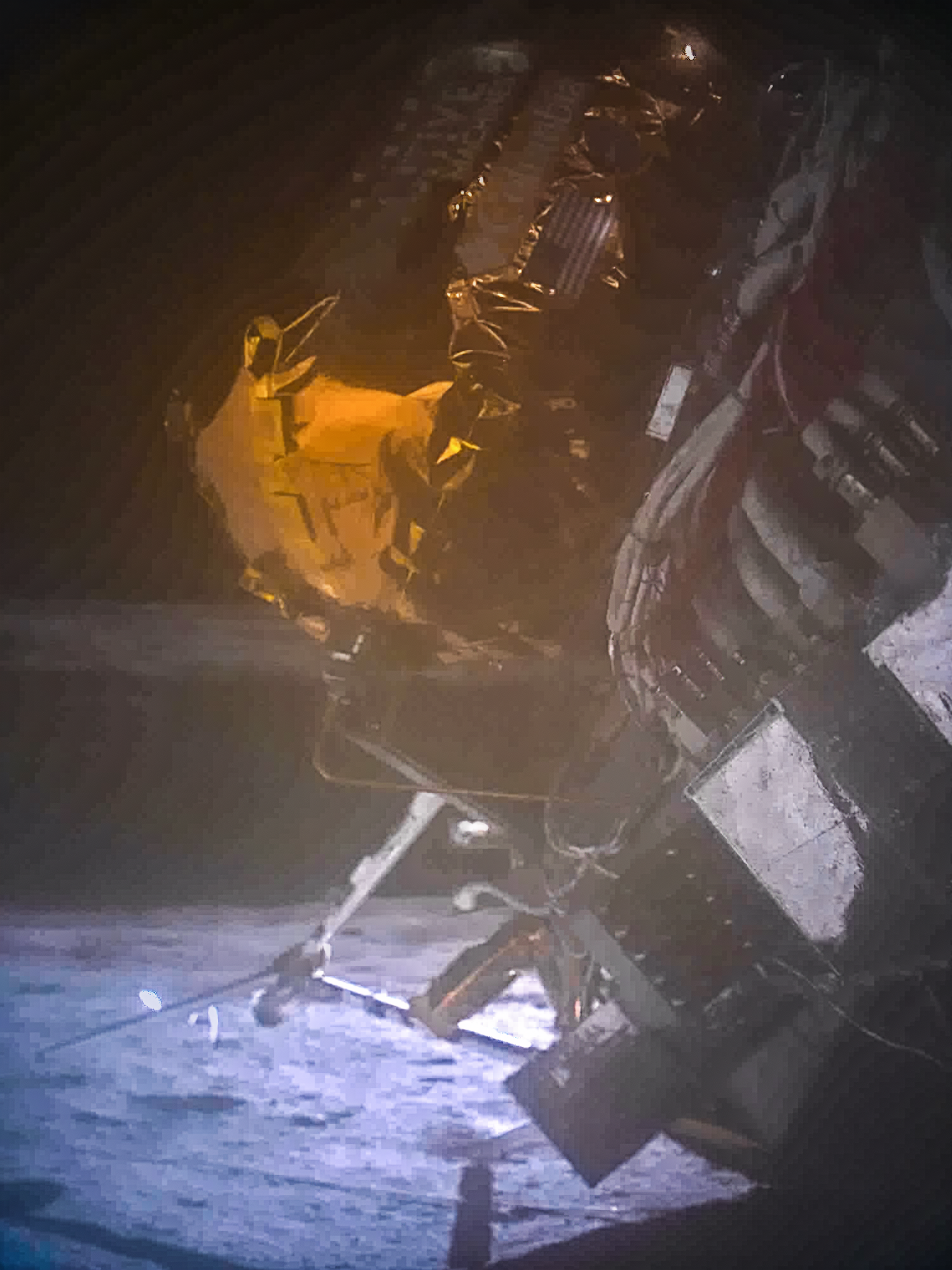
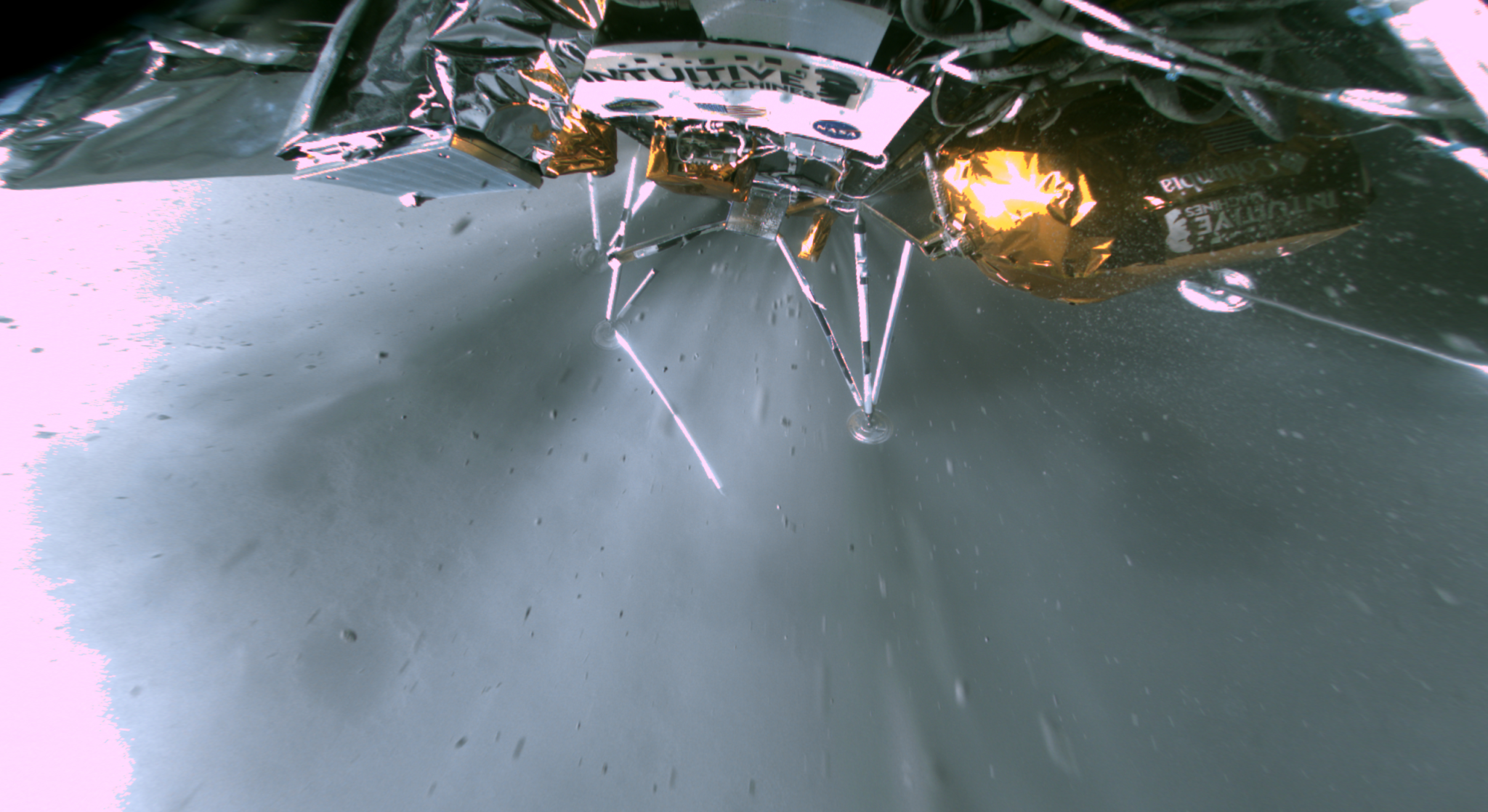
The first images from this historical mission are now available and showcase the orientation of the lander along with a view of the South Pole region on the Moon. Odysseus is gently leaning into the lunar surface, preserving the ability to return scientific data. After successful transmission of images to Earth, Intuitive Machines continues to gain additional insight into Odysseus’ position on the lunar surface. All data gathered from this mission will aid Intuitive Machines in their next two CLPS contracts that NASA has previously awarded.

For more information about the agency’s Commercial Lunar Payload Services initiative, visit: 

https://www.nasa.gov/clps

Odysseus’ landing captured a leg, as it performed its primary task, absorbing first contact with the lunar surface. With the lander’s liquid methane and liquid oxygen engine still throttling, it provided stability.
Credit: Intuitive Machines
Taken on Tuesday, Feb. 27, Odysseus captured an image using its narrow-field-of-view camera.
Credit: Intuitive Machines

Powered by WPeMatico

Get The Details…
Jeffery Rubio