Lightning from Above

Lightning from Above

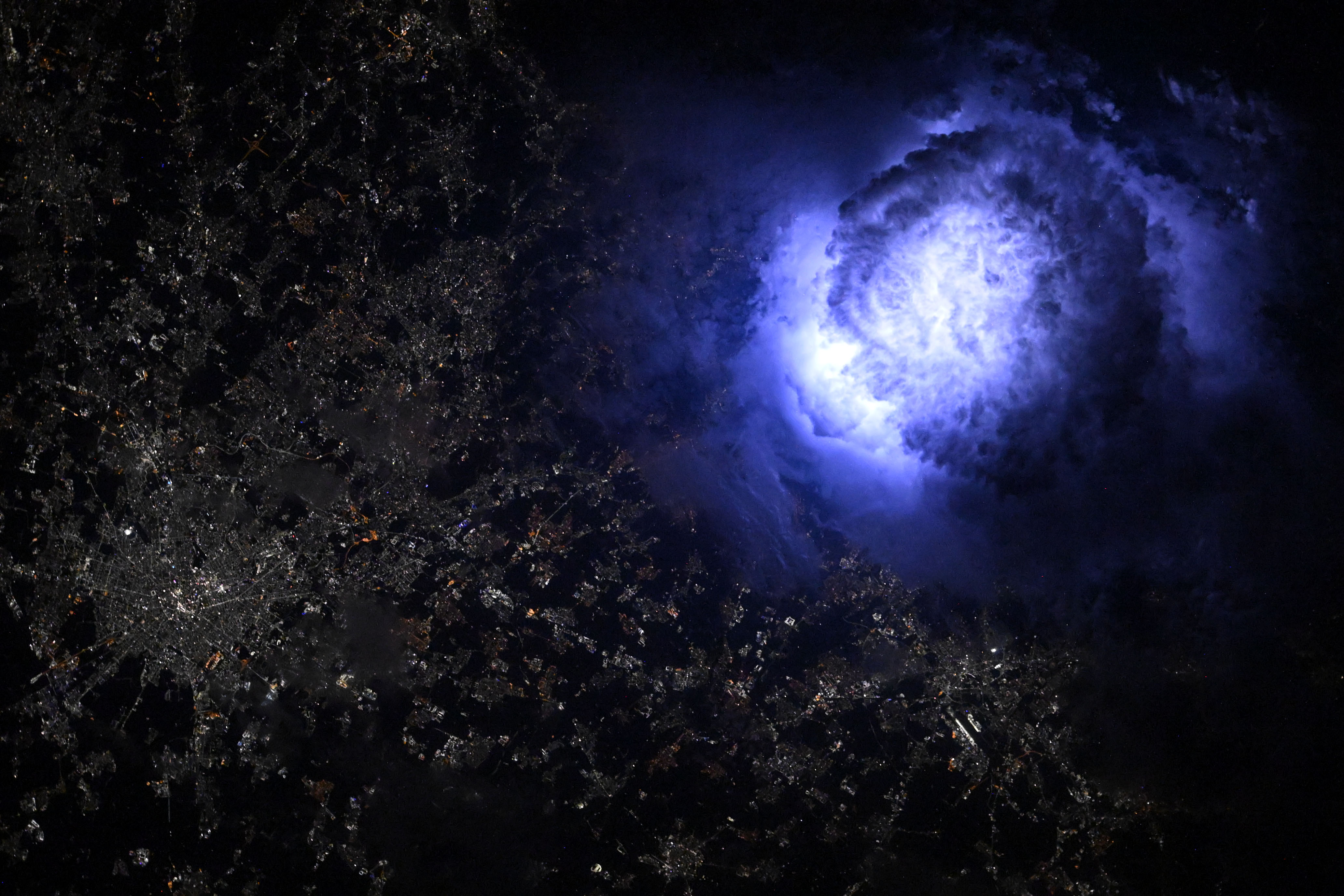
Lightning turns a cloud formation an eerie blue above Milan, Italy. The view is from the International Space Station.
NASA/Nichole Ayers

NASA astronaut Nichole Ayers captured this image of lightning while orbiting aboard the International Space Station more than 250 miles above Milan, Italy on July 1, 2025. Storm observations from space station help scientists study Earth’s upper atmosphere, which can improve weather models and protect communication systems and aircraft. Space station crew take photographs of Earth that record how the planet changes over time due to human activity and natural events. This record allows scientists to monitor disasters and direct response on the ground and study phenomena.

Image credit: NASA/Nichole Ayers

Powered by WPeMatico

Get The Details…
Monika Luabeya

Algae Swirls Across a South African Reservoir

Algae Swirls Across a South African Reservoir

June 2022-July 2023
NASA Earth Observatory / Lauren Dauphin

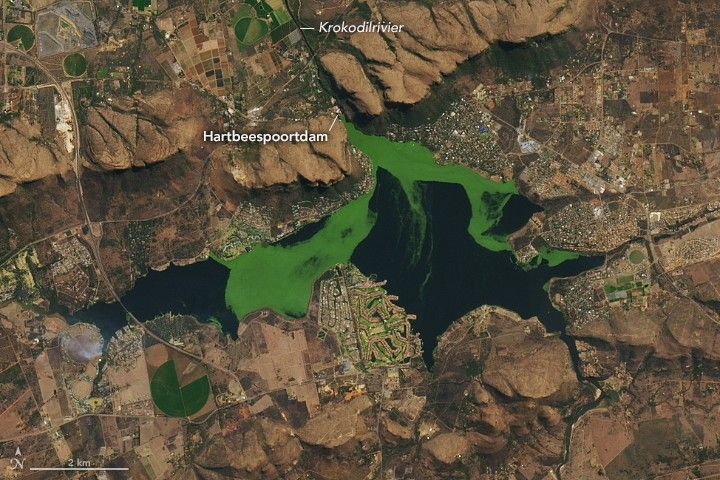
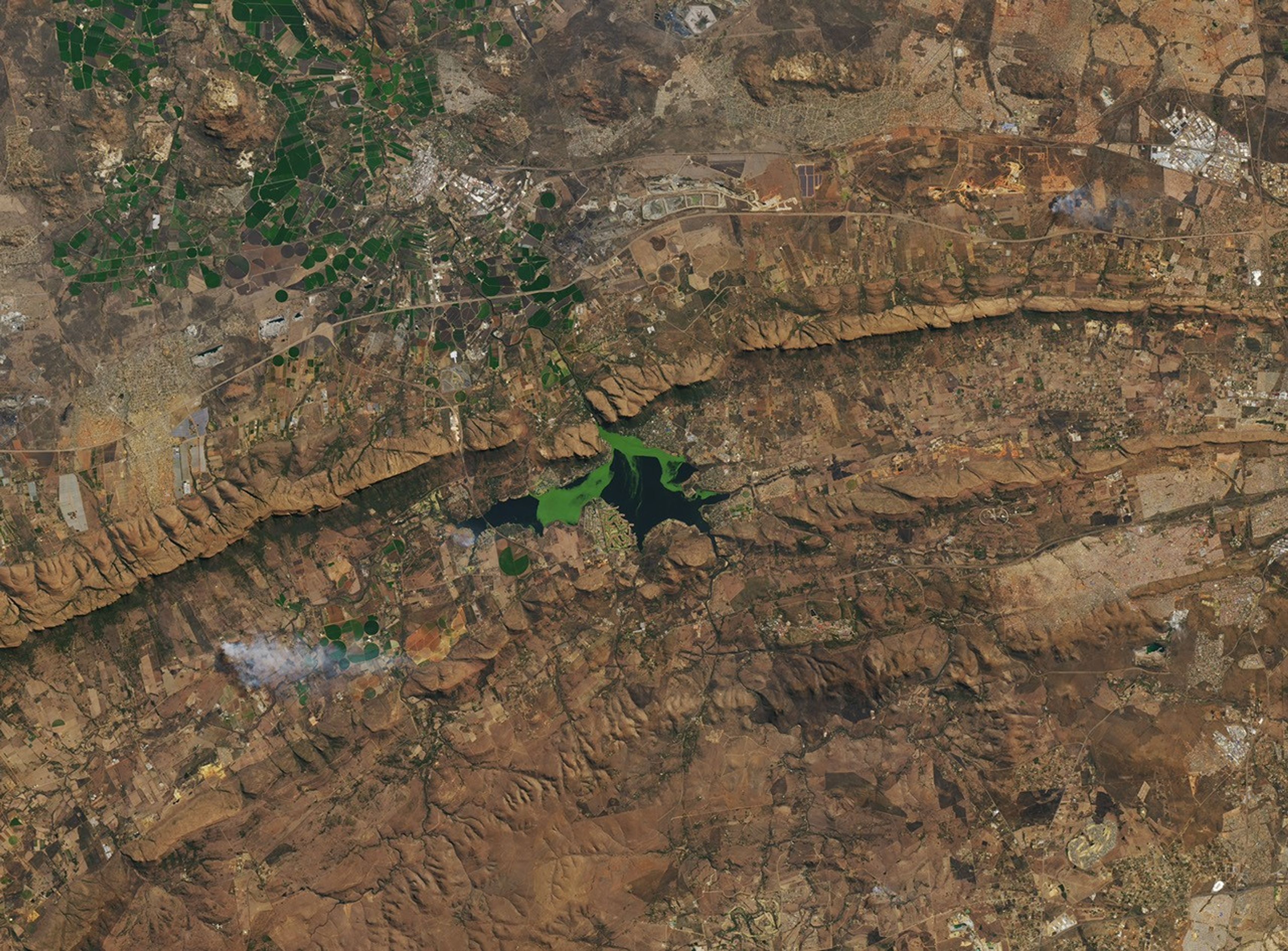
On clear days in Hartbeespoort, South Africa, satellite images often reveal a reservoir with shades of deep blue interrupted by drifting patches of vivid green. These shifting features indicate algae blooms, which can affect water quality, ecosystems, and nearby human communities.

In this animation, from June 2022 to July 2023, an algal bloom grows, moves around the reservoir, and then fades. The animation is composed of images from Harmonized Landsat and Sentinel-2 (HLS), a NASA product that combines imagery from the NASA/USGS Landsat 8 and Landsat 9 satellites and the European Space Agency’s Sentinel-2A, 2B, and 2C satellites.

Algae is an umbrella term for photosynthetic organisms that live in water, encompassing everything from single-celled cyanobacteria to seaweed. They play a vital role in maintaining healthy ecosystems. But when colonies of algae spread too widely or release harmful toxins, they can threaten the very environments they support. These colonies are known as harmful algal blooms, or HABs.

Some HABs are toxic and often are part of a process called eutrophication. Eutrophication begins when there are too many nutrients in an ecosystem—because of agricultural runoff and other inputs—leading to a rapid growth of algae.

“It’s like having a garden,” said Bridget Seegers, a NASA scientist who studies cyanobacteria in freshwater ecosystems. “If you add a lot of nutrients, you’re going to have a lot of growth.”

Eventually, the algae die off. As decomposers break down the dead algae, they consume oxygen, which can lead to hypoxia and the formation of dead zones.

A satellite image of a mostly brown landscape features a dark-blue reservoir partially covered by bright green algae in the north and center.
August 10, 2022

Such conditions have been documented at the Hartbeespoortdam (Hartbeespoort Dam) reservoir, located about 25 kilometers (16 miles) west of Pretoria and used primarily for recreation and irrigation. The reservoir is home to regular harmful algal blooms containing cyanobacteria. It also hosts large mats of invasive water hyacinths. While hyacinths do not produce toxins, they do contribute to eutrophication when they die and decompose.

Harmful algal blooms can affect ecosystem health and human lives and livelihoods. In April 2023, South African authorities linked a large fish kill in Hartbeespoort to low oxygen levels caused by excessive algal growth. More broadly, HABs in drinking water reservoirs can reduce water availability and raise water treatment costs, while swimming in HAB-infested waters can cause rashes, and pets or livestock that drink it may fall ill or die.

One 2022 paper published in Remote Sensing examined algae in the reservoir from 1980 to 2020 using Landsat data. “This is a reservoir that has always been monitored heavily by the local department of water resources,” said Adam Ali, the lead author of the paper. The research used satellite data to provide a big-picture view of conditions across the entire reservoir over long time scales. Using 40 years of Landsat data, the researchers found that the biggest drivers of algal growth were total phosphorus content—a nutrient found in runoff—and water temperature, with blooms typically expanding in the warm summer months and subsiding in the winter.

They also identified key trends over space and time. Algal productivity was higher near Krokodilrivier (Crocodile River) inflows and in the western part of the reservoir due to golf course runoff and restricted water circulation, demonstrating how HABs are influenced by runoff and river inputs. Large blooms occurred between 1982 and 1986, when total phosphorus levels were high. A bioremediation program in the late 1980s succeeded in limiting algae growth, but after funding ended in the late 1990s, harmful algal blooms spiked again in the early 2000s.

To track algae from space, the researchers analyzed the water’s color by measuring different wavelengths of light. From this, they estimated the concentration of chlorophyll-a, a common pigment in algae, and used these values to approximate algae biomass over time. Although water samples remain necessary to confirm that a bloom is harmful, satellite data can help scientists understand the drivers of harmful algal blooms, especially in remote regions where regular ground monitoring is expensive and time intensive.

New and forthcoming NASA missions promise to advance space-based water quality monitoring. The next Landsat satellite is expected to measure wavelengths specifically designed to detect HABs. NASA’s PACE (Plankton, Aerosol, Cloud, ocean Ecosystem) mission, launched in 2024, collects data in hundreds of precise wavelength bands in the visible spectrum, which can help scientists identify the type of algae that comprise a certain bloom—a key factor in determining toxicity. Given PACE’s spatial resolution, the data is most useful in coastal areas or larger inland water bodies. Ali is working with researchers at NASA Ames to integrate PACE into future studies.

Animation by Ross Walter/Landsat Science Office Support, using data from the Harmonized Landsat and Sentinel-2 (HLS) product. Still image by Lauren Dauphin/NASA Earth Observatory using Landsat data from the U.S. Geological Survey. Story by Madeleine Gregory/Landsat Science Office Support.

References & Resources

You may also be interested in:

Stay up-to-date with the latest content from NASA as we explore the universe and discover more about our home planet.

Iraq Reservoirs Plunge to Low Levels

5 min read

A multi-year drought has put extra strain on farmers and water managers in the Middle Eastern country.

Article

Lost Towns of the Quabbin

4 min read

Forests play a key role in filtering the waters of a reservoir in central Massachusetts that’s home to submerged towns…

Article

Reservoirs Dwindle in South Texas

3 min read

Drought in the Nueces River basin is reducing reservoir levels, leaving residents and industry in the Corpus Christi area facing…

Article

Powered by WPeMatico

Get The Details…

Life Science Fills Day as Expedition 74 Nears Thursday Spacewalk

Life Science Fills Day as Expedition 74 Nears Thursday Spacewalk

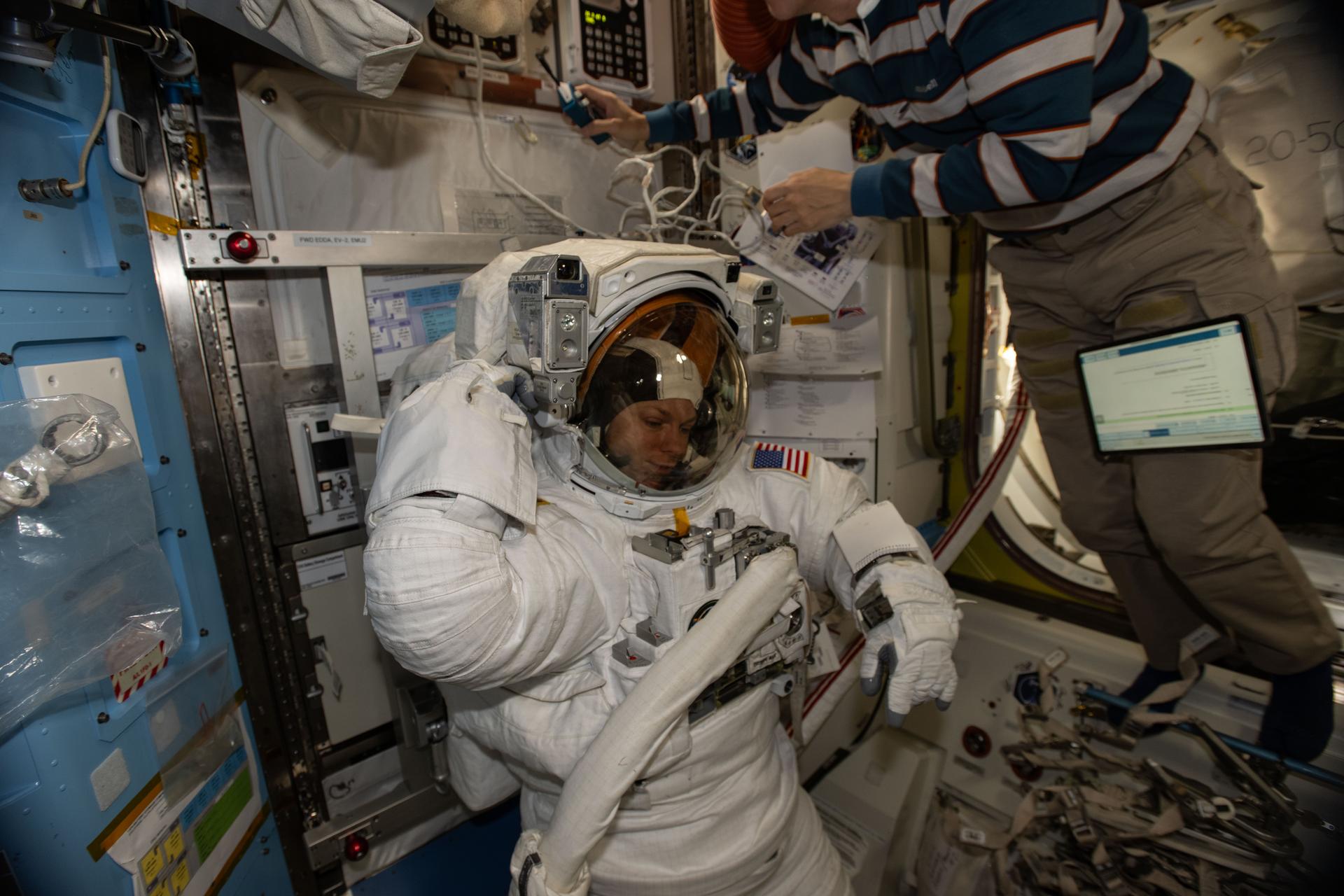
NASA astronaut and Expedition 74 Flight Engineer Zena Cardman is pictured in her pressurized spacesuit, checking its communication and power systems ahead of a spacewalk planned for Thursday, Jan. 8, 2025. At upper right, JAXA (Japan Aerospace Exploration Agency) astronaut and Flight Engineer Kimiya Yui assists Cardman as she tests the operations of her spacesuit inside the International Space Station’s Quest airlock.
NASA astronaut Zena Cardman is pictured in her pressurized spacesuit, checking its communication and power systems ahead of a spacewalk planned for Thursday, Jan. 8, 2025.
NASA

Exercise research and biomedical science promoting healthy humans on and off Earth topped the schedule aboard the International Space Station on Tuesday. Meanwhile, two NASA astronauts are preparing for the year’s first spacewalk, scheduled to begin Thursday.

Expedition 74 Commander Mike Fincke of NASA spent Tuesday exploring how exercising in weightlessness affects a crew member’s musculoskeletal system. Fincke first set up specialized video gear and calibrated the hardware to monitor how his body responds to working out on the Tranquility module’s advanced resistive exercise device (ARED). Next, he performed a series of squats on the ARED—a device that mimics free weights on Earth—as researchers on the ground monitored. Insights from this study will allow doctors to adjust and improve spaceflight workouts, ensuring astronauts maximize muscle and bone health. Potential Earth benefits include improving athletic training and advancing recovery and rehabilitation techniques.

NASA Flight Engineers Zena Cardman and Chris Williams partnered in the Columbus laboratory module for a pair of eye checks for human research. Cardman led both checks, first operating hardware that sent light signals to electrodes attached around Williams’ eyes. Biomedical software then recorded how his retinas and the cells in the back of his eyes responded to the flashes of light. For the second eye exam, Cardman operated medical imaging gear that Williams peered into for a different look at his retina, cornea, and lens. The downlinked data will help researchers understand and treat potential space-caused changes to eye anatomy and function.

Fincke and Cardman are scheduled to begin a six-and-a-half-hour spacewalk at 8 a.m. EST on Thursday, with live NASA+ coverage starting at 6:30 a.m. The duo will finalize their preparations on Wednesday by organizing tools, checking spacesuits, and reviewing spacewalk procedures with assistance from Williams and Flight Engineer Kimiya Yui of JAXA (Japan Aerospace Exploration Agency). During the spacewalk, they will install a modification kit and route cables to set up the station’s port-side truss structure for a future roll-out solar array. NASA managers previewed on X Thursday’s spacewalk and a second spacewalk planned for Jan. 15.

Yui began his day Tuesday practicing robotic maneuvers planned for the Jan. 15 spacewalk, which will involve installing and relocating hardware on the orbital outpost. Afterward, Yui collected water samples from an oxygen generator for ground analysis, then cleaned a filter and screen on the life support device.

Roscosmos Flight Engineers Sergey Kud-Sverchkov and Sergei Mikaev studied how living and working in microgravity affects the respiratory system. The cosmonauts took turns wearing an acoustic sensor around their tracheas to record sounds as they forcefully exhaled. Results will help doctors and crews monitor the respiratory system and provide early signs of possible space-caused breathing disorders.

Roscosmos Flight Engineer Oleg Platonov started his shift photographing his cosmonaut crewmates as they conducted lung research activities. Next, he cleaned, inspected, and photographed fans and ventilation system components in the Nauka science module.

Learn more about station activities by following the space station blog, @space_station on X, as well as the ISS Facebook and ISS Instagram accounts.

Get the latest from NASA delivered every week. Subscribe here.

Powered by WPeMatico

Get The Details…

Mark A. Garcia

Supernova Remnant Video From NASA’s Chandra Is Decades in Making

Supernova Remnant Video From NASA’s Chandra Is Decades in Making

A new video shows changes in Kepler’s Supernova Remnant using data from NASA’s Chandra X-ray Observatory captured over more than two and a half decades with observations taken in 2000, 2004, 2006, 2014, and 2025. In this video, which is the longest-spanning one ever released by Chandra, X-rays (blue) from the telescope have been combined with an optical image (red, green, and blue) from Pan-STARRS.
X-ray: NASA/CXC/SAO; Optical: Pan-STARRS

A new video shows the evolution of Kepler’s Supernova Remnant using data from NASA’s Chandra X-ray Observatory captured over more than two and a half decades.

Kepler’s Supernova Remnant, named after the German astronomer Johannes Kepler, was first spotted in the night sky in 1604. Today, astronomers know that a white dwarf star exploded when it exceeded a critical mass, after pulling material from a companion star, or merging with another white dwarf. This kind of supernova is known as a Type Ia, and scientists use it to measure the expansion of the universe.

Supernova remnants, the debris fields left behind after a stellar explosion, often glow strongly in X-ray light because the material has been heated to millions of degrees from the blast. The remnant is located in our galaxy, about 17,000 light-years from Earth, allowing Chandra to make detailed  images of the debris and how it changes with time. This latest video includes its X-ray data from 2000, 2004, 2006, 2014, and 2025. This makes it the longest-spanning video that Chandra has ever released, enabled by Chandra’s longevity.

“The plot of Kepler’s story is just now beginning to unfold,” said Jessye Gassel, a graduate student at George Mason University in Virginia, who led the work. “It’s remarkable that we can watch as these remains from this shattered star crash into material already thrown out into space.” Gassel presented the new Chandra video and the associated research at the 247th meeting of the American Astronomical Society in Phoenix.

The researchers used the video to show that the fastest parts of the remnant are traveling at about 13.8 million miles per hour (2% of the speed of light), moving toward the bottom of the image. Meanwhile, the slowest parts are traveling toward the top at about 4 million miles per hour (0.5% of the speed of light). This large difference in speed is because the gas that the remnant is plowing into toward the top of the image is denser than the gas toward the bottom. This gives scientists information about the environments into which this star exploded.

“Supernova explosions and the elements they hurl into space are the lifeblood of new stars and planets,” said Brian Williams of NASA’s Goddard Space Flight Center in Greenbelt, Maryland, and principal investigator of the new Chandra observations of Kepler. “Understanding exactly how they behave is crucial to knowing our cosmic history.”

The team also examined the widths of the rims forming the blast wave of the explosion. The blast wave is the leading edge of the explosion and the first to encounter material outside of the star. By measuring how wide it is and how fast it is traveling, astronomers glean more information about both the explosion of the star and its surroundings.

NASA’s Marshall Space Flight Center in Huntsville, Alabama, manages the Chandra program. The Smithsonian Astrophysical Observatory’s Chandra X-ray Center controls science operations from Cambridge, Massachusetts, and flight operations from Burlington, Massachusetts.

To learn more about Chandra, visit:

https://science.nasa.gov/chandra

Read more from NASA’s Chandra X-ray Observatory

Learn more about the Chandra X-ray Observatory and its mission here:

https://www.nasa.gov/chandra

https://chandra.si.edu

Visual Description

This release features a ten second silent video of Kepler’s expanding Supernova Remnant, located in our own galaxy, about 17,000 light-years from Earth. The video was created using X-ray data gathered in 2000, 2004, 2006, 2014, and 2025. Those distinct datasets were turned into highly-detailed visuals, creating a 25-year timelapse-style video of the growing remnant.

Kepler’s Supernova Remnant was once a white dwarf star that exploded when it exceeded its critical mass. Here, in X-ray light, the remnant resembles a cloudy neon blue ring with a diagonal cross line stretching from our upper right down to our lower left. The ring appears thinner and wispier at the bottom, with a band of white arching across the top.

As the video plays, cycling through the 5 datasets, the ring subtly, but clearly, expands, like a slowly inflating balloon. In the video, this sequence is replayed several times with dates included at our lower right, to give sighted learners time to absorb the visual information. Upon close inspection, researchers have determined that the bottom of the remnant is expanding fastest; about 13.8 million miles per hour, or 2% of the speed of light. The top of the ring appears to be expanding the slowest; about 4 million miles per hour, or 0.5% of the speed of light. The large difference in speed is because the gas that the remnant is plowing into towards the top of the image is denser than the gas towards the bottom.

Collecting and interpreting this data over decades has provided information about the environment into which the white dwarf star exploded, and has helped scientists understand how remnants change with time.

Share

Details

Last Updated

Jan 06, 2026

Editor
Lee Mohon
Contact
Joel Wallace

Powered by WPeMatico

Get The Details…
Lee Mohon

NASA Awards Launch Range Contract for Wallops Flight Facility

NASA Awards Launch Range Contract for Wallops Flight Facility

The letters NASA on a blue circle with red and white detail, all surrounded by a black background
Credit: NASA

NASA has selected ARES Technical Services Corporation of McLean, Virginia, to provide launch range operations support at the agency’s Wallops Flight Facility in Virginia.

The Wallops Range Contract has a total potential value of $339.8 million with a one-year base period expected to begin Tuesday, Feb. 10, and four one-year option periods that if exercised would extend it to 2031. The contract includes a cost-plus-fixed-fee core with an indefinite-delivery/indefinite-quantity component and the ability to issue cost-plus-fixed-fee or firm-fixed-price task orders.

The scope of the work includes launch range operations support such as radar, telemetry, logistics, tracking, and communications services for flight vehicles including orbital and suborbital rockets, aircraft, satellites, balloons, and unmanned aerial systems. Additional responsibilities include information and computer systems services; testing, modifying, and installing communications and electronic systems at launch facilities, launch control centers, and test facilities; and range technology sustainment engineering services.

Work will primarily occur at NASA Wallops with additional support at sites such as the agency’s Bermuda Tracking Station, Poker Flat Research Range in Alaska, and other temporary duty locations.

For information about NASA and agency programs, visit:

https://www.nasa.gov/

-end-

Tiernan Doyle
Headquarters, Washington
202-358-1600
tiernan.doyle@nasa.gov

Robert Garner
Goddard Space Flight Center, Greenbelt, Md.
301-286-5687
rob.garner@nasa.gov

Share

Details

Last Updated

Jan 06, 2026

Powered by WPeMatico

Get The Details…
Tiernan P. Doyle