CADRE Rovers’ Test Drive in the Mars Yard

CADRE Rovers’ Test Drive in the Mars Yard

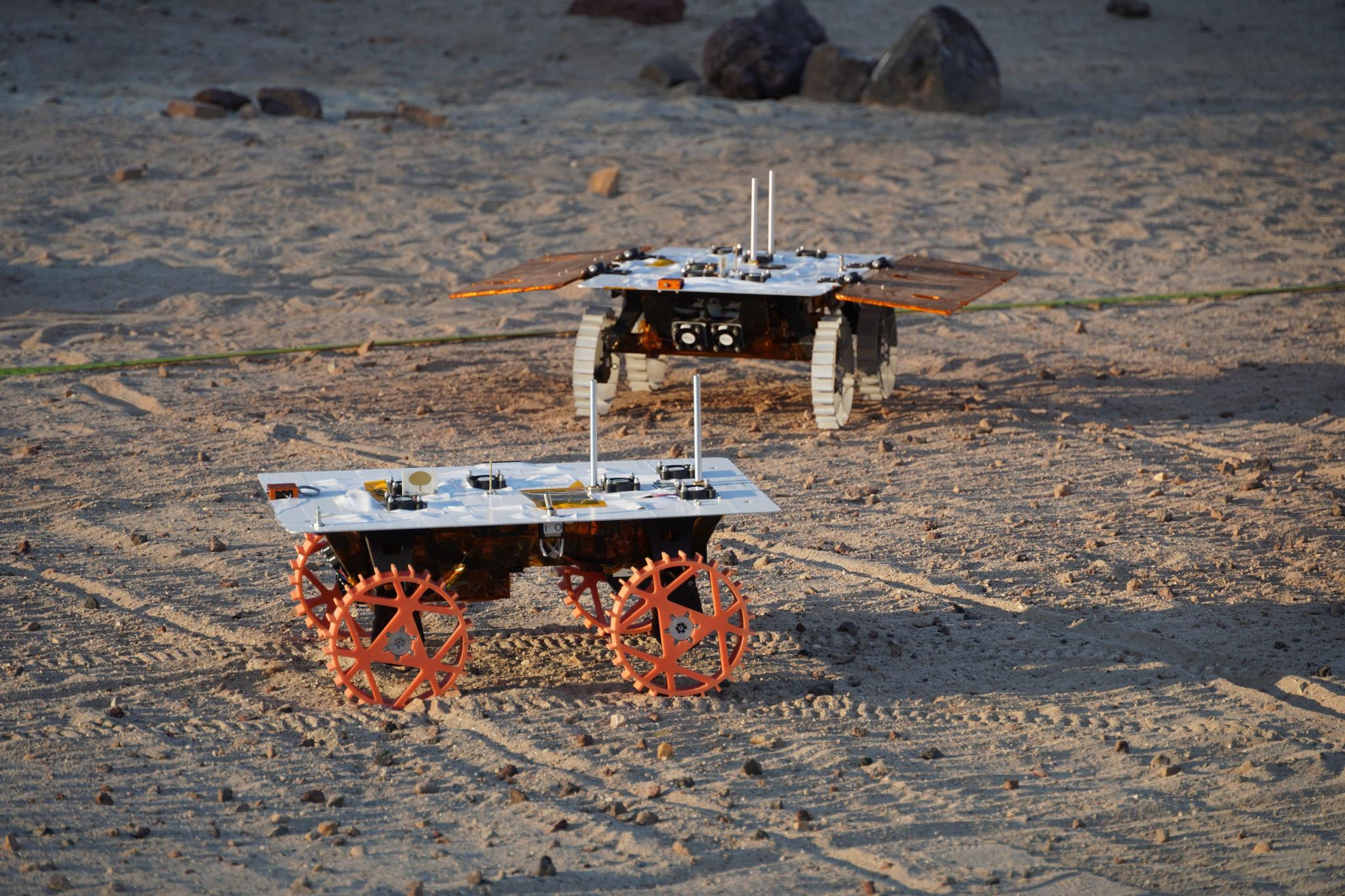
Two small rovers in a sandy yard. The rover in the back has solar panels fitted to it and white wheels. The one in the front has orange wheels and no solar panels.
NASA/JPL-Caltech

Two full-scale development model rovers, part of NASA’s Cooperative Autonomous Distributed Robotic Exploration (CADRE) technology demonstration, drive in the Mars Yard at the agency’s Jet Propulsion Laboratory in Southern California in this image from August 2023. The project is designed to show that a group of robotic spacecraft can work together as a team to accomplish tasks and record data autonomously – without explicit commands from mission controllers on Earth.

A series of Mars Yard tests with the development models confirmed CADRE hardware and software can work together to accomplish key goals for the project. The rovers drove together in formation and adjusted their plans as a group when faced with unexpected obstacles.

CADRE is slated to arrive at the Reiner Gamma region of the Moon through NASA’s Commercial Lunar Payload Services (CLPS) initiative. The network of robots will spend the daylight hours of a single lunar day – about 14 Earth days – conducting experiments that will test their capabilities.

Image Credit: NASA/JPL-Caltech

Powered by WPeMatico

Get The Details…
Monika Luabeya

NASA’s OSIRIS-REx Mission Awarded Collier Trophy

NASA’s OSIRIS-REx Mission Awarded Collier Trophy

NASA and the OSIRIS-REx (Origins, Spectral Interpretation, Resource Identification, and Security – Regolith Explorer) mission team have won the National Aeronautic Association’s (NAA) Robert J. Collier Trophy. NAA awards the trophy annually for what it determines is “the greatest achievement in aerospace and astronautics in America.” The OSIRIS-REx team will be celebrated at an award dinner on June 13, 2024, in Washington, D.C. 

The NAA bestowed the Robert J. Collier Trophy on the team behind NASA’s OSIRIS-REx, acknowledging the mission’s place in aerospace history by being the first U.S. mission to collect a sample from an asteroid and deliver it to Earth for study.

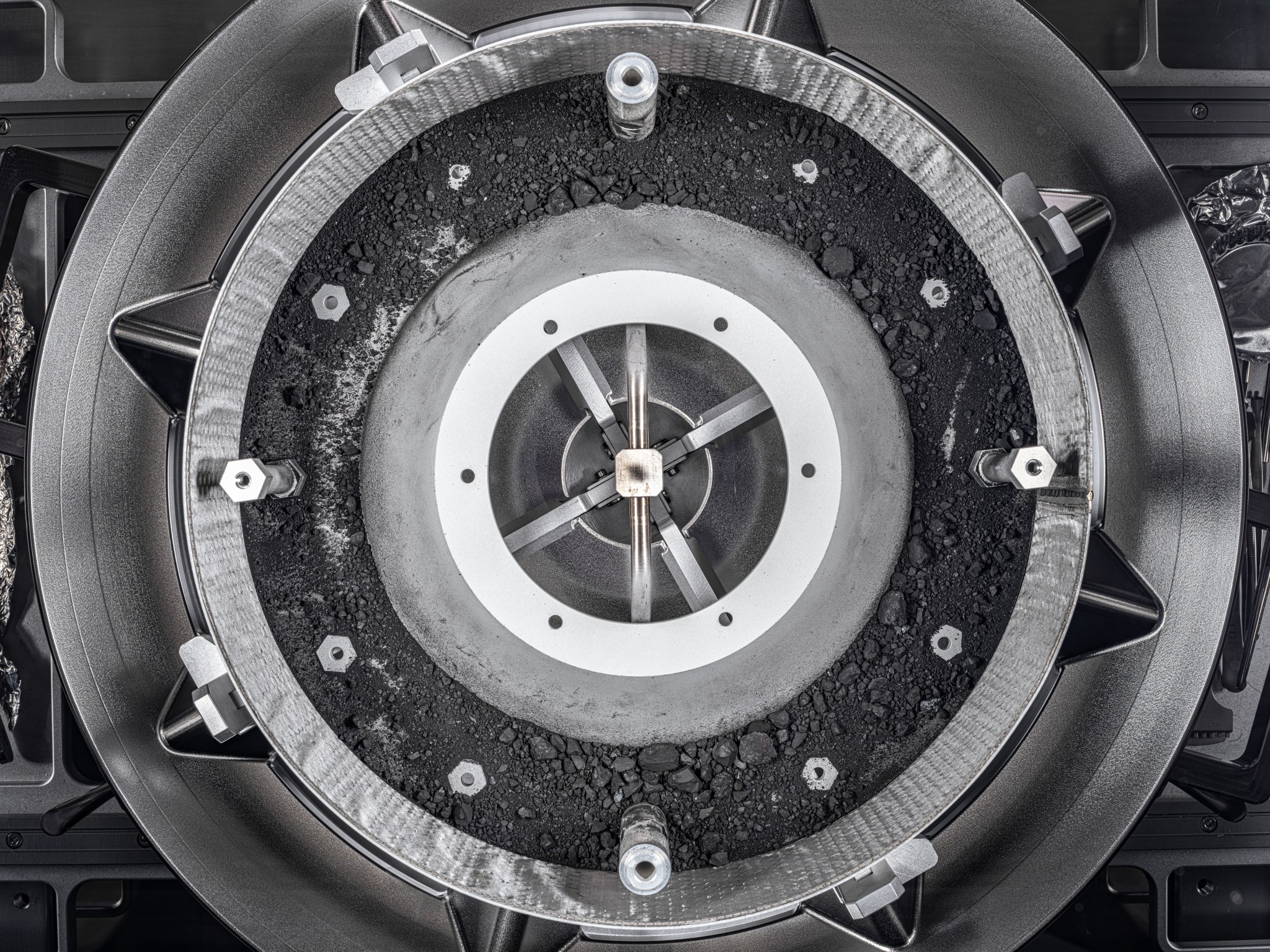
A top-down view of the OSIRIS-REx Touch-and-Go-Sample-Acquisition-Mechanism (TAGSAM) head with the lid removed, revealing the remainder of the asteroid sample inside. The TAGSAM is round, metallic silver, and looks like three concentric circles. The outermost circle has eight triangular metal ridges. The second ring is covered in deep gray, rocky dust particles and small rocks, with silver bolts peeking through the dust. The central circle has three metal bars, crossing in a star pattern.
A top-down view of the OSIRIS-REx Touch-and-Go-Sample-Acquisition-Mechanism (TAGSAM) head with the lid removed, revealing the remainder of the asteroid sample inside. Erika Blumenfeld, creative lead for the Advanced Imaging and Visualization of Astromaterials (AIVA) and Joe Aebersold, project management lead, captured this picture using manual high-resolution precision photography and a semi-automated focus stacking procedure. The result is an image that can be zoomed in on to show extreme detail of the sample. The remaining sample material includes dust and rocks up to about .4 in (one cm) in size.
NASA/Erika Blumenfeld & Joseph Aebersold

“Congratulations to the OSIRIS-REx team on this well-deserved honor,” said NASA Administrator Bill Nelson. “By successfully designing, building, and carrying out the first U.S. mission to collect an asteroid sample, NASA proved once again that we do big things. Things that inspire the world. We look forward to the incredible science to come that will tell us more about our solar system and help protect humanity here on Earth.”

Established more than a century ago, the award has marked major achievements in the timeline of flight, including Orville Wright in 1913 for developing the automatic stabilizer; Air Force test pilot Chuck Yeager for his sound-barrier-breaking 1947 flight of the X-1 rocket plane; the crews of NASA’s Apollo 8, 11, and 15 for their missions to the Moon in the late 1960s and early ’70s; and NASA’s Ingenuity Mars Helicopter.

The OSIRIS-REx team includes NASA’s Goddard Space Flight Center in Greenbelt, Maryland; Lockheed Martin in Littleton, Colorado; University of Arizona, Tucson; and KinetX in Tempe, Arizona.

The sample from the ancient asteroid Bennu that OSIRIS-REx delivered to Earth in September 2023 will give researchers worldwide a glimpse into the earliest days of our solar system, offering insights into planet formation and the origin of organics essential for life on Earth. Data collected by the spacecraft combined with future analysis of the Bennu sample will also aid our understanding of asteroids that could impact Earth.

The Collier Trophy adds to the recent Robert H. Goddard Memorial Trophy received by NASA’s OSIRIS-REx team in March 2024.

Following its successful sample return, the OSIRIS-REx spacecraft was renamed OSIRIS-APEX and will now enter an extended mission to visit and study near-Earth asteroid Apophis in 2029.

NASA Goddard provides overall mission management, systems engineering, and the safety and mission assurance for OSIRIS-REx. Dante Lauretta of the University of Arizona, Tucson, is the principal investigator. The university leads the science team and the mission’s science observation planning and data processing. Lockheed Martin Space in Littleton, Colorado, built the spacecraft and provides flight operations. Goddard and KinetX Aerospace are responsible for navigating the OSIRIS-REx spacecraft. Processing and curation for OSIRIS-REx’s Bennu sample takes place at NASA’s Johnson Space Center in Houston. International partnerships on this mission include the OSIRIS-REx Laser Altimeter instrument from CSA (the Canadian Space Agency) and asteroid sample science collaboration with JAXA’s (the Japan Aerospace Exploration Agency) Hayabusa2 mission. OSIRIS-REx is the third mission in NASA’s New Frontiers Program, managed by the agency’s Marshall Space Flight Center in Huntsville, Alabama, for the agency’s Science Mission Directorate at NASA Headquarters in Washington.

Find more information about NASA’s OSIRIS-REx mission at:

https://science.nasa.gov/mission/osiris-rex

Rob Gutro
NASA’s Goddard Space Flight Center, Greenbelt, Md.
Robert.j.gutro@nasa.gov 

Karen Fox / Charles Blue
Headquarters, Washington
202-358-1257 / 202-802-5345
 

Powered by WPeMatico

Get The Details…
Katy Mersmann

Order Up: High School Students Compete to Launch Their Food into Space with NASA HUNCH Culinary Competition

Order Up: High School Students Compete to Launch Their Food into Space with NASA HUNCH Culinary Competition

3 Min Read

Order Up: High School Students Compete to Launch Their Food into Space with NASA HUNCH Culinary Competition

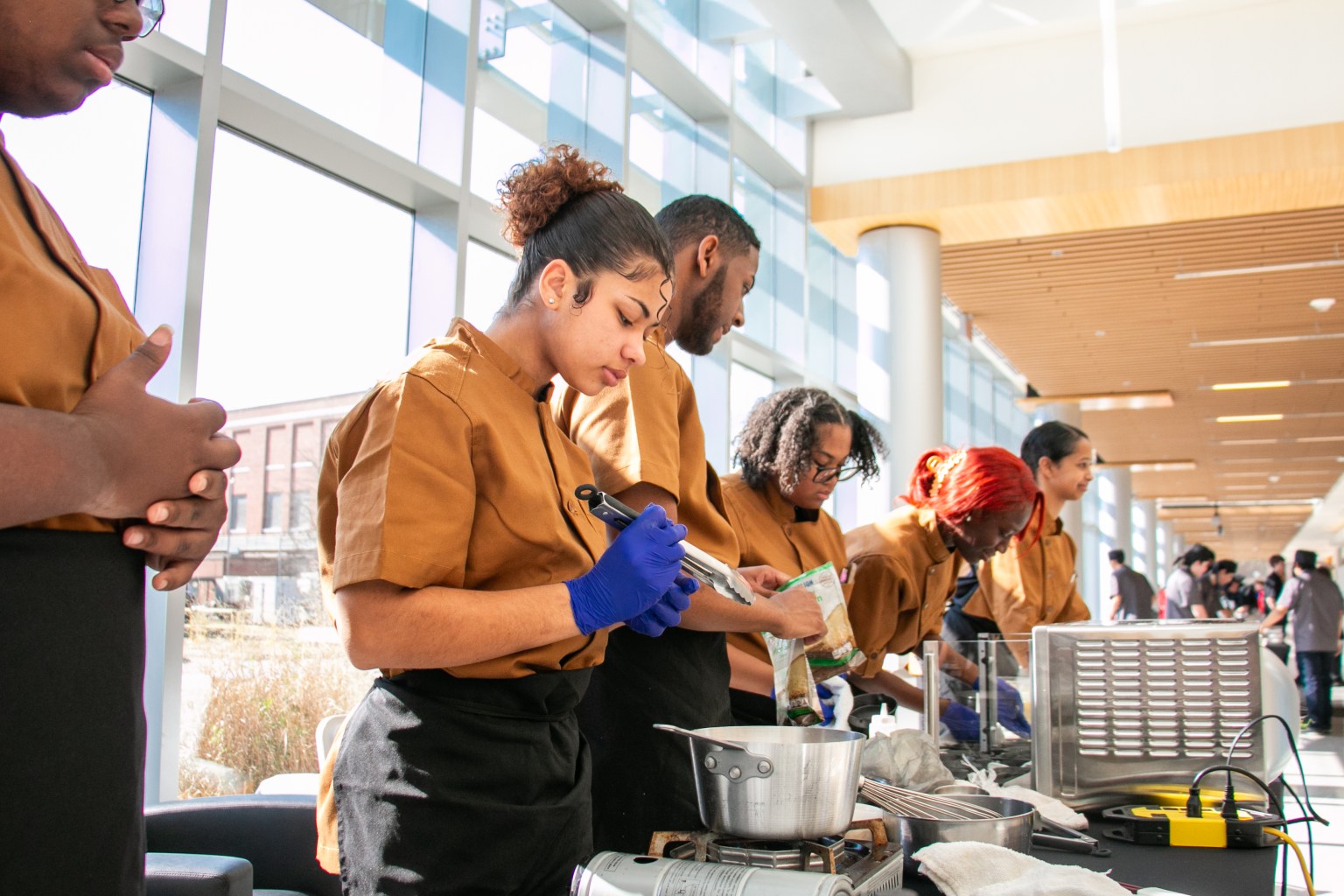
High school students in deep orange chef jackets stand above pots, pans and other cooking equipment as they prepare their savory breakfast meal for the NASA HUNCH Culinary Challenge.

High School students in chef jackets line long black tables at NASA’s Langley Research Center preparing savory breakfast dishes fit for astronauts onboard the International Space Station.

Credits:
NASA/Angelique Herring

On Monday, Feb. 26, visitors to the Integrated Engineering Services Building at NASA’s Langley Research Center in Hampton, Virginia, were greeted by the mouthwatering smell of roasted garlic, sautéed peppers and onions, fragrant herbs, and the unexpected discovery that the building’s main hallway had been turned into a pop-up kitchen for local high school students.

These students were participants in NASA HUNCH Culinary. NASA HUNCH (High School Students United with NASA to Create Hardware) is a Project Based Learning program where high school students participate in the design and fabrication of real world valued products for NASA. HUNCH has six areas of focus that students may choose to participate in: Precision Machining, Softgoods, Design and Prototype, Food Science, Communications, and Software.

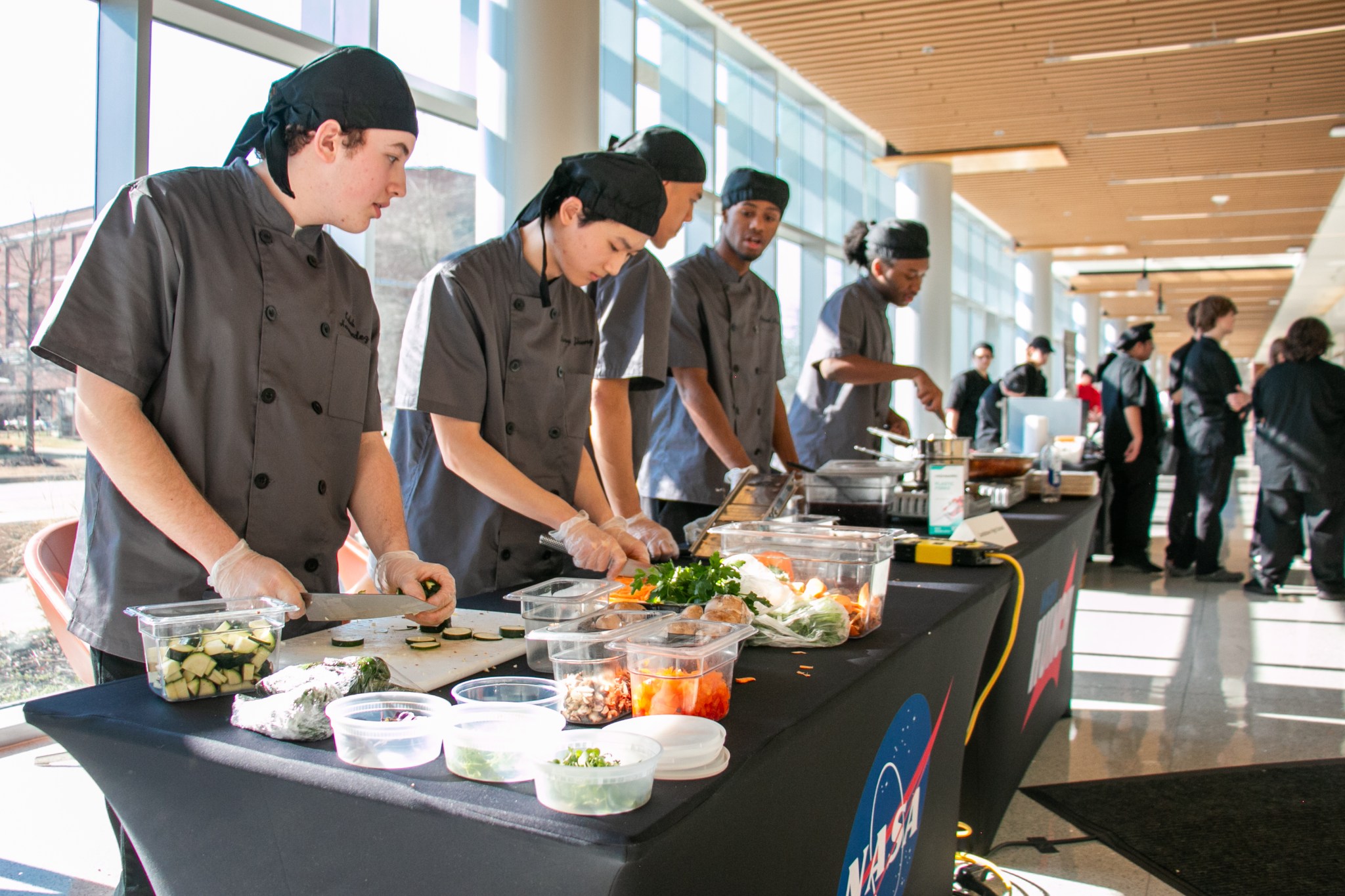
High school students in matching grey aprons and black chefs hats chop vegetables on a long black table as they prepare their savory entry for NASA's HUNCH Culinary Challenge
High School students chop vegetables as they prepare their savory entry for NASA’s HUNCH Culinary Challenge.
NASA/Angelique Herring

The HUNCH Astronaut Culinary Program provides students the opportunity to create dishes for astronauts aboard the International Space Station. Students must create tasty recipes following a specific food processing procedure and meeting certain nutritional requirements. These dishes must meet the standards of the NASA Johnson Space Center Food Lab in Houston, Texas.

Through this program, students gain culinary experience as well as experience with research and presenting their work in a professional environment. Students spend weeks perfecting their recipes so that on competition day, they can recreate their dishes in person at various NASA centers across the country.

This year, HUNCH Culinary student teams were tasked with the challenge of creating a savory breakfast dish that included a vegetable. The recipes had to fall between 150 and 350 calories, contain less than 12 grams of fat and 250 milligrams of sodium, have at least one gram of fiber, and “must process well for spaceflight and for use in microgravity” among several other requirements.

An eager hand reaches for a small serving of eggs scrambled with vegetables and topped with seeds as a larger skillet of the savory breakfast dish sits to the left.
NASA/Angelique Herring

Several students described challenges around creating a recipe under these guidelines. Nyland Clay, a student at Landstown High School in Virginia Beach, explained his team’s problem solving around the minimal sodium guideline.

“We were able to work around that by using different types of flavors in order to substitute for the extra sodium,” he said. “One of the ways we did this was with poblano peppers. When seared over a grill, they make a nice smoky flavor that doesn’t add any sodium whatsoever.”

Nyland’s team additionally chose to use ground turkey in their sweet potato hash recipe instead of ground beef to avoid unnecessary fat.

Travis Walker, culinary instructor at Phoebus High School in Hampton and former executive catering chef manager for the NASA Langley Exchange, spoke highly of his students as his reason for teaching.

“The most rewarding part is just watching the growth of the kids,” he said. “From the day you get them and they can’t boil water, to the time they get here and they’re in these competitions and excelling — that’s the most rewarding part.”

The student groups with the highest scores will be invited to Johnson Space Center in Houston for a final competition where their dishes will be judged by Johnson Food Lab personnel, industry professionals, the ISS program office, and astronauts. The criteria are quality, taste, and the students’ work on the research paper and presentation video. The winning entree will be processed by the Johnson Space Center Food Lab and sent up to the station for the astronauts to enjoy.

Share

Details

Last Updated

Mar 26, 2024

Related Terms

Powered by WPeMatico

Get The Details…
Angelique Herring

University Teams Selected as Finalists to Envision New Aviation Responses to Natural Disasters 

University Teams Selected as Finalists to Envision New Aviation Responses to Natural Disasters 

3 min read

Preparations for Next Moonwalk Simulations Underway (and Underwater)

This is a graphic about NASA's Gateways to Blue Skies Competition. The graphic has text that reads
The Gateways to Blue Skies Competition is sponsored by NASA’s Aeronautics Research Mission Directorate and is managed by the National Institute of Aerospace.
NIA

Eight teams participating in the 2024 Gateways to Blue Skies: Advancing Aviation for Natural Disasters Competition have been selected to present their design concepts to a panel of industry experts at the 2024 Blue Skies Forum, May 30 and 31, 2024 at NASA’s Ames Research Center in Mountain View, California.  

Sponsored by NASA’s Aeronautics Research Mission Directorate (ARMD), this year’s Blue Skies Competition asked teams of university students to research and conceptualize aviation-related systems that will aid in natural disaster management, and to submit a five to seven-page proposal and a video summarizing their concept.  

“We are thrilled with the diversity of ideas from all the finalists and can see their passion for making a real impact in natural disaster response through new and improved aviation systems,” said Steven Holz, NASA Aeronautics University Innovation Assistant Project Manager and Blue Skies judge and co-chair. “We look forward to seeing their final papers, infographics, and hearing their final presentations at the forum.” 

The 2024 Gateways to Blue Skies: Advancing Aviation for Natural Disasters finalist projects represent diverse natural disaster response types, including earthquakes, avalanches, volcanic eruptions, hurricanes, floods, and wildfires: 

Boston University  

Deployable Unmanned Aerial System to Detect and Map Volcanic Ash Clouds  

Advisor: James Geiger  

Boston University  

Rapid Evaluation, Coordination, Observation, Verification & Environmental Reporting (RECOVER)  

Advisor: Dr. Anthony Linn  

Bowie State University  

Enhancing Earthquake Disaster Relief with Artificial Intelligence and Machine Learning  

Advisor: Dr. Haydar Teymourlouei  

California State Polytechnic University, Pomona  

Aero-Quake Emergency Response Network  

Advisor: Mark Gonda  

Cerritos College  

F.I.R.E. (Fire Intervention Retardant Expeller)  

Advisor: Janet McLarty-Schroeder  

Columbia University  

AVATARS: Aerial Vehicles for Avalanche Terrain Assessment and Reporting Systems  

Faculty Advisor: Dr. Mike Massimino  

North Carolina State University  

Reconnaissance and Emergency Aircraft for Critical Hurricane Relief (REACHR)  

Advisor: Dr. Felix Ewere  

University of Texas, Austin  

Data Integrated UAV for Wildfire Management  

Advisor: Dr. Christian Claudel  

As climate change increasingly influences the frequency and severity of natural disasters on a global scale, opportunities to contribute at the intersection of technological advancement, aviation, and natural disasters grow in both number and importance. NASA Aeronautics is dedicated to expanding its efforts to assist commercial, industry, and government partners in advancing aviation-related systems that could help prepare for natural disasters, lessen their impacts, and speed up recovery efforts. 

The eight finalist teams each receive $8,000 stipends to facilitate full participation in the Gateways to Blue Skies Forum, which will be held in May in Mountain View and will be livestreamed globally. Winning team members earn a chance to intern at one of NASA’s Aeronautics centers in the 2024-25 academic year. 

The 2024 Gateways to Blue Skies competition is sponsored by NASA’s Aeronautics Research Mission Directorate’s (ARMD’s) University Innovation Project (UI) and is managed by the National Institute of Aerospace (NIA). 

For more on the Gateways to Blues Skies: Advancing Aviation for Natural Disasters competition, visit https://blueskies.nianet.org

Share

Details

Last Updated

Mar 26, 2024

Powered by WPeMatico

Get The Details…
Julia L. Bradshaw

Tech Today: Cutting the Knee Surgery Cord

Tech Today: Cutting the Knee Surgery Cord

2 min read

Preparations for Next Moonwalk Simulations Underway (and Underwater)

Lazurite's ArthroFree Wireless Camera System on a table, held by a person wearing surgical gloves.
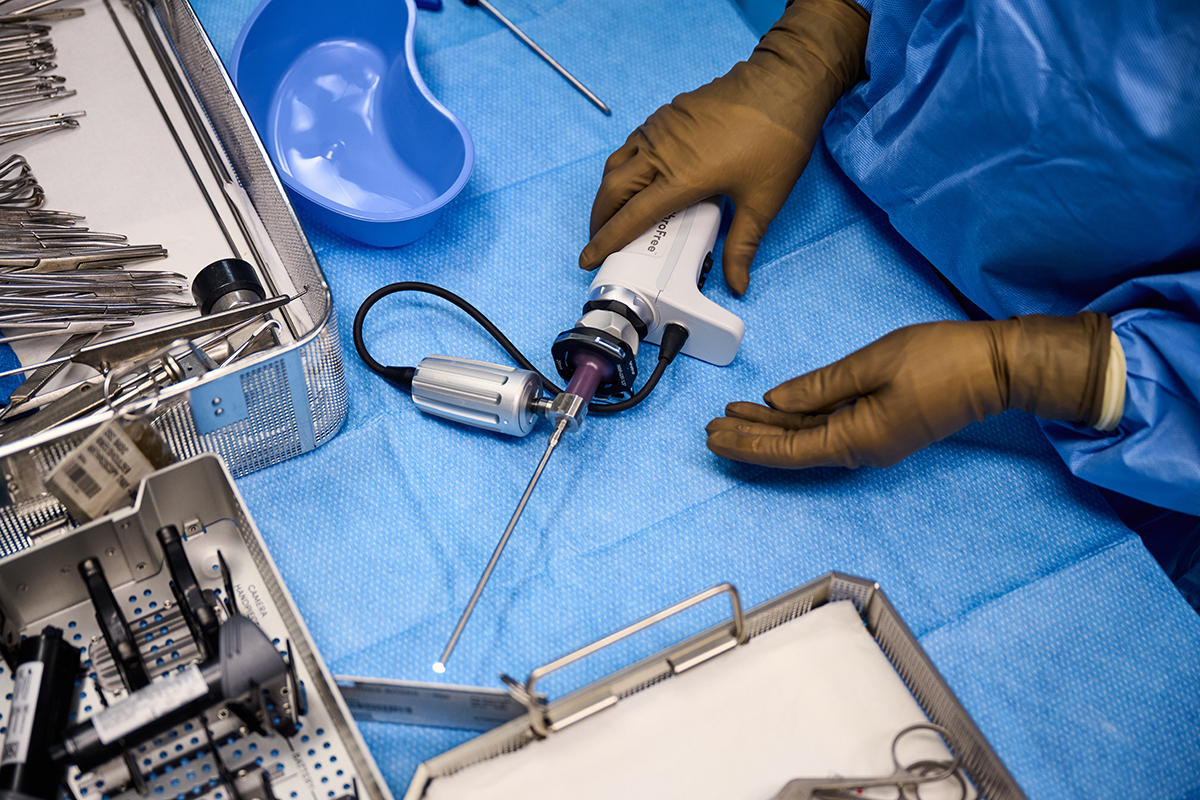
Lazurite’s ArthroFree Wireless Camera System incorporated aerospace-grade lithium-ion batteries after developers consulted with NASA engineers.
Credit: Lazurite Holdings LLC

After Eugene Malinskiy saw a physician assistant trip over arthroscopic camera cords during a medical procedure, he and his brother, Ilya, set out to develop a wireless arthroscopic camera.

Early in the development process, the Malinskiys got a boost from engineers at NASA’s Glenn Research Center in Cleveland, who advised on technical specifications through the center’s Adopt-a-City program. This agency program enabled Glenn engineers to consult with them pro bono via a Space Act Agreement with the city of Cleveland.

The team also consulted with NASA engineers on their plan to use the ultra-wideband protocol – radio technology enabling encrypted transfer of a high-definition signal – and their planned processors and chips used in the device’s central processing unit.

Ilya Malinskiy said the company gave investors the space agency engineers’ feedback. “Being able to say we had very skilled NASA engineers take a look at our device and say we should keep going was very, very useful.”

It turned out that the first wireless arthroscopic camera wasn’t entirely unlike CubeSats – tiny satellites that often orbit Earth in clusters.

“We had a lot of the same issues,” Ilya Malinskiy said. “We both have very small devices that need reliable power without adding a lot of weight.”

Ultimately, the NASA engineers connected the Lazurite team with several high-fidelity aerospace lithium-ion battery vendors.

In 2022, Lazurite’s ArthroFree Wireless Camera System became the first FDA-cleared wireless camera system for minimally invasive surgery. Since then, the device has assisted in countless surgeries, and the company has raised tens of millions of dollars.

Powered by WPeMatico

Get The Details…
Andrew Wagner