NASA Astronaut Don Pettit to Conduct Science During Fourth Mission
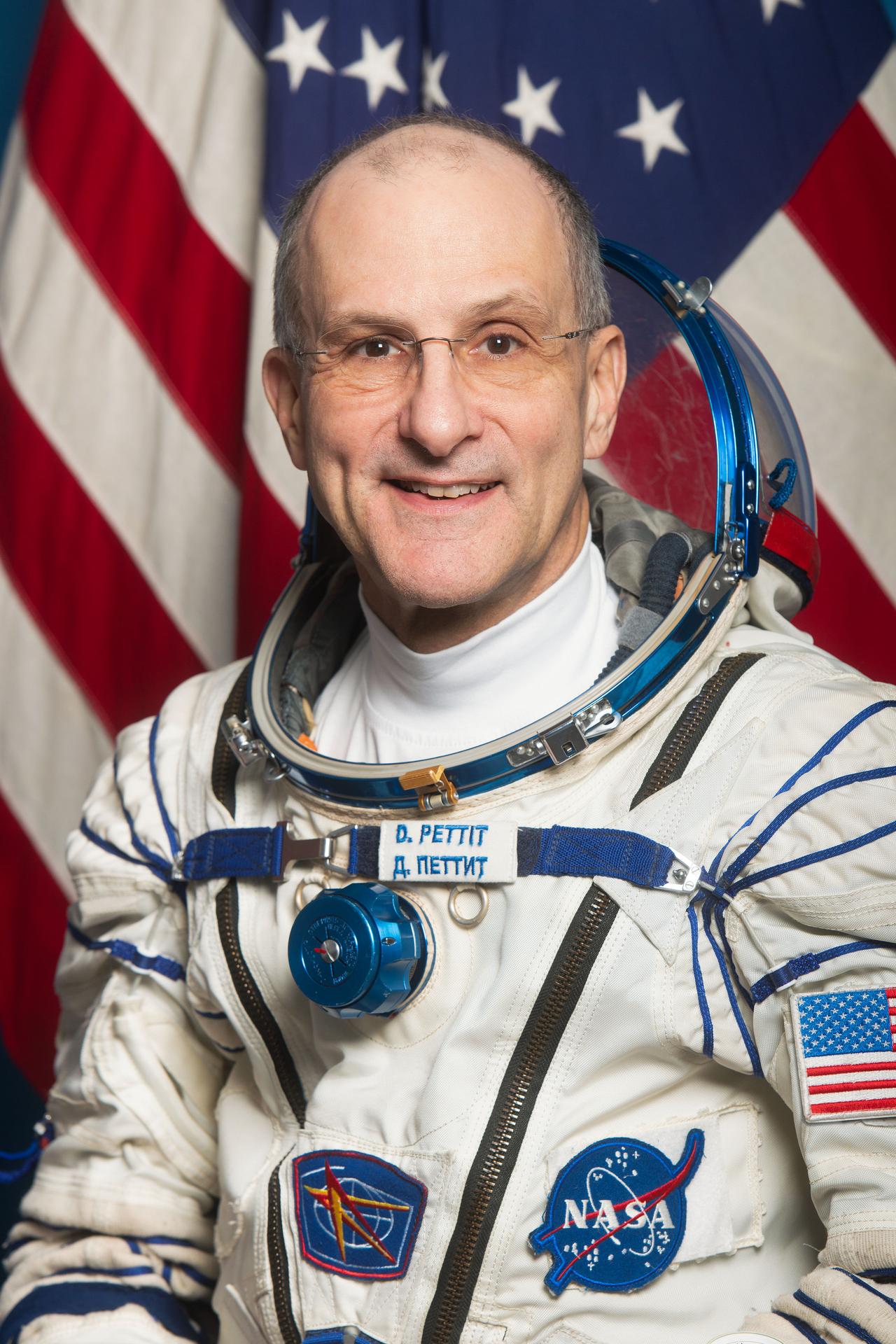
NASA astronaut Don Pettit poses for a crew portrait at the Gagarin Cosmonaut Training Center.
NASA
During his fourth mission to the International Space Station, NASA astronaut Don Pettit will serve as a flight engineer and member of the Expedition 71/72 crew. After blasting off to space, Pettit will conduct scientific investigations and technology demonstrations to help prepare crew for future space missions.
Pettit will launch on the Roscosmos Soyuz MS-26 spacecraft in September 2024, accompanied by Roscosmos cosmonauts Alexey Ovchinin and Ivan Vagner. The trio will spend approximately six months aboard the orbital laboratory.
NASA selected Pettit as an astronaut in 1996. A veteran of three spaceflights, he made integral advancements in technology and demonstrations for human exploration. He served as a science officer for Expedition 6 in 2003, operated the robotic arm for STS-126 space shuttle Endeavour in 2008, and served as a flight engineer for Expedition 30/31 in 2012. Pettit has logged 370 days in space and conducted two spacewalks totaling 13 hours and 17 minutes.
The Expedition 6 crew launched on STS-113 space shuttle Endeavour expecting to return on STS-114 space shuttle Discovery after a two and a half month mission. Following the space shuttle Columbia accident that grounded the shuttle fleet, the crew returned on the Soyuz TMA-1 spacecraft after five and a half months, landing in Kazakhstan. On his next 16-day mission, STS-126, Pettit helped expand the living quarters of the space station and installed a regenerative life support system to reclaim potable water from urine. During Expedition 30/31, Pettit also captured the first commercial cargo spacecraft, the SpaceX Dragon, using the robotic arm.
A native from Silverton, Oregon, Pettit holds a bachelor’s degree in chemical engineering from Oregon State University, Corvallis, and a doctorate in chemical engineering from the University of Arizona, Tucson. Prior to his career with NASA, Pettit worked as a staff scientist at the Los Alamos National Laboratory in New Mexico.
For more than two decades, humans have lived and worked continuously aboard the International Space Station, advancing scientific knowledge and making research breakthroughs that are not possible on Earth. The station is a critical testbed for NASA to understand and overcome the challenges of long-duration spaceflight and to expand commercial opportunities in low Earth orbit. As commercial companies focus on providing human space transportation services and destinations as part of a robust low Earth orbit economy, NASA is able to focus more of its resources on deep space missions to the Moon and Mars.
Get breaking news, images and features from the space station on the station blog, Instagram, Facebook, and X.
Learn more about International Space Station research and operations at:
Marshall Hosts 37th Small Business Alliance Meeting
By Celine Smith
NASA’s Marshall Space Flight Center hosted its 37th Small Business Alliance meeting March 21 at the U.S. Space & Rocket Center’s Davidson Center for Space Exploration. The event brought together hundreds of attendees from 39 states and 21 countries to network and learn about opportunities to do business with NASA.
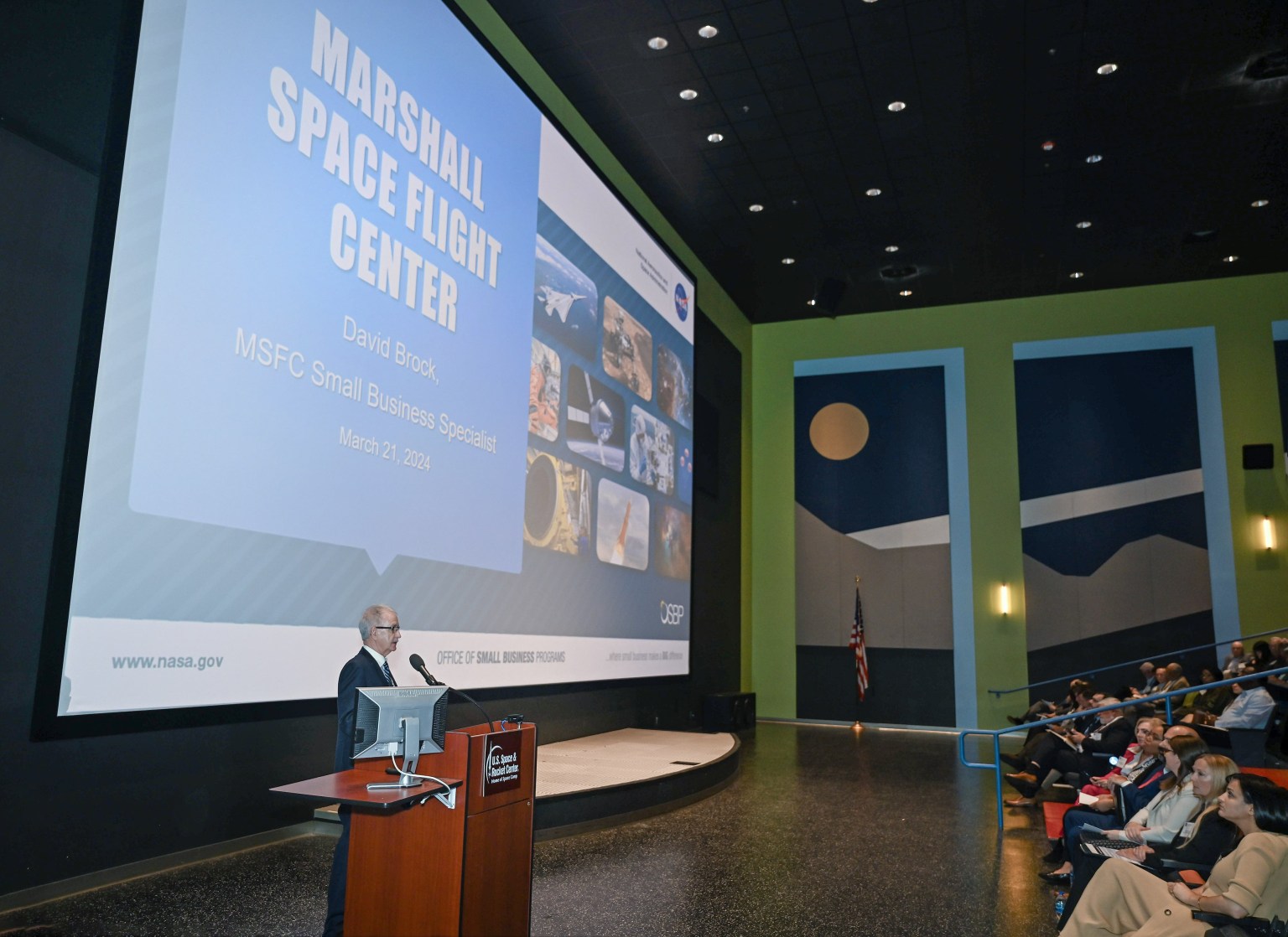
“Today is about bringing the NASA marketplace directly to small businesses so they cannot only learn about how to get involved at NASA, but specifically in Huntsville and at Marshall,” said David Brock, small business specialist in Marshall’s Office of Procurement.
David Brock, small business specialist at NASA’s Marshall Space Flight Center, talks to attendees at the 37th Small Business Alliance meeting March 21.
NASA/Charles Beason
The mayors of Huntsville, Madison, and Decatur gave a series of welcome remarks and thanked small businesses for their positive impact on their communities and the local economy.
Lisa Bates, deputy director of Marshall’s Engineering Directorate, emphasized the importance of small businesses to Marshall. “We have had so many tremendous accomplishments and so much of that is due to partnerships with small businesses,” Bates said. “We’ve done this together as a team.”
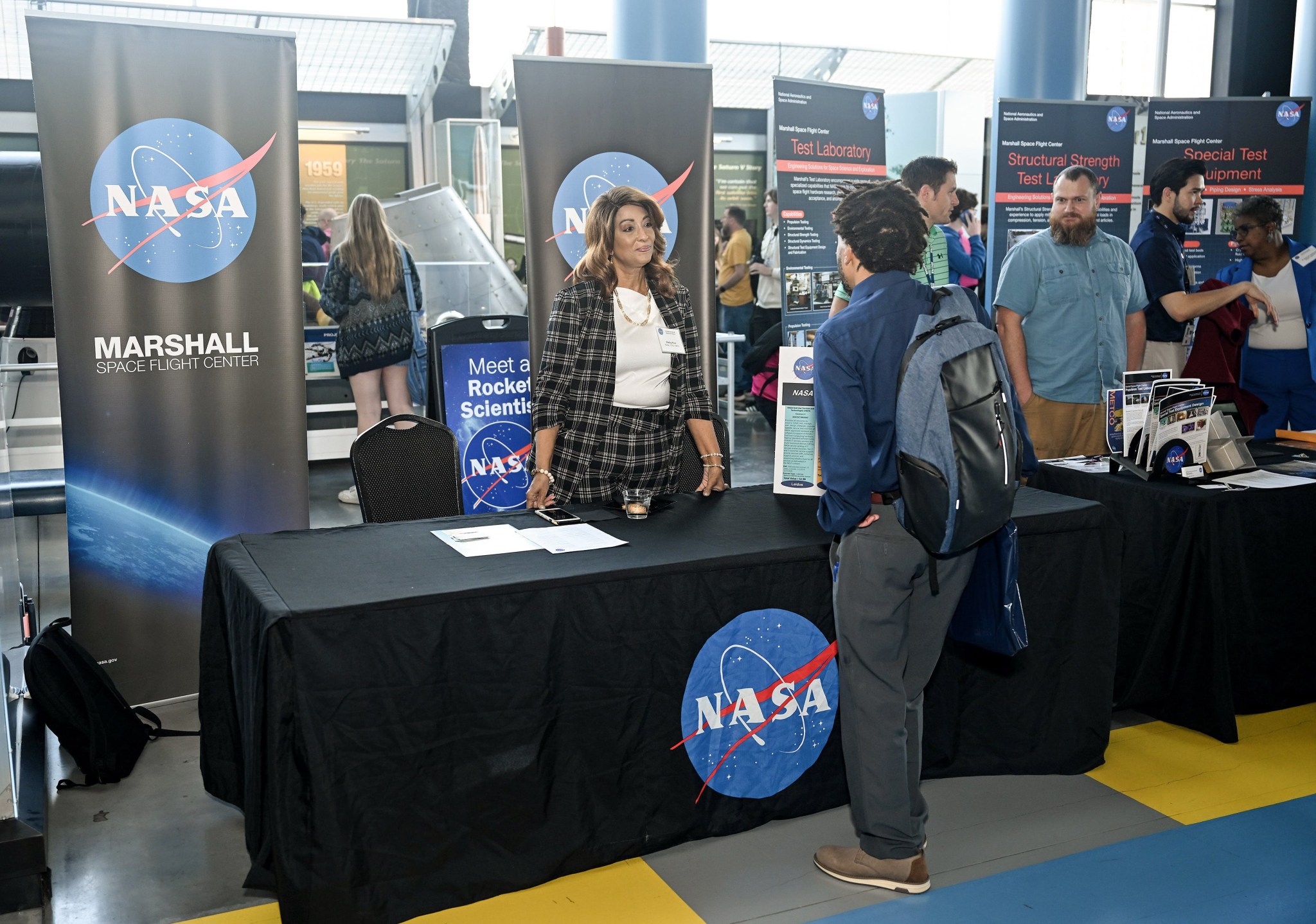
Kathy Rice, center, an information technology specialist at Marshall, talks with an attendee about the center’s small business capabilities.
NASA/Charles Beason
Bates said that small businesses make up more than half of NASA’s suppliers and 32 of the 45 SLS (Space Launch System) suppliers in Alabama.
“I truly believe that teamwork and partnership is at the heart of every great achievement, and I look forward to being successful and exceptional with each of you,” said Bates.
Smith, a Media Fusion employee, supports the Marshall Office of Communications.
Mitzi Adams watched several astronauts walk on the Moon when she was a teenager during NASA’s Apollo missions. That’s when Adams realized she wanted to be a NASA scientist. She also envisioned having an office on the lunar surface by 2000.
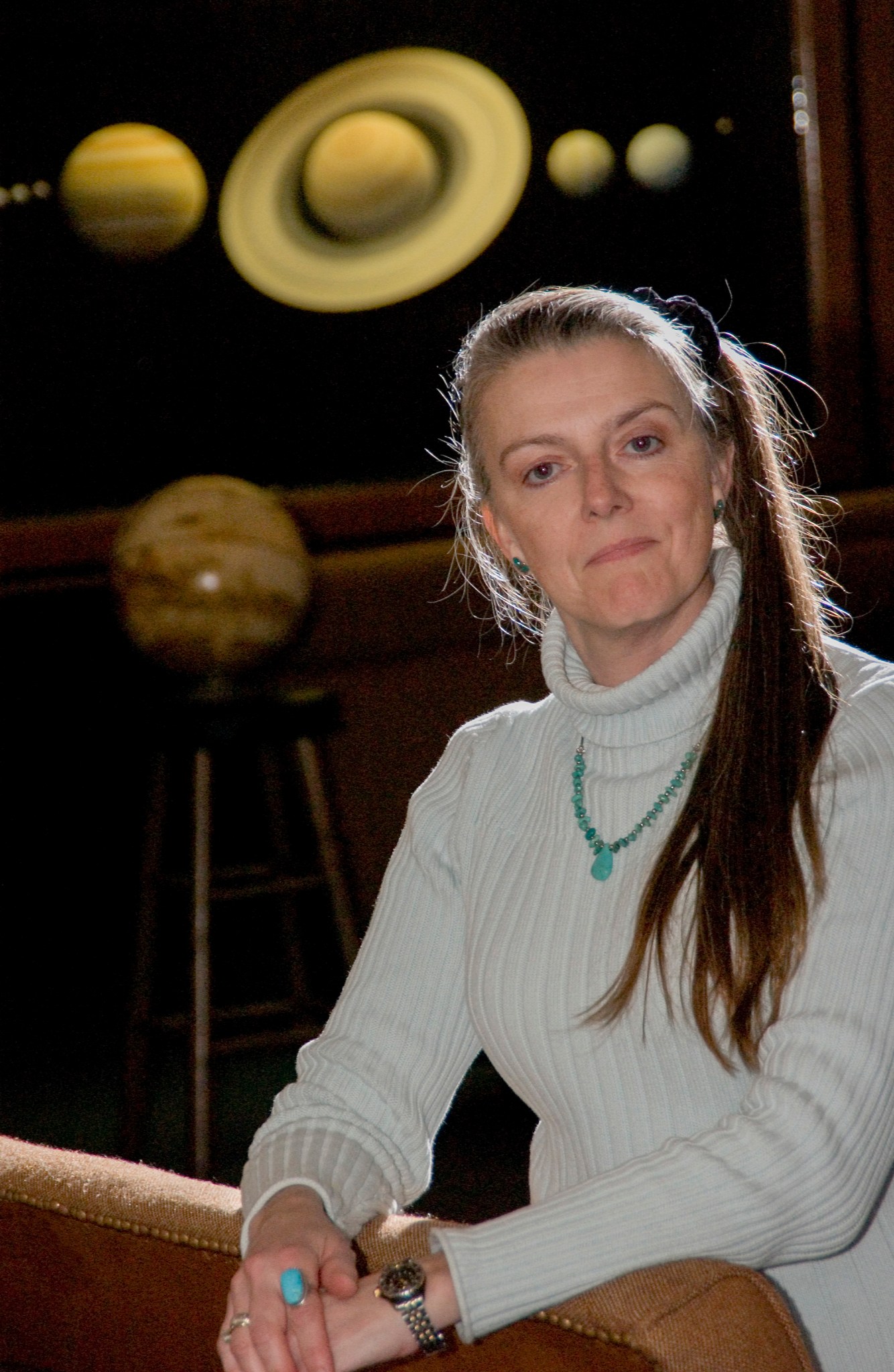
Today, Adams is a NASA scientist at the agency’s Marshall Space Flight Center. She is the assistant manager of the Heliophysics and Planetary Science branch of the Science and Technology Office. And while she doesn’t have an office on the Moon, she does see a path for future scientists and explorers to reach that destination.
Mitzi Adams is a NASA scientist at the agency’s Marshall Space Flight Center. She is the assistant manager of the Heliophysics and Planetary Science branch of the Science and Technology Office, where she is responsible for the day-to-day operations of the branch.
NASA/Emmett Givens
“We are on the cusp of landing another human on the Moon for the first time in more than 50 years,” said Adams, who has worked at NASA for 35 years. “This time, however, there is a desire for a sustained presence, as well as a renewed interest in scientific research and discovery. If I were a high school student today, I feel that there would be a high probability that at least one of my offices would be located on the Moon in the not-too-distant future. There are many possibilities for this generation of students to be heavily involved in human space exploration. This is truly exciting.”
Heliophysics encompasses the study of the Sun and its effects on Earth, the solar system, and space itself. With the focus on the upcoming total solar eclipse April 8, Adams said participating and organizing NASA outreach events for the 2017 eclipse is one of the proudest moments of her career.
“We partnered with the city of Hopkinsville, Kentucky, Austin Peay State University, the U.S. Space & Rocket Center, and The INSPIRE Project to involve high school students and the public in observations and science experiments surrounding the 2017 solar eclipse,” said Adams, who is from Atlanta, Georgia. “We presented science topics to the students and allowed them to choose their observation site, based on their interests. In the intervening years since the eclipse, those INSPIRE Project students have been extremely successful, both in academics and in the business world. One of those students graduated from the Air Force Academy in 2022. That student is currently in flight school and expects to earn her wings in the next couple of months. We like to think that we were a positive influence on her and that the eclipse inspired her to obtain a STEM degree.”
Question: What excites you most about the future of human space exploration, or your NASA work, and your team’s role it?
Adams: For the safety of astronauts who will remain on the surface of a world devoid of a protective atmosphere, as well as when traveling between the Earth and the Moon (or Mars), it is imperative that we understand better the Sun and space weather. To date, through a fleet of spacecraft studying the Sun, we have made great strides in nowcasting solar events, such as flares and coronal-mass ejections. In addition, through a sounding-rocket program, our scientists have contributed to basic knowledge of solar physics and are beginning to unravel the puzzle surrounding magnetic-reconnection events in the solar atmosphere that may be causing flares and coronal-mass ejections.
Question: Who or what drives/motivates you?
Adams: Many things. As a teenager, I was inspired by Edgar Mitchell, lunar-module pilot on Apollo 14, whom I met and pestered throughout his life. He never discouraged me from my goals and always encouraged. I have always been a science fiction fan. I think my first science fiction book as a third-grade student was “Have Space Suit – Will Travel,” by Robert Heinlein. So, it was only natural that I became a Star Trek fan. From Star Trek, I was inspired by Nichelle Nichols, who played Lt. Uhura, and Leonard Nimoy, who played Mr. Spock, a science officer.
When I speak to students, I ask what they think is the most important attribute of a scientist. The answer I seek from them is curiosity – puzzles and mysteries drive and motivate me. Observing the Sun, I have seen eruptions and phenomena that I want to understand, which drives me to access those data and do the analysis!
Question: Who or what inspired you to pursue an education/career that led you to NASA and Marshall?
Adams: I’ve always wanted to be a scientist and I could have studied geology or astronomy. Since becoming an astronaut also was a goal, I decided that astronomy would be the best path. Specifically, as I was about to obtain my undergraduate degree from Georgia State University, I thought I needed internship experience. Since one of my caving friends, Joe Dabbs, worked at Marshall, I asked if he knew anyone who might need a summer student. Joe put me in touch with Ron Moore with NASA and Gordon Emslie of the University of Alabama in Huntsville (UAH), who hired me for the summer. They apparently were pleased with my work because they suggested I apply to UAH for graduate school and to the graduate co-op program. I was accepted by both and earned a master’s degree in physics from UAH, after which I was hired by Marshall as a research scientist in solar physics.
Question: What advice do you have for employees early in their NASA career or those in new leadership roles?
Adams: Networking is important. Engage with colleagues at meetings and seek out collaborations. Read research papers and contact those scientists who are included in the references list. Don’t be intimidated by scientists who have a lot of experience. If a problem/question in your research world is appealing, find ways you can contribute to finding solutions and ask the first or second author scientist if you can help.
Question: What do you enjoy doing with your time while away from work?
Adams: Believe it or not, I enjoy reading Latin in small doses and have read two of the Harry Potter books in Latin, with help from two friends. I also enjoy hiking on trails, playing with my 3-year-old white Shepherd named Albus, which means white in Latin, and reading and watching science fiction.
Smith, a Media Fusion employee and the Marshall Star editor, supports the Marshall Office of Communications.
Steven Wofford Named Manager of SLS Stages Office at Marshall
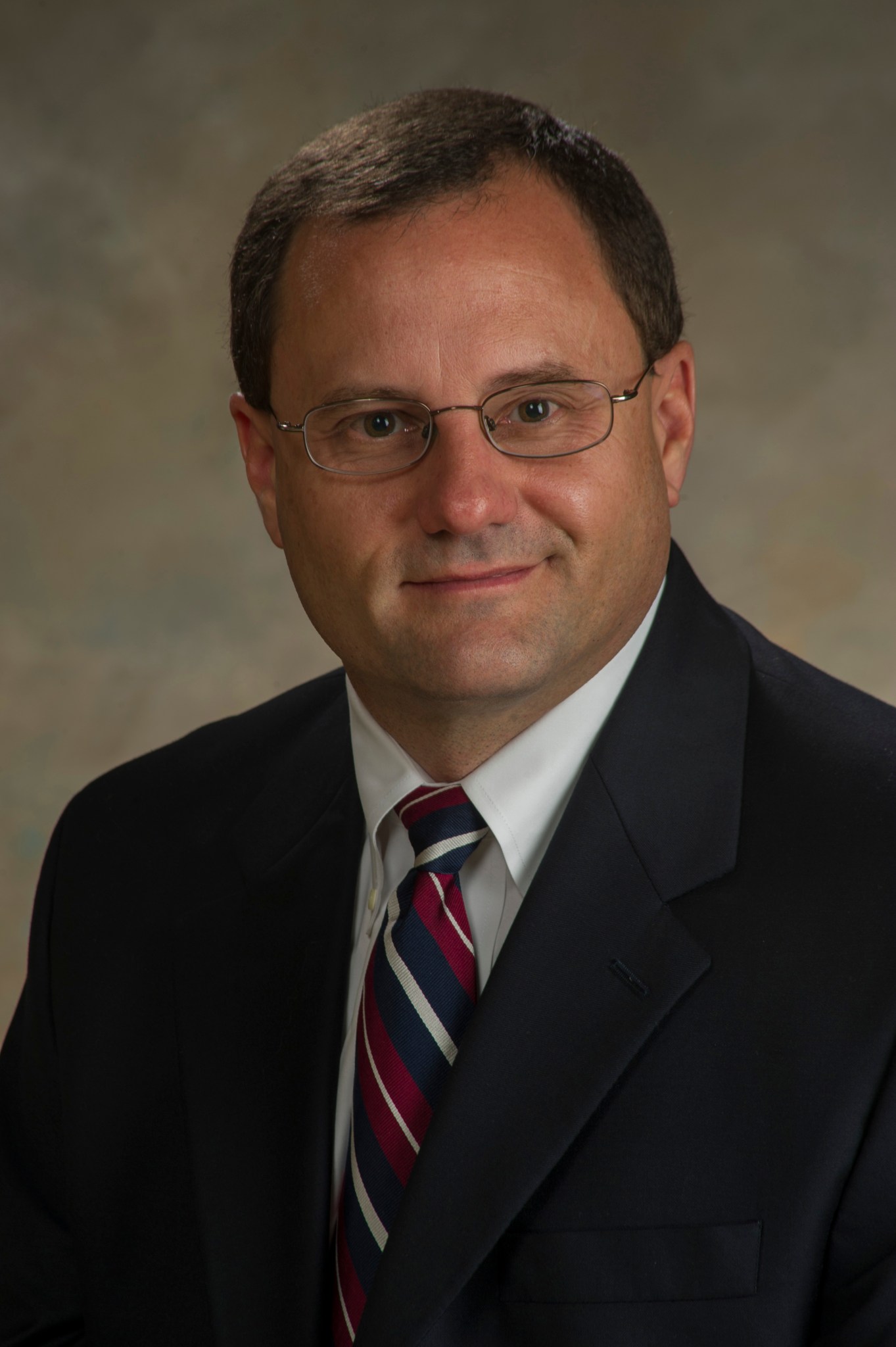
Steven J. (Steve) Wofford has been named to the Senior Executive Service position of manager of the SLS (Space Launch System) Stages Office at NASA’s Marshall Space Flight Center.
In his new role, he will lead activities and operations associated with the core stage, associated main propulsion systems, and integration of the vehicle avionics system. Wofford also will be responsible for support equipment and facilities used in the design, development, test, and transfer of SLS core stages. He previously was appointed as manager of the Block 1B/Exploration Upper Stage Development Office at Marshall in 2020.
Steven J. (Steve) Wofford has been named to the Senior Executive Service position of manager of the SLS (Space Launch System) Stages Office at NASA’s Marshall Space Flight Center.
NASA
From 2014 to 2020, Wofford was manager of the SLS Program’s Liquid Engines Office at Marshall. From 2012 to 2014, he was deputy director of Marshall’s Safety and Mission Assurance Directorate, where he was responsible for overseeing safe execution of all center programs, projects, and institutional services. He was business manager for the Safety and Mission Assurance Directorate from 2011 to 2012.
From 2009 to 2011, Wofford was deputy manager of the Space Shuttle Main Engine Project Office at Marshall, helping to see the shuttle program to its successful conclusion in 2011. He was Shuttle Propulsion chief safety officer for the Safety and Mission Assurance Directorate from 2006 to 2009, formulating and communicating flight safety guidance and serving as Marshall’s safety technical authority on a wide gamut of propulsion technical issues.
In 2005 and 2006, he led engine component design and development for engine technologies supporting the Ares I and Ares V launch vehicles, next-generation rocket development programs that helped inform work resulting in the design, delivery, and manufacture of SLS engine systems.
Wofford began his NASA career in 2000 as a subsystem manager in Marshall’s Space Shuttle Main Engine Project Office. Before that, he supported the agency for more than 13 years as a contractor engineer, conducting assessment engineering and project integration engineering duties in support of the space shuttle main engine.
A Huntsville native, Wofford earned a bachelor’s degree in mechanical engineering in 1986 from the University of Alabama, and a master’s degree in aerospace engineering in 1991 from the University of Alabama in Huntsville.
His numerous career honors include a NASA Exceptional Achievement Medal in 2009 for his leadership in defining, implementing, and executing safety and mission assurance technical authority for the Space Shuttle Program. He also received a NASA Silver Snoopy Award in 1998, presented to team members who have made significant contributions to the human spaceflight program; and a Spaceflight Awareness Award in 1992 for his contributions as a contractor to the space shuttle main engine. In 2018, he was named a distinguished fellow of the University of Alabama in Tuscaloosa’s College of Engineering.
Wofford and his wife, Marisa, reside in Huntsville and have two sons.
Marshall’s Women of Excellence Host Author for Women’s History Month Event
The Women of Excellence employee resource group at NASA’s Marshall Space Flight Center hosted an event March 18 in association with Women’s History Month.
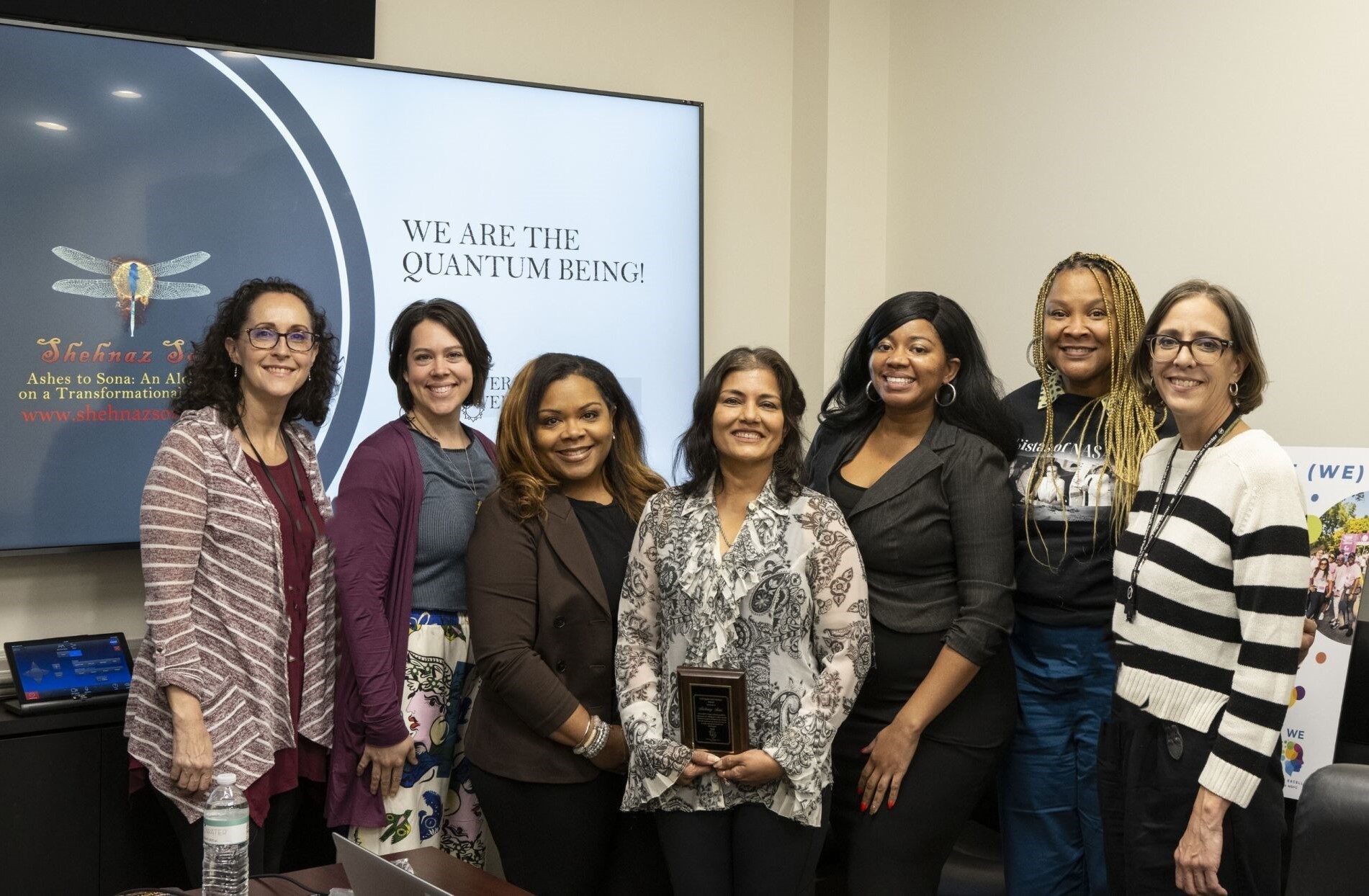
Shehnaz Soni, center, a NASA senior systems engineer, author, and speaker, smiles with Women of Excellence members following her March 18 presentation to the employee resource group at NASA’s Marshall Space Flight Center. The event was a part of Women’s History Month in March. From left are Kristina Honeycutt, Leah Varner, Denise Smithers, Soni, LaBreesha Batey, Aquita Wherry, and Anastasia Byler.
NASA/Danielle Burleson
The event, titled “Self-Ignite into Destiny: A Pivot from Stressful Environments,” was part of NASA’s agencywide table-talk series.
Shehnaz Soni, a NASA senior systems engineer, author, and speaker, discussed her story, methodologies to reduce stress, and the importance of self-care in a unique way, reiterating that “We Are the Quantum Being.”
Women of Excellence, or WE, is co-chaired by LaBreesha Batey and Denise Smithers. The group’s aim is to help Marshall women reach their full potential and have access to equal opportunities at NASA. Team members can visit Inside Marshall to learn more about WE and other employee resource groups.
Mission Success is in Our Hands is a safety initiative collaboration between NASA’s Marshall Space Flight Center and Jacobs. As part of the initiative, eight Marshall team members are featured in testimonial banners placed around the center. This is the fifth in a Marshall Star series profiling team members featured in the testimonial banners. The Mission Success team also awards the Golden Eagle Award on a quarterly basis to Marshall and contractor personnel who are nominated by their peers or management. Candidates for this award have made significant, identifiable contributions that exceed normal job expectations to advance flight safety and mission assurance. Nominations are open now to team members online at Inside Marshall.
Amit Patel is a Jacobs Space Exploration Group solid rocket motor design engineer supporting NASA’s Marshall Space Flight Center.
NASA/Charles Beason
Amit Patel is a Jacobs Space Exploration Group solid rocket motor design engineer supporting Marshall, where he has produced multiple iterations for solid rocket motors on NASA’s Mars Ascent Vehicle and performed motor internal ballistics analysis on Space Launch System boosters and other programs. His key responsibilities include designing solid rocket motor grains, ensuring launch vehicles can meet mission requirements through ballistics performance analysis, manufacturing process flow, and testing.
Patel has worked at Marshall for three years. He previously was a research engineer at the University of Alabama in Huntsville’s Propulsion Research Center, where he worked on design and hot-fire testing of solid, liquid, and hybrids motors and developed a testbed for electric propulsion thrusters for small satellites. A North Alabama native, Patel earned his doctorate in aerospace systems engineering from the University of Alabama in Huntsville, along with a Master of Business Administration.
Question: How does your work support the safety and success of NASA and Marshall missions?
Patel: My work directly contributes to the success of NASA and Marshall missions by ensuring that solid rocket motors are designed to meet the stringent performance and reliability requirements necessary for achieving target orbital insertions. Through careful motor optimization, requirements management, and post-test data analysis I can help maximize the probability of mission success.
Question: What does the Mission Success is in Our Hands initiative mean to you?
Patel: Overall, the Mission Success is in Our Hands initiative reminds us that whatever role we play, we all are an integral part in the technical excellence and unwavering dedication to safety in the pursuit of NASA’s mission objectives. It serves as a reminder that the success of every mission is contingent upon the collective efforts and commitment of every individual involved, from engineers and scientists to administrators and support staff.
Question: How can we work together better to achieve mission success?
Patel: By prioritizing relationship-building within the team, we can harness the collective talents, creativity, and resilience of individuals to overcome engineering obstacles and contribute to the success of complex missions. We can build this synergy through enhanced communication, mutual respect and trust in one another, a shared understanding of goals and vision, and effective problem-solving when faced with challenges.
Question: Do you have anything else you’d like to share?
Patel: The work we do in the aerospace industry has far-reaching implications that extend beyond the confines of Earth’s atmosphere. By pushing the boundaries of exploration, innovation, and collaboration, we strive to leave a lasting legacy of progress and discovery that will benefit future generations and inspire them to reach even greater heights.
Smith, a Media Fusion employee and the Marshall Star editor, supports the Marshall Office of Communications.
Panelists Highlight Centennial Challenges at South by Southwest Conference
South by Southwest chose to feature a panel discussion on NASA’s Prizes, Challenges, and Crowdsourcing program at this year’s conference and festival in Austin, Texas, on March 10.
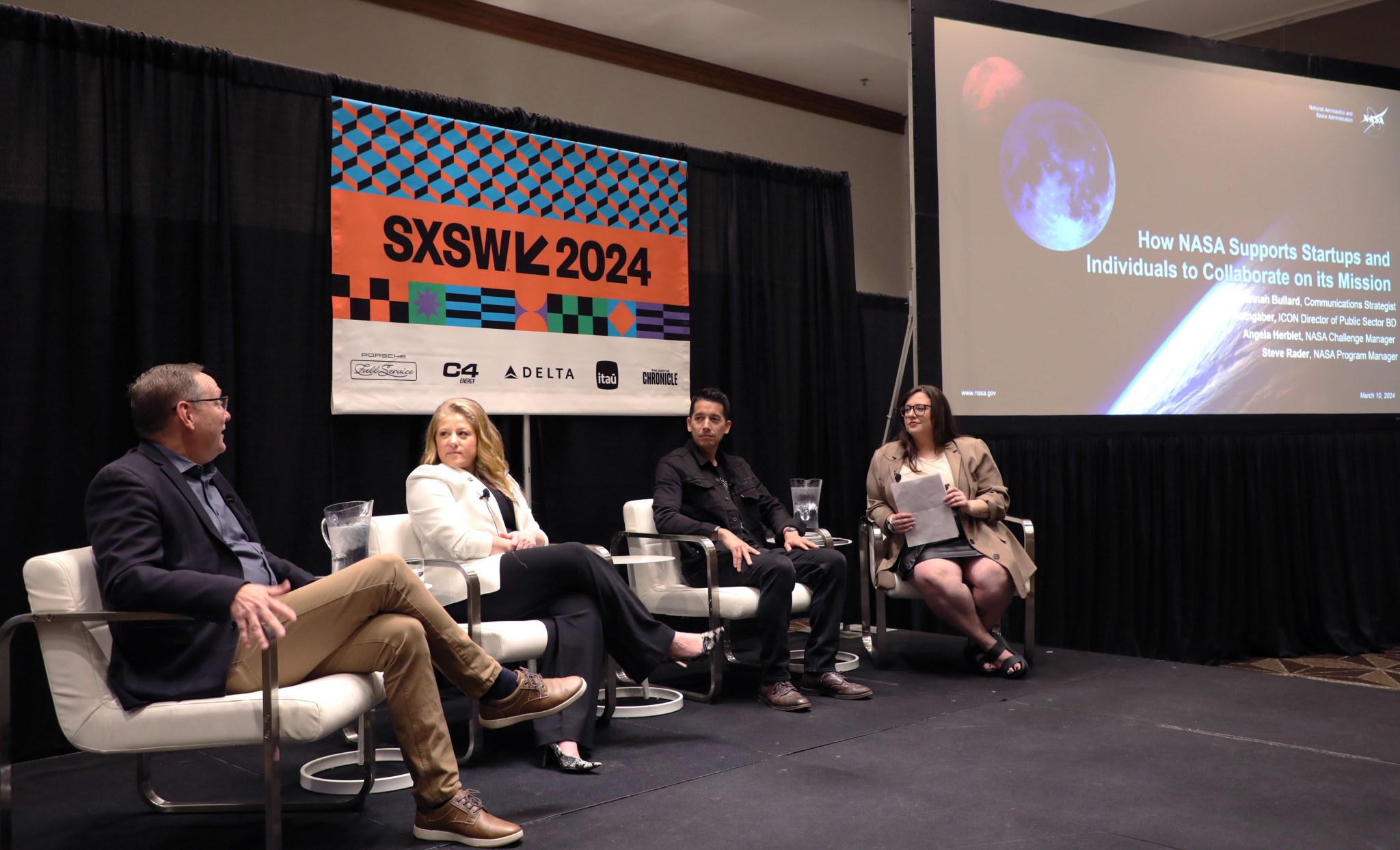
Panelists from NASA’s Marshall Space Flight Center, the agency’s Johnson Space Center, and ICON Technology Inc. gave a presentation titled, “How NASA Supports Startups and Individuals to Collaborate on its Mission.” The panel touched on several notable success stories from Centennial Challenges, the Center of Excellence for Collaborative Innovation, and NASA Tournament Lab, including ICON’s journey from competing in NASA’s 3D-Printed Habitat Challenge to securing multiple contracts and partnerships.
From left, panelists Steve Rader from NASA’s Johnson Space Center, Angela Herblet from the agency’s Marshall Space Flight Center, Andrew Rothgaber from ICON Technology, and Savannah Bullard from Marshall discuss NASA’s Prizes, Challenges, and Crowdsourcing program at the South by Southwest Conference on March 10 in Austin, Texas.
Centennial Challenges were initiated in 2005 to directly engage the public in the process of advanced technology development. The program offers incentive prizes to generate revolutionary solutions to problems of interest to NASA and the nation. The program seeks innovations from diverse and non-traditional sources. Competitors are not supported by government funding and awards are only made to successful teams when the challenges are met.
The annual South by Southwest Conference celebrates the convergence of technology, film and television, music, education, and culture.
Shuttle, Family Inspire NASA’s Cryogenic Technology Manager
By Daniel Boyette
Jeremy Kenny squinted his eyes as he looked toward the brilliant light. Then came the deafening sound waves that vibrated his body. This was the moment he’d dreamed about since childhood.
It was Nov. 16, 2009, at NASA’s Kennedy Space Center, and Kenny and his wife were watching space shuttle Atlantis embark on a mission to the International Space Station. Kenny, who was less than two years into his NASA career, had the opportunity to see the liftoff from Launch Pad 39A as part of receiving the Space Flight Awareness Award for supporting the Space Shuttle Program’s solid rocket booster flight program.
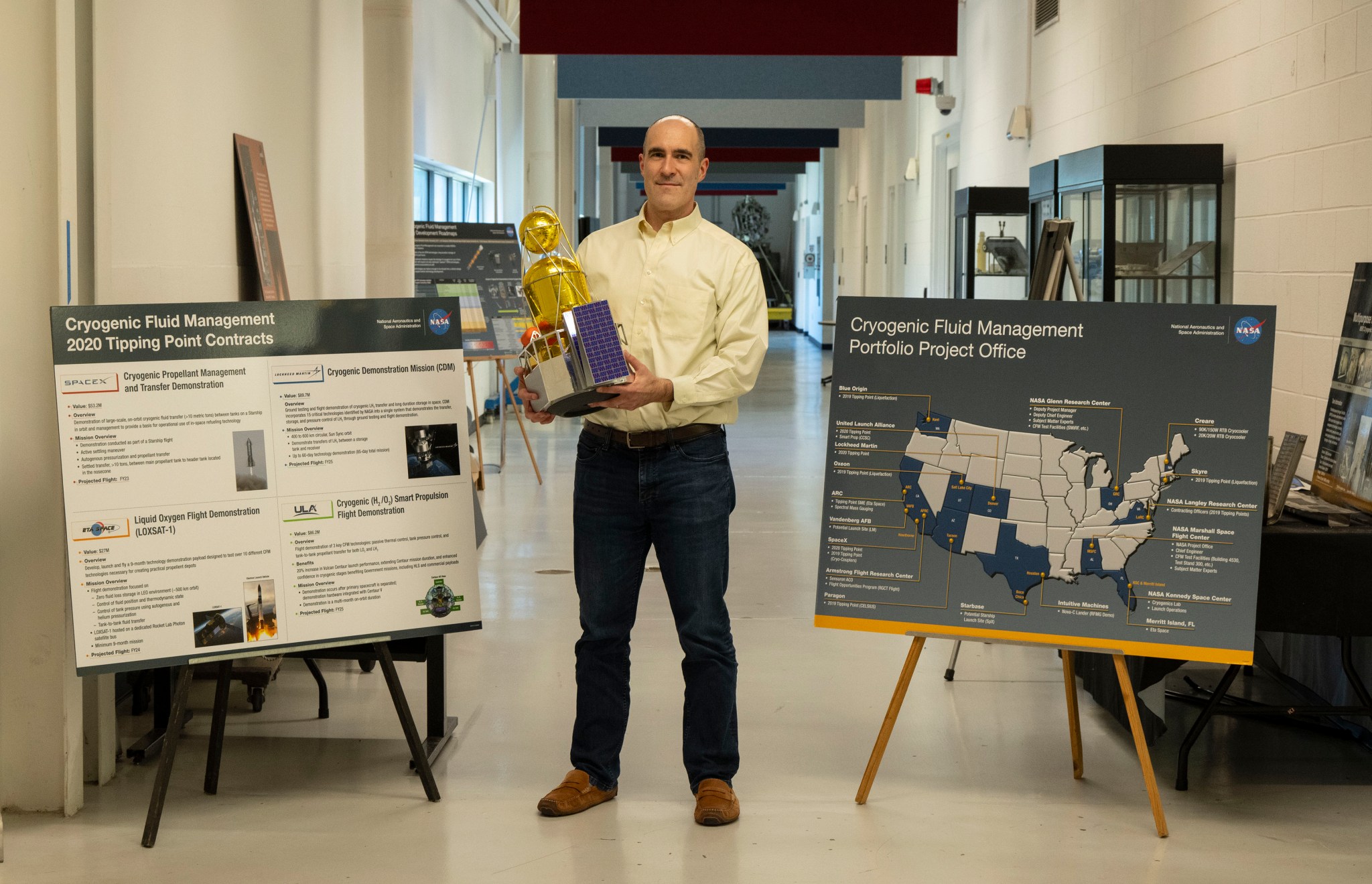
Jeremy Kenny, manager of NASA’s Cryogenic Fluid Management Portfolio Project, holds a model spacecraft for the proposed large cryogenic demonstration mission. The mission aims to demonstrate liquid hydrogen management, including near-zero propellant boil off and highly efficient propellant transfer, needed to achieve long-duration transit to/from Mars and spacecraft loitering during on-surface campaigns.
Credit: NASA/Danielle Burleson
“That was the first launch I ever witnessed in person,” said Kenny, whose inspiration for working at NASA came from watching televised shuttle launches as a youth. “It was amazing and made me appreciate how such a powerful system could be designed and flown so successfully.”
With the final shuttle mission two years later, NASA set its sights on designing and building its future Artemis rocket: SLS (Space Launch System). Kenny was selected to lead the SLS Modal Acoustic Test program, which helped engineers understand how loud the rocket would be during liftoff. He later joined another key Artemis effort, the human landing system program, as a technical manager, overseeing the development of lander systems that will transport astronauts to the Moon’s surface.
“Artemis is an inspiring campaign for future human spaceflight exploration,” Kenny said. “I worked with SLS, Orion, and Exploration Ground Systems, and it was very fulfilling to see all the pieces come together for the successful Artemis I launch.”
In January, Kenny was named manager of NASA’s Cryogenic Fluid Management (CFM) Portfolio project, where he oversees a cross-agency team based at NASA’s Marshall Space Flight Center and Glenn Research Center. The CFM portfolio includes innovative technologies to store, transfer, and measure ultra-cold fluids – such as liquid hydrogen, liquid oxygen, and liquid methane. These cryogens are the most common propellants in space exploration, making CFM integral to NASA’s future exploration and science efforts.
“We must mature CFM technologies to support future flight mission architectures,” said Kenny. “The strong partnership between Marshall and Glenn in CFM maturation continues to produce excellent results, enabling in-space cryogenic systems vital to NASA’s Moon to Mars vision.”
Kenny’s choice of profession comes as little surprise, given his family background. He had a grandfather and an uncle who worked with the U.S. Army Corps of Engineers in the family’s hometown of Vicksburg, Mississippi. From them, Kenny learned how math and physics could be implemented in real-world applications. He earned three degrees in mechanical engineering: a bachelor’s from Mississippi State University in Starkville, a master’s from Georgia Tech in Atlanta, and a doctorate from the University of Alabama in Huntsville.
“My grandfather showed me various engineering software programs he worked on to simulate ground terrains for military transportation systems,” Kenny said. “My uncle worked on engineering developments for various military systems; he was a key influence for me to pursue graduate degrees in mechanical engineering.”
When Kenny’s not working to evolve technology for NASA’s future deep space exploration missions, he’s spending time with his wife and their two daughters, who are involved in choir and dance.
“Watching them practice and perform inspires me,” Kenny said with a smile. “My biggest challenge is balancing my professional work, which I love, and spending time with my family, who I love. With work comes many exciting opportunities, and solving hard problems is fun. But that excitement should not detract from keeping your personal relationships healthy. One day, I’ll retire and spend all my free time with family.”
The CFM Portfolio Project’s work is under NASA’s Technology Demonstration Missions Program, part of NASA’s Space Technology Mission Directorate, which oversees a broad portfolio of technology development and demonstration projects across NASA centers and American industry partners.
Boyette, a Media Fusion employee, supports the Cryogenic Fluid Management Portfolio Project and Marshall’s Office of Strategic Analysis & Communications.
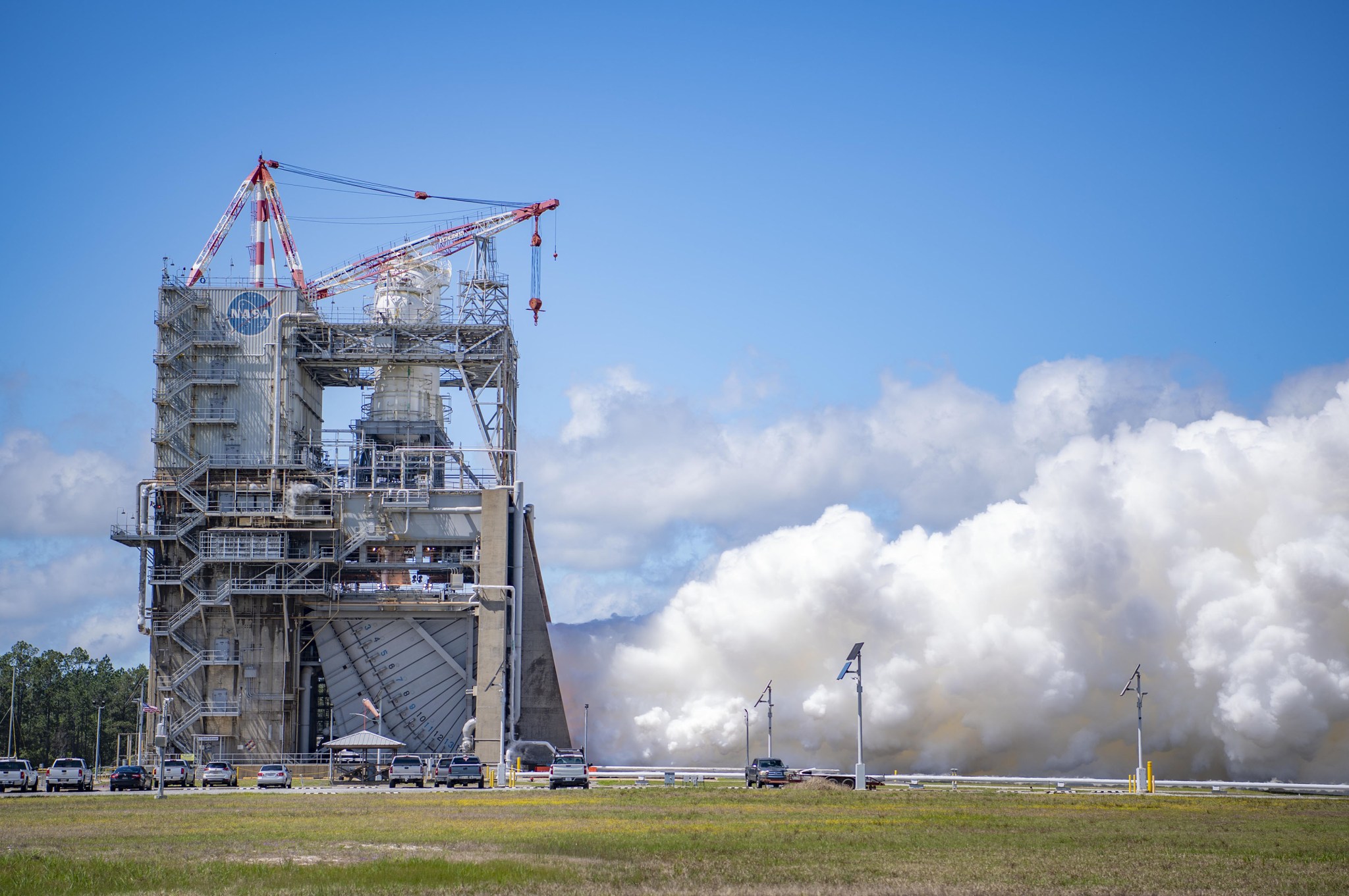
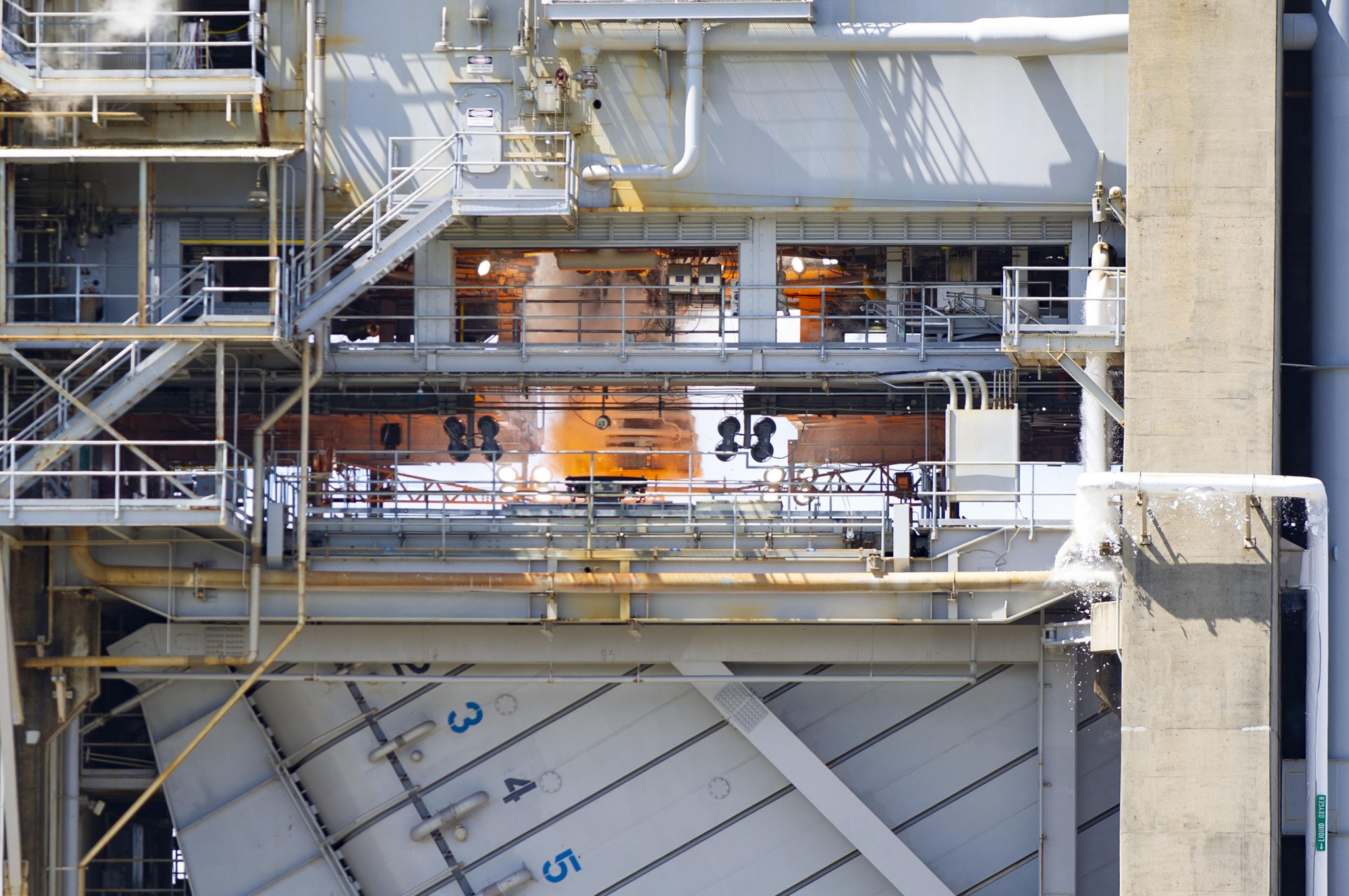
NASA continued a key RS-25 engine test series for future Artemis flights of the agency’s powerful SLS (Space Launch System) rocket March 22 and March 27 with hot fires on the Fred Haise Test Stand at NASA’s Stennis Space Center.
NASA continued a key RS-25 engine test series for future Artemis flights of the agency’s powerful SLS (Space Launch System) rocket March 22 with a hot fire on the Fred Haise Test Stand at NASA’s Stennis Space Center.
NASA/Danny Nowlin
The tests marked the 10th and 11th hot fire in a 12-test series to certify production of new RS-25 engines by lead contractor Aerojet Rocketdyne, an L3 Harris Technologies company.
On March 22, the Stennis test team fired the certification engine for 500 seconds, or the same amount of time engines must fire to help launch the SLS rocket to space with astronauts aboard the Orion spacecraft. Operators powered the engine up to a level of 113%, which is beyond the 111% power level new RS-25 engines use to provide additional thrust. Testing up to the 113% power level provides a margin of operational safety.
Newly produced engines will power NASA’s SLS rocket on Artemis missions to the Moon and beyond, beginning with Artemis V. For Artemis missions I-IV, NASA and Aerojet Rocketdyne modified 16 former space shuttle engines for use on the SLS rocket. Four RS-25 engines fire simultaneously to help launch each SLS rocket, producing up to 2 million pounds of combined thrust.
The Stennis test team fired the certification engine March 22 for 500 seconds, or the same amount of time engines must fire to help launch the SLS rocket to space with astronauts aboard the Orion spacecraft.
NASA/Danny Nowlin
NASA’s Marshall Space Flight Center manages the SLS Program.
Through Artemis, NASA will establish the foundation for long-term scientific exploration at the Moon, land the first woman, first person of color, and first international partner astronaut on the lunar surface, and prepare for human expeditions to Mars for the benefit of all. RS-25 tests at NASA Stennis are conducted by a diverse team of operators from NASA, Aerojet Rocketdyne, and Syncom Space Services, prime contractor for site facilities and operations.
Payload Adapter Testing: A Key Step for Artemis IV Rocket’s Success
A test article of the SLS (Space Launch System) rocket’s payload adapter is ready for evaluation, marking a critical milestone on the journey to the hardware’s debut on NASA’s Artemis IV mission.
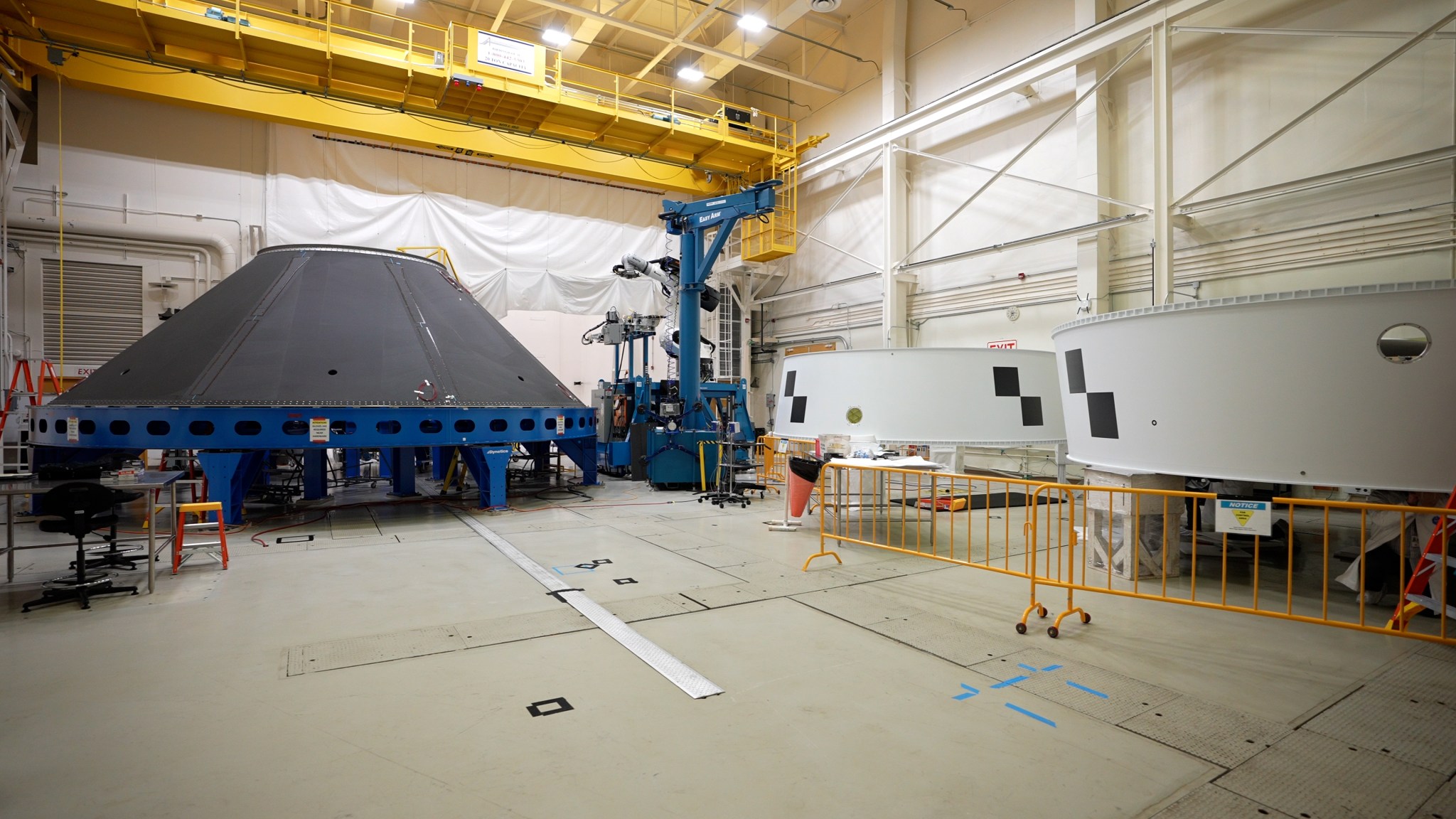
Comprised of two metal rings and eight composite panels, the cone-shaped payload adapter will be part of the SLS Block 1B configuration and housed inside the universal stage adapter atop the rocket’s more powerful in-space stage, called the exploration upper stage. The payload adapter is an evolution from the Orion stage adapter used in the Block 1 configuration of the first three Artemis missions that sits at the topmost portion of the rocket and helps connect the rocket and spacecraft.
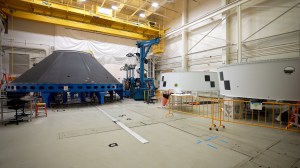
Key adapters for the first crewed Artemis missions are manufactured at NASA’s Marshall Space Flight Center. The cone-shaped payload adapter, left, will debut on the Block 1B configuration of the SLS rocket beginning with Artemis IV, while the Orion stage adapters, right, will be used for Artemis II and Artemis III.
NASA/Sam Lott
“Like the Orion stage adapter and the launch vehicle stage adapter used for the first three SLS flights, the payload adapter for the evolved SLS Block 1B configuration is fully manufactured and tested at NASA’s Marshall Space Flight Center,” said Casey Wolfe, assistant branch chief for the advanced manufacturing branch at Marshall. “Marshall’s automated fiber placement and large-scale integration facilities provide our teams the ability to build composite hardware elements for multiple Artemis missions in parallel, allowing for cost and schedule savings.”
At about 8.5 feet tall, the payload adapter’s eight composite sandwich panels, which measure about 12 feet each in length, contain a metallic honeycomb-style structure at their thickest point but taper to a single carbon fiber layer at each end. The panels are pieced together using a high-precision process called determinant assembly, in which each component is designed to fit securely in a specific place, like puzzle pieces.
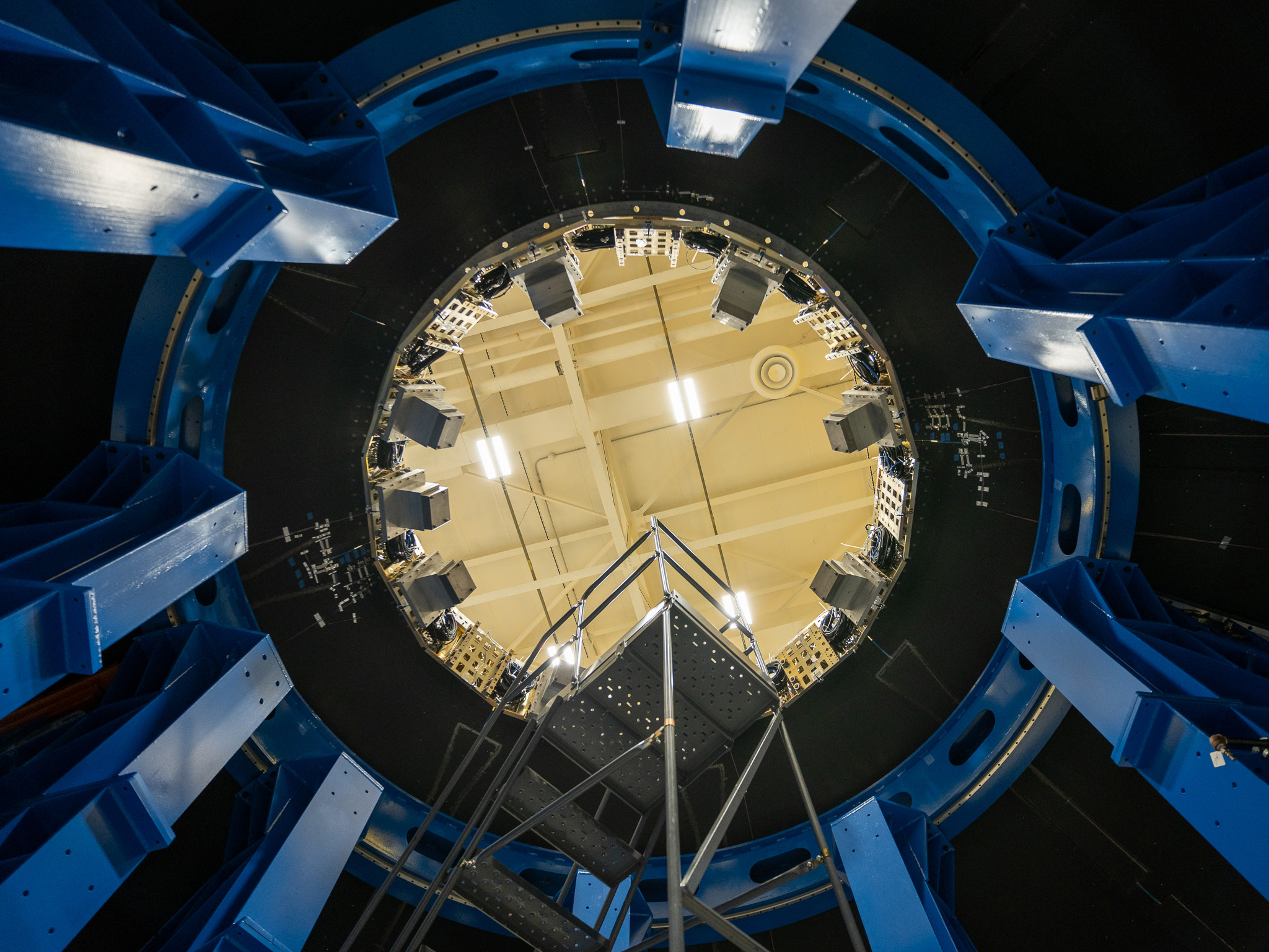
Teams at Marshall manufactured, prepared, and moved the payload adapter test article. The payload adapter will undergo testing in the same test stand that once housed the SLS liquid oxygen tank structure test article.
NASA
After manufacturing, the payload adapter will also be structurally tested at Marshall, which manages the SLS Program. The first structural test series begins this spring. Test teams will use the engineering development unit – an exact replica of the flight version of the hardware – to check the structure’s strength and durability by twisting, shaking, and applying extreme pressure.
While every Block 1B configuration of the SLS rocket will use a payload adapter, each will be customized to fit the mission’s needs. The determinant assembly method and digital tooling ensure a more efficient and uniform manufacturing process, regardless of the mission profile, to ensure hardware remains on schedule. Data from this test series will further inform design and manufacturing processes as teams begin manufacturing the qualification and flight hardware for Artemis IV.
NASA is working to land the first woman, first person of color, and its first international partner astronaut on the Moon under Artemis. SLS is part of NASA’s backbone for deep space exploration, along with the Orion spacecraft and Gateway in orbit around the Moon and commercial human landing systems, next-generational spacesuits, and rovers on the lunar surface. SLS is the only rocket that can send Orion, astronauts, and supplies to the Moon in a single launch.
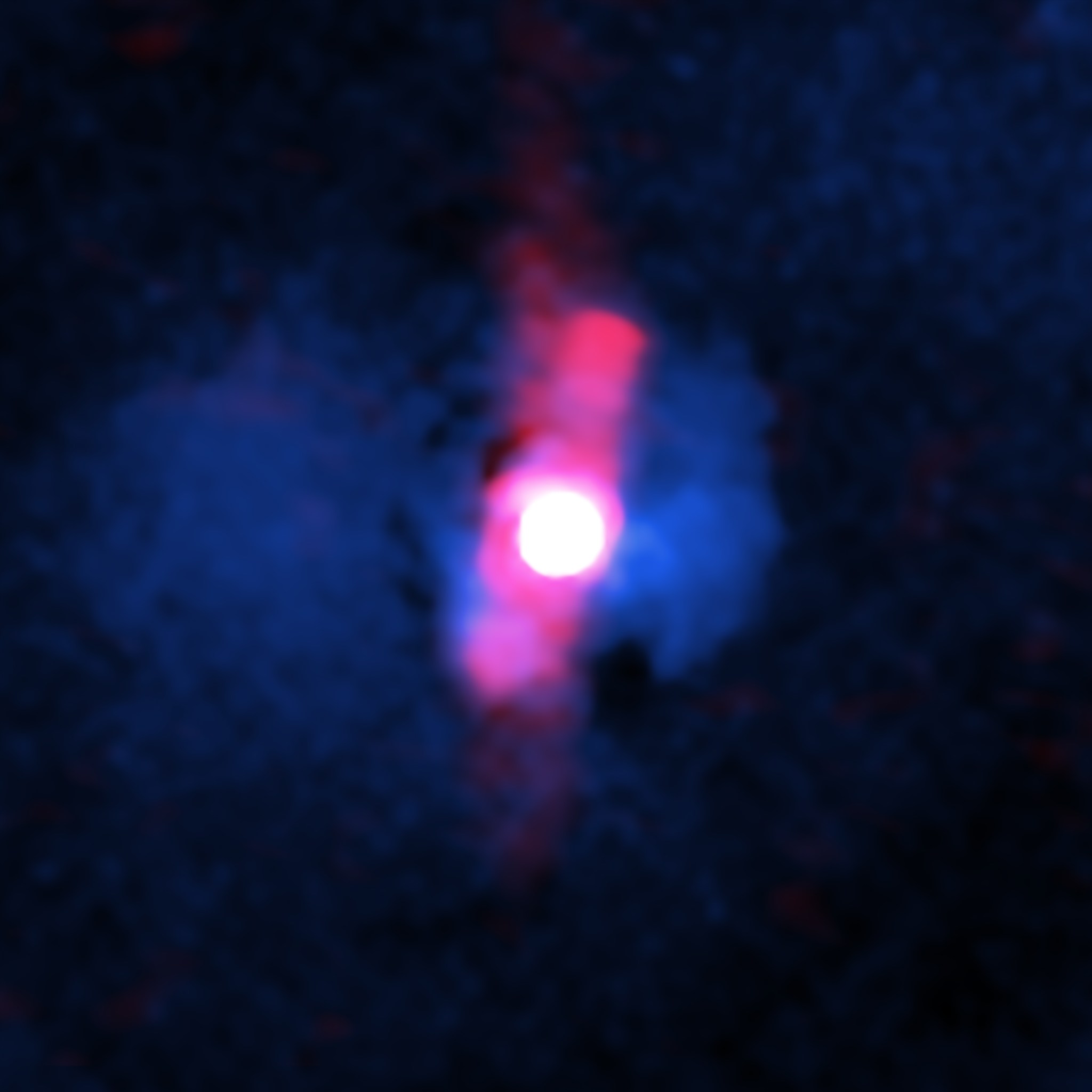
A new image shows a quasar, a rapidly growing supermassive black hole, which is not achieving what astronomers would expect from it, as reported in a press release. Data from NASA’s Chandra X-ray Observatory (blue) and radio data from the NSF’s Karl G. Jansky’s Very Large Array (red) reveal some of the evidence for this quasar’s disappointing impact on its host galaxy.
Known as H1821+643, this quasar is about 3.4 billion light-years from Earth. Quasars are a rare and extreme class of supermassive black holes that are furiously pulling material inwards, producing intense radiation and sometimes powerful jets. H1821+643 is the closest quasar to Earth in a cluster of galaxies.
This composite image shows a quasar, a rare and extreme class of supermassive black hole. Known as H1821+643, this quasar is about 3.4 billion light-years from Earth.
X-ray: NASA/CXC/Univ. of Nottingham/H. Russell et al.; Radio: NSF/NRAO/VLA; Image Processing: NASA/CXC/SAO/N. Wolk
Quasars are different than other supermassive black holes in the centers of galaxy clusters in that they are pulling in more material at a higher rate. Astronomers have found that non-quasar black holes growing at moderate rates influence their surroundings by preventing the intergalactic hot gas from cooling down too much. This regulates the growth of stars around the black hole.
The influence of quasars, however, is not as well known. This new study of H1821+643 that quasars – despite being so active – may be less important in driving the fate of their host galaxy and cluster than some scientists might expect.
To reach this conclusion the team used Chandra to study the hot gas that H1821+643 and its host galaxy are shrouded in. The bright X-rays from the quasar, however, made it difficult to study the weaker X-rays from the hot gas. The researchers carefully removed the X-ray glare to reveal what the black hole’s influence is, which is reflected in the new composite image showing X-rays from hot gas in the cluster surrounding the quasar. This allowed them to see that the quasar is actually having little effect on its surroundings.
Using Chandra, the team found that the density of gas near the black hole in the center of the galaxy is much higher, and the gas temperatures much lower, than in regions farther away. Scientists expect the hot gas to behave like this when there is little or no energy input (which would typically come from outbursts from a black hole) to prevent the hot gas from cooling down and flowing towards the center of the cluster.
A paper describing these results has been accepted into the Monthly Notices of the Royal Astronomical Society and is available online. The authors are Helen Russell (University of Nottingham, UK), Paul Nulsen (Center for Astrophysics | Harvard & Smithsonian), Andy Fabian (University of Cambridge, UK), Thomas Braben (University of Nottingham), Niel Brandt (Penn State University), Lucy Clews (University of Nottingham), Michael McDonald (Massachusetts Institute of Technology), Christopher Reynolds (University of Maryland), Jeremy Saunders (Max Planck Institute for Extraterrestrial Research), and Sylvain Veilleux (University of Maryland).
NASA’s Marshall Space Flight Center manages the Chandra program. The Smithsonian Astrophysical Observatory’s Chandra X-ray Center controls science from Cambridge Massachusetts and flight operations from Burlington, Massachusetts.
OSIRIS-REx Mission Awarded Robert Goddard Memorial Trophy
NASA’s OSIRIS-REx team was selected as the winner of the National Space Club and Foundation’s 2024 Dr. Robert H. Goddard Memorial Trophy for their tremendous work on the first U.S. mission to bring an asteroid sample to Earth. The winning team received the award at the 67th Annual Robert H. Goddard Memorial Dinner at the Washington Hilton Hotel on March 22.
The OSIRIS-REx (Origins, Spectral Interpretation, Resource Identification, and Security – Regolith Explorer) team includes NASA’s Goddard Space Flight Center, Maryland; Lockheed Martin in Littleton, Colorado; University of Arizona, Tucson and KinetX in Tempe, Arizona.
The sample return capsule from NASA’s OSIRIS-REx mission is seen shortly after touching down in the desert Sept. 24, 2023, at the Department of Defense’s Utah Test and Training Range. The sample was collected from the asteroid Bennu in October 2020 by NASA’s OSIRIS-REx spacecraft.
NASA/Keegan Barber
The trophy is National Space Club’s highest honor and presented annually to the individual or group who has made a substantial contribution to U.S. leadership in astronautics or rocketry.
“The OSIRIS-REx team’s successful delivery of the asteroid Bennu sample to Earth will enable important scientific discoveries for generations to come,” said Lori Glaze, director of the Planetary Science Division at NASA Headquarters. “I’m so pleased to see the mission team recognized with the Robert H. Goddard Memorial Trophy for their accomplishments.”
The sample, which is the largest asteroid sample ever delivered to Earth, is from the ancient asteroid Bennu and will give researchers worldwide a glimpse into the earliest days of our solar system, offering insights into planet formation and the origin of organics that led to life on Earth. Data collected by the spacecraft combined with future analysis of the Bennu sample will also aid our understanding of asteroids that can impact Earth.
The OSIRIS-REx mission conducted unprecedented centimeter-scale mapping of Bennu, surpassing precision levels achieved for any other planetary body and setting three Guinness World Records for: smallest object orbited by a spacecraft, closest orbit of an asteroid and highest resolution satellite map of any planetary body.
“The OSIRIS-REx mission rewrote U.S. space exploration history,” said Joe Vealencis, president, NSCF. “The data the spacecraft collected, plus all that we have yet to uncover from the sample it brought back, means scientists and engineers will be reaping the benefits of this mission for years to come.”
Following its successful sample return, the OSIRIS-REx spacecraft was renamed OSIRIS-APEX and will now enter an extended mission to visit and study near-Earth asteroid Apophis in 2029.
OSIRIS-REx’s success was made possible by the unique contributions of over 1,000 individuals from government and mission partners like the science lead at the University of Arizona, the project team at NASA’s Goddard Space Flight Center, the curation team at NASA’s Johnson Space Center, spacecraft design, operations, and recovery by Lockheed Martin, guidance and navigation at KinetX, and the launch provider at United Launch Alliance.
OSIRIS-REx is the third mission in NASA’s New Frontiers Program, managed by NASA’s Marshall Space Flight Center for the Science Mission Directorate at NASA Headquarters.
Key Test Drive of Orion on NASA’s Artemis II to Aid Future Missions
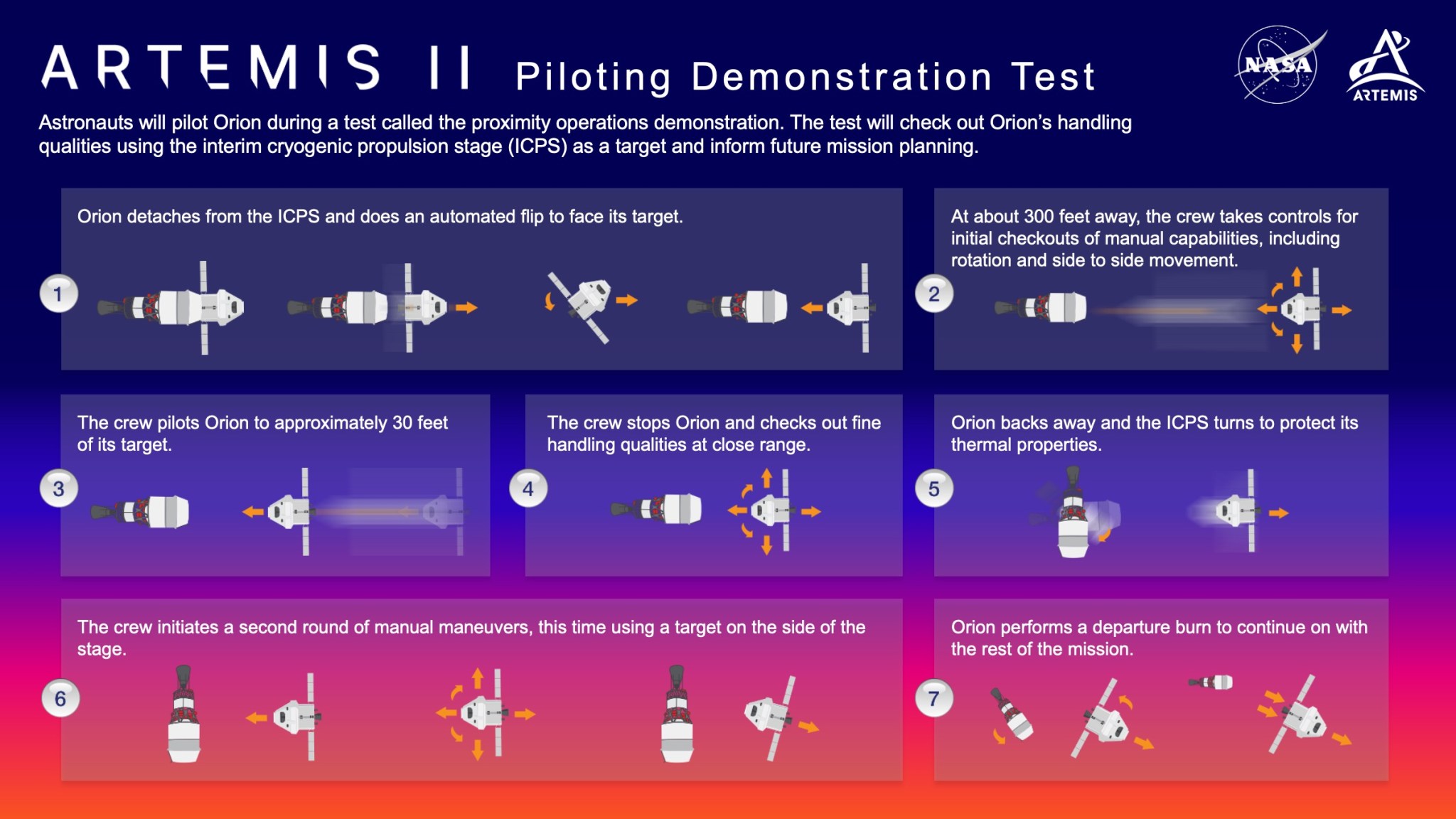
Astronauts will test drive NASA’s Orion spacecraft for the first time during the agency’s Artemis II test flight next year. While many of the spacecraft’s maneuvers like big propulsive burns are automated, a key test called the proximity operations demonstration will evaluate the manual handling qualities of Orion.
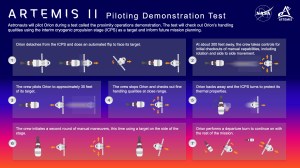
During the approximately 70-minute demonstration set to begin about three hours into the mission, the crew will command Orion through a series of moves using the detached upper stage of the SLS (Space Launch System) rocket as a mark. The in-space propulsion stage, called the interim cryogenic propulsion stage (ICPS), includes an approximately two-foot target that will be used to evaluate how Orion flies with astronauts at the controls.
“There are always differences between a ground simulation and what an actual spacecraft will fly like in space,” said Brian Anderson, Orion rendezvous, proximity operations, and docking manager within the Orion Program at NASA’s Johnson Space Center. “The demonstration is a flight test objective that helps us reduce risk for future missions that involve rendezvous and docking with other spacecraft.”
After NASA’s Reid Wiseman, Victor Glover, and Christina Koch, and CSA (Canadian Space Agency) astronaut Jeremy Hansen are safely in space, the Moon rocket’s upper stage will fire twice to put Orion on a high Earth orbit trajectory. Then, the spacecraft will automatically separate from the rocket stage, firing several separation bolts before springs push Orion a safe distance away.
As the spacecraft and its crew move away, Orion will perform an automated backflip to turn around and face the stage. At approximately 300 feet away, Orion will stop its relative motion. The crew will take control and use the translational and rotational hand controllers and display system to make very small movements to ensure Orion is responding as expected.
Next, the crew will very slowly pilot Orion to within approximately 30 feet of the stage. A two-foot auxiliary target mounted inside the top of the stage, similar to the docking target used by spacecraft visiting the International Space Station, will guide their aim.
“The crew will view the target by using a docking camera mounted inside the docking hatch window on the top of the crew module to see how well aligned they are with the docking target mounted to the ICPS,” Anderson said.
“It’s a good stand in for what crews will see when they dock with Starship on Artemis III and to the Gateway on future missions.”
About 30 feet from the stage, Orion will stop and the crew will checkout the spacecraft’s fine handling qualities to evaluate how it performs in close proximity to another spacecraft. Small maneuvers performed very close to the ICPS will be done using the reaction control system thrusters on Orion’s European Service Module.
Orion will then back away and allow the stage to turn to protect its thermal properties. The crew will follow the stage, initiate a second round of manual maneuvers using another target mounted on the side of the stage, approach within approximately 30 feet, perform another fine handling quality check out, then back away.
At the end of the demonstration, Orion will perform an automated departure burn to move away from the ICPS before the stage then fires to re-enter Earth’s atmosphere over a remote location in the Pacific Ocean. During Orion’s departure burn, engineers will use the spacecraft’s docking camera to gather precise positioning measurements, which will help inform navigation during rendezvous activities on future missions in the lunar environment, where there is no GPS system.
Because the Artemis II Orion is not docking with another spacecraft, it is not equipped with a docking module containing lights and therefore is reliant on the ICPS to be lit enough by the Sun to allow the crew to see the targets.
“As with many of our tests, it’s possible the proximity operations demonstration won’t go exactly as expected,” said Anderson. “Even if we don’t accomplish every part of the demonstration, we’ll continue on with the test flight as planned to accomplish our primary objectives, including evaluating Orion’s systems with crew aboard in the deep space environment and keeping the crew safe during the mission.”
The approximately 10-day Artemis II flight will test NASA’s foundational human deep space exploration capabilities, the SLS rocket and Orion spacecraft, for the first time with astronauts and will pave the way for lunar surface missions, including landing the first woman, first person of color, and first international partner astronaut on the Moon.
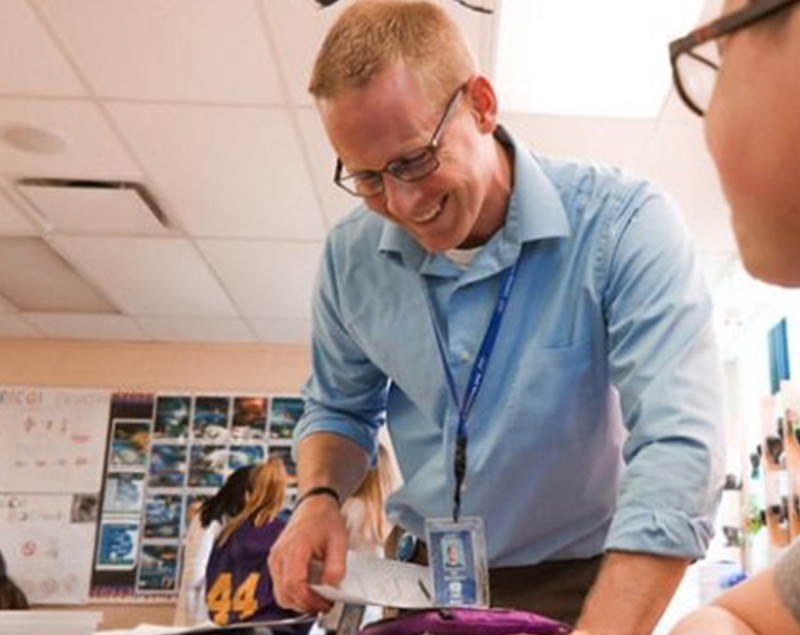
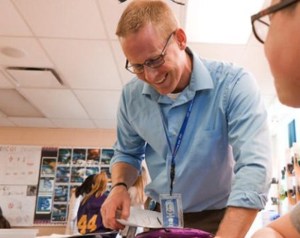
Jeffrey Bouwman at work in his classroom. Mr. Bouwman has long used citizen science projects in his classroom. Learn more about Mr. Bouwman in his NASA citizen scientist profile.
Jeffrey Bouwman
Citizen science projects – research projects that need lots of people and are designed for participation by anyone – are a great way for formal and informal students and enthusiasts to learn science by doing it. There are a number of these participatory projects addressing a wide variety of research questions. These projects have a range of difficulty, training requirements, time requirements, and equipment – in short, there really is a project for everyone!
Finding Your First Project
Choosing a project that’s right for your students or informal learners begins with choosing a project that works for you. Use the tables here to identify some projects that have the appropriate timing, challenge level, and equipment (or lack thereof!) that are right for you and your learners. If you have never contributed to a participatory or citizen science project, it’s a great idea to start with a simple project that doesn’t require a lot of equipment.
Here are a few suggestions for getting started:
Review the project descriptions to help choose the best one for you. Whittle your choice down to 1 or 2 projects. If you need a day-of-eclipse project, pick a second one that you can do anytime as a practice project for yourself.
Do the project yourself. If you want to do a day-of eclipse project that is not yet available, pick another project to practice with. It will give you a sense of how these opportunities are structured and what it might feel like for your learners to participate. Read the project website, complete the preparation or training materials, and do the task enough to get a feel for what’s involved, what’s tricky, and what’s fun or satisfying about it. You don’t need to master the project or solve all problems that might arise. Do it until you have a sense for what participation feels like and what learning opportunities the project or task includes.
When you introduce the project to your learners, emphasize that this is a real chance to do scientific research alongside other interested people around the world and with the professional team leading the project. Don’t hesitate to remind them that this is a NASA project working with NASA scientists!
Are you an informal educator? Incorporate a citizen science project into an existing program with a small and/or familiar audience, or recruit a small group of volunteers or docents to try it with you. Set clear expectations (“we’ll be learning this together!”) and go for it. You will learn more about how to lead others through a project by trying it than any other way. Adjust your approach as you learn.
Are you a formal educator? Start small by asking for volunteers to try the project out with you after school or during a study hall. Or pick a class and just go for it. You will learn the most about how to use and facilitate citizen science projects in your classroom by simply doing one. Adjust your approach as you and your students learn.
And thank you for participating!
By Sarah Kirn Citizen Science Strategist, NASA, at the Gulf of Maine Research Institute
Contribute to NASA Research on Eclipse Day – and Every Day
4 min read
Contribute to NASA Research on Eclipse Day – and Every Day
NASA is celebrating the Sun during the Heliophysics Big Year, which extends through the end of 2024. You can get involved to help us learn more about our star and its influence on our planet. With exciting experiments happening during the total solar eclipse that will cross North America on April 8, to widespread investigations going on throughout the year, keep reading to find a project that’s right for you.
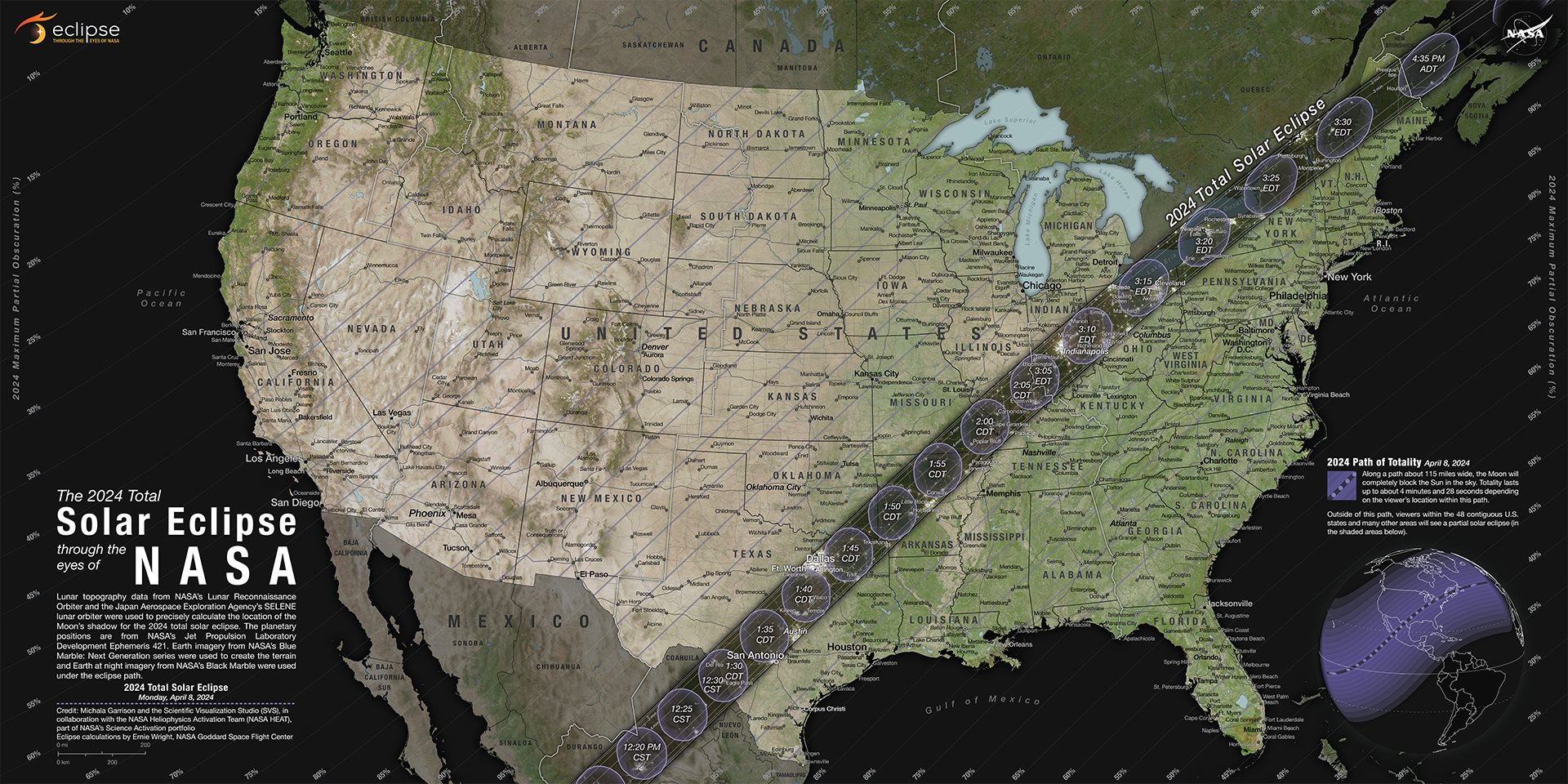
The dark band that runs from Mexico into Texas and all the way to Maine and Maritime Canada shows the path of totality for the April 8, 2024, eclipse. This is the area where people on Earth can witness a total eclipse of the Sun. Outside of this path, observers may see a partial eclipse, with the amount of the Sun being blocked by the Moon decreasing with distance from the path.
NASA/Scientific Visualization Studio/Michala Garrison; Eclipse Calculations By Ernie Wright, NASA Goddard Space Flight Center
What Is Citizen Science (Also Called Participatory Science)?
NASA defines citizen science as “a form of open collaboration in which individuals or organizations participate in the scientific process in various ways” from collecting and analyzing data to making discoveries and solving problems. ”Citizen” here refers to citizens of planet Earth, and these projects are open to everyone, regardless of country of birth or legal citizenship status.
NASA sponsors citizen science projects across all five areas of research that it pursues: Earth science, planetary science, astrophysics, biological and physical sciences, and heliophysics. And yes, there are a few projects that are focused on the April 8 solar eclipse!
What You Can Do
Depending which project you join, you might:
Observe and record in pictures or words natural phenomena like clouds, animal noises, or a solar eclipse.
Learn how to recognize or classify patterns in data or pictures of a comet or solar jet.
Learn how to build and use scientific equipment like radio telescopes or ham radios.
Your contribution may be a large or small piece of the picture, but what you do as part of a NASA citizen science project is essential to answering the research question or need that the project addresses. And while you’re contributing to science, you might also develop new skills and make friends. You can read about some project participants – and what motivates them – in these profiles.
The Projects
NASA citizen science projects related to the April 8, 2024, eclipse and solar science are presented in four groups below. You can see all NASA citizen science projects on this website.
Use the tables below to find the project for you! A few notes:
“Minimum time required” refers to how much time it would take you to get up to speed from the start.
“Where” refers to where you need to be in order to participate.
Are you an educator looking for ways to involve your formal or informal students in eclipse-related science? Check out this companion blog post for some tips for educators.
Eclipse Projects That Need You on April 8!
Quick-Start Projects That Require No Special Equipment
Many NASA citizen science projects start out with a straightforward, structured task, but that doesn’t have to be where your contributions end. Some projects offer webinars or host regular video conference calls where enthusiastic volunteers can learn about and participate in the work that comes after data collection or classification. Hundreds of volunteers have become involved in deep ways. Over 450 volunteers have even been recognized for their contributions by being named as co-authors of scientific papers, which are the formal way in which scientists announce new discoveries and ideas.
By Sarah Kirn Citizen Science Strategist, NASA, at the Gulf of Maine Research Institute
Diez maneras en que los estudiantes pueden prepararse para ser astronautas
¿Quieres ser astronauta, pero no sabes por dónde empezar? ¡Estas son algunas maneras en las que puedes comenzar tu viaje! Incluso si no aún no reúnes los requisitos para ser astronauta, mediante la Oficina de Participación STEM (ciencia, tecnología, ingeniería y matemáticas) de la NASA, u OSTEM, hay formas de participar en las misiones de la NASA. Echa un vistazo a las 10 mejores maneras de ser astronauta:
1. Solicita una pasantía en la NASA.
Convertirse en pasante es la manera perfecta de comenzar con la NASA. ¡Varios astronautas comenzaron como pasantes! La astronauta recién estrenada Jessica Watkins fue seleccionada como pasante de la NASA mientras era estudiante de pregrado y posgrado. “Esas experiencias fueron realmente las que me ayudaron a formarme como científica y exploradora”, dijo Watkins, atribuyéndolo a las experiencias prácticas de las que tuvo la oportunidad de ser parte durante sus pasantías. ¿Te interesa participar? Puedes encontrar más información en: intern.nasa.gov
2. Participa en los desafíos estudiantiles de Artemis.
¿Sabías que los Desafíos estudiantiles de Artemis (en inglés) contribuyen directamente a la misión de la NASA? El Reto estudiantil para lanzamientos suborbitales, el Desafío del rover de exploración humana, la Tecnología de interfaz del usuario de trajes espaciales para estudiantes (SUITS, por sus siglas en inglés), los Lunabotics, los Equipos de diseño experimental de flotación neutra microgravedad (Micro-G NExT, por sus siglas en inglés), El Reto de sistemas de lanzamiento para las Naciones Originarias y el Reto estudiantil Big Idea (Gran Idea) varían según la misión y el nivel académico (desde la escuela intermedia a la universidad) y abarcan muchos elementos del programa Artemis. Los desafíos estudiantiles de Artemis te permiten ser creativo, tomar lo que has aprendido en el aula y aplicarlo a los desafíos existentes para la exploración espacial.
3. Suscríbete a NASA EXPRESS.
¡Mantente informado sobre lo que sucede dentro de la NASA! NASA EXPRESS es un boletín semanal (en inglés) que ofrece novedades y oportunidades de la NASA y de la comunidad de Participación en STEM. NASA EXPRESS es un gran recurso para que los estudiantes exploren diversas oportunidades en STEM más allá de las paredes del aula. ¡Suscríbete hoy! Y si prefieres recibir tus noticias de la NASA en español, suscríbete a nuestro boletín Novedades de la NASA.
4. Asiste al ASTRO CAMP® o al Campamento Espacial.
¿Eres un joven explorador? Mejora tus destrezas en el ASTRO CAMP® en el Centro Espacial Stennis de la NASA. La astronauta de la NASA Kate Rubins viajó a la Estación Espacial Internacional en 2016, pero antes de eso asistió al Campamento Espacial cuando cursaba séptimo grado, después de ahorrar el dinero que le pagaban por hacer tareas domésticas para poder asistir. Rubins soñaba con convertirse en astronauta cuando era niña y dejó el campamento sabiendo que tenía que tomar tantos cursos de matemáticas y ciencias como pudiera para hacer realidad su sueño.
5. ¡Aprende lo que realmente se necesita para convertirte en astronauta!
Existen muchos mitos y conceptos erróneos sobre lo que se necesita para ser astronauta. Infórmate sobre los hechos y los requisitos, y prepárate para una experiencia fuera de este mundo, literalmente.
6. Una gran variedad de carreras profesionales pueden llevarte al espacio: ¡Encuentra una que te guste!
¡Mantén una mentalidad abierta! No tienes que ser ingeniero o seguir un camino específico para ser astronauta. Los astronautas de la NASA provienen de todos los ámbitos de la vida: maestros, médicos, biólogos, geólogos, militares… ¡y más! La cohorte de astronautas más reciente refleja este nivel de diversidad. Por encima de todo, asegúrate de que amas lo que haces.
7. Mantente activo.
La aptitud física es una gran parte del entrenamiento de los astronautas y de la vida diaria en el espacio. A bordo de la Estación Espacial Internacional, los astronautas se ejercitan dos horas al día para mantener sus huesos fuertes en el entorno de microgravedad. Mantén un estilo de vida saludable y un régimen de ejercicios, ¡o prueba un nuevo deporte! Encuentra más información (en inglés) sobre cómo los astronautas se mantienen en forma aquí.
8. Participa en ferias de ciencias e ingeniería.
Tómate el tiempo para mostrar tu arduo trabajo e ingenio fuera del aula. Las ferias de ciencias e ingeniería son una excelente manera no solo de mostrar tu trabajo, sino también de inspirarte en las personas que te rodean.
9. Postúlate a escuelas de posgrado y de capacitación profesional, o a un programa de entrenamiento para pilotos.
Planifica tu futuro. Si quieres ser astronauta, es imprescindible obtener un título académico avanzado. Los astronautas deben completar una maestría en un campo de STEM, trabajar para obtener un doctorado o tener un doctorado en medicina o una licenciatura en medicina osteopráctica. Postúlate para una escuela de posgrado y da un paso adelante en tu educación, preparándote para la vida en el espacio. Otra forma de calificar es mediante la realización de un programa como piloto de pruebas en una institución acreditada.
10. Inscríbete en clases y clubes de STEM.
¿No estás todavía a nivel universitario o de posgrado? Nunca es demasiado pronto para involucrarte en áreas de STEM y dar los primeros pasos hacia una carrera fuera de este mundo. Elige clases de ciencias, matemáticas y programación que se alineen con tus objetivos y únete a clubes y actividades relacionadas con STEM fuera del aula. Si tu escuela o comunidad no ofrece un club para lo que te interesa, ¡crea uno!
Mientras la NASA continúa avanzando con el programa Artemis y el reclutamiento de astronautas, tú, la futura fuerza laboral de STEM que podría algún día llevarnos a mundos distantes, eres una parte importante de eso. A través de la variedad de recursos de OSTEM, puedes unirte a nosotros en este viaje mientras avanzamos hacia la Luna… y más allá.