NASA Sets Coverage for Boeing Starliner’s First Crewed Launch, Docking

NASA Sets Coverage for Boeing Starliner’s First Crewed Launch, Docking
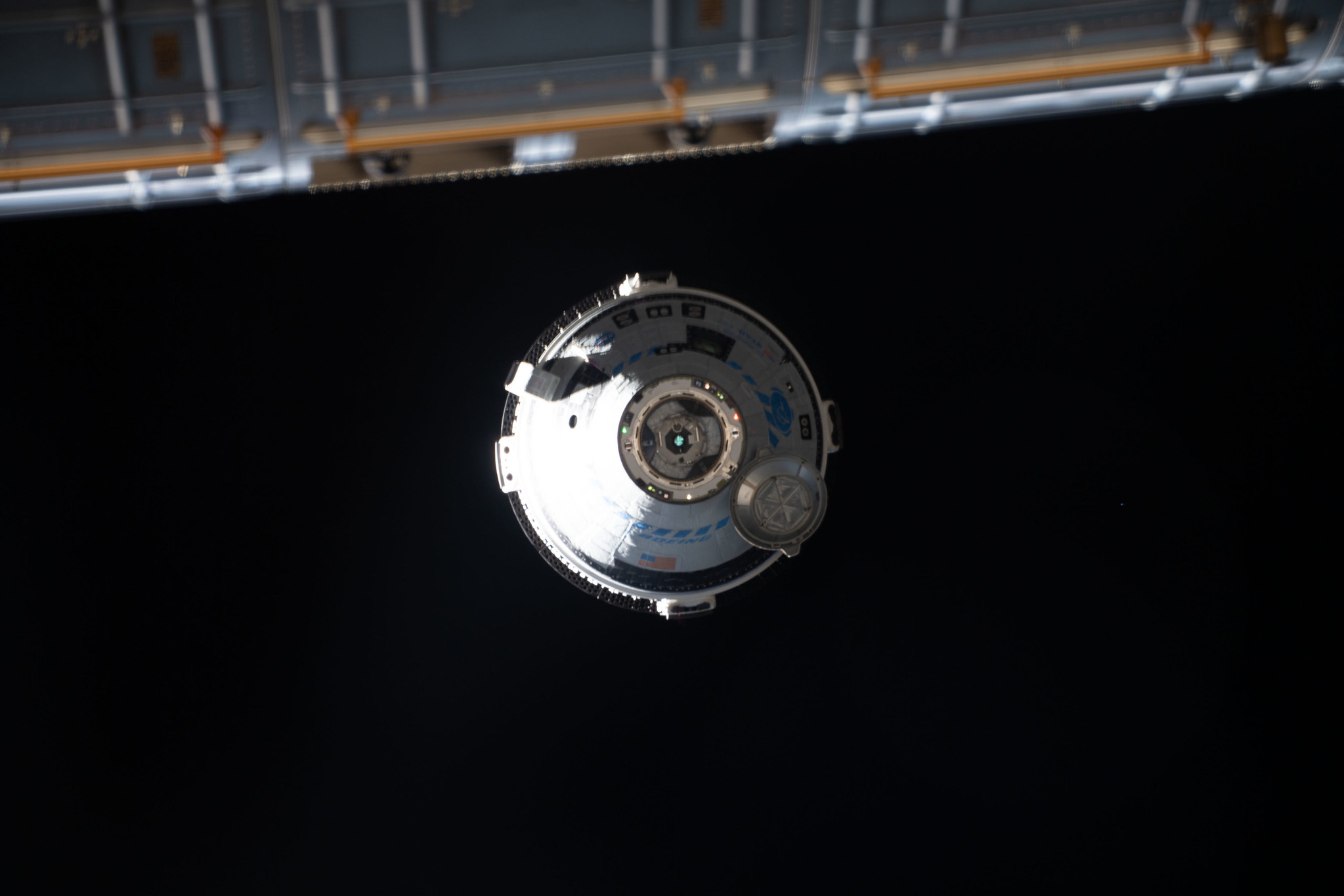
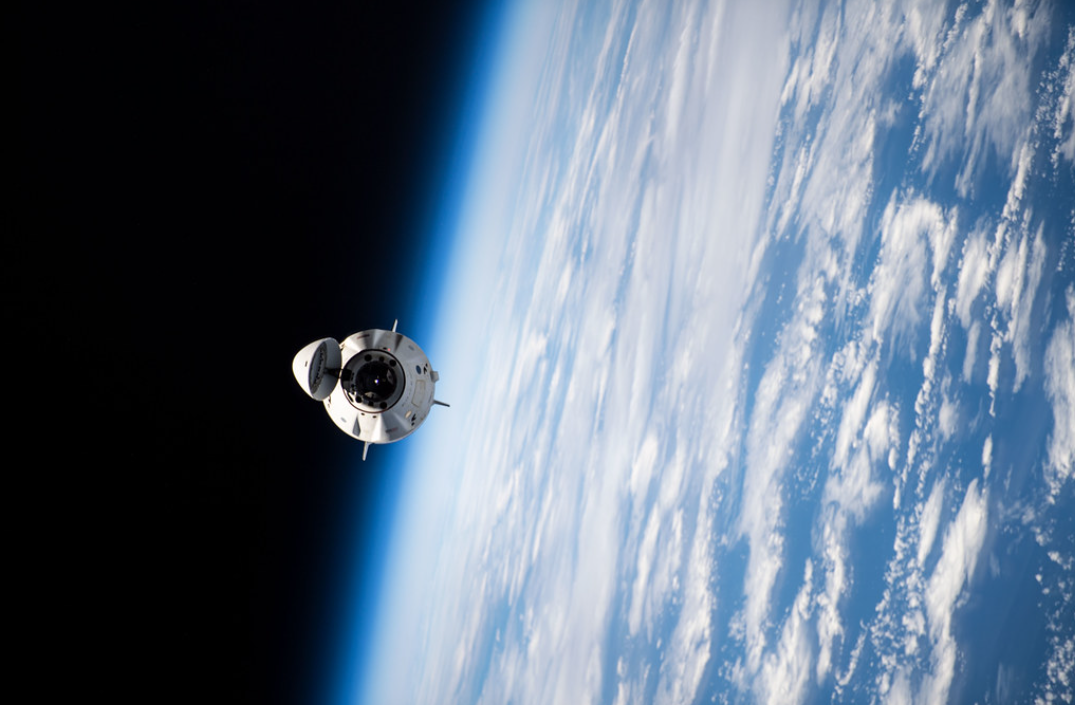
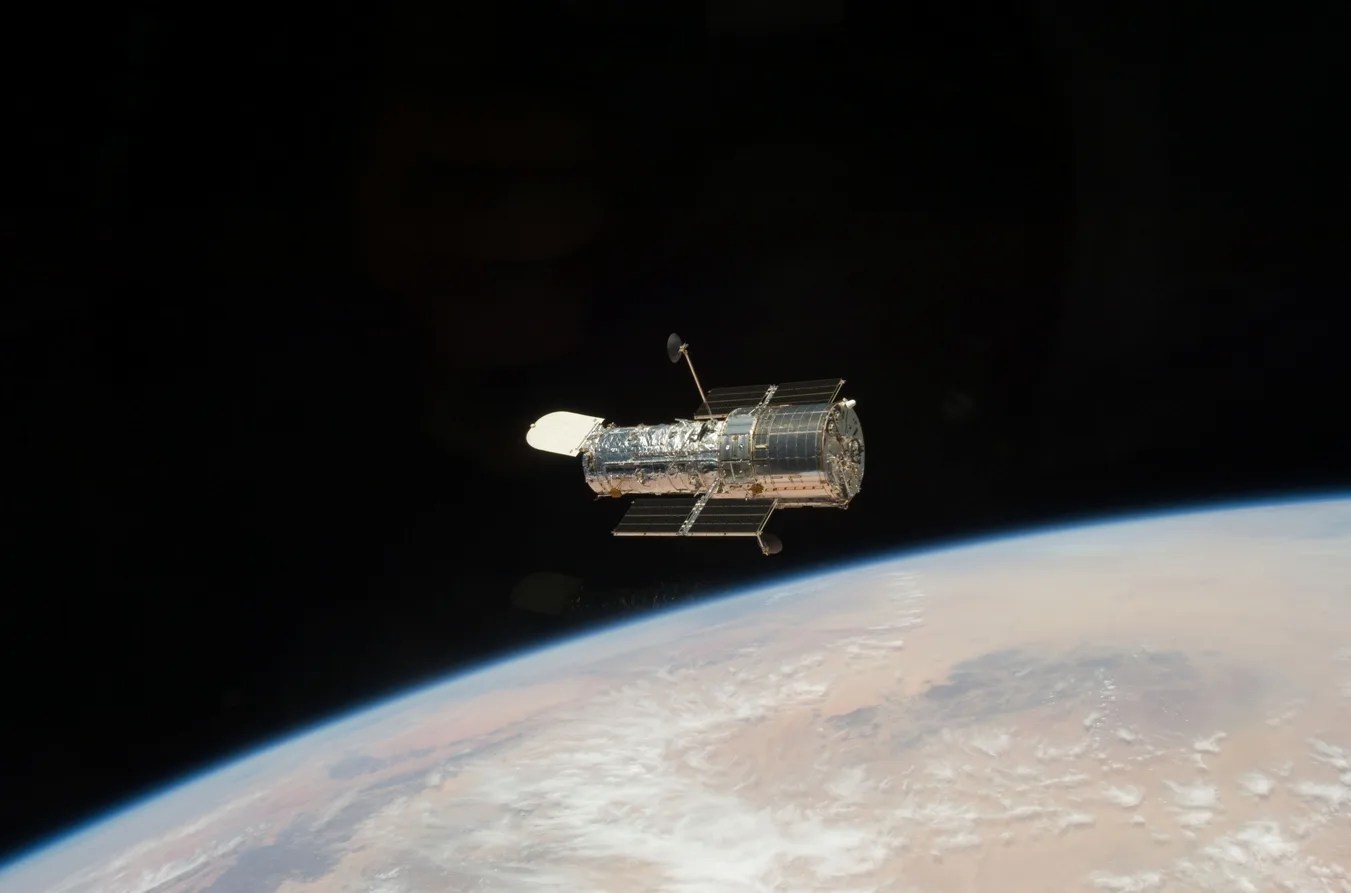
Boeing’s Starliner spacecraft approaches the International Space Station. NASA astronauts Butch Wilmore and Suni Williams will launch aboard Starliner on a United Launch Alliance Atlas V rocket for NASA’s Boeing Crew Flight Test.
Credits: NASA

NASA will provide live coverage of prelaunch and launch activities for the agency’s Boeing Crew Flight Test, which will carry NASA astronauts Butch Wilmore and Suni Williams to and from the International Space Station.

Launch of the ULA (United Launch Alliance) Atlas V rocket and Boeing Starliner spacecraft is targeted for 10:34 p.m. EDT Monday, May 6, from Space Launch Complex-41 at Cape Canaveral Space Force Station in Florida.

The flight test will carry Wilmore and Williams to the space station for about a week to test the Starliner spacecraft and its subsystems before NASA certifies the transportation system for rotational missions to the orbiting laboratory for the agency’s Commercial Crew Program.

Starliner will dock to the forward-facing port of the station’s Harmony module at 12:48 a.m., Wednesday, May 8.

The deadline for media accreditation for in-person coverage of this launch has passed. The agency’s media credentialing policy is available online. For questions about media accreditation, please email: ksc-media-accreditat@mail.nasa.gov.

NASA’s mission coverage is as follows (all times Eastern and subject to change based on real-time operations):

Wednesday, May 1

1:30 p.m. – Virtual news conference at Kennedy with the flight test astronauts:

  • NASA astronaut Butch Wilmore
  • NASA astronaut Suni Williams

Coverage of the virtual news conference will stream live on NASA+, NASA Television, the NASA app, YouTube, and the agency’s website.

Media may ask questions via phone only. For the dial-in number and passcode, please contact the Kennedy newsroom no later than 12:30 p.m., Wednesday, May 1, at: ksc-newsroom@mail.nasa.gov.

Friday, May 3
12:30 p.m. – Prelaunch news conference at Kennedy (no earlier than one hour after completion of the Launch Readiness Review) with the following participants:

  • NASA Administrator Bill Nelson
  • Steve Stich, manager, NASA’s Commercial Crew Program
  • Dana Weigel, manager, NASA’s International Space Station Program
  • Emily Nelson, chief flight director, NASA
  • Jennifer Buchli, chief scientist, NASA’s International Space Station Program
  • Mark Nappi, vice president and program manager, Commercial Crew Program, Boeing
  • Gary Wentz, vice president, Government and Commercial Programs, ULA
  • Brian Cizek, launch weather officer, 45th Weather Squadron, Cape Canaveral Space Force Station

Coverage of the prelaunch news conference will stream live on NASA+, NASA Television, the NASA app, YouTube, and the agency’s website.

Media may ask questions in person and via phone. Limited auditorium space will be available for in-person participation. For the dial-in number and passcode, media should contact the Kennedy newsroom no later than 11:30 a.m., Friday, May 3, at ksc-newsroom@mail.nasa.gov.

3:30 p.m. – NASA Social panel live stream event at Kennedy with the following participants:

  • Ian Kappes, deputy launch vehicle office manager, NASA’s Commercial Crew Program
  • Amy Comeau Denker, Starliner associate chief engineer, Boeing
  • Caleb Weiss, system engineering and test leader, ULA
  • Jennifer Buchli, chief scientist, NASA’s International Space Station Program

Coverage of the panel live stream event will stream live at @NASAKennedy on YouTube, @NASAKennedy on X, and @NASAKennedy on Facebook. Members of the public may ask questions online by posting questions to the YouTube, X, and Facebook livestreams using #AskNASA.

Monday, May 6

6:30 p.m. – Launch coverage begins on NASA+, NASA Television, the NASA app, YouTube, and the agency’s website.

10:34 p.m. – Launch

Launch coverage on NASA+ will end shortly after Starliner orbital insertion. NASA Television will provide continuous coverage leading up to docking and through hatch opening and welcome remarks.

Tuesday, May 7

12 a.m. – Postlaunch news conference with the following participants:

  • NASA Deputy Administrator Pam Melroy
  • Ken Bowersox, associate administrator, NASA’s Space Operations Mission Directorate
  • Steve Stich, manager, NASA’s Commercial Crew Program
  • Dana Weigel, manager, NASA’s International Space Station Program
  • Mark Nappi, vice president and program manager, Commercial Crew Program, Boeing
  • Gary Wentz, vice president, Government and Commercial Programs, ULA

Coverage of the postlaunch news conference will air live on NASA+, NASA Television, the NASA app, YouTube, and the agency’s website.

NASA+ will resume coverage and NASA Television’s media channel will break from in-orbit coverage to carry the postlaunch news conference. Mission operational coverage will continue on NASA Television’s public channel and the agency’s website. Once the postlaunch news conference is complete, NASA+ coverage will end, and mission coverage will continue on both NASA channels.

Media may ask questions in person and via phone. Limited auditorium space will be available for in-person participation. For the dial-in number and passcode, media should contact the Kennedy newsroom no later than 10:30 p.m., Monday, May 6, at ksc-newsroom@mail.nasa.gov.

10:15 p.m. – Arrival coverage resumes on NASA+, the NASA app, and YouTube, and continues on NASA Television and the agency’s website.

Wednesday, May 8
12:48 a.m. – Targeted docking to the forward-facing port of the station’s Harmony module

2:35 a.m. – Hatch opening

3:15 a.m. – Welcome remarks

4:15 a.m. – Post-docking news conference at Johnson with the following participants:

  • NASA Associate Administrator Jim Free
  • Steve Stich, manager, NASA’s Commercial Crew Program
  • Dana Weigel, manager, NASA’s International Space Station Program
  • Mark Nappi, vice president and program manager, Commercial Crew Program, Boeing

Coverage of the post-docking news conference will air live on NASA+, NASA Television, the NASA app, YouTube, and the agency’s website.

All times are estimates and could be adjusted based on operations after launch. Follow the space station blog for the most up-to-date operations information.

Audio Only Coverage

Audio only of the news conferences and launch coverage will be carried on the NASA “V” circuits, which may be accessed by dialing 321-867-1220, -1240 or -7135. On launch day, “mission audio,” countdown activities without NASA Television launch commentary, will be carried on 321-867-7135.

Launch audio also will be available on Launch Information Service and Amateur Television System’s VHF radio frequency 146.940 MHz and KSC Amateur Radio Club’s UHF radio frequency 444.925 MHz, FM mode, heard within Brevard County on the Space Coast.

Live Video Coverage Prior to Launch

NASA will provide a live video feed of Space Launch Complex-41 approximately 48 hours prior to the planned liftoff of the mission. Pending unlikely technical issues, the feed will be uninterrupted until the prelaunch broadcast begins on NASA Television, approximately four hours prior to launch. Once the feed is live, find it here: http://youtube.com/kscnewsroom.

NASA Website Launch Coverage

Launch day coverage of the mission will be available on the agency’s website. Coverage will include live streaming and blog updates beginning no earlier than 6:30 p.m., May 6 as the countdown milestones occur. On-demand streaming video and photos of the launch will be available shortly after liftoff.

For questions about countdown coverage, contact the Kennedy newsroom at 321-867-2468. Follow countdown coverage on the commercial crew or the Crew Flight Test blog.

Attend the Launch Virtually

Members of the public can register to attend this launch virtually. NASA’s virtual guest program for this mission also includes curated launch resources, notifications about related opportunities or changes, and a stamp for the NASA virtual guest passport following launch.

Watch and Engage on Social Media

Let people know you’re following the mission on X, Facebook, and Instagram by using the hashtags #Starliner and #NASASocial. You can also stay connected by following and tagging these accounts:

X: @NASA, @NASAKennedy, @NASASocial, @Space_Station, @ISS_Research, @ISS National Lab, @BoeingSpace, @Commercial_Crew

Facebook: NASA, NASAKennedy, ISS, ISS National Lab

Instagram: @NASA, @NASAKennedy, @ISS, @ISSNationalLab

Coverage en Espanol

Did you know NASA has a Spanish section called NASA en Espanol? Check out NASA en Espanol on X, Instagram, Facebook, and YouTube for additional mission coverage.

Para obtener información sobre cobertura en español en el Centro Espacial Kennedy o si desea solicitar entrevistas en español, comuníquese con Antonia Jaramillo: 321-501-8425; antonia.jaramillobotero@nasa.gov; o Messod Bendayan: 256-930-1371; messod.c.bendayan@nasa.gov.

NASA’s Commercial Crew Program has delivered on its goal of safe, reliable, and cost-effective transportation to and from the International Space Station from the United States through a partnership with American private industry. This partnership is changing the arc of human spaceflight history by opening access to low-Earth orbit and the International Space Station to more people, science, and commercial opportunities. The space station remains the springboard to NASA’s next great leap in space exploration, including future missions to the Moon and, eventually, to Mars.

For NASA’s launch blog and more information about the mission, visit:

https://www.nasa.gov/commercialcrew

-end-

Joshua Finch / Claire O’Shea
Headquarters, Washington
202-358-1100
joshua.a.finch@nasa.gov / claire.a.o’shea@nasa.gov

Steven Siceloff / Danielle Sempsrott / Stephanie Plucinsky
Kennedy Space Center, Florida
321-867-2468
steven.p.siceloff@nasa.gov / danielle.c.sempsrott@nasa.gov / stephanie.n.plucinsky@nasa.gov

Leah Cheshier
Johnson Space Center, Houston
281-483-5111
leah.d.cheshier@nasa.gov

Powered by WPeMatico

Get The Details…
Tiernan P. Doyle
The Horse’s Mane

The Horse’s Mane

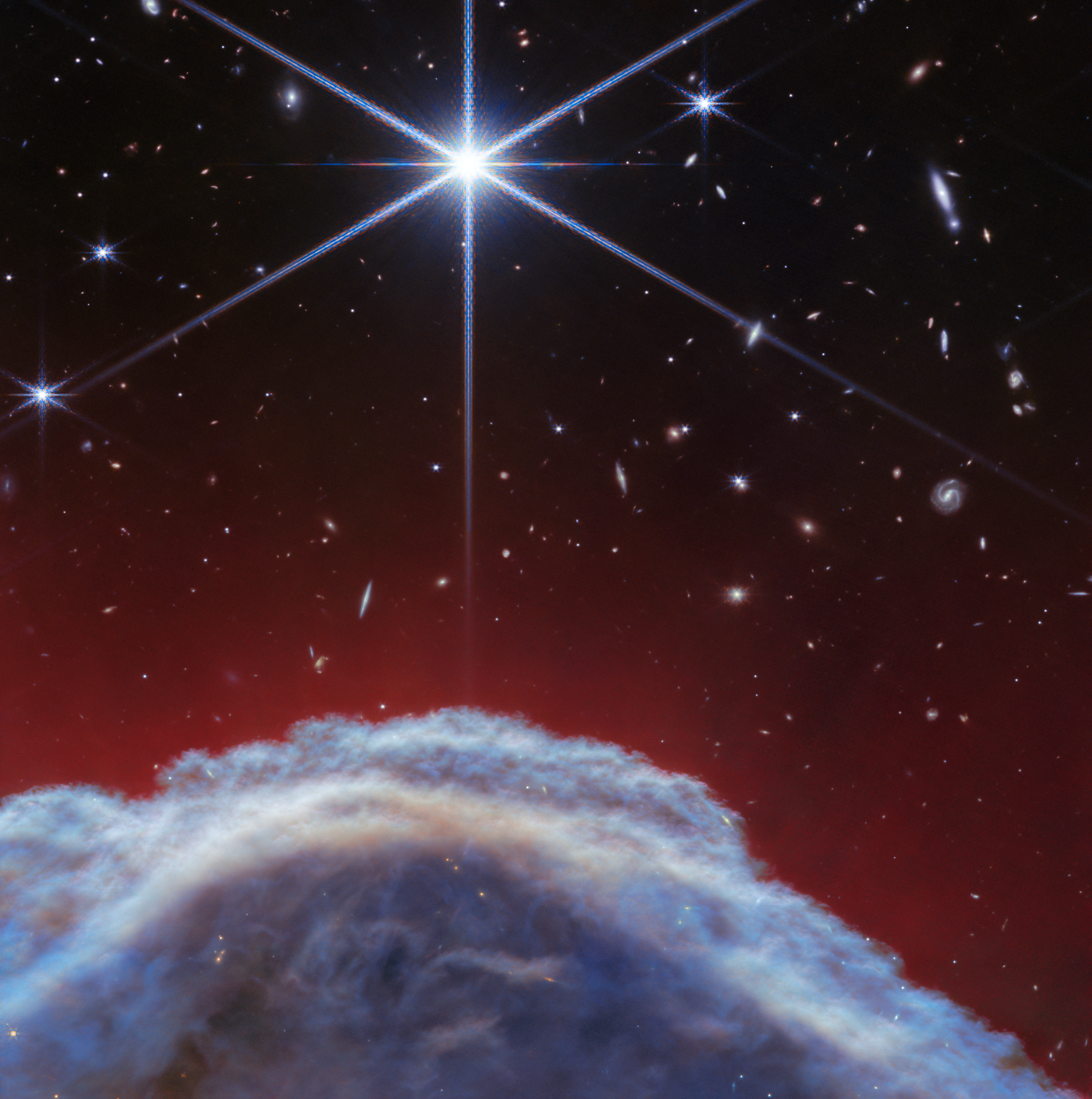
A clumpy dome of blueish-gray clouds rises about a third of the way from the bottom. Above it, streaky, translucent red wisps brush upward to about halfway up the image. The top half of the image is the black background of space with one prominent, bright white star with Webb’s 8-point diffraction spikes. Additional stars and galaxies are scattered throughout the image, although very few are seen through the thick clouds at bottom, and all are significantly smaller than the largest star.
Rising from turbulent waves of dust and gas is the Horsehead Nebula, otherwise known as Barnard 33, which resides roughly 1300 light-years away. The NASA/ESA/CSA James Webb Space Telescope has captured the sharpest infrared images to date of one of the most distinctive objects in our skies, the Horsehead Nebula. Webb’s new view focuses on the illuminated edge of the top of the nebula’s distinctive dust and gas structure.

This image of part of the Horsehead Nebula, captured by NASA’s James Webb Space Telescope and released on April 29, 2024, shows the nebula in a whole new light, capturing the region’s complexity with unprecedented spatial resolution. Located roughly 1,300 light-years away, the nebula formed from a collapsing interstellar cloud of material, and glows because it is illuminated by a nearby hot star. The gas clouds surrounding the Horsehead have already dissipated, but the jutting pillar is made of thick clumps of material and therefore is harder to erode. Astronomers estimate that the Horsehead has about 5 million years left before it too disintegrates.

Image Credit: NASA, ESA, CSA, K. Misselt (University of Arizona) and A. Abergel (IAS/University Paris-Saclay, CNRS)

Powered by WPeMatico

Get The Details…
Monika Luabeya

NASA Sets Coverage for Dragon Spacecraft Relocation on Space Station

NASA Sets Coverage for Dragon Spacecraft Relocation on Space Station

The SpaceX Dragon crew spacecraft pictured from the International Space Station.
Credit: NASA

In preparation for the arrival of NASA’s Boeing Crew Flight Test, four crew members aboard the International Space Station will relocate the SpaceX Dragon crew spacecraft to a different docking port Thursday, May 2, to make way for Boeing’s Starliner spacecraft.

NASA will provide live coverage of the move beginning at 7:30 a.m. EDT on NASA+, NASA Television, the NASA app, YouTube, and the agency’s website. Learn how to stream NASA TV through a variety of platforms including social media.

NASA astronauts Matt Dominick, Mike Barratt, and Jeanette Epps, as well as Roscosmos cosmonaut Alexander Grebenkin, will undock from the forward-facing port of the station’s Harmony module at 7:45 a.m. The spacecraft will then autonomously dock with the module’s space-facing port at 8:28 a.m.

The relocation, supported by flight controllers at NASA’s Johnson Space Center in Houston and SpaceX in Hawthorne, California, will free up Harmony’s forward-facing port for the docking of the Boeing Starliner spacecraft for its first flight with astronauts in May. Starliner will autonomously dock to the forward-facing port of the Harmony module, delivering NASA astronauts Butch Wilmore and Suni Williams to the space station.

This will be the fourth port relocation of a Dragon spacecraft with crew, following previous relocations during the Crew-1, Crew-2, and Crew-6 missions.

NASA’s SpaceX Crew-8 mission launched March 3 from NASA’s Kennedy Space Center in Florida and docked to the space station March 5. Crew-8, targeted to return this fall, is the eighth rotational crew mission from NASA and SpaceX as a part of the agency’s Commercial Crew Program.

Learn more about space station activities by following @space_station and @ISS_Research on X, as well as the ISS Facebook, ISS Instagram, and the space station blog.

-end-

Joshua Finch / Claire O’Shea
Headquarters, Washington
202-358-1100
joshua.a.finch@nasa.gov / claire.a.o’shea@nasa.gov

Sandra Jones / Anna Schneider
Johnson Space Center, Houston
281-483-5111
sandra.p.jones@nasa.gov / anna.c.schneider@nasa.gov

Powered by WPeMatico

Get The Details…
Lauren E. Low

NASA Scientists Gear Up for Solar Storms at Mars

NASA Scientists Gear Up for Solar Storms at Mars

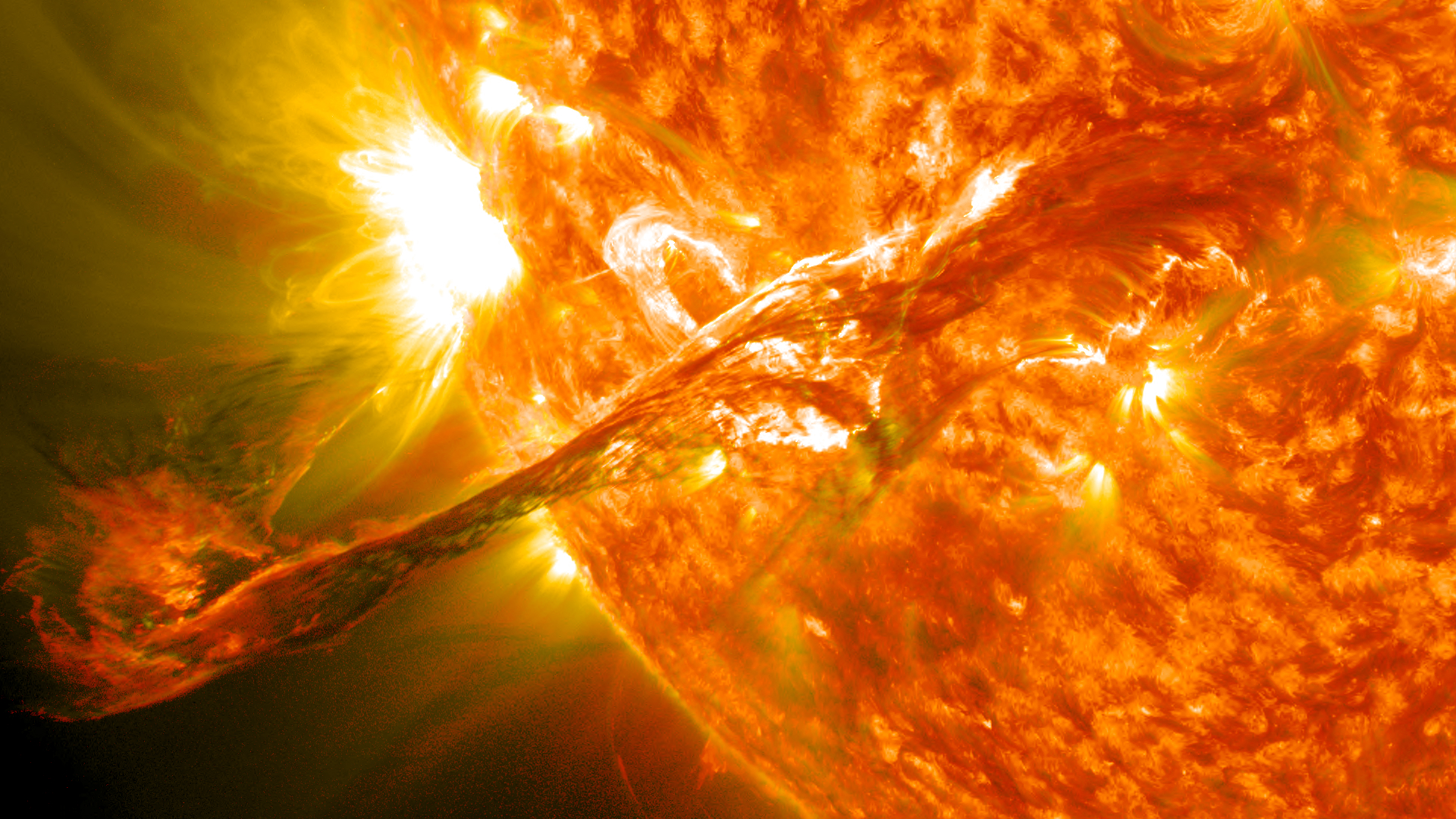
This coronal mass ejection, captured by NASA’s Solar Dynamics Observatory, erupted on the Sun Aug. 31, 2012, traveling over 900 miles per second and sending radiation deep into space. Earth’s magnetic field shields it from radiation produced by solar events like this one, while Mars lacks that kind of shielding.
NASA/GFSC/SDO

The Sun will be at peak activity this year, providing a rare opportunity to study how solar storms and radiation could affect future astronauts on the Red Planet.

In the months ahead, two of NASA’s Mars spacecraft will have an unprecedented opportunity to study how solar flares — giant explosions on the Sun’s surface — could affect robots and future astronauts on the Red Planet.

That’s because the Sun is entering a period of peak activity called solar maximum, something that occurs roughly every 11 years. During solar maximum, the Sun is especially prone to throwing fiery tantrums in a variety of forms — including solar flares and coronal mass ejections — that launch radiation deep into space. When a series of these solar events erupts, it’s called a solar storm.

Earth’s magnetic field largely shields our home planet from the effects of these storms. But Mars lost its global magnetic field long ago, leaving the Red Planet more vulnerable to the Sun’s energetic particles. Just how intense does solar activity get on Mars? Researchers hope the current solar maximum will give them a chance to find out. Before sending humans there, space agencies need to determine, among many other details, what kind of radiation protection astronauts would require.

Learn how NASA’s MAVEN and the agency’s Curiosity rover will study solar flares and radiation at Mars during solar maximum – a period when the Sun is at peak activity. Credit: NASA/JPL-Caltech/GSFC/SDO/MSSS/University of Colorado

“For humans and assets on the Martian surface, we don’t have a solid handle on what the effect is from radiation during solar activity,” said Shannon Curry of the University of Colorado Boulder’s Laboratory for Atmospheric and Space Physics. Curry is principal investigator for NASA’s MAVEN (Mars Atmosphere and Volatile EvolutioN) orbiter, which is managed by NASA’s Goddard Space Flight Center in Greenbelt, Maryland. “I’d actually love to see the ‘big one’ at Mars this year — a large event that we can study to understand solar radiation better before astronauts go to Mars.”

Measuring High and Low

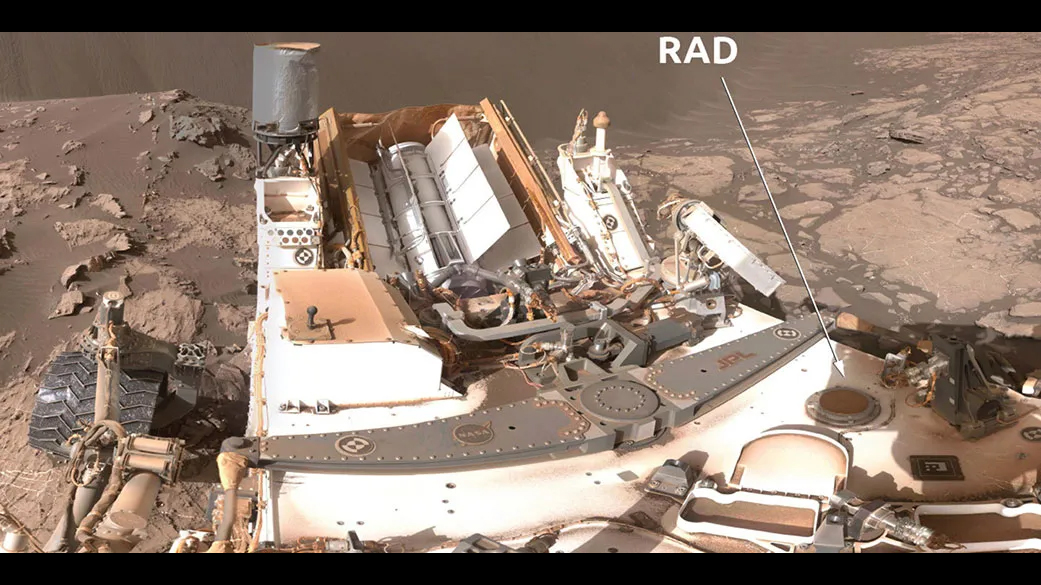
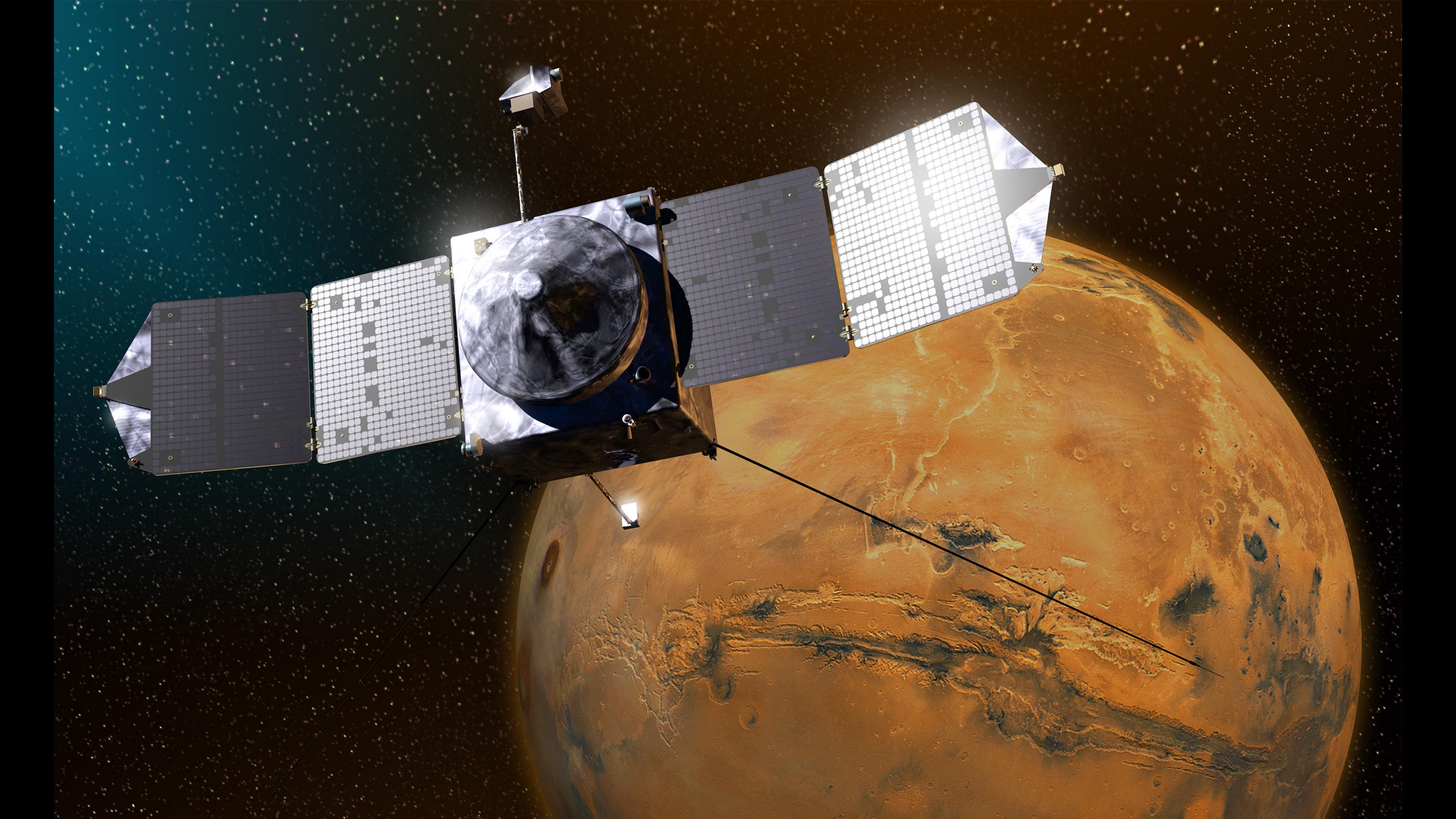
MAVEN observes radiation, solar particles, and more from high above Mars. The planet’s thin atmosphere can affect the intensity of the particles by the time they reach the surface, which is where NASA’s Curiosity rover comes in. Data from Curiosity’s Radiation Assessment Detector, or RAD, has helped scientists understand how radiation breaks down carbon-based molecules on the surface, a process that could affect whether signs of ancient microbial life are preserved there. The instrument has also provided NASA with an idea of how much shielding from radiation astronauts could expect by using caves, lava tubes, or cliff faces for protection.

When a solar event occurs, scientists look both at the quantity of solar particles and how energetic they are.

“You can have a million particles with low energy or 10 particles with extremely high energy,” said RAD’s principal investigator, Don Hassler of the Boulder, Colorado, office of the Southwest Research Institute. “While MAVEN’s instruments are more sensitive to lower-energy ones, RAD is the only instrument capable of seeing the high-energy ones that make it through the atmosphere to the surface, where astronauts would be.”

When MAVEN detects a big solar flare, the orbiter’s team lets the Curiosity team know so they can watch for changes in RAD’s data. The two missions can even assemble a time series measuring changes down to the half-second as particles arrive at the Martian atmosphere, interact with it, and eventually strike the surface.

The MAVEN mission also leads an early warning system that lets other Mars spacecraft teams know when radiation levels begin to rise. The heads-up enables missions to turn off instruments that could be vulnerable to solar flares, which can interfere with electronics and radio communication.

Lost Water

Beyond helping to keep astronauts and spacecraft safe, studying solar maximum could also lend insight into why Mars changed from being a warm, wet Earth-like world billions of years ago to the freezing desert it is today.

The planet is at a point in its orbit when it’s closest to the Sun, which heats up the atmosphere. That can cause billowing dust storms to blanket the surface. Sometimes the storms merge, becoming global.

While there’s little water left on Mars — mostly ice under the surface and at the poles — some still circulates as vapor in the atmosphere. Scientists wonder whether global dust storms help to eject this water vapor, lofting it high above the planet, where the atmosphere gets stripped away during solar storms. One theory is that this process, repeated enough times over eons, might explain how Mars went from having lakes and rivers to virtually no water today.

If a global dust storm were to occur at the same time as a solar storm, it would provide an opportunity to test that theory. Scientists are especially excited because this particular solar maximum is occurring at the start of the dustiest season on Mars, but they also know that a global dust storm is a rare occurrence.

More About the Missions

NASA’s Goddard Space Flight Center in Greenbelt, Maryland, manages the MAVEN mission. Lockheed Martin Space built the spacecraft and is responsible for mission operations. JPL provides navigation and Deep Space Network support. The Laboratory for Atmospheric and Space Physics at the University of Colorado Boulder is responsible for managing science operations and public outreach and communications. 

Curiosity was built by NASA’s Jet Propulsion Laboratory, which is managed by Caltech in Pasadena, California. JPL leads the mission on behalf of NASA’s Science Mission Directorate in Washington. The RAD investigation is supported by NASA’s Heliophysics Division as part of NASA’s Heliophysics System Observatory (HSO).

Additional information about the missions can be found at:

https://mars.nasa.gov/maven/

and

http://mars.nasa.gov/msl

News Media Contacts

Nancy Neal Jones
Goddard Space Flight Center, Greenbelt, Md.
301-286-0039
nancy.n.jones@nasa.gov

Andrew Good
Jet Propulsion Laboratory, Pasadena, Calif.
818-393-2433
andrew.c.good@jpl.nasa.gov

Karen Fox / Charles Blue
NASA Headquarters, Washington
301-286-6284 / 202-802-5345
karen.c.fox@nasa.gov / charles.e.blue@nasa.gov

2024-052

Powered by WPeMatico

Get The Details…
Naomi Hartono

NASA Administrator Names New Stennis Space Center Director

NASA Administrator Names New Stennis Space Center Director

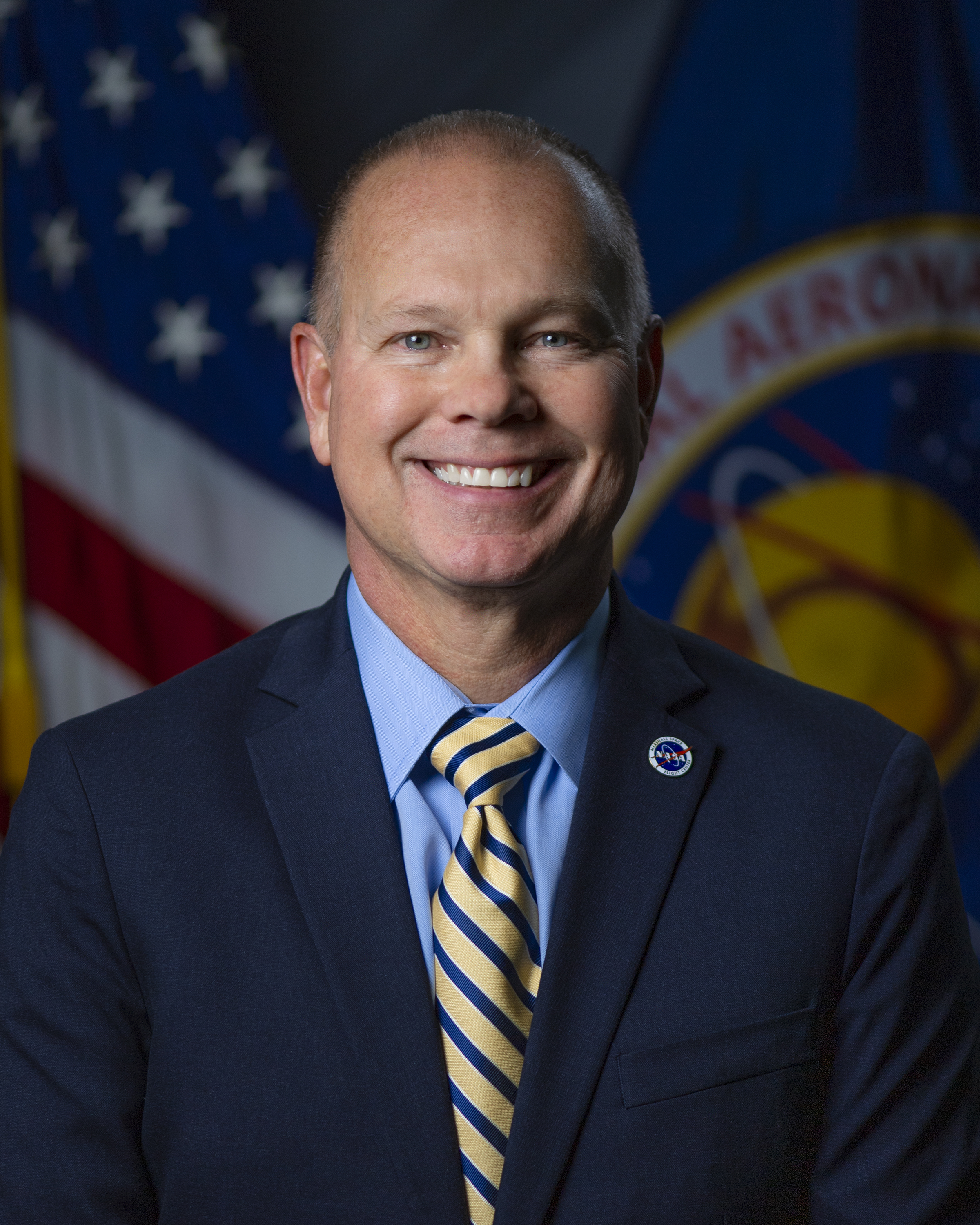
John Bailey, wearing a dark suit and striped tie, sits for a portrait with the United State of American and NASA flags in the background
John Bailey, director, John C. Stennis Space Center

NASA Administrator Bill Nelson on Monday named John Bailey as director of the agency’s Stennis Space Center near Bay St. Louis, Mississippi, effective immediately. Bailey had been serving as acting director since January. 

“John will build on his nearly 35 years of federal service to lead our talented workforce at Stennis,” said Nelson. “So much of NASA runs through Stennis. It is where we hone new and exciting capabilities in aerospace, technology, and deep space exploration. I am confident that John will lead the nation’s largest and premier propulsion test site to even greater success.”

NASA Stennis also is a unique federal city, home to more than 50 resident tenants with a combined workforce of over 5,200. The center tested the SLS (Space Launch System) core stage that helped launch the Artemis I mission. It also is testing all RS-25 engines to help power SLS launches and will conduct flightworthy testing of the agency’s new exploration upper stage prior to its use in space on future Artemis missions to the Moon and beyond.

The center is a leader in partnering and working with commercial aerospace companies to support their propulsion test projects. It also is expanding as an aerospace and technology hub, and in development of intelligent and autonomous systems needed for deep space exploration.

“This is an exciting time for NASA Stennis, and I am deeply honored to lead its great family of employees who make up this amazing workforce,” Bailey said. “We are dedicated to continuing to provide frontline support to the agency’s missions and initiatives. I look forward to our shared future and success.”

Bailey has more than three decades of federal service with the U.S. Air Force and NASA. As a communications engineer with the U.S. Air Force, Bailey led electronic communications testing worldwide. He joined the NASA Stennis team in 1999 and subsequently served in a variety of roles, managing and leading technical and non-technical organizations and supervising employees with a wide range of skills and backgrounds.

Bailey was tapped in 2015 to lead the NASA Stennis Engineering and Test Directorate, managing critical rocket propulsion test assets exceeding $2 billion in value and projects more than $221 million. He was named NASA Stennis associate director in 2018 and selected as the center’s deputy director in 2021.

An Alabama native, Bailey holds a bachelor’s degree in Electrical Engineering and a master’s degree in Business Administration from the University of South Alabama.

Access Bailey’s online biography at:

https://www.nasa.gov/people/john-w-bailey-jr/

-end-

Cheryl Warner 
Headquarters, Washington 
202-358-1600 
cheryl.m.warner@nasa.gov

C. Lacy Thompson
Stennis Space Center, Bay St. Louis, Miss.
228-363-5499
calvin.l.thompson@nasa.gov

Powered by WPeMatico

Get The Details…
Abbey A. Donaldson