Two Observatories, One Cosmic Eye: Hubble and Euclid View Cat’s Eye Nebula

Two Observatories, One Cosmic Eye: Hubble and Euclid View Cat’s Eye Nebula

3 Min Read

Two Observatories, One Cosmic Eye: Hubble and Euclid View Cat’s Eye Nebula

A planetary nebula in space. The star in the very center is surrounded by white bubbles and loops of gas, all shining with a powerful blue light. Farther away a broken ring of red and blue gas clouds surrounds the nebula. A multitude of golden and white stars, wisps of gas and distant galaxies of various sizes surround the nebula on the black background.
Hubble and Euclid teamed up in this image of the Cat’s Eye Nebula, NGC 6543.
Credits:
ESA/Hubble & NASA, ESA Euclid/Euclid Consortium/NASA/Q1-2025, J.-C. Cuillandre & E. Bertin (CEA Paris-Saclay), Z. Tsvetanov
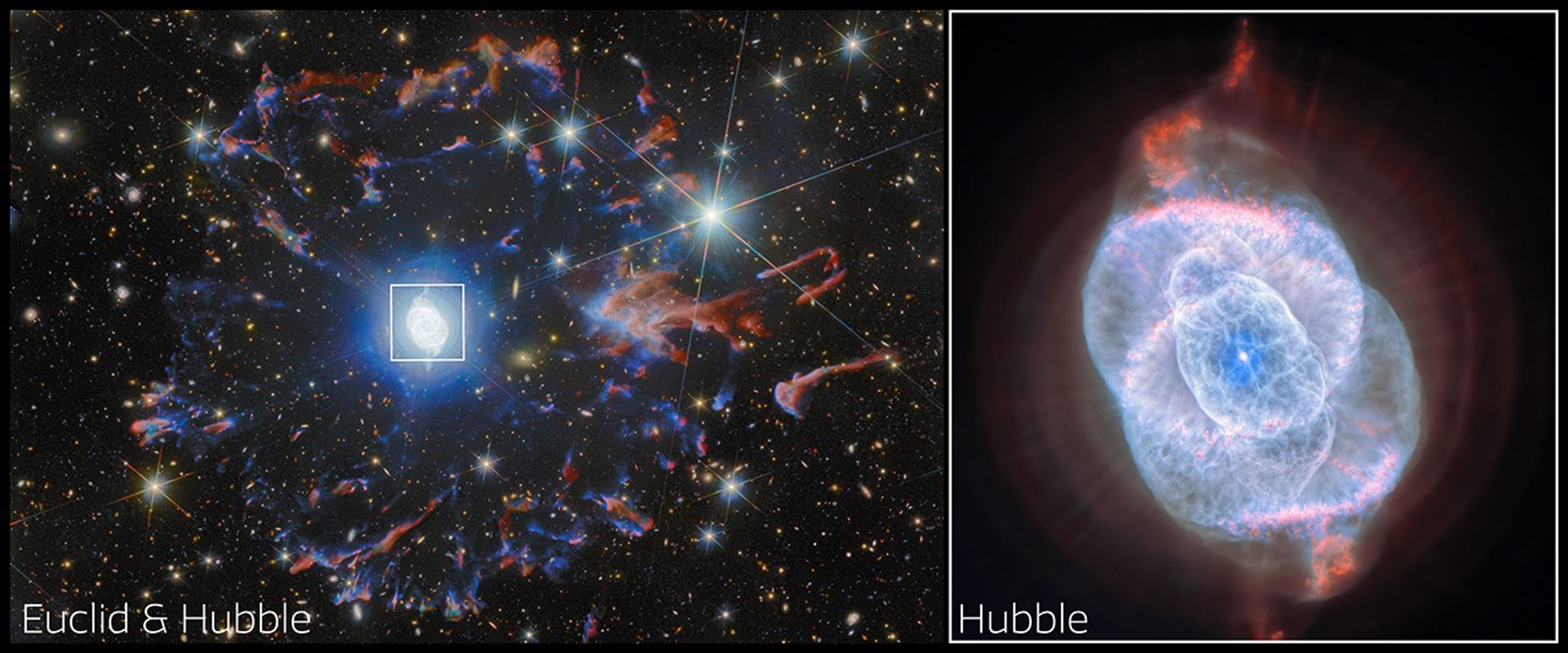
Two images of a planetary nebula (the Cat's Eye Nebula) in space. The image to the left, labeled “Euclid & Hubble”, shows the whole nebula and its surroundings. A star in the very center is surrounded by white bubbles and loops of gas, all shining with a powerful blue light. Farther away a broken ring of red and blue gas clouds surrounds the nebula. The background shows many stars and distant galaxies. A white box indicates the center of the nebula and this region is the image to the right, labelled “Hubble”. It shows the multi-layered bubbles, pointed jets and circular shells of gas that make up the nebula, as well as the central star, in greater detail.
ESA/Hubble & NASA, ESA Euclid/Euclid Consortium/NASA/Q1-2025, J.-C. Cuillandre & E. Bertin (CEA Paris-Saclay), Z. Tsvetanov

This new NASA/ESA Hubble Space Telescope image features one of the most visually intricate remnants of a dying star: the Cat’s Eye Nebula, also known as NGC 6543. This extraordinary planetary nebula lies in the constellation Draco and has captivated astronomers for decades with its elaborate and multilayered structure. Observations with ESA’s Gaia mission place the nebula at 4,400 light-years away.

Planetary nebulae, so-called because of their round shape, which made them appear to look like planets when viewed through early telescopes, are in fact expanding gas thrown off by stars in their final stages of evolution. It was the Cat’s Eye Nebula itself where this fact was first discovered in 1864 — examining the spectrum of its light reveals the emission from individual molecules that’s characteristic of a gas, distinguishing planetary nebulae from stars and galaxies. 

Hubble also revolutionized our understanding of planetary nebulae; its detailed images showed that the simple, circular appearance of a planetary nebula seen from the ground belies a very complex morphology. This was particularly true of the Cat’s Eye Nebula, where Hubble images in 1995 revealed never-before-seen structures that broadened our understanding of how planetary nebulae come to be.

An image of the center of a planetary nebula (the Cat's Eye Nebula). A blue star sits at the center within a series of overlapping, translucent bubbles of gas. The bubbles have a complex, filamentary structure. The two largest bubbles overlap halfway, creating an eye-like shape with the star at the center. Jets of high-speed gas point out of the top and bottom of the nebula. Faint, concentric circles of gas also surround the star, out beyond the bubbles.
In this new image, Hubble captures the very core of billowing gas with the High Resolution Channel sub-instrument on its Advanced Camera for Surveys (ACS). This instrument is optimized for taking very sharp images of fine details in a small area, such as the complex features at the heart of the Cat’s Eye Nebula. The data reveal a tapestry of concentric shells, jets of high-speed gas and dense knots sculpted by shock interactions, features that appear almost surreal in their intricacy. These structures are believed to record episodic mass loss from the dying star at the nebula’s center, creating a kind of cosmic “fossil record” of its final evolutionary stages. Part of these data were also used in a previous image of the Cat’s Eye Nebula, released in 2004. Previously unused data from ACS is combined with state-of-the-art image processing to create this new image, the sharpest yet taken of this nebula.
ESA/Hubble & NASA, Z. Tsvetanov

This time, Hubble is joined by ESA’s Euclid space telescope to create a new image of NGC 6543. The combined eyes of Hubble and Euclid reveal the remarkable complexity of stellar death in this object. Though primarily designed to map the distant universe, Euclid captures the Cat’s Eye Nebula as part of its deep imaging surveys. In Euclid’s wide, near-infrared, and visible light view, the arcs and filaments of the nebula’s bright central region are situated within a halo of colorful fragments of gas zooming away from the star. This ring was ejected from the star at an earlier stage, before the main nebula at the center formed. The whole nebula stands out against a backdrop teeming with distant galaxies, demonstrating how local astrophysical beauty and the farthest reaches of the cosmos can be seen together with Euclid.

A planetary nebula in space. The star in the very center is surrounded by white bubbles and loops of gas, all shining with a powerful blue light. Farther away a broken ring of red and blue gas clouds surrounds the nebula. A multitude of golden and white stars, wisps of gas and distant galaxies of various sizes surround the nebula on the black background.
In Euclid’s wide, near-infrared, and visible light view, the arcs and filaments of the nebula’s bright central region are situated within a halo of colorful fragments of gas zooming away from the star. This ring was ejected from the star at an earlier stage, before the main nebula at the center formed. Hubble captures the very core of the billowing gas with high-resolution visible-light images, adding extra detail in the center of this image. The whole nebula stands out against a backdrop teeming with distant galaxies, demonstrating how local astrophysical beauty and the farthest reaches of the cosmos can be seen together in modern astronomical surveys. Together, these missions provide a rich and complementary view of NGC 6543 — revealing the delicate interplay between stellar end-of-life processes and the vast cosmic tapestry beyond.
ESA/Hubble & NASA, ESA Euclid/Euclid Consortium/NASA/Q1-2025, J.-C. Cuillandre & E. Bertin (CEA Paris-Saclay), Z. Tsvetanov

Within this broad view of the nebula and its surroundings, Hubble captures the very core of the billowing gas with a new high-resolution visible-light image, adding extra detail in the center of this image. The data reveal a tapestry of concentric shells, jets of high-speed gas and dense knots sculpted by shock interactions, features that appear almost surreal in their intricacy. These structures are believed to record episodic mass loss from the dying star at the nebula’s center, creating a kind of cosmic “fossil record” of its final evolutionary stages.

Combining the focused view of Hubble with Euclid’s deep field observations not only highlights the nebula’s exquisite structure but also places it within the broader context of the universe that both space telescopes explore. Together, these missions provide a rich and complementary view of NGC 6543 — revealing the delicate interplay between stellar end-of-life processes and the vast cosmic tapestry beyond.

Media Contact:

Claire Andreoli
NASA’s Goddard Space Flight CenterGreenbelt, MD
claire.andreoli@nasa.gov

Share

Details

Last Updated
Mar 03, 2026
Editor
Andrea Gianopoulos

Powered by WPeMatico
Get The Details…

Smoke Rises Over Big Cypress National Preserve

Smoke Rises Over Big Cypress National Preserve

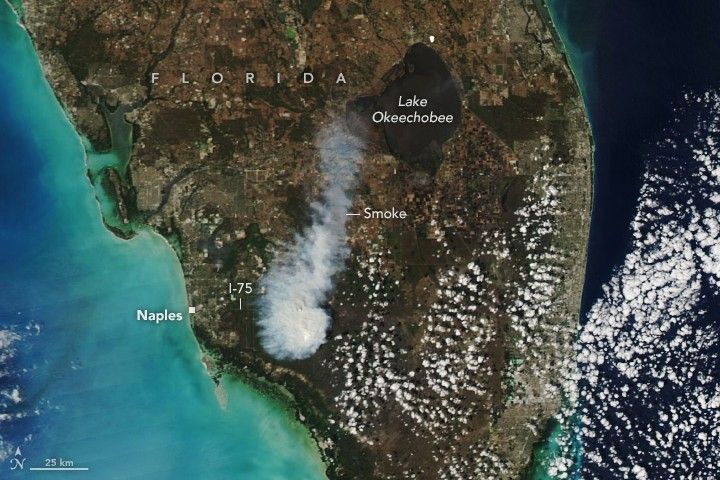
A satellite image of southern Florida shows white-gray smoke east of the coastal city of Naples. Winds carry the plume northward toward Lake Okeechobee.
February 25, 2026

On February 22, 2026, a wildland fire was discovered in Big Cypress National Preserve, about 25 miles (40 kilometers) east of Naples, Florida. The blaze, dubbed the National fire, moved through dry vegetation and sent a plume of smoke billowing over parts of the preserve and nearby communities. 

The MODIS (Moderate Resolution Imaging Spectroradiometer) on NASA’s Aqua satellite captured this image on the afternoon of February 25. By then, the fire had burned around 24,000 acres (9,700 hectares), according to the National Park Service.

After carrying smoke southward in previous days, winds shifted to start pushing it north by the time Aqua captured this image. According to news reports, the smoke reduced visibility and led to the brief closure of I-75—the interstate nicknamed “Alligator Alley” that runs east-west through the northern part of the preserve. It also contributed to smog over Lake Okeechobee

The fire continued to spread over the next several days, reaching just over 35,000 acres (14,000 hectares) by February 28, according to InciWeb. As of March 2, it remained roughly the same size and was 38 percent contained. 

The fire’s cause remains under investigation. Officials noted, however, that its spread was driven by ample fuel, including vegetation that was dry from persistent, extreme drought and damaged by recent frost. The National Interagency Fire Center’s wildland fire outlook calls for above-normal fire potential across Florida through May.

NASA Earth Observatory image by Lauren Dauphin, using MODIS data from NASA EOSDIS LANCE and GIBS/Worldview. Story by Kathryn Hansen.

References & Resources

You may also be interested in:

Stay up-to-date with the latest content from NASA as we explore the universe and discover more about our home planet.

Smoky Skies in the Pacific Northwest

3 min read

Smoke filled river valleys in northeastern Washington and parts of British Columbia.

Article

B.C. Wildfires Send Smoke Skyward

2 min read

Lightning likely ignited several large fires that sent smoke pouring over the Canadian province in early September 2025.

Article

Fire Threatens Rare Forests in Argentina

3 min read

Blazes spread across Los Alerces National Park, home to some of the world’s oldest trees.

Article

Powered by WPeMatico
Get The Details…

Spacewalk and Japanese Cargo Craft Departure Preps Kick Off Week

Spacewalk and Japanese Cargo Craft Departure Preps Kick Off Week

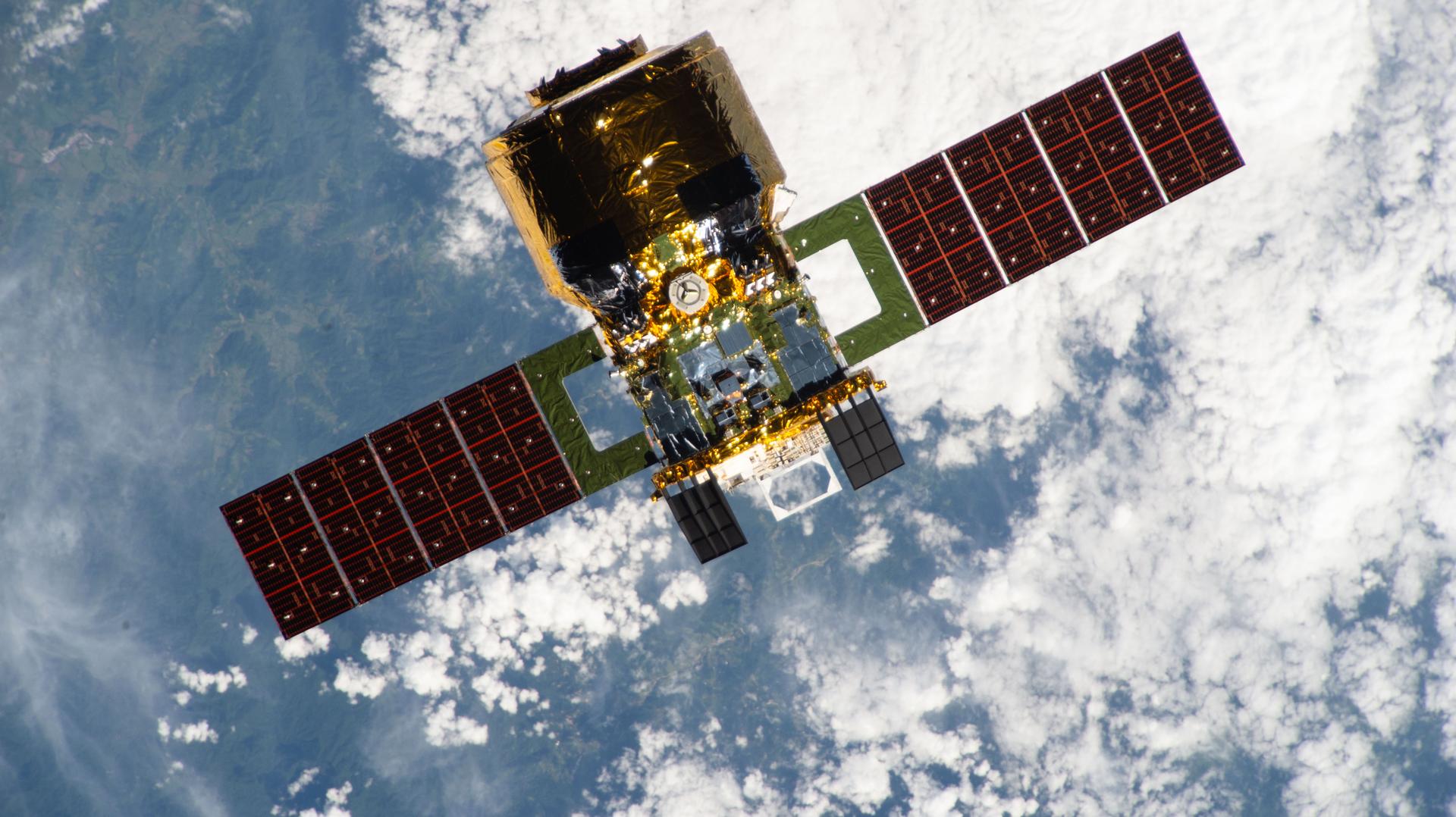
The new HTV-X1 cargo spacecraft from JAXA (Japan Aerospace Exploration Agency), carrying about 12,800 pounds of science, supplies, and hardware for the Expedition 73 crew, slowly approaches the International Space Station 262 miles above Colombia.
The new HTV-X1 cargo spacecraft from JAXA (Japan Aerospace Exploration Agency), carrying over 12,000 pounds of science, supplies, and hardware, approaches the International Space Station for a robotic capture on Oct. 29, 2025.
NASA

The Expedition 74 crew kicked off the work week readying a spacesuit and studying procedures for an upcoming spacewalk later this month. The International Space Station residents are also packing a Japanese cargo craft and preparing it for departure from the International Space Station at the end of the week.

NASA flight engineers Chris Williams and Jack Hathaway partnered with each other before lunchtime on Monday and unstowed spacesuit components and staged them inside the Quest airlock. Afterward, NASA flight engineer Jessica Meir worked inside Quest and installed leg and arm components on a single spacesuit then swapped components from one spacesuit to another.

Hathaway later joined ESA (European Space Agency) Flight Engineer Sophie Adenot and reviewed how to suit up an astronaut, guide a spacewalker in and out of the airlock, communicate with mission controllers during a spacewalk, and more. The astronauts are gearing up for a spacewalk that was postponed in January to install a modification kit and route cables for a future roll-out solar array on the port side of the orbital outpost.

Williams also trained for the departure of JAXA’s (Japan Aerospace Exploration Agency) HTV-X1 cargo craft that launched to the space station in October from Tanegashima Space Center. He reviewed the procedures he will use when the Canadarm2 robotic arm releases the HTV-X1 into Earth orbit and when monitoring the Japanese cargo craft’s departure. Meir, after her spacesuit work, continued packing the HTV-X1 with trash and discarded gear.

The HTV-X1 will first be robotically detached from the Harmony module’s space-facing port on Thursday and parked overnight for a sensor demonstration test. Next, the Canadarm2 will release HTV-X1 at 12 p.m. EST on Friday for three months of remote science activities before its fiery, but safe reentry above the south Pacific Ocean. Live coverage begins at 11:45 a.m. EST on NASA+Amazon Prime, and the agency’s YouTube channel.

Amid the spacesuit and cargo-packed schedule, the astronauts also worked on advanced technology and human research. Williams finished installing and configuring a pair of small robotic arms in the Kibo laboratory module that will test precision mobility and experiment automation in microgravity. Adenot took a cognition test to understand how living in microgravity affects orientation, reasoning, decision-making, and more. Meanwhile, Hathaway and Meir took turns pedaling on the Destiny laboratory module’s exercise cycle as a heart rate monitor measured their cardiac activity providing insights into microgravity’s effect on the human body.

In the Roscosmos segment of the orbital lab, flight engineers Sergei Mikaev and Andrey Fedyaev explored using artificial intelligence tools to log a crew member’s activities improving communications and crew effectiveness. Station commander Sergey Kud-Sverchkov performed a photographic inspection of the Zvezda service module’s windows then explored using molecular beams to grow semiconductor structures in an ultra-high vacuum.

Learn more about station activities by following the space station blog, @space_station on X, as well as the ISS Facebook and ISS Instagram accounts.

Get the latest from NASA delivered every week. Subscribe here.

Powered by WPeMatico
Get The Details…

Mark A. Garcia

What’s Up: March 2026 Skywatching Tips from NASA

What’s Up: March 2026 Skywatching Tips from NASA

A total lunar eclipse glows red, Venus and Saturn get close, and we ring in the vernal equinox

A total lunar eclipse blood moon takes centre stage, Venus and Saturn cozy up for a conjunction, and we celebrate the vernal equinox. 

Skywatching Highlights

  • March 3: Total Lunar Eclipse (Blood Moon)
  • March 8: Venus + Saturn Conjunction
  • March 20: Vernal Equinox

Transcript

A total lunar eclipse blood moon takes center stage, Venus and Saturn cozy up for a conjunction and we celebrate the vernal equinox.

That’s What’s Up this March.

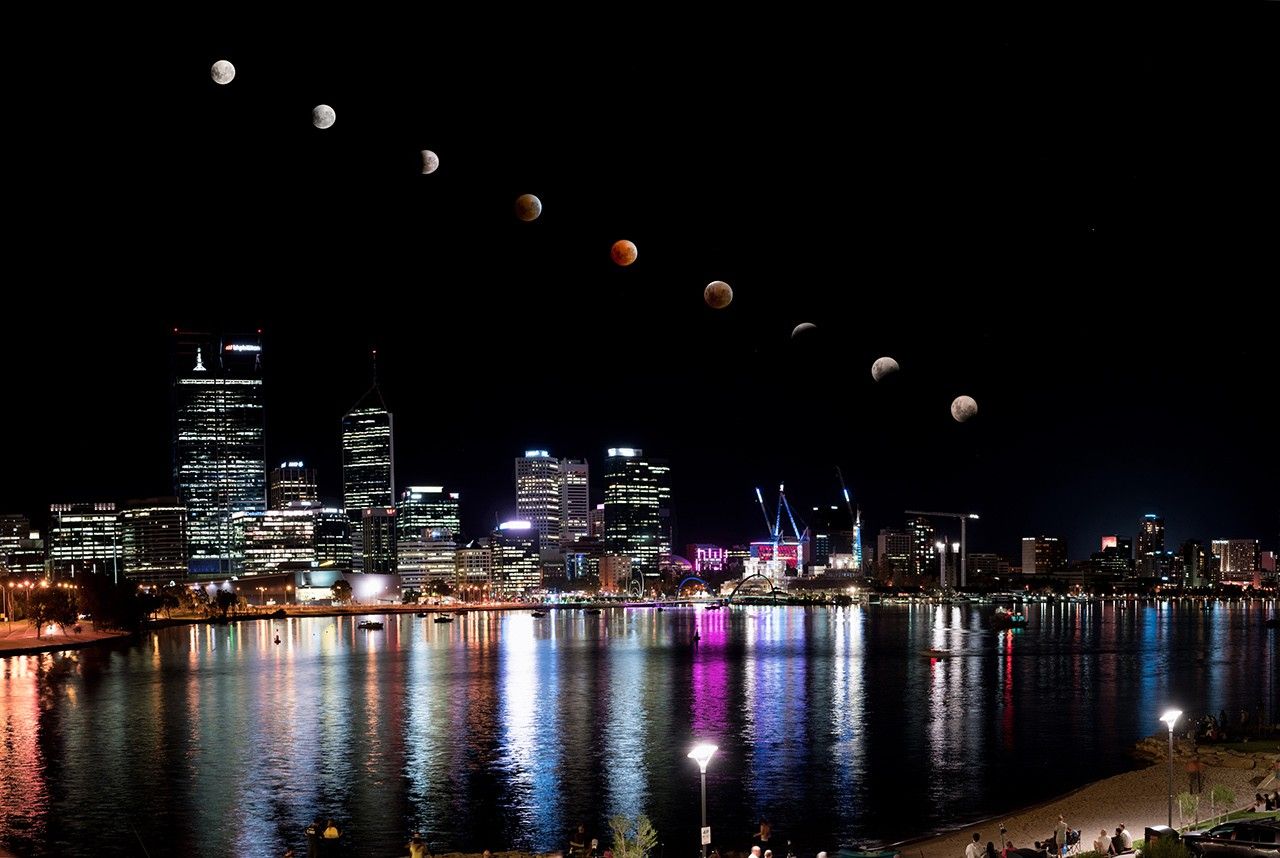
Is it Mars or is it the Moon? On March 3rd, a total lunar eclipse will turn the Moon bright red.

A wide-angle, night-time composite photograph of a lunar eclipse over the Perth, Australia skyline. A diagonal line of nine moons arches across the dark sky, documenting the progression of the eclipse: starting from a bright full moon at the top left, transitioning into a dark reddish-orange
Photograph showing a full lunar eclipse progression across the night sky over a city skyline.
Trevor Dobson via Flick_CC BY-NC-ND 2.0

During a lunar eclipse, which can only happen during a full Moon, Earth passes between the Sun and the Moon, casting a shadow on the lunar surface.

During a partial lunar eclipse, the Moon moves only partially into the dark shadow, or umbra, cast by Earth. 

But, during a full lunar eclipse, the Sun, Earth, and Moon are exactly aligned, leaving the Moon completely enveloped in Earth’s shadow.

When this happens, the Moon actually turns blood red. 

While you might imagine a full lunar eclipse would leave the Moon completely dark, Earth’s atmosphere scatters the light, illuminating the Moon in this orange-reddish hue. 

So look up and bask in the red glow of our lunar companion.

This full lunar eclipse will be visible from eastern Asia and Australia in the evening, from the Pacific at night, and from most of North and Central America as well as western South America in the early morning. 

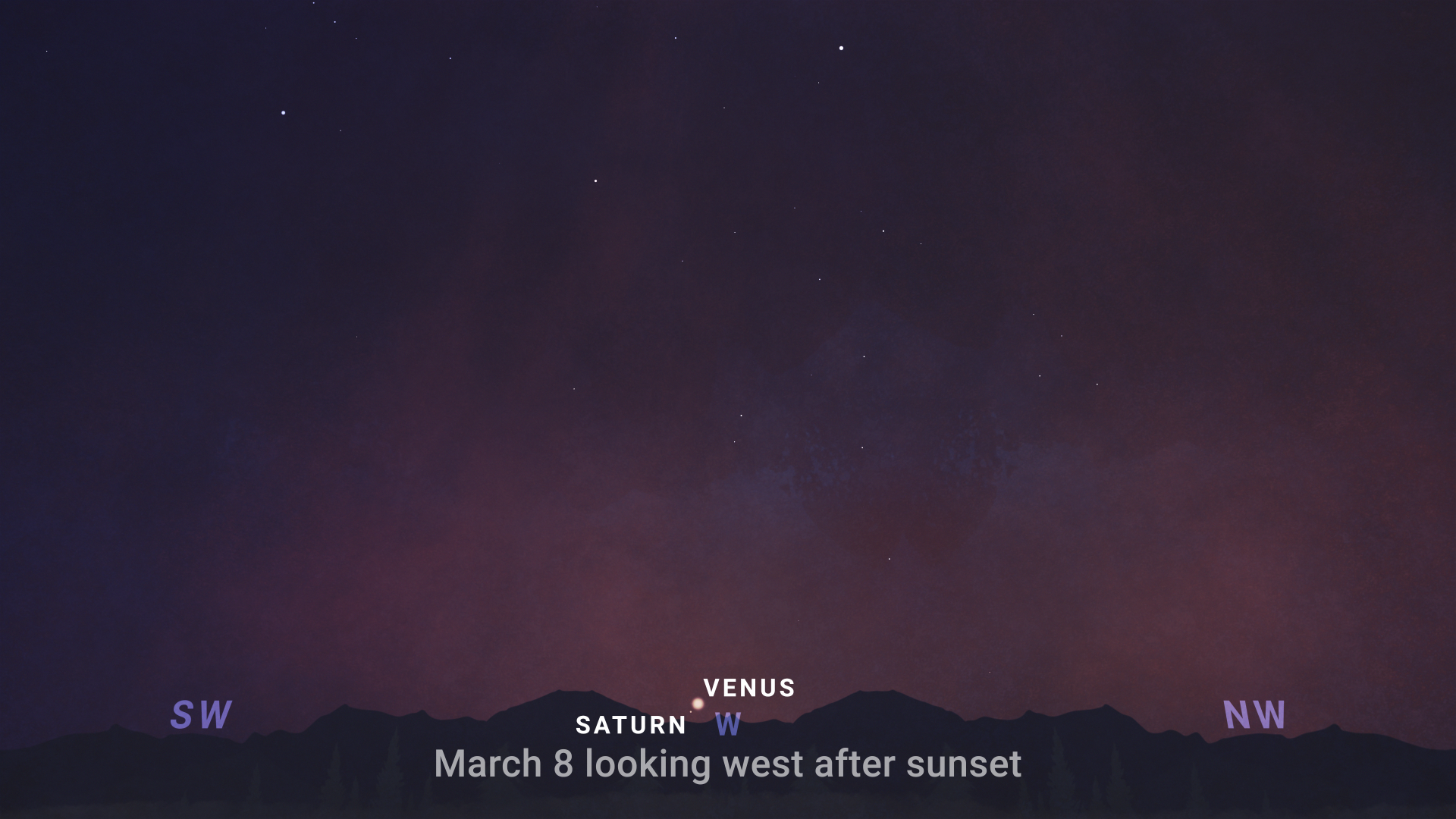
On March 8th, Venus and Saturn will cozy up for a conjunction in the evening sky.

A digital sky map titled
Sky chart showing a conjunction between Saturn and Venus constellation on March 8, 2026. “Saturn” is labeled as well as “Venus.”
NASA/JPL-Caltech

The pair will be about one degree apart, which is roughly the width of a single finger if you hold it at arm’s length.

A conjunction happens when two objects in the night sky appear close together, even if they’re far apart in space. In reality, Venus and Saturn are nearly a billion miles apart! 

But to see the pair get close in the sky from our perspective, look close to the horizon in the western sky just after sunset.

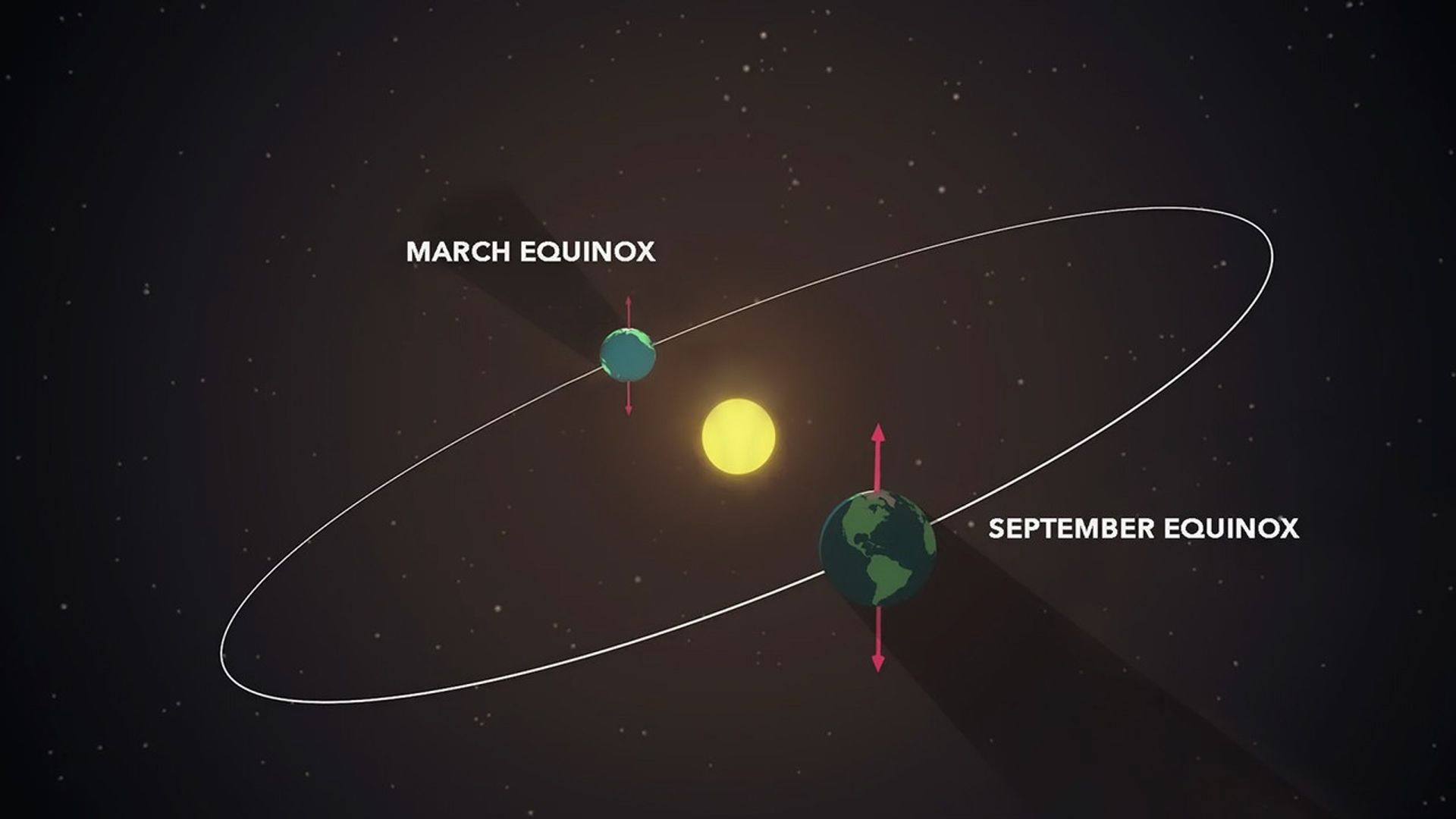
On March 20th, we ring in the vernal equinox, marking a transition into the next season.

An illustration of a glowing dark space background with some faint stars. At the center is the sun with a drawn orbital path around it. On one side of the orbital path is the labeled
An illustration of the March (spring) and September (fall or autumn) equinoxes. During the equinoxes, both hemispheres receive nearly equal amounts of daylight. (Image not to scale)
NASA/GSFC/Genna Duberstein

While this is colloquially known as the first day of spring in the northern hemisphere and the first day of autumn in the southern hemisphere, astronomically this equinox occurs when the Sun crosses above Earth’s equator while traveling from south to north.

On this day, northern and southern hemispheres experience roughly equal amounts of sunlight and day and night are also about equal, each lasting almost exactly 12 hours. 

So enjoy the start of a new season with a day of perfectly balanced sunlight.

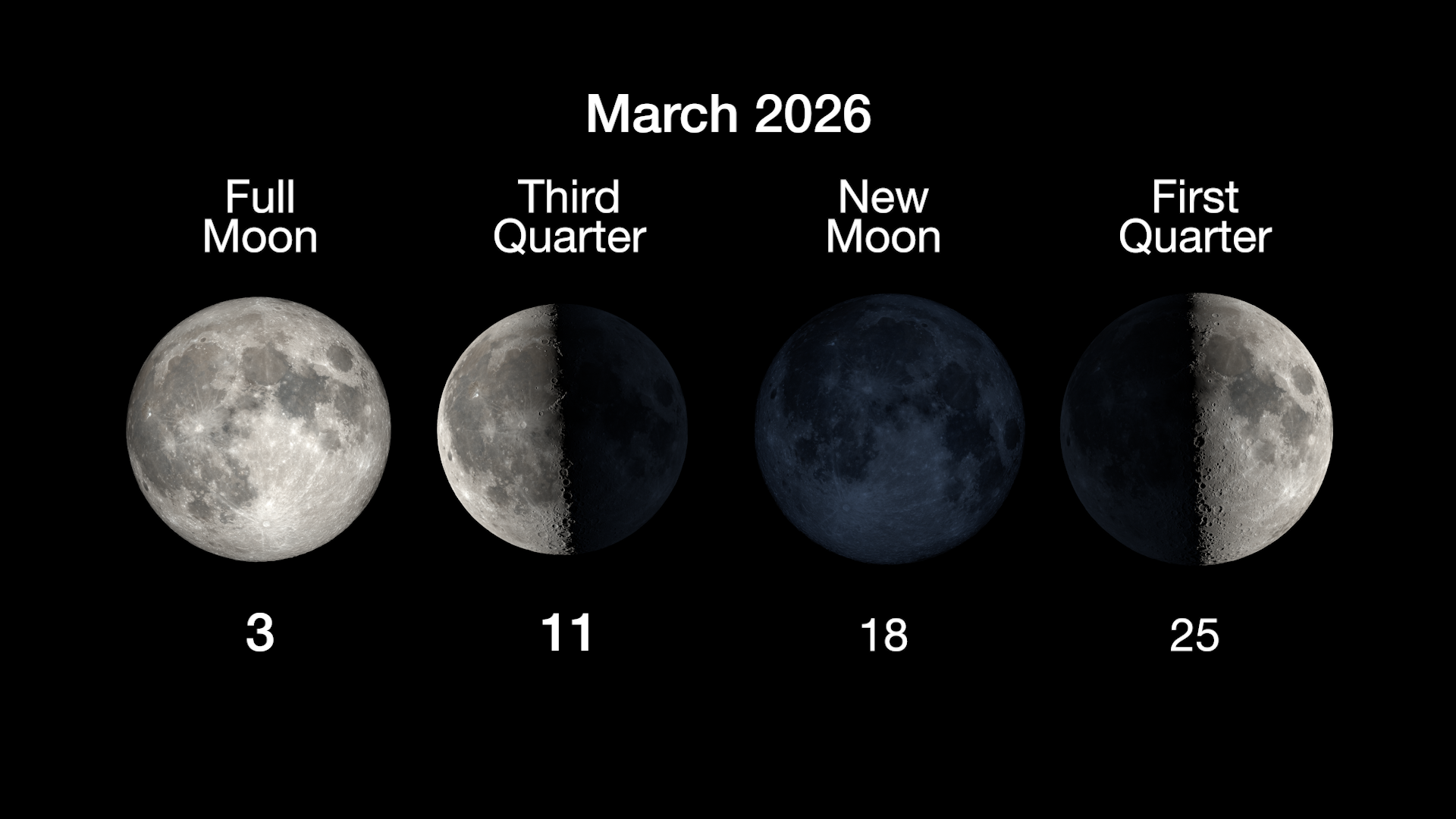
Here are the phases of the Moon for March.

The main phases of the Moon are illustrated in a horizontal row, with the full moon on March 3, the third quarter moon on March 11, the new moon on March 18, and the first quarter moon on March 25.
The phases of the Moon for March 2026.
NASA/JPL-Caltech

You can stay up to date on all of NASA’s missions exploring the solar system and beyond at science.nasa.gov.

I’m Chelsea Gohd from NASA’s Jet Propulsion Laboratory, and that’s What’s Up for this month.

Keep Exploring

Discover More Topics From NASA

Powered by WPeMatico
Get The Details…

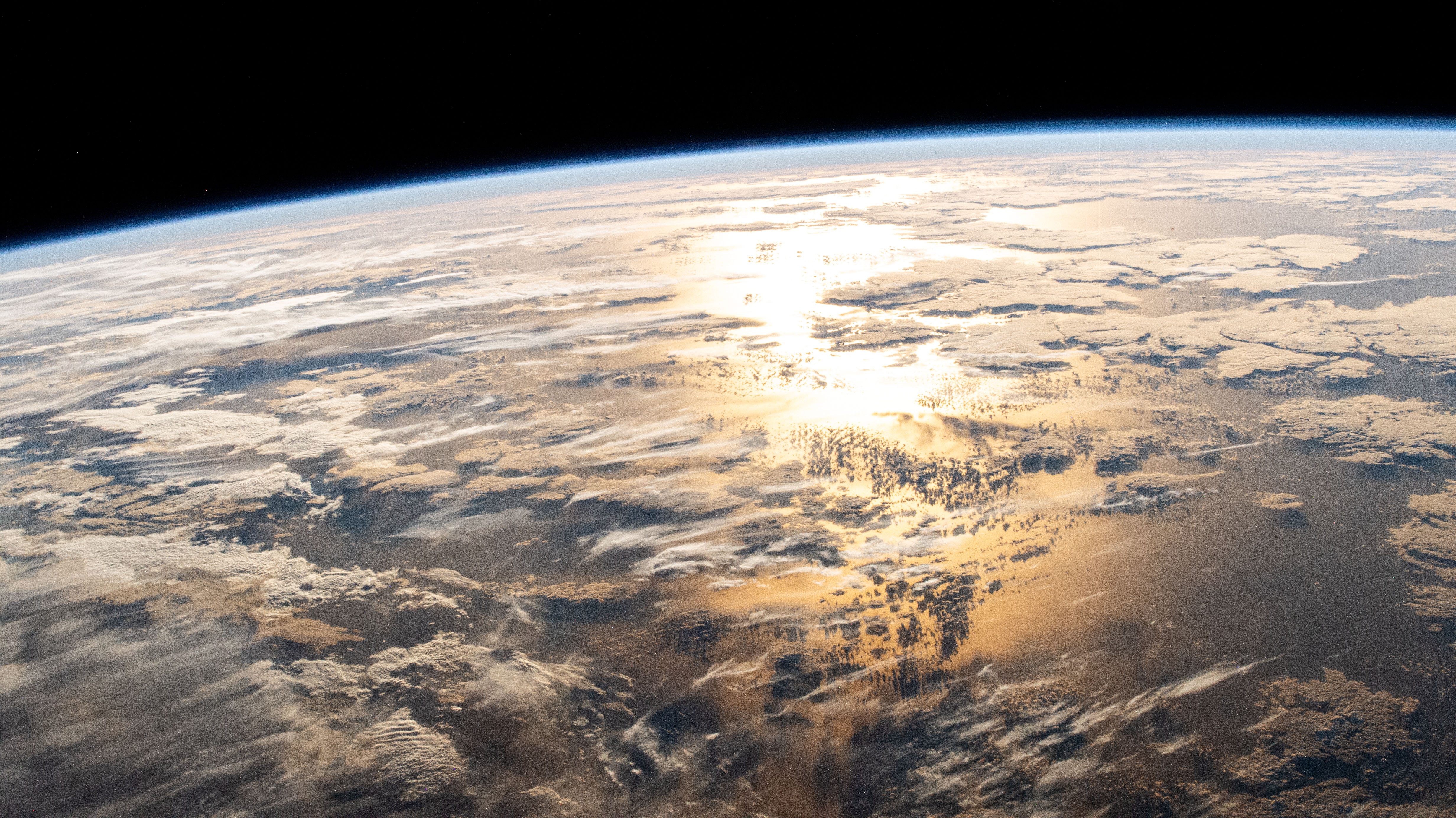
Sunglint on Atlantic Ocean

Sunglint on Atlantic Ocean

A view of the Atlantic Ocean from the International Space Station. Sun shines on the water, turning the water in the middle of the photo yellow-orange. There are flat, white clouds scattered above the ocean. In the distance, Earth’s gentle curve is outlined by a pale blue hazy line – that’s our atmosphere. Beyond that is the darkness of space.
NASA

Sunlight beams off a partly cloudy Atlantic Ocean just after sunrise as the International Space Station orbited 263 miles above on March 5, 2025. This is an example of sunglint, an optical phenomenon that occurs when sunlight reflects off the surface of water at the same angle that a satellite sensor views it. The result is a mirror-like specular reflection of sunlight off the water and back at the satellite sensor or astronaut.

While sunglint often produces visually stunning images, the phenomenon can create problems for remote sensing scientists because it obscures features that are usually visible. This is particularly true for oceanographers who use satellites to study phytoplankton and ocean color. As a result, researchers have developed several methods to screen sunglint-contaminated imagery out of data archives.

Despite the challenges posed by sunglint, the phenomenon does offer some unique scientific opportunities. It makes it easier, for instance, to detect oil on the water surface, whether it is from natural oil seeps or human-caused oil spills. This is because a layer of oil smooths water surfaces.

Text credit: Adam Voiland

Image credit: NASA

Powered by WPeMatico
Get The Details…
Monika Luabeya