

Stem Cell Research for Cancer, Spacesuit Work Kick Off June
The Expedition 74 crew kicked off June with a busy schedule of microgravity research harvesting stem cells, installing physics hardware, and watering plants aboard the International Space Station. Spacesuit work and life support maintenance rounded out the day for the orbital residents.
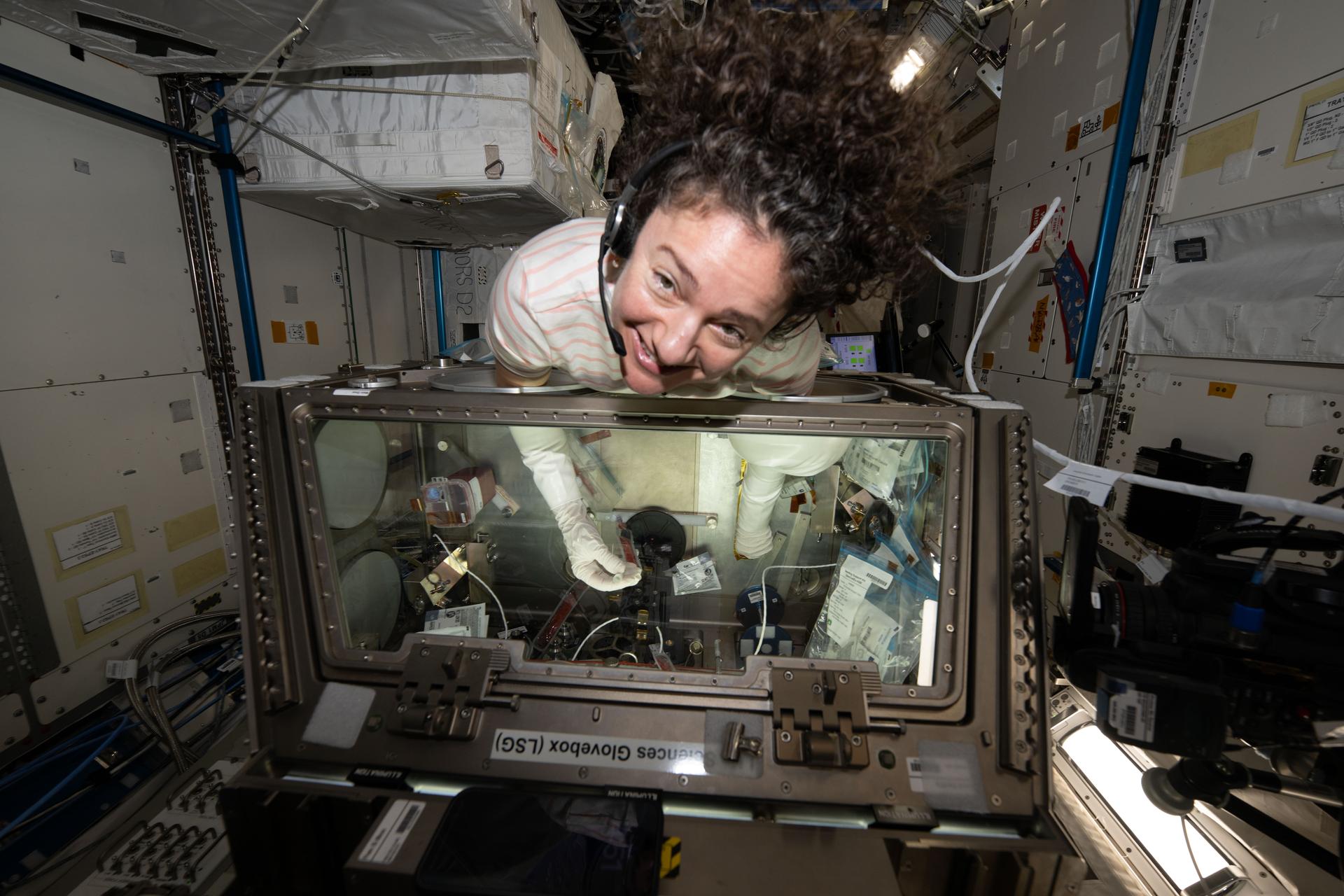
Manufacturing blood stem cells in space is a key objective of a new biotechnology investigation taking place aboard the orbiting lab. NASA flight engineer Jessica Meir harvested stem cell samples growing inside the Kibo laboratory module and placed them inside the KERMIT fluorescent microscope for observation on Monday. Flight engineer Sophie Adenot of ESA (European Space Agency) assisted Meir with the research operations collecting the samples for processing then stowing them in a science freezer for preservation and later analysis. Doctors are exploring how the stem cells self-replicate in weightlessness with an eye toward using the space environment to develop treatments for cancer and blood diseases.
Adenot started her Monday shift installing the Solid Combustion Experiment Module inside Kibo’s multi-purpose small payload rack. She then inserted a gas bottle in the combustion research device to continue studying how solid materials ignite, burn, propagate flame, and self-extinguish in microgravity. She also joined NASA flight engineer Jack Hathaway and helped him unpack hardware stowed inside the Quest airlock to make room for upcoming spacewalk preparations.
Hathway spent the majority of his time inside Quest checking out the functionality and installing batteries on a spacesuit jetpack. A spacewalker would use the jetpack, also called Simplified Aid For EVA Rescue (SAFER), to safely maneuver back to the space station in the unlikely event they became untethered from their worksite. He also activated sample-containing tubes filled with seeds and microbes for a variety of student-designed experiments in the Harmony module. Finally, he watered and photographed alfalfa plants growing inside the Columbus laboratory module’s Veggie facility for the Veg-06 study to promote food production in space.
Flight engineer Chris Williams worked throughout Monday setting up fluid physics hardware and specialized imaging gear inside Columbus. The new components will enable the observation of how fluids boil, condense, and flow in microgravity possibly leading to newer, more advanced thermal systems for future spacecraft on missions to the Moon, Mars, and beyond.
Cosmonauts Sergey Kud-Sverchkov and Sergei Mikaev continued stowing spacewalking tools they used during a science hardware spacewalk on May 27. The duo also returned a set of U.S. tools, including lights, cameras, and batteries, they wore on their Orlan suits, to William who stowed them back inside Quest.
Roscosmos flight engineer Andrey Fedyaev began his shift collecting air samples for analysis from inside the Zvezda and Nauka modules. The samples are analyzed for ammonia, carbon dioxide, and other elements to determine the quality of the station’s atmosphere. During the second half of his shift, Fedyaev was back inside Nauka inspecting and cleaning a pair of laptop computers before servicing the science module’s ventilation system.
Learn more about station activities by following the space station blog, @space_stationon X, as well as the ISS Facebook and ISS Instagram accounts.
Get the latest from NASA delivered every week. Subscribe here.
Powered by WPeMatico
Mark A. Garcia
