Expedition 73 Tracks Health and Gears Up for Cargo Missions

Expedition 73 Tracks Health and Gears Up for Cargo Missions

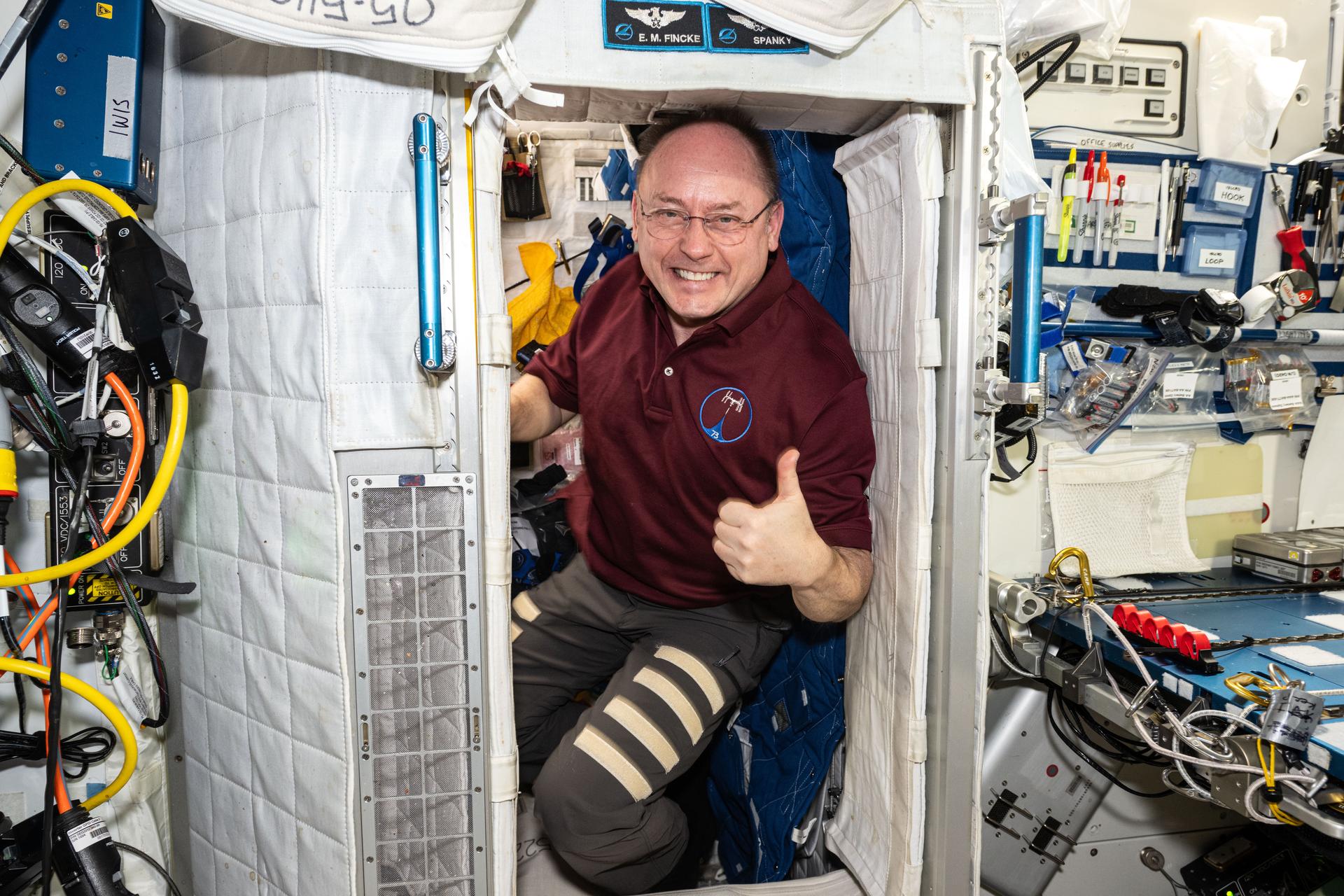
NASA astronaut and Expedition 73 Flight Engineer Mike Fincke poses for a portrait inside the International Space Station's Columbus laboratory module during research operations to learn how the body maintains its core temperature in microgravity.
NASA astronaut Mike Fincke poses for a portrait inside the Columbus laboratory module during research operations.
NASA

The Expedition 73 crew kicked off the week tracking health in microgravity and working on spacesuit gear. The orbital residents also will soon see the arrival of a cargo craft and the departure of another at the International Space Station.

NASA Flight Engineers Jonny Kim and Zena Cardman took turns attaching a variety of sensors to themselves on Monday for a pair of studies measuring their health data in microgravity. Kim began a 48-hour session wearing the Bio-Monitor vest and headband tracking his cardiovascular health for the CIPHER suite of 14 human research investigations. Cardman wore electrodes and breathing gear measuring her heart and breathing rate while pedaling on the Destiny laboratory module’s exercise cycle. Doctors monitor the astronauts’ aerobic health to ensure their bodies can handle sustained physical activities such as long spacewalks or the return to Earth’s gravity after several months in space.

After the health monitoring sessions, Kim joined JAXA (Japan Aerospace Exploration Agency) Flight Engineer Kimiya Yui in the Columbus laboratory module where they set up a pair of research incubators and connected them to a portable power supply. Cardman assisted NASA Flight Engineer Mike Fincke in the Quest airlock, servicing high-definition camera hardware worn on spacesuit helmets.

Yui, a veteran of two spaceflights, began his shift in the Kibo laboratory module setting up botany hardware for the Plant Cell Division experiment that is investigating space agricultural techniques. He also readied equipment for Tuesday’s Immunity Assay study when he will collect his blood and saliva samples for analysis back on Earth to understand how living in space affects cellular immunity.

In the Roscosmos segment of the orbital outpost, cosmonauts Sergey Ryzhikov and Alexey Zubritsky gathered trash and outdated gear for disposal aboard the Progress 91 resupply ship docked to the rear port of the Zvezda service module. The Progress 91 is due to wrap up a six-month cargo mission in September when it will undock from Zvezda and reenter Earth’s atmosphere above the South Pacific Ocean for a fiery, but safe destruction.

Roscosmos cosmonaut and first-time space-flyer Oleg Platonov trained to use the COLBERT treadmill with assistance from Yui who also set up a Bluetooth monitor measuring Platonov’s heart rate during his workout. Afterward, Platonov installed and activated Earth observation gear to capture multispectral imagery of landmarks on the ground.

Preparations aboard the station and on the ground continue for the next launch to deliver science investigations, supplies, and equipment to the orbital outpost. NASA and SpaceX are targeting 2:45 a.m. EDT, Sunday, Aug. 24, to launch more than 5,000 pounds of cargo aboard a SpaceX Dragon spacecraft from Cape Canaveral Space Force Station in Florida.

Learn more about station activities by following the space station blog, @space_station on X, as well as the ISS Facebook and ISS Instagram accounts.

Get the latest from NASA delivered every week. Subscribe here.

Powered by WPeMatico

Get The Details…

Mark A. Garcia

Crew Sets Up Space Hardware to Make Fiber Optics and Brew Lunar Sake

Crew Sets Up Space Hardware to Make Fiber Optics and Brew Lunar Sake

The International Space Station soars 259 miles above Cambodia in this long-duration photograph revealing star trails, lightning storms, and the city lights of Southeast Asia streaking below.
NASA

Fiber manufacturing and lunar brewing wrapped up the research week aboard the International Space Station helping NASA and its international partners promote the commercialization of space. The Expedition 73 crew also continued its space biology studies to keep astronauts healthy while packing a resupply ship for its upcoming departure and maintaining life support systems.

NASA Flight Engineer Jonny Kim opened up the Destiny laboratory module’s Microgravity Science Glovebox and installed fabrication hardware inside to explore the commercial production of optical fibers in microgravity. Operators on the ground will remotely control the hardware as it pulls the thin glass strands that engineers will analyze to determine if the quality exceeds fiber production in Earth’s gravity environment. Results may improve manufacturing techniques for both Earth and space communication industries.

JAXA (Japan Aerospace Exploration Agency) astronaut Kimiya Yui spent his day inside the Kibo laboratory module reconfiguring a research incubator, called the Cell Biology Experiment Facility-L (CBEF-L). Yui replaced trays and compartments inside the scientific device to accommodate a technology demonstration of  fermentation and brewing in microgravity. The JAXA DASSAI MOON study will simulate lunar gravity in the CBEF-L, ferment and brew sake yeast, then send frozen samples back to Earth for analysis. Results may allow a familiar taste from Earth to be produced on the Moon for future visitors.

NASA Flight Engineer Zena Cardman began her shift processing samples for analysis for the CIPHER suite of 14 human research investigations. The second part of her CIPHER study saw Cardman take a series of computer-based tests to track space-related changes to her brain function. Insights may lead to advanced tools such as brain scans, thinking tests, and task simulations to monitor and protect astronaut cognition during long-duration space missions.

NASA Flight Engineer Mike Fincke spent his day inside the Destiny lab servicing life support components and replacing communications hardware. Fincke first accessed a thermal system rack and inspected its hoses then gained access to a failed GPS receiver behind the rack and replaced it.

Roscosmos cosmonauts Sergey Ryzhikov and Alexey Zubritsky, station commander and flight engineer respectively, continued their weeklong investigation into how weightlessness affects tiny blood vessels, or the microcirculatory system. Once again the duo attached electrodes to their head, fingers, and toes, and conducted blood pressure checks to observe how living in space affects their cardiovascular health. Ryzhikov also packed trash inside the Progress 91 cargo craft ahead of next month’s departure while Zubritsky cleaned dust filters in the Rassvet module and configured cameras.

Roscosmos Flight Engineer Oleg Platonov spent his day inside the Nauka science module working on its ventilation system and checking its laptop computers. He also explored how weightlessness is affecting his sense of balance and direction by wearing virtual reality glasses and electrodes around his eyes and forehead then responding to computer-controlled stimuli.

Learn more about station activities by following the space station blog@space_station on X, as well as the ISS Facebook and ISS Instagram accounts.

Get the latest from NASA delivered every week. Subscribe here.

Powered by WPeMatico

Get The Details…

Kelcie Nicole Howren

Head to Toe Blood Flow Studies on Station are Protecting Space Crews

Head to Toe Blood Flow Studies on Station are Protecting Space Crews

The city lights of Sub-Saharan Africa streak below the International Space Station as it orbited 260 miles above the Tanzania-Zambia border in this long-duration photograph. At top right, lightning storms illuminate the cloud tops with the Soyuz MS-27 spacecraft docked to the Prichal module in the foreground.
The city lights of Sub-Saharan Africa streak below the space station as it orbited above the Tanzania-Zambia border in this long-duration photograph. At top right, lightning storms illuminate the cloud tops with the Soyuz MS-27 spacecraft docked to the Prichal module in the foreground.
NASA

Expedition 73 continued exploring how microgravity affects blood flow to help doctors protect crews staying longer in space and traveling farther away from Earth. The International Space Station residents also kept up preparations for an upcoming U.S. cargo mission while maintaining orbital lab systems.

Weightlessness affects a crew member’s blood flow from the head, heart, hands, all the way to the feet resulting in variety of space-caused conditions doctors seek to understand and treat. One long-running space station study, Cerebral Autoregulation, is looking at how the brain regulates its blood supply as the cardiovascular system tries to maintain arterial blood pressure. Flight Engineer Kimiya Yui of JAXA (Japan Aerospace Exploration Agency) wrapped up a session of the brain study on Thursday and downloaded his blood pressure and other biomedical data collected from electrodes he wore while he slept overnight. Results may provide insights into space-related lightheadedness and fainting issues on Earth.

Roscosmos cosmonauts Sergey Ryzhikov and Alexey Zubritsky, station commander and flight engineer respectively, also explored blood flow in space and examined their microcirculatory system, or the tiny blood vessels, in their hands and feet. The data collected from electrodes attached to their head, fingers, and toes, as well as blood pressure checks, may inform ways to protect heart health in space and prepare them for the return to Earth’s gravity.

NASA Flight Engineers Jonny Kim and Mike Fincke began their day together swapping out orbital plumbing components inside the Tranquility module. Kim then joined NASA astronaut Zena Cardman and checked thermal control system hoses on the Destiny laboratory module’s Materials Science Research Rack-1, a research facility to help discover new applications for existing materials and new or improved materials.

Fincke continued his preparations for the next SpaceX Dragon cargo mission targeted to resupply the crew at the end of August. The four-time station astronaut studied procedures that he will use to monitor Dragon’s automated approach, rendezvous, and docking to the Harmony module’s forward port. Fincke then joined fellow crewmates Cardman, Kim, Yui, and Roscosmos cosmonaut Oleg Platonov to review and train on emergency procedures for the SpaceX Dragon crew spacecraft docked to Harmony’s space-facing port.

NASA and SpaceX are targeting 2:45 a.m. EDT, Sunday, Aug. 24, for the next launch to deliver science investigations, supplies, and equipment to the International Space Station. This is the 33rd SpaceX commercial resupply services mission to the orbital laboratory for NASA. Filled with more than 5,000 pounds of supplies, a SpaceX Dragon spacecraft on a Falcon 9 rocket will lift off from Space Launch Complex 40 at Cape Canaveral Space Force Station in Florida. The date adjustment provides additional time for mission readiness as teams work to complete final prelaunch preparations.

Platonov processed microbe samples stowed in an incubator and collected from modules throughout the station’s Roscosmos segment. The samples will be analyzed to characterize the microbial environment of the orbital outpost for the protection of the crew and its hardware. The first-time space-flyer also spent a portion of his shift on standard life support and plumbing duties.

Learn more about station activities by following the space station blog, @space_station on X, as well as the ISS Facebook and ISS Instagram accounts.

Get the latest from NASA delivered every week. Subscribe here.

Powered by WPeMatico

Get The Details…

Mark A. Garcia

Crew Tackles Cardiac Research, Cargo Ops, and Spacesuit Checks

Crew Tackles Cardiac Research, Cargo Ops, and Spacesuit Checks

A vivid red and green aurora crowns Earth’s horizon over the southern Indian Ocean in this photo from the International Space Station as it orbited 270 miles above. At top left, a lit window reveals the docked SpaceX Dragon crew spacecraft docked to the orbital outpost's forward port on the Harmony module, set against a starry sky captured with long-exposure, low-light settings.
A vivid red and green aurora crowns Earth’s horizon over the southern Indian Ocean in this photo from the International Space Station as it orbited 270 miles above.
NASA

Heart and blood pressure studies led the research schedule for the Expedition 73 crew on Wednesday informing scientists how the cardiovascular system adapts to weightlessness. The International Space Station residents are also gearing up for the next SpaceX Dragon cargo mission and cleaning spacesuits for potential spacewalks later this year.

A suite of 14 human research investigations, also known as CIPHER, has been underway aboard the orbital lab for several years providing doctors continual insights into an astronaut’s health in space. The growing database of knowledge helps crew members train for long-duration missions, maintain their fitness in orbit, and prepare for the return to Earth’s gravity.

NASA Flight Engineers Mike Fincke and Zena Cardman began their shift in the Columbus laboratory module with blood pressure checks and artery scans for the cardiac research portion of the CIPHER investigation. Fincke led the CIPHER biomedical operations first measuring Cardman’s blood pressure then scanning her arteries with the Ultrasound 2 device. Doctors on the ground monitored the activities in real time to learn about the unique cardiovascular risks astronauts face when living and working in space.

Afterward, Fincke reviewed the upcoming Dragon resupply mission due to visit the orbital outpost next week. The four-time space station visitor examined the areas where the new cargo will be stowed and studied the tools he will use to monitor Dragon’s approach and rendezvous. Cardman joined NASA Flight Engineer Jonny Kim and assisted him as he serviced components on a pair of spacesuits in the Quest airlock throughout his shift. Kim also spent some time Wednesday reviewing Dragon’s cargo operations.

Flight Engineer Kimiya Yui of JAXA (Japan Aerospace Exploration Agency), who is on his second spaceflight, juggled an array of science and maintenance duties throughout his shift on Wednesday. During the first half of his day he configured a robot camera for a ground operations test and collected airflow measurements in the pressurized mating adapter where the SpaceX Dragon crew spacecraft is docked to on the Harmony module. After lunch, Yui replaced a pair of air quality sensors in the Destiny laboratory module then set up and wore the sensors that would measure the blood flow in his brain as he slept overnight.

Station Commander Sergey Ryzhikov and Flight Engineer Alexey Zubritsky, both Roscosmos cosmonauts, continued their cardiac research on Wednesday splitting their day on a pair of human research experiments. The duo first attached electrodes to their chests for an electrocardiogram that recorded the heart’s electrical activity to detect potential space-caused heart issues. Afterward, Ryzhikov and Zubritsky replaced the electrodes with sensors on their hands, fingers, feet, and toes and measured how blood flows in the tiny vessels, or microcirculatory system.

Roscosmos Oleg Platonov spent the first half of his shift downlinking Earth imagery of North and South America and replacing life support gear inside the Nauka science module. Next, he spent the rest of his day getting up to speed with station systems and conducting a regularly scheduled hearing test.

Learn more about station activities by following the space station blog, @space_station on X, as well as the ISS Facebook and ISS Instagram accounts.

Get the latest from NASA delivered every week. Subscribe here.

Powered by WPeMatico

Get The Details…

Mark A. Garcia

Station Crew Tracks Changes to Eyes, Brain, and Blood in Space

Station Crew Tracks Changes to Eyes, Brain, and Blood in Space

NASA astronaut and Expedition 73 Flight Engineer Jonny Kim stows research samples inside a cryogenic storage unit for installation inside a science freezer for preservation inside the International Space Station's Destiny laboratory module. Offically called the Minus Eighty-Degree Laboratory Freezer for ISS, or MELFI, the ultra-cold storage unit enables space biology research by preserving biological samples for analysis including blood, saliva, urine, microbes, and more.
NASA astronaut Jonny Kim stores research samples like blood, saliva, and microbes inside an ultra-cold science freezer to keep them preserved for future analysis.
NASA

More human research was underway aboard the International Space Station on Tuesday as the Expedition 73 crew explored how working in space affects the eyes, brain, circulatory system, and more. Quantum physics hardware and spacesuit maintenance rounded out the schedule for the seven orbital residents.

NASA Flight Engineers Mike Fincke and Zena Cardman joined each other in the Columbus laboratory module for an eye exam helping doctors identify potential space-caused changes to eye anatomy and function. Fincke, with assistance from specialists on the ground, operated medical gear that sent signals to electrodes attached to Cardman’s forehead and around her eyes. The test, one part of the CIPHER suite of 14 human research investigations, measures how the retina responds to light providing insights into an astronaut’s visual adaptation to microgravity.

NASA Flight Engineer Jonny Kim participated in a secondary portion of the CIPHER investigation taking a test to monitor how his sense of balance, direction, and memory is adjusting to weightlessness. He first collected and processed his blood and urine samples for analysis as is standard procedure for the CIPHER study. Afterward, Kim opened up spatial cognition software on a laptop computer and took a series of tests helping doctors track changes to brain function in space. Results may help researchers design advanced tools such as brain scans, thinking tests, and task simulations to monitor and protect cognition during long-duration space missions.

Kim and Cardman also worked together inside the Quest airlock and swapped components on a pair of spacesuits preparing for potential spacewalks planned for later this year.

JAXA (Japan Aerospace Exploration Agency) Flight Engineer Kimiya Yui, who is on his second space station mission, opened up the Cold Atom Lab in the Destiny laboratory module and replaced computer components inside the physics device. The research facility chills atoms below the average temperature of the universe allowing scientists to observe atomic wave functions and quantum characteristics unachievable on Earth.

Roscosmos cosmonauts Sergey Ryzhikov and Alexey Zubritsky continued studying the microcirculatory system wearing sensors measuring how blood flows to the tiny vessels in a crew member’s hands, fingers, feet, and toes. The data will help doctors refine methods and develop tools to understand how weightlessness affects blood circulation and keep crews healthy during long-duration space missions.

Ryzhikov earlier joined new Flight Engineer Oleg Platonov and swabbed surfaces throughout the station’s Roscosmos segment collecting microbe samples for analysis. The samples were placed in petri dishes for incubation and later analysis to characterize the microbial environment of the orbital outpost for the protection of the crew and its hardware. Platonov also partnered with Zubritsky taking turns wearing an acoustic sensor on their necks measuring the volume as they rapidly exhaled for an ongoing respiratory study.

Learn more about station activities by following the space station blog, @space_station on X, as well as the ISS Facebook and ISS Instagram accounts.

Get the latest from NASA delivered every week. Subscribe here.

Powered by WPeMatico

Get The Details…

Mark A. Garcia