
Boeing’s Starliner Spacecraft Touches Down in New Mexico

Boeing’s Starliner Spacecraft Touches Down in New Mexico
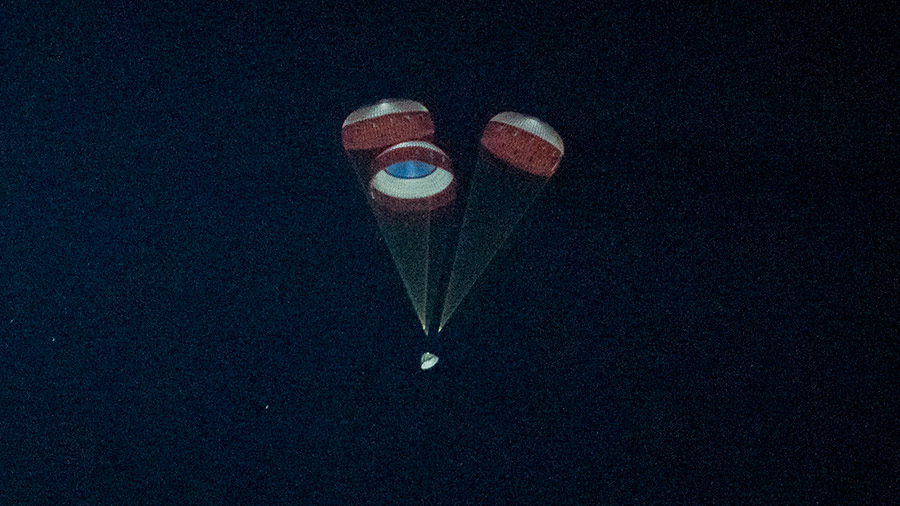
The Boeing CST-100 Starliner spacecraft lands
The Boeing CST-100 Starliner spacecraft lands under three main parachutes in White Sands, New Mexico, Sunday, Dec. 22, 2019. Photo Credit: NASA/Aubrey Gemignani

Boeing’s CST-100 Starliner spacecraft completed the first touchdown on land of a human-rated space capsule in U.S. history Sunday, Dec. 22, 2019, at White Sands Space Harbor in New Mexico, wrapping up the uncrewed Orbital Flight Test as part of NASA’s Commercial Crew Program.

Starliner settled gently onto its air bags at 7:58 a.m. EST in a pre-dawn landing that helps set the stage for future crewed landings at the same site. The landing followed a deorbit burn at 7:23 a.m., separation of the spacecraft’s service module, and successful deployment of its three main parachutes and six airbags.

NASA and Boeing will host a postlanding news conference at 10 a.m. with:

  • NASA Administrator Jim Bridenstine
  • Jim Chilton, senior vice president of Boeing’s Space and Launch Division
  • Steve Stich, deputy manager of NASA’s Commercial Crew Program

The news conference will air live on NASA TV and the agency’s website.

More details about the mission and NASA’s commercial crew program can be found in the press kit online and by following the commercial crew blog, @commercial_crew and commercial crew on Facebook.

Get The Details…

Mark Garcia

Powered by WPeMatico

U.S. Starliner Spacecraft Fires Engines to Return to Earth

U.S. Starliner Spacecraft Fires Engines to Return to Earth

Boeing's CST-100 Starliner spacecraft
Illustration of Boeing’s CST-100 Starliner spacecraft. Credit: Boeing

NASA TV and the agency’s website continue to provide live coverage of the landing of Boeing’s CST-100 Starliner spacecraft.

At 7:23 a.m. EST, the spacecraft began its deorbit burn that puts Starliner on the right path to land at White Sands, New Mexico at 7:57 a.m. The service module has successfully separated from the crew module containing Rosie the rocketeer, an anthropometric test device whose sensors will provide teams on Earth valuable data for when crew members land in the Starliner.

At 7:53 the drogue parachute will be released, pulling out the spacecraft’s three main parachutes that will slow the capsule to a safe landing on Earth a little more than an hour before sunrise in the southwestern desert.

More details about the mission and NASA’s commercial crew program can be found in the press kit online and by following the commercial crew blog, @commercial_crew and commercial crew on Facebook.

Get The Details…

Mark Garcia

Powered by WPeMatico

NASA TV Broadcasting Live Landing Coverage of Starliner Today

NASA TV Broadcasting Live Landing Coverage of Starliner Today

Boeing’s CST-100 Starliner spacecraft launches
A United Launch Alliance Atlas V rocket with Boeing’s CST-100 Starliner spacecraft launches on Dec. 20, 2019, from Florida. Photo Credit: NASA/Joel Kowsky

NASA and Boeing will provide live coverage of the landing on Sunday, Dec. 22, of the company’s CST-100 Starliner spacecraft, on return from its Orbital Flight Test for NASA’s Commercial Crew Program.

Starliner will execute a deorbit burn at 7:23 a.m. EST to begin its return to Earth, headed for a parachute-assisted landing at 7:57 a.m. at White Sands Space Harbor in New Mexico. NASA Television and the agency’s website will provide mission coverage ahead the spacecraft reentry and landing beginning at 6:45 a.m.

NASA and Boeing will host a postlanding news conference at 10 a.m. with:

  • NASA Administrator Jim Bridenstine
  • Jim Chilton, senior vice president of Boeing’s Space and Launch Division
  • Steve Stich, deputy manager of NASA’s Commercial Crew Program

The news conference will air live on NASA TV and the agency’s website.

The uncrewed Starliner spacecraft launched on a United Launch Alliance (ULA) Atlas V rocket Friday, Dec. 20, from Space Launch Complex 41 at Cape Canaveral Air Force Station in Florida.

Though Starliner did not reach the planned orbit or dock to the space station as planned, Boeing still was able to complete a number of test objectives. Teams from NASA, Boeing and ULA worked quickly to ensure the spacecraft was in a stable orbit and preserved enough fuel for multiple landing opportunities.

Boeing Starliner updates provides the latest information from the Orbital Flight Test.

More details about the mission and NASA’s commercial crew program can be found in the press kit online and by following the commercial crew blog, @commercial_crew and commercial crew on Facebook.

Get The Details…

Mark Garcia

Powered by WPeMatico

Boeing Starliner Orbital Flight Test Update

Boeing Starliner Orbital Flight Test Update

Get The Details…

Mark Garcia

Powered by WPeMatico

Station Preps for New U.S. Crew Ship in Middle of Space Research

Station Preps for New U.S. Crew Ship in Middle of Space Research

NASA astronauts pose with Boeing’s CST-100 Starliner spacecraft behind them
NASA astronauts (from left) Nicole Mann, Michael Fincke, Suni Williams, Josh Cassada, and Eric Boe pose for a picture with Boeing’s CST-100 Starliner spacecraft behind them.

Boeing’s new CST-100 Starliner crew ship rolled out to its launch pad in Florida today. The Expedition 61 crew is preparing the International Space Station for Starliner’s arrival while continuing advanced space research.

The Starliner spacecraft sits atop an Atlas V rocket from United Launch Alliance counting down to a liftoff Friday at 6:36 a.m. EST. This will be Boeing’s first Orbital Flight Test of the uncrewed vehicle that will dock to the station Saturday at 8:27 a.m.

NASA astronauts Jessica Meir and Christina Koch are getting ready for duty Saturday morning when they will monitor Starliner’s automated rendezvous and docking with the orbiting lab. The duo will then conduct leak checks, open the hatch and ingress the vehicle to begin a week of docked operations. Starliner is also delivering about 600 pounds of cargo to the crew and will return science samples to Earth after its departure on Dec. 28.

Meanwhile, microgravity science is always ongoing aboard the station to improve life for humans on Earth and in space. Today, NASA Flight Engineer Andrew Morgan studied how weightlessness affects an optical material that can control the reflection and absorption of light. Results could improve solar power technology and electronic mobile displays.

Meir had her eyes scanned with an ultrasound device by ESA (European Space Agency) Commander Luca Parmitano for a look at her cornea, lens and optic nerve. She had a second eye exam using optical coherence tomography for a view of her retina.

The flight engineers in the Russian side of the space station checked on a pair of docked spaceships while working science and maintenance. Cosmonaut Oleg Skripochka charged electronics gear in the Soyuz MS-15 crew ship. He also worked on plumbing systems in the Progress 74 cargo craft. Cosmonaut Alexander Skvortsov set up hardware for an Earth imaging study that explores the effects of natural and manmade catastrophes.

Get The Details…

Mark Garcia

Powered by WPeMatico