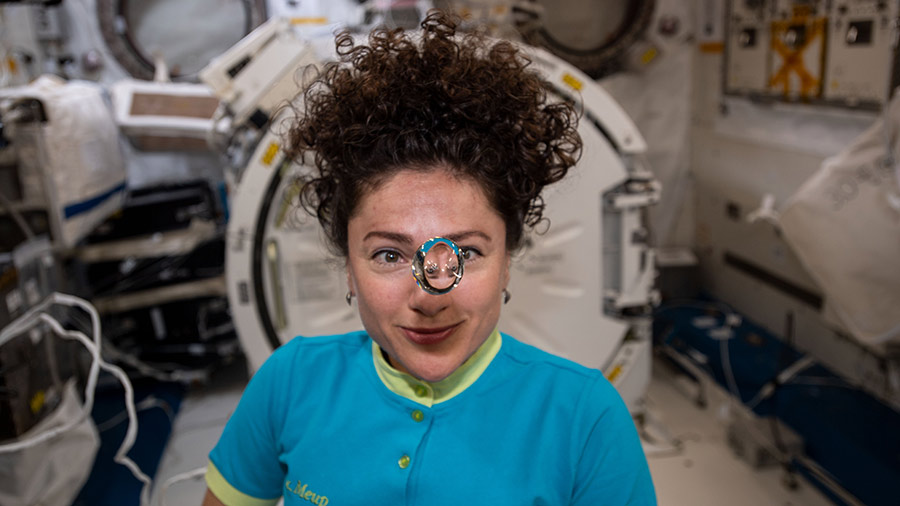
NASA astronaut Jessica Meir observes a floating sphere of water formed by microgravity.
The Cygnus space freighter is open for business at the Unity module where it will stay for the next three months. The Expedition 62 crew has begun unloading over three tons of science, supplies and station hardware delivered Tuesday to replenish the orbital lab.
NASA astronauts Jessica Meir and Andrew Morgan opened Cygnus’ hatch a few hours after its capture and installation Tuesday morning. Afterward, the duo entered the vehicle and began unpacking and setting up over a ton of new science new experiments. The critical research is being stowed in station science freezers, activated in research racks and readied for upcoming operations.
Meir removed science freezers containing research samples from Cygnus and installed them in EXPRESS racks aboard the station. She also began reviewing operations for the just-delivered OsteOmics-02 study to prevent bone loss on Earth and in space.
Morgan retrieved a variety of research hardware from Cygnus and began integrating and activating them in station systems. The new Mobile SpaceLab, a tissue and cell culturing facility, was installed and powered up on an EXPRESS rack.
In the afternoon, the NASA Flight Engineers joined Commander Oleg Skripochka of Roscosmos to review emergency procedures. The trio went over the steps they would take in the unlikely event of a fire, pressure leak or ammonia leak aboard the station. The veteran cosmonaut spent the majority of Wednesday on the upkeep of Russian lab systems.
During the crew’s lunchtime a series of nine nanosatellites were deployed outside Japan’s Kibo laboratory module. They will each study different phenomena such as X-rays from distant pulsars, atmospheric and natural events and the effects of space radiation on hardware.
Cygnus Cargo Craft Attached to Station for Three-Month Stay
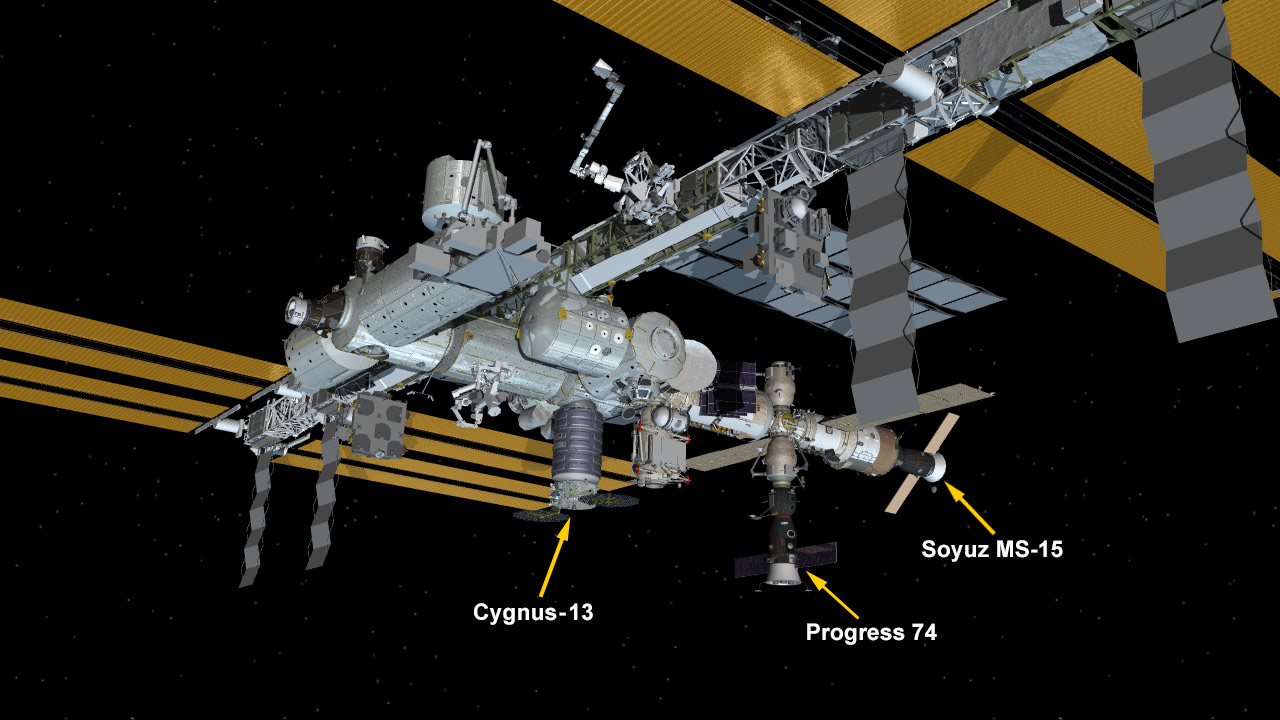
Feb. 18, 2020: International Space Station Configuration. Three spaceships are parked at the space station including the U.S. Northrop Grumman Cygnus cargo craft and Russia’s Progress 74 resupply ship and Soyuz MS-15 crew ship.
After its capture this morning at 4:05 a.m. EST, the Northrop Grumman Cygnus spacecraft was bolted into place on the International Space Station’s
Earth-facing port of the Unity module at 6:16 a.m. At the time of installation, the space station was flying over south of New Zealand.
The spacecraft’s arrival brings more than 7,500 pounds of research and supplies to space station. Here are some of the scientific investigations:
Better Tissue and Cell Culturing in Space
Mobile SpaceLab, a tissue and cell culturing facility, offers investigators a quick-turnaround platform to perform sophisticated microgravity biology experiments. Such experiments are critical for determining how microgravity affects human physiology and identifying ways to mitigate negative effects. The platform can work in multiple configurations, allowing investigators to tailor the facility to their needs.
Mochii
The Mochii investigation provides an initial demonstration of a new miniature scanning electron microscope (SEM) with spectroscopy. Mochii will demonstrate real-time, on-site imaging and measurements of micro- and nanostructures aboard the space station. This capability could accelerate answers to many scientific inquiries and mission decisions and serve the public as a powerful and unique microgravity research platform.
Examining Bone Loss in Microgravity
Crew members experience bone loss in orbit, stemming from the lack of gravity acting on their bones. OsteoOmics investigates the molecular mechanisms that dictate this bone loss by examining osteoblasts, cells in the body that form bone, and osteoclasts, which dissolve bone. A better understanding of these mechanisms could lead to more effective prevention of astronaut bone loss during space missions.
Fighting Bacteria with Phages
Phage Evolution examines the effects of microgravity and radiation exposure on phage and bacterial host interactions, including phage specificity for a bacterial host and host resistance to specific phages. A better understanding of the effects of microgravity and cosmic radiation on bacteriophages and hosts could result in significant developments for phage technology, ultimately helping protect the health of astronauts on future missions.
(Do Not) Light My Fire
The Spacecraft Fire Experiment-IV (Saffire-IV) investigation examines fire development and growth in different materials and environmental conditions, fire detection and monitoring, and post-fire cleanup capabilities. It is part of a series of fire investigations conducted in the Cygnus resupply vehicle after its departure from space station, eliminating exposure of humans or occupied spacecraft to fire danger.
The Cygnus NG CRS-13 spacecraft for this space station resupply mission is named in honor of U.S. Air Force Maj. Robert Lawrence, the first African American astronaut selected by any program, specifically chosen for the Air Force’s Manned Orbital Laboratory Program in June 1967. Lawrence died in an F-104 Starfighter aircraft accident at Edwards Air Force Base, California six months later at the age of 32.
This is the second time two Cygnus spacecraft will be in flight at the same time, as the NG-12 vehicle remains in orbit after departing from the station on Jan. 31.
Robotic Arm Reaches Out and Captures Cygnus Cargo Craft
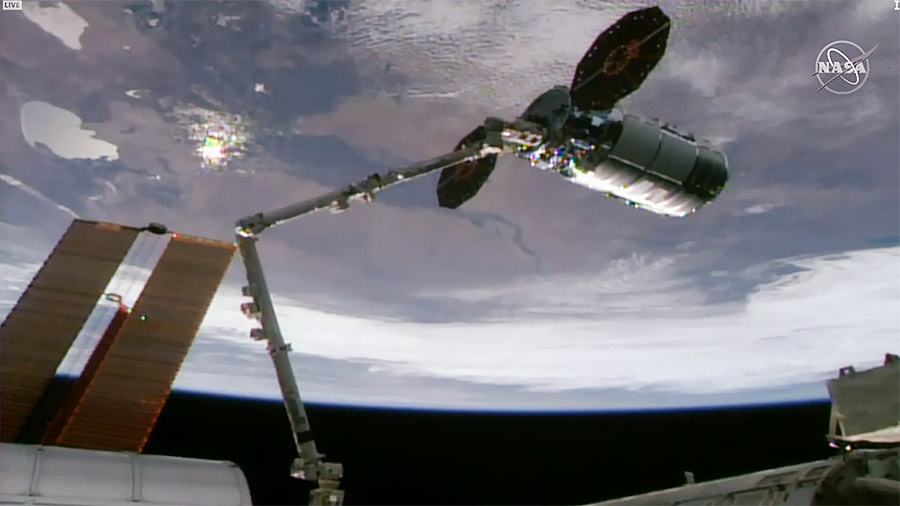
The U.S. Cygnus cargo craft from Northrop Grumman was about 12 meters away from the station when the Canadarm2 robotic arm captured it.
At 4:05 a.m. EST, NASA Flight Engineer Andrew Morgan grappled Cygnus and NASA astronaut Jessica Meir acted as a backup. After capture, the spacecraft will be installed on the Unity module’s Earth-facing port.
The station was flying over southeastern Russia when it was captured.
NASA Television coverage of installation will begin at 6:00 a.m. Cygnus will remain at the orbiting laboratory for a three-month stay before it disposes of several thousand pounds of trash through its fiery reentry into Earth’s atmosphere.
U.S. Cygnus Cargo Ship Blasts Off to Station for Tuesday Delivery
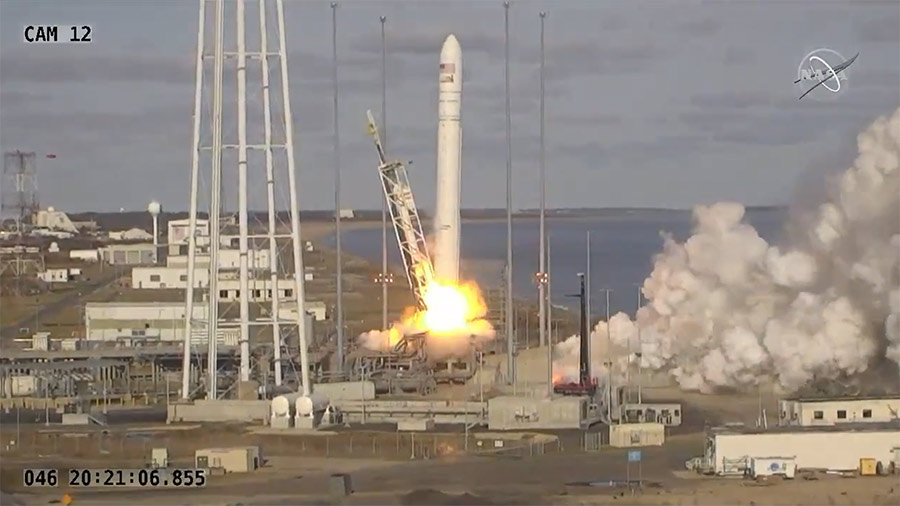
Northrop Grumman’s Cygnus resupply spacecraft launches on time atop the Antares rocket from the Wallops Flight Facility in Virginia. Credit: NASA TV
Northrop Grumman’s Cygnus resupply spacecraft is on its way to the station with approximately 7,500 pounds of science investigations and cargo after launching at 3:21 p.m. EST Saturday, Feb. 15 from NASA’s Wallops Flight Facility in Virginia. At the time of liftoff, the International Space Station was flying 258 statute miles over the western Pacific, northeast of the Northern Mariana Island.
The spacecraft launched on an Antares rocket from the Virginia Mid-Atlantic Regional Spaceport’s Pad 0A at Wallops. Automated command to initiate solar array deploy will begin at 4:40 p.m., about one hour and 19 minutes after launch. Solar array deployment will take about 30 minutes. Confirmation of solar deployment will be shared on the launch blog and social media at @NASA_Wallops and @space_station.
Cygnus is scheduled to arrive at the orbiting laboratory around 4:05 a.m. Tuesday, Feb. 18. Coverage of the spacecraft’s approach and arrival will begin at 2:30 a.m. on NASA Television and the agency’s website. NASA astronaut Andrew Morgan will use the space station’s robotic arm to capture Cygnus, while NASA’s Jessica Meir monitors telemetry. The spacecraft is scheduled to stay at the space station until May.
The spacecraft’s arrival brings more than 7,500 pounds of research and supplies to space station. Here are some of the scientific investigations:
Better Tissue and Cell Culturing in Space
Mobile SpaceLab, a tissue and cell culturing facility, offers investigators a quick-turnaround platform to perform sophisticated microgravity biology experiments. Such experiments are critical for determining how microgravity affects human physiology and identifying ways to mitigate negative effects. The platform can work in multiple configurations, allowing investigators to tailor the facility to their needs.
Mochii
The Mochii investigation provides an initial demonstration of a new miniature scanning electron microscope (SEM) with spectroscopy. Mochii will demonstrate real-time, on-site imaging and measurements of micro- and nanostructures aboard the space station. This capability could accelerate answers to many scientific inquiries and mission decisions and serve the public as a powerful and unique microgravity research platform.
Examining Bone Loss in Microgravity
Crew members experience bone loss in orbit, stemming from the lack of gravity acting on their bones. OsteoOmics investigates the molecular mechanisms that dictate this bone loss by examining osteoblasts, cells in the body that form bone, and osteoclasts, which dissolve bone. A better understanding of these mechanisms could lead to more effective prevention of astronaut bone loss during space missions.
Fighting Bacteria with Phages
Phage Evolution examines the effects of microgravity and radiation exposure on phage and bacterial host interactions, including phage specificity for a bacterial host and host resistance to specific phages. A better understanding of the effects of microgravity and cosmic radiation on bacteriophages and hosts could result in significant developments for phage technology, ultimately helping protect the health of astronauts on future missions.
(Do Not) Light My Fire
The Spacecraft Fire Experiment-IV (Saffire-IV) investigation examines fire development and growth in different materials and environmental conditions, fire detection and monitoring, and post-fire cleanup capabilities. It is part of a series of fire investigations conducted in the Cygnus resupply vehicle after its departure from space station, eliminating exposure of humans or occupied spacecraft to fire danger.
Northrop Grumman named the NG CRS-13 Cygnus spacecraft after former astronaut Robert Henry Lawrence Jr. Major Lawrence was selected in honor of his prominent place in history as the first African American astronaut.
This is Northrop Grumman’s 13th cargo flight to the space station and will support dozens of new and existing investigations.
Station Crew Demos Wi-Fi Power, Sets Up For Rodent Research
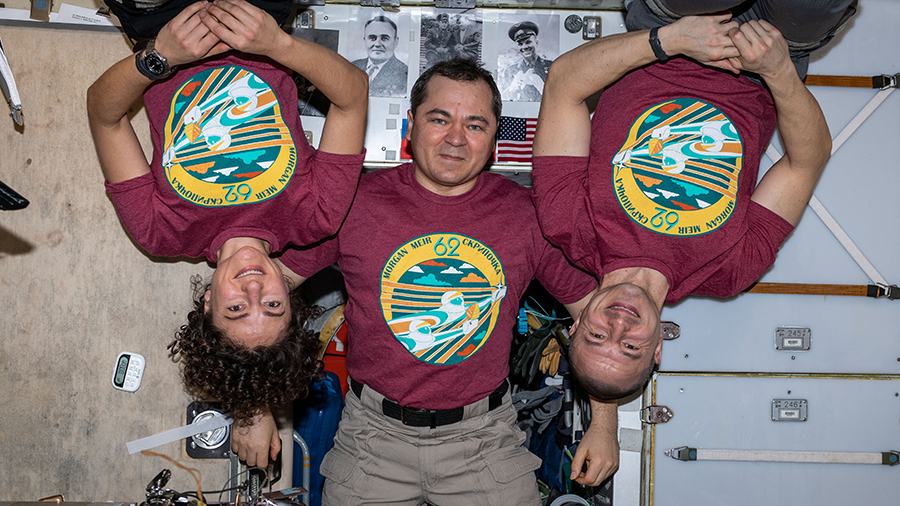
The three-member Expedition 62 crew, sporting their mission patch on t-shirts, will be living aboard the station until April. In the center, is Roscosmos Commander Oleg Skripochka flanked by NASA Flight Engineers Jessica Meir and Andrew Morgan.
A science demonstration for students and space research to improve life kept the Expedition 62 crew busy on Wednesday. The International Space Station residents also worked on a host of orbital plumbing and housecleaning tasks.
Radio waves generate energy that can be harnessed for a variety of applications including wirelessly powering devices or possibly beaming solar energy down to Earth. NASA Flight Engineer Jessica Meir filmed how a flashlight powered by Wi-Fi gets brighter and darker as it moves closer or farther away from a Wi-Fi device aboard the station. The video will be sent down to students to demonstrate the technology developed by the Naval Research Laboratory.
Biology research also takes place aboard the orbiting lab and the crew will soon continue exploring how microgravity affects rodents. NASA Flight Engineer Andrew Morgan worked in Japan’s Kibo lab module setting up the Life Science Glovebox that will house the rodents to be delivered on an upcoming cargo mission. Mice physiology is similar to humans so researchers observe how their bodies react to weightlessness as well as countermeasures to the long-term effects.
Meir and Morgan also split their on life support maintenance and space plumbing. Meir set up acoustic monitors to measure station sound levels before checking on safety masks and charging spacesuit batteries. Morgan printed out housecleaning to-do lists then worked on the U.S. bathroom, also known as the Waste and Hygiene Compartment.
Commander Oleg Skripochka of Roscosmos serviced Russian Orlan spacesuit water loops and checked for leaks. After checking on water tanks in the Progress 74 cargo craft, he set up exercise research gear then photographed the after effects of catastrophes on Earth.
The Cygnus cargo craft from Northrop Grumman is counting down to a launch from Virginia on Friday at 3:43 p.m. EST. The U.S. space freighter, loaded with 7,300 pounds of science, supplies and hardware, will arrive Sunday for a robotic capture with the Canadarm2 at 4 a.m. NASA TV will cover all the launch, capture and installation activities live.