
Station Trio Checks Eyes, Keeps Lab in Tip-Top Shape

Station Trio Checks Eyes, Keeps Lab in Tip-Top Shape
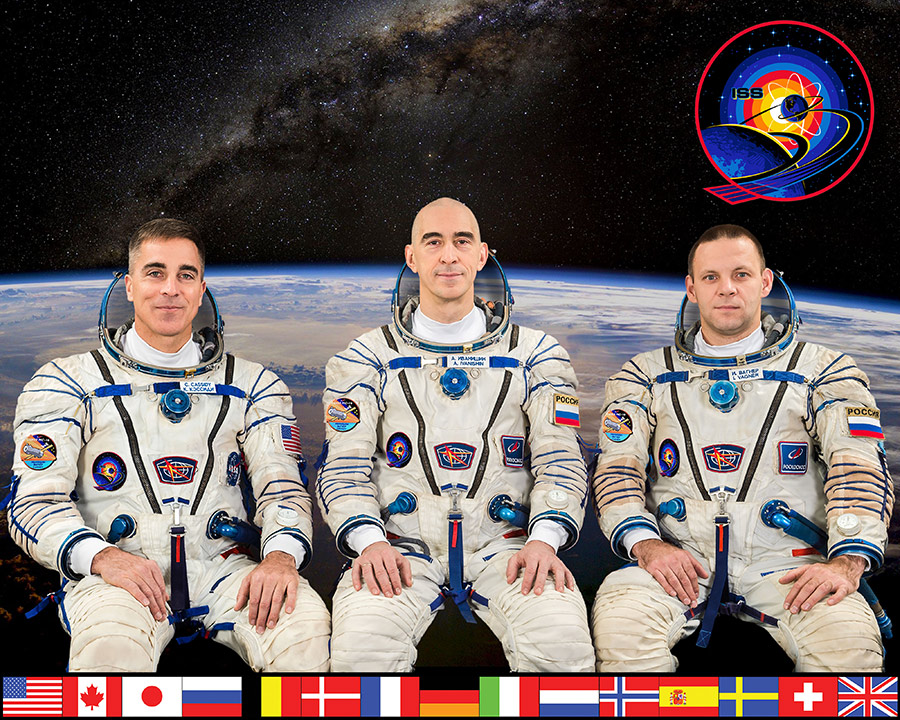
The three-member Expedition 63 crew aboard the International Space Station
The three-member Expedition 63 crew aboard the International Space Station with (from left) NASA astronaut and Commander Chris Cassidy and Roscosmos cosmonauts and Flight Engineers Anatoly Ivanishin and Ivan Vagner.

The Expedition 63 crew focused its attention today on maintaining International Space Station systems and keeping the orbiting lab in tip-top shape. More eye checks were also on the schedule as doctors seek to protect crew vision in microgravity.

Commander Chris Cassidy of NASA started his morning organizing science hardware inside the Columbus laboratory module from the European Space Agency (ESA). He reconfigured radiation detection gear and adjusted research racks to install stowage bags and create more space inside Columbus. Afterward, Cassidy removed an atmosphere monitor from the U.S. Destiny laboratory module then reinstalled and activated it inside the Harmony module.

The veteran NASA astronaut also partnered once again with experienced Flight Engineer Anatoly Ivanishin for another eye exam, this time using optical coherence tomography gear. Crew members have reported vision issues and scientists are exploring why and seek to ensure healthy eyes while living in space.

Ivanishin, who is on his third station spaceflight, spent Thursday morning servicing power systems in the Russian segment of the orbiting lab. Before wrapping up his day with eye checks, he replaced Russian thermal sensors and updated the station’s inventory management system.

First time space-flyer Ivan Vagner participated in a variety public affairs events for Russian media. He had a live event in the morning where he discussed living aboard the space station. He also recorded messages celebrating Russian space achievements to be broadcast on Earth at later date. Vagner ended his day checking out spacecraft systems inside the Progress 75 cargo craft.

Get The Details…

Mark Garcia

Powered by WPeMatico

Flying Robots, Ultrasound Eye Scans Top Science Schedule

Flying Robots, Ultrasound Eye Scans Top Science Schedule

NASA astronaut and Expedition 63 Commander Chris Cassidy sets up an Astrobee robotic assistant
NASA astronaut and Expedition 63 Commander Chris Cassidy sets up an Astrobee robotic assistant, one of a trio of cube-shaped, free-flying robots, for a test of its mobility and vision system inside the Kibo laboratory module.

Flying robots and ultrasound eye scans were the top science activities aboard the International Space Station today. The Expedition 63 crew also serviced a variety of lab hardware and tested a wearable health monitor.

Free-flying robotic assistants called AstroBees were checked out as Commander Chris Cassidy once again tested their ability to autonomously navigate the orbiting lab. The veteran astronaut then shut down and docked the small cube-shaped devices inside the Kibo laboratory module from JAXA (Japan Aerospace Exploration Agency).

Students on Earth will soon get a chance to “test-drive” the Astrobees in a competition for the best program to control the robotic devices. Researchers are also exploring the Astrobees’ potential to perform routine station duties so the crew has more time for critical science.

Cassidy also tackled more mundane tasks during the morning as he worked on space plumbing duties in the Kibo lab. The commander wiped leaking water and inspected plumbing connections in Kibo’s Water Recovery System.

In the afternoon, Cassidy had his eyes scanned by three-time station Flight Engineer Anatoly Ivanishin using an ultrasound device. The ultrasound exam, with real-time inputs from doctors on the ground, looks at the health of the retina, cornea and optic nerve.

Ivanishin started his workday swapping fuel bottles inside the Combustion Integrated Rack which enables safe studies of fuels, flames and soot in microgravity. First-time space flyer Ivan Vagner worked during the morning on Russian power supply systems before servicing water tanks in the Zvezda service module. Just after lunchtime, Vagner attached the Holter Monitor, a non-invasive medical device, to his chest that will measure his heart’s electrical activity.

Get The Details…

Norah Moran

Powered by WPeMatico

Japanese Resupply Ship, SpaceX Crew Dragon Nearing Launch Dates

Japanese Resupply Ship, SpaceX Crew Dragon Nearing Launch Dates

Japan's H-II Transfer Vehicle (left) and the SpaceX Crew Dragon (right) are scheduled to launch to the International Space Station this month.
Japan’s H-II Transfer Vehicle (left) and the SpaceX Crew Dragon (right) are scheduled to launch to the International Space Station this month.

A Japanese cargo ship is poised to resupply the Expedition 63 crew just as a U.S. space freighter has completed its stay at the International Space Station. The three station residents are also getting ready to welcome two Commercial Crew members in just over two weeks.

Japan’s ninth H-II Transfer Vehicle cargo mission (HTV-9) is due to lift off on May 20 aboard an H-IIB rocket from the Tanegashima Space Center. The cargo craft from JAXA (Japan Aerospace Exploration Agency) is delivering fresh food and supplies, new science experiments and new lithium-ion batteries to upgrade the station’s power systems.

The HTV-9 will arrive at the station on May 25 where Commander Chris Cassidy, with Flight Engineer Ivan Vagner as back up, will capture the cargo craft with the Canadarm2 robotic arm. Ground controllers will take over afterward and remotely install the HTV-9 to the Harmony module’s Earth-facing port where it will stay for two months.

Just two days later, NASA will launch the first crew from the United States since 2011 aboard the SpaceX Crew Dragon. Veteran astronauts Bob Behnken and Doug Hurley will take a 19-hour trip to the station while testing systems inside the Crew Dragon. It will automatically dock on May 28 to the International Docking Adapter located on the Harmony module’s forward port. After the hatches open, the duo will join the Expedition 63 crew to ramp up science and maintenance operations aboard the orbiting lab.

Get The Details…

Mark Garcia

Powered by WPeMatico

NASA Completes Negotiations for Additional Soyuz Seat in Fall

NASA Completes Negotiations for Additional Soyuz Seat in Fall

The International Space Station
The International Space Station is pictured from space shuttle Endeavour after its undocking in February 2010.

To ensure the agency keeps its commitment for safe operations via a continuous U.S. presence aboard the International Space Station until commercial crew capabilities are routinely available, NASA has completed negotiations with the State Space Corporation Roscosmos to purchase one additional Soyuz seat for a launch this fall.

The agency received no responses from U.S. suppliers to a synopsis issued in the fall of 2019 for crew transportation in 2020. Boeing and SpaceX are in the final stages of development and testing of new human space transportation systems that will launch astronauts from American soil, including NASA’s SpaceX Demo-2 mission scheduled for launch no earlier than May 27.

In case you missed it, NASA Administrator Jim Bridenstine shared why the Demo-2 mission is essential.

Get The Details…

Mark Garcia

Powered by WPeMatico

U.S. Cygnus Resupply Ship Departs Station

U.S. Cygnus Resupply Ship Departs Station

In this frame from NASA TV, the U.S. Cygnus space freighter from Northrop Grumman is pictured moments after being released from the space station's Canadarm2 robotic arm.
In this frame from NASA TV, the U.S. Cygnus space freighter from Northrop Grumman is pictured moments after being released from the space station’s Canadarm2 robotic arm.

The Cygnus spacecraft successfully departed the International Space Station three months after arriving at the space station to deliver about 7,500 of scientific experiments and supplies to the orbiting laboratory.

Within 24 hours of its release, Cygnus will begin its secondary mission, hosting the Spacecraft Fire Safety Experiment – IV (Saffire-IV), which provides an environment to safely study fire in microgravity. It also will deploy a series of payloads. Northrop Grumman flight controllers in Dulles, Virginia, will initiate Cygnus’ deorbit to burn up in Earth’s atmosphere Friday, May 29.

Get space station news, images and features via social media on Instagram at: @iss, ISS on Facebook, and on Twitter @Space_Station and @ISS_Research.

Get The Details…

Mark Garcia

Powered by WPeMatico