Russian Cargo Ship Leaves, Crew Tests Dragon’s Comfort Factors

Russian Cargo Ship Leaves, Crew Tests Dragon’s Comfort Factors

July 8, 2020: International Space Station Configuration. Four spaceships are attached to the space station including the SpaceX Crew Dragon, the HTV-9 resupply ship from JAXA (Japan Aerospace Exploration Agency) and Russia's Progress 75 resupply ship and Soyuz MS-16 crew ship.
July 8, 2020: International Space Station Configuration. Four spaceships are attached to the space station including the SpaceX Crew Dragon, the HTV-9 resupply ship from JAXA (Japan Aerospace Exploration Agency) and Russia’s Progress 75 resupply ship and Soyuz MS-16 crew ship.

Russia’s Progress 74 (74P) cargo craft departed the International Space Station today leaving four spaceships from the U.S., Russia and Japan parked at the orbital lab. It will be replaced in two weeks when the Progress 76 arrives to replenish the crew.

The 74P undocked today at 2:23 p.m. EDT after seven months attached to the Pirs docking compartment. The trash-packed resupply ship will descend into Earth’s atmosphere above the South Pacific for a fiery but safe demise. The 76P will take its place when it launches on July 23 at 10:26 a.m. and docks just three-and-a-half hours later to Pirs.

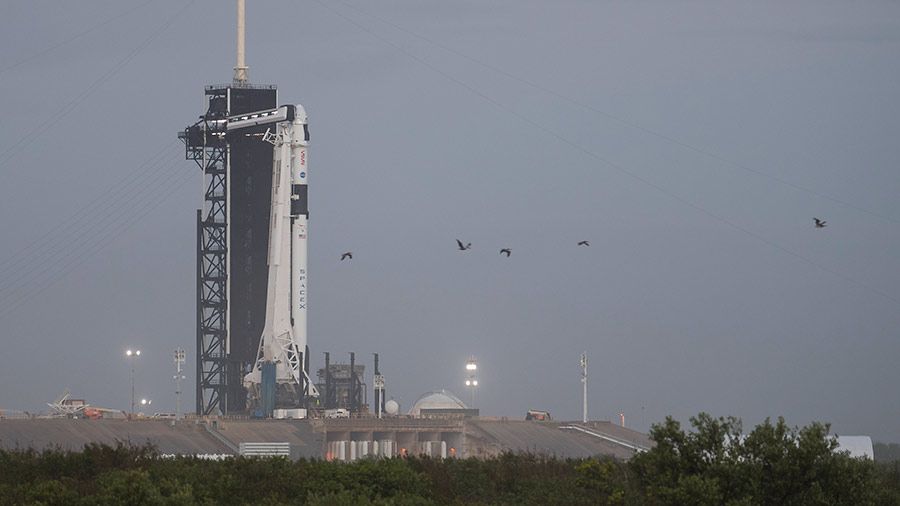
Four out of the five Expedition 63 crew members assessed comfort factors inside the docked SpaceX Crew Dragon today. This is a demonstration of the Crew Dragon’s habitability ahead of the SpaceX Crew-1 mission planned for later this year.

NASA astronauts Doug Hurley and Bob Behnken, who piloted the Crew Dragon, will be joined by station Commander Chris Cassidy and Flight Engineer Anatoly Ivanishin for the one-hour habitability test. The crew will arrange the cabin to suit the four space residents and report their comfort levels to engineers on the ground.

While they were setting up Crew Dragon for the test, the three NASA astronauts also had time for ultrasound eye scans, microfluid studies and orbital plumbing work. The two cosmonauts, including Flight Engineer Ivan Vagner, juggled a variety of Russian space research and tested Soyuz crew ship communications gear.

Get The Details…

Mark Garcia

Powered by WPeMatico

New Satellites Set for Deployment, Cargo Craft Ready for Departure

New Satellites Set for Deployment, Cargo Craft Ready for Departure

(From left) Expedition 63 Commander Chris Cassidy and Flight Engineer Bob Behnken are pictured inside the Bigelow Expandable Activity Module (BEAM).

The Expedition 63 crew readied a pair of tiny satellites for deployment and finished packing a Russian cargo craft for departure. The International Space Station residents also checked on BEAM today then worked on life support and computer maintenance.

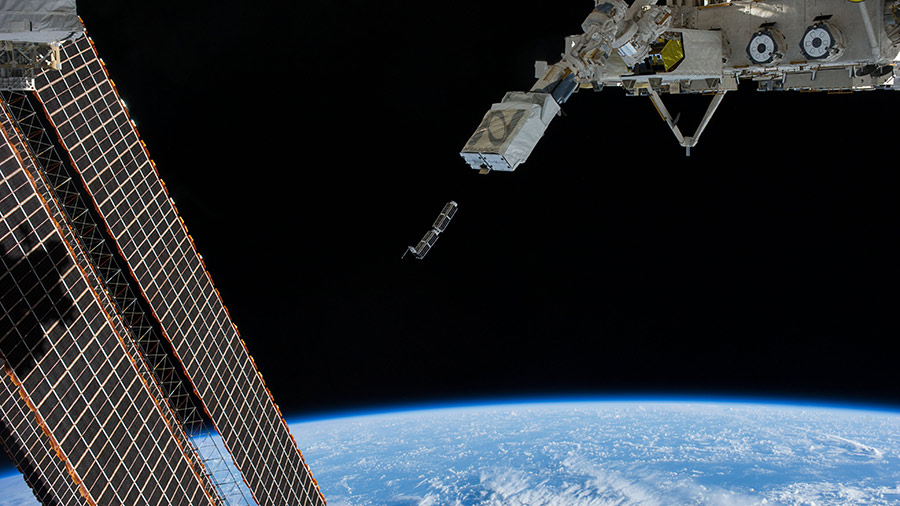
Two CubeSats were installed inside a NanoRacks small satellite deployer this morning for release into Earth orbit later this week from outside Japan’s Kibo laboratory module. NASA Commander Chris Cassidy set up the satellite gear and placed it inside Kibo’s airlock for retrieval by the Japanese robotic arm. One satellite will demonstrate the performance of a tiny but powerful exo-planet telescope, while the other will test returning small payloads safely into Earth’s atmosphere.

Russia’s Progress 74 (74P) resupply ship has been packed with trash and obsolete gear and is ready to end its seven-month stay at the orbiting lab. Cosmonauts Anatoly Ivanishin and Ivan Vagner finalized the cargo transfers today before closing the 74P’s hatch and performing the standard spacecraft leak checks. The 74P will undock Wednesday at 2:23 p.m. EDT from the Pirs docking compartment and descend into Earth’s atmosphere over the South Pacific for a fiery disposal.

BEAM, the Bigelow Expandable Activity Module, has been attached to the station since 2016 and is currently being used as a storage space. NASA Flight Engineers Doug Hurley and Bob Behnken opened up and entered BEAM today to check sensor batteries and retrieve charcoal filters. The sensors monitor BEAM’s pressure and environment while the filters remove impurities from the station’s atmosphere.

The duo also worked on a variety of lab maintenance tasks keeping the station in tip-top shape. Hurley worked on orbital plumbing and checked computer connections. Behnken set up the charcoal filters from BEAM and upgraded software on a laptop computer dedicated to operations in the Microgravity Science Glovebox.

Get The Details…

Mark Garcia

Powered by WPeMatico

Cargo and Science Operations Start Work Week

Cargo and Science Operations Start Work Week

 The SpaceX Crew Dragon and the Japan's HTV-9 resupply ship figure prominently in this photograph taken during the July 1 spacewalk.
The SpaceX Crew Dragon and the Japan’s HTV-9 resupply ship figure prominently in this photograph taken during the July 1 spacewalk.

A Russian cargo craft is due to depart the International Space Station in the middle of the week after seven months on orbit. The five-member Expedition 63 crew stayed busy all-day Monday continuing the upkeep of space research gear and life support hardware.

The Progress 74 (74P) resupply ship is being packed with trash and obsolete gear today ahead of its undocking on Wednesday at 2:23 p.m. EDT. The 74P has been attached to the Pirs docking compartment since Dec. 9 where it docked carrying nearly three tons of food, fuel and supplies for the orbital residents. After separating from the station, the 74P will fire its deorbit engines over the South Pacific and burn up safely in the Earth’s atmosphere.

The Progress 76 (76P), the next cargo ship to replenish the crew, is scheduled to launch on July 23 and dock to Pirs just two orbits later. The station will slightly lower its orbit on Saturday to accommodate the approach and rendezvous of 76P. This follows last week’s orbital maneuver to boost the station out of the way of a piece of rocket debris near its flight path.

Amidst the cargo craft operations, the space lab residents serviced a variety of advanced science equipment today. The operations are continuing the numerous space experiments benefiting humans on Earth and in space.

Commander Chris Cassidy stowed satellite deployment gear before cleaning a specialized furnace that enables observation of materials heated to extreme temperatures. Flight Engineers Doug Hurley and Bob Behnken juggled an array of orbital plumbing, computer maintenance, light installation and sensor battery swap tasks.

Cosmonaut Anatoly Ivanishin replaced fuel bottles inside the Combustion Integrated Rack to continue safe fuel and flame research. Fellow cosmonaut Ivan Vagner checked smoke detectors and photographed the Earth while wrapping up cargo operations in the 74P. The duo started the day measuring their body mass using a device that applies a known force to the crew member with the resulting acceleration providing a mass calculation.

Get The Details…

Mark Garcia

Powered by WPeMatico

Astronauts Check Suits Following Spacewalk

Astronauts Check Suits Following Spacewalk

Astronaut Bob Behnken works during a spacewalk to swap an aging nickel-hydrogen battery for a new lithium-ion battery.

Spacesuit checks were on the schedule today for the Expedition 63 crew following a spacewalk to replace aging batteries on the International Space Station. The orbital residents also juggled a variety of science activities.

NASA astronauts Chris Cassidy and Bob Behnken are back to work today after Wednesday’s spacewalk to swap batteries and route cables on the station’s Starboard-6 truss structure. The duo recharged batteries and refilled water tanks inside their U.S. spacesuits. Flight Engineer Doug Hurley also joined the pair in the afternoon for eye scans with an ultrasound device.

All three astronauts called down to Mission Control today and briefed specialists with the results of the mission’s second spacewalk. Station managers will assess the orbital lab’s upgraded power status before scheduling more battery swap spacewalks later this month.

Cassidy also configured cables on a specialized furnace before uploading new software to the high-temperature research device. Hurley worked with experiment hardware that seeks to better control the separation of blood cells and plasma to improve medical diagnostic devices.

Cosmonauts Anatoly Ivanishin and Ivan Vagner partnered up Thursday morning for cardiac research. The duo is studying how the heart reacts to a unique suit that reverses the flow of blood towards the head caused by weightlessness. The pair then split up for life support maintenance and radiation checks.

Get The Details…

Mark Garcia

Powered by WPeMatico

Cassidy and Behnken Wrap Up Battery Spacewalk

Cassidy and Behnken Wrap Up Battery Spacewalk

NASA astronaut Bob Behnken is pictured tethered to the space station during a spacewalk to swap batteries on the orbiting lab's truss structure.
NASA astronaut Bob Behnken is pictured tethered to the space station’s truss structure during a spacewalk to swap batteries and route cables .

NASA astronauts Chris Cassidy and Robert Behnken concluded their spacewalk at 12:14 p.m. EDT. During the six hour and one-minute spacewalk, the two NASA astronauts completed half the work to upgrade the batteries that provide power for one channel on one pair of the station’s solar arrays. The new batteries provide an improved and more efficient power capacity for operations.

They successfully moved and connected one new, powerful lithium-ion battery and its adapter place to complete the circuit to the new battery and relocated one aging nickel-hydrogen battery to an external platform for future disposal.

They also loosened the bolts on nickel-hydrogen batteries that will be replaced to complete the power capability upgrade on the far starboard truss and complete the station’s battery replacement work that began in January 2017 with the first series of power upgrade spacewalks. Behnken and Cassidy will complete the work during the final two spacewalks later this month.

Cassidy and Behnken also will route power and ethernet cables in preparation for the installation of a new external wireless communications system with an enhanced HD camera and to increase helmet camera coverage for future spacewalks. To support future power system upgrades, they also will remove a device called an “H-Fixture” that was installed before the solar arrays were launched to the space station.

This was the eighth spacewalk for both each astronaut. Cassidy now has spent a total of 43 hours and 22 minutes spacewalking. Behnken has now spent a total of 49 hours and 41 minutes spacewalking.

Space station crew members have conducted 229 spacewalks in support of assembly and maintenance of the orbiting laboratory. Spacewalkers have now spent a total of 60 days and 34 minutes working outside the station.

At 4 p.m. today, NASA astronaut Kate Rubins will discuss her upcoming second mission to the International Space Station, along with cosmonauts Sergey Ryzhikov and Sergey Kud-Sverchkov of the Russian space agency Roscosmos, during a news conference from NASA’s Johnson Space Center in Houston that will be broadcast live on NASA Television and on the agency’s website.

Learn more about station activities by following @space_station and @ISS_Research on Twitter as well as the ISS Facebook and ISS Instagram accounts.

Get The Details…

Mark Garcia

Powered by WPeMatico