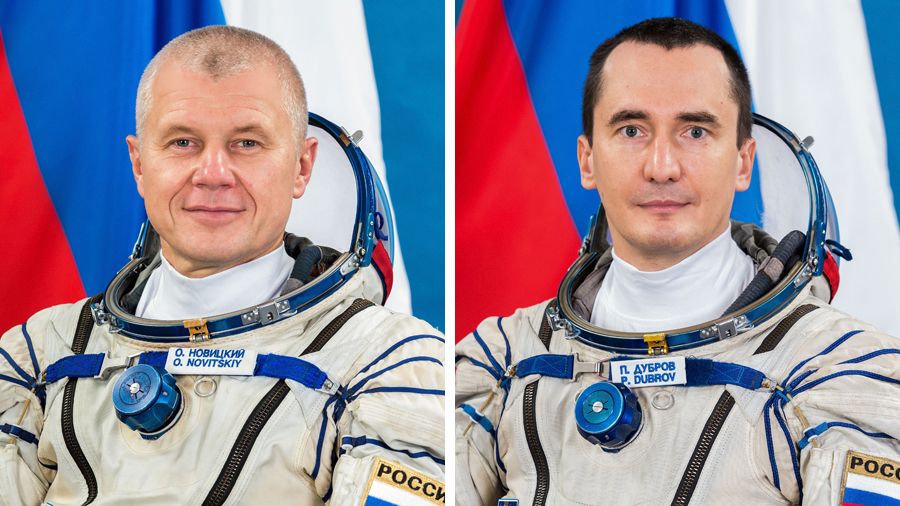
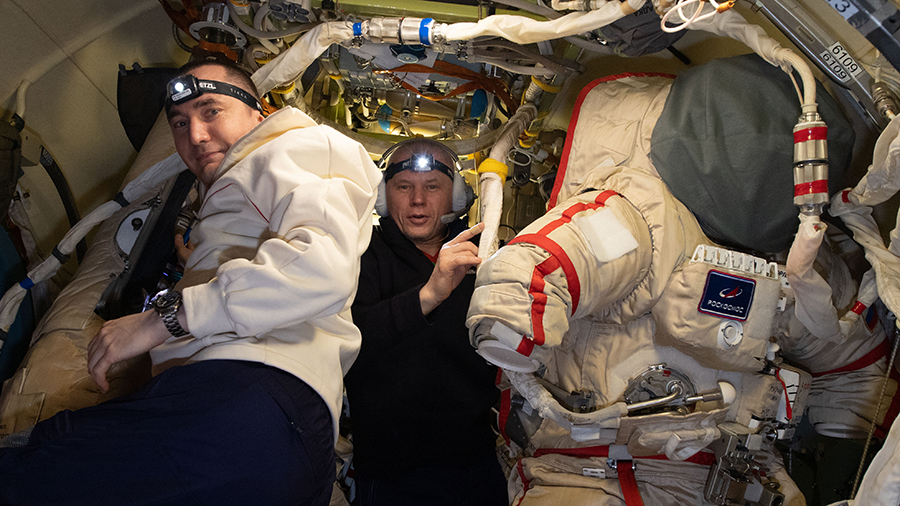
Cosmonauts (from left) Oleg Novitskiy and Pyotr Dubrov are conducting their second spacewalk together.
NASA Television coverage of today’s spacewalk with cosmonauts Oleg Novitskiy and Pyotr Dubrov of the Russian space agency Roscosmos is now underway and is also available on the NASA app and the agency’s website.
The crew members of Expedition 65 are preparing to exit the International Space Station‘s Poisk module on the space-facing side of the station’s Russian segment for a spacewalk expected to begin at approximately 10:35 a.m. EDT and last as long as seven hours.
It will be the first of up to 11 spacewalks to prepare the new Nauka multipurpose laboratory module for operations in space. Watch a video animation preview of today’s spacewalk and planned activities at: https://www.youtube.com/watch?v=hfacX6864b4
During the spacewalk today and subsequent spacewalk planned for Sept. 9, the cosmonauts will install handrails on Nauka and connect power, ethernet, and data cables between the recently arrived module and the Zvezda service module. Nauka launched on a Russian Proton-M rocket July 21 from the Baikonur Cosmodrome in Kazakhstan and docked autonomously to the Earth-facing Zvezda port July 29.
This will be the second spacewalk for both Novitskiy and Dubrov; the 242nd spacewalk in support of space station assembly, maintenance and upgrades; and the 10th and spacewalk at the station in 2021.
Two cosmonauts will exit the International Space Station on Friday to begin powering up the new Russian science module. While they prepare today for the excursion, the rest of the Expedition 65 crew focused on new science experiments and reviewed an upcoming U.S. spacewalk.
Russia’s Nauka multipurpose laboratory module, attached to the station since July 29, will be connected to the station’s ethernet and power systems during a spacewalk set to start Friday at 10:35 a.m. EDT. Roscosmos Flight Engineers Oleg Novitskiy and Pyotr Dubrov will exit the Poisk airlock to begin about seven hours of routing and mating cables on the outside of Nauka.
The spacewalking cosmonauts were joined on Thursday by NASA Flight Engineer Mark Vande Hei and Commander Akihiko Hoshide of the Japan Aerospace Exploration Agency (JAXA) for a review of Friday’s spacewalk procedures. Vande Hei will also assist the spacewalkers in and out of their Russian Orlan spacesuits inside the Poisk module.
Novitskiy and Dubrov have another spacewalk scheduled on Sept. 9 to continue outfitting Nauka with handrails and cables. Both spacewalks will be broadcast live on NASA TV, the NASA app, and the agency’s website.
New space investigations recently delivered aboard the SpaceX Cargo Dragon are just getting under way aboard the orbiting lab. NASA Flight Engineer Megan McArthur kicked off the Genes In Space-8 study today to explore how medicines may act differently in microgravity. A student-designed experiment, started today by NASA Flight Engineer Shane Kimbrough, looks at the mating habits of tardigrades living inside mixture tubes and stowed in a NanoRacks research device.
The next spacewalk following the Russian excursions is planned for Sept. 12 with Hoshide and Pesquet. The duo reviewed procedures today tasked for the scheduled six-and-a-half hour excursion. They will exit the U.S. Quest airlock to modify the Port-4 (P4) truss structure preparing it for a new Roll-Out Solar Array due to arrive next year aboard the Space Cargo Dragon space freighter.
New Dragon Science Under Way Ahead of Friday’s Spacewalk
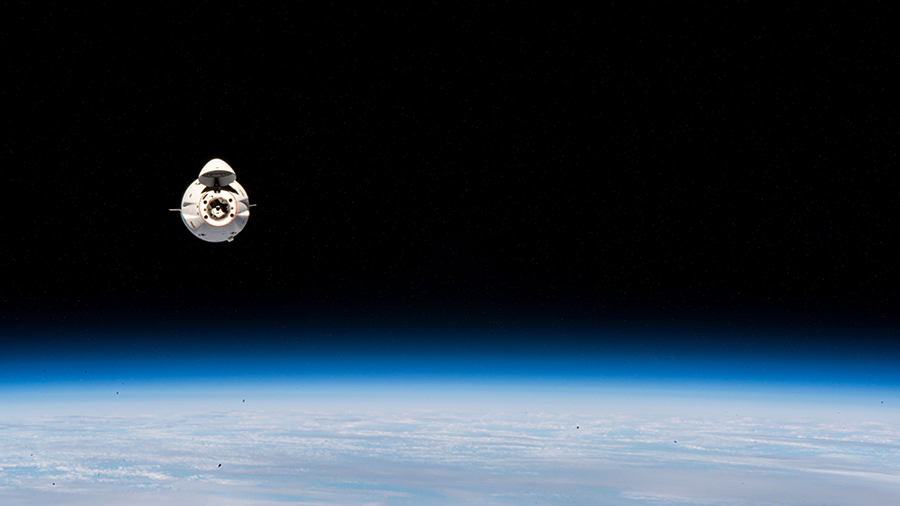
The SpaceX Cargo Dragon vehicle approaches the International Space Station on Aug. 30, 2021.
The Expedition 65 crew continued unloading a variety of cargo including rodents from the SpaceX Cargo Dragon today. The International Space Station residents are also headlong into preparations for two Russian spacewalks and one U.S. spacewalk.
Space botany is also a critical part of the station research program as scientists learn to support astronauts longer and farther in space. During a break in today’s rodent transfers, Kimbrough serviced petri plates for the new APEX-08 investigation that is studying how plants adapt to space-caused stress.
NASA Flight Engineers Megan McArthur and Mark Vande Hei also partnered together unpacking science gear from Dragon. McArthur installed a new NanoRacks module, recently delivered aboard the U.S. space freighter, during the morning that will soon host science experiments. Vande Hei helped out in the afternoon continuing to unload the more than 4,800 pounds of research, crew supplies and hardware.
Pesquet will join Commander Akihiko Hoshide of the Japan Aerospace Exploration Agency (JAXA) for a spacewalk on Sept. 12 to modify the station’s Port-4 (P4) truss structure. They will install a modification kit that will prepare the P4 for future Roll-Out Solar Array installation work. Hoshide worked Wednesday afternoon cleaning their U.S. spacesuit cooling loops today with assistance from Vande Hei.
The first two spacewalks will be conducted by Roscosmos Flight Engineers Oleg Novitskiy and Pyotr Dubrov. The duo will first exit the Poisk airlock on Friday at 10:35 a.m. EDT to route and mate power and ethernet cables on the Nauka multipurpose laboratory. The second spacewalk will be on Sept. 9 to install handrails and finish the cable work on Nauka. NASA TV will broadcast both excursions live.
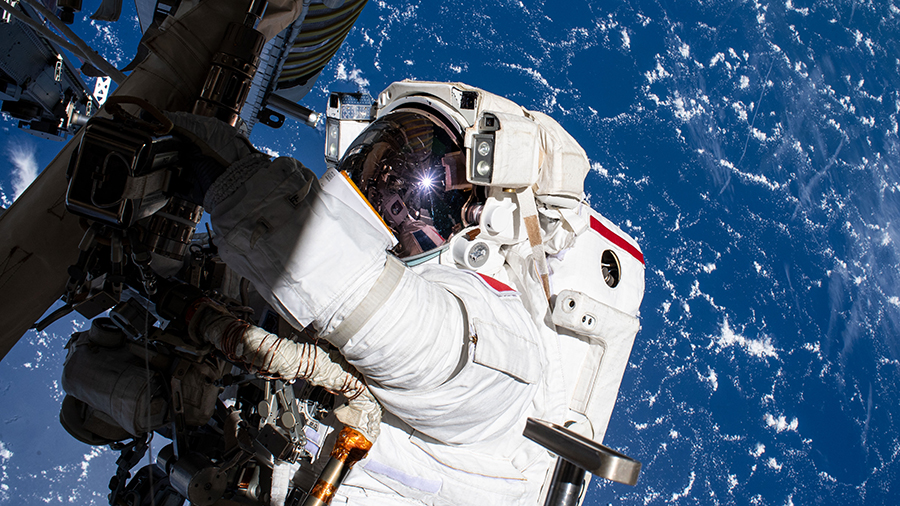
Astronaut Thomas Pesquet works during a spacewalk on June 25 to install the second roll out solar array on the station’s Port-6 truss structure.
The Expedition 65 crew is unpacking brand new science experiments that arrived Monday when the SpaceX Cargo Dragon docked to the International Space Station. Two cosmonauts are also getting ready for the first of two spacewalks to power up Russia’s new science module.
Commander Akihiko Hoshide of the Japan Aerospace Exploration Agency (JAXA) also joined his crewmates and helped to unpack the new space shipment. The three-time station visitor is also preparing for another spacewalk set for Sept. 12 with Pesquet. He worked on a 360-degree virtual reality camera that will film and Pesquet during the spacewalk and began filling U.S. spacesuit water tanks. The duo will begin preparing the Port-4 (P4) truss structure for a new Roll-Out Solar Array.
Two cosmonauts are gearing up for the first pair of up to 11 spacewalks to outfit the Nauka multipurpose laboratory for science operations. Roscosmos Flight Engineers Oleg Novitskiy and Pyotr Dubrov will exit the Poisk airlock on Friday at 10:35 a.m. EDT to route and mate power and ethernet cables on Nauka. The duo will go out again on Sept. 9 to install handrails and finish the cable work on the new module that docked to the Zvezda service module on July 29.
Aug. 30, 2021: International Space Station Configuration. Five spaceships are parked at the space station including Northrop Grumman’s Cygnus space freighter; the SpaceX Crew and Cargo Dragon vehicles; and Russia’s Soyuz MS-18 crew ship and ISS Progress 78 resupply ship.
While the International Space Station was traveling about 260 miles over the Western Australia, a SpaceX Dragon cargo spacecraft autonomously docked to the forward-facing port of the orbiting laboratory’s Harmony module at 10:30 a.m. EDT, Monday, Aug. 30. Flight Engineers Shane Kimbrough and Megan McArthur of NASA monitored operations.
Among the science experiments Dragon is delivering to the space station are:
Building bone with byproducts REducing Arthritis Dependent Inflammation First Phase (READI FP) evaluates the effects of microgravity and space radiation on the growth of bone tissue and tests whether bioactive metabolites, which include substances such as antioxidants formed when food is broken down, might protect bones during spaceflight. The metabolites that will be tested come from plant extracts generated as waste products in wine production. Protecting the health of crew members from the effects of microgravity is crucial for the success of future long-duration space missions. This study could improve scientists’ understanding of the physical changes that cause bone loss and identify potential countermeasures. This insight also could contribute to prevention and treatment of bone loss on Earth, particularly in post-menopausal women.
Keeping an eye on eyes Retinal Diagnostics tests whether a small, light-based device can capture images of the retinas of astronauts to document progression of vision problems known as Space-Associated Neuro-Ocular Syndrome (SANS). The device uses a commercially available lens approved for routine clinical use and is lightweight, mobile, and noninvasive. The videos and images will be downlinked to test and train models for detecting common signs of SANS in astronauts. The investigation is sponsored by ESA (European Space Agency) with the German Aerospace Center Institute of Space Medicine and European Astronaut Centre.
Robotic helpers
The Nanoracks-GITAI Robotic Arm will demonstrate the microgravity versatility and dexterity of a robot designed by GITAI Japan Inc. Results could support development of robotic labor to support crew activities and tasks, as well as inform servicing, assembly, and manufacturing tasks while in orbit. Robotic support could lower costs and improve crew safety by having robots take on tasks that could expose crew members to hazards. The technology also has applications in extreme and potentially dangerous environments on Earth, including disaster relief, deep-sea excavation, and servicing nuclear power plants. The experiment will be conducted inside the Nanoracks Bishop Airlock, the space station’s first commercial airlock.
Putting materials to the test MISSE-15 NASA is one of a series of investigations on Alpha Space’s Materials ISS Experiment Flight Facility, which is testing how the space environment affects the performance and durability of specific materials and components. These tests provide insights that support development of better materials needed for space exploration. Testing materials in space has the potential to significantly speed up their development. Materials capable of standing up to space also have potential applications in harsh environments on Earth and for improved radiation protection, better solar cells, and more durable concrete.
Helping plants deal with stress
Plants grown under microgravity conditions typically display evidence of stress. Advanced Plant EXperiment-08 (APEX-08) examines the role of compounds known as polyamines in the response of the small, flowering plant thale cress to microgravity stress. Because expression of the genes involved in polyamine metabolism remain the same in space as on the ground, plants do not appear to use polyamines to respond to stress in microgravity. APEX-08 attempts to engineer a way for them to do so. Results could help identify key targets for genetic engineering of plants more suited to microgravity.
Easier drug delivery
The Faraday Research Facility is a multipurpose unit that uses the space station’s EXPRESS payload rack systems, which enable quick, simple integration of multiple payloads . On this first flight, the facility hosts a Houston Methodist Research Institute experiment and two STEM collaborations, including “Making Space for Girls” with the Girl Scouts of Citrus Council in Orlando, Florida.
The Faraday Nanofluidic Implant Communication Experiment (Faraday-NICE) tests an implantable, remote-controlled drug delivery system using sealed containers of saline solution as surrogate test subjects. The device could provide an alternative to bulky, cumbersome infusion pumps, a possible game changer for long-term management of chronic conditions on Earth. Remote-controlled drug delivery could simplify administration for people with limitations.
A partnership between Faraday and Girls Scouts allows troops to play a role in conducting the control experiments, including providing them with images of the same experiments that are happening in space. The studies involve plant growth, ant colonization, and the brine shrimp lifecycle.
These are just a few of the hundreds of investigations currently being conducted aboard the orbiting laboratory in the areas of biology and biotechnology, physical sciences, and Earth and space science. Advances in these areas will help keep astronauts healthy during long-duration space travel and demonstrate technologies for future human and robotic exploration beyond low-Earth orbit to the Moon and Mars through Artemis.