Watch Live NASA TV Coverage of the Progress 82 Cargo Launch
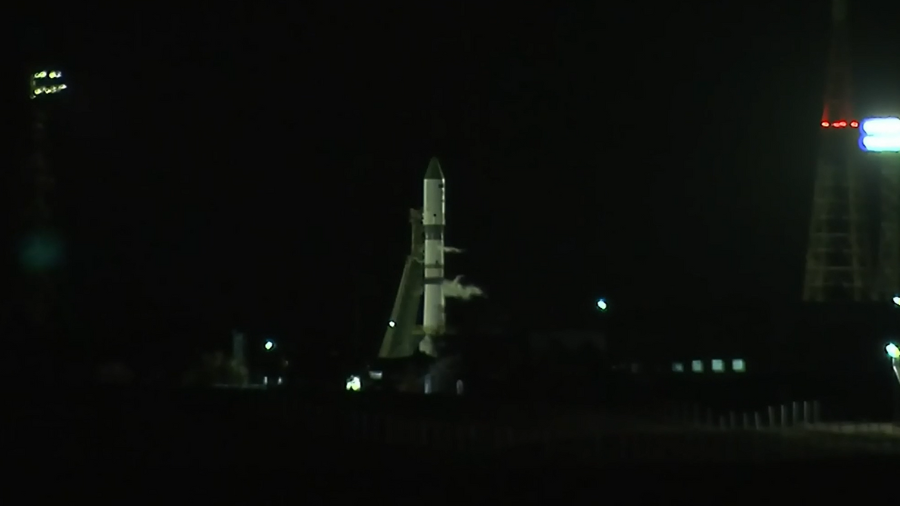
The Progress 82 cargo craft is seen on the launchpad at Baikonur Cosmodrome in Kazakhstan. Credit: Roscosmos/ NASA TV.
NASA Television, the agency’s website and the NASA app now are providing live coverage of the launch of a Roscosmos cargo spacecraft to the International Space Station.
The uncrewed Progress 82 is scheduled to lift off at 8:20 p.m. EDT Tuesday, Oct. 25 (5:20 a.m. Baikonur time Oct. 26), on a Soyuz rocket from the Baikonur Cosmodrome in Kazakhstan. Progress will dock to the space-facing side of the Poisk module two days later, on Thursday, Oct. 27 at 10:49 p.m. EDT.
Cargo Mission Ready to Launch Amid Busy Space Science Schedule
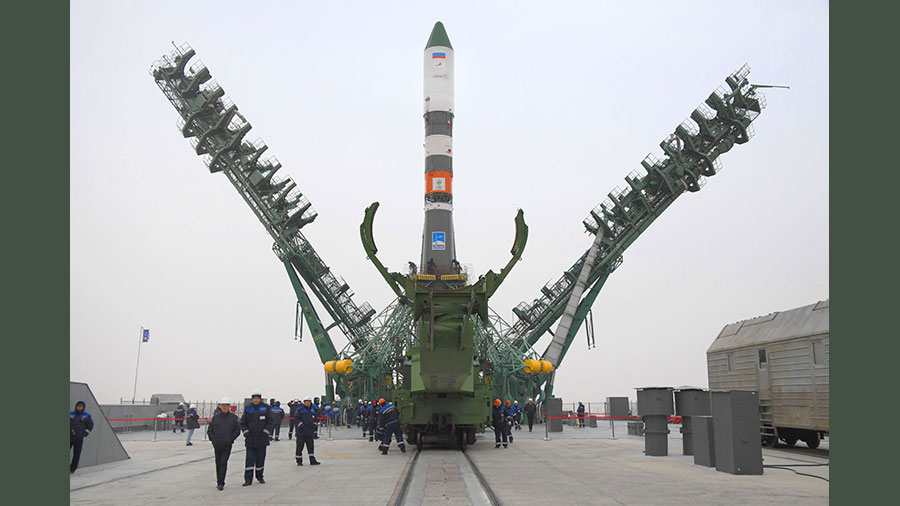
The Progress 82 cargo craft stands atop its rocket at the Baikonur Cosmodrome launch pad in Kazakhstan during pre-launch processing. Credit: RSC/Energia
A new resupply mission stands ready to launch from Kazakhstan tonight to the International Space Station. As the seven Expedition 68 crewmates await their space delivery they tended to vegetables, scanned each other’s eyes, tested robotic inventory scanning, and explored plasma physics.
A rocket with the ISS Progress 82 cargo craft atop is counting down to its lift off from Kazakhstan’s Baikonur Cosmodrome at 8:20 p.m. EDT today to the orbiting lab. Filled with about three tons of food, fuel, and supplies to replenish the orbital residents, the Progress 82 will take a two-day trip to the space station and automatically dock to the Poisk module at 10:49 p.m. EDT on Thursday. NASA TV will broadcast the events live on the agency’s app and website with launch coverage beginning at 8 p.m. on Tuesday and docking coverage at 10:15 p.m. on Thursday.
Back in space, the four astronauts and three cosmonauts aboard the station concentrated on numerous state-of-the-art science experiments benefiting humans both in space and on Earth. Ranging from space botany, human research, and microgravity physics, the studies help crew members adjust to long-term missions in weightlessness and provide innovations enhancing products and services on Earth.
NASA Flight Engineer Frank Rubio spent Tuesday morning nourishing and monitoring vegetables growing inside the Columbus laboratory module. The XROOTS investigation explores soilless methods, or hydroponic and aeroponic techniques, to grow crops in space and sustain crews living off the Earth.
Rubio also joined his fellow flight engineers, Josh Cassada and Nicole Mann, both from NASA, and Koichi Wakata from the Japan Aerospace Exploration Agency (JAXA) for eye scans using the Human Research Facility’s ultrasound device. The optic exams give researchers insight into how microgravity affects the eye’s shape, pressure, retinas and vision.
Mann, who also cleaned and inspected U.S. module hatch seals, joined Wakata and pointed their cameras outside the station photographing the condition of solar array components. In addition, Wakata turned on an Astrobee robotic free-flyer to demonstrate its use of wireless technology, or radio frequency identification, to manage cargo inventory on the space station. Cassada worked inside the Zarya module to maximize storage space.
Commander Sergey Prokopyev configured research hardware in the Columbus module to explore plasma crystals, or highly-charged microparticles, to gain fundamental space physics knowledge and possibly improve the design of future spacecraft. Cosmonauts Dmitri Petelin and Anna Kikina took turns studying future planetary spacecraft and robotic piloting techniques. Petelin then went on and explored how the digestion system adapts to microgravity, while Kikina observed Earth’s nighttime atmospheric glow in the near-ultraviolet wavelength.
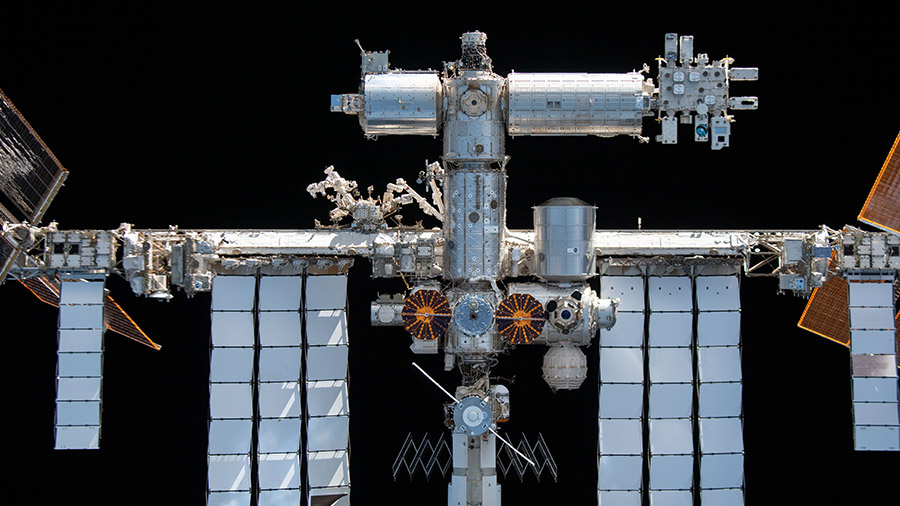
The International Space Station is pictured from the SpaceX Crew Dragon Endeavour during a fly around of the orbiting lab that took place on Nov. 8, 2021.
This evening, the International Space Station’s Progress 81 thrusters fired for 5 minutes, 5 seconds in a Pre-Determined Debris Avoidance Maneuver (PDAM) to provide the complex an extra measure of distance away from the predicted track of a fragment of Russian Cosmos 1408 debris.
The thruster firing occurred at 8:25 p.m. EDT and the maneuver had no impact on station operations. Without the maneuver, it was predicted that the fragment could have passed within about three miles from the station.
The PDAM increased the station’s altitude by 2/10 of a mile at apogee and 8/10 of a mile at perigee and left the station in an orbit of 264.3 x 255.4 statute miles.
Cargo Mission Nears Launch During Human Research on Station
NASA astronaut Nicole Mann poses inside BEAM, the Bigelow Expandable Activity Module, during cargo activities aboard the space station on Oct. 17, 2022.
The next cargo mission to resupply the Expedition 68 crew is ready to launch to the International Space Station on Tuesday evening. In the meantime, the seven orbital lab residents worked on a host of human research studies and serviced a pair of spacesuits to start the work week.
The ISS Progress 82 cargo craft stands atop its rocket at the Baikonur Cosmodrome in Kazakhstan counting down to its liftoff at 8:20 p.m. EDT on Tuesday. The Roscosmos resupply ship will orbit Earth for two days before docking to the Poisk module at 10:49 p.m. on Thursday. NASA TV, on the agency’s app and website, begins its live launch broadcast at 8 p.m. on Tuesday and the docking activities beginning at 10:15 p.m. on Thursday.
Commander Sergey Prokopyev and Flight Engineer Dmitri Petelin joined each other on Monday and practiced remotely controlling the Progress 82 cargo craft on a computer. The two cosmonauts were inside the Zvezda service module training on the telerobotically operated rendezvous unit, or TORU, in the event the Progress 82 would be unable to automatically dock to the space station on its own.
Biomedical studies were at the top of Monday’s schedule for the four astronauts living and working aboard the space station. NASA Flight Engineers Nicole Mann and Josh Cassada started the morning collecting and processing their blood samples before storing them in a science freezer for future analysis. The pair then joined Frank Rubio of NASA and Koichi Wakata of the Japan Aerospace Exploration Agency (JAXA) for a vision test using a standard eye chart. Rubio then assisted Mann as she pedaled on an exercise cycle for a study exploring how weightlessness affects the cardiovascular and respiratory systems. Mann attached Bio-Monitor sensors to herself for the exercise session and recorded physiological data that will be downloaded to doctors on Earth for analysis.
Rubio and Cassada would end the day installing helmet lights and resizing a pair of spacesuits ahead of planned future spacewalks. Mann gathered trash for packing inside the next Northrop Grumman Cygnus cargo vehicle targeted to launch in November. Wakata cleaned the inside the of Microgravity Science Glovebox following research into using artificial intelligence to manufacture fiber optic cables in space.
Cosmonaut Anna Kikina, who launched to the station on the SpaceX Crew-5 mission, spent a portion of her day servicing video and computer hardware before loading data to enable operations with the European robotic arm. She wrapped up her work shift observing Earth’s nighttime atmospheric glow in the near-ultraviolet wavelength.
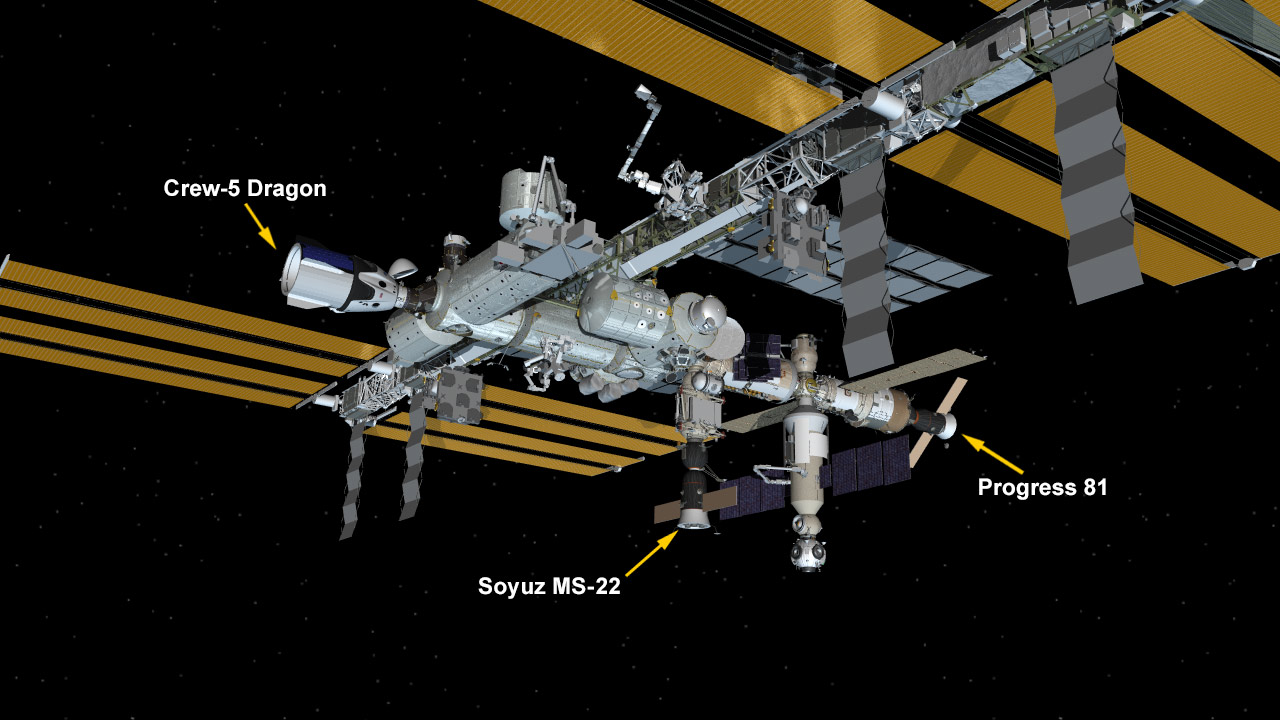
Oct. 23, 2022: International Space Station Configuration. Three spaceships are docked at the space station including the SpaceX Crew Dragon Endurance, the Soyuz MS-22 crew ship and the Progress 81 resupply ship.
The uncrewed Roscosmos Progress 80 spacecraft undocked from the International Space Station’s Poisk module at 6:46 p.m. EDT on Sunday, Oct. 23, 2022.
The spacecraft backed away from the space station, and a few hours later, Progress’ engines fired in a deorbit maneuver to send the cargo craft into a destructive re-entry in the Earth’s atmosphere over the Pacific Ocean.
The uncrewed Russian Progress 80 launched on a Soyuz rocket at 11:25 p.m. EST (9:25 a.m. on Feb. 15 Baikonur time) on Monday, Feb. 14, 2022, from the Baikonur Cosmodrome in Kazakhstan. The unpiloted cargo craft delivered almost three tons of food, fuel and supplies to the International Space Station.