NASA is GO for U.S. Spacewalks Outside International Space Station

NASA is GO for U.S. Spacewalks Outside International Space Station

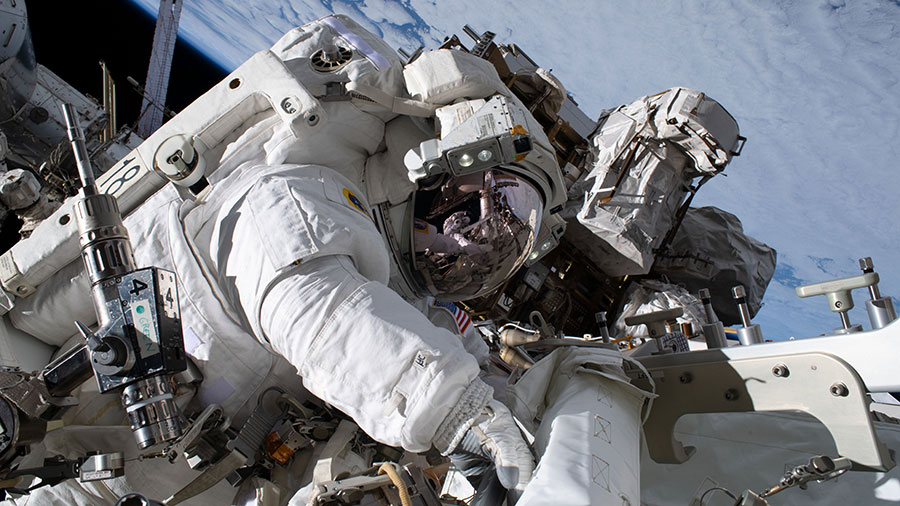
ESA astronaut Matthias Maurer points the camera toward himself and takes a "space-selfie" during a spacewalk on March 23, 2022.
ESA astronaut Matthias Maurer points the camera toward himself and takes a “space-selfie” during a spacewalk on March 23, 2022.

NASA completed a flight readiness review in October, and is “GO” to resume routine spacewalks outside of the International Space Station. The first of three planned spacewalks is targeted to begin around mid-November to continue the work to install roll out solar arrays, called iROSA.

The review marks the completion of an investigation into the cause of a thin layer of moisture being discovered in March inside ESA (European Space Agency) astronaut Matthias Maurer’s helmet after station airlock re-pressurization following a nearly seven-hour spacewalk. Mauer was conducting a spacewalk focused on preparation of new solar array installation outside the microgravity laboratory.

Following the successful spacewalk, the space station crew expedited Maurer’s helmet removal and then gathered data in coordination with ground support teams at NASA’s Johnson Space Center in Houston. The agency identified the event as a close-call and immediately declared a stop to all future planned U.S. Operating Segment spacewalks pending an investigation into the cause. NASA returned to Earth water samples and some suit hardware with Soyuz 65S and NASA’s SpaceX Crew-3 mission, as well as returned the spacesuit as part of the agency’s SpaceX CRS-25 mission for detailed analysis.

During the investigation, the space station team completed a detailed test, teardown, and evaluation of the water samples and suit hardware to determine what led to the observed water, which was more than normal, in the helmet.

The team confirmed there were no hardware failures within the suit. The cause for the water in the helmet was likely due to integrated system performance where several variables such as crew exertion and crew cooling settings led to the generation of comparatively larger than normal amounts of condensation within the system.

Based on the findings, the team has updated operational procedures and developed new mitigation hardware to minimize scenarios where integrated performance results in water accumulation, while absorbing any water that does appear. These measures will help contain any liquid in the helmet to continue to keep crew safe.

“Crew safety is the top priority of NASA and our international partners,” said Kathryn Lueders, associate administrator for NASA’s Space Operations Mission Directorate. “I’m proud of the space station and ground teams’ work to keep our crew members safe, for taking the time necessary to close out the investigation, and for continually findings ways to mitigate risks in human spaceflight.”

Based on the results of the investigation, the additional operational procedures, and mitigation hardware, the NASA management team concurred and approved return to normal operations.


Learn more about station activities by following the space station blog@space_station and @ISS_Research on Twitter, as well as the ISS Facebook and ISS Instagram accounts.

Get weekly video highlights at: http://jscfeatures.jsc.nasa.gov/videoupdate/

Get the latest from NASA delivered every week. Subscribe here: www.nasa.gov/subscribe

Get The Details…

Mark Garcia

Powered by WPeMatico

Muscle and Crop Studies Helping Crews Adapt to Space Missions

Muscle and Crop Studies Helping Crews Adapt to Space Missions

The 11 crew members who lived aboard the station together for eight days pose for a portrait on Oct. 12, 2022.

Today aboard the International Space Station, the Expedition 68 crew explored how to maintain healthy bodies and grow crops in the weightless environment of space. Learning to live long-term in microgravity and farther away from Earth orbit requires astronauts to sustain themselves without relying on visiting resupply missions.

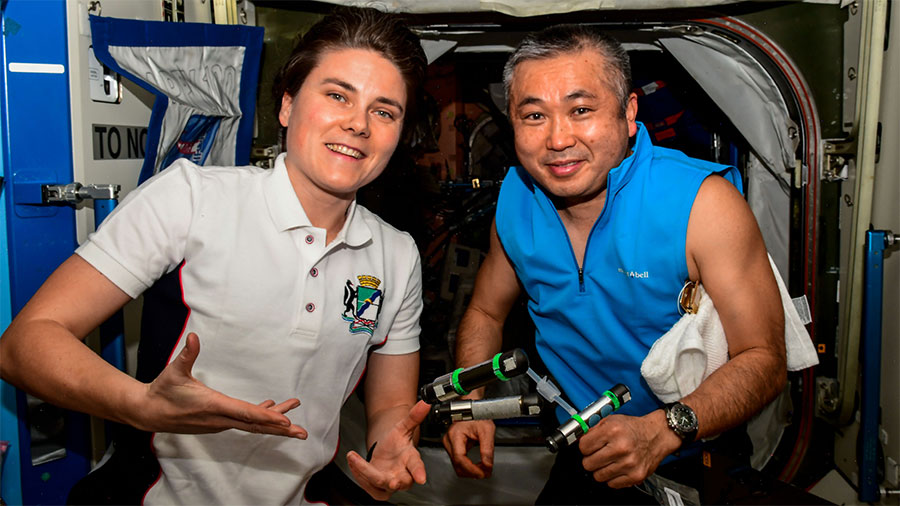
Humans lose muscle and bone mass much faster in space than on Earth due to the lack of gravity bearing down on them. However, the space station crew members work out two hours every day on a treadmill, an exercise cycle, and a resistive device, to offset and counteract the effects microgravity. One experiment called Myotones, worked on today by U.S. and Japanese Flight Engineers Nicole Mann and Koichi Wakata, tracks how a crew member’s muscles adapt to space. The duo took turns marking their neck, back, leg and arm muscles, while inside the Columbus laboratory module. Afterward, the pair used the specialized Myotones device to measure the biochemical properties of the same muscles, including muscle tone, stiffness, and elasticity.

Mann then went on and partnered with fellow NASA Flight Engineer Josh Cassada strapping sensors to each other and pedaling on the U.S. Destiny laboratory module’s exercise bike to measure their aerobic capacity on orbit. Frank Rubio, also a NASA flight engineer, mixed a nutrient solution to nourish vegetables growing inside the Columbus lab for the XROOTS study. The space botany study investigates using hydronic and aeroponic methods to grow crops on spacecraft and space habitats so astronauts can feed themselves in low-Earth orbit and beyond.

Roscosmos Flight Engineer Anna Kikina studied advanced Earth photography techniques that use ultrasound sensors to help target landmarks on the ground. Her fellow cosmonauts, Commander Sergey Prokopyev and Flight Engineer Dmitri Petelin, are preparing for a new cargo mission due to launch from Kazakhstan at the end of the month. The duo tested the station’s TORU, or telerobotically operated rendezvous unit, that would be used to manually control an approaching spacecraft in the unlikely event it was unable to automatically approach and dock on its own.


Learn more about station activities by following the space station blog@space_station and @ISS_Research on Twitter, as well as the ISS Facebook and ISS Instagram accounts.

Get weekly video highlights at: http://jscfeatures.jsc.nasa.gov/videoupdate/

Get the latest from NASA delivered every week. Subscribe here: www.nasa.gov/subscribe

Get The Details…

Mark Garcia

Powered by WPeMatico

Brain Science, BEAM Work as Station Orbits Higher for Cargo Mission

Brain Science, BEAM Work as Station Orbits Higher for Cargo Mission

Astronaut (from left) Nicole Mann, Koichi Wakata, and Josh Cassada are pictured aboard the SpaceX Dragon Endurance crew ship during a flight to the space station on Oct. 2, 2022.

The seven-member Expedition 68 crew was busy aboard the International Space Station at the beginning of the week studying how the central nervous system adapts to microgravity and stowing hardware inside the BEAM module. The orbital residents also trained to operate Europe’s new robotic arm and packed a Russian cargo craft ahead of its upcoming departure.

Two astronauts from the U.S. and Japan joined each other on Monday to learn how the brain adapts to the lack of a traditional up and down reference in space. NASA Flight Engineer Josh Cassada kicked off the human research study in the morning while seated inside the Columbus laboratory module and wearing a virtual reality headset. Flight Engineer Koichi Wakata of the Japan Aerospace Exploration Agency (JAXA) took over in the afternoon for the free-floating portion of the study exploring how weightlessness impacts an astronaut’s reach-to-grasp function.

NASA Flight Engineers Frank Rubio and Nicole Mann partnered together inside the Bigelow Expandable Activity Module for cargo and maintenance activities. Rubio opened up BEAM and entered with Mann to organize hardware to be returned on the next SpaceX Dragon mission planned for later this year. Mann also collected air and surface samples from inside BEAM for microbial analysis.

First time space-flyer Anna Kikina of Roscosmos trained on a computer to learn how to operate the European robotic arm, the station’s third and newest manipulator, attached to the Nauka multipurpose laboratory module. New cosmonaut Dmitri Petelin began his day on water transfer activities before studying advanced Earth photography techniques. Finally, Commander Sergey Prokopyev, on his second station mission, updated the space lab inventory system and packed trash inside the ISS Progress 80 resupply ship docked to the Poisk mini-research module. The Progress 80 is due to leave the station next week packed with trash and obsolete gear for a fiery, but safe disposal above the south Pacific Ocean.

In the meantime, the station was orbiting higher on Monday to prepare for the arrival of a new cargo mission from Roscosmos. The ISS Progress 81 cargo craft docked to the Zvezda service module fired its engines for 10 minutes and 30 seconds today boosting the station’s orbit. The reboost places the orbital lab at the correct altitude to receive the Progress 82 resupply ship after it launches from Kazakhstan to replace the Progress 80 vehicle.

Get The Details…

Mark Garcia

Powered by WPeMatico

SpaceX Crew-4 Returns with Splashdown on Florida’s Atlantic Coast

SpaceX Crew-4 Returns with Splashdown on Florida’s Atlantic Coast

The SpaceX Dragon Freedom crew ship carrying four astronauts splashes down in the Atlantic Ocean off the coast of Florida. Credit: NASA/Bill Ingalls

NASA astronauts Bob Hines, Kjell Lindgren, and Jessica Watkins, as well as ESA (European Space Agency) astronaut Samantha Cristoforetti splashed down safely in the SpaceX Dragon Freedom in the Atlantic Ocean off the coast of Jacksonville, Florida, at 4:55 p.m. EDT after 170 days in space.

Teams on the Megan recovery ship, including two fast boats, now are in the process of securing Dragon and ensuring the spacecraft is safe for the recovery effort. As the fast boat teams complete their work, the recovery ship will move into position to hoist Dragon onto the main deck of Megan with the astronauts inside. Once on the main deck, the crew will be taken out of the spacecraft and receive medical checks before a helicopter ride to Jacksonville to board a plane for Houston.


More details about the mission and NASA’s commercial crew program can be found by following the commercial crew blog, @commercial_crew and commercial crew on Facebook.

Learn more about station activities by following the space station blog@space_station and @ISS_Research on Twitter, as well as the ISS Facebook and ISS Instagram accounts.

Get weekly video highlights at: http://jscfeatures.jsc.nasa.gov/videoupdate/

Get the latest from NASA delivered every week. Subscribe here: www.nasa.gov/subscribe

Get The Details…

Mark Garcia

Powered by WPeMatico

Dragon Freedom Undocks with SpaceX Crew-4 Astronauts

Dragon Freedom Undocks with SpaceX Crew-4 Astronauts

The SpaceX Dragon Freedom crew ship with four Crew-4 astronauts aboard undocks from the space station to begin its return to Earth. Credit: NASA TV

The SpaceX Dragon Freedom spacecraft with NASA astronauts Bob Hines, Kjell Lindgren, and Jessica Watkins, as well as ESA (European Space Agency) astronaut Samantha Cristoforetti inside undocked from the space-facing port of the International Space Station’s Harmony module at 12:05 p.m. EDT to complete a nearly six-month science mission.

NASA will continue to provide live coverage until Freedom splashes down at approximately 4:55 p.m. EDT near Jacksonville off the coast of Florida and the Crew-4 astronauts are recovered.

NASA’s SpaceX Crew-4 mission launched Apr. 27 on a Falcon 9 rocket from the agency’s Kennedy Space Center in Florida and docked to the space station later the same day.


More details about the mission and NASA’s commercial crew program can be found by following the commercial crew blog, @commercial_crew and commercial crew on Facebook.

Learn more about station activities by following the space station blog@space_station and @ISS_Research on Twitter, as well as the ISS Facebook and ISS Instagram accounts.

Get weekly video highlights at: http://jscfeatures.jsc.nasa.gov/videoupdate/

Get the latest from NASA delivered every week. Subscribe here: www.nasa.gov/subscribe

Get The Details…

Mark Garcia

Powered by WPeMatico