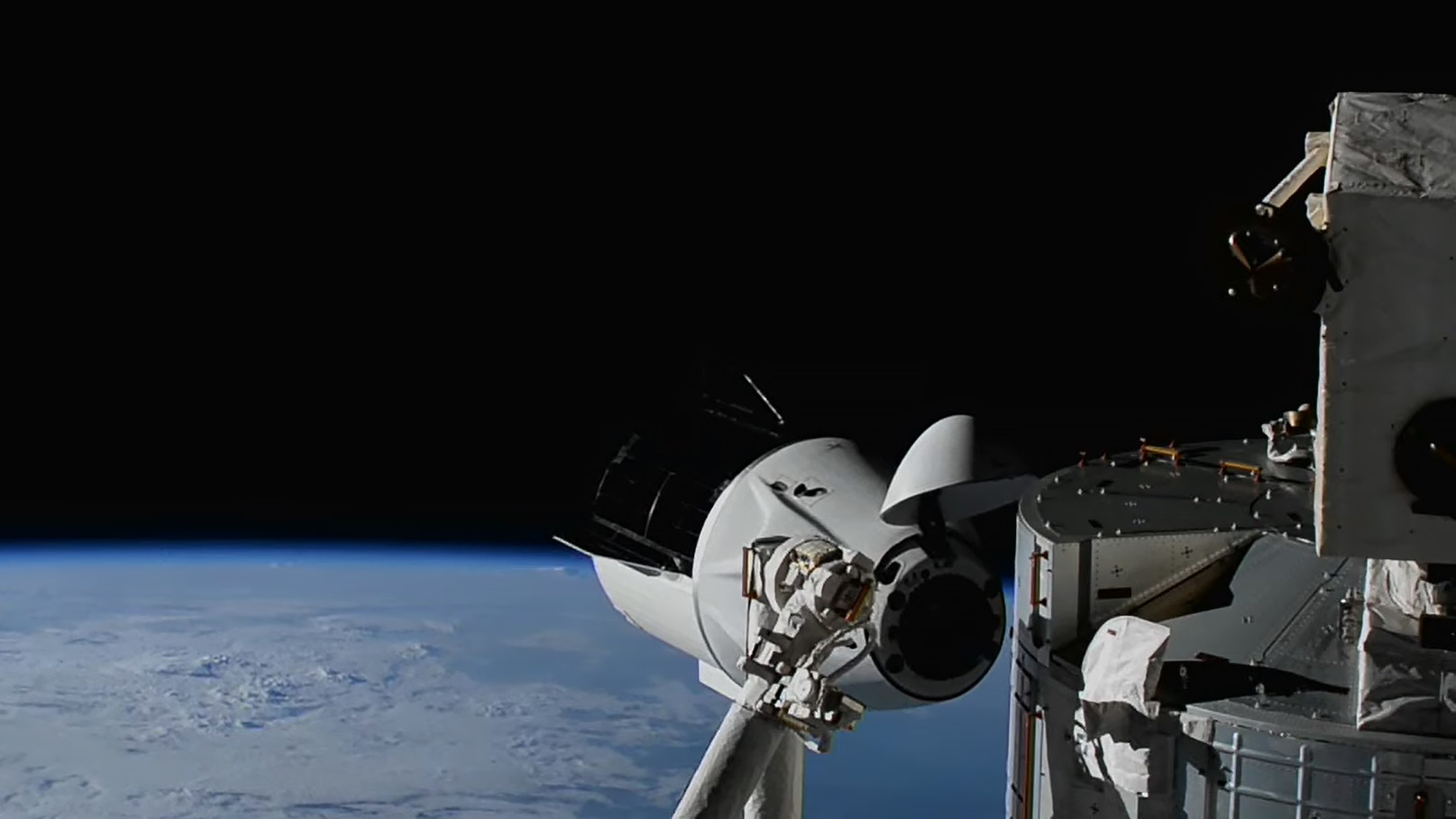
The SpaceX Crew Dragon spacecraft approaches the Harmony module’s forward port for a docking during its relocation maneuver above the United States. Credit: NASA TV
The SpaceX Dragon, with Expedition 69 crew members Steve Bowen and Woody Hoburg of NASA, UAE (United Arab Emirates) astronaut Sultan Alneyadi, and Roscosmos cosmonaut Andrey Fedyaev aboard, has successfully docked to the forward port of the Harmony module of the International Space Station at 8:01 a.m. EDT.
This was the 27th spacecraft relocation in space station history. The move made room for the arrival of the uncrewed SpaceX Dragon carrying cargo to station as part of the company’s 28th commercial resupply services mission for NASA, targeted to launch in June.
NASA’s SpaceX Crew-6 members are scheduled to return to Earth in August.
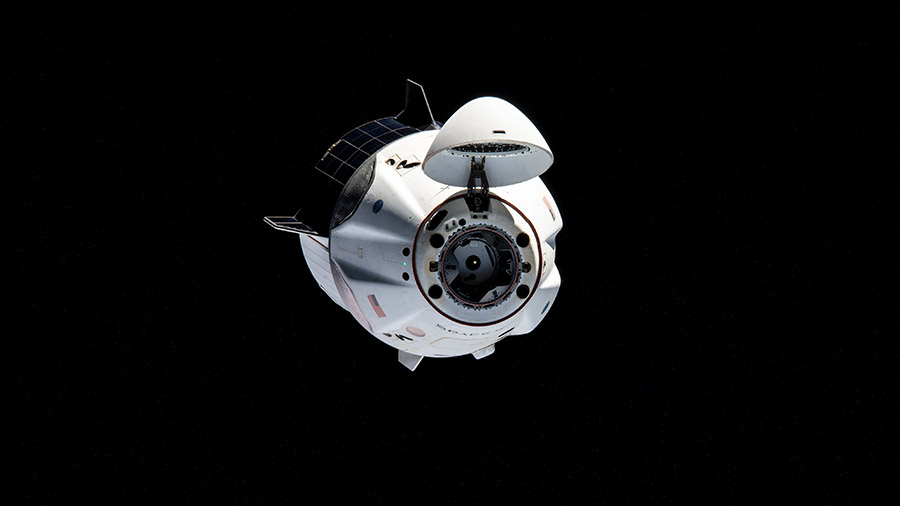
The SpaceX Crew Dragon Resilience is pictured during a relocation maneuver on April 5, 2021, carrying astronauts Michael Hopkins, Victor Glover, Shannon Walker and Soichi Noguchi.
The SpaceX Dragon, with Expedition 69 crew members Steve Bowen and Woody Hoburg of NASA, UAE (United Arab Emirates) astronaut Sultan Alneyadi, and Roscosmos cosmonaut Andrey Fedyaev aboard, has undocked from the Harmony module on the space-facing side of the complex, and is on its way to redock to the forward port of the module.
Redocking to the forward port of the module is planned for approximately 8:06 a.m. EDT, and is airing live on NASA Television, the NASA app, and the agency’s website.
This is the 27th spacecraft relocation in station history. The move is making room for the arrival of the uncrewed SpaceX Dragon carrying cargo to station as part of the company’s 28th commercial resupply services mission for NASA, targeted to launch in June.
NASA’s SpaceX Crew-6 members are scheduled to return to Earth in August.
Dragon Crew Ship Moving to New Port Live on NASA TV
The SpaceX Crew Dragon Resilience is pictured during a relocation maneuver on April 5, 2021, carrying astronauts Michael Hopkins, Victor Glover, Shannon Walker and Soichi Noguchi.
NASA coverage is underway as four crew members aboard the International Space Station take a short trip inside their SpaceX Dragon to relocate the spacecraft from one docking port to another.
Undocking is scheduled at 7:10 a.m. EDT with redocking planned at 7:53 a.m. Relocation activities will air live on NASA Television, the NASA app, and the agency’s website.
The SpaceX Dragon, with Expedition 69 crew members Steve Bowen and Woody Hoburg of NASA, UAE (United Arab Emirates) astronaut Sultan Alneyadi, and Roscosmos cosmonaut Andrey Fedyaev, will undock from the space-facing port of the Harmony module, and redock to the station’s forward Harmony port.
This will be the 27th spacecraft relocation in station history. The move will make room for the arrival of the uncrewed SpaceX Dragon carrying cargo to station as part of the company’s 28th commercial resupply services mission for NASA, targeted to launch in June.
NASA’s SpaceX Crew-6 members are scheduled to return to Earth in August.
Dragon Crew Ship Changing Ports, Cosmonauts Cleanup After Spacewalk
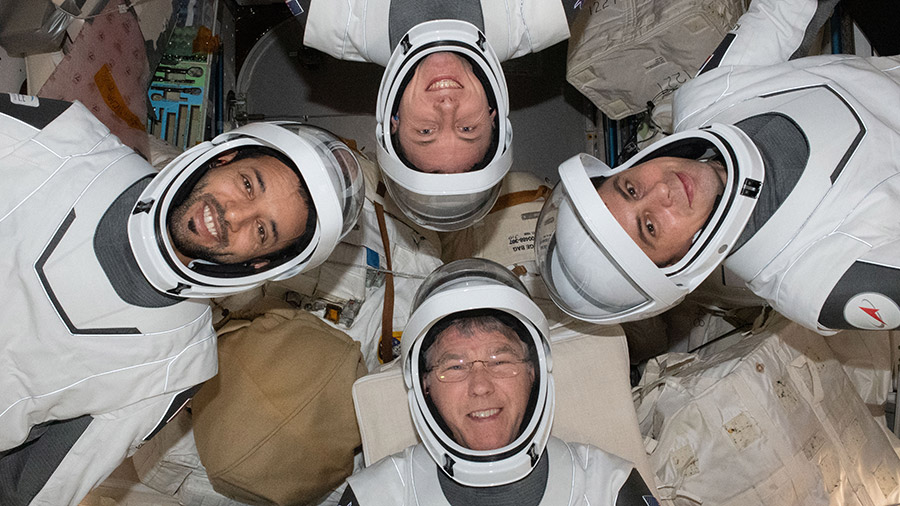
Four Expedition 69 flight engineers aboard the International Space Station pose for a portrait in the pressure suits they will wear when they relocate the SpaceX Dragon Endeavour crew ship.
Four Expedition 69 crew members are reviewing the procedures they will use when they move the SpaceX Crew Dragon spacecraft to a new port on Saturday morning. The rest of the crew aboard the International Space Station is cleaning up after completing a spacewalk earlier this week.
NASA Flight Engineers Stephen Bowen and Woody Hoburg will respectively command and pilot the Crew Dragon Endeavour spacecraft when it undocks from the Harmony module’s space-facing port at 7:10 a.m. EDT on Saturday. The pair will be flanked by UAE (United Arab Emirates) astronaut Sultan Alneyadi and Roscosmos cosmonaut Andrey Fedyaev during the planned 43-minute relocation maneuver. Endeavour, with the four crewmates inside, will automatically redock to Harmony’s forward port at 7:53 a.m. NASA TV begins it live relocation coverage at 7 a.m. on the agency’s app and website.
The quartet began Friday morning simulating their spacecraft maneuvers in coordination with mission controllers on the ground. Afterward, the foursome held a space-to-ground conference with the controllers discussing training, procedures, and mission readiness.
Endeavour’s relocation will open up Harmony’s top port for the upcoming SpaceX CRS-28 cargo mission. This enables the Canadarm2 robotic arm to reach out and access the cargo inside the SpaceX Dragon resupply ship’s trunk. Inside Dragon’s trunk will be a new set of roll-out solar arrays that the Canadarm2 will grapple and temporarily stow on the station’s starboard-side truss structure. Two astronauts on a future spacewalk will permanently install the roll-out solar arrays on the starboard truss augmenting the orbital outpost’s power generation system.
Three cosmonauts reconfigured the Roscosmos segment of the space station following Wednesday’s spacewalk to move an experiment airlock. Commander Sergey Prokopyev and Flight Engineer Dmitri Petelin deactivated and cleaned their spacesuits then stowed the tools they used during their seven-hour, 11-minute spacewalk. Fedyaev, who controlled the European robotic arm (ERA) during the spacewalk, spent Friday inside the Nauka science module removing cameras and powering down the ERA.
Prokopyev and Petelin have one more spacewalk to conduct this month when they exit the Poisk airlock on May 12 to deploy a radiator that was attached to Nauka during a previous spacewalk on April 19. Fedyaev will be inside the station monitoring the spacewalkers who will also fill the radiator with coolant and perform maintenance on the ERA.
Cosmonauts Move Experiment Airlock and Complete Spacewalk
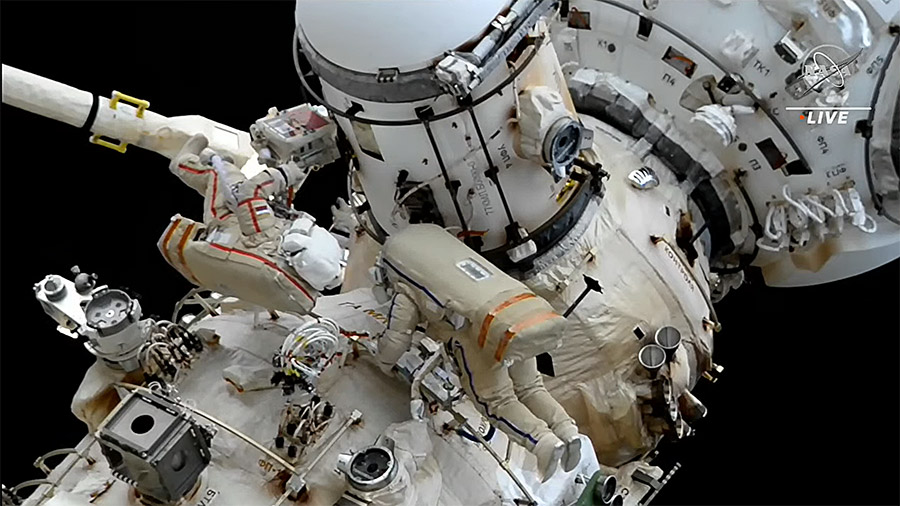
Spacewalkers Sergey Prokopyev and Dmitri Petelin work outside the space station to install an experiment module on the Nauka science module with assistance from the European robotic arm. Credit: NASA TV
Roscosmos cosmonauts Sergey Prokopyev and Dmitri Petelin concluded their spacewalk May 3 at 11:11 p.m. EDT after 7 hours and 11 minutes.
Prokopyev and Petelin completed their major objectives, which included relocating an experiment airlock from the Rassvet module to the Nauka science module with assistance from European robotic arm operator cosmonaut Andrey Fedyaev.
This was the fifth spacewalk in Prokopyev’s career, and the third for Petelin. It is the fifth spacewalk at the station in 2023 and the 262nd spacewalk for space station assembly, maintenance, and upgrades.
The two Roscosmos cosmonauts will also conduct a spacewalk on Friday, May 12, to deploy a radiator on Nauka and connect mechanical, electrical, and hydraulic lines.