Crew Unpacks New Science and Readies for Next Spacewalk

Crew Unpacks New Science and Readies for Next Spacewalk
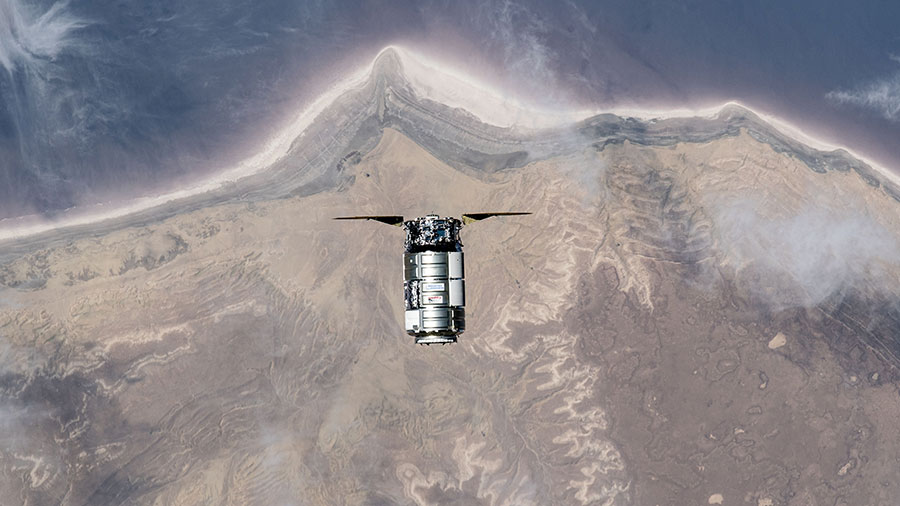
The Cygnus cargo craft approaches the International Space Station on Aug. 4 while orbiting 261 miles above the coast of the Garabogazköl Basin in Turkmenistan.

A U.S. cargo craft is open for business at the International Space Station and two cosmonauts are gearing up for a spacewalk on Wednesday. The Expedition 69 crew also kicked off the work week exploring high temperature physics and ways to make semiconductor crystals.

NASA Flight Engineer Frank Rubio worked throughout Monday unpacking some of the 8,200 pounds of science and supplies delivered aboard Northrop Grumman’s Cygnus space freighter on Friday. A couple of the new experiments include investigations looking at the formation of 3D neuron cell structures and an Astrobee robotic free-flyer to assist astronauts. News crew supplies include food, water, life support gear, and spacewalking hardware.

Flight Engineers Stephen Bowen of NASA and Sultan Alneyadi of UAE (United Arab Emirates) worked on a pair of different space physics investigations on Monday. Bowen swapped out samples inside the Electrostatic Levitation Furnace that explores the thermophysical properties of materials subjected to high temperatures in microgravity. Alneyadi set up new hardware in the Microgravity Science Glovebox to improve the technology of producing semiconductor crystals.

NASA Flight Engineer Woody Hoburg began his day on science maintenance work swapping out research gear and inspecting a rack in the Columbus laboratory module. He also serviced new Cold Atom Lab hardware inside the Destiny laboratory module. The Cold Atom Lab observes the quantum behavior of atoms chilled to temperatures near absolute zero. Hoburg also joined his crewmates and assisted Rubio as he unloaded cargo from inside Cygnus.

Two cosmonauts are in final preparations for the year’s 10th spacewalk out of the station set to begin at 10:45 a.m. on Wednesday. Commander Sergey Prokopyev and Flight Engineer Dmitri Petelin will exit the Poisk airlock in their Orlan spacesuits and spend about six and a half hours installing micrometeoroid orbital debris shields and relocating hardware. The duo from Roscosmos spent Monday configuring communications gear and checking their spacesuits for leaks. This will be Prokopyev’s and Petelin’s sixth spacewalk together since their first on Nov. 17, 2022.

Roscosmos Flight Engineer Andrey Fedyaev spent his day primarily on life support tasks. He started Monday replacing heat exchanger fans in the Nauka science module. In the afternoon, Fedyaev worked on the Zvezda service module’s Elektron oxygen generator that splits reclaimed water into oxygen and hydrogen.

On Aug. 5, the Progress 83 spacecraft’s thrusters fired for three minutes, 16 seconds in a planned avoidance maneuver to provide the International Space Station an extra measure of distance away from a predicted track of a debris fragment.

The thruster firing occurred at 10:03 p.m. EDT, and the maneuver had no impact on station operations, including the trajectory phasing for either the upcoming Roscosmos Progress 85 cargo launch on Tuesday, Aug. 22, and SpaceX Crew-7 launch on Aug. 25.

Powered by WPeMatico

Get The Details…

Mark Garcia

Cygnus Installed on Station, Crew Begins Cargo Ops

Cygnus Installed on Station, Crew Begins Cargo Ops

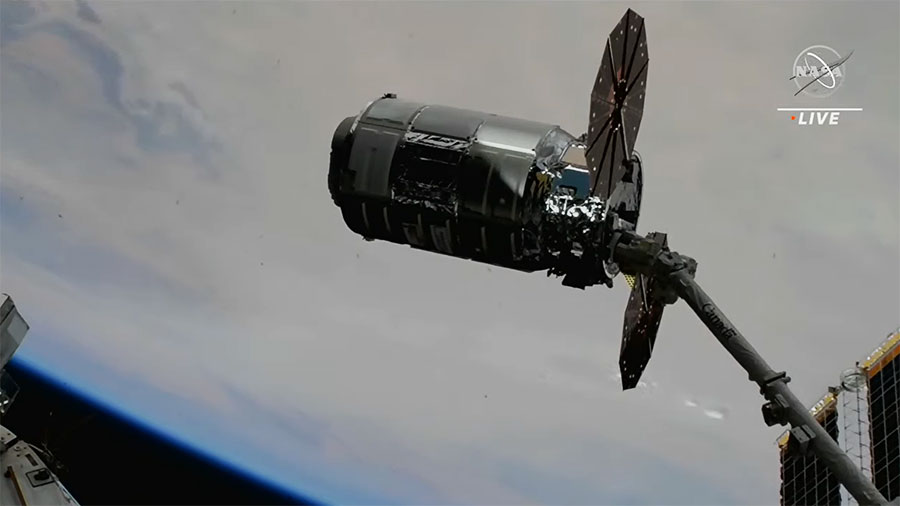
Northrop Grumman's Cygnus space freighter is guided to its installation point on the space station's Unity module by the Canadarm2 robotic arm. Credit: NASA TV
Northrop Grumman’s Cygnus space freighter is guided to its installation point on the space station’s Unity module by the Canadarm2 robotic arm. Credit: NASA TV

Northrop Grumman’s Cygnus spacecraft installation at the International Space Station is now complete. Cygnus, carrying over 8,200 pounds of cargo and science experiments, launched atop the company’s Antares rocket at 8:31 p.m. EDT Tuesday, Aug. 1, from NASA’s Wallops Flight Facility in Virginia. At 5:52 a.m., NASA astronaut Woody Hoburg, along with NASA astronaut Frank Rubio as backup, captured Cygnus using the station’s Canadarm2 robotic arm.

Highlights of space station research facilitated by delivery aboard this Cygnus are:

Cygnus will remain at the space station until October before it departs for a destructive re-entry into Earth’s atmosphere.


Learn more about station activities by following the space station blog, @space_station and @ISS_Research on Twitter, as well as the ISS Facebook and ISS Instagram accounts.

Get weekly video highlights at: https://roundupreads.jsc.nasa.gov/videoupdate/

Get the latest from NASA delivered every week. Subscribe here: www.nasa.gov/subscribe

Powered by WPeMatico

Get The Details…

Mark Garcia

Robotic Arm Installing Cygnus Live on NASA TV

Robotic Arm Installing Cygnus Live on NASA TV

Northrop Grumman's Cygnus space freighter is pictured moments before being captured with the Canadarm2 robotic arm by NASA astronaut Woody Hoburg. Credit: NASA TV
Northrop Grumman’s Cygnus space freighter is pictured moments before being captured with the Canadarm2 robotic arm by NASA astronaut Woody Hoburg. Credit: NASA TV

NASA’s live coverage of the installation of Northrop Grumman’s Cygnus spacecraft at the International Space Station is underway. At 5:55 a.m. EDT, NASA astronaut Woody Hoburg, with NASA astronaut Frank Rubio acting as backup, captured the Cygnus spacecraft using the station’s Canadarm2 robotic arm. Cygnus is carrying over 8,200 pounds of supplies, hardware, and science experiments.

This is Northrop Grumman’s 19th commercial resupply mission to the space station for NASA. Northrop Grumman named the Cygnus spacecraft the S.S. Laurel Clark in honor of the late NASA astronaut, undersea medical officer, and naval flight officer, Laurel Clark.

Cygnus will remain at the space station until October before it departs for a destructive re-entry into Earth’s atmosphere.

NASA Television, the NASA app, and agency’s website are providing live coverage of the spacecraft’s installation.


Learn more about station activities by following the space station blog, @space_station and @ISS_Research on Twitter, as well as the ISS Facebook and ISS Instagram accounts.

Get weekly video highlights at: https://roundupreads.jsc.nasa.gov/videoupdate/

Get the latest from NASA delivered every week. Subscribe here: www.nasa.gov/subscribe

Powered by WPeMatico

Get The Details…

Mark Garcia

NASA Astronauts Capture Cygnus Cargo Craft with Robotic Arm

NASA Astronauts Capture Cygnus Cargo Craft with Robotic Arm

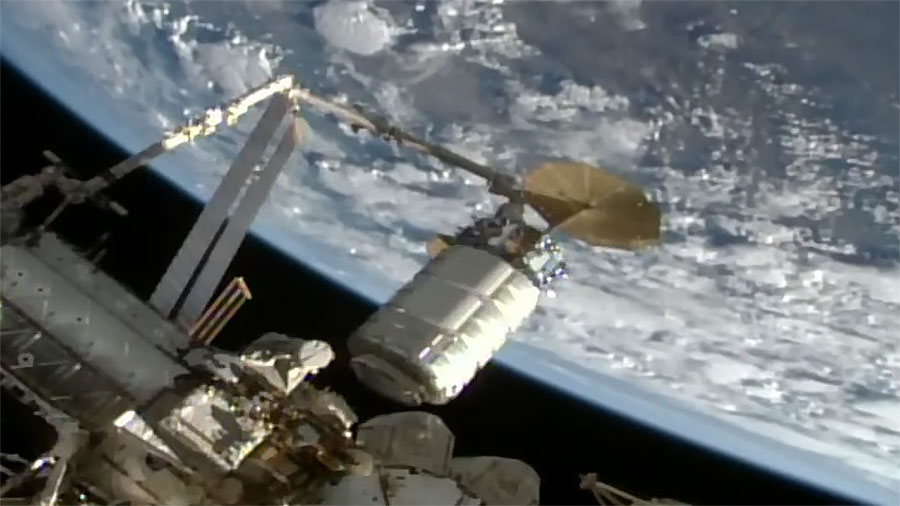
Northrop Grumman's Cygnus space freighter is pictured in the grips of the Canadarm2 robotic arm following its capture as both spacecraft orbited above Africa. Credit: NASA TV
Northrop Grumman’s Cygnus space freighter is pictured in the grips of the Canadarm2 robotic arm following its capture as both spacecraft orbited above Africa. Credit: NASA TV

At 5:52 a.m. EDT, NASA astronaut Woody Hoburg, with NASA astronaut Frank Rubio acting as backup, captured Northrop Grumman’s Cygnus spacecraft using the International Space Station’s Canadarm2 robotic arm. Mission control in Houston will actively command the arm to rotate Cygnus to its installation orientation and then to guide it in for installation on the station’s Unity module Earth-facing port.

NASA Television, the NASA app, and agency’s website will provide live coverage of the spacecraft’s installation beginning at 7:30 a.m.

The Cygnus spacecraft launched Tuesday, Aug. 1, on the company’s Antares rocket from NASA’s Wallops Flight Facility in Virginia at 8:31 p.m. This is Northrop Grumman’s 19th commercial resupply mission to the International Space Station for NASA. The Cygnus spacecraft is carrying a supply of over 8,200 pounds of scientific investigations and cargo to the orbiting laboratory.

Northrop Grumman named the Cygnus the S.S. Laurel Clark in honor of the late NASA astronaut, undersea medical officer, and naval flight officer, Laurel Clark.


Learn more about station activities by following the space station blog, @space_station and @ISS_Research on Twitter, as well as the ISS Facebook and ISS Instagram accounts.

Get weekly video highlights at: https://roundupreads.jsc.nasa.gov/videoupdate/

Get the latest from NASA delivered every week. Subscribe here: www.nasa.gov/subscribe

Powered by WPeMatico

Get The Details…

Mark Garcia

NASA Astronauts Capture Cygnus with Robotic Arm

NASA Astronauts Capture Cygnus with Robotic Arm

Northrop Grumman's Cygnus space freighter is pictured in the grips of the Canadarm2 robotic arm following its capture as both spacecraft orbited above Africa. Credit: NASA TV
Northrop Grumman’s Cygnus space freighter is pictured in the grips of the Canadarm2 robotic arm following its capture as both spacecraft orbited above Africa. Credit: NASA TV

At 5:52 a.m. EDT, NASA astronaut Woody Hoburg, with NASA astronaut Frank Rubio acting as backup, captured Northrop Grumman’s Cygnus spacecraft using the International Space Station’s Canadarm2 robotic arm. Mission control in Houston will actively command the arm to rotate Cygnus to its installation orientation and then to guide it in for installation on the station’s Unity module Earth-facing port.

NASA Television, the NASA app, and agency’s website will provide live coverage of the spacecraft’s installation beginning at 7:30 a.m.

The Cygnus spacecraft launched Tuesday, Aug. 1, on the company’s Antares rocket from NASA’s Wallops Flight Facility in Virginia at 8:31 p.m. This is Northrop Grumman’s 19th commercial resupply mission to the International Space Station for NASA. The Cygnus spacecraft is carrying a supply of over 8,200 pounds of scientific investigations and cargo to the orbiting laboratory.

Northrop Grumman named the Cygnus the S.S. Laurel Clark in honor of the late NASA astronaut, undersea medical officer, and naval flight officer, Laurel Clark.


Learn more about station activities by following the space station blog, @space_station and @ISS_Research on Twitter, as well as the ISS Facebook and ISS Instagram accounts.

Get weekly video highlights at: https://roundupreads.jsc.nasa.gov/videoupdate/

Get the latest from NASA delivered every week. Subscribe here: www.nasa.gov/subscribe

Powered by WPeMatico

Get The Details…

Mark Garcia