Astronauts Prep for Roll-Out Solar Array Installation Job
NASA astronaut Woody Hoburg rides the Canadarm2 robotic arm while maneuvering a roll-out solar array during a spacewalk on June 9, 2023, 257 miles above the Pacific Ocean.
The International Space Station’s sixth roll-out solar array will be installed this week after last week’s installation of its fifth roll-out solar array. The Expedition 69 crew spent Monday preparing for the installation spacewalk while also continuing research, cargo, and maintenance activities.
NASA astronauts Stephen Bowen and Woody Hoburg will once again exit the space station’s Quest airlock at 9:20 a.m. EDT on Thursday for their second roll-out solar array installation spacewalk together. The spacewalkers will install another roll-out solar array on the opposite side of the starboard truss structure where they installed the orbital outpost’s fifth roll-out solar array. Thursday’s spacewalk will represent the completion of the power upgrade work ultimately increasing the station’s power-generating capacity by 30%.
Bowen and Hoburg spent several hours on Monday reviewing their solar array installation procedures, configuring spacewalking tools, and conferring with ground engineers. The pair were also joined around midday by Flight Engineers Frank Rubio of NASA and Sultan Alneyadi of UAE (United Arab Emirates) for the procedure reviews. Rubio and Alneyadi then completed their work shift after training on a computer for the Canadarm2 robotic arm maneuvers they will use to support Thursday’s spacewalkers.
The four astronauts still had time on Monday for a variety of other activities promoting health, studying physics, and resupplying the orbital outpost. Rubio had a vision test that had him reading characters on a standard eye chart. Bowen swapped samples inside the Fluids Science Laboratory for a foam physics study potentially benefitting Earth and space industries. Hoburg and Alneyadi took turns unpacking the SpaceX Dragon cargo vehicle and stowing the new science experiments, hardware, and crew supplies aboard the station.
The space station’s three cosmonauts with Commander Sergey Prokopyev and Flight Engineers Dmitri Petelin and Andrey Fedyaev cleared their schedule on Monday and relaxed. The trio will soon begin preparing for the next spacewalk out of the Roscosmos segment of the orbiting lab.
NASA Spacewalkers Complete Solar Array Installation
Astronaut Woody Hoburg watches as a new roll-out solar array deploys after he and fellow NASA spacewalker Stephen Bowen (out of frame) successfully installed it on the space station. Credit: NASA TV
Expedition 69 Flight Engineers Steve Bowen and Woody Hoburg of NASA concluded their spacewalk at 3:28 p.m. EDT after 6 hours and 3 minutes.
Bowen and Hoburg completed all of their objectives to install an IROSA (International Space Station Roll-Out Solar Array) to augment power generation for the 1A power channel on the station’s starboard truss structure. The crew members also completed several get ahead tasks setting the stage for the duo to go back outside Thursday, June 15, to install the sixth in the series of IROSAs on the starboard 6 truss of the station for the 1B power channel.
The new arrays are 60 feet long by 20 feet wide (18.2 meters by 6 meters) and will shade a little more than half of the original arrays, which are 112 feet long by 39 feet wide. Each new IROSA will produce more than 20 kilowatts of electricity, and once all are installed, will enable a 30% increase in power production over the station’s current arrays.
It was the 264th spacewalk in support of space station assembly, upgrades, and maintenance, and was the third spacewalk for both astronauts.
Bowen and Hoburg are in the midst of a science mission living and working aboard the microgravity laboratory to advance scientific knowledge and demonstrate new technologies for future human and robotic exploration missions, including lunar missions through NASA’s Artemis program.
Astronauts Make Final Preparations for Friday’s Spacewalk
NASA astronauts (from left) Woody Hoburg, Frank Rubio, and Stephen Bowen talk to elementary and junior high school students on Earth.
Four Expedition 69 astronauts are making final preparations ahead of Friday’s spacewalk to continue upgrading the International Space Station’s power generation system. Meanwhile, the orbital outpost’s three cosmonauts focused on heart research and plasma physics while ensuring station systems remain in tip-top shape.
NASA Flight Engineers Stephen Bowen and Woody Hoburg are scheduled to set their Extravehicular Mobility Units (EMUs), or spacesuits, to battery power at 9:15 a.m. EDT on Friday officially beginning a spacewalk to install roll-out solar arrays on the station’s starboard truss structure. Ahead of the spacewalk, the duo staged their EMUs and spacewalking tools inside the Quest airlock where they will exit the station into the vacuum of space. The two astronauts were also joined by Flight Engineers Frank Rubio of NASA and Sultan Alneyadi of UAE (United Arab Emirates) for a final review of their spacewalking tasks and robotic support procedures. Rubio and Alneyadi will assist Bowen and Hoburg from inside the station on Friday.
The roll-out solar arrays arrived on Tuesday after the SpaceX Dragon cargo vehicle docked to the orbital lab following its Monday launch. Ground engineers on Wednesday remotely-commanded the Canadarm2 robotic arm to remove the solar arrays from Dragon’s unpressurized trunk and attach them to a pallet on the starboard truss in preparation for Friday’s installation spacewalk. This will be the station’s fifth roll-out solar array improving its power-generating capability by 30%.
On the Roscosmos side of the space station, Commander Sergey Prokopyev and Flight Engineer Dmitri Petelin partnered together for a long-running study into the effects of weightlessness on the human heart. Prokopyev later disconnected hardware that supported a plasma study that explores electrically-charged micro-particles such as electrons, ions, and neutral gases. Petelin investigated ways to improve communications with international crews and mission controllers from around the world. Flight Engineer Andrey Fedyaev worked throughout the day on computer and power systems maintenance.
Dragon Delivers Solar Arrays Setting Up Friday’s Spacewalk
The SpaceX Dragon cargo craft approaches the station for an automated docking above the Pacific Ocean off the coast of Japan on June 6, 2023.
Expedition 69 crew members have opened the hatch to the SpaceX Dragon cargo craft and begun unpacking several tons of cargo packed inside. Stowed inside the resupply ship is a pair of roll-out solar arrays that will soon be removed for installation on the International Space Station during the next spacewalk.
Dragon craft docked to the orbital outpost’s Harmony module at 5:54 a.m. EDT on Monday less than a day after launching from NASA’s Kennedy Space Center. Dragon’s hatch was opened less than two hours later following the completion of standard air and pressure leaks. Soon after, Flight Engineers Frank Rubio, Stephen Bowen, and Woody Hoburg, all from NASA, and Sultan Alneyadi from UAE (United Arab Emirates) entered Dragon and began offloading some of the more than 7,000 pounds of science experiments, station hardware, and crew supplies packed inside.
Controllers on the ground will also command the Canadarm2 robotic arm to extract a pair of roll-out solar arrays stowed inside Dragon’s unpressurized trunk. The remotely-controlled Canadarm2 will gently maneuver the solar arrays and temporarily stow them on a pallet attached to the station’s starboard-side truss structure. The robotic transfer work prepares the solar arrays for installation and activation on the starboard truss structure during a spacewalk planned to start at 9:15 a.m. on Friday.
Bowen and Hoburg will be the two spacewalkers installing the station’s fifth set of roll-out solar arrays on Friday. The two astronauts began Wednesday morning organizing tools and reviewing the procedures they will use during the seven-hour spacewalk. Rubio and Alneyadi, who will assist the spacewalkers from inside the station, also participated in the tool work and procedure reviews. The quartet will get back together on Thursday for final preparations including a last look at the spacewalk procedures, a final robotics review, and a conference with mission specialists on the ground.
In the midst of Wednesday’s spacewalk preparations, the four astronauts fit in other duties including running science experiments and maintaining lab operations. Bowen set up standard optometry gear found in a doctor’s office on Earth and imaged Hoburg’s eyes for a human research study. Rubio continued unpacking Dragon while Alneyadi conducted test runs of an Astrobee robotic free-flying assistant.
The station’s three cosmonauts had their day full of research, electronics maintenance, and cargo duties in the Roscosmos segment of the orbiting lab. Commander Sergey Prokopyev and Flight Engineer Andrey Fedyaev took turns wearing a cap packed with sensors that monitored their brain activity while practicing futuristic robotic and spacecraft piloting techniques on a computer. Flight Engineer Dmitri Petelin worked throughout the day testing power and data cables in the Zvezda service module before transferring cargo from the ISS Progress 84 space freighter.
Dragon Docks to Station, Delivers New Cargo and Solar Arrays
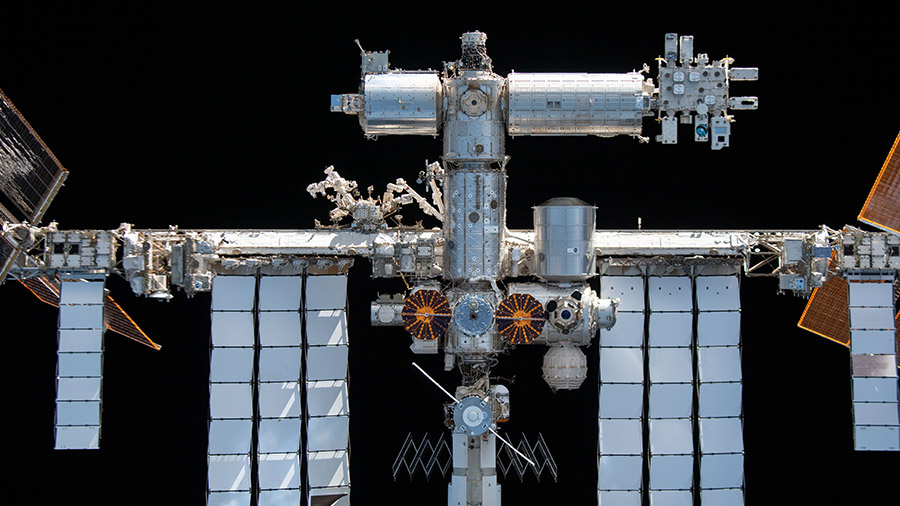
June 6, 2023: International Space Station Configuration. Five spaceships are docked at the space station including the SpaceX Dragon Endeavour, the SpaceX Dragon cargo craft, and Roscosmos’ Soyuz MS-23 crew ship and Progress 83 and 84 resupply ships.
While the International Space Station was traveling approximately 270 miles over the coast of Brazil, a SpaceX Dragon cargo spacecraft autonomously docked to the station’s Harmony module at 5:54 a.m. EDT, with NASA astronaut Woody Hoburg monitoring operations.
The SpaceX Dragon launched as part of the company’s 28th contracted commercial resupply services mission for NASA at 11:47 a.m. EDT, June 5, from Launch Complex 39A at the agency’s Kennedy Space Center in Florida. The Dragon will spend about three weeks attached to the space station before it returns to Earth with cargo and research.
The SpaceX Dragon has delivered a pair of IROSAs (International Space Station Roll Out Solar Arrays) that, once installed, will expand the energy-production capabilities of the microgravity complex.
Among the science experiments Dragon delivered to the space station are:
Thunderstorm Watch
What Happens Above Thunderstorms (Thor-Davis), an investigation from ESA (European Space Agency), observes thunderstorms from the space station. This vantage point allows researchers to see the electrical activity from above, particularly the inception, frequency, and altitude of recently discovered blue discharges. Scientists plan to estimate the energy of these phenomena to determine their effect on the atmosphere. A better understanding of lightning and electrical activity in Earth’s atmosphere could improve atmospheric models and provide a better understanding of Earth’s climate and weather.
Helping Plants Chill in Space
Plants exposed to environmental stress, including spaceflight, undergo changes to adapt, but those changes may not be passed on to the next generation. Plant Habitat-03 (PH-03) assesses whether plants grown in space can transfer such adaptations to the next generation and, if so, whether a change continues through subsequent generations or stabilizes.
The investigation creates a second generation of plants using seeds previously produced in space and returned to Earth. Results could provide insight into how to grow multiple generations of plants to provide food and other services on future space missions. This investigation also could support development of strategies for adapting crops and other economically important plants to marginal and reclaimed habitats on Earth.
Testing a Telomere Technique
Telomeres, genetic structures that protect our chromosomes, shorten with age and wear. But research has shown that telomeres lengthen in space. Genes in Space-10 tests a technique for measuring telomere length in microgravity, where methods typically employed on Earth are difficult to use due to gravity. The experiment explores whether telomere lengthening in space is caused by proliferation of stem cells — undifferentiated cells that give rise to specific body components and that typically have long telomeres.
Understanding the mechanism behind telomere lengthening could reveal possible effects on astronaut health during long-duration missions. Results also could lay the groundwork for a variety of related research to benefit future space travel and people on the ground.
Genes in Space is a national contest for students in grades 7 through 12 to design biotechnology experiments for space. The program is sponsored by miniPCR, Math for America, Boeing, New England Biolabs Ltd., and the ISS National Laboratory.
Thawing Ice, Solar Storms, and Attitude Recovery
Mission 26 for the station’s Nanoracks CubeSat Deployer (NRCSD) includes Educational Space Science and Engineering CubeSat Experiment Mission (ESSENCE), sponsored by the ISS National Laboratory and developed by universities in Canada and Australia. It carries a wide-angle camera to monitor thawing of ice and permafrost in the Canadian Arctic, which could provide a better understanding of the effects on Earth’s climate and support better local infrastructure planning.
The satellite also carries a solar energetic proton detector to collect data on periods of solar activity that emit highly energized radioactive protons that can damage the structure and electronic components of spacecraft. Understanding these effects could help make future CubeSats more resistant to radiation. In addition, the investigation demonstrates a novel method to recover control of a satellite’s attitude, or orientation, if a control mechanism fails. ESSENCE is part of the Canadian CubeSat Project, led by CSA (Canadian Space Agency).
Watching Cosmic Weathering
Iris, sponsored by the ISS National Laboratory, observes weathering of geological samples exposed to direct solar and background cosmic radiation and determines whether changes are visually detectable. The investigation also demonstrates experimental sun sensors, torque rods (which provide attitude control and detumbling for satellites), and a battery heater. A collaboration between graduate, undergraduate, and middle school students in Canada, the project provides hands-on experience that promotes interest in science, technology, engineering, and mathematics studies and careers.
These are just a few of the hundreds of investigations currently being conducted aboard the orbiting laboratory in the areas of biology and biotechnology, physical sciences, and Earth and space science. Advances in these areas will benefit life on Earth, help keep astronauts healthy during long-duration space travel, and demonstrate technologies for future human and robotic exploration beyond low Earth orbit to the Moon through NASA’s Artemis missions and eventually Mars.