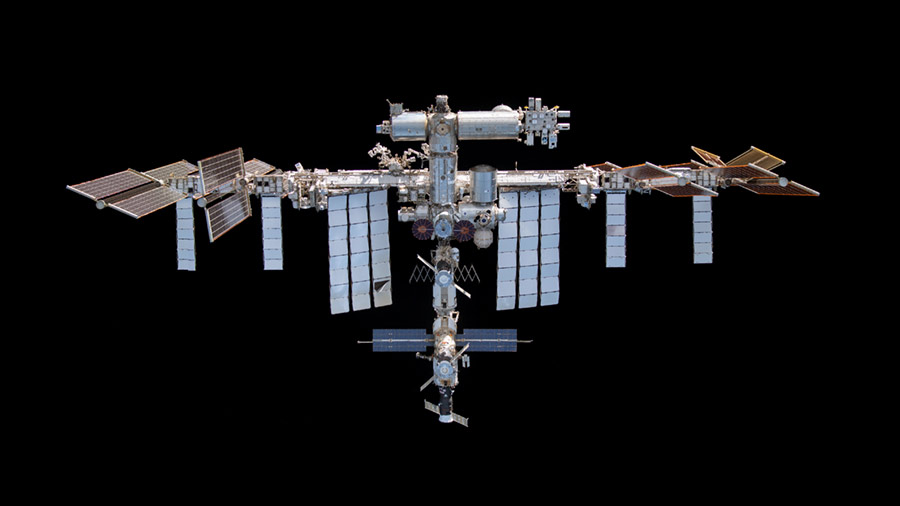
Space Biology, Manufacturing Research Helping Plan Future Long-Term Missions

Space Biology, Manufacturing Research Helping Plan Future Long-Term Missions
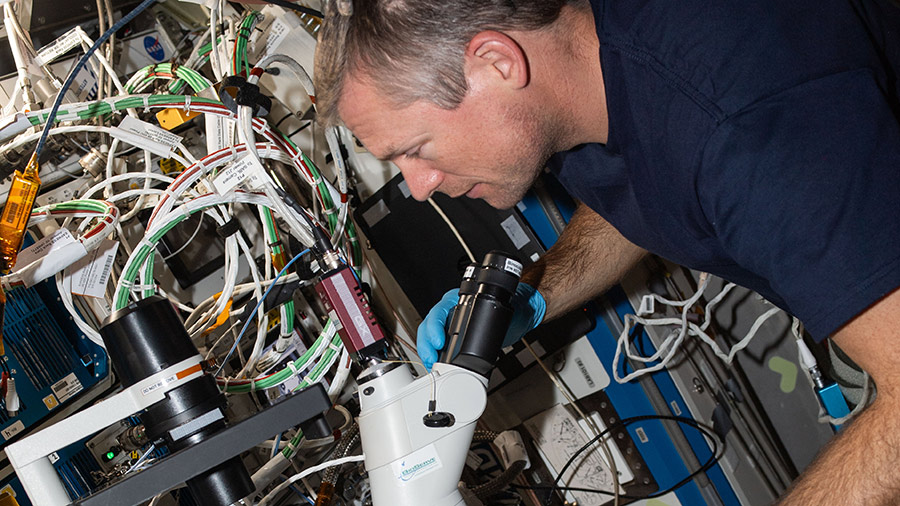
Astronaut Andreas Mogensen operates a microscope to capture imagery of brain cell-like samples for the Cerebral Ageing space biology study.

Astronaut health, an aging study, and cargo operations kept the Expedition 70 crew busy on Tuesday. The International Space Station residents also explored space manufacturing and downloaded radiation data.

Scientists representing NASA and its international partners are collecting a multitude of physiological and psychological data from crew members living on the orbital outpost. The observations from the CIPHER suite of 14 human research experiments will help researchers and mission planners understand health issues astronauts may face on future missions. Insights from the space biology study will be especially useful when crews begin traveling longer and farther away from Earth toward the Moon, Mars, and beyond.

NASA astronaut Loral O’Hara spent most of Tuesday contributing to the CIPHER study processing blood and urine samples and participating in a cognition test. She processed the samples in a centrifuge and stowed them in a science freezer for later analysis. Results from the sample analyses and cognition tests will help doctors and astronauts prepare for long-term radiation exposure, isolation, extreme distances, and closed environments.

Aging is a key research topic aboard the space station as researchers study microgravity’s affect on brain cell-like samples. NASA Flight Engineer Jasmin Moghbeli was busy during the morning treating some of those samples inside the Kibo laboratory module’s Life Science Glovebox. The Cerebral Ageing study may provide insights unachievable on Earth into accelerated ageing symptoms, neurodegenerative diseases, and hypersensitivity to ultraviolet radiation on a molecular level. Results may promote advanced health treatments on Earth and in space.

Morale is also a very important characteristic to ensure mission success during long periods in deep space. Scientists are exploring the hypothesis that virtual reality experiences onboard a spacecraft may lead to less stress and greater mental relaxation. Commander Andreas Mogensen from ESA (European Space Agency) took part in that study today, VR Mental Care, wearing VR goggles and a controller, and watching a 360-degree movie to understand its stabilizing effect on the nervous system.

Astronaut Satoshi Furukawa from JAXA (Japan Aerospace Exploration Agency) worked inside the SpaceX Dragon Endurance crew spacecraft checking orbital plumbing gear with assistance from Mogensen. In the Harmony module’s port adjacent to Endurance, Moghbeli worked on cargo transfers inside the Dragon cargo spacecraft as O’Hara photographed some of the specially delivered gear.

3D printing in space is critical as crews traveling farther in space will be less dependent on cargo missions launched from Earth. Veteran cosmonaut Oleg Kononenko printed test samples in a 3D printer to learn how to manufacture tools and supplies on demand in microgravity. The five-time station resident also attached sensors to himself measuring his cardiac activity for a long-running Roscosmos experiment.

Roscosmos Flight Engineer Konstantin Borisov assisted Kononenko with the cardiac sensor attachments, checked camera hardware, then downloaded monthly radiation detection data. Flight Engineer Nikolai Chub explored how spaceflight conditions such as spacecraft vibrations, electric fields, and magnetic fields affect fluid systems.


Learn more about station activities by following the space station blog, @space_station and @ISS_Research on X, as well as the ISS Facebook and ISS Instagram accounts.

Get weekly video highlights at: https://roundupreads.jsc.nasa.gov/videoupdate/

Get the latest from NASA delivered every week. Subscribe here: www.nasa.gov/subscribe

Powered by WPeMatico

Get The Details…

Mark Garcia

Crew Studies Biology and Works in Dragon as Station Turns 25

Crew Studies Biology and Works in Dragon as Station Turns 25

The space station is pictured from the SpaceX Crew Dragon Endeavour during its departure and flyaround on Nov. 8, 2021.

Space biology and Dragon work were the top duties at the beginning of the week for the Expedition 70 crew. The International Space Station also turned 25 years old today with its first module having orbited Earth since 1998.

Eye scans were on the biomedical research schedule for four astronauts on Monday afternoon. Commander Andreas Mogensen kicked off the exams activating the Ultrasound 2 device then setting up communications gear allowing doctors on the ground to remotely monitor the activities. Mogensen from ESA (European Space Agency) then took turns with flight engineers Loral O’Hara, Jasmin Moghbeli, and Satoshi Furukawa in the Columbus laboratory module participating in the regularly scheduled eye exams.

Mogensen partnered with Moghbeli from NASA at the end of the day and practiced SpaceX Dragon Endurance undocking and landing procedures on the crew spacecraft’s computers. Mogensen earlier unpacked medical supply kits from Endurance and stowed them inside the orbital outpost. O’Hara from NASA and Furukawa from JAXA (Japan Aerospace Exploration Agency) worked inside Endurance as well configuring orbital plumbing gear in the vehicle that has been docked to the station since Aug. 27.

O’Hara later worked on a space botany study to promote STEM (Science, Technology, Engineering, and Math) education among tribal members. Five varieties of seeds provided by the Choctaw Nation of Oklahoma are exposed to microgravity for several months then returned to Earth and planted next to the same seeds left on Earth for comparison. Furukawa turned off a microscope in the Kibo laboratory module and removed samples for a study that was observing how cells sense gravity or the lack gravity. He then stayed in Kibo setting up research hardware and connecting an incubator for an upcoming experiment to observe stem cell growth that may support regenerative medicine technology.

In the Roscosmos segment of the space station, veteran cosmonaut Oleg Kononenko spent the day inside the Nauka science module checking its airlock, ventilation, and docking systems. Flight Engineer Nikolai Chub attached sensors to himself monitoring his cardiac activity then cleaned air ducts inside the Nauka and Poisk modules. Flight Engineer Konstantin Borisov wore a sensor-packed cap that recorded his responses while practicing futuristic planetary and robotic piloting techniques on a computer.

On Nov. 20, the International Space Station passes 25 years since the first module launched into orbit. The Zarya module lifted off in November 1998 from the Baikonur Cosmodrome in Kazakhstan and would shortly be joined by the Unity module less than a month later. Through this global endeavor, 273 people from 21 countries now have visited the unique microgravity laboratory that has hosted more than 3,000 research and educational investigations from people in 108 countries and areas.


Learn more about station activities by following the space station blog, @space_station and @ISS_Research on X, as well as the ISS Facebook and ISS Instagram accounts.

Get weekly video highlights at: https://roundupreads.jsc.nasa.gov/videoupdate/

Get the latest from NASA delivered every week. Subscribe here: www.nasa.gov/subscribe

Powered by WPeMatico

Get The Details…

Mark Garcia

Space Biology Research Wraps Up Crew’s Work Week

Space Biology Research Wraps Up Crew’s Work Week

The sun's first rays begin illuminating Earth's atmosphere as the space station orbited 260 miles above the central United States.
The sun’s first rays begin illuminating Earth’s atmosphere as the space station orbited 260 miles above the central United States.

Bacteria, brain aging, and gravity-sensing cells were the main research subjects aboard the International Space Station on Friday. The seven Expedition 70 crew members also worked on computers, communications gear, and life support maintenance to wrap up the work week.

NASA Flight Engineer Loral O’Hara explored how microorganisms grow in microgravity, the potential damage they cause to spacecraft, and ways to disinfect the harmful bacteria. She inoculated microbe samples inside the Life Science Glovebox that will be compared to uninoculated samples. The NASA-sponsored Bacteria Adhesion and Corrosion study takes place in the Kibo laboratory module and aims to keep space crews and humans on Earth healthy.

Commander Andreas Mogensen from ESA (European Space Agency) viewed cell samples under a microscope for the Cerebral Ageing experiment. The study looks at brain cell-like samples to understand accelerated aging symptoms seen in patients on Earth and observed in astronauts on long-term space missions.

Astronaut Satoshi Furukawa from JAXA (Japan Aerospace Exploration Agency) prepared different cell samples for observation inside the Confocal Microscope then closed out the Cell Gravisensing biology Investigation. Earlier in the day, he swapped hard drives on a laptop computer then assisted O’Hara continuing to unpack the SpaceX Dragon cargo spacecraft.

NASA Flight Engineer Jasmin Moghbeli spent her day in the Harmony module configuring a variety of NASA and Roscosmos hardware. She first calibrated an ultrasonic inspection device that uses high-frequency sound waves to analyze materials, Afterward, Moghbeli checked space-to-ground, VHF, and inter-module communication systems.

Roscosmos cosmonaut Oleg Kononenko researched 3D printing techniques to learn how to manufacture tools and supplies in space and reduce dependence on cargo missions from Earth. Cosmonaut Nikolai Chub spent his day on life support and electronics maintenance. Cosmonaut Konstantin Borisov configured Soyuz crew ship and Progress resupply ship laptop computers then continued his photographic analysis of the station’s Roscosmos modules.


Learn more about station activities by following the space station blog, @space_station and @ISS_Research on X, as well as the ISS Facebook and ISS Instagram accounts.

Get weekly video highlights at: https://roundupreads.jsc.nasa.gov/videoupdate/

Get the latest from NASA delivered every week. Subscribe here: www.nasa.gov/subscribe

Powered by WPeMatico

Get The Details…

Mark Garcia

Station Research Benefits Humans on Earth, Crews in Space

Station Research Benefits Humans on Earth, Crews in Space

Astronaut Loral O'Hara uses a portable glovebag to replace components on a biological printer that tests the printing of organ-like tissues in microgravity.
Astronaut Loral O’Hara uses a portable glovebag to replace components on a biological printer that tests the printing of organ-like tissues in microgravity.

A variety of research taking place today on the International Space Station is helping NASA and its partners support crews living and working off the Earth. The ongoing Expedition 70 investigations are informing ways to improve human health and plan future missions to the Moon, Mars, and beyond.

Astronauts Loral O’Hara and Satoshi Furukawa joined each other in the Columbus laboratory module for vein scans using the Ultrasound 2 device. Doctors on the ground assisted the duo monitoring how weightlessness affects the neck, shoulder, and leg veins, and learning how to keep crews healthy.

O’Hara from NASA also teamed up with fellow NASA Flight Engineer Jasmin Moghbeli and worked in the Tranquility module throughout Thursday. Both astronauts were clearing hardware from the Bishop airlock to make space for the NanoRacks External Platform. Bishop will open its door to space and the platform will be retrieved by the Canadarm2 robotic arm for scientific operations outside of the orbital laboratory. The external research gear is designed to carry experiments for exposure to the vacuum of outer space.

Furukawa from JAXA (Japan Aerospace Exploration Agency) collected cell samples from an incubator and placed them inside the Confocal Microscope to observe how they sense microgravity. He also swapped a gas bottle inside the Electrostatic Levitation Furnace then assisted O’Hara and Moghbeli with the NanoRacks work.

Commander Andreas Mogensen from ESA (European Space Agency) began his day with a conference with ESA managers, charged portable electronics inside the SpaceX Dragon Endurance spacecraft, then set up Earth science hardware. The two-time station visitor then supported a student-designed space botany experiment, analyzed station water samples, and serviced spacesuit batteries.

Veteran Roscosmos cosmonaut Oleg Kononenko practiced futuristic piloting techniques that may be used to operate spacecraft and robots on potential planetary missions. Flight Engineer Nikolai Chub tested a 3D printer for its ability to manufacture tools and supplies without assistance from Earth. Flight Engineer Konstantin Borisov worked on orbital plumbing duties inside the Nauka science module then conducted a photographic analysis of the station’s Roscosmos modules.


Learn more about station activities by following the space station blog, @space_station and @ISS_Research on X, as well as the ISS Facebook and ISS Instagram accounts.

Get weekly video highlights at: https://roundupreads.jsc.nasa.gov/videoupdate/

Get the latest from NASA delivered every week. Subscribe here: www.nasa.gov/subscribe

Powered by WPeMatico

Get The Details…

Mark Garcia

Robotics Activities Continue; Crew Completes an Array of Research

Robotics Activities Continue; Crew Completes an Array of Research

An aurora glows in Earth's atmosphere as the International Space Station soared 260 miles above Utah during orbital nighttime.
An aurora glows in Earth’s atmosphere as the International Space Station soared 260 miles above Utah during orbital nighttime.

Another busy day of science activities is underway for the Expedition 70 crew and robotics ground controllers following the arrival of SpaceX’s Dragon cargo spacecraft last weekend. The seven members aboard the International Space Station spent time on an array of research today while grounds teams remotely retrieved science hardware from Dragon.

Flight Engineer Loral O’Hara started work in the morning on an experiment that studies age-related liver dysfunction and regeneration. The first-time station resident of NASA processed liver tissue samples in the Life Sciences Glovebox, research that could help scientists understand the biology of aging and its effects on disease mechanisms. Later in the day, Flight Engineer Jasmin Moghbeli of NASA took over this work before stowing the samples.

After yesterday’s ILLUMA-T extraction, mission controllers from the U.S. spent another day on robotics activities to retrieve more science hardware delivered inside Dragon’s unpressurized trunk. Remotely controlling the Canadarm2 robotic arm, engineers extracted the new Atmospheric Waves Experiment (AWE) payload to mount it to the exterior of the orbiting laboratory. From its perch, AWE will track small-scale atmospheric gravity waves in our home planet’s upper atmosphere to investigate how they contribute to space weather, which affects space- and ground-based comms, navigation, and tracking systems.

While ground teams worked remotely outside the station, research experiments continued for other residents aboard. Commander Andreas Mogensen of ESA (European Space Agency) spent the majority of his day deploying six antimicrobial placards for a four-month investigation that will test a coating to inhibit microbial growth on several surfaces aboard the orbiting laboratory.

Meanwhile, after yesterday’s start on treating cell samples inside the Kibo laboratory, astronaut Satoshi Furukawa of JAXA (Japan Aerospace Exploration Agency) continued this work for the Cell Gravisensing-2 study. Using a microscope, he observed additional samples to help researchers learn how lack of gravity affects cell response.

The trio of cosmonauts kept busy with their own scientific research and maintenance activities. Flight Engineer Konstantin Borisov worked on an ongoing investigation that observes Earth’s nighttime atmosphere in near-ultraviolet and photographed the Zarya and Nauka modules to assist in future planning of repairs and science equipment placement. Flight Engineer Oleg Kononenko inspected hardware in Nauka, while Flight Engineer Nikolai Chub completed some orbital plumbing and investigated the processes of liquid phases in microgravity.


Learn more about station activities by following the space station blog, @space_station and @ISS_Research on X, as well as the ISS Facebook and ISS Instagram accounts.

Get weekly video highlights at: https://roundupreads.jsc.nasa.gov/videoupdate/

Get the latest from NASA delivered every week. Subscribe here: www.nasa.gov/subscribe

Powered by WPeMatico

Get The Details…

Abby Graf